
The US Men got spanked by Germany 3-1 on Saturday and now will face a Ghana tonight at 8:30 pm on TNT and Peacock. This Ghana team that lost to Mexico 2-0 over the weekend. Watch Christian Pulisic score a worldie against Germany Ok lets start with this is not a good loss to a more talented and better team. Germany sucks right now and has not played well for months – hell years to be honest. This is a poor German side that we should have tied at worst. Richards was exposed AGAIN – Miles Robinson is our best inside back with Ream and Dest is NOT and never will be. Outside back Scally showed me enough to jetison Dest unless we are down 2 at the half. Adding the Robinson’s would have kept this at 1-1. Simple enough. Now let’s see if GB has the brains to at lest put Miles in. Have to have speed next to Ream not cluelessness. Now we see why Richards can’t get time in the EPL – needs more learning. The offense in the first half especially was exciting and we created lots of chances. Pulisic was fouled by Ter Stegan (who played fantastically) should have been 2-0 early. Still we could not feed Balogun but Pulisic and Weah were electric. We lost the Dmid though – Musah can not be that guy to replace Adams against good teams. Now Ghana is not good – but I am going to guess they will slide 1 in somehow – so how about 2-1 USA.
Shane’s Starters for today
Pulisic/Balogun/Reyna
Musah//McKinney
Lennard Maloney
Jones//Ream//Miles Robinson//Scally
US Roster for Ghana Game
GOALKEEPERS (2): Ethan Horvath (Nottingham Forest/ENG; 9/0), Matt Turner (Nottingham Forest/ENG; 33/0)
DEFENDERS (8): Cameron Carter-Vickers (Celtic/SCO; 12/0),Sergiño Dest (PSV Eindhoven/NED; 28/2), DeJuan Jones (New England Revolution; 7/0), Kristoffer Lund (Palermo/ITA; 2/0), Tim Ream (Fulham/ENG; 52/1), Chris Richards (Crystal Palace/ENG; 12/1), Miles Robinson (Atlanta United; 26/3), Joe Scally (Borussia Mönchengladbach/GER; 6/0)
MIDFIELDERS (7): Johnny Cardoso (Internacional/BRA; 7/0), Luca de la Torre (Celta Vigo/ESP; 17/0), Lennard Maloney (Heidenheim/GER; 0/0), Weston McKennie (Juventus/ITA; 46/11), Yunus Musah (AC Milan/ITA; 29/0), Gio Reyna (Borussia Dortmund/GER; 20/4), Malik Tillman (PSV Eindhoven/NED; 6/0)
FORWARDS (6): Brenden Aaronson (Union Berlin/GER; 34/8), Folarin Balogun (Monaco/FRA; 4/2), Kevin Paredes (Wolfsburg/GER; 1/0), Ricardo Pepi (PSV Eindhoven/NED; 18/9), Christian Pulisic (AC Milan/ITA; 62/26), Tim Weah (Juventus/ITA; 33/5)
Indy 11 Wrap Up Season with 3-3 win @ San Antonio
Indy Eleven scored a pair of first half goals then held on for a 3-3 win at San Antonio on the road Saturday evening. The win improved the Boys in Blue to 13-12-9 on the season, Indy has already clinched a USL Championship playoff spot, its third since joining the league in 2018.
Tough Day at Murray as Both Carmel Teams Lose Regionals to Cathedral
The Top Ranked Carmel High boys lost a close one to Cathedral 2-1 for a 2nd straight year in the Regional Finals. Carmel finished the season at 17-2-2 with its playoff journey taking it through the daunting road of Westfield, Zionsville, North Central, Pike and Cathedral. Also a tough end to the season for the two-time State Finalist Carmel High Girls lost to Cathedral 2-1 at home Saturday in the Regional Finals. Cathedral turned the tide from last year with a PK and a questionable goal In the first half and held on to win despite a Red Card controversy in the 2nd half. Still a great season for Carmel and their seniors.
UEFA European Championship TV schedule
- Tuesday, October 17
- 02:45 PM ET Lithuania vs. Hungary (UEFA Euro Qualifying)
- 02:45 PM ET Malta vs. Ukraine (UEFA Euro Qualifying)
- 02:45 PM ET Northern Ireland vs. Slovenia (UEFA Euro Qualifying)
- 02:45 PM ET San Marino vs. Denmark (UEFA Euro Qualifying)
- 02:45 PM ET England vs. Italy (UEFA Euro Qualifying)
- FS1,
- Replay Midnight on FS1
- 8:30 pm USA vs Ghana TNT, PEacock
- 2 am Euro Qualifier Highlights
USA
USMNT has Midfield dilemmas and no simple Solution – yahoo Soccer – Bushnell
USMNT taught tough lessons in attacking precision, defensive shape vs. Germany 2dJeff Carlisle
Pulisic earns 7/10 rating as defense struggles in 3-1 Germany loss 3dCesar Hernandez
Berhalter: Defensive woes cost U.S. vs. Germany
2023 October Friendlies – USA 1-3 Germany: The USMNT wilts despite high expectations
2023 USMNT Friendly: Scouting Ghana
USA vs. Germany, 2023 Friendly: Man of the Match
After a frantic start, USMNT looses control of tempo & focus in “moments” during 3-1 loss to Germany
How a twist of fate, family advice helped Balogun become the USMNT’s next big thing
How will USMNT line up vs Ghana?
Gio looks good – but US loses 3-1 Mike DeCourcy Sporting News
Aaronson: ‘We’ve learned so many things’ from Ger loss
Ranking all USMNT vs. Ghana matchups
USMNT still not ready for the elite of international soccer after getting picked apart by Germany
Gregg Berhalter faults USMNT for not unlocking Folarin Balogun vs. Germany: ‘It’s about just looking for him’
Analysis: U.S. U-23 team opens Olympic cycle with win over Mexico
World
- Can Luciano Spalletti remake his Napoli recipe in charge of Italy?
- England fans may have turned on Jordan Henderson — but he still has Gareth Southgate
England vs Italy: Will Luciano Spalletti reignite Azzurri after Roberto Mancini walked away? - Belgium-Sweden match suspended after shooting
USA vs. Ghana, 2023 Friendly: What to watch for
A chance to rebound against a familiar foe.
By Donald Wine II@blazindw Oct 16, 2023, 9:00am PDT STars and Stripes
/cdn.vox-cdn.com/uploads/chorus_image/image/72761066/1735752157.0.jpg)
The United States Men’s National Team return to action tomorrow when they take on Ghana at GEODIS Park in Nashville. The USMNT are coming off a 3-1 defeat to Germany over the weekend and they hope to get back on track against a Ghana team that has been a real rival over the years.
The two teams have met 4 times previously, with the series split evenly. Both sides have won twice, and each match has ended with a 2-1 score. The last time the two teams faced each other was in July 2017, which was a 2-1 win for the United States. Can history repeat itself with the scoreline? It won’t matter for the United States so long as they get the win.
Latest Form
USA
L (1-3) – Germany – Friendly
W (4-0) – Oman – Friendly
W (3-0) – Uzbekistan – Friendly
D (1-1) – Panama – Concacaf Gold Cup Semifinals**
D (2-2) – Canada – Concacaf Gold Cup Quarterfinal*
W (6-0) – Trinidad & Tobago – Concacaf Gold Cup Group A
*Advanced on penalties
**Lost on penalties
Ghana
L (0-2) – Mexico – Friendly
W (3-1) – Liberia – Friendly
W (2-1) – Central African Republic – Africa Cup of Nations Qualifying
D (0-0) – Madagascar – Africa Cup of Nations Qualifying
D (1-1) – Angola – Africa Cup of Nations Qualifying
What To Watch For
Get the defense back on track. Germany made the American defense look disorganized for much of the second half, so it’s important for guys to not let Ghana get behind them and create chances. Ghana can get frustrated if their intensity is matched, and on the field the USMNT needs to bring the energy to keep Ghana on their heels.
Who steps up on offense? The offense was stagnant in the 2nd half, and most considered it pretty aggressive for much of the first. They need to finish chances, and that’s going to come in time. The hope is that the attackers can string a couple of plays together to get open shots on goal, or to use our set pieces to create a good scoring chance.
The subs need to make an impact. The substitutes in the past few matches haven’t given us a ton to sing about. They hopefully recognize that they have the chance to make an impact and fans want to see one of them do just that tomorrow.
Lineup Prediction
The USMNT will likely have some changes in their starting XI, but some of the continuity will continue when they take the field against Ghana:
:no_upscale()/cdn.vox-cdn.com/uploads/chorus_asset/file/25005186/IMG_2210.jpeg)
Matt Turner will once again be in goal, with DeJuan Jones, Tim Ream, Cameron Carter-Vickers, and Sergiño Dest will make up the back line. In the middle, we will once again see Weston McKennie, Gio Reyna, and Yunus Musah, while up top, Ricardo Pepi will get the start alongside Tim Weah and Christian Pulisic.
Prediction
The USMNT get back on track with a 2-1 victory.
In loss to Germany, USMNT shows it has to evolve in Berhalter’s second cycle

By Paul TenorioOct 14, 2023
Ahead of Saturday afternoon’s friendly against Germany, U.S. men’s national team coach Gregg Berhalter said games like this were “not about being afraid of the result (or) being afraid of competing, it’s about embracing these moments.”His hope: that in the next three years before the 2026 World Cup, games like this would serve as opportunities to learn what it will take to compete — and beat — the very best in international soccer.
ADVERTISEMENT
The 3-1 loss to Germany in front of a sold-out crowd of 37,743 in East Hartford, Connecticut, however, showed the U.S. still has to evolve – from the team that was eliminated by the Netherlands in the knockout round of the 2022 World Cup to one that can make a deep run on home soil.“We still have a lot of work to do,” center back Tim Ream said bluntly when asked what the big takeaway from the game was. The U.S. started the game well, but in the second half Germany seized control of the contest and the Americans never really found their way back into it. The U.S. was at times too stretched in defensive transition after bad turnovers, and in other moments Germany was given too much time and space near the top of the box.“We do need to not give the ball away so quickly in bad areas,” Ream said. “You give the ball away around the 18? OK, fine. In the attacking half? I get it, that’s no problem, you’re trying things. But when you give the ball away too quickly in midfield as we’re trying to get our attacking and build-up shape then it’s going to look A) disjointed, and B) guys are going to look out of position. And when you do that against good players, they punish you.”
 Gio Reyna went 45 minutes in a central position (Andrew Katsampes/ISI Photos/Getty Images)
Some of the defensive problems highlighted the absence of captain Tyler Adams, who has been a stalwart for the U.S. at defensive midfield and helps to break up passing lanes, make key tackles and set the tone in midfield. The World Cup captain has been out with a hamstring injury since March, and after suffering a setback earlier this month is now expected to miss a significant amount of time more. Berhalter said going into this window that Adams’ absence gave the U.S. a chance to test out some “Plan B” options for playing without him. The Germany game showed that the “Plan B” still isn’t quite clear.But it wasn’t about the absence of one player. There were disconnects that both allowed Germany to get on the ball higher up the field, and then find the small lanes around the box that their world-class players exploited. “When you watch them and what they do and it’s one of those where you break a line and you get down to their box and all of a sudden they’re behind the ball,” Ream said. “And I think that’s kind of where we need to learn, is to get guys behind the ball, get compact, especially in and around our defensive 18. And that’s something that again, it’s a learning process, and it’s something that we need to look at and make sure we do better.”Multiple players said the U.S. needs to find ways to put together more complete performances over the whole 90 minutes. The first half gave the team confidence that they could match Germany — they were able to get in behind Germany’s back line on multiple occasions and seemed to just lack that final action — but there was a drop-off in the second half performance.Yunus Musah started as the deeper midfielder on Saturday, with Weston McKennie ahead of him and Gio Reyna in a No. 10 role.Reyna, who played exclusively as a winger in the last World Cup cycle, looked dangerous and effective centrally under interim managers earlier this year. His return to the team with Berhalter on the sideline was among the headlines of this camp, and how Berhalter would utilize him was the biggest question. Reyna had a solid 45-minute outing on Saturday, and playing him in that central role showed promise. Reyna had to come out at halftime, however, as he ramps up his form and fitness.In the first half, though, the U.S. looked dangerous in attack at times and got behind Germany on several occasions. Early in the game, Pulisic was called offside on what would have been a breakaway; Berhalter felt it should not have been whistled dead. On another attack, Reyna found Balogun to set up Pulisic in alone on Marc-André ter Stegen, but Pulisic went down after taking a touch around the goalkeeper.“I went around him and there’s for sure contact,” Pulisic said.The referee didn’t blow the whistle, but a few minutes later Pulisic scored a fantastic goal, beating four German defenders and blistering a ball into the upper corner.“That’s a world-class goal,” Berhalter said.After Pulisic gave the U.S. an early lead, however, Germany pulled back even. Leroy Sané used a clever double-touch to split Musah and Reyna in the 39th minute at the top of the box, and Ilkay Gündogan played a perfect through ball to Sané to put him through on goal. Goalkeeper Matt Turner made the initial save, but Gündogan was there to tuck home the rebound for the equalizer. In the second half, Germany took further control.In the 58th minute, Germany once again enjoyed too much time and space on the ball in their attacking third, and Jamal Musiala found Robin Gosens, whose stylish one-touch pass played Niclas Füllkrug in on goal. Left back Sergiño Dest was late to step, holding Füllkrug onside, and Germany had the lead. Three minutes later, Germany once again attacked the space right on the top of the box. The U.S. was a bit unfortunate in that Ream’s tackle on Musiala deflected right to Füllkrug, who found Musiala in the box to make it 3-1. But while the lucky bounce may have helped, the goal felt reflective of the spaces Germany attacked regularly.
“It’s these split seconds where you need to be well-positioned,” Berhalter said.
In the end, as Ream said, the result showed how much more the U.S. has to do to catch the world powers. But the group also felt that, like at the World Cup last year, they’re not far off.
“It’s frustrating because it’s just little moments,” Turner said. “I sort of alluded to this recently about how little moments could have made a big difference for us in the World Cup. And it’s kind of like the same story.”
(Photo: Adam Glanzman/USSF/Getty Images for USSF)
USMNT learns hard lessons vs. Germany in attack, defense
 Jeff Carlisle, U.S. soccer correspondentOct 15, 2023, 07:11 AM ET
EAST HARTFORD, Conn. — Prior to the U.S. men’s national team’s match with Germany on Saturday, manager Gregg Berhalter said “we need to learn” from playing such a high-powered opponent. Die Mannschaft certainly dealt out more than a few lessons in beating the United States 3-1 at Pratt & Whitney Stadium at Rentschler Field.The match saw the U.S. break the tie in the 27th minute thanks to a stunning long-distance goal from Christian Pulisic. But even at that point, Germany had been carving up the U.S. defense, and eventually the goals arrived on the way to a deserved win.Overall, the result felt similar to the 3-1 defeat to Netherlands that knocked the U.S. out of the 2022 World Cup in the round of 16. Granted, the U.S. on that night in Qatar had much better possession — Germany had a 60-40 edge on Saturday — but in critical moments, both the Dutch and the Germans had that extra bit of quality to turn opportunities into goals.More critically, the U.S. defensive performance left plenty to be desired. One of the glaring issues against Germany included how the U.S. struggled to handle the visitors’ press. Germany made 10 recoveries in the U.S’s defensive third — that’s the most by a U.S. opponent since the 2-0 defeat to Japan right before the 2022 World Cup, one that wasn’t as close as the score might indicate.
EDITOR’S PICKS
- Pulisic earns 7/10 rating as defense struggles in 3-1 Germany loss3dCesar Hernandez
- Dempsey, Drogba have high hopes for USMNT and MLS3dRoberto Rojas
- Berhalter: Defensive woes cost U.S. vs. Germany2dJeff Carlisle
The frequency with which the U.S. was coughing up the ball made it difficult to get the entire team pushed up-field into the attack, which left the Americans’ defensive shape vulnerable when the ball turned over. The U.S. got “gapped” — where there was little to no defensive midfield pressure in transition — by smart passes on far too many occasions. Not even a tweak to the team’s defensive shape in the first half, when it moved from a 4-4-2 to more of a 4-3-3, was enough to stem the tide.”When you make those mistakes of giving the ball away in the midfield, then [transition chances] are going to happen,” central defender Tim Ream said. “And that’s kind of what you saw today, the breakdowns with guys being out of position and then there’s an overwhelming desire to try to win the ball back immediately. That complicates things as well. You want to press after the loss and that complicates getting into that defensive shape.”So it’s not for want of trying. I think sometimes, it’s overworking instead of maybe picking and choosing the moments.”With Tyler Adams missing due to an ongoing hamstring injury, Berhalter turned to Yunus Musah and Weston McKennie for some bite and defensive coverage in midfield. Except it didn’t work. Much of this was down to the fact that positionally, the two left too much space in the middle for Germany to exploit, whether it was in the middle third or near the top of the U.S. penalty area.It’s worth emphasizing the fact that Germany’s lineup is brimming with quality, be it Ilkay Gündogan, Leroy Sané, Jamal Musiala or Florian Wirtz. And to be fair, the Germans also got some fortuitous bounces. Matt Turner‘s touch from Sane’s dribble fell right Gundogan for Germany’s first. Ream’s tackle deflected to Niclas Füllkrug in the runup to Germany’s third.But too often, the U.S. didn’t help itself, allowing Germany to make the most of its luck. On all three goals, the U.S. pressure just outside the box was lacking. Someone, anyone, needed to deliver a tackle that was going to defuse the situation. All of this left the U.S. back line in difficult situations.”It was kind of like seeing a train wreck coming, but you couldn’t quite move from it,” defender Chris Richards said. “That’s kind of what it felt like at some points.”He added about Germany: “When they’re on the ball and they have 20, 30 yards [of space], it’s a tough team to play against.”All of this pointed to how much the U.S. is missing Adams. Saturday’s game wasn’t the first time that the U.S. has had to do without the AFC Bournemouth midfielder. The Americans claimed the Concacaf Nations League title despite him being absent, but Germany is the kind of opponent to punish mistakes more ruthlessly than Mexico or Canada, and the tenacity in midfield that was missing on Saturday is precisely the kind Adams provides.It seems unlikely Adams would have missed tackles with the same regularity that the U.S. did Saturday. With him on the shelf for the foreseeable future, it’s up to Berhalter to find a way forward. There doesn’t appear to be any easy answers.
Berhalter: Performance vs. Germany should give USMNT confidence
Gregg Berhalter explains what the USMNT can take from their 3-1 loss to Germany.
There were lessons to be had on the attacking side as well, though they were tougher to spot, especially given the wow factor of Pulisic’s goal. The U.S. created some transition opportunities of its own in the first half, with Timothy Weah taking the chance to showcase his speed on more than one occasion. Germany was certainly left to scramble a few times in order to keep the U.S. at bay, and Pulisic had one goal called back for a dubious offside call. (A penalty appeal from Pulisic was also denied.)
The U.S. cause was aided significantly by having Giovanni Reyna back in the lineup. In this calendar year, the U.S. has looked the most fluid when Reyna has been on the field, especially when he plays more centrally. Reyna did float around the field a bit, but he was involved often enough in his 45 minutes of action to give some hope that the U.S. can trouble the world’s better teams.
All that said, the U.S. was still missing some precision in the final third, which remains one of this team’s biggest weaknesses and is a big reason it hasn’t yet moved closer to the world’s elite. Not for the first time, centering passes were just a bit behind their intended targets, or just a bit too high. The USMNT’s out-of-sync attack reflected in its stats: Its xG from open play in Saturday’s match was 0.09, the lowest such mark in any game under Berhalter. As dangerous as the U.S. was at times, it absolutely has to get shots off.
Is Germany an excellent team? You bet. But the chances were there for the U.S., and it didn’t take advantage of its at times excellent approach work.
“[There are] still a lot of things that we can do better. A lot of things we improve on,” Ream added. “A lot of things to work on to be able to compete for 90 minutes, not just for 45.”
The U.S. will get a chance to show that Tuesday against Ghana in Nashville.
Christian Pulisic goal not enough for USMNT in 3-1 loss to Germany in friendly

By The Athletic Staff and more Oct 14, 2023
By Paul Tenorio and Seb Stafford-Bloor
The U.S. men’s national team fell 3-1 to Germany in a friendly Saturday after a promising first half from the American side. Here’s what you need to know:
- USMNT captain Christian Pulisic opened the scoring in the 27th minute with a blistering shot from outside the box into the upper right corner. But after İlkay Gündoğan tied it up in the 39th minute, Germany dominated the second half and scored in the 58th (by Niclas Füllkrug) and 61st minutes (Jamal Musiala).
- Gio Reyna started for the U.S. in his return to the squad after suffering a leg fracture in the CONCACAF Nations League final in June — it also marked his first match under coach Gregg Berhalter since their relationship came under the microscope after the 2022 World Cup.
- The match was Germany’s first with new coach Julian Nagelsmann, hired in September, at the helm.
How did Reyna look?
Saturday’s game was the first time in which Berhalter and Reyna were back in U.S. men’s national team camp together. Berhalter said ahead of the game he no longer wanted to look back and instead, “it’s about talking about the future.” The Germany game provided a first opportunity to do that.
ADVERTISEMENT
One way that happened: Reyna starting as a No. 10.
After playing mostly as a winger who came inside the pocket to find the ball in a 4-3-3 during the last cycle, the 20-year-old played in the No. 10 role in Nations League games under interim managers Anthony Hudson and B.J. Callaghan this spring and summer.
Berhalter clearly liked what he saw in those games. While Reyna was on a minutes limit — he had played just 27 minutes for club or country since injuring his leg on June 18 in the Nations League final — he started in the game in that spot.The new shape allowed Berhalter to test out a formation change when the team is missing captain Tyler Adams, who is out for an extended period of time with a hamstring injury. Yunus Musah dropped into a lower role in midfield, and Weston McKennie played in a No. 8 role behind Reyna. Pulisic and Tim Weah started on the wings.Reyna had some good moments in the first half, at one point playing Folarin Balogun through on a chance where Pulisic was in alone on goal and went down looking for a penalty after taking a touch past Marc-André ter Stegen. It was an overall positive outing for Reyna, who was subbed at halftime as he works back from his injury.The U.S. will likely look to build on it on Tuesday against Ghana. — Paul Tenorio, senior soccer writer

USMNT still has room to evolve in Berhalter’s second World Cup cycle
No Adams hurts
With Adams out due to a hamstring injury, the U.S. started with Musah as the No. 6. Germany, though, found far too much space around the edge of the Americans’ penalty box, and Adams’ ability to step in, make tackles and kill off attacks was clearly missed.The outing likely will give Berhalter some headaches as he thinks through how to best set up this team when Adams is out. He could opt for a player who is more of a traditional defensive midfielder, like Johnny Cardoso or Lenny Maloney, or he might be forced to play with two more defensive-minded midfielders in a double pivot. — Tenorio
ADVERTISEMENT
An encouraging showing for Germany
Germany’s flaws remain much as they were. Their defense is still porous and continues to look fragile against the counter-attack. A more ruthless opponent might have built a bigger lead than the U.S. managed.Nevertheless, this was still a success. One of the long-term issues that Nagelsmann inherited was an inability to create chances. It was heartening, then, to see the Germans so potent with the ball. Nagelsmann’s gegenpress seemed well-oiled and it created opportunities, but he will also have been pleased by how much movement there was ahead of, and around the ball in the attacking third. Germany manufactured plenty of scoring opportunities through the quick, intricate passing that has been so absent from their games in 2023.Leroy Sané really should have scored at the end of a slick second half move. Füllkrug might have more than just one goal.Germany looked dangerous. More to the point, Germany were actually fun to watch and that has not been the case for a long time.It matters, too. Nagelsmann is facing a technical challenge, because there are areas of his team in which the depth of talent simply is not there, but he is also — in effect — having to remarket this team to its own country. The German public has grown disinterested and disillusioned with the national team, but performances like this, that possess vibrancy and life, will hopefully start to reverse that process.This was a good afternoon for Nagelsmann and for Germany. — Seb Stafford-Bloor, Germany soccer writer
USMNT has Adams-shaped hole in midfield, no one to fill it
- Jeff Carlisle, U.S. soccer correspondentOct 16, 2023, 10:28 AM ET
ShareLikeOpen Extended Reactions63
EAST HARTFORD, Conn. — Saturday’s match against Germany gave U.S. men’s national team manager Gregg Berhalter a chance to try out what he calls his “Plan B” in the U.S. midfield. Otherwise known as: Life Without Tyler Adams.
It’s not the first time the U.S. has had to rummage around in its tactical bag to find a way to compensate for the absence of the injured AFC Bournemouth midfielder. Just last June, the U.S. won the Concacaf Nations League without Adams’ influence. The situation was similar two years prior, with Adams reduced to a late, 37-minute stint in the extra-time win over Mexico in that year’s Nations League final.
ADVERTISING
But the Americans’ 3-1 defeat to Germany on Saturday gives one pause. Neither Yunus Musah nor Weston McKennie delivered the kind of bite and ground coverage that Adams usually provides in midfield, and the center of the U.S. defense was worse for it. The U.S. was more vulnerable than usual on the counterattack, and there was general ineffectiveness in terms of putting in tackles near the top of the U.S. penalty area.
So a question that has been on the collective mind of the U.S. comes even more into focus: What is the best path forward without the Americans’ World Cup captain?
Adams has spent much of the past seven months on the sideline. A hamstring injury sustained in March of last season with Leeds United first put him out of action, only for him to require surgery in May. Following his offseason move to the Cherries, Adams made his club debut on Sept. 27 in the Carabao Cup match against Stoke City, playing the last 20 minutes. But he suffered a setback in that match, with manager Andoni Iraola telling the Bournemouth Daily Echo that Adams is “going to be out for some time.”
– Stream on ESPN+: LaLiga, Bundesliga, more (U.S.)
That assessment puts Berhalter in a bit of a bind given how Adams’ skill set is nearly impossible to replicate. It also highlights the reality that while the U.S. established a solid foundation at the last World Cup, building on that performance isn’t straightforward. The form of players fluctuates, as does their health. That said, Berhalter prefers to look at the at the situation in a more positive light.
“It gives us an opportunity to have a Plan B when — and if — Tyler isn’t available and we’ll work through this,” he said on a recent conference call with reporters prior to Saturday’s match against Germany.
Easier said than done.
Adams is one of the most important players on the U.S. men’s national team. His aforementioned range and tackling enable the U.S. to play with a single defensive midfielder, allowing the likes of Musah and McKennie to push further forward in a bid to augment the U.S. attack, and his overall prowess helps snuff out opposition counterattacks. That latter trait could have come in especially handy against Germany, as the U.S. was continually overrun in central positions during a 3-1 loss.
EDITOR’S PICKS
- USMNT taught tough lessons in attacking precision, defensive shape vs. Germany2dJeff Carlisle
- Pulisic earns 7/10 rating as defense struggles in 3-1 Germany loss3dCesar Hernandez
- How a twist of fate, family advice helped Balogun become the USMNT’s next big thing5dConnor O’Halloran
Adams’ stats bear this out. Among Concacaf midfielders who logged at least 500 minutes of playing time during qualifying for the 2022 World Cup, Adams ranked second in tackles per 90 minutes (including stoppage time) at 3.01, fourth in defensive interventions per 90 minutes at 13.15 and second in duels won at 60.8%. He put up similar numbers in the Premier League with Leeds last season, delivering 3.42 tackles per 90 minutes of actual playing time along with 14.12 defensive interventions and a duel-win rate of 57%.Yes, these numbers are a function of his position, but they also reveal he did his job well. So well, in fact, that his injury is viewed in some quarters as being a primary reason Leeds were relegated to the English Championship. His play at the 2022 World Cup in Qatar drew similar praise.Now Berhalter has to find an alternative. On Saturday, he opted to drop Musah and McKennie deeper in a double pivot. That, however, is a solution that is rife with issues.Berhalter noted how in last week’s UEFA Champions League match between AC Milan and Borussia Dortmund, Musah was deployed deeper in midfield, but Musah’s preference to carry the ball out of trouble resulted in some hair-raising moments in which possession was lost in dangerous areas. He had some similar difficulties on Saturday, although not as often.If Musah really is going to be positioned in a deeper-lying role, he’ll need to come up with a greater variety of solutions than just dribbling out of tough spots. He knows it, too.”I feel like it’s an area of the field where it’s delicate, so you have to be like, try and play simple,” Musah said on a Zoom call with reporters. “So I have to simplify my game and try to play simple one-, two-touch. Obviously, you’re not in the pockets as you are when you’re playing higher.”As for McKennie, giving him more defensive responsibility could blunt some of his better attributes, namely his ability to make late runs into the box. He’s also admitted he prefers a role that’s more expansive than playing as a No. 6.”My favorite role for sure is to play an 8 on both sides of the ball,” he told reporters via Zoom. “I don’t really … I wouldn’t say that I don’t do well, but I am someone that just likes to be free to roam around the field, and I feel like I have a good understanding of the game, a good vision of the game, and I know where I’m needed at certain points and where I’m not.”The problem is that Gio Reyna, who made his first appearance for the U.S. on Saturday since fracturing his right leg last June, also prefers some freedom. At some point, there needs to be a little less freedom and more positional discipline, something that McKennie has at times struggled with. Berhalter recognized this Saturday, eventually moving Reyna further back to help McKennie and Musah, but to no avail. In the second half, Berhalter subbed in Luca de la Torre for Reyna without much impact, but dropping him deeper just might be worth trying again.One criticism of the so-called “MMA midfield” of Musa, McKennie and Adams is a general lack of creativity and precision passing. This is an area where De la Torre’s presence could benefit the U.S. team. The downside, however, is that De la Torre is light in terms of the defensive side of the ball. Over parts of two seasons with LaLiga‘s Celta Vigo, De la Torre’s win percentage in terms of tackles, duels and aerials is 27.3%, 31% and 25%, respectively, far below Adams’ numbers of 39.7%, 57% and 63.4%. In terms of defensive interventions, he averages 5.77 per 90 minutes this season, although it’s worth noting that with Celta he’s usually playing higher up the field.erculez Gomez and Sebastian Salazar debate the biggest storylines and break down the best highlights that soccer in the Americas has to offer. Stream on ESPN+ (U.S. only)Plenty of eyes will be on Heidenheim midfielder Lennard Maloney, Berhalter’s latest dual-national recruit. His defensive numbers over parts of the past two seasons (33%, 49.4% and 55.4%), which include a title-winning campaign in the 2. Bundesliga, veer closer to Adams, although his passing percentage of just 73.7% will need to improve.The best fit of all might be Internacional midfielder Johnny Cardoso, who has been tidy on the ball in Brazil’s Serie A (86.1% pass completions in the past three seasons) as well as solid in defense (34%, 51.1% and 57%) in the same time span. However, he hasn’t really caught the eye in the few opportunities he’s had for the U.S. (eight appearances since 2020). He’s currently in camp, and might get more of a shot against Ghana on Tuesday.
There are other options. LAFC‘s Kellyn Acosta has filled in for Adams in the past, but his play has been uneven on those occasions. Other possibilities included Venezia‘s Tanner Tessmann and the Columbus Crew‘s Aidan Morris, both of whom could get some looks with the U.S. Olympic team.Complicating matters is the question about where to deploy Reyna. Berhalter hasn’t ruled out playing the Dortmund attacker in any number of spots, be it right wing, attacking midfielder in a 4-2-3-1 or as part of a midfield three. If Reyna is used as an attacking midfielder, that will impact the decision as to who plays behind him.The next opportunity to test out the U.S. team’s midfield options is Tuesday against Ghana, followed by next month’s encounters in the Concacaf Nations League. Based on how the U.S. midfield currently looks, more experimentation is needed.
U.S. men’s soccer falls short in major test against star-studded Germany
After Christian Pulisic’s dazzling opening goal, a defensive collapse in the second half loss showed how far the Americans still have to go before hosting the 2026 World Cup.
/cloudfront-us-east-1.images.arcpublishing.com/pmn/72GZBL6KM5CVHEYGQJIZ6PQ7TY.jpg)
EAST HARTFORD, Conn. — Given a rare chance to play a major European power, the U.S. men’s soccer team’s stars showed at times against Germany that it could rise to the moment. But after playing the first half to a creditable tie, a defensive collapse in the second half of an eventual 3-1 loss showed how far the Americans still have to go before hosting the 2026 World Cup.The packed crowd of 37,743 at Rentschler Field certainly got its money’s worth. Hershey’s Christian Pulisic scored a spectacular opener for the U.S. in the 27th minute, Ilkay Gündoğan answered in the 39th, while Niclas Füllkrug and Jamal Musiala decided the game in the 58th and 61st minutes.“The first half especially, I thought we were really good, and then it came down to some moments,” U.S. manager Gregg Berhalter said. “I think the goals were conceded a little bit too easily. … Good learning experience for the group, and we know we need to get better if we’re going to win these.”Headlining the American starters was Gio Reyna, whose presence helped finally put to bed the scandal that swept up his and Berhalter’s families. Berhalter gave Reyna a further endorsement by starting him in a central attacking midfield role, unlike the right-wing position he’s played for the U.S. in the past. Weston McKennie and Yunus Musah started in the deeper central spots.
» READ MORE: Catching up with Medford’s Brenden Aaronson ahead of the U.S.-Germany game
/cloudfront-us-east-1.images.arcpublishing.com/pmn/LZS3FBPV75H7VHBHDEJXEDRR54.jpg)
Germany is not as dominant a force in the soccer world as it used to be, but the Mannschaft’s roster oozes with talent and prestige — and a much-needed dose of youth. Star playmakers Musiala (Bayern Munich) and Florian Wirtz (Bayer Leverkusen) are just 20 years old.
The highlights
Without the stakes of an official competition, the first half was wonderfully wide-open. Though the U.S. was outshot, 11-4, it gave as good as it got, including a beautiful combination in the 26th minute involving Reyna, right-back Joe Scally, and the starting front line of right winger Tim Weah, striker Folarin Balogun, and Pulisic, who played left wing.
🚨 ¿PENAL PARA ESTADOS UNIDOS?
🔥 ¡Juzga tú mismo! 👇
🇺🇸 0-0 🇩🇪
📺📱 EN VIVO por @Telemundo y @peacock ➡️ https://t.co/rq6pvJcV77
#USMNT #USMNTtelemundo #TeamUSA pic.twitter.com/27wG2kivrv— Telemundo Deportes (@TelemundoSports) October 14, 2023
Pulisic’s goal was one of his finest in a U.S. jersey — or any jersey. He took a layoff pass from Balogun on the left wing, cut to the middle amid two German defenders, and then sent former Chelsea teammate Antonio Rüdiger (now of Real Madrid) backward as he kept going forward. Twenty yards from goal, Pulisic uncorked a dazzling curler of a shot that German goalkeeper Marc-André ter Stegen had no chance to save.
💨 ¡GOLAAAAAAZO DE ESTADOS UNIDOS!
🚨 ¡Oooobra de arte de @pulisic! ¡Espectacular GOLAZO! 😱😱😱
🇺🇸 1-0 🇩🇪
📺📱 EN VIVO por @Telemundo y @peacock ➡️ https://t.co/rq6pvJcV77
#USMNT #USMNTtelemundo #TeamUSA pic.twitter.com/RauLhj1zmx— Telemundo Deportes (@TelemundoSports) October 14, 2023
The lead lasted 12 minutes. Leroy Sané, also of Bayern, shredded the U.S. back line with a run in from the right wing for which eight American players had front-row seats. A quick give-and-go with Gündoğan later, goalie Matt Turner was forced into a dive that pushed the ball right to Gündoğan’s feet on the doorstep.
Gündogan brings Germany back level 👊
Watch USA vs. Germany live on TNT or Max 📺 pic.twitter.com/BHnPnZonxA— B/R Football (@brfootball) October 14, 2023
Reyna departed at halftime in a preplanned move, replaced by Luca de la Torre. That also gave the midfield some defensive reinforcement, as de la Torre played level with McKennie and Musah instead of in front of them.
The lowlights
It didn’t feel like much reinforcement, though, when Füllkrug put Germany ahead. After recovering a Turner goal kick, the Germans built a 14-pass move under relatively little pressure that culminated in an open 12-yard shot.Füllkrug makes no mistake from there 💥
Watch USA vs. Germany live on TNT or Max 📺 pic.twitter.com/bcPyH3wDAP— B/R Football (@brfootball) October 14, 2023
Musiala and Füllkrug teamed up on the third, with the former’s delicate chip to the latter starting the decisive give-and-go. Turner charged for the ball, Füllkrug slipped it behind him, and Musiala did the rest.
”We cost so much energy with our own counterattacks that it’s hard to really stay consistent in all of your actions [and] your defensive shape,” Berhalter said. “The games against opponents like this can’t be that open. It needs to be tighter.”
Turner concurred.
“They found space in the middle of the field, in the midfield and on top of our [18-yard] box,” he said. “Balls kind of bounced around and our shape was broken, sagging, and keeping guys onside.”
⚽️💨 ¡MUSIALA! ¡ALEMANIA AUMENTA LA VENTAJA!
☝️ El crack de @FCBayern firma el tercero para Alemania 🔥
🇺🇸 1-3 🇩🇪
📺📱 EN VIVO por @Telemundo y @peacock ➡️ https://t.co/rq6pvJcV77
#USMNT #USMNTtelemundo #FutbolUSA @USMNT pic.twitter.com/b6O8DTa1k6— Telemundo Deportes (@TelemundoSports) October 14, 2023
Five minutes after Germany’s third goal, Berhalter made a triple-substitution: Cameron Carter-Vickers for Chris Richards at centerback, Medford’s Brenden Aaronson for Weah, and Ricardo Pepi for Balogun. The Americans’ final subs came in the 75th, Johnny Cardoso replacing McKennie and Kevin Paredes for Pulisic.”I came on and just tried to do the best I could, really, and just tried to make some things in the final third happen,” Aaronson said.Aaronson had a highlight in the 78th when he spun around Rüdiger on the right wing, darted into the 18-yard box, then took a shove in the back from Rüdiger. But referee Fernando Guerrero of Mexico didn’t judge it a foul, and, with no video review in use, play went on.
» READ MORE: Expect the 2026 World Cup schedule to be announced by the end of the year, FIFA says
/cloudfront-us-east-1.images.arcpublishing.com/pmn/7A5PTJQQNFBQVJPIK5ZPLMLV3A.jpg)
At the start of second-half stoppage time, Aaronson won a free kick atop the 18-yard box with some fancy footwork, and he got to take the shot. But as all 10 German outfield players and eight Americans took their places nearby, Aaronson’s attempt hit Germany’s jumping wall of defenders.“And they were all 6-foot-4, so that didn’t help,” he quipped.That felt like a pretty good metaphor for the task at hand for the U.S. men, in this game and for the next three years. At least it won’t be long until the next chance for a win: Tuesday against perennial World Cup foe Ghana in Nashville (8:30 p.m., TNT, Universo, Max, Peacock).
Why Gio Reyna hasn’t found his USMNT, Borussia Dortmund form
 Ryan O’Hanlon, ESPN.com writerOct 17, 2023, 08:09 AM ET
Who is Gio Reyna?
The answer depends on who’s asking the question. The average American probably knows him as the kid whose parents tried to blackmail U.S. men’s national team coach Gregg Berhalter out of a job during the World Cup. But I think — I hope? — we can move on from that.
ADVERTISING
To many USMNT fans, then, Reyna represents the ceiling of the team’s potential. Imagine what might’ve happened in Qatar had Reyna been healthy and not feuding with the manager?
For all of the success of the current generation — already the most successful generation of American soccer players — the likes of Christian Pulisic and Tyler Adams are top players in large part because they’re top athletes who can cover lots of space. While Reyna isn’t lacking in athletic ability or size, he offers a different kind of promise to the other top Americans — one where a playmaker steps on the ball, slows the game down, glides past defenders and slips in a through-ball. It’s a vision of American soccer that we’ve never actually seen in the real world before.When you ask everyone else in the soccer world, including his current club team, who Gio Reyna is, he exists as a projection more so than as an actual player. He’s a promising young talent in a competitive landscape with more of them than ever before. He’s a 20-year-old who has started 10 games for Borussia Dortmund since we started letting fans back in the stands.In reality, none of us really know who Gio Reyna is because none of us ever really get to watch him play.
Injured players keep getting injured, and Reyna is no different
Back in May of 2021, Reyna seemed like he was the next uber-prospect at Borussia Dortmund. We already knew about Erling Haaland by then. Jadon Sancho was pumping out goals and assists at a rate that rivaled Kylian Mbappé. Already Jude Bellingham had his jersey retired by Birmingham City.Reyna was right there with them. In fact, Reyna scored more goals, created more assists, started more matches and played more minutes than Bellingham across the 2020-21 season. At this point, Reyna was keeping elite company.Minutes played is a powerful predictor of future performance, and it’s also a solid indicator of current quality. If you’re doing winning things on a soccer field, chances are you’re going to play. And among players who are currently still in the 20-and-under age group today, Reyna had played the fourth-most total minutes across Europe’s Big Five leagues by the end of the 2020-21 season.
EDITOR’S PICKS
- The USMNT’s struggle to play well without Tyler Adams is a problem11hJeff Carlisle
- Pulisic earns 7/10 rating as defense struggles in 3-1 Germany loss3dCesar Hernandez
- How a twist of fate, family advice helped Balogun become the USMNT’s next big thing5dConnor O’Halloran
Here’s the top five:
- Eduardo Camavinga: 4,883 minutes
- Florian Wirtz: 2,595 minutes
- Pedri: 2,428 minutes
- Gio Reyna: 2,326 minutes
- Jude Bellingham: 1,701 minutes
According to the crowd-sourced valuations at the site Transfermarkt, those four other non-Reyna players are, respectively, the 17th-, 23rd-, ninth- and third-most valuable players in the world as of today. At the top, Bellingham is valued at €150 million, while Wirtz marks the low end at €85 million. The average valuation of the four players is right around €105 million.The specific numbers matter less than how they compare to the fourth guy on the minutes list. Reyna’s current valuation sits at €25 million, which puts him in a tie with more than 60 other players for the 307th-most valuable player in the world.What happened is that, well, nothing happened. As of today, Camavinga, Bellingham, Wirtz and Pedri all rank in the top seven for minutes played among players currently age 20 and under. Camavinga is first (8,770 minutes), Bellingham is second (7,865), Wirtz is third (6,087) and Pedri is seventh (5,468). Reyna, meanwhile, has dropped down to 16th, with 3,404 minutes — now behind a pair of other Americans in Yunus Musah and Joe Scally. Put another way, Reyna has played just over 1,000 minutes over the past two-plus seasons.The main reason: injuries. Now, both Pedri and Wirtz have dealt with significant injury problems over the same stretch, and they’ve still each managed to double their minutes-played totals since the end of the ’20-21 season. Reyna, though, is injured so often that he suffers in multiple ways.
Why Gio Reyna is integral to USMNT success
Sebastian Salazar and Herculez Gomez discuss Gio Reyna’s performance on his return to the USMNT vs. Germany.Reyna misses games because he’s simply unavailable for selection. He misses games because he’s always working back from injury, so he’s rarely what any manager would consider fully fit. And he misses games because he’s so frequently out of the picture that even when he is available for selection, other Dortmund players get chosen ahead of him since they’re in front of the coach in training and matches every week.Per Transfermarkt, Reyna has already missed 67 games due to injury across his fledgling pro career. For comparison, Camavinga has missed 13 and Bellingham four. Wirtz is at 71 and Pedri is at 66, so injuries aren’t the only explanation for Reyna’s lack of game time, but all three of them have already missed a ton of matches. Perhaps the most consistently available non-defender-or-goalkeeper of his generation is Liverpool‘s Mohamed Salah. He has missed 26 matches due to injury across his entire career. He’s 11 years older than all of these guys.
How does Reyna play when he plays?
Back to that original question: Who is Gio Reyna?In his one season as a consistent starter, Reyna mostly profiled as a “dribbler” according to Michael Imburgio’s DAVIES model, which classifies players into various roles based on their statistical profiles. A dribbler, per the model, is an “attacking player that play[s] relatively high up the pitch, usually linking play between creators and finishers, and often look to beat defenders on the dribble when they receive the ball.”There are “direct dribblers” — guys who beat defenders and either shoot or create chances — and “wide dribblers” — guys who beat defenders and cross the ball — and Reyna looked like a bit of both. In his 600-something minutes from Dortmund last season, Reyna fit into a number of different roles, but he spent the biggest chunks of his time looking like either a direct dribbler or a progressive forward. The definition of the latter, from Imburgio: “Finishers that often drop deep and play progressive passes forward in addition to getting on the end of attacking move.”
Last season, Reyna attempted 3.5 shots per 90 minutes, nearly a two-shot increase on his 2020-21 rate of 1.7. While his goals unsustainably outpaced his expected goals (7 goals vs. 4.2 xG), his rate of non-penalty xG per-90 nearly tripled from his one season as a starter, from 0.18 to 0.51. Per FBref, over the last 365 days his xG-per-90 rate puts him into the 95th percentile among attacking midfielders and wingers across the Big Five leagues.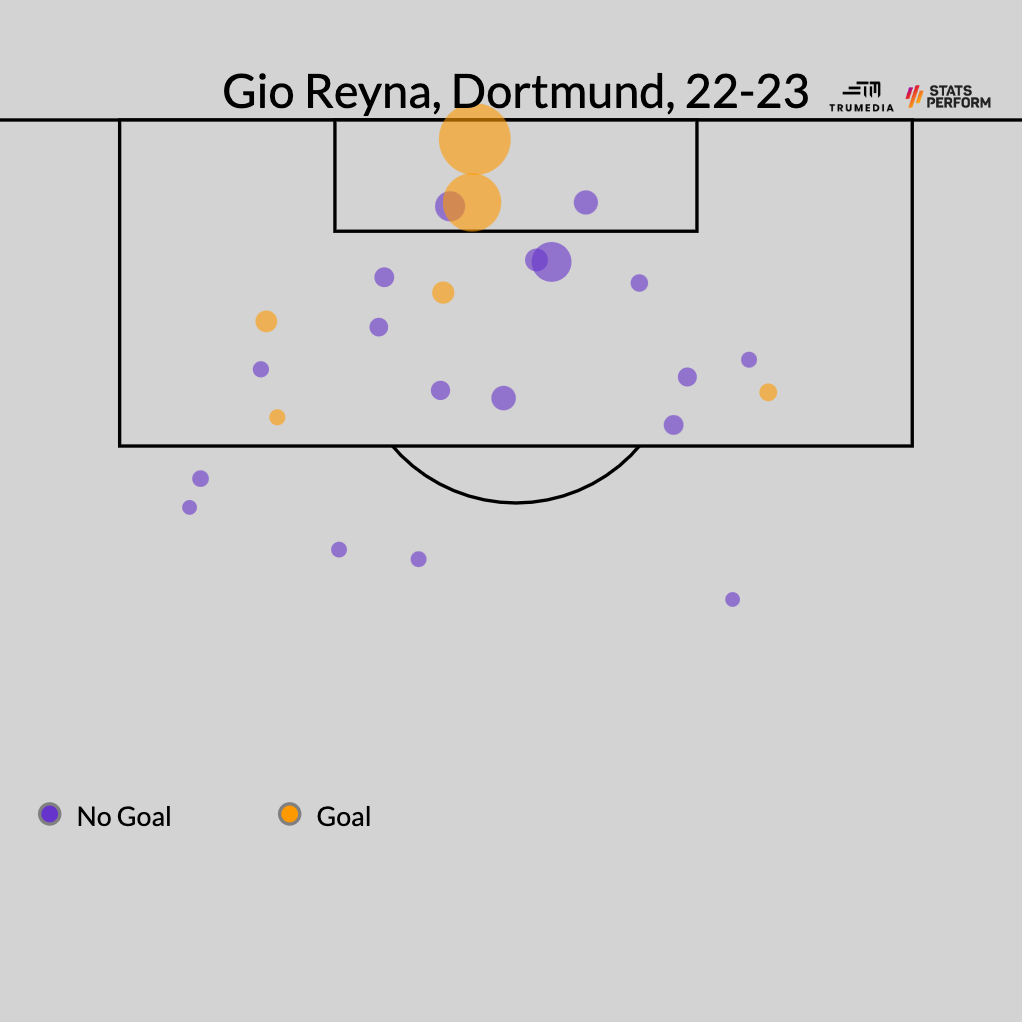
Except, more than half of all the xG he generated last season came from three shots — two of which were either from rebounds or knockdowns on set plays. While the instinct to crash the goal in these situations is a valuable one, it seems pretty unlikely that Reyna could drive this much proportionate goal-scoring if he were ever to regain a consistent spot in the Dortmund lineup.
The problem with any kind of statistical analysis of Reyna’s performance, then, is the same problem with any kind of analysis of his performance: He doesn’t play consistently enough for anyone to be confident about anything. Reyna’s career is rife with small on-and-off sample sizes.
However, if we look at all of his Bundesliga minutes over the past four seasons together, then we’re at least getting 3,000-plus minutes of game time. Over that stretch, he stands out in three specific areas among all players in Germany’s top tier. Per Soccerment, he’s in the 91st percentile for open-play expected assists. Here are all of his passes worth at least 0.05 expected assists, or xA, during his Dortmund career: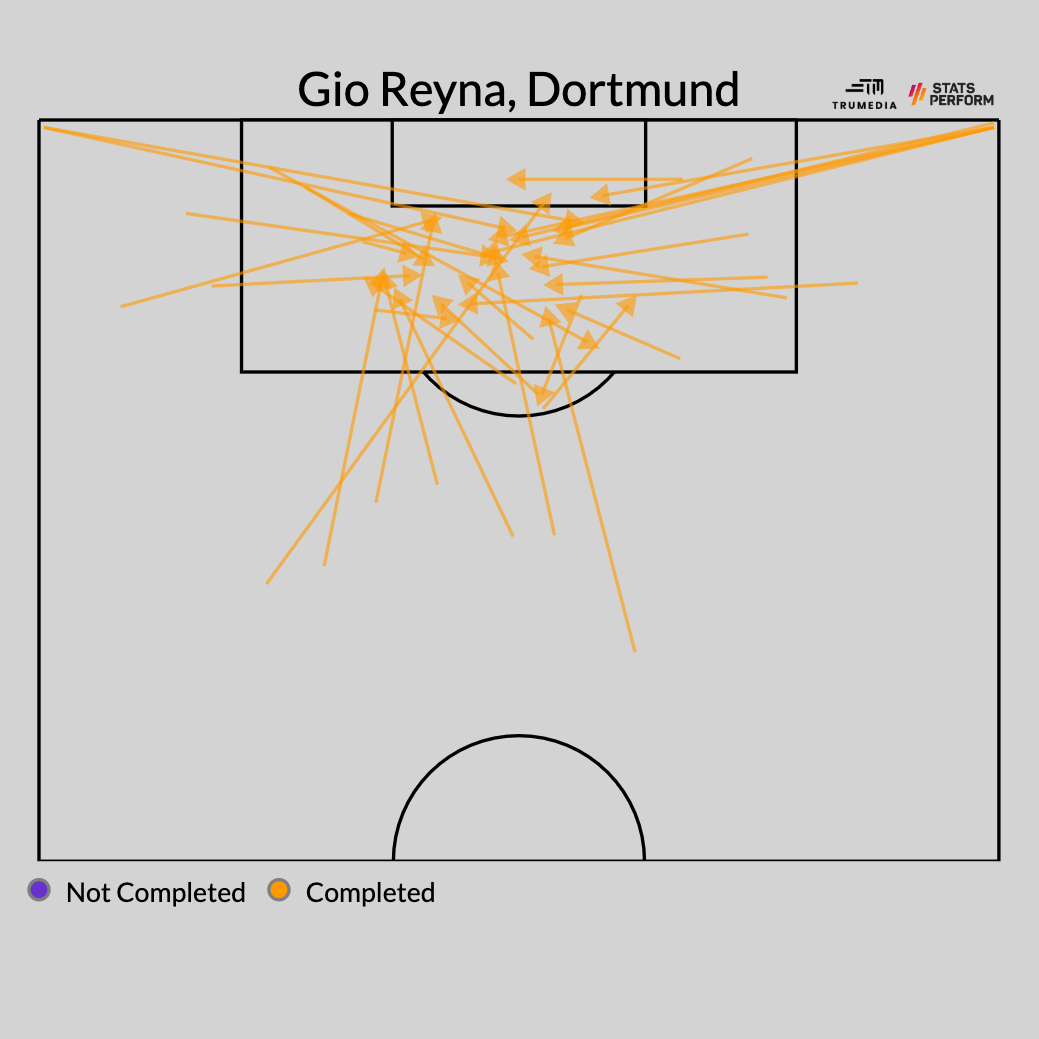
Reyna is also in the 94th percentile for the expected threat created from carries — which looks at where a carry begins and ends and then determines how much it increases a team’s probability of scoring a goal. And he’s in the 96th percentile for one-two passing sequences opened — which just means you’re the player who starts the one-two.That, overall, checks out. As a mostly teenage pro, Reyna has mainly been someone who drives the ball upfield with his feet, combines in tight spaces with teammates, and creates chances for his teammates in and around the box. If you want to take the most optimistic view possible, you can look at last season, squint a little bit, and decide that he has also added goal-scoring to that profile.I, of course, would caution against that because I’d caution against anything with Reyna, right now. At 17, he was so impressive that he looked pretty likely to become a star. In the years since, he has been so injured that it’d be hard to imagine him not continuing to get injured for the rest of his career. However, neither one negates the other. The potential for Reyna to still be a star exists, as does the potential for him to be one of those guys who never develops because he’s never healthy enough to be on the field consistently enough.
The most likely outcome, as ever, exists somewhere in between. Since 2010, 42 players have registered at least 20 non-penalty goals and assists across the Big Five leagues before their 21st birthday. Reyna is one of them. He has one fewer goal contribution than Son Heung-Min, a superstar, and one more than François Kamano, a player currently in the Saudi Pro League who you’ve almost definitely never heard of.
There’s so much that can still happen. Gio Reyna just has to play.
How Christian Pulisic’s offseason training shaped his form with AC Milan, USMNT

By Felipe Cardenas Oct 12, 2023
Christian Pulisic is a player reborn since signing for AC Milan in July. The former Chelsea winger left behind a frustrating spell in the Premier League for life in Serie A, and thus far, the American has delivered. Pulisic has scored four goals in eight games for the Rossoneri while becoming a key piece to Stefano Pioli’s new-look side.
ADVERTISEMENT
Pulisic’s reemergence isn’t a coincidence. While he waited for a new club over the summer, Pulisic traveled to South Florida for a week of individual training with Ethan Sonis, who runs SAT Soccer in Miami. Sonis, 27, leads a five-person team of professional trainers who have amassed an impressive list of global clientele. His location in Miami certainly helps. For years, footballers have flocked to the city during their offseason.
The sessions take place under the hot Florida sun on a private field away from the cameras and scrutiny that his clients, like Pulisic, constantly attract.
“I don’t stargaze,” Sonis said. “(The players) don’t have to be perfect. I treat them like any regular human. I catch them raw. I catch them emotionally. They can get hot-headed with me. They can cry, they can scream, they can mess up.”
More from The Athletic…
- Why the U.S. will face a challenge finding opponents
- Pulisic scores late winner to send Milan to top of Serie A
- Tyler Adams could face surgery on hamstring injury
European-based players Paulo Dybala, Andrés Guardado, Moises Kean, Jorge Sánchez and Joaquín Correa have all worked with Sonis in Miami. A longer list of MLS players have relied on Sonis, as well. He trained Austin FC’s Sebastián Driuissi and Julián Carranza of the Philadelphia Union in 2022. Driuissi scored 25 goals and finished runner-up in the MLS MVP race last year, while Carranza had a breakout season with the Union during their MLS Cup run.
But Pulisic was the big get for Sonis. When he launched SAT Soccer four years ago, Sonis trained youth and college players. The pandemic, though, changed his business completely. When football around the world stopped, former Inter Miami winger Rodolfo Pizarro contacted Sonis and asked if he could train with him. The requests from other players continued thereafter, many of whom contacted Sonis via social media.
Pulisic’s camp reached out to Sonis before the United States’ CONCACAF Nations League semifinal versus Mexico. Milan had not yet finalized the deal to sign Pulisic for $24.2 million. French side Lyon had also shown interest. With his future briefly uncertain, Pulisic and Sonis tailored the training sessions around the three positions that Pulisic typically occupies: right wing, left wing and the No. 10.
 SAT Soccer trainers Sergio Perdoma (left) and Ethan Sonis (right) with Christian Pulisic. (SAT)
“What can you do better?” Sonis asked Pulisic. “That’s the conversation I had with Christian and with any player that I work with. My goal is to prepare them to be the best. I’m not preparing them to be two or three. I’m preparing them to be number one. That’s my expectation and that’s the demand that I’m putting on them.”
ADVERTISEMENT
Then there’s step two.
“I have to get them to believe that what we’re going to do can really work and can really be successful,” said Sonis. He said that professional offseason training regimens remain “old school” with a focus on cardio.
“I’ve seen what the clubs give players,” Sonis said. “It’s just a running packet and that’s not enough.”
Pulisic arrived with his own checklist to work on, and Sonis came prepared having reviewed a number of Pulisic’s past matches with Chelsea and the USMNT. He presented Pulisic with the good and the bad, then customized a program for Pulisic that would maximize their time together – one that honed in on beating defenders off of the first touch, sharpening Pulisic’s touches in tight spaces and finishing. Because Pulisic’s next club destination was not known, Sonis covered a number of tactical scenarios as well.

“We had to be as prepared as possible and open to many different positions to get him ready for whatever league that was going to be,” Sonis said. “He does like the 10. He really enjoys that, but we said as a group, let’s prepare for everything. You’re working with such a high-level elite player, so it’s about adding pieces. Turning off his first touch. That was a big one.”
Pulisic’s injury history was another data point that Sonis had to consider. At Chelsea, Pulisic was plagued by ailments that forced him to miss more than 50 games over five seasons in London. It has become a stigma for the USMNT captain — a seemingly inevitable setback that Pulisic would face every European season.
After he signed with AC Milan, the analysis that followed centered mainly around Pulisic’s last chance to impress at a big club and whether he could stay healthy long enough to help Milan fight for their second Scudetto in three years. Pulisic’s start in Serie A is the byproduct of having had a complete and injury-free preseason under Pioli, who was among the American’s main admirers.
 Pulisic takes a shot during a finishing drill in South Florida (SAT)
“For a guy like Christian, with injuries, we needed to work a lot on getting the confidence to pull through sessions without feeling anything and being confident in front of goal,” Sonis said. “That was our biggest thing.”
ADVERTISEMENT
Pioli has been measured with Pulisic’s minutes to start the season. Through eight games, Pulisic has had just one 90-minute performance, which came in Milan’s second Serie A match against Torino. Pulisic has started eight of Milan’s 10 games (including in Champions League), often conceding his place to Nigerian winger Samuel Chukwueze.
Pulisic’s four goals, each one a different type of finish, mirror the work that he did with Sonis. Every session ended with a heavy workload in front of goal that stressed repetition and clean technique. Sonis said that the objective was to increase Pulisic’s goal-scoring production this season “to where he’s an all-around lethal finisher.” Pulisic isn’t known as a prolific goal scorer, but he is expected to be an integral part of Milan’s attack. So far, so good.

Pulisic’s latest goal for Milan was the winner in a 1-0 victory over Genoa on Oct. 7. It was a lovely bit of skill that featured a deft first touch, a turn in a tight space and a clinical finish — everything he worked on rigorously over the summer.
The goal Pulisic scored in his Milan debut against Bologna, however, highlighted his most dominant traits. From the right wing, Pulisic split two defenders with a quick burst then dribbled into the half space where he combined with Olivier Giroud. His former Chelsea teammate’s one-time pass set up Pulisic towards goal. After two close-control touches, he unleashed a shot into the opposite corner of the net.

Scoring again in the next match against Torino, Pulisic picked up the ball in the middle of the park and led a Milan counterattack. He played his other ex-Chelsea teammate, Ruben Loftus-Cheek, into space and then met Loftus-Cheek’s cross for an easy tap-in.
Pulisic’s goal against Lazio on Sept. 30 was a difficult left-footed half-volley from a Rafael Leão cross. But it was his movement that must’ve made Sonis proud. Pulisic came off the right wing and sprinted towards the penalty spot. He recognized his opportunity and took the space that Giroud had left behind. It was a training ground move and finish.
“I’m not the guy that’s teaching Christian something new,” Sonis said. “I’m just giving him another layer to say look, you can do this type of stuff. Go for it. You’re an elite player. No one should be able to touch him with the type of speed that he has.”

Pulisic was a big signing for Milan, but he isn’t the team’s star man. That’s quite the opposite when Pulisic represents his country, where he is relied upon heavily for goals and chance creation. He’ll lead the U.S. in a marquee friendly against Germany on Saturday in Connecticut. Speed and agility training was an important part of Sonis’ sessions with Pulisic, who was fresh off his first round of workouts with Sonis leading up to the CONCACAF Nations League semifinal. An inspired Pulisic was unplayable against Mexico, as he used his pace to overpower his markers and score a brace in the American’s 3-0 win.
ADVERTISEMENT
Pulisic continued to work with Sonis up until his transfer to Milan was completed. The results were positive and Pulisic’s start in Italy is further proof.
“He enjoyed it,” said Sonis. “And I give him a lot of credit. This is Florida. It was hot and muggy. He felt in his own heart that he gave himself the best shot.”
Sonis stays in touch with each player and their respective camps and will travel to them if a player requests it. That’s especially true of Pulisic; working with him has been the pinnacle of Sonis’ short career as a professional trainer.
“Christian is the face of U.S. Soccer,” said Sonis. “He’s the guy. He’s the captain. Who would have thought three, four years ago when I started this whole business that I would be training the guy,” he said. “The best marketing for me is when Christian goes and puts two on Mexico. That’s the truth.”
 |
| Welcome to The Rondo, our weekly look around the USL Championship and beyond. I’m Nicholas Murray.This Rondo sounds like: Always Ascending by Franz FerdinandBut first…The brackets are set, now you can join more than 2,500 fans who have submitted their picks in the 2023 USL Championship and League One Playoff Bracket Challenge so far. Click the banner below to make your picks and you could win the grand prize of a 65-inch Hisense television. |
| 1. One Big Thing – Meet the Playoff Dark Horses |
| Before we start, a caution – the winner of the USL Championship Final has never been lower than a No. 4 seed entering the postseason.No. 1 seeds have claimed five of the 11 Championship Finals that have previously been played, with No. 2 seeds accounting for three more.But, as we enter this year’s postseason, here are three teams seeded No. 5 or lower that based on form and squad could do the unthinkable in the 2023 USL Championship Playoffs.Colorado Springs Switchbacks FC |
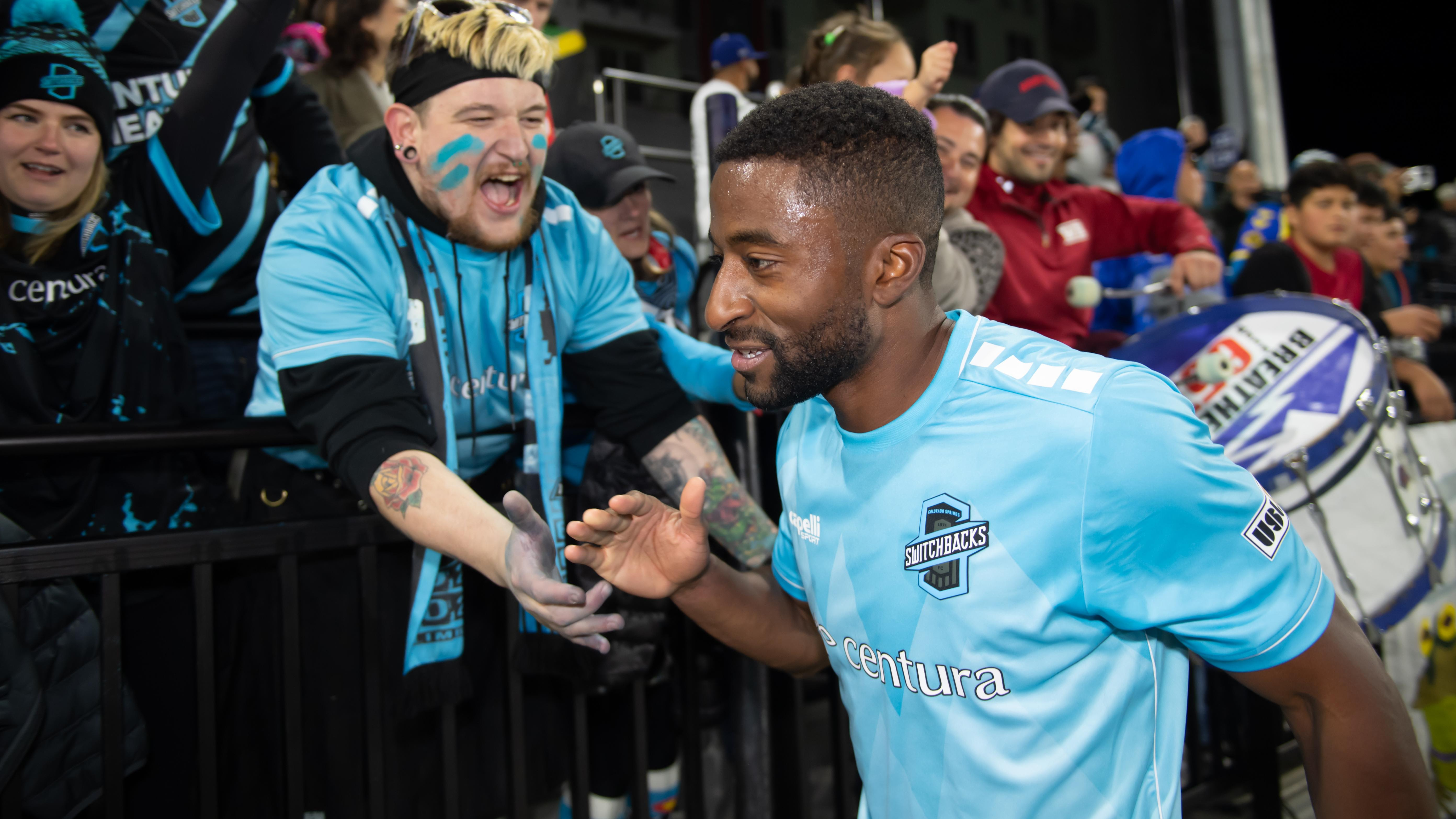 |
| Head Coach: Stephen Hogan Regular Season: 16-13-5, 53pts – 5th, Western Conference Best Prior Postseason Run: Western Conference Final, 2022Why They’ll Make a RunThe Switchbacks are the hottest team in the Western Conference going into the playoffs, undefeated in their last seven games – their longest run since the 2021 season – while claiming a Western-best 17 points from their last eight outings. The squad has changed substantially from a season ago when the side reached the Western Conference Final, but the quality is still here. Jamaican forward Romario Williams equaled a career-best with 15 goals, while goalkeeper Christian Herrera stepped into the starting role and tied for fifth in the league with 10 shutouts and seventh with 79 saves. Colorado Springs has shown it can measure up to the best in the West. It swept its series with No. 3 seed Orange County SC and defeated No. 1 seed Sacramento Republic FC on home turf. It also took victories against two of the top three in the East in Pittsburgh Riverhounds SC and the Charleston Battery in their interconference meetings.Why They Won’tThe first hurdle is the biggest. San Antonio FC has had Colorado Springs’ number over the past four years, going 10 games undefeated in the series between the sides since the Switchbacks won 1-0 early in the 2019 season. The Switchbacks must go to Toyota Field to not only try to advance, but to end a lengthy streak of failure against SAFC.Indy Eleven |
 |
| Head Coach: Mark Lowry Regular Season: 13-11-10, 49pts – 6th, Eastern Conference Best Prior Postseason Run: Eastern Conference Final, 2019Why They’ll Make a RunAfter a shaky start, Indy’s form has been comparable to the better teams in the Eastern Conference over the final two-thirds of the season. Since June 1, Indy’s 10 wins have only been surpassed by the top two seeds in the conference. Since August 1 the side has gone 7-3-3 to comfortably secure its first trip to the playoffs since 2019. That’s a group that’s figured some things out. If Indy’s going to win it all, it’s almost certainly going to have to do so on the road. The good news? Indy was the second-best road team in the USL Championship in the past regular season, taking 28 points from 17 games. The Boys in Blue won away from home at Pittsburgh Riverhounds SC and the Charleston Battery and drew with the Tampa Bay Rowdies and Memphis 901 FC. Seems good. There might be no better motivation for a group of veterans than adding the one thing that’s eluded them so far. In players like Solomon Asante and Sebastian Guenzatti, Indy has players who’ve been to the Championship Final before only to taste defeat. In Aodhan Quinn, it has a league legend who has never played in the league’s biggest game. Expect the energy to be amped up.Why They Won’tIndy’s defense tied for third-fewest goals allowed in the regular season with 38 allowed in 34 games. It also ranked 18th in Expected Goals Conceded at 44.49xGA. It had better hope the regression that seems ready to show up doesn’t appear in the next month.New Mexico United |
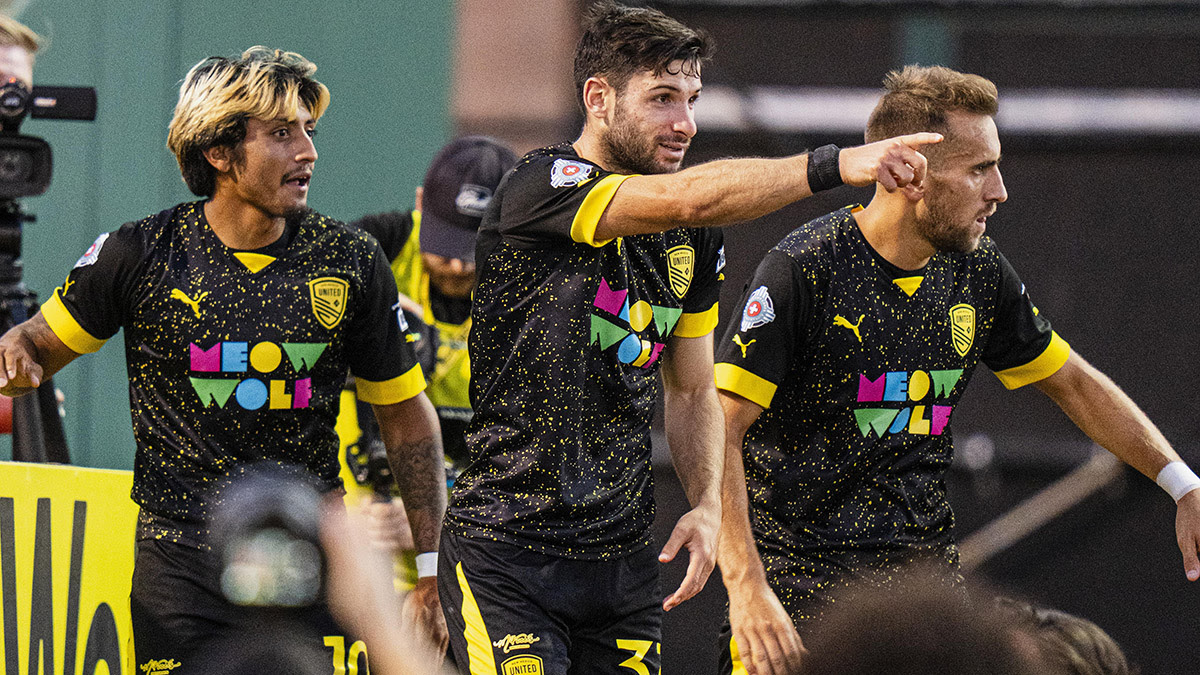 |
| Head Coach: Eric Quill Regular Season: 13-14-7, 46pts – 8th, Eastern Conference Best Prior Postseason Run: Western Conference Semifinals, 2020Why They’ll Make a RunYou could say New Mexico United’s playoff run has already begun. With three games to go, the side was in 11th place in the West and rated a 7 percent chance to make the postseason. Since then, it’s reeled off three consecutive wins against Louisville City FC, Phoenix Rising FC, and Memphis 901 FC to get back into the playoffs. Those are no small feats, and this side has positive momentum. New Mexico has shown it’s got enough firepower to hang with anyone. United’s 51 goals tied for sixth-most in the league this season, and they came from a variety of sources. El Salvador international Amando Moreno led the way with 10 goals, but 11 players for New Mexico scored at least twice this season. A different hero for every game? Could be. This group has players who know what it takes to win in the postseason. Both Justin Portillo and Kalen Ryden were on Real Monarchs SLC’s 2019 title-winning squad – at No. 4, the lowest prior seed to win the title. Greg Hurst won a League One title with Union Omaha in 2021. Head Coach Eric Quill has also guided a team to playoff silverware, winning the League One title in 2019 with North Texas SC.Why They Won’tFor all its positives, New Mexico won only four road games in the regular season. To win the title, it will have to match that number in four consecutive weekends. |
 The Ole BallCoach