
US Men lose 5-1 to Colombia play Brazil Wednesday night at 7 pm on TNT
Ok so I watched again before writing this. On the bright side we were down 2-1 with 75 minutes to go to a team that is unbeaten in 22 straight games in South American qualifying which included wins over Brazil, England, Germany and more. The bad news – we subbed in Cameron Carter Vickers at center back and immediately gave up 3 goals. The Celtic Man Vickers should not see the field again this summer – Miles Robinson is 5 times better than him – MLS player be damned. (Heck I would prefer Miles & Zimmerman at the centerback spots there right now – at least they will fight!) Each were dumb give-aways, but 5-1 is hard to explain when 2-1 or even 2-2 looked to be the result coming with 15 minutes left. Also on the bad side – our starting keeper Matt Turner was HORRIFIC – of the 5 goals I would say 3 of them were definitely save-able balls. I am not sure Tim Howard gives up more than 1 on the night. It’s time to give Ethan Horvath a game – Turner is proving his 4 months with no games at Nottingham Forest have cost him.
On the good side right back Joe Scally was amazing – basically keeping the electric Liverpool man Luis Diaz in check – while in for Dest. Dmid Johnny Cardosa was fantastic until the 75th minute mark when his giveaway gave up the deciding 3rd goal, he’s no Adams – but he proved the #6 should be his spot when Adams is not healthy. I thought Weah was good on the right wing, (not so good at right back) and substitute Haji Wright was electric when he checked in for Pulisic. I think Haji deserves a shot up top as the #9 – Balogen seemed disconnected like he has been for months now. Of course everyone is calling for Berhalter’s head again – and while I am not pleased with the result – GB did not give-away 3 balls inside his own half leading to 3 stupid easy goals. Now – he needs to regroup this team – get them ready for Brazil and NOT lose by more than 1 goal to Brazil. We had 0ver 60% possession on the night – which is nice but Colombia outshot us 17-5. I have always thought the US should be a counter attacking team rather than trying to control the tempo – with Pulisic and Weah on the wings – Mckinney in the midfield – and Reyna quarterbacking the middle – I just love the idea of counter attacking with a vengeance. Maybe we’ll see that vs Brazil and into the Copa America. Listen lost to Brazil by 3 goals or more – not advance past the group stages of Copa and Berhalter should be fired. We’ll finish 2nd in the group on Copa but my excitement for this team going to the Semi’s is basically dead at this point. I am hoping for a 3-2 or 2-1 loss on the night? Wouldn’t a 2-2 be nice? Listen Mexico righted the ship vs Brazil why not the US?
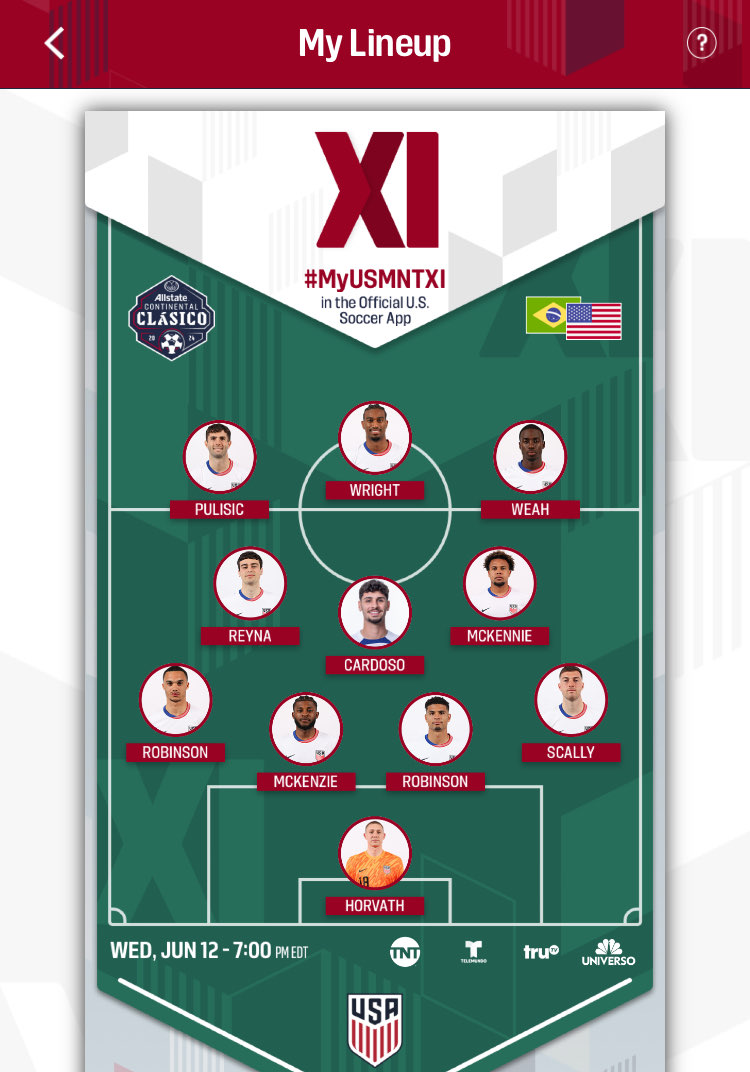
Here’s my starters for Wed night 7 pm on TNT vs Brazil:
Indy 11 Bring 11 game unbeaten streak home vs San Antonio this Sat Night at the Mike.
The Boys in Blue closed out a two-match road trip Sunday night with a win against Birmingham Legion FC. Indy sits at 8-4-2 in third place in the Eastern Conference and return home to host San Antonio FC this Saturday, June 15 at the Mike. Single-game tickets are available for all matches via Ticketmaster. Great Story about Carmel Dad’s Club’s own Cam Lindley and his journey back to Indy 11. The 11 Ladies will host King’s Hammer FC Wed night 7 pm at Grand Park Events Center – tix just $10.
Euro’s Start Friday
The European Championships start Friday — I have included some preview stories below – I will have my full preview and predictions Friday. Copa America of course starts the following weekend as the summer of soccer 2024 on Fox gets underway.
Carmel High Girls Soccer Camp July 22-25
2-4:30 pm @ Murray Stadium Register Here contact fdixon@ccs.k1.in.us for more info
GAMES ON TV to WATCH
Wed, June 12
7 pm TNT, Tele US Men vs Brazil
Fri, June 14 Euro 2024 Begins
3 pm Fox Germany vs Scotland
8 pm Amazon Prime KC Current vs Chicago Red Stars NWSL
Sat, June 15
9 am Hungary vs Switzerland
12 pm Fox Spain vs Croatia
3 pm Fox Italy vs Albania
7 pm TV 8 Indy 11 vs San Antonio @ the Mike
Sun, June 16
9 am FS1 Poland vs Netherlands Euro
12 noon FS1 Slovenia vs Denmark
3 pm Fox Serbia vs England Euro
Thur, June 20 COPA America Starts
12 noon FS1 Denmark vs England
3 pm Fox Spain vs Italy
8 pm Fox Argentina vs Canada COPA
Sat, June 22
6 pm Fox Ecuador vs Venezuela COPA
7 pm ESPN+ Indy 11 vs OC @ the Mike Pride Night
9 pm Fox Mexico vs Jamaica COPA
Sun, June 23
6 pm Fox, Univision USMNT vs Bolivia COPA America
9 pm FS1 Uruguay vs Panama COPA
Thur, June 27
6 pm Fox USMNT vs Panama COPA
Mon, July 1
9 pm Fox, Univision USMNT vs Uraguay
Sat July 13
3 pm TNT, Tele US Women vs Mexico
Tues, July 16
7:30 pm TNT, Universo US Women vs Costa Rica
July 24 starts US U23 Men & US Women In Olympics
(American’s in Parenthesis)
How to Watch Indy Eleven USL Championship Action
=======RackZ BAR BQ ====Save 20% ===========
(Photo: Brad Smith/Getty Images for USSF)
Heading over to the Badger Field for Training or Games? Try out the Best BarBQ in Town right across the street (131st) from Northview Church on the corner of Hazelldell & 131st. RackZ BBQ

Save 20% on your order
(mention the ole ballcoach)
Check out the BarBQ Ribs, pulled Pork and Chicken, Brisket and more. Sweet, Tangy or Spicy sauce. Mention you heard about it from the Ole Ballcoach — and Ryan will give you 20% off your next meal. https://www.rackzbbqindy.com/ Call ahead at 317-688-7290 M-Th 11-8 pm, 11-9 Fri/Sat, 12-8 pm on Sunday. Pick some up after practice – Its good eatin! You won’t be disappointed and tell ’em the Ole Ballcoach Sent You!

======================RackZ BAR BQ ====Save 20% ======================

USA vs. Brazil, 2024 Friendly: What to watch for Stars & Stripes By Donald Wine II
U.S. lopsided loss to Colombia down to more than Turner’s 3/10 performance ESPN Cesar Hernandez
Adams ‘ready to play role’ for USMNT vs. Brazil ESPN Jeff Carlisle
USMNT player ratings vs Colombia: Which US players made an impression?
Gregg Berhalter’s USMNT seat is preheating
Thumped by Colombia, the USMNT gets a ‘wake-up call’ that shouldn’t be necessary
USMNT 1-5 Colombia: Mistake-happy Yanks punished by impressive Cafeteros
Report: Weston McKennie to Aston Villa – Is this a good move for USMNT star?
Indy 11
Indy Eleven Coaches Show | Episode 4
White Named to USL W League Team of the Month
European Championships
Southgate: I’ll ‘probably’ quit if England lose Euros
Is it now or never for England manager Southgate at Euro 2024? ESPN James Olley
Gordon: Huge competition for England Euro places
Sources: Saka fit for England’s Euro 2024 opener
Why Spain can win Euro 2024 despite tough group with Italy, Croatia Luis de la Fuente says Pedri is hitting best form

USMNT 1, Colombia 5: U.S. gets ‘wake-up call’ after second-half defensive collapse

By Paul Tenorio Jun 8, 2024 THe Athletic
The U.S. men’s national team’s game against Colombia was always meant to be a tune-up for Copa América this summer. A pair of games, ending Wednesday in Orlando against Brazil, was the last chance for the U.S. to test options before the tournament. On Saturday in Landover, Maryland, the U.S. had plenty to take away on what not to do.They were sloppy in the back and gave Colombia several chances, and Los Cafeteros did not waste them.The result was an ugly 5-1 scoreline that leaves the U.S. knowing they have plenty of work to do before the Copa América starts — especially considering Colombia is a potential knockout round opponent if the U.S. advances from the group stage.“We’re nowhere near the level we need to play at if we want to win games coming into Copa América,” U.S. winger Christian Pulisic said. “It’s better that it happened now, but we can’t be anywhere near playing like that and expect to win games.”The concern about this U.S. team was whether they could beat big opponents on big stages. This game only enhanced those questions.“We’re not framing it as a lesson learned,” U.S. head coach Gregg Berhalter said. “We’re actually framing it as a wake-up call. Really poor performance against a top team and I think if you give, or I know if you give a team like that the opportunities that we gave them, you’re going to have no chance to win. It’s never going to happen. And that’s what’s really disappointing about the game.”
Should fans worry about the U.S. defense?
Simply put, it was one of the worst performances in recent memory we’ve seen from the U.S. backline.
Part of that might be chalked up to the level of the opponent, but there were also far too many mistakes from players who are considered some of the most reliable in this U.S. pool. The U.S. made errors that gave too many chances to Colombia, and Colombia finished those looks easily and gratefully.
The issues weren’t isolated to one or two players. Center back Tim Ream wasn’t as clean as we have come to expect in a U.S. uniform. Part of that might be because he played just one Premier League game for Fulham since February 17. If Ream is going to be the starter in Copa, getting these minutes in the friendlies is vital, but the hiccups probably aren’t unexpected.
ADVERTISEMENT
Antonee Robinson, who has been one of the highest-floor players for the U.S. in the last three years, had an off day. Cameron Carter-Vickers had a poor giveaway that led directly to a goal in the second half. Johnny Cardoso struggled in midfield starting at the No. 6 in his biggest opportunity so far in a U.S. jersey. Even goalkeeper Matt Turner, who didn’t play much this year for Nottingham Forest, looked shaky in net, giving up a couple of goals at the near post.
Colombia’s third goal saw seven U.S. defenders in the box, yet none picked up the late Colombian runners for an easy finish. It was the start of a final 15 minutes that was as ugly as you’ll see.
“From the 75th minute on, it was, I think, a lack of respect for our opponent, the game of soccer, what we were doing,” Berhalter said. “And the sad thing is it overshadows how we got back into the game, how we were aggressive, how we had them on their heels, and they were struggling for a moment when it was 2-1, and we weren’t able to capitalize that on it and then the game went to pieces late in the match.”
The attacking side for the U.S. has typically been the area we’ve spent most of our time analyzing. What can the U.S. do better to find more goals? Against Colombia, however, there were just too many bad moments that gave Los Cafeteros easy looks at goal in transition and it led to a blowout loss.
The U.S. is going to have to be much better against Brazil on Wednesday, and in the Copa after that.
Did the U.S. get a necessary ‘wake-up call’?
Multiple times during the press conference, Berhalter called the performance a “wake-up call.” It better be for the U.S.There has never been this much hype around a U.S. men’s national team. The starting lineup consisted completely of players who play overseas. There were starters from AC Milan, Juventus, Monaco, Crystal Palace and Fulham, among others, on the field. The expectations going into the Copa América are to contend for a trophy. What we saw on Saturday night was far short of that.This performance puts everyone on notice. No doubt that means Berhalter, too, as he has been entrusted with taking this team from young upstarts into a group that should be peaking when the World Cup comes to these shores in two years’ time.“We take responsibility as a coaching staff, for sure,” Berhalter said. “We can’t put this all on the players. It’s our job to prepare them with a game plan, and then it’s about execution. And I think that this game will help us understand that when we don’t do things we’re supposed to do, we’ll get hurt really quickly.”
ADVERTISEMENT
The Copa is about playing big games against big opponents. That’s what these friendlies were supposed to be, too.“It’s about understanding what it takes to beat teams like this,” Berhalter said. “And when I said a wake up call, there’s some glaring things that you have to address if you’re going to compete at this level. And so we just go back to work. Our mindset the whole time is we want to improve. We want to get better. We want to use every opportunity, every game we play to keep improving. And we’ll certainly keep the same theme in this one.”It will be difficult to know where to start. As noted above, the U.S. was sloppy and disjointed defensively, even before things got truly ugly late. The bright moments in the game were never connected enough to truly threaten Colombia for extended periods.
What were the USMNT’s early errors?
The frustration for the U.S. wasn’t just about the hole they found themselves in 20 minutes into Saturday’s game against Colombia. It was how they found themselves there.
Robinson went to the ground to prevent a ball from sliding in behind him, but there was no run coming. That led to an easy first goal. Then, Tim Ream’s mistake playing out of the back eventually led to a corner kick that wasn’t cleared and was finished by Borre at the back post. Again, a preventable goal.The U.S. was lucky to avoid a third when Antonee Robinson turned it over in the 61st minute inside his own half and the counter led to Luis Diaz’s shot hitting off the inside of the post, rolling across the face of goal and out.
The U.S. is very much still the underdog against teams like Colombia and, on Wednesday in Orlando, Brazil. The U.S. was 3-13-5 all-time vs. Colombia going into the game, their second-worst record against any opponent. The worst? Brazil. The USMNT is 1-18-0 against the Seleção all-time. Considering the records, considering the opponents, the U.S. has to play a clean game. They can’t give away easy half-chances. If they do, the result is what we saw against Colombia: Two mistakes from the back line, and two goals for Colombia.he final 15 minutes was a true lesson in the level needed to compete against good teams. There was a lot of bad and a lot of blame to go around.“You can go back and check the goals,” Berhalter said, of spreading the issues around beyond one or two individuals. “It’s midfielders not recovering, it’s guys losing the ball in positions when our fullbacks are high, they got hung out to dry a number of occasions. It’s a second phase from a set piece. It’s a miscue on a ball that’s going out of bounds in the first six minutes of the game. So, it’s a collective thing and the reason why I’m so disappointed is because guys just didn’t do their job.”
 Weah was a rare bright spot for the U.S. against Colombia. (Photo by Greg Fiume/USSF/Getty Images for USSF)
Tim Weah’s goal a lone bright spot
When we talk about core players for the U.S. men’s national team, so often the same names come up: Pulisic, Gio Reyna, Weston McKennie and Tyler Adams. Weah, though, has been one of the most consistent starters and performers for the U.S., putting in quietly dangerous outings in qualifiers, Qatar, where he scored the first goal of the tournament for the U.S., and Nations League.
So much of the damage Weah has caused for the U.S. has been through his verticality on the wing. He takes defenders on, can beat you to the end line and is also dangerous arriving in the box to finish. On Saturday, he showed a bit more of what he can do.
Weah dropped centrally to get on the ball, turned after receiving a pass from Gio Reyna and curled a pass wide to Folarin Balogun. Weah then sprinted into the box, signaling to Balogun where he wanted to get it back, then blistered a shot to the far post when Balogun laid it out to him.
With the right back spot somewhat open, there has been talk about playing Weah there considering he has played right wingback for Juventus. His goal against Colombia showed some of the attacking edge you might lose by dropping Weah deeper on the field.
 Pulisic left the game at halftime due to managing his minutes. (Photo by Tim Nwachukwu/Getty Images)
How did Christian Pulisic look in 45 minutes?
Pulisic played just 45 minutes for the U.S. on Saturday, as he was pulled at halftime in a planned substitution to manage his minutes ahead of the Copa América tournament, but there were a few important takeaways from the 45 minutes .First, Pulisic wore the armband. We’ve seen Pulisic take on more of a leadership role with this U.S. team beyond just his on-field performances. He seems willing to embrace other aspects of leadership, and though this is not the first time seeing him wearing the captain’s armband, I think it’s taking on more significance for the team’s biggest star. Secondly, Pulisic was the most dangerous player for the U.S. in the first half, and that is what the USMNT is going to need to see from the winger if they want to be successful in the Copa. Pulisic was the best-attacking player for the U.S. in Qatar and tends to step up on the biggest stages. Coming off of a career club season, the U.S. will need him to carry it over. Against Colombia, he hit the post on a header and also served in a dangerous cross in the 42nd minute. One thing we didn’t see that I wonder if we will during the Copa: Pulisic and Weah switching sides during the game to unbalance opponents, especially considering Pulisic’s success playing on the right for AC Milan.
What next for USMNT?
Wednesday, June 12: Brazil (Camping World Stadium, Orlando), friendly, 7 pm ET
USMNT goalkeeper Matt Turner apologises to fans after 5-1 defeat to Colombia

By Colin Millar Jun 9, 2024
United States goalkeeper Matt Turner apologised to the national team fans after their 5-1 defeat against Colombia on Saturday.Gregg Berhalter’s side suffered a heavy defeat in Maryland in their penultimate warm-up match for this summer’s Copa America, which the U.S. is hosting.Jhon Arias, Rafael Borre, Richard Rios, Jorge Carrascal and Luis Sinisterra were all on target for Colombia, with Timothy Weah’s goal just before the hour mark proving to be just a consolation for the U.S.“We didn’t have any answers for the way Colombia changed themselves, changed the way they pressed,” Turner said after the match. “They had a different intensity about them that we didn’t have for the game. “So it’s really, really disappointing in front of such a great crowd to perform like that, so I want to apologise to the fans as well, because that’s not what we’re about and we need to bounce back in a big way.”
 Weah was a rare bright spot for the U.S. against Colombia. (Greg Fiume/USSF/Getty Images for USSF)
The Nottingham Forest goalkeeper said he was “obviously disappointed” with his personal performance and added that he and his team-mates “need to look in the mirror” after the result. The U.S. play Brazil on June 12 to conclude their preparation for the Copa America. They get their campaign underway against Bolivia on June 23, before taking on Panama four days later and finalising their group stage campaign against Uruguay on July 1. (John Dorton/ISI Photos/USSF/Getty Images for USSF)
USMNT international Brenden Aaronson to stay at Leeds United

By Tom Bogert and Nancy Froston Jun 10, 2024
U.S. international midfielder Brenden Aaronson will stay at Leeds United this season after a positive conversation with head coach Daniel Farke, sources briefed on the situation tell The Athletic.Aaronson still had an active release clause in which he could have left on a free loan again and had interest in Germany, but opted to return to Leeds. Aaronson spent the 2023/24 season on loan at Union Berlin. The player feels he has unfinished business in England and Farke plans for the American to play a key role in their promotion push, sources say.Leeds lost in the Championship playoff final against Southampton after finishing third in the table.
Aaronson, 23, had a difficult start to life in Germany, but finished strong. He appeared in 30 of the club’s 34 league games and all six Champions League games.The Yorkshire Evening Post first reported Aaronson was likely to stay at Leeds this summer.The Athletic first revealed the relegation release clause in Aaronson’s contract last summer, which meant interested clubs needed only to cover his full salary as part of the deal. That clause remains active.Aaronson appeared in 36 of the club’s 38 Premier League games in 2022-23 as they suffered relegation. He was criticized by fans for lack of goal contributions, particularly with his hefty price tag. Leeds initially signed Aaronson in the summer of 2022 for £25million ($30m) from RB Salzburg. The U.S. international is preparing for the Copa America and already has 40 caps with the national team.
Euro 2024 Group A guide: Germany’s narrow No 10s, resolute Hungary and Scotland’s set pieces
Liam Tharme Jun 11, 2024 The Athletic
Sign up for The Athletic today with our limited-time Tournament Sale offer.
Six groups, with 24 teams in total, playing 51 games in 31 days — Euro 2024 is going to be relentless.
To help you navigate and prepare, The Athletic has compiled guides to each of the groups. They detail each team’s tactics, key players, weaknesses, stats and quirks.
Expect screengrabs to show team shapes and tactics-board GIFs demonstrating attacking rotations and pressing structures. There will be podcast clips and videos embedded for further reading/listening.
https://open.spotify.com/embed/episode/2mPj8kruh6LLUygl33wPt0?utm_source=generator
First up, it’s… Group A, where the host nation Germany are joined by Hungary, Scotland and Switzerland. All four were at the previous European Championship three years ago, though none of them went beyond the quarter-finals. It is a group of back threes, No 10s and set pieces. Let’s go.
Germany
- Manager: Julian Nagelsmann
- Captain: Ilkay Gundogan
- Qualifying record: Qualified automatically as hosts
- Euros debut: 1972 (winners — as West Germany)
- Euro 2020: Round of 16
- Average age of squad in qualifying: N/A
- Most caps in squad: Thomas Muller (129)
- Top scorer in squad: Thomas Muller (45)
How they play (tactics and formations)
Had they not qualified by virtue of being the hosts, Germany might not have been at this tournament. By their standards, 2023 was disastrous — six defeats from their 11 games, including three consecutive losses for the first time since 1985.
It was their most defeats in a calendar year since 2018 and also their most goals conceded (22) since 2012. Bad records to break at any time, especially in a year without a major tournament and with evidence that the problems we saw during their 2022 World Cup group-stage exit had not been solved.
Nagelsmann became the second-youngest men’s national-team head coach in Germany’s history, replacing Hansi Flick — who was sacked after just 25 games. When asked the classic football-philosophy question in his first press conference, Nagelsmann described it as “healthy aggression towards the opponent’s goal, which doesn’t only apply when in possession. We want to cause problems for our opponents.” He alluded to principles rather than patterns in attacking, saying that “it won’t be as complex as it can be in club football. It’s about giving the players something to identify with.”
Despite the limited time he’s had in the job, Nagelsmann has trialled various systems and personnel — 31 players featured in his first six games. He started with a narrow 4-4-2, followed by a 4-2-3-1 with a pure No 9, switched to a back three with Kai Havertz at wing-back, and settled on a 4-2-3-1 with Havertz as a false nine. The Arsenal forward frequently drops in to overload midfield, while central midfielder Toni Kroos rotates out to the left frequently. This pushes the left-back, Maximilian Mittelstadt, upfield.
Boldly, the attack is structured around two 21-year-olds in Jamal Musiala and Florian Wirtz — narrow No 10s who play either side of captain Ilkay Gundogan. This trio have freedom to roam and rotate.


Build-up is patient, packed with short passes trying to shift opponents so that lanes into the No 10s are opened. Expect up-back-through patterns, centre-backs trying ambitious balls into the forwards and occasional passes in behind if the opposition play a high defensive line and do not put pressure on the ball. With three (arguably four) No 10s, Germany have plenty of midfield runners to attack that space — see their second goal away against France in a March friendly.
They press aggressively, locking on man-for-man out wide. The 4-2-3-1 tends to shift to a 4-4-2, allowing them to mark and cover opposition central midfielders before stepping out, though they take risks by pushing full-backs high to press opposition full-backs. Considering Nagelsmann hasn’t been in charge for long, it is well co-ordinated.
Germany showed against France and the Netherlands, their other opponents in March, that they can disrupt the build-up of Europe’s best sides. Equally, when played through, their back line is exposed, centre-backs are pulled wide and opposition midfielders can exploit space in behind the Germany full-backs.
High risk, high reward.


Key player(s)
Kroos came out of international retirement in February at the age of 34, after nearly three years away, and says he will hang up his boots for good whenever Germany’s tournament ends.
He is ninth on Germany’s caps list, and made his return in the impressive wins at home to the Netherlands and away to France in March. He provided assists in both games — a precise chip into midfield for Wirtz’s kick-off goal away to the French, and an inswinging corner for Niclas Fullkrug’s winner against the Dutch.
Kroos joins Bastian Schweinsteiger, Lothar Matthaus and Lukas Podolski as Germans to play in four European Championships. Nagelsmann’s play-style suits, and needs, Kroos’ distribution and line-breaking abilities.


Kroos’ sublime return suggests Nagelsmann’s decision might be a masterstroke
What’s their weakness?
Finishing. They were the most wasteful team at the World Cup 18 months ago, scoring six goals from chances worth over 10 expected goals. In their 25 games under Flick, no player reached double digits for goals. So this problem predates Nagelsmann, and there is no straightforward solution.
Havertz suits the passing style but has been a wasteful finisher in recent seasons, whereas Nagelsmann’s goalscoring options have box forwards and target man profiles. Borussia Dortmund’s Fullkrug is the standout, with 11 goals in 16 caps — including five in 10 substitute appearances. He came off the bench in all three World Cup games, scoring twice.
Fullkrug (12 league goals), along with Deniz Undav (18) and Maximilian Beier (16), were three of the top five German scorers in Europe’s top-five leagues in 2023-24. They all play in the Bundesliga.
German strikers currently fit one of three categories: stylistically suited (Havertz), experienced (see Thomas Muller) or goalscorers (the three above).
 Kai Havertz (Ina Fassbender/AFP via Getty Images)
One thing to watch out for
Germany must fight the form books to win. They reached four semi-finals and three finals in eight major tournaments between 2002 and 2016, winning the 2014 World Cup. Since a semi-final finish at Euro 2016, however, they have not won a knockout game.
Compounding that, none of the past 10 host nations have won the European Championship — France in 1984, Italy in 1968 and Spain in 1964 are the only three countries to win the competition when staging it. England (Euro 2020), France (2016) and Portugal (2004) have all lost the final on home soil more recently.
How to follow the European Championship on The Athletic…
- Latest Euro 2024 news here
- Euro 2024 fixtures and schedule
- Euro 2024 team guides: Everything you need to know
Scotland
- Manager: Steve Clarke
- Captain: Andy Robertson
- Qualifying record: P8 W5 D2 L1 GF17 GA8
- Euros debut: 1992 (Group stage)
- Euro 2020: Group stage
- Average age of squad in qualifying: 27.7
- Most caps in squad: Andy Robertson (71)
- Top scorer in squad: John McGinn (17)
How they play (tactics and formations)
Steve Clarke’s contract was extended until 2026 in March. It was recognition for Scotland achieving Euros qualification, and how they did it. Clarke, Scotland’s longest-serving national team manager since Craig Brown between 1993 and 2001, has evolved a squad and implemented a clear style.
He coached Scotland to and in Euro 2020, their first major tournament in 23 years. No wins and only one goal from the three group matches made for a sobering tournament, despite an excellent defensive performance to draw 0-0 against England at Wembley.
Qualification suggests they are better this time around. Scotland won their first five group games, notably beating Spain 2-0. They play a 3-4-2-1 and defend in a 5-4-1.

It is a partial truth but really an oversimplification to see their system as a way to fit Kieran Tierney and Andy Robertson, two top-level left-backs, into the same team. Tierney plays left centre-back, as Scotland’s best forward passer and with impressive range, and underlaps in attack. It allows Robertson to play a wing-back role, perfect for his athleticism and final ball.

‘There is no spite from me – Mikel Arteta was 100% right’ – Kieran Tierney interview
Clarke plays two narrow No 10s behind a target-man No 9. The first-choices for that pairing are John McGinn and Ryan Christie, who both play on the opposite side to their dominant foot. This sets them up to deliver back-post crosses and hit switches when they have their back to goal. The latter is important as they are often the out-ball when the back five win duels and launch counter-attacks.
“A few years ago, we played with that deep block against the teams seeded above us and made it difficult for them and looked to counter,” said Clarke after March’s friendly defeat against Northern Ireland. Scotland are evolving beyond just underdog football, and on their good days mix build-up between playing through the thirds and hitting the forwards directly.
They defend across the pitch more, sometimes sitting deep but pressing high specifically at opposition goal kicks. This is typically man-for-man, and they drop to a mid-block quickly if the press is broken.


Key player(s)
McGinn is Scotland’s top scorer (17) under Clarke, playing in all but three of his 55 games in charge. McGinn’s role varies, sometimes crashing the box, linking play in deeper positions, providing the final ball himself and offering a long shot.
Scotland will benefit from McGinn going into the tournament on the back of his best-ever top-flight season, one in which he helped Aston Villa to fourth place in the Premier League, and a return to the European Cup/Champions League after 42 years.

“The way we play, the way the team is structured, is for that striker to help the midfield to score goals,” said Clarke. This applies to Scott McTominay, too. The Manchester United midfielder plays deeper than McGinn in build-up but attacks the box as an auxiliary striker. He scored seven of Scotland’s 17 qualifying goals “I’d be lying if I said I’d expected it,” said Clarke. “I tweaked his position a little bit, I allowed him a little bit more freedom to get forward and suddenly he was scoring goals.”
What’s their weakness?
Scotland’s recent performances against Spain and England are exceptions to the rule. Under Clarke, they have only won once in 10 games against opponents who were in the top 20 of FIFA’s world rankings. Their starting XI, individually and collectively, is better than at the previous Euros, but Clarke partly picks a consistent team because of a lack of quality depth options — especially at right wing-back beyond Nathan Patterson and Aaron Hickey, who both miss this tournament through injury.
Scotland struggle vs top 20 FIFA sides
| METRIC | TOP 20 | OUTSIDE TOP 20 |
|---|---|---|
| Games | 10 | 45 |
| Wins | 1 | 24 |
| Draws | 2 | 11 |
| Defeats | 7 | 10 |
| Goals/game | 0.7 | 1.6 |
| Goals conceded/game | 2.5 | 1 |
| Clean sheet % | 20 | 40 |
Scotland were excellent for 70 minutes in March against the Netherlands, mixing their attacking and defensive approaches, but eventually faded and lost 4-0.
Before beating Gibraltar 2-0 last Monday, they had gone seven games without a win (19 goals conceded) for the first time since 1997-98. That run also included friendly defeats against England and France, and draws in the final two qualification matches after sealing their place in Germany, and quite crudely suggests a glass ceiling. Scotland are not a nation with great tournament history, with group-stage exits in all 11 appearances at World Cups and European Championships.
One thing to watch out for
Austin MacPhee is Scotland’s set-piece coach, working with both them and Villa at club level since the start of the 2021-22 season. Scotland have plenty of height and in playing a back three have aerial threats aplenty for both boxes — their success or not in defending crosses often determines their results against better teams.
There were identical headed goals by Lyndon Dykes (who misses these Euros through injury) from inswinging corners in the 3-0 win against Ukraine in the 2022 Nations League. James Forrest’s deliveries to the corner of the box, at the near post, resembled typical Villa inswinging corners from the left.

McGinn, who works with MacPhee at Villa, delivers fantastic deep inswingers from the right. That delivery created goals against Austria, Denmark (both 2021), Armenia (2022) and, most significantly, the winner in their 3-2 victory at home against Israel in 2022 World Cup qualification.
 (Ian MacNicol/Getty Images)
Switzerland
- Manager: Murat Yakin
- Captain: Granit Xhaka
- Qualifying record: P10 W4 D5 L1 GF22 GA11
- Euros debut: 1996 (Group stage)
- Euro 2020: Quarter-finals
- Average age of squad in qualifying: 29.0
- Most caps in squad: Granit Xhaka (125)
- Top scorer in squad: Xherdan Shaqiri (31)
How they play (tactics and formations)
Switzerland: perennially decent. They have qualified from the groups at four of the past five major tournaments but only won one knockout tie, beating France on penalties at Euro 2020.
Murat Yakin is tactically flexible but has issues to fix. Switzerland qualified for the 2022 World Cup with Europe’s strongest defence (only two goals conceded) and playing a 4-2-3-1 but they underwhelmed in the finals, dumped out 6-1 by Portugal in the round of 16.
Yakin had promised the “best World Cup ever” from “the best Switzerland national team that has ever existed”, and they fell well short. Euro 2024 qualifying then did little to vindicate him, with too many draws (five) meaning Switzerland finished second behind Romania in a favourable group. The Swiss FA have publicly backed Yakin, who said he would “try a few things” in the March internationals.
He has trialled a permanent 3-4-2-1 with and without the ball, though Switzerland have attacked in that shape previously. The team is structured around three key left-footers, who are all among the nation’s four most-capped players.


Ricardo Rodriguez plays on the left of the back three, as he does for his Italian club side Torino (who play the same shape). Central midfielder Granit Xhaka is often the deepest midfielder in build-up and sometimes a box-crashing threat. Right-winger Xherdan Shaqiri has a free role. He provides back-post inswinging crosses and picks apart defences with dribbles or long shots. Switzerland often hit big switches to him and Shaqiri is supported by an overlapping central midfielder.
ADVERTISEMENT
Against inferior opposition, their individual quality shines and they score stylish cutback goals — see Renato Steffen’s hat-trick in their 5-0 win over Belarus, where all three goals came from cutback moves from the left. When facing a superior side, expect early crosses, as Switzerland rarely get sustained possession upfield and struggle to play through a co-ordinated high press.
They had the second-highest possession average (71 per cent) in qualifying, but this is less a reflection of controlling matches and more that they faced weaker opposition. Yakin says Switzerland want to dominate the ball but they must shore up the defensive base — 11 goals conceded was the leakiest defence of any team to qualify for these Euros.
In the March internationals, they mixed between mid-block defending in a 5-4-1 or 5-2-3, and pressing man-for-man. It worked better, keeping clean sheets against Denmark and the Republic of Ireland (who also played back threes).

Key player(s)
Other players might play bigger roles in qualifying, but Shaqiri’s finals record speaks for itself. Switzerland have scored 28 goals across their past five appearances at World Cups and Euros, and 13 were either scored or assisted by Shaqiri, an ever-present at those tournaments. He is a triple threat of dribbler, passer and finisher, takes set pieces and can play as the false nine too, which he did in March’s game in Dublin.

At the other end, Switzerland will hope goalkeeper Yann Sommer can carry his club form into the Euros. He kept 19 clean sheets and only conceded 19 goals in 34 games last season as Inter Milan won the Serie A title — his international record is 34 clean sheets in 89 caps, conceding less than a goal per game (88 in total).
What’s their weakness?
Conceding late goals. Six of the 11 scored against Switzerland in qualifying came after the 80th minute and contributed greatly to them having so many draws. These goals had no repeatable pattern but a common theme of individual errors despite sound structures: the back five losing/not tracking runners in-behind (without enough pressure on the ball) in settled defence, losing first contacts at crosses and defending set pieces badly.
Such poor game-management belies their individual experience — Sommer, 35, was in goal for all six of those concessions — and is atypical for a team defending in a back five. It needs resolving.
One thing to watch out for
Burnley’s Zeki Amdouni. Vincent Kompany, his manager last season who is now in charge at Bayern Munich, has called the 23-year-old a “natural goalscorer”. He was Switzerland’s top scorer in qualifying (six), averaging a goal every 83 minutes. He is a flexible forward, equally threatening against set defences as in transition, with the ball at his feet or attacking crosses/passes in behind. He may not start, but could prove an excellent substitute.
Hungary
- Manager: Marco Rossi
- Captain: Dominik Szoboszlai
- Qualifying record: P8 W5 D3 L0 GF16 GA7
- Euros debut: 1964 (third place)
- Euro 2020: Group stage
- Average age of squad in qualifying: 27.8
- Most caps in squad: Adam Nagy (81)
- Top scorer in squad: Roland Sallai (13)
How they play (tactics and formations)
Hungary have grown exponentially as a footballing force in the past two years.
Questions were asked of Marco Rossi after a group-stage exit at Euro 2020 and their failure to qualify for the 2022 World Cup.
The Italian, in charge since June 2018, is their longest-serving national-team boss since Lajos Baroti in the 1950s and 1960s. Hungary’s 2022-23 Nations League performance set a marker, finishing second in a group that included Euro 2020 winners Italy and runners-up England, plus Germany.
Those games showed Hungary at their best under Rossi: defensively strong, dropping into a typically-Italian 5-4-1 in their own half. They conceded just seven big chances across the six Nations League games, half as many as they created (14). Successful and sustainable.

Rossi’s favourite game of that Nations League run was not Hungary’s first win in Germany (1-0) since 2004 or in England (4-0) since 1954, but rather the 1-1 draw at home to the Germans. His explanation: because they “could only get behind us twice or three times, it was an almost perfect 90 minutes from a professional perspective”. Germany had 67 per cent possession that day but were outshot 11-6, and only managed one big chance and one shot on target (Hungary had four big chances and seven efforts on target).

The Nations League success proved no fluke, as Hungary qualified for these Euros without losing. They only conceded seven goals in their eight matches and 2023 became their first calendar year without a defeat since 1976. Hungary defend with more aggression now than at Euro 2020, where they had the least intense defensive approach based on opposition passes allowed per defensive action (25.9).
The centre-backs, especially Adam Lang on the right side, defend touch-tight. Central midfielders mark aggressively and the No 10s stay high to press centre-backs. The No 9 drops onto either the midfield pivot or a centre-back who steps out.
Hungary often lock on man-for-man when opponents play wide. All these jumps, especially from centre-backs, can leave exploitable space in-behind if the timing is not perfect. Equally, when well co-ordinated, it forces turnovers from which they can counter.
No 9s rarely have good games against Hungary. Since Euro 2020, Aleksandar Mitrovic, Harry Kane and Timo Werner have started a combined nine games against them and only scored one goal. Three very different strikers, all of which Hungary can defend. They are adaptable.

Their biggest vulnerability in settled defending is direct balls and runs inside the wing-back, especially back-post crosses delivered from their right and targeting left wing-back Milos Kerkez. Hungary defend better than they attack, but their rotational build-up approach has caused problems when they play long.
On paper, it looks like a box midfield in a 3-4-2-1, though the left No 6 regularly rotates out to the left centre-back spot, pushing that side’s centre-back and wing-back upfield.

Here’s how that looked against Italy in September 2022, where another of their typical rotations can be seen — the wing-back and No 10 trading places (see Loic Nego out wide).

Similarly against Germany three months earlier, this time with Callum Styles, of Barnsley in League One, the third tier of English football, fulfilling Andras Schafer’s role and no wing-back/No 10 rotation on the right.

All this is designed to get more bodies on the last line, especially when they are up against a back four.
Their first pass typically is short, but under pressure Hungary’s back line play direct to the No 9 rather than through midfield. Expect wing-back to wing-back switches and runs in behind, while their build-up patterns of defender to No 9 to No 10 to release the wing-back are reminiscent of Simone Inzaghi’s Inter Milan.
Hungary are strong at seeing out leads: they are unbeaten in the last 28 games when scoring first, which includes going ahead against France (once), Germany (three times) and England (three times).
Key player(s)
Dominik Szoboszlai became captain after Adam Szalai’s international retirement in September 2022. The 3-4-2-1 structure frees the Liverpool midfielder to play No 10 and rotate, maximising his passing range. Sometimes he drops into the box at goal kicks, receives from the goalkeeper and hits long balls.

Szoboszlai is Hungary’s key man against low blocks and weaker opposition, though this owes to the No 6s too.
The first-choice pairing here are Adam Nagy and Schafer. Nagy has played 57 of Rossi’s 63 games, and is often the lone pivot when Schafer rotates to left centre-back. The pair are tough tacklers, Schafer is a comfortable dribbler from the back and Nagy likes a diagonal.
What’s their weakness?
Dominating games. After all, Hungary had the fewest open-play sequences of 10-plus passes at Euro 2020. In qualifying, their possession ranged between 36 and 72 per cent, and they only managed eight goals from open play. When they have played expansively, notably at home to Serbia in qualifying, they looked vulnerable to counter-attacks.
ADVERTISEMENT
“It could be harder against them (group opponents Montenegro, Bulgaria and Lithuania) than it was against the classy teams in the Nations League,” said Rossi before the start of qualifying. “It will almost be a completely new situation for us to have the burden of being favourites on our shoulders.”
Rossi emphasises they are a “young, developing team,” but in the group matches against Switzerland and Scotland — both likely to go with back fives themselves — Hungary will have to play more than just underdog football if they are to qualify for the knockout phase.
One thing to watch for
Set pieces. No team bettered Hungary’s six set-piece goals in qualifying. Szoboszlai takes most of these, and is also 17 out of 18 from the penalty spot in his senior career (94 per cent).
Like Scotland, playing three centre-backs and a tall No 9 means Hungary have aerial threats aplenty, and they defend corners almost exclusively man-to-man. Here’s their national-team analyst, Istvan Beregi, examining set pieces.


The Radar – The Athletic’s 50 players to watch at Euro 2024
Fixtures
Round 1:
- 14/06/2024 — Germany vs Scotland (9pm CEST, 8pm BST, 3pm EDT)
- 15/06/2024 — Hungary vs Switzerland (3pm CEST, 2pm BST, 9am EDT)
Round 2:
- 19/06/2024 — Germany vs Hungary (6pm CEST, 5pm BST, 12pm EDT)
- 19/06/2024 — Scotland vs Switzerland (9pm CEST, 8pm BST, 3pm EDT)
Round 3:
- 23/06/2024 — Switzerland vs Germany (9pm CEST, 8pm BST, 3pm EDT)
- 23/06/2024 — Scotland vs Hungary (9pm CEST, 8pm BST, 3pm EDT)
(Top photos: Getty Images; design: Eamonn Dalton)

Euro 2024 Group B guide: Spain’s wide rotations, Italy’s flexibility and Albania’s long shots
Ahmed Walid Jun 11, 2024 The Athletic
How will Italy set up under Luciano Spalletti? What’s the Spanish quirk we should look out for? What can we expect from Albania?
Euro 2024 is nearly upon us and The Athletic will be running in-depth tactical group guides so you know what to expect from every nation competing in Germany.
We’ll look at each team’s playing style, strengths, weaknesses and key players, and highlight things to keep an eye on during the tournament.
ADVERTISEMENT
Expect to see screengrabs analysing tactical moments in games, embedded videos of key clips to watch, the occasional podcast clip and data visualisation to highlight patterns and trends — think of yourself as a national team head coach and this a mini opposition dossier for you to read pre-match.
This time we’re looking at Group B, which features Spain, Italy, Croatia and Albania.
The Radar – The Athletic’s 50 players to watch at Euro 2024
Spain
- Manager: Luis de la Fuente
- Captain: Alvaro Morata
- Qualifying record: P8, W7, D0, L1, GF25, GA5
- Euro 2020: Semi-finals
- Most caps in squad: Alvaro Morata (73)
- Top scorer in squad: Alvaro Morata (35)
How do they play?
If you haven’t watched Spain for a while and have only a basic idea about how they might play, you are still probably on the right track.
Under head coach Luis de la Fuente, Spain are still looking to dominate possession in a 4-3-3 shape on the ball with a focus on combinations down the flanks between the winger, the full-back and the No 8.

The prominence of Spain’s wingers, such as Lamine Yamal, has also led to more crosses into the penalty area. In Euro 2024 qualifying matches, De la Fuente’s side had the fourth-most crosses per game (26.3) of the 53 nations competing for a place in the final tournament.
This approach tallies well with the head coach’s choices for the striker position. Morata is strong in the air and Joselu has been making a positive impact off the bench, too, scoring four goals from his nine substitute appearances.
On top of that, Mikel Merino, Fabian Ruiz or whoever is playing as a No 8 constantly makes off-ball runs into the box to provide the winger or the full-back with multiple options.
Another feature of Spain’s game in possession is Morata’s tendency to drop and offer himself as a passing option in the middle of the pitch, which makes him a viable option as a false nine if he is needed to play that role.
Off the ball, Spain defend in a 4-4-2 — like the majority of the top football teams in the world — with one of the central midfielders moving up next to Morata or Joselu. When they lose possession, they focus on winning the ball back quickly to limit the opponent’s transitions.
https://open.spotify.com/embed/episode/4wy7BJ58VSqX4dRcegI0Gc?utm_source=generator
Their key player(s)
The level Rodri has maintained in the last couple of years positions him as one of the best midfielders in the world, if not the best. He is vital to Manchester City and Spain.
Rodri’s ability to dictate the tempo, receive the ball under pressure and split the opponent’s line is only matched by his off-ball prowess. He is always in the right position when his team have the ball, which allows him to win the ball back quickly once it is lost, and his defensive presence is complemented by his smart positioning when Spain are out of possession, too.
Great players might drop a level or two on the international stage, but Rodri elevates Spain to another dimension.
 (Denis Doyle/Getty Images)
Pedri has only featured twice for Spain since the 2022 World Cup, and the recurring muscle injuries meant that he only started 21 matches for Barcelona in the 2023-24 season.
His match fitness is a concern, but he is Spain’s best No 8 and his performance against Northern Ireland on Saturday should bring back some hope regarding the levels he could reach in the tournament.
What is their weakness?
Not necessarily a weakness in their playing style, but missing Gavi, one of their best midfielders, is Spain’s biggest problem entering this tournament. Gavi was the only player to feature in all of De la Fuente’s games until his injury against Georgia. His off-ball movement and intensity were crucial in Spain’s qualifiers and those qualities will be missed.
One thing to watch out for…
If Spain’s passing combinations down one side of the pitch are halted by the opponent’s defence, they look to switch the ball quickly to the other side to try to put their winger in a one-versus-one situation or create an overload using the full-back.
Looking at the number of attempted switches of play — which is defined by Opta as any pass that travels at least 60 per cent of the width of the pitch — Spain’s 7.5 per game was the second-most of all teams competing in the Euro qualifiers after Georgia (8.1). In terms of successful switches of play, their 6.5 per game topped the charts.
These switches of play are often played by Rodri, who is instrumental to a similar attacking move at City.

One example is Ferran Torres’ goal in the 3-1 victory against Georgia last November. Here, Fabian Ruiz roams towards the right wing and combines with Oihan Sancet to find Rodri…

… who switches the play to Nico Williams and Jose Gaya before Georgia’s defensive block can shift across…

… leaving their right wing-back, Otar Kakabadze, in a one-versus-two situation. Williams finds Gaya’s overlap, while on the other side, Torres starts his run to attack the back post…

… and Spain’s left-back plays the ball towards that area, for Torres to head the ball into the net.


Italy
- Manager: Luciano Spalletti
- Captain: Gianluigi Donnarumma
- Qualifying record: P8, W4, D2, L2, GF16, GA9
- Euro 2020: Winners
- Most caps in squad: Gianluigi Donnarumma (62)
- Top scorer in squad: Nicolo Barella (Nine)
How do they play?
Until last March, Luciano Spalletti looked set on playing with a back four. However, the Italy manager said that he wanted to do “something modern” before the friendlies against Venezuela and Ecuador in March.
“There is an openness now to being footballers who know how to interpret multiple systems within the same match,” said Spalletti. “Before we had little time and we only focused on one system. Even when we lost, I said we would stay in that system, but now there is more time to do something different.”
ADVERTISEMENT
The difference was moving to a back three instead of the back four Italy implemented in Spalletti’s games in the Euro qualifiers. In his first six games, Italy’s 4-3-3 in possession depended on wing play with flexible rotations between the full-back, No 8 and the winger to break down teams in the wide areas.

In this example, against Ukraine last September, Barella’s movement drags Taras Stepanenko and creates space in midfield, which is attacked by Italy’s full-back, Federico Dimarco, after combining with Mattia Zaccagni. Complementing that movement was Giacomo Raspadori dropping from a centre-forward position to provide a passing option, but the interesting role in Italy’s wide combinations is the opposite full-back — Giovanni Di Lorenzo in this sequence.

After Dimarco plays the ball to Raspadori, and the Napoli forward combines with Davide Frattesi (Italy’s No 8 above), he finds Di Lorenzo unmarked in a narrow position after Ukraine’s left-winger Viktor Tsygankov has dropped to protect his left-back.
The time Di Lorenzo has on the ball allows him to pick his pass, but despite the move not ending in a goal, it’s an attacking sequence that Spalletti’s team has been using regularly when Italy have played in a 4-3-3.
That move resulted in their only goal against England the following month. Here, Barella’s rotation to the left-back space forces Kalvin Phillips to press Destiny Udogie as Phil Foden focuses on the Inter Milan midfielder. Italy’s left-back then combines with Stephan El Shaarawy to exploit the space in England’s midfield, before carrying the ball forward…

… and playing it wide to the left-winger. Meanwhile, Italy’s right-back, Di Lorenzo, advances on the other side…

… and is in a position to receive the switch of play, with Marcus Rashford late to the action. El Shaarawy spots Di Lorenzo, but his pass is intercepted by Declan Rice and the ball falls to Domenico Berardi (out of shot) on the right wing.

Di Lorenzo’s narrow positioning allows him to make an underlapping run behind Kieran Trippier, which is found by Berardi, before the right-back’s low cross into the penalty box is attacked by Gianluca Scamacca to give Italy the lead.

As for the back-three scenario, Italy have used different formations in possession while maintaining a solid 5-4-1 shape without the ball. Against Venezuela, Federico Chiesa’s participation meant that Spalletti’s 3-5-2 on the ball was lopsided because the Juventus forward excels in space and one-versus-one situations down the wing rather than central areas.

The 3-2-4-1 shape used against Ecuador was more fluid, and Raspadori’s link-up play helped Italy’s passing combinations in central areas.

Despite attacking in a different shape, Spalletti’s side focused on combinations between the No 10, wing-back and No 6, allowing the wide centre-backs to exchange positions with the wing-backs.
The common theme in Italy’s attacking game is their dependence on passing combinations in wide areas and rotations between the players in those spaces, regardless of the shape.
Their key player(s)
After an impressive season with Inter, Barella is entering Euro 2024 as his country’s shining light. The midfielder’s ability to win back the ball in midfield and help the team defensively strengthens Spalletti’s side without the ball, but it’s his technical ability and the options he provides in possession that make him crucial to this side.
ADVERTISEMENT
Barella constantly drops to help Italy build up the attacks, while also supporting the passing combinations out wide with his precise passing and off-ball movement. The latter is another feature of his game that allows him to be an offensive threat in the opposition penalty area with late runs from midfield.
 (Adam Hunger/Getty Images)
What is their weakness?
Once Italy lose possession, they look vulnerable on defensive transitions. They leave large spaces between their defensive line and the rest of the team. Rashford’s goal in the 3-1 loss against England last October is a scene that Spalletti would preferably avoid in the upcoming tournament.

The back-three formation has provided more central cover when Italy are transitioning from attack to defence, but it’s still an area that opponents can exploit.
One thing to watch out for…
Italy’s corner threat.
Throughout the qualifying matches and in their recent friendlies, Italy’s attacking corners have been one of their main offensive solutions. In terms of expected goals (xG) per 100 corners — which allows us to level the playing field when comparing across teams — their rate of 5.7 was the sixth-best of the 53 nations that competed for a place in this summer’s tournament.
Croatia
- Manager: Zlatko Dalic
- Captain: Luka Modric
- Qualifying record: P8, W5, D1, L2, GF13, GA4
- Euro 2020: Round of 16
- Most caps in squad: Luka Modric (175)
- Top scorer in squad: Ivan Perisic (33)
How do they play?
There’s not much deviation from how Croatia have been playing under Dalic in previous tournaments.
They still set up in a 4-3-3 formation, and they are still built around the midfield trio of Marcelo Brozovic, Mateo Kovacic and Luka Modric, with flying full-backs as prominent as ever down the wings. However, matches against Armenia and Latvia showed they can mix it up by playing Andrej Kramaric as a No 10 in a 4-2-3-1.
Croatia’s possession game is mainly built on the technical abilities of Brozovic, Kovacic and Modric. The experienced trio drop deep to control the game with the ball.
Their fluid movement, passing combinations and interchanging of positions allow them to play through opponents and progress the ball into the final third. In front of them, the front three usually occupy narrow positions to present themselves as passing options to the midfielders…

… and create space for the full-backs to attack. In this example, from the 2-0 victory away to Turkey in March 2023, Borna Barisic and Josip Stanisic are high up the pitch, flanking a narrow front three of Ivan Perisic, Kramaric and Mario Pasalic.

Earlier in that game, Josip Sutalo’s long pass into the advanced right-back Stanisic had led to the opener.
Here, Pasalic’s narrow positioning occupies Turkey’s left-back, and Sutalo finds Stanisic’s run behind the defence, before the right-back plays the ball into Pasalic. Meanwhile, Kovacic is making a late run into the box and the ball falls into his path after Perisic and Pasilic fail to find a shooting angle. The City midfielder doesn’t hesitate and scores to make it 1-0.

The profiles of the players playing in Croatia’s front line complement their tactical approach. When Kramaric starts as the side’s centre-forward, his movement and link-up play allow him to drop and overload the midfield.
In addition, choosing Lovro Majer or Pasalic to play as the team’s right-sided option rather than an out-and-out winger means Croatia can overload the central areas and use Majer or Pasalic to play through their opponents.

Their key player(s)
Croatia’s midfield of Kovacic, Brozovic and Modric is a trio that most nations dream of, even if they are into their thirties. Together, they provide a balance of technical ability, press resistance, ball carrying, athleticism and defensive quality.
On top of that, their experience at the international stage will be needed. Brozovic (96 caps) and Kovacic (101) are among the wiliest players at the tournament, while Modric (175) is the country’s most-capped player of all time. After guiding their team to third and second place in the two most recent World Cups, they will be hoping to emulate that success in a European Championship.
What is their weakness?
The four goals Croatia conceded in their eight qualifying matches could had been more — their non-penalty xG conceded was 6.4. At times, their back line has been porous — defenders made mistakes and Dominik Livakovic’s saves were important.
The Fenerbahce goalkeeper registered a ‘goals prevented’ figure of 2.3 in Croatia’s qualifying campaign. There are ways past this side’s defence, but the hard part is beating Livakovic.
One thing to watch out for…
In their last six penalty shootouts, Croatia lost only once (in the 2023 Nations League final against Spain). Their shootout victories helped them progress at the 2018 and 2022 World Cups, beating Denmark and Japan in the last 16 and Russia and Brazil in the quarter-finals of the two tournaments respectively.
ADVERTISEMENT
In the last World Cup, Livakovic saved three penalties against Japan’s Takumi Minamino, Kaoru Mitoma and Maya Yoshida, before stopping Brazil’s Rodrygo in the following round. If Croatia advance to the knockout stage in Euro 2024, their continuing record in the shootouts is something to keep an eye on.
Albania
- Manager: Sylvinho
- Captain: Berat Djimsiti
- Qualifying record: P8, W4, D3, L1, GF12, GA4
- Euro 2020: Did not qualify
- Most caps in squad: Elseid Hysaj (84)
- Top scorer in squad: Rey Manaj (Eight)
How do they play?
Unlike the rest of Group B, Albania favour a more direct approach on the ball. Playing out of a 4-2-3-1 shape, Sylvinho’s team play to their centre-forward with long passes to flick on to one of the wingers and fight for second balls.
Their other option for moving the ball up the pitch are direct passes to their wide players, Jasir Asani and Taulant Seferi, which come in the form of quick deliveries from the full-backs, or diagonals from the centre-backs and midfielders.
Off the ball, Albania drop into a medium-low block in their own half, with the experience of Djimsiti and Hysaj essential to their defensive organisation. However, they are a proactive side in this situation — always on the front foot and looking to win the ball back as quickly as possible in their own half to start the counter.

Once they win possession, the pace of the wide players, Nedim Bajrami’s ball-carrying ability, and the accurate passing of Kristjan Asllani and Ylber Ramadani make Albania a threat on attacking transitions.
Asllani and Ramadani’s vision and passing ability empower the forwards’ runs behind the defence, which is a feature of how this Albania side attacks the opponents.


Their key player(s)
Ramadani and Asllani, Albania’s double pivot in midfield, are the complete package. The duo’s defensive positioning supports the defensive line and allows Sylvinho’s side to retrieve possession in the middle of the pitch. Their defensive awareness is complemented by their smart positioning when Albania are in possession of the ball — constantly adjusting their positions to provide passing options for their defensive line — and their ability to receive the ball with their back to the goal. Asllani, in particular, knows how to use his body to shield the ball, which makes him harder to dispossess.Down the right wing, 29-year-old Asani, who was called up to the national team for the first time in March 2023, was one of Albania’s most impressive players in the Euro qualifiers. The winger’s dribbling ability gives him an advantage in one-versus-one situations to use his best asset, which is ball striking. Asani finds team-mates with inch-perfect passes, and his trademark finish is cutting inside before finding the far corner.is goal against Poland last September is a glimpse of what he can do when he is allowed to shoot.Normally, players of this profile are a burden on the defensive side of things, but Asani regularly tracks back to support his right-back, Hysaj. In the two games against Czech Republic last autumn, Sylvinho used Asani as a situational wing-back when Albania were in the defensive phase to prevent Czech Republic from overloading their back four.

What is their weakness?
Despite the experience of their defensive line, Albania’s front-footed defending in their own half could be vulnerable against three sides who excel on passing combinations and off-ball movement.
Albania’s 0.78 non-penalty xG conceded per game in the Euro qualifiers will be tested against stronger opponents who have the collective and individual tools to break down defences and score from difficult situations.
One thing to watch out for…
Long-range shots.
Five of Albania’s 12 goals in the Euro qualifiers came from outside the penalty area, which partly explains their xG overperformance.

In addition to Asani’s three strikes against Moldova, Poland and Czech Republic, Asllani and Bajrami also scored important goals from distance on Albania’s road to Euro 2024.

Sylvinho’s team isn’t the most complicated attacking unit, and goals from individual moments of brilliance could get Albania in the lead and let them play a favourable game state, where they can drop deeper and attack on transitions.
Fixtures
Round 1:
- 15/06/2024 — Spain vs Croatia (6pm CEST, 5pm BST, 12pm EDT)
- 15/06/2024 — Italy vs Albania (9pm CEST, 8pm BST, 3pm EDT)
Round 2:
- 19/06/2024 — Croatia vs Albania (3pm CEST, 2pm BST, 9am EDT)
- 20/06/2024 — Spain vs Italy (9pm CEST, 8pm BST, 3pm EDT)
Round 3:
- 24/06/2024 — Albania vs Spain (9pm CEST, 8pm BST, 3pm EDT)
- 24/06/2024 — Croatia vs Italy (9pm CEST, 8pm BST, 3pm EDT)
(Header design: Eamonn Dalton, photos: Getty Images)

Euro 2024 Group C guide: England’s evolution, Denmark’s diagonals and Slovenia’s strict 4-4-2
Jun 11, 2024
23
Sign up for The Athletic today with our limited-time Tournament Sale offer
Welcome to your third Euro 2024 group guide: Group C.
To help you navigate and prepare for the tournament, The Athletic have compiled group guides, containing each team’s tactics, key players, weaknesses, stats and quirks.
Expect screengrabs to show team shapes and tactics board gifs demonstrating attacking rotations and pressing structures. There will be podcast clips and videos embedded for further reading/listening.
Group C features Gareth Southgate’s England, alongside Serbia, Slovenia and Denmark — England beat Denmark in the Euro 2020 semi-final. It is a group of back fives, build-up rotations and high-scoring No 9s.
https://open.spotify.com/embed/episode/2mPj8kruh6LLUygl33wPt0?utm_source=generator
Serbia
- Manager: Dragan Stojkovic
- Captain: Dusan Tadic
- Qualifying record: P8 W4 D2 L2 GF15 GA9
- Euros debut: 1960 (Runners-up, as Yugoslavia)
- Euro 2020: Failed to qualify
- Average age of squad in qualifying: 28.4
- Most caps in squad: Dusan Tadic (108)
- Top scorer in squad: Aleksandar Mitrovic (58)
How they play (tactics and formations)
Serbia (formerly part of Yugoslavia) are at their first Euros as a nation-state, after gaining independence in 2006. Head coach Dragan Stojkovic, whose contract ends after the tournament, has said qualifying from the group “would be a success”.
Those who watched them at the 2022 World Cup can expect the same setup: a back five, wing-backs and two defensive midfielders, but either two No 10s and a lone No 9 or one No 10 behind a front two.

Their attacking style is mixed, with a 62 per cent possession average in qualifying — about the same as England and Italy. Against better opposition, though, their strengths are playing direct. Aleksandar Mitrovic is the main focal point but likes to drop in, and is paired with off-the-shoulder Dusan Vlahovic or Luka Jovic.
Serbia’s strikers
| PAIRING | MINUTES TOGETHER | COMBINED GOALS |
|---|---|---|
| Mitrovic & Vlahovic | 912 | 23 |
| Mitrovic & Jovic | 560 | 16 |
| Vlahovic & Jovic | 341 | 12 |

Serbia, strikers and scouting: Under the skin of one of Europe’s talent hotbeds
Crosses are Serbia’s main route to goal, especially down the left and particularly from the wing-backs. They had the most headed shots in Euros qualifying, while only Spain and Portugal (seven each) had more headed goals than Serbia’s five. Look out for up-back-through attacking combinations to find the No 10 by playing into the No 9, and then releasing the wing-back.
Against a mid-block, Serbia pull one of the defensive midfielders out to create a makeshift back four, pushing the outside centre-back to the touchline and the wing-back upfield — this allows them to overload the last line.


In attack, they can be devastating. Serbia have scored in 33 out of 39 Stojkovic’s games and have scored three or more on 13 occasions. They won their 2022 Nations League group featuring Norway, Slovenia (also in this Euros group) and Sweden, with the best attack of any League B team (13 goals in six games). No wonder Stojkovic has labelled his team a “golden generation”.
Key player(s)
Mitrovic and Dusan Tadic, even with the pair moving to relatively lower-quality leagues last summer — Mitrovic from Fulham to Saudi Arabia’s Al Hilal, and Tadic from Ajax in the Netherlands to Turkey’s Fenerbahce.
Mitrovic’s international record speaks for itself: 58 goals in 91 caps, with 12 braces and three hat-tricks. When he is on it, Mitrovic is hard to stop, especially for opponents who struggle to defend aerial balls into the box.

Tadic, now 35, still puts up outstanding creative numbers. Only four players bettered his four assists in qualifying, and Serbia’s attack — particularly from central spaces — gains another gear entirely when the No 10 is on the field. He has every final pass in the book: through balls to lock-pick defences, crosses from either side for the No 9s, cutbacks and one-twos to connect with the wing-backs.
 Dusan Tadic is still a key player — even at 35 (Srdjan Stevanovic/Getty Images)
What’s their weakness?
Conceding goals. Serbia have only kept four clean sheets in 15 games since the World Cup, particularly problematic as Serbia have only played two teams ranked in FIFA’s top 20 (USA and Belgium) in that time. Impressively, Serbia have only had three losses by two or more goals under Stojkovic, but this owes more to their attack than a watertight defence.
Behind Costa Rica, Serbia had the second-worst 2022 World Cup group-stage defence. They faced 50 shots worth 7.6 expected goals and conceded eight times. It cost them qualification, drawing against Cameroon and losing against Switzerland despite leading in both matches. “At this level there are no excuses. We had the talent to score goals, but it’s often not just about talent, but about organisation,” said Tadic.

Their porousness owes to build-up errors against a high press (see their friendly against Belgium in March) but mainly aggressive use of wing-backs defensively. Rather than keeping a flat back five, Serbia jump their wing-backs to opposition No 8s/No 10s, vacating space in behind and pulling centre-backs wide to cover against wingers.
When Serbia press, they push the wing-backs up to press from a 3-4-3. It often leaves them three-v-three on halfway, reliant on their defenders to win duels.

One thing to watch for
The Tadic-Mitrovic combination. One has assisted the other 21 times (unsurprisingly, 19 have been Tadic to Mitrovic) in 76 caps together. This included three goals in Euros qualification and one against Switzerland at the World Cup. No prizes for guessing the goal method — an early, near-post cross for a glancing header.
England
- Manager: Gareth Southgate
- Captain: Harry Kane
- Qualifying record: P8 W6 D2 L0 GF22 GA4
- Euros debut: 1968 (Third-place)
- Euro 2020: Runners-up
- Average age of squad in qualifying: 27.9
- Most caps in squad: Harry Kane (91)
- Top scorer in squad: Harry Kane (63)
How they play (tactics and formations)
Three major tournaments for England under Gareth Southgate: one quarter-final finish (World Cup 2022), one semi-final (World Cup 2018) and one final (Euro 2020). They have gone incredibly close and vanquished certain national demons but do not yet have silverware to show for it.
Southgate has evolved England into a style more like 2008-2012 Spain than the England teams of the same era. “We’ve been more dominant in the games we’ve played. We have had complete control in pretty much every match,” said Southgate at the end of 2023.

England showed at World Cup 2022 that they no longer needed to system switch against bigger nations. They continued with the 4-3-3 in the quarter-finals against France, rather than going to the 3-4-3. Jude Bellingham’s exceptional development means a 4-2-3-1, with him the No 10, ought to be plan A in Germany.
Though a back four on paper, right-back Kyle Walker tucked round in build-up in knockout games in Qatar. This provided cover against the pacy Ismaila Sarr and, more importantly, Kylian Mbappe, when England played Senegal and France.

England turning their 4-3-3 into a 3-2-5 attacking shape is synonymous with how most top Premier League sides attack. Southgate has said they are “looking at creative solutions”, having trialled Trent Alexander-Arnold in midfield and Rico Lewis in a hybrid full-back/midfield role. Expect to see short buildup with central midfield rotations to push a full-back upfield.


Southgate and England have not got the credit they deserve for such a composed qualification campaign. They were unbeaten in their first 10 games post-World Cup, with a first win in Italy since 1961, before they lost 1-0 to Brazil at Wembley in March. It meant they went unbeaten in 2023, their first calendar year without defeat since 2011.
Southgate has stressed the importance of “adaptability”, individually and collectively. England can expect back fives and mid/low-blocks in the groups, but will need to win midfield battles and show their defensive side against better teams in the knockout stages.
https://open.spotify.com/embed/episode/7jv4Pps8NcjKSaA8yp42R5?utm_source=generator
While the discussion will no doubt fixate on England’s attacking options, their defensive record has been excellent up to now. At the past two tournaments, England kept more clean sheets (eight) than goals conceded (six) in 12 games, and only allowed four goals against in eight Euros qualifying matches. Only Argentina (39) bettered England’s final-third regains at the World Cup (34). Even so, the absence of Harry Maguire through injury, and the lack of clarity about when Luke Shaw will be fit, means England head into Euro 2024 with more defensive questions than many expected.

Key player(s)
Harry Kane. Responsible for 12 goals and three assists at the last three major tournaments, he has been directly involved in over 40 per cent of England’s goals. Italy’s then head coach Roberto Mancini described Kane as the “complete striker” when England won in Naples in March 2023.
His creative side has grown internationally, suited to supplying England’s plethora of dribblers out wide (Bukayo Saka, Anthony Gordon, Jarrod Bowen) or as No 10s (Jude Bellingham, Phil Foden). Kane (eight goals) was fourth top scorer in qualifying and is on his best penalty streak of his career — since missing in the quarter-finals against France, he has scored all 15, including four for England. Oh, and 2023-24 was his best-ever scoring season (36, including five penalties).

What’s their weakness?
Positionally, left-back. Shaw, “physically vulnerable” in Southgate’s words, is the only natural left-back and enters the tournament injured. England’s results with a right-footer (Kieran Trippier) at left-back are better than one might expect, but they do lose an attacking dimension and might need to shuffle their right side to compensate creatively.
Collectively, defending counter-attacks. England’s ambition to dominate games against even the best means their counter-press has to be spot on. Southgate said it was “exceptional” in the 3-1 win away to Scotland, but it was not in the Wembley defeat against Brazil. England’s high line gave too much space for Brazil’s front three to run in behind, and they duly conceded their most big chances (seven) in any game under Southgate.
One thing to watch for
Goals in the final 15 minutes before half-time. England have shown remarkable consistency in wearing teams down with possession. They scored five without conceding between 30 and 45 minutes at the World Cup, the joint-most with Argentina. It was also England’s best 15-minute period of the game in qualification for that World Cup (nine/39 goals) and this Euros (eight/22 goals).

Denmark
- Manager: Kasper Hjulmand
- Captain: Christian Eriksen
- Qualifying record: P10 W7 D1 L2 GF19 GA10
- Euros debut: 1964 (Fourth-place)
- Euro 2020: Semi-finals
- Average age of squad in qualifying: 28.5
- Most caps in squad: Simon Kjaer (132)
- Top scorer in squad: Christian Eriksen (41)
How they play (tactics and formations)
Euro 2022 and World Cup 2022 went entirely differently for Denmark. At the last Euros, they made the semi-finals for the first time since they won the tournament in 1992. Their cross-heavy 3-4-3 was awkward to defend against, especially right-footed left wing-back Joachim Maehle.

But they flattered to deceive in Qatar. Head coach Kasper Hjulmand was consistent in his pre-tournament message, wanting to evolve beyond “underdog” football to “be proactive, dominate as much as possible, go for goals”. Tunisia cancelled out their shape in the first game (0-0) and, after losing to France (2-1) on matchday two, they switched to a 4-3-3 for the final match versus Australia.
Denmark lacked incision. Their switches to Maehle were as predictable as defendable. Australia won 1-0 with a counter-attack goal. We “haven’t played with the tempo and the rhythm,” said Hjulmand afterwards, adding that “the structures just go out of the match”. It was the only time in Hjulmand’s tenure (50 games) that Denmark have gone three games without a win.

The numbers made for stark reading: No wins and only one goal scored, from a set piece; the only team to not complete a through ball; the most switches of play per game; the lowest dribble success rate.

Denmark’s disaster: How the World Cup dark horses fell flat
Against inferior teams in Euros qualification, Denmark stuck with the 4-3-3, but played a 3-4-3 in both games against Slovenia, their strongest opposition. It gives a stronger defensive base, settling into a 5-4-1 or 5-3-2, and gets midfielders closer to support Maehle, who has played off the right too.

Christian Eriksen and Pierre-Emile Hojbjerg are the first-choice midfield partnership, balancing a passer with a ball-winner. This means Hjulmand can be creative with his front three, mixing between playing a front two with one No 10, or a lone striker and two No 10s.
Expect switches of play, especially to Maehle, from Crystal Palace’s Joachim Andersen (one of five Palace players in Group C), who plays right centre-back. There will be penetrative runs from No 8s against a low block and plenty of early crosses and cutbacks — the wing-back and midfielders like to crash the box.

Key player(s)
The quality of Eriksen and Maehle is known, with Hjulmand saying Eriksen is the “best player in Denmark”. Their success at this Euros will depend on the performances of and service to Rasmus Hojlund.
Denmark’s recent issue with No 9s has been a wild variety of profiles (Jonas Wind, Martin Braithwaite, Yussuf Poulsen) and the lack of a consistent scorer. Maehle is the only player with 10+ goals under Hjulmand, and he used a different striker in each World Cup game.
Pressure, then, on Hojlund, who only made his senior debut in late 2022 and was not part of the World Cup squad. He has settled into senior international football fantastically, with seven goals in 14 caps. All of those were in qualifying and, while he has not scored in four friendly appearances since, Hojlund’s goal-scoring variety is promising: a mix of one-touch finishes from crosses/cutbacks — which Hojlund throws himself at — and angled finishes, similar to his penalty-box-based debut season at Manchester United.

What’s their weakness?
Denmark are not a strong team from losing positions, which speaks to a lack of a plan B — they might change shape but their tactics remain the same. They have lost five of their last six when conceding first, not coming from behind since they won 2-1 in France in March 2022.
Aside from Hojlund (who is likely to start), they lack a goalscorer from the bench and Denmark have not had many tactical acid tests. They were the only top 50-ranked FIFA team in their qualifying group and Hjulmand’s side have only played one team ranked higher than them (Switzerland in a 0-0 friendly draw in March) since the 2022 World Cup.
One thing to watch for
Straight corners. They played eight of these at the World Cup (from a total of 21) and nine at Euro 2020 (of 39), the most of any team at either tournament. With Eriksen’s delivery, Hojlund’s height plus three centre-backs, Denmark are stacked with set-piece quality.
Slovenia
- Manager: Matjaz Kek
- Captain: Jan Oblak
- Qualifying record: P10 W7 D1 L2 GF20 GA9
- Euros debut: 2000 (Group stage)
- Euro 2020: Failed to qualify
- Average age of squad in qualifying: 27.1
- Most caps in squad: Jasmin Kurtic (91)
- Top scorer in squad: Josip Ilicic (17)
How they play (tactics and formations)
Slovenia are back, at their first major tournament since the 2010 World Cup. At a glance, not a lot looks to have changed. Matjaz Kek managed them in South Africa in 2010 and is in his second stint as national team boss, having returned in November 2018. They play a 4-4-2, as they did then, though none of the 2010 squad remain.
It is a team built on structure: “I like to give players freedom, but I demand their full responsibility,” said Kek ahead of the March friendly win (2-0) at home to Portugal. “We must be able to suffer defensively, but we must also think about when we have the ball. We cannot just wait in a block,” he added.
The switch to 4-4-2 came at the end of the 2022 Nations League, when they finished third in a group featuring Sweden, Serbia and Norway, having initially played a back three. In the 19 games since the system switch, Slovenia have 13 wins, four draws and only two defeats, outscoring opponents 34-16 and keeping seven clean sheets. That form meant 2023 was their best calendar year ever for wins (seven, from 10 games) and goals-per-game (two).

The 4-4-2 lives on as a key defensive setup – this is how it works
Their style is devoutly risk-averse. They set up to press high at opposition goal-kicks but quickly retreat to a 4-4-2 mid-block.


When building up, expect to see the first pass or two short, but under pressure they play long to the front two, looking for flick-ons and second balls. They like wide combinations, especially one-twos, but rotations are minimal. A central midfielder occasionally plays between the centre-backs, though a common tactic is rolling the ball-side winger infield to act as an auxiliary No 8 in support of the No 9.

Slovenia are stubborn to build up against, pressing aggressively when teams pass into midfield. Of teams to make the finals, only Georgia (109) made more tackles in qualifying (Slovenia made 91).
They force teams round and into crossing. Despite Slovenia playing a back four and theoretically being vulnerable to a front-five overload against wing-back systems, they make aggressive winger and full-back pressing jumps against a back-five. This forces the outside centre-back to pass long and pins the wing-back.


Slovenia are dangerous on counter-attacks, especially as they leave their front two up when defending deep. Expect to see launched passes or dribbles from midfielders. They have repeatedly scored from opposition goal kicks too, when they punt upfield and Slovenia win the aerial duel, then quickly play in behind the high line.
Their opener at home to Portugal was a classic counter-attack, going end-to-end in 13 seconds and five passes. Second-best was Benjamin Sesko’s second goal in the 2-0 qualifying win at home to Finland. Fittingly, they sealed their place in Germany by beating Kazakhstan at home, with the winning goal coming from a counter-attack.
Slovenia might be the weakest team in the group but they keep games tight. Sixteen of their 26 wins under Kek have been by one goal, with eight of 12 losses by a single goal. In many ways, they play an ideal, disciplined tournament style — they only received 10 yellow cards in 10 qualifying games, the fewest of any nation going to Germany, and qualified automatically for the first time ever.
Key player(s)
Goalkeeper and national team captain Jan Oblak gets his “fulfilment of a childhood dream”. He made his international debut back in late 2012 but will finally represent Slovenia in a major tournament. The Atletico Madrid goalkeeper’s shot-stopping has dipped in recent years, admittedly from one of the world’s best to closer to average, but his international record is solid: Oblak has 30 clean sheets and only 53 goals conceded in 64 caps.

At the other end, Slovenia have another match-winner in Sesko. He has just turned 21, but at 6ft 4in (193cm) provides a phenomenal profile and has had an excellent debut season at RB Leipzig. “He is physically strong, technically gifted and mature,” said Kek on Sesko in 2023. “There aren’t many strikers like this in the world. I think he has steadily improved, becoming more concrete in his decisions.”

Sesko brings a lot in build-up, able to take aerial balls and bring midfielders into play, as well as chase channels. Most importantly, though, he scores goals — every type you can imagine, and at an excellent rate.
Sesko, Slovenia’s youngest player and youngest goalscorer, has 11 goals in 29 caps. There is every chance he wins the goal of the tournament, with an eye for an outrageous finish — check his volleys against Sweden and Norway in the 2022 Nations League, one scored with either foot.
https://open.spotify.com/embed/episode/6MEsiixXjtT9DtAY83rIuK?utm_source=generator
What’s their weakness?
Individually, a lack of major tournament experience — none of these players have featured at a Euros or World Cup before. There is a lack of depth, with only four players in Europe’s top five leagues. Slovenia need their individuals at both ends to shine. “They have the privilege to rotate, we do not,” said Kek ahead of the Portugal friendly in March. “We must take advantage of everything we have.“
One thing to watch for
Josip Ilicic, now 36, has been recalled by Kek for the tournament despite not playing international football since November 2021. He is the joint-fifth-most capped player in Slovenia’s history (91), with Samir Handanovic, and third top-scorer. Ilicic scored Slovenia’s winner in a friendly against Armenia in early June, his first international goal since November 2021.
Ilicic was released by Atalanta at the end of 2021-22, after five seasons there, now playing for NK Maribor in Slovenia’s top flight. A versatile forward, most likely to play a wide midfield role, given the established front two of Sesko and Andraz Sporar (they started six out of 10 qualifiers together). Atalanta head coach Gianpiero Gasperini once said that Ilicic was “worthy of the Ballon d’Or”. He has a chance for a fairytale career ending.
Fixtures
Round 1:
- 16/06/2024 — Slovenia vs Denmark (5pm BST, 6pm CEST, 12pm EDT)
- 16/06/2024 — Serbia vs England (8pm BST, 9pm CEST, 3pm EDT)
Round 2:
- 20/06/2024 — Slovenia vs Serbia (2pm BST, 3pm CEST, 9am EDT)
- 20/06/2024 — Denmark vs England (5pm BST, 6pm CEST, 12pm EDT)
Round 3:
- 25/06/2024 — England vs Slovenia (8pm BST, 9pm CEST, 3pm EDT)
- 25/06/2024 — Denmark vs Slovenia (8pm BST, 9pm CEST, 3pm EDT)
(Top photo: Getty Images; design: Eamonn Dalton)

Euro 2024 Group D guide: France’s Mbappe plan, Netherlands’ shape-shifting and Austria’s energy
Jun 11, 2024
4
Sign up for The Athletic today with our limited-time Tournament Sale offer.
What tactics do the Netherlands employ? What should we look out for from France? And what can we expect from Ralf Rangnick’s Austria?
The 2024 European Championship finals start on Friday and The Athletic is running in-depth tactical group guides, so you know what to expect from every nation competing in Germany over the next month or so. We will examine each team’s playing style, strengths, weaknesses and key players, and highlight things to keep an eye on during the tournament.
ADVERTISEMENT
Expect to see screengrabs analysing tactical moments in games, embedded videos of key clips to watch, the occasional podcast clip and data visualisation to highlight patterns and trends — think of yourself as a national-team head coach and this a mini opposition dossier for you to read pre-match.
Here’s Group D, which features France, the Netherlands, Austria and Poland.
https://open.spotify.com/embed/episode/2mPj8kruh6LLUygl33wPt0?utm_source=generator
France
- Manager: Didier Deschamps
- Captain: Kylian Mbappe
- Qualifying record: P8, W7, D1, L0, GF29, GA3
- Euro 2020: Round of 16
- Most caps in squad: Olivier Giroud (133)
- Top scorer in squad: Olivier Giroud (57)
How do they play?
Logically, France haven’t moved away from the approach that guided them to the final of the 2022 World Cup, where they lost to Argentina on penalties.
After shifting his reigning world champions to a back four on the eve of that tournament 18 months ago, Didier Deschamps has continued with that shape since then, with Antoine Griezmann playing in a midfield three after he impressed in that role at the World Cup.

France’s main attacking threat comes from the wide areas, where the focus is on finding Kylian Mbappe and Ousmane Dembele in one-v-one situations.
Mbappe and Dembele have the upper hand over most full-backs in the game because of their quick acceleration and dribbling ability in isolated situations, but the French wingers also look to combine with advancing full-backs, especially the left-sided Theo Hernandez, who regularly occupies a higher position than Jules Kounde, the right-back. When Deschamps wants more attacking power from his full-backs, Jonathan Clauss usually starts rather than Kounde.
To balance Hernandez’s forward surges down the left, Adrien Rabiot maintains a deeper position in midfield, alongside Aurelien Tchouameni and in front of the remaining defenders.
The left-back’s advanced position on that side allows France to attack multiple lanes and support captain Mbappe in wide areas, either by allowing him to move inside, combining with him or simply creating space for him to go to work.

The biggest question entering this tournament is who will lead France’s attack.
Olivier Giroud, Marcus Thuram and Randal Kolo Muani have all started as the team’s centre-forward since the World Cup. Giroud’s link-up play has been vital to Deschamps’ team for many years, but Kolo Muani’s off-ball movement and runs in behind provide a different profile, while Thuram offers a balance between both.
Off the ball, France’s defensive shape moves to a lopsided 4-4-2 with the right-winger dropping next to the flattened midfield line. This way, Deschamps frees Mbappe of any defensive responsibilities and keeps him in an advanced position to be a threat on the transition.

France’s defensive organisation is empowered by the individual quality of their defenders. From their duelling ability to their pace, the French defensive line isn’t easy to beat, and if bypassed they are usually able to recover their positions.
Their key player(s)
There is no doubting Mbappe’s star qualities or Tchouameni’s all-round skill set, but the key player for this France side is surely Griezmann. The Atletico Madrid forward has played across the front line throughout his international career, scoring 44 goals for France since his debut 10 years ago.
That switch to a No 8 role in 2022 enhanced his importance to this side. From a deeper position, Griezmann can make late runs into the box to attack crosses, or find team-mates with accurate passes in the final third.
In addition, Griezmann is aware of his positioning when France are defending in a 4-4-2 mid-block, while having a defensive impact across the pitch with his well-timed sliding tackles.
 (Jonathan Moscrop/Getty Images)
What is their weakness?
The risk-reward of giving Mbappe a free hand.
On one hand, its attacking benefits have been clear in possession and on attacking transitions for the last couple of years, but France’s narrow 2-1 quarter-final victory against England in the 2022 World Cup illustrated that their left side can be exploited when facing strong opposition.
Before that game, Gareth Southgate’s assistant Steve Holland hinted at the idea of attacking France down Mbappe’s side. “There is always a plus and a minus to everyone,” Holland said. “It’s that cat-and-mouse of, ‘Yes, we have still got to try to deal with him’ but we also have to try to exploit the weakness that his super-strength delivers. Trying to adapt your team to cover for that while still trying to create your own problems is the challenge.”
Despite losing by the odd goal that day, England’s approach worked and only small details cost them.
https://open.spotify.com/embed/episode/7DatrDOAU5tZ8N2JzqhO4i?utm_source=generator
How to follow the European Championship on The Athletic…
- Latest Euro 2024 news here
- Euro 2024 fixtures and schedule
- Euro 2024 team guides: Everything you need to know
One thing to watch out for…
Cutbacks to Mbappe.
More often than not, the now Real Madrid winger occupies a central position rather than attacking the back post when the team is attacking the wide areas. From there, Mbappe constantly offers himself as a cutback option while the centre-forward is dragging the defensive line deeper.
In this example from a Euros qualifier last October against the Netherlands, also group opponents this summer, Mbappe is ready to attack the penalty area while Kingsley Coman finds Clauss’ overlapping run down the other side.

As the right-back approaches the ball, Mbappe adjusts his movement to present himself as a cutback option with Kolo Muani’s movement forcing defenders Virgil van Dijk and Nathan Ake deeper. Clauss spots him and plays the correct pass, but Lutsharel Geertruida manages to intercept.

In the 14-0 victory against minnows Gibraltar the following month, Mbappe managed to score from a cutback from the other side.
Here, he is in a narrow position with Theo Hernandez down the left wing. The left-back makes a run behind the defence, which is found by Youssouf Fofana’s pass, before Hernandez plays the cutback into Mbappe, who holds his run to keep a distance from the defenders and finishes into the bottom corner.

Netherlands
- Manager: Ronald Koeman
- Captain: Virgil van Dijk
- Qualifying record: P8, W6, D0, L2, GF17, GA7
- Euro 2020: Round of 16
- Most caps in squad: Daley Blind (107)
- Top scorer in squad: Memphis Depay (45)
How do they play?
Alternating between a back three and four, Ronald Koeman’s Netherlands continuously change their shape from game to game, or within the same match — as in this example from the 1-0 away victory against Greece last October.

Despite that, the differences between the 3-2-4-1 and 4-2-3-1 on the ball are minimal. Apart from having one centre-back fewer and a more attacking profile in the front line, the Dutch still look to find their No 10s between the lines and combine to create an advantage for their widest players — whether these are wing-backs, a wide forward or an overlapping full-back.
When attacking from a back three, Koeman’s side either try to find the wing-backs directly or play through the opposition to force them into a narrow shape, before using the wide players. In this example from last September, also against Greece, Frenkie de Jong finds Cody Gakpo in between the lines, which forces Manolis Siopis to react…

… leaving Xavi Simons in a bigger space in midfield. Once Gakpo dribbles by the Greece midfielder, the positions of Simons and right wing-back Denzel Dumfries give Kostas Tsimikas a dilemma: moving inside to limit the space for Simons provides Dumfries with an advantage, and vice versa.

Tsimikas decides to hold his position to prevent Gakpo playing the ball to Simons in a dangerous situation, but in turn it creates room out wide for Dumfries to attack and the Liverpool forward finds him with a pass through the defence…

… before Dumfries crosses the ball towards Wout Weghorst, who scores to make it 3-0.


On the other hand, the 4-2-3-1 provides a different profile in the front line; rather than having two wing-backs, it’s an overlapping full-back and a winger. Often, one of the wingers would roam inside the pitch to create space for the advancing full-back.
Here against the Republic of Ireland, also last September, Donyell Malen’s movement drags James McClean inside and creates space for Dumfries to attack. The right-back’s run is found by De Jong with a chipped pass over the defence, and Dumfries heads the ball across goal for Weghorst to score the winner.

Out of possession is where the difference between their shapes is most stark, with an additional centre-back making it a back five instead of a back four.
In addition, the Netherlands are able to press higher up the pitch if needed, with their centre-backs accustomed to aggressively marking opponents in advanced positions.
Their key player(s)
Netherlands’ spine coming into the tournament was composed of Van Dijk, De Jong and Simons — and they will be weakened significantly by De Jong’s absence because of the ankle injury that has troubled him for months.
His presence in the Netherlands’ midfield has been vital to the team, on and off the ball. His ball-carrying ability helps the team evade the press, while moving them up the thirds where his precise passes are crucial. Complementing that is his superb tackling and defensive positioning when his team is out of possession.
ADVERTISEMENT
With De Jong ruled out of the tournament on Monday, Jerdy Schouten and Joey Veerman are the likely pairing for the Netherlands’ first group stage game against Poland on Sunday. Schouten was always expected to partner De Jong, but Veerman’s promotion does at least come at a moment of career-best form, with the 25-year-old impressing during the Netherlands’ 4-0 warm-up win over Iceland on Monday evening, creating Xavi Simons’ opener beautifully. Other options in midfield include Atalanta’s Teun Koopmeiners and ex-Liverpool midfielder Gini Wijnaldum.
They have strength elsewhere. Captain Van Dijk’s defensive prowess and ability to cover space are essential to this side’s defensive phases and on transitions. Meanwhile, his diagonals to the wide players and progressive passes through the lines are the base of Koeman’s attacking ideas. The Liverpool centre-back also empowers their defensive and offensive set pieces with his aerial ability.
 Koeman relies on Van Dijk’s trademark diagonals (ANP via Getty Images)
Much will be expected of Simons at this tournament.
Whether as a No 10, narrow forward or a winger, he is able to receive the ball in the tightest of spaces and dribble past opponents to create chances for his team-mates. Simons’ creativity and technical ability on the ball are the catalyst to Netherlands’ passing combinations through the centre and out wide. In 2023-24, he managed double figures for both goals (10) and assists (13) at RB Leipzig, where he was on loan from Paris Saint-Germain.
What is their weakness?
The Dutch defence was solid in most of their qualifying campaign, managing five clean sheets in six games against Greece, Gibraltar (twice each) and the Republic of Ireland. But against stronger opposition, their back line has suffered. In their two group matches against France, they conceded six times.
On top of that, they let in four against Croatia and three against Italy in the 2022-23 Nations League finals last June, and two against Germany in March.
One thing to watch out for…
As the Netherlands’ wide forwards combine with their wing-backs in the final third, one feature of this attack is the wing-backs rotating positions with the forwards to be a threat inside the penalty area.

In this example, in a 2-1 loss against France last October, left wing-back Quilindschy Hartman plays a one-two with Steven Bergwijn, which allows them to cut through the French defence, as Hartman attacks the vacant space and curls the ball into the near corner.

On other occasions, the narrow positioning of the wing-backs creates space for the Dutch forwards in wide areas.
Here, Dumfries and Simons combine down the right side, but it is Daley Blind’s movement from a narrow position that is the catalyst to the goal. The left wing-back’s positioning attracts Greece’s right-back, Lazaros Rota, and frees Gakpo towards the back post. Dumfries then finds the unmarked Gakpo, who scores to double Netherlands’ lead.

Austria
- Manager: Ralf Rangnick
- Captain: Marko Arnautovic
- Qualifying record: P8, W6, D1, L1, GF17, GA7
- Euro 2020: Round of 16
- Most caps in squad: Marko Arnautovic (112)
- Top scorer in squad: Marko Arnautovic (36)
How do they play?
Austria’s cautious and reactive football under their previous manager, Franco Foda, is a thing of the past.
Ralf Rangnick’s arrival in summer 2022 after their failure to qualify for the World Cup has transformed the team’s playing style to an energetic and proactive one, which the players have warmed to. “Maybe we’re fed up with playing a certain kind of football, like we’ve always had in previous years,” said their currently injured captain, David Alaba, after a 1-1 draw with France two years ago.
Under Rangnick, Austria operate in a 4-2-2-2 in possession with narrow No 10s behind two forwards. One of their main attacking ideas is to find this front four with direct passes on the ground, so they can combine with each other.

They access the front four through their full-backs or directly from the centre-backs, who usually position themselves wider in the build-up phase with one member of the midfield double pivot dropping to support.
In this example, against Turkey in March, Maximilian Wober and Kevin Danso split up, with Xaver Schlager dropping in between them to provide those centre-backs with better passing angles in to the No 10s or the front men.


In another example, in the 2-0 win against Slovakia three days earlier, Wober’s wider position in the build-up phase allows him to find Marcel Sabitzer between the lines, before he passes to Romano Schmid behind the defence, and the latter plays a ball across the goal for Andreas Weimann to double the lead.

When they aren’t able to play through their opponents, Austria go direct with long passes towards Michael Gregoritsch or Marko Arnautovic and look to win the second ball, which is helped by the close proximity of their front four players when in possession.
Off the ball, the team’s high-intensity approach suits their players, with many having either played within the Red Bull club network, of which Rangnick was the tactical architect, or worked with coaches influenced by him.
This high-octane style creates numerous transitional situations, which fit the profiles of their midfielders and forwards, who are adept at winning the ball back quickly and attacking space.
In terms of the high press, Rangnick’s side start with a 4-4-2 shape…

… but then adjust by dropping a midfielder to provide a safety net or mark players moving in between the lines, and one of the wide forwards moving inside.
In this example, against Germany last November, Sabitzer moves inside to mark Ilkay Gundogan as Xaver Schlager drops deeper to protect the midfield with Nicolas Seiwald pushing forward to press Leon Goretzka. Germany’s decision to start the move down their left side means that it’s Austria’s far midfielder, Sabitzer, who moves inside the pitch, with his team-mates Konrad Laimer and Christoph Baumgartner pressing down the other side.


In case Germany build their attack down the right side, the movement of the Austria players mirrors them: Gregoritsch and Sabitzer press Mats Hummels and Jonathan Tah, Schlager marks Gundogan and Laimer moves inside to keep an eye on Goretzka, with Seiwald (out of shot) dropping deeper to zonally defend the midfield.

In that March friendly against Turkey, it only took two minutes for this pressing scheme to give Austria the lead.
Kaan Ayhan playing the ball to his left-back, Cenk Ozkacar, triggers the press, with Laimer moving towards Ozkacar, Schlager marking Hakan Calhanoglu, Seiwald (again out of shot. Nothing personal, Nicolas!) defends against Turkey’s No 10, and Schmid moves inside to press Salih Ozcan.

Under pressure, and with no passing options, Turkey’s left-back returns the ball to Ayhan…

… who tries to play through the press to Ozcan, but Schmid is in the correct position to pressure the midfielder with Austria’s forwards close by.

Baumgartner manages to win the loose ball, and though his shot is saved, Schlager scores from the rebound.

Their key player(s)
Gregoritsch has scored eight times in his past 12 matches for Austria, including a hat-trick against Turkey, but it’s not only about the goals.
The tall Freiburg centre-forward is an aerial outlet to Rangnick’s side when they can’t build up the attack, and a link-up player when they are passing through the thirds. Meanwhile, his well-timed runs behind defences provide Austria with a threat on the transition.
 (Robbie Jay Barratt – AMA/Getty Images)
What is their weakness?
Two major injuries will hinder Austria’s chances this summer, because missing Alaba and Xaver Schlager is more than just playing without your best players — both of them are necessary for this style to succeed.
Real Madrid defender Alaba is the captain of this side, and Austria will miss his leadership of the back line, proactive work off the ball and prowess in terms of defending the penalty area — when they play deeper, Austria’s low block isn’t as strong as their high press.
ADVERTISEMENT
Schlager’s anterior cruciate ligament (ACL) injury playing for RB Leipzig just over a month means that Austria’s midfield will be without one of their best ball winners, who has also been essential to their build-up and switch of play from one side of the pitch to the other.
To make things worse, their first-choice goalkeeper Alexander Schlager is also out of the tournament with a knee injury.
One thing to watch out for…
Due to Austria’s approach on the ball, their full-backs have space to attack down the wings and the No 10s complement that by positioning themselves in the half-spaces. The passing combination to look out for is the out-to-in pattern, where one of the double pivot or centre-backs plays the ball to the advancing full-back…

… who then finds the No 10 between the lines or behind the defence.
In this example, Patrick Wimmer’s narrow position allows him to attack the space behind Turkey’s right-back, who moves up to face Alexander Prass, Austria’s left-back. Prass finds Wimmer’s run…

… and he goes on to set up Maximilian Entrup to score.


Poland
- Manager: Michal Probierz
- Captain: Robert Lewandowski
- Qualifying record: P10, W4, D3, L3, GF15, GA11 (qualified through play-offs)
- Euro 2020: Group stage
- Most caps in squad: Robert Lewandowski (150)
- Top scorer in squad: Robert Lewandowski (82)
How do they play?
After sacking Fernando Santos, Portugal’s Euro 2016-winning coach, last September following defeats to the Czech Republic, Moldova and Albania in three of his six matches during eight months in charge, Poland decided to promote their under-21s coach, Michal Probierz, to the top job.
Under Probierz, the senior side have maintained a back-three shape which moves to a 5-3-2 when they are defending in the middle third or deeper. Aerially, it’s hard to get the better of towering centre-backs, Jan Bednarek and Jakub Kiwior, who have featured regularly alongside a third defender in the heart of the defence.

Poland’s attacking strength lies with wing-backs Nicola Zalewski and Przemyslaw Frankowski. Probierz’s team focuses exclusively on attacking wide areas by finding their wing-backs high up the pitch, or playing long passes into the channels towards their centre-forwards.
Crosses from Zalewski and Frankowski are Poland’s main threat in the final third, with left wing-back Zalewski able to cross with both feet. This ambidexterity is a useful tool, because he can dribble with his right foot and cross with the left before the opposing defender reacts.

In this example, against Latvia in November, Zalewski dribbles towards the byline with his right foot, while Frankowski moves into the penalty box to overload the back post…

… before connecting with the left wing-back’s left-footed cross to give Poland the lead.


Their key player(s)
If you are a country’s leading appearance holder and record goalscorer, it’s hard for you not to be their key player.
Lewandowski has scored for Poland in the World Cup, the European Championship, in qualifying for both, and in the Nations League. He is also able to score every type of goal: left foot, right foot, header.
ADVERTISEMENT
But going into the tournament there are concerns about his fitness, after the Barcelona striker had to be withdrawn after half an hour of Poland’s final warm-up match, against Turkey on Monday. It will be a massive blow to Poland if he is not fit to take part in the tournament.
Poland’s crossing-based playing style complements Lewandowski’s penalty-box presence and aerial finishing. Also, playing two strikers up front lessens the load on Lewandowski, who turns 36 in August, and allows him to drop deeper to link the attack or roam to the channel, while the other centre-forward provides a central threat.
Making plenty of the chances for Lewandowski is Zalewski, on the left wing. Since a 1-1 draw with the Czech Republic in November, Zalewski has solidified his status as this team’s main creator. The left wing-back’s dribbling ability provides him an advantage in one-v-one situations, and allows him to beat the defender in front of him before crossing into the penalty area.
 (Visionhaus/Getty Images)
What is their weakness?
A lack of attacking diversity — which makes Lewandowski’s involvement so important.
Poland’s attacking approach is simple and effective. However, they are over-dependent on wing-backs Zalewski and Frankowski in terms of chance creation. Their two main options for ball progression are either long passes to the centre-forwards, or circulating the ball towards their wide areas.
Opponents analysing Poland’s games will deliver a clear plan before the match: stop the wing-backs.
One thing to watch out for…
Despite only making his international debut in October, Jakub Piotrowski’s attacking skill set perfectly fits Poland’s style of play. Featuring as a No 8 in midfield, Piotrowski’s off-ball movement complements the team’s wing play by providing passing options for the wing-backs and wide centre-backs, or making late runs into the penalty area.

Piotrowski’s runs from midfield helped him score 17 goals for Bulgarian champions Ludogorets last season. In this example, against Botev Plovdiv in March, he makes a late run into the penalty area, which is found by the right-back, Aslak Witry, before the Pole heads the ball home.

Moreover, Piotrowski’s long-range shots and threat on attacking set pieces offer Poland attacking solutions they are definitely in need of.
The Radar – The Athletic’s 50 players to watch at Euro 2024
Fixtures
Round 1:
- 16/06/2024 — Poland vs Netherlands (3pm CEST, 2pm BST, 9am EDT)
- 17/06/2024 — Austria vs France (9pm CEST, 8pm BST, 3pm EDT)
Round 2:
- 21/06/2024 — Poland vs Austria (6pm CEST, 5pm BST, 12pm EDT)
- 21/06/2024 — Netherlands vs France (9pm CEST, 8pm BST, 3pm EDT)
Round 3:
- 25/06/2024 — France vs Poland (6pm CEST, 5pm BST, 12pm EDT)
- 25/06/2024 — Netherlands vs Austria (6pm CEST, 5pm BST, 12pm EDT)
(Top photos: Getty Images; design: Eamonn Dalton)
 The Ole BallCoach