
Indy 11 Win 1st, Face Lexington Tonite at 7 pm on ESPN+
Miami, Fla.- Indy Eleven scored three first-half goals off set pieces on its way to a 3-1 victory at Miami in its USL Championship season opener last weekend. Six players made their debuts for the Boys in Blue—Elvis Amoh, Hogan, Kizza, James Murphy, Bruno Rendon, and Oliver Brynéus. Rendon tied for team highs with six recoveries (with Maalique Foster) and three tackles won (with Aedan Stanley). Indy Eleven travels to Lexington SC today at 7 p.m. in a game streamed on ESPN+. The Boys in Blue host 2024 Champion Colorado Springs Switchbacks FC at Carroll Stadium to open the home slate on Saturday, March 29 at 7 pm. Single-game tickets are available for all matches via Ticketmaster. Season, Flex Plan, Group, and Hospitality tickets are available here. For questions, call (317) 685-1100.
US loses to Panama 1-0 faces Canada for 3rd Sun 6 pm on Para+, Univision
I don’t even know what to say? Horrific Management, Horrific preparation, Horrific play! Those who were dogging Gregg Berhalter and begging for a foreign manager might need to rethink things. Pochettino was clueless in this game. Yes we are missing players but that was a B- team for Panama that absorbed pressure all game and countered to win 1-0. USa vs Panama Highlights The US had zero creativity in this game despite having 90% possession and 4 shots on goal. Musah at right back? Starting 2 #6s I mean — he got nothing right in this game. Yes the players were shit on this day – no spark, no aggression – only Pulisic seemed to friggin care they couldn’t score. But his subs? No Luna or Reyna at the 10 to try to find a pass on the subs. You can see now why POCH has NEVER won a trophy at any level. Sure he talks a good game working part time for 6M a year while still living in Europe. But I am not sure he has a clue. ESPN FC Questions Everything US Soccer Now for the players – this game lacked bite, lacked hard tackles, lacked what used to make the US strong – PRIDE. Not sure these millionaires playing overseas understand what US Soccer is supposed to be about. Always play like an underdog.
Sure we are missing huge players here – no Jedi Robinson was huge (the goal came from his side) and we had no movement down the left wing. No forwards up top (Pepi + Bologan are both injured) but Agyemang couldn’t hit the ocean from the pier on his 2 golden chances where was Haji Wright? I love Ream but if he starts the World Cup next summer the US will be out in 3 games. Oh and Matt Turner – its way past time for him to be replaced – I think Horvath is our best – but Matt can’t start again until he plays more in Europe. Men in Blazers Wrap Turner’s Goal I am so upset I don’t know what else to say. The US plays Canada and the man who should be our coach on Sunday at 6 pm. No one will be there again – who would pay money to watch this US team play (I was in LA last week-nothing about the game anywhere – but the Mexican’s bought all the tickets anyway). My buddy in The American Outlaws out there said they literally got no access to tickets.
DETAILED ROSTER BY POSITION (club/country; caps/goals)
GOALKEEPERS (3): Patrick Schulte (Columbus Crew; 3/0), Zack Steffen (Colorado Rapids; 30/0), Matt Turner (Crystal Palace/ENG; 49/0)
DEFENDERS (8): Cameron Carter-Vickers (Celtic/SCO; 18/0), Marlon Fossey (Standard Liege/BEL; 1/0), Mark McKenzie (Toulouse/FRA; 17/0), Tim Ream (Charlotte FC; 67/1), Chris Richards (Crystal Palace/ENG; 23/1), Antonee Robinson (Fulham/ENG; 50/4), Joe Scally (Borussia Mönchengladbach/GER; 19/0), Auston Trusty (Celtic/SCO; 4/0)
MIDFIELDERS (6): Tyler Adams (Bournemouth/ENG; 42/2), Johnny Cardoso (Real Betis/ESP; 18/0), Diego Luna (Real Salt Lake; 3/0), Weston McKennie (Juventus/ITA; 58/11), Gio Reyna (Borussia Dortmund/GER; 31/8), Tanner Tessmann (Olympique Lyon/FRA; 6/0)
FORWARDS (6): Patrick Agyemang (Charlotte FC; 2/2), Yunus Musah (AC Milan/ITA; 45/1), Christian Pulisic (AC Milan/ITA; 76/32), Josh Sargent (Norwich City/ENG; 27/5), Timothy Weah (Juventus/ITA; 42/7), Brian White (Vancouver Whitecaps/CAN; 3/1)
TV Schedule
Sat 3/22
1 pm Fox Sp 2 Modova vs Norway
7:30 pm Ion TV Washington Spirit (Rodman) vs KC (Chawinga)
8:30 pm Apple TV Salt Lake vs Dallas
10 pm Ion TV Bay FC vs Louisville NWSL
10:30 pm Apple TV Seattle Sounders vs Houston
10:30 pm Apple TV Vancouver vs Chicago
Sunday 3/23
3:45 pm FS2 Germany vs Italy NL
3:45 PM Fubo TV Spain vs Netherlands NL
4 pm Apple TV Austin vs San Diego
5 pm ESPN2 NY/NJ Gothem vs Orlando Pride (Marta)
6 pm Univision, Para+ USA vs Canada 3rd place NL
9:30 pm Uni, Para+ Mexico vs Panama NL FINAL
Mon, 3/24
3:46 pm FS 2 England vs Latvia WCQ
Tues 3/25
3:46 pm FS 2 Israel vs Norway WCQ
8 pm Telemundo Argentina vs Brazil WCQ
NWSL Schedule
MLS Schedule
USL Schedule
US MEN
Fighters wanted: USMNT effort called into question after Nations League loss to Panama
Yes, USMNT fans: It’s time to worry about the 2026 World Cup Jeff Carlisle
Concacaf Nations League 3rd Place Preview – USA vs. Canada: Fated to pretend
2025 CONCACAF Nations League Finals: Scouting Canada
Concacaf Nations League Semi-Final: USA 0-1 Panama – The USMNT books a trip to the third place game
USMNT loses to Panama again in worst performance of Pochettino era Jeff Carlisle ESPN
For the USMNT and U.S., World Cup prep gets off to a ‘painful,’ sleepy start Harry Bushnell
USMNT flunks Mauricio Pochettino’s first test, loses 1-0 to Panama
USa vs Panama Highlights
Panama’s Cecilio Waterman celebrates epic goal with French legend Thierry Henry

WORLD
Netherlands vs. Spain UEFA Nations League Highlights | FOX …
Croatia vs. France UEFA Nations League Highlights | FOX …
Italy 1-2 Germany: Visitors come from behind to win first leg
Five big winners from Thomas Tuchel’s first England game
Seven things you might have missed from Thursday’s Nations League action
Thomas Tuchel coaches England to victory over Albania in his first game
One moment of magic enough for 10-man Argentina to unlock Uruguay
Kylian Mbappé’s barren spell continues for Les Bleus

Indy 11
#LEXvIND Preview
Recap-MIA 1:3 IND
United Soccer League (USL) Launches Division One & Promotion/Relegation
Blake & Hogan earn USLC “Team of the Week” honors
Big Brothers Big Sisters of Central Indiana Spotlight Partner for “Kick for a Cause”
Indy Eleven Announces 2025 Promotional Schedule – Tickets on Sale NOW!
NWSL
FIFA: Huge revenue gaps across women’s soccer
NWSL Power Rankings: Orlando Pride stamp authority in week
When did NWSL teams begin playing? Key years to know
Angel City, Wave draw on 2nd-half Thompson goal
Whitham, 14, becomes youngest player in NWSL
Angel City’s Leroux takes mental health break
López, Dumornay, Shaw lead best U21 women’s soccer players
MLS
Power Rankings: St. Louis CITY continue climb, Charlotte FC rebound
Ranking MLS’s 7 unbeaten teams: Who’s left standing?
Every MLS call-up: March 2025 international window
Concacaf Champions Cup 2025: Inter Miami, LAFC book quarterfinal series
======RackZ BAR BQ ====Save 20% ===
Looking for a good summer meal? Try out the Best BarBQ in Town right across the street (131st) from Northview Church on the corner of Hazelldell & 131st. RackZ BBQ

Save 20% on your order
(mention the ole ballcoach)
Check out the BarBQ Ribs, pulled Pork and Chicken, Brisket and more. Sweet, Tangy or Spicy sauce. Mention you heard about it from the Ole Ballcoach — and Ryan will give you 20% off your next meal. https://www.rackzbbqindy.com/ Call ahead at 317-688-7290 M-Th 11-8 pm, 11-9 Fri/Sat, 12-8 pm on Sunday. Pick some up after practice – Its good eatin! You won’t be disappointed and tell ’em the Ole Ballcoach Sent You!

======================RackZ BAR BQ ====Save 20% ======================
| Early blockbusters headline NWSL |
 Kansas City faces 2024 NWSL runners-up Washington on Saturday. (Kyle Rivas/NWSL via Getty Images) |
| The NWSL’s second match weekend promises some standout matchups, as last week’s winners look to build while its losers attempt to shift the energy. |
| Last year’s top-four finishers square off against one another this weekend, while a pair teams searching for their first points of 2025 will do the same. |
| What to watch: While not a carbon copy of the 2024 playoffs, these heavyweight clashes could set the early-days tone for 2025’s championship favorites. |
| Washington Spirit vs. KC Current, Saturday at 7:30 PM ET (ION): Each coming off big regular-season opener wins, KC travels to DC for a game with great potential for attacking fireworks.Gotham FC vs. Orlando Pride, Sunday at 5 PM ET (ESPN2): Orlando sit atop the NWSL table after battering Chicago 6-0 last weekend, but now face a pragmatic and talented Gotham side in a game with chess match written all over it.Chicago Stars vs. Houston Dash, Sunday at 3 PM ET (Paramount+): After suffering tough losses last week, both Chicago and Houston are eager to put their first points on the board with bounce-back performances. |
| Bottom line: With a number of teams already looking close to mid-season form, these early NWSL matchups really could have major implications down the line. |
USMNT vs. Canada: A desirable matchup with undesirable third-place stakes

By Joshua Kloke March 21, 2025 1:25 pm EDT
INGLEWOOD, Calif. – Stephen Eustáquio began to look down at the floor in frustration before stopping to consider what lies ahead. It was less just a few hours after his Canada team came into their Concacaf Nations League semifinal against Mexico riding a wave of optimism and, they believed, preparation before a must-win match. That sense of optimism began to erode just 47 seconds after kickoff when Mexico scored the opening goal. It then disappeared completely with Mexico’s second goal to send El Tri to the final. The long-time bosses of Concacaf showed the savviness and experience Canada still lack.Canada’s midfield general knows this.“It’s experience,” he said of what Mexico has that Canada doesn’t right now. “It’s something that we will get in the future, we just have to continue to work.”
And when Eustáquio considered when the next opportunity to work, as it were, would come? That’s when his demeanor flipped.
“It’s a game against the U.S., and that motivates us a lot more,” he said of Canada’s opponent in the upcoming third-place game, following the U.S.’s stunning defeat in the other semifinal to Panama. “They’re our rivals. We beat them in (a September friendly). They want to beat us, and we want to beat them again.”U.S. vs. Canada: it’s the game so many at the Nations League – the Canadians especially – wanted. It’s just happening under wholly undesirable circumstances. The next chapter in this burgeoning rivalry will be more about avoiding catastrophe and humiliation rather than competing for a trophy. Both Canada and the U.S. should have woken up Friday morning feeling incomplete. With the World Cup a little over a year away, this third-place game offers each a chance to save face, and the opportunity to do so against an opponent equally as determined to set things back on course.
Against Panama, the U.S. couldn’t display the necessary work rate and emotion to properly influence the game, in manager Mauricio Pochettino’s estimation. A lackadaisical performance made for a wholly boring affair. Coupled with a premature Copa América exit, this group of skilled American players – many plying their trade for prominent European clubs – will aim to turn its talent into a more cohesive effort against Canada.The difference was the way they fight for the game,” Pochettino said of Panama. “They were hungry for every single ball. Every ball was the last one for Panama and, from the touchline, you feel that difference.”For the U.S., facing Canada presents a second match in which it can demonstrate the requisite enthusiasm, intensity and quality that’s been lacking, arguably dating back to the 2022 World Cup.“Just as we always do after games: We have to rest a bit, we’re going to watch back the game a little bit, see what we can improve on so we can get better and just get ourselves in the best physical and mental conditions to go again in a few days,” U.S. star Christian Pulisic said.
 The Nations League semifinals made for a night of long faces for Christian Pulisic and the U.S. (Jayne Kamin-Oncea/Imagn Images)
For Canada, it can probably sleep a little easier knowing the effort was front and center against Mexico. It dominated possession, tried to act as the aggressor by winning more duels and got close to goal on occasion. But once Canada got there, it faltered mightily. The questionable finishing and lack of quality final passes were once again Canada’s tactical undoing. Canada has now been shut out in half of manager Jesse Marsch’s 14 games in charge. The time to continue relying solely on his trusted forward pair of Jonathan David and Cyle Larin may have run out.
But beyond rectifying poor play in the final third, the intangibles will matter to Canada against the U.S. Canada knows its core is lacking a truly decisive win against the U.S. in tournament play. It may not be in a final, and perhaps a third-place match won’t carry the same clout, but this is an opponent the players have been eyeing, backed with supreme motivation.
“There’s no secret there’s a bit of a political issues surrounding this game more recently,” Canada’s Jonathan Osorio said. “There’s no hiding that it is the back of our mind. But at the end of the day, we are going to prepare for this game the best way possible: to go out and win.”
That’s been easier said than done for Canada. A group with talent that can stack up against the of the U.S., must show the kind of canny and game management that is necessary in pressure-filled, tournament situations. There was no doubting Canada’s intensity against Mexico. But the Canadians still lack the experience to turn intensity into quality attacking opportunities and close games out. The latter was alarmingly true earlier this summer as Canada squandered a lead in the Copa América third-place game against Uruguay.
“Now, it’s just that little bit of savviness that the best teams have and the best players have that we’re going to continue to push (for),” Marsch said.
 Canada was left to grimace after a 2-0 defeat to Mexico in the Nations League semifinals. (Kevork Djansezian/Getty Images)
As Osorio alluded to, this match could garner more attention than the average third-place game because of the wider implications.
The strained political relations between the two longstanding allies – and World Cup cohosts – serves as a backdrop. How each team channels that aspect – or elects not to – will reveal plenty. The recent Canada-U.S. games at the 4 Nations Face-Off hockey tournament provided a window into what kind of intensity an inflamed political climate can create. There were three fights in nine seconds. Fans booing opposition national anthems. A final that went down as an immediate classic.
The third-place setting zaps some of the organic aura surrounding the game, but there should still be plenty of motivation considering each’s desire to respond to disappointment – and doing so amid the external factors.
Plus, outside of this summer’s Gold Cup, which will feature less-than-full strength squads given that FIFA has allowed clubs to take priority over countries for the expanded Club World Cup, this will realistically be each team’s final opportunity to play a truly competitive game before hosting World Cup games at home.
So no, there’s no trophy at stake. It’s not a final. But it’s still a matchup that both can use to apply to the games that truly matter in 15 months.
“Every game from now on,” Canada’s Jonathan David quickly and sternly answered, when asked about the third-place game, “is preparation for the World Cup.”
Yes, USMNT fans: It’s time to worry about the 2026 World Cup
- Jeff Carlisle ESPN Mar 22, 2025, 08:00 AM ET
LOS ANGELES — In the wake of the U.S. men’s national team‘s 1-0 defeat to Panama in the semifinals of the Concacaf Nations League (CNL), it’s fair to say it’s time for USMNT fans to worry about the 2026 FIFA World Cup. The U.S. has shown flashes of stellar play since manager Mauricio Pochettino took over last September, especially in the CNL quarterfinal series with Jamaica. But Thursday’s semifinal exit exposed some old troubles. The USMNT’s lack of aggression to start matches, especially when the opposition cedes possession, remains a problem. That leads to an inability to break down tightly packed defenses. And though Panama has emerged in Concacaf as a tough-to-break-down unit, if the Americans can’t consistently get past the Canaleros, who have beaten the U.S. three straight times in tournament play, how can the USMNT expect to get out of a group at the World Cup? That isn’t to say that all hope is lost for the Americans — far from it. But with just 447 days between now and the start of the World Cup, Pochettino has little time and few opportunities to turn things around. This summer’s Concacaf Gold Cup — the USMNT’s only competitive games before the World Cup — has taken on increasing importance. It will allow Pochettino an extended camp to further familiarize himself with his players. The U.S. will also host friendlies against Turkey and Switzerland before Gold Cup matches to mimic the cadence of the World Cup.
The hope — which is not guaranteed based on Thursday’s performance — is that the players will get more experience in knockout games. But on this front, Pochettino’s plans are being undermined by the Club World Cup, with the Juventus duo of Weston McKennie and Timothy Weah, along with Borussia Dortmund‘s Gio Reyna, all possibly unavailable for the Gold Cup due to their respective clubs’ participation.
After that, and with no CNL scheduled for 2026, there are just four more international windows in September, October, November of 2025 and March of 2026, plus some pre-World Cup friendlies. That is a scant amount of time to further refine things.
And there is plenty this U.S. team needs to refine, especially with the ball.
To get a sense of how toothless the American attack was against Panama: The U.S. had 811 touches, the 11th time the Americans have had more than 800 touches in a game since September 2017. But they had an expected goals, or xG, of 0.68, making it the first time in that span that the U.S. had over 800 touches but an xG below 1.00. That shows the U.S. had plenty of time with the ball, but struggled to create dangerous scoring chances.
The return of several injured players would greatly help the U.S. cause. The U.S. has badly missed right-back Sergiño Dest, who has recently returned for PSV Eindhoven after suffering an ACL tear 11 months ago. Dest is the ultimate attacking wild card who can deliver the unexpected, either off the dribble or striking at goal. Left-back Antonee Robinson and his marauding runs down the flank were also missed against Panama.
The two absences have a massive effect on the way the U.S. plays. Joe Scally is a capable, defense-first option, but isn’t one to contribute much to the attack. That’s why in Dest’s absence, Scally usually stays home and allows the opposite full-back to get forward. But Yunus Musah seems miscast as a wing-back, given his distribution limitations.
The frontline has also been beset by injuries, with Folarin Balogun and Ricardo Pepi out for long stretches. Their returns would increase the competition for places in attack that have lacked a certain spark.
All these absences lead to questions about the depth of the USMNT’s player pool. But in situations like Thursday’s loss to Panama, the U.S. would also be aided by Pochettino tilting the lineup more toward attack. Against a team bunkering in, Tanner Tessmann‘s presence in the midfield seemed redundant given that the defensively dependable Tyler Adams was back in the team. That would’ve freed a spot for a more creative player such as Reyna or Diego Luna in the middle.
Herculez Gomez calls USMNT’s performance ‘pathetic’ in loss to Panama
Herculez Gomez rips Mauricio Pochettino and the United States men’s national team in their loss to Panama.
Yet the team’s mindset might be Pochettino’s most difficult challenge. The U.S. manager pointed to a “lack of aggression” in the first half, which he described as “painful” to watch.
This was illustrated by the Americans’ touches in Panama’s box. The U.S. had 32 touches in the Panamanian penalty area. That ranks 12th in the USMNT’s past 35 games. But only nine of those touches came in the first half. When Tim Weah started occupying wider positions in the second half, the U.S. made more headway.
Pochettino needs to create competitive tension for playing time. But are the players who could take on bigger roles good enough to unseat any incumbents? Solving the aggression puzzle won’t be easy. Some players are proving not as capable as their club reputations dictated at one point.
Pochettino has attempted to bring in reinforcements, mostly from MLS clubs, and has talked up how they’ll get chances to impress. But until he gives those players more prominent roles, his words will feel empty.
Still, there are limits to how much Pochettino can do as a manager. At some point, the onus is on the players to improve, and channel the aggression required.
“You always learn more from setbacks than you do from games that, say, we would’ve won, that you’re papering over the issues that I think everybody saw in terms of getting behind and aggression and all that,” U.S. defender Tim Ream said. “There’s always teaching moments, there’s always learning moments in every game, every training, every day that you step on the field and we have to look at that and make sure that we take on board exactly what he wants, take on board exactly what he needs and that starts with the duels and the aggression and the intensity.”
The USMNT will miss a chance to defend their CNL title after winning the past three, but Sunday’s third-place game against a very motivated Canada will be an opportunity to put those lessons into practice.
With Alphonso Davies, Jonathan David and Cyle Larin available, it seems likely Canada will be more adventurous than Panama in attack. But Pochettino shouldn’t change his entire starting 11. He should continue to establish chemistry. Playing time needs to be earned, as well. But there seems to be some opportunities for players.
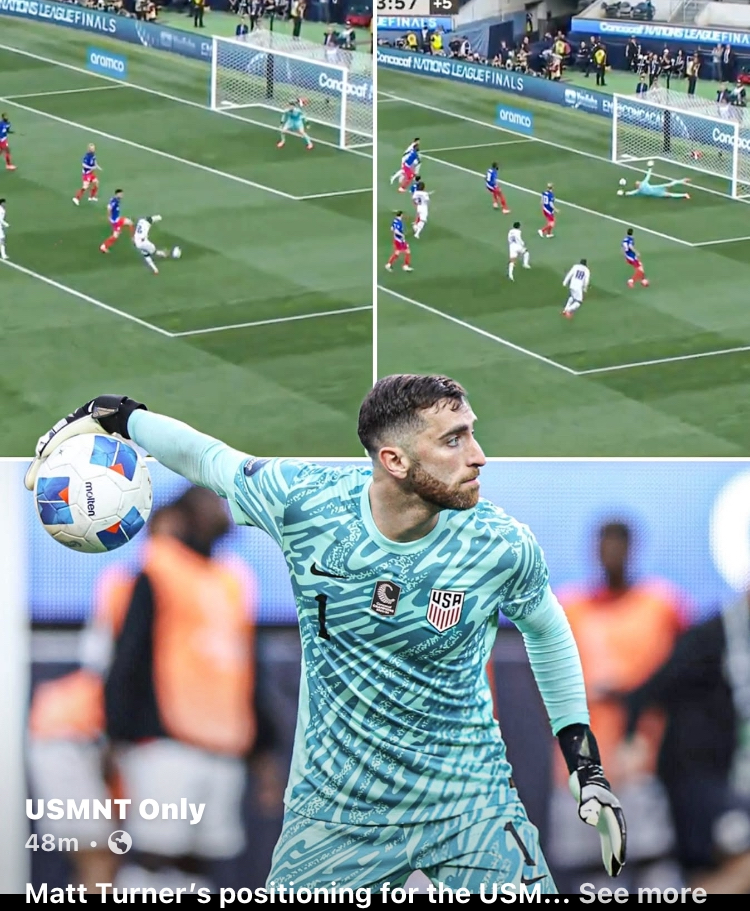
Zack Steffen appears to be a clear choice in goal, given Matt Turner‘s suspect positioning on Cecilio Waterman‘s game winner, when he was shaded too close to his near post. Reyna or Luna in taking Tessmann’s place seems another obvious swap. Patrick Agyemang looked active in his 22 minutes against Panama.
At minimum, USMNT fans will want progress. That bar is low after the poor showing against Panama. But with just under 15 months left to the World Cup, the U.S. needs to show signs that it’s moving forward again.
Fighters wanted: USMNT effort called into question after Nations League loss to Panama
After getting easily bounced from the Copa America in the group stage, the USMNT is out of the Nations League in the semifinal with a loss to Panama. Mauricio Pochettino’s hire did not automatically reverse fortunes. Now it’s clear there is a lot of tough work to do with the team.
BY Brian SciarettaPosted March 21, 2025
12:00 PM
LAST SUMMER, US Soccer hired Mauricio Pochettino as head coach and following a poor Copa America showing, it was expected that this would advance the national team to be in its best possible position to compete at the 2026 World Cup, which it will cohost. Now, after an embarrassing 1-0 loss to Panama in California in the semifinal of the Nations League, the team and Pochettino face difficult questions and potentially even more difficult answers. With two straight ugly early eliminations in tournaments it hosted inside of a year, alarm bells should be going off. There is always the temptation to be overly harsh following a loss. This is a team sport and upsets frequently happen. But the bigger problem for the USMNT wasn’t the loss. It was the effort. After the game, the comments from Pochettino were revealing because he wasn’t focused on the loss, but the fact that the U.S team was simply out-worked by a very disciplined and well-coached Panama team that deserved to win. “They were hungry for every ball like it as the last one,” Pochettino said of Panama. “You could feel the difference on the field.” He went on.
“We are the USA, but you cannot win with your shirt. You need to come here and be better and suffer and win the duels and work hard. If not, it’s not going to be enough.”“If you don’t have aggression, it’s impossible,” Pochettino said, “because the opponent knows that we are going to play into the feet. You are going to play safe. You are not going to take risk. If you want to play football, you need to take risks, you need to go forward, you need to win duels, sometimes 50-50.”It’s actually easy to envision a scenario way down the line when we look back on this loss and realize it was a good thing. For a long time, the team’s short falls have been blamed on Gregg Berhalter or the series of interim coaches the team had after the World Cup or after the Copa America. Fans and people in the Federation seem to be under the impression that a good coach was what was separating this team from greatness.But now, there is nowhere for the players to hide. The Federation broke the bank and went through extraordinary measures to hire Pochettino. Instead, we got a performance that was either equal or worse than we have gotten in the past with a number of coaches.This does not absolve Pochettino of blame. Sure, there are questions whether he needed more playmakers in the midfield to connect to the attack. Should he have started Joe Scally on the left side? Should he have started Matt Turner in goal with his lack of playing time. Those are fair questions. But they are a drop in the bucket of the real problem in as to why this team was outworked playing at home against Panama a year out from the World Cup? You can point out the talent on this US team, but talent only matters if you have desire when you step foot on the field to begin with. When you don’t, you get France at the 2010 World Cup. At least now, everyone’s eyes (players, coaches, fans, federation officials) should be wide open to the task at hand. The team is much further behind than many expected, maybe even Pochettino himself.
When he was hired, Pochettino spoke about when he played for Argentina. He emphasized that there was no difference between playing for his country in a friendly or in a World Cup – there was always maximum desperation for the shirt. He gave the impression that it was very important to him and, more importantly, it was instinctive to the Argentinian players. The loss against Panama revealed that the US team is missing some very basic requirements Pochettino demands or expects from his teams. There is a lot to break down from this game.
Specifics of the game
The specifics of this game are not nearly as significant as the big picture problems, but they are worth discussing nonetheless because there were some serious tactical problems.The most obvious tactical mistakes was that there was no link between the midfield and the offense. The from line of Christian Pulisic, Josh Sargent, and Tim Weah were all poor. Despite it having been a front line that has played together for years, including at a World Cup, there was nothing going on with them. Sargent was a bit unlucky and was starved for service (8 touches over 68 minutes and 2 completed passes) but Weah and Pulisic were very ineffective. 
Weston McKennie had a decent moment when he set up Sargent in the first half for a shot off the post. Aside from that, McKinney struggled to be that link on a consistent basis.Scally and Musah were the outside backs and were tasked with pressing forward, but the opportunities with them were few and far between.There is some talk about the players who were not here or did not get off the bench. It is fair to note that the US team was missing some key players such as Sergino Dest, Ricardo Pepi, and Antonee Robinson. But any talk of them missing this game is to ignore the bigger problems. The US team had more than enough talent to win this game, and they were outworked across the board.
Now what?
After the team departs from camp next week, there is rightfully going to be a lot of talk about how this team will use this experience as a learning lesson for the future. Pochettino is going to have to strike a fine balance between not blowing everything up, but making a significant number of changes. The challenge Pochettino faces is that you cannot coach desire or passion – that needs to be instinctive for players upon arrival in camp. What is perhaps most disappointing for fans is that after the loss to Panama, Pachino said he wanted to make such passion and hard work part of the US teams DNA. But anyone who has followed this program for a long time will tell you that it used to be the team’s leading hallmark. In the years just before and just after the millennium, that was a key reason how they used to beat teams that were considered superior. It is how they advanced to the quarterfinal of the 2002 World Cup. It’s not that Pochettino has to make this part of the team’s DNA, it’s that it has been lost and he has to reinstall it.
Starting this summer, Pochettino will need to make changes and he will need to hold some of these players accountable. It begins with scouting the entire player pool, both domestically and abroad.
There needs to be fewer lock starters and more of a need for the players to feel they need to continuously prove themselves in order to justify their selection to the team. This summer will be revealing in how Pochettino, after he has time to digest the March disappointment, how he makes changes. It would be very surprising if he makes only limited changes.
The USMNT has the same problems now that it did under Gregg Berhalter and Pochettino’s mere arrival didn’t automatically improve things. He is going to have to take active measures.
Once Pochettino can find players he trusts, then he rectify the tactical shortcomings we saw against Panama – such has better fullback setups, having a true attacking midfielders to bridge the gap between possession and chance creations. But many problems needs to be addressed before he gets to that point.
Third Place Game awaits
Before the players return to their clubs, the USMNT must play the third place game against Canada. It’s a game where participation offers only insult to injury. For Pochettino, this could very well serve as an important test and evaluation tool for players?
Any player wants to get called up for big and prestigious games, but who wants to play in a game that anything but important? The players who do could be the players that Pochettino wants in the future.
Expect Pochettino to make a lot of changes to the starting XI. He should give other players the opportunity to show what they could do. Fortunately for the USMNT, they will be playing a Canadian team that should be motivated to face the USMNT. Canada sees the USMNT as an important measuring stick and there is a growing rivalry between the two neighboring nations. Canada’s American head coach Jesse Marsch would love to kick the USMNT while it is down.
The USMNT needs a test when it is at a low point. A loss to Canada with a poor effort would be a morale killer with just 15 months to go until the World Cup. It should be a gut check moment and you can learn a lot about a team and its players at its low points just as much as the high points.
Same Berhalter-era USMNT woes linger under Pochettino in Nations League debacle

By Paul Tenorio arch 21, 2025
INGLEWOOD, Calif. — Two hundred and sixty-two days had passed since the last time the U.S. men’s national team players walked disappointed off of the field after a premature exit from an international ournament on home soil. Four hundred and forty-nine days remain for them to figure out why — and fix it. The USMNT’s stunning 1-0 loss to Panama on Thursday night felt like familiar territory for anyone who has followed this team over the last six years. The U.S. changed coaches after falling in the group stage of the Copa América last summer. Gregg Berhalter was out. Mauricio Pochettino was in. The players, though, remained largely the same. And some of the problems this U.S. team displayed under Berhalter remained the same.It was, perhaps, the biggest benefit of hiring Pochettino, one of the highest-profile coaches in the world, who arrived in the U.S. with a reputation for winning in Europe and coaching some of the world’s biggest clubs and players. The attention, and some of the blame, would have to start shifting onto a player pool whose reputation had been built up but now had to start delivering.The loss to Panama, the same team that sent the U.S. on its way to Copa elimination in Atlanta last summer, had some of the hallmarks and warning signs we have long seen from this team. The players struggle to break down organized teams that play in a low block. They sometimes fail to meet the moment emotionally. They too often lack a killer instinct.Pochettino’s press conference after the loss hit on all of those ideas.
“Did we control the game? Yes. Did we dominate the game? Yes. Did we play in the opposition half? Yes. Did we create some strategy to move the ball quickly and (have) good positional game in the opposite half? Yes. But you need aggression,” Pochettino said. “If you don’t have aggression, it’s impossible. Because the opponent always knows we are going to play into the feet. You are going to play safe. You are not going to take risks. If you want to play football, you need to take risks. You need to go forward. You need to win duels. Sometimes, 50-50, the ball, that is my ball. ….“We need to find a way to compete better. And that’s it. I don’t (want to say) I like this (loss), no. But it’s (worth paying) attention, because, OK, we are (the) USA, but you can’t win with your shirt. Or you cannot win if you play here (at a big club), there, or, I don’t know. You need to show (it). And you need to come here and be better and suffer and win the duels and work hard. If not, it’s not going to be enough.”
It was a stern warning for players with 15 months left until the biggest possible spotlight is on them at a home World Cup. A tournament they’ll open in this same stadium.The Americans had won several trophies in Concacaf in spite of those flaws. They took home all three previous versions of this Nations League tournament. They had a Gold Cup trophy, too. But after losing to the Netherlands in the group stage in Qatar in 2022, the U.S. didn’t seem to be growing. In the end, the federation made a coaching change to address those issues. In his first true test, though, Pochettino failed to equal what his predecessor – and even an interim stopgap – had accomplished.
 USMNT manager Mauricio Pochettino endures defeat to Panama in the Concacaf Nations League. (Gary A. Vasquez/Imagn Images)
If the Copa América wasn’t a wake up call on its own, then perhaps this was an even bigger warning shot. Changing the coach isn’t going to fix things on its own. Something else has to change.The U.S. started slowly in the first half. There was an overall lack of energy, and it hardly created much in the way of chances. The second half was slightly better. Second-half substitute Patrick Agyemang had two good looks at goal. But something was missing – bite and aggression. The U.S. didn’t seem ready to assert itself as the better team.“It was a perfect opportunity to start that rebuilding process right now,” U.S. midfielder Tyler Adams said. “It’s a bit disappointing in my eyes. I don’t know what we lacked exactly, whether it was that competitive nature, that mentality, but we need to look in the mirror before anything and just realize that when we have these types of games, we can’t wait for something to happen. We need to make things happen, put games on our terms.”Pochettino said this week that he preferred to learn lessons from winning games, but that sometimes the best lessons come in losses. Wins can allow you to paper over flaws. Losses fully expose those issues. They force you, as Adams said, to look in the mirror. Sometimes, they can be a turning point.This U.S. team learned a similar lesson early in the last World Cup cycle. They went on the road to Canada in a Nations League game in 2019 and lost, 2-0, in Toronto. A month later, the U.S. rocked their northern neighbor in the return leg, 4-1. They did so in part because of how they rebuilt the team’s mentality after the loss.“I think the message from that point on was intensity is the starting point,” former U.S. midfielder Sebastian Lletget said of the loss in Canada at the time. “We took a lot of pride in how we wanted to play and how we wanted to do things attacking wise — we felt like we had all the structure all down, but I think the mentality, I think that’s where we were lacking on that day. I think Canada sort of opened up our eyes to that.”Sound familiar?That loss in Toronto pushed the U.S. to a higher level. It showed that international soccer was as much about intensity as it was tactics, that talent or potential wasn’t enough on its own.On Thursday, Panama reminded the U.S. of that.Maybe, in the end, it will be a good thing. The U.S. must find a way to make it a turning point, rather than the continuation of a backslide.
Thierry Henry swarmed by epic Panama celebration as USMNT knocked out of Nations League finals
Cecilio Waterman struck the only goal of Thursday’s first semifinal deep into injury time then ran straight toward Henry.
(Top photo: Jayne Kamin-Oncea/Imagn Images)
The defensive breakdown that doomed the USMNT to defeat against Panama

By Jeff Rueter March 21, 2025
Whenever you watch a game with a group and a commentator claims that a player “wanted it more,” you’re bound to hear a few scoffs.It’s a tried-and-true axiom rolled into a Bull Durham quote. In theory, every player at a sport’s highest level wants to succeed. If one player rises above an opponent to win an aerial duel, they may be able to credit their jumping reach, their strength, their reflexive timing or their raw height before even considering their intrinsic desire.And yet, rare occasions present themselves where passion and drive are at a perceived imbalance akin to a possession battle. Take, for example, Thursday night’s Concacaf Nations League semifinal between Panama and the United States men’s national team. The game was teeming with tension, as the USMNT hoped to exorcise its demons and avenge last summer’s defeat to their regional rival in the Copa América group stage.In the wake of that match, U.S. Soccer’s brass made an expensive bet that hiring Mauricio Pochettino to replace Gregg Berhalter would help get the program back on track to win such contests. The players on the field promised they’d “learn from it” and be better prepared, against Panama and other teams defending grittily in a low block.And yet, 266 days after that shocking defeat in Atlanta, the decisive moment for Panama sure seemed to embody that old cliché: Los Canaleros sure seemed to want it more.
Pochettino was the most obvious change from last summer’s sinking, but Thursday’s lineup presented a few more alterations.
First was the team’s shape, with the USMNT lining up in a 3-4-3 with a midfield box, rather than Berhalter’s preferred base 4-3-3. The emphasis was to retain possession in the middle against Panama’s usual 5-4-1 shape, ceding the wide areas as Tim Weah was asked to patrol in the left half-space.
Another was the personnel. Still without Sergiño Dest as he works back from his torn anterior cruciate ligament, the team saw its other first-choice full back — Fulham ace Antonee Robinson — exit camp before the Panama match with an undisclosed ailment. While Joe Scally struggled throughout his three Copa América games, Pochettino asked him to deputize for Robinson on the left.
It’s a spot Scally has played before, but seldom does these days; only 179 of his 2,017 Bundesliga minutes this year have come there, with the rest spent at right back. Unfortunately, the Borussia Mönchengladbach defender was exploited in the decisive sequence.
Advertisement
The sequence begins with Christian Pulisic winning a header at the edge of the midfield third, hoping to head it down to Jack McGlynn. The ball takes a hop a yard in front of the Houston Dynamo midfielder, leaving him to swing a leg at it in vain.
Instead, it trickles towards Panama forward Cecilio Waterman. Four USMNT players immediately converge, desperate to force the ball off the striker’s foot and back into their own possession. Mark McKenzie unsettles Waterman, who prods the ball back into open terrain rather than ceding to his opponent.

Waterman’s poke rolls right into a patch with an amount of weight that puts the nearby United States players in a precarious spot. Most opt not to leave their posts, watching the loose ball as they follow conservative instincts and don’t open passing lanes. Ultimately, Scally stops his run toward the box and turns, but is beaten to it by one of the game’s final inclusions. Janpol Morales, a 26-year-old winger playing in Ecuador who debuted for Panama this month, is quicker to it and scampers to collect the ball in front of Scally. With one of his mere two pass attempts on the night, Morales gets the ball to his team’s chief string-puller, Adalberto ‘Coco’ Carrasquilla.

The standstill nature of the United States’ defending doesn’t just allow Morales to make a decisive impact. It also leaves Carrasquilla with ample time to survey his options as the game enters its final minute, allowing Waterman to leave the scene of McKenzie’s convergence almost entirely undetected, especially once Scally commits to chase the ball alongside Morales.
Even after Scally has fully committed to Morales’ run, Tim Ream fails to stick with Waterman as he backsteps toward the corner of the box. Usually, this is where Ream would expect to find Robinson, his long-time starting team-mate for the USMNT and Fulham. With Scally already playing out of position and now drawn into the heart of the park, Waterman is some distance from his nearest defender with the game on the line.

Carrasquilla might be surprised by how open Waterman is, as the midfielder decides to recollect his initial windup to ensure he gets the weight right on his pass. That proved wise, as Waterman struggled to trap the ball — although it only served to give his shot some additional momentum given the total lack of defenders nearby.
Advertisement
Waterman’s shot comes in with considerable power and expert angling, spotting goalkeeper Matt Turner hugging his near post and instead opting to send it across goal. Turner’s lack of recent match involvement is perhaps relevant here, given his conservative positioning and inability to force a difficult shooting angle once Carrasquilla had readied his eventual assist.

This was just Panama’s third shot of the match, and its first on frame. Nevertheless, miscommunication, a second-rate effort to collect a loose ball and some tired legs gave Panama all it needed to beat the USMNT in another cagey matchup.
As the Panama players rushed CBS pundit Thierry Henry to celebrate, the United States was left to appreciate the scale of this fresh failure.
Throughout the broadcast, commentators Chris Wittyngham and Tony Meola highlighted this Panama squad’s lack of experience at the highest levels of club soccer. At one point, Wittyngham cited some recent history as defender César Blackman became the first Panamanian to play in a UEFA Champions League game — although it was immediately hedged that his team, Slovan Bratislava, finished second-bottom of the league-phase table.
When compared to the over half-dozen Americans whose teams advanced to the Champions League playoff round, it seemed to suggest a talent imbalance. Of course, that only gets a national team so far.
 Pochettino’s gameplan was not enough to overcome Panama’s energy and spirit. (Robin Alam / ISI Photos/Getty Images)
A year ago, there were excuses: playing a man down, alleged second-cycle syndrome causing a downturn in form under Berhalter, and an uncalled foul forcing Turner to exit at halftime.
On Thursday, all three of those factors were answered in full. At few points in the preceding 93 minutes did the hosts play with the confidence and explosiveness that should accompany a tournament’s three-time defending champion. There was little evidence that taking orders from Pochettino helped them improve after the “lessons learned” under Berhalter.
Advertisement
Handed a fresh opportunity to rectify one of the program’s worst results in recent memory, the team instead one-upped that showing with an even poorer showing. Only they can know whether they had wanted to succeed enough in this window. Still in the wake of last summer’s debacle in the Copa América, however, it’s a group running out of opportunities to provide reasons for optimism heading into a World Cup on home soil.
(Top photo: Robin Alam/ISI Photos/Getty Images)
USMNT coach Mauricio Pochettino not to blame for Nations League exit, Tyler Adams says

By Felipe Cardenas March 21, 2025
INGLEWOOD, Calif. — Tyler Adams refused to blame head coach Mauricio Pochettino for the United States’ devastating 1-0 loss to Panama on Thursday as the squad came to terms with its sudden exit from Concacaf Nations League contention.“I’ve never blamed a coach in my entire career,” midfielder Adams said emphatically after Cecilio Waterman’s injury-time winner spurred Panama to a victory at SoFi Stadium. “I mean, the losses depend on the players unless you go out and try something completely random. … There was not a lack of communication after today. We knew exactly what we needed to do. We knew we needed to be competitive. I don’t think we were as competitive as we needed to be.”The USMNT’s exit dealt a massive blow to Pochettino’s feel-good process heading toward the 2026 World Cup. It will now face Canada in Sunday’s third-place game. The Argentine manager told reporters that the Panamanians were hungrier. At the international level, the consequences are dire.“We feel very disappointed because the way we approached the game wasn’t the right way,” he said. “In the first half, we were too comfortable on the pitch. We didn’t show aggression with the ball. We also didn’t show aggression in a defensive way. The first half was very painful to see.“This is not the way that we want to build this journey together. And moving forward, with the objective to play in the World Cup, the objective is to be competitive by seeing that this — it’s a good point to pay attention to — that this is not enough.”The Americans were sleepwalking in a poorly attended semifinal. Their lack of urgency was evident from the start, and despite perking in the second half and attacking with more purpose, Pochettino’s side always looked more timid. Panama relied on hard tackling and a commitment to defending in the low block and making the field as narrow as possible.
 Weston McKennie claimed the USMNT needed more “nastiness” against Panama. (Robin Alam / ISI Photos / Getty Images)
“Knowing him, he brings a bit of that South American vibe into the group and that grittiness and makes it known to us that football isn’t always about being beautiful,” midfielder Weston McKennie said of Pochettino. “It’s always also about the grit, the desire, the nastiness that you put into the game, as well. … So I think it’s about time that our team starts doing that also.”Pochettino refused to blame the tame crowd atmosphere for the lackadaisical effort by his players. For a former player who was known as a cutthroat defender, he was perplexed by his players’ disappointing effort.“(The crowd) cannot be an excuse just because you didn’t have a full stadium with your fans,” he said. “Why weren’t we more aggressive? I think the analysis is simple. If we look at the duels won, it’s clear that we lost those to Panama. When the game is played in tight spaces, when winning duels is important, where recovering possession means you’re in a one-versus-one situation and you’re disorganizing the opponent, when possession is won consistently in the final third, that’s always going to favor a team as organized as Panama. And when you don’t show the best version of yourself, things get complicated.“Every single (duel) was the last one for every single player for Panama. We felt that from the touchline. We’re the USA, but we cannot win just because of the shirt.”
 Thursday’s defeat rekindled memories of the Copa América defeat to Panama that ultimately sealed Gregg Berhalter’s fate. (Hector Vivas / Getty Images)
This isn’t a new problem for the USMNT. There were multiple occasions under former head coach Gregg Berhalter when a lack of steel and grit led to subpar performances. Pochettino’s assessment now places the spotlight directly on a group of players who are less than 15 months from taking part in a home World Cup.“It’s disappointing, of course,” winger Christian Pulisic said. “We obviously had the ball most of the game, but we just couldn’t create enough. We weren’t dangerous enough. And yeah, you know, they got one shot at the end, and that was the story.”Panama defeated the U.S. in a penalty shootout in the 2023 Gold Cup semifinals. The Central Americans then recorded a shock win over Berhalter’s side at the Copa América last summer. The defeat in Los Angeles on Thursday marked the third straight loss to Panama in a competitive match. Pochettino won his debut as U.S. head coach over Panama in a friendly last October.When a reporter reminded Pulisic of those facts, the AC Milan winger responded: “What do you want me to say? It’s tough. It’s tough. We want to win.” (Top photo of Tyler Adams: Robin Alam / ISI Photos / Getty Images)
Panama deals USMNT another deflating, exposing defeat in Nations League stunner

By Paul Tenorio arch 20, 2025
The goal came seemingly out of nowhere.The U.S. had actually shown a bit of life in what had been a mostly lifeless Concacaf Nations League semifinal. Patrick Agyemang, the substitute forward, had a couple of good looks at goal. Weston McKennie had just unleashed a shot from the top of the box.But Panama, which had been so disciplined defensively, pushed the ball down the field in stoppage time. On the counter, the ball found its way to the right side of the box to Panamanian forward Cecilio Waterman. He took control and picked out the far post, beating the outstretched hand of Matt Turner in the 94th minute.Waterman ripped off his shirt, jumped the boards and stood in front of Thierry Henry, pointing and screaming, “Eres mi idolo,” — “You are my idol” — into the face of the legendary French forward and CBS pundit before hugging him.A few minutes later the final whistle sounded, and just like that, the three-time defending Concacaf Nations League champions were dethroned. Panama had downed the U.S., 1-0, and secured a place in Sunday’s final against either Mexico or Canada.It was a second consecutive massive disappointment in international competition for the USMNT, which was knocked out of the Copa América last year in the group stage. Once again, Panama played a feature role in the exit. After coming up empty on his first real chance at a trophy as U.S. coach, Mauricio Pochettino now will be left to figure out a tough defeat.And instead of playing for a fourth straight title, the U.S. will play in a third-place game.“This is embarrassing,” legendary U.S. forward Clint Dempsey said in his postmatch comments on CBS’s broadcast. “You look at Copa América — hosting the tournament and not getting out of the group, and now look at this situation here on home soil, have an opportunity to win your fourth Concacaf Nations League — and Panama does it again. They are our bogey team. We weren’t good enough. We had four great chances. Of those chances you think we’d score at least one or two of those. We weren’t able to get it done tonight and it’s an embarrassment.”With just over one year left until it cohosts the 2026 World Cup, the U.S. clearly has much left to sort.Beyond the defeat, here are a couple of other thoughts on the result:
Crowd disappoints
The U.S. kicked off at 4 p.m. on a Thursday in Los Angeles. It was the start of March Madness as the NCAA tournament tipped off. Tickets were sold for the doubleheader, which meant anyone coming to see Mexico-Canada didn’t need to show up for the first game.Still, it was a bit jarring to see the swaths of open seats at SoFi Stadium at kickoff for the U.S.-Panama semifinal.The U.S. will play two of its three World Cup games at the venue in Inglewood. The hope is that they will draw a huge home crowd. And while Thursday’s crowd is likely no indication of what the World Cup atmosphere will look like, the lack of noise and excitement in the stadium contributed to a game that, at times, felt more like a friendly than it did a competitive fixture.
Robinson’s importance underscored by his absence
When left back Antonee Robinson withdrew from U.S. camp earlier this week with an injury, it was immediately clear that it would have a domino effect for the Americans.Robinson is not just the best left back in the U.S. pool, he is also one of the best players on the team — and there is no clear like-for-like replacement. Pochettino acknowledged as much with his lineup choices on Thursday against Panama. Joe Scally moved from right back to left back to replace Robinson, and Yunus Musah slid from a midfield position to right back for the U.S.Beyond the shuffling that had to occur to fill the hole on the left side, the U.S. clearly lacked the verticality and service that Robinson gives them from the left side. Without his runs on the left side, Tim Weah playing inverted was less effective. The U.S. tilted the attack to the right side through Yunus Musah, but Musah’s strength is carrying the ball forward more than looking for the final pass or cross — he ranks in the 99th percentile in progressive carries per 90 minutes and just the 48th percentile in progressive passes, per FBref.As a result, the U.S. struggled to take advantage of some of the space on the wings as Panama denied space centrally to Pulisic, Weah and McKennie.The U.S. seemed to figure it out a bit more in the second half with Weah staying a bit wider on the left side, but it wasn’t enough to find a goal.(Top photo: Michael Owens/Getty Images)

Matt Turner and the challenge of being first-choice goalkeeper for the USMNT but not his club
19
March 22, 2025Updated 3:41 am EDT
It is so often the way with goalkeepers — 90 minutes of relative inactivity, one big moment, then a whole lot of judgement.
For Matt Turner, that’s what came deep into added time at SoFi Stadium in Los Angeles on Thursday, when Panama took their only shot on target all game — from the right side of the penalty area, drilled to the bottom left corner; Turner, who had taken position to the right of his goal, could not get his gloves to it.
Advertisement
“That ball can’t end up in the back of the net,” lamented former USMNT goalkeeper-turned-pundit Tony Meola.
Then, not long after the end of the home side’s 1-0 loss in that Concacaf Nations League semi-final, criticism of the goalkeeper appeared on social media, alongside stills of the goal questioning his movement.
 Jack McGlynn and Tim Ream are dejected as Panama celebrate their late winner (Robin Alam/ISI Photos/Getty Images)
That the USMNT won’t now win a fourth consecutive Nations League final is not solely down to Turner. Thursday’s defeat was a collective failure.
And although Panama, who also beat the United States 2-1 in a pivotal Copa America group-stage meeting last summer to set up the host nation’s early exit from that tournament, have now become their bogey team, there will be tougher tests on the horizon for Mauricio Pochettino’s side as they build towards the 2026 World Cup, also largely to be played on American soil.
That is where Turner’s status as second-choice for his club — he has made only four starts this season for Crystal Palace, all in the domestic cup competitions rather than the Premier League — but the USMNT’s No 1 for their biggest games will come under further scrutiny.
It’s something he got asked about by reporters in the build-up to Thursday’s match.
“Obviously, my club situation isn’t ideal right now,” said the 30-year-old, who is on a season-long loan at Palace from rival Premier League club Nottingham Forest. “But I’m giving every opportunity that I have to play the utmost importance and trying to put good performances together, just control what I can right now and then let the chips fall where they may.”
Not ideal then, but neither is it unprecedented.
Sergio Romero was Argentina’s first-choice goalkeeper as they got to the final of the 2014 World Cup despite being second-string at Monaco of Ligue 1, the top division of French club football, and continued in his starting role for the national team despite going on to be the backup to David de Gea at Manchester United. Romero later described it as a “difficult situation”.
Former Palace goalkeeper Wayne Hennessey also had spells as No 1 for Wales, despite hardly playing in the Premier League at the back-end of his time at Selhurst Park. Hennessey was then second-choice for Burnley and Forest while still getting games for his country, including at the 2022 World Cup.
 Romero reached the 2014 World Cup final despite being second-choice at his club (Mike Egerton/PA Images via Getty Images)
For the USMNT it is not a new situation, either.
One of Turner’s current understudies, Zack Steffen of MLS side Colorado Rapids, played in the 2021 Nations League finals win against Mexico and in qualifiers for the following year’s World Cup while spending most of his two complete seasons at Manchester City of the Premier League on the bench.
Advertisement
“It’s come full circle,” says Matt Pyzdrowski, a coach and former goalkeeper who played professionally in the U.S. and Sweden, and is now The Athletic’s goalkeeping analyst. “Matt was playing regularly in MLS (for New England Revolution, before a July 2022 move to Europe with Arsenal) and trying to get ahead of Zack, who wasn’t playing as much as he’d like in England. Now they have kind of switched places.”
For large parts of Thursday’s game, Turner was less busy than he had been when playing 45 minutes of Palace’s 1-0 win over Norwegian side Hamarkameratene in a friendly last week.
In that practice game, part of Palace’s warm-weather training camp in Marbella, Spain during a break in their domestic schedule, he made two saves in the second half after replacing first-choice Dean Henderson at the interval. He touched the ball 17 times, only seven fewer times than in the 99 minutes, including added time, against Panama (24).
The questions come from the one decisive moment that did not go his way, meaning the U.S. will not play in Sunday’s final. But despite that setback, Turner has generally played well enough for the national team to retain his place in it, keeping high-profile errors at a bare minimum.
“It’s obviously a problem but, at the moment, I don’t think it’s a big problem because Matt has always performed for the USMNT,” says Pyzdrowski. “That’s the biggest thing you need to consider. If he was making lots of errors and not performing, then of course it would be a more pressing issue. But he has always done pretty well for his country despite not playing regularly at all for his club.”
 Henderson, who is in the current England squad, and Turner warm up for Palace (Sebastian Frej/MB Media/Getty Images)
It remains to be seen whether Turner stays in the team for Sunday’s third-place play-off against Canada.
Patrick Schulte of Columbus Crew was in goal the last time the countries met, a 2-1 win for the Canadians last September in a friendly while the USMNT had Mikey Varas in interim charge. Had it been an important fixture, it is likely Turner would have been in the team that day in Kansas City and not on the bench. That means his performances for the national team are generally buoyed by the feeling of being trusted as a regular, according to Pyzdrowski.
Advertisement
“It doesn’t matter who you are as a player, you just want to feel valued,” he says. “Then you feel more comfortable on the field and it’s important not to overlook it. Matt has built up a lot of credit with the national team.
“In a perfect world, he’d be playing every week, regardless of what that requires — if it’s going back to MLS — because he’d naturally be sharper. But at the moment it hasn’t caused him too many issues.”
Turner has largely been Palace’s cup goalkeeper this season, starting one of the three Carabao Cup matches they played following his late-August arrival and, more significantly, all three FA Cup ties to date. He will hope to retain his place in the quarter-finals on March 29 against USMNT team-mate Antonee Robinson’s Fulham.
The only potential downside to his inactivity in the Premier League, Henderson has been an ever-present for Palace to date and Turner’s last appearance in the competition was for Forest in January last year, is a potential lack of time facing key high-level-game scenarios.
“The biggest issue of not playing regularly is just rustiness,” says Pyzdrowski. “And the relationship with your back line and reading of the play — how deep the balls come, or crosses into the box.
“I wouldn’t say that saving the ball and the speed of the ball is that much of a problem, because you get a lot of that in training. You get a ton of reps (in training) even when you’re on the bench. It’s more situations that can only arise in games.”
Those daily sessions between games are also different as a club’s backup ’keeper, though. “In training, the focus is really on the No 1, so the drills you do are suited to them,” says Pyzdrowski. “A lot of the situations Matt will be in during training won’t be with the guys who play every week (other reserves), so he’s not building those relationships.
“But then that’s the important thing with the national team: that he’s familiar with the setup and the guys there. He built that up over time and really earned his spot.”
 Turner during Thursday’s defeat by Panama (Shaun Clark/ISI Photos/USSF/Getty Images for USSF)
Veteran goalkeeper Andy Lonergan had spells as a backup, and even third-choice, towards the end of his career with top clubs such as Liverpool and Everton. He feels Turner’s extra physical freshness, in contrast to a ’keeper going through the grind of playing every weekend in the Premier League, should actually be a positive.
Advertisement
“He’s fresh for these games, raring to go and experienced,” says the 41-year-old, now a player/coach at Wigan Athletic in League One, the third tier of English football. “I know Dean Kiely, who works with him at Palace and speaks very highly of him and says how good he is in training.
“He’s got hundreds of games behind him and has been at big teams now, so I don’t think he’ll be too concerned about the situation. He has no niggles, no injuries, and he comes to these USMNT camps champing at the bit. When you’re second-choice (at a club) but have something to work towards, like the cup games and then the international games, you have a good focus.
“Ideally you want to play all the time and keep that rhythm because it isn’t easy coming in every six weeks in the cup, and his last international camp was in November. But from his point of view, I don’t think it’ll be an issue.”
Pyzdrowski points out that, in theory at least, playing a Panama team ranked 36th in the world by FIFA (20 places below the United States) can be less taxing on a goalkeeper’s reflexes than a game in the English top flight. “International football is a little different from the Premier League,” he says. “A game against Panama will be different and have perhaps less intensity than a Premier League game, so that will also help him feel his way into it.”
 Lonergan playing for Everton against Western Sydney Wanderers in a 2022 friendly (Brett Hemmings/Getty Images for Bursty)
Like Pyzdrowski, Lonergan’s only concern would be whether players in Turner’s situation can stay sharp for in-game situations.
“Speaking from experience, the only fear when I wasn’t playing (regularly) but was a cup ’keeper with a game in six weeks’ time is that, in training, you’re doing small-side games so your reactions are bang-on,” he says. “But it’s your distances with the back four, balls over the top and through balls where you could be a little bit out of sync.
“That was always my concern, because training and 11-a-side on full pitches are different. In training, you’re on autopilot, flying around, but in games those decisions are vital.
Advertisement
“Through balls, distances and balls over the top are the hardest to practice as a ’keeper. You can do it in training but there are no consequences, whereas in a match if you decide to come (for a ball) and don’t get there, you’re in trouble. In training, you can keep doing it until you get it right.”
With the World Cup 15 months away, it could be that Turner — who made only seven appearances in his year with Arsenal before joining Forest, where he made 17 league starts last season — looks for a new team where he is more likely to be first choice. His loan at Palace expires in June and he has another two years to go on his contract with Forest, where Belgium international Matz Sels has established himself as a key player in goal as they make a surprise push for Champions League qualification.
“It’s not an unworkable situation as it is,” adds Pyzdrowski, who recently started a new role coaching the goalkeepers at Swedish top-flight side Malmo. “But the challenge it creates is because the goalkeeping position is so delicate, with so many small details. You really can only work on a lot of them in games.
“Goalkeeper training has evolved a lot in the last 10 years, in terms of the different repetitions and exercises you do compared to just lots of shots and volleys.
 Turner catches a cross during Palace’s recent FA Cup win against Millwall (Rob Newell – CameraSport via Getty Images)
“Now it’s more match relevant, but even if you have one or two goalkeeper coaches and they’re taking shots at you, it’s not the same as a top-class striker coming at you, with the speed and accuracy. Yes, you’ll do some exercises with the team, but training just isn’t built around the number two or number three.
“You’re important and you have a role, but the coach needs guys on the team (the starters) working together to build those relationships.”
With the national team, those bonds seem as strong as ever. But to face the game’s very best at a World Cup just over a year away, Turner may decide he needs to increase his weekly workload.
Panama defeat conjures memories of USMNT’s most devastating losses

By Pablo Maurer 0March 22, 2025 8:00 am EDT
The U.S. men’s national team’s 1-0 loss to Panama in the Concacaf Nations League semifinals was unquestionably a humiliating one. The USMNT, replete with stars playing abroad and coached by the reputable Mauricio Pochettino, looked listless against the Panamanians. Despite the fact that Panama has now beaten the Americans three times in the last 20 months, the result still felt like a gut-punch to the U.S. – the program and its fans.
Advertisement
Not that many of them watched the match in person. Just before the anthems on Thursday, U.S. star Christian Pulisic was spotted grimacing at the large swaths of empty seats around SoFi Stadium. The dour atmosphere – it didn’t help that it was a 4 p.m. local time kickoff outside Los Angeles – only added to the heartburn surrounding the result. A significantly larger crowd turned up for the second match of the day, between Mexico and Canada.
Pochettino spent much of the run-up to the game doing media, offering bold predictions that the USMNT were real contenders to win the World Cup in 2026, which is a little over a year away. In other interviews, he spoke of returning to the EPL some day and yearned for a conversation with U.S. President Donald Trump. The Argentine is charming, for certain, but his guile will mean nothing if he can’t accomplish his stated goals. He was brought in in large part to motivate this “golden generation” of U.S. players, but very few of them looked committed or golden on Thursday night.
The loss is unquestionably the poorest result of Pochettino’s seven-match tenure to date, and the U.S. still has a chance to save a bit of face against Canada in the third-place game. A loss in that match, which certainly feels possible, would only add to the misery surrounding the USMNT’s recent performances, and with time running short when it comes to galvanizing the country around the sport and program, results like Thursday’s come with some added layers.
Perspective is important, though, and even a fourth-place finish in a Concacaf Nations League wouldn’t hold a candle to some of the U.S. men’s most devastating previous failures, ones that had massive consequences. If you’re the kind of fan that likes to lean into your grief, then keep reading.
Costa Rica 1, USMNT 0; May 31, 1985
By the time the USMNT’s final qualifier of the 1986 World Cup cycle rolled around, the whole of American soccer was in a tailspin. The North American Soccer League (NASL) — the first real, top-flight league in U.S. history — had closed up shop permanently just two months earlier. The national team was largely made up of players from the Major Indoor Soccer League, and they rarely played the outdoor game, outside of national team call-ups. Some team members even played in semi-professional leagues and held part-time jobs.
Advertisement
Mexico, the dominant team in the region for decades, had already qualified for the 1986 World Cup as the host nation. In an era where only two teams from Concacaf qualified, the USMNT was looked upon as a favorite to advance. It needed only a draw against Costa Rica to advance to the next round of qualifying and take a step closer to a first World Cup berth since 1950.
The NASL’s collapse and public apathy toward the sport put the U.S. Soccer Federation in a bind and made ticket sales an essential revenue stream. Consequential matches in the U.S, even World Cup qualifiers, frequently felt like away games, with crowds full of immigrants from Latin American countries. Such was the case against Costa Rica.
“There was an agent that represented some of the (Costa Rican) players,” remembered USMNT’s Perry Van der Beck. “The federation sold this game to him. The stadium was just full of Costa Ricans — the halftime show, even, was just full of Costa Rican music, all aimed at the Costa Rican fans.”
The U.S. was led by head coach Alkis Panagoulias. Born in Greece, Panagoulias was a “token offering,” remembers former USMNT defender Alan Merrick, “who truly believed that the so-called ‘American spirit’ would carry us alone.” He was short of technical acumen and long on inspirational quotes.
“In this country, somewhere out there, maybe in Harlem or Los Angeles, there is the next Pelé,” Panagoulias once said. “And not just one — maybe 20 or 30.”
None of them was present against Costa Rica. The U.S. had the lion’s share of possession that day and played a bright opening half hour, yet the Costa Ricans pulled ahead on a lucky strike. USMNT forward Ricky Davis, along with fellow upstart Hugo Pérez, had a half-dozen decent chances for the U.S., all of which missed the mark.
Then, in the 73rd minute, a ray of hope: Defender Dan Canter fired in a shot that appeared to go in. The referee signaled for a goal, which was later waved off. It had hit the side netting, and 20 minutes later, the match ended. So did the U.S.’s hopes of qualification.

“I don’t know where we go from there,” Davis told reporters after the match. “There was our best chance to make it to the World Cup. We won’t have another chance until 1990. Who knows where soccer in America will be by then?”
The defeat is among the darkest moments in U.S. soccer history, but it also marks a beginning. Panagoulias and a host of players would be shown the door, replaced by a generation of talent that would eventually lead the U.S. to its first World Cup qualification in 40 years.
Among the only players to survive that transition was Paul Caligiuri. Not only did the USMNT legend take place in one of the program’s darkest moments, he scored the famed “shot heard ‘round the world” against Trinidad and Tobago that qualified the U.S. for the 1990 World Cup in Italy.
Iran 2, USMNT 1; June 21, 1998
The USMNT entered the 1998 World Cup in France riding a wave of hype. It followed a respectable showing at the 1994 World Cup on home soil with a series of wonderful results: a shocking run to the semifinals of the 1995 Copa America, the country’s first (and still only) victory over Brazil a few years later and a host of other respectable encounters against legitimately good teams across the globe.
Advertisement
Under the surface, though, cracks had begun to show. Some of the squad’s veterans, many of whom were part of the ‘94 cycle, had butted heads with head coach Steve Sampson over roster decisions and their dwindling roles. Sampson added fuel to the fire when he brought in a series of foreign-born players, much to the chagrin of the team’s veterans.
And infamously, Sampson excluded U.S. legend John Harkes from the final roster after learning that Harkes had been engaged in an affair with the wife of teammate Eric Wynalda. A difficult draw made the U.S.’s task in 1998 even more difficult, and after losing the opening match to Germany and with Yugoslavia looming, the USMNT’s second match against Iran became a must-win.
The game was framed by decades-old turmoil between Iran and the United States, and as matchday approached, things grew tense. SWAT teams and snipers were present in the stadium and FIFA had mandated strict protocols for how both teams interacted before the match. The U.S. and Iran, seeking to make a statement, took a team photograph together, with the Iranians presenting the U.S. players with white flowers.
 USMNT and Iran pose together at the 1998 World Cup. (Photo by Nader Davoodi ATPImages/Getty Images)
For his part, Sampson made a half-dozen changes to his starting XI from the Germany loss and altered his formation, as well. The U.S. started the game on the front foot, nearly pulling ahead on a Brian McBride header, which hit the post. But the Iranians were opportunistic, and they grabbed a pair of goals on the counterattack. The 2-1 loss, combined with other results, eliminated the USMNT from the World Cup after two games.
The writing was on the wall for Sampson, who’d be dismissed not long after the tournament’s conclusion. Many of the club’s senior players, most notably veteran defender Alexi Lalas, sealed Sampson’s fate by publicly criticizing him in the press. The 1998 debacle marked the end of an era for U.S. Soccer, with many of the team’s highest-profile players, those who’d taken part in the 1994 World Cup, moving on for good.
Czech Republic 3, USMNT 0; June 12, 2006
It’s nearly impossible to overstate the hype surrounding the USMNT in the run-up to the 2006 World Cup. The U.S. had shocked the world with a deep run in 2002 and stormed through qualifying for the ‘06 tournament, booking a ticket to Germany with three matches remaining. The U.S. roster was a who’s who of American soccer royalty, maybe the most talented collection of American players ever sent to a World Cup.
The qualifying run had pushed the U.S. up to fifth in FIFA’s (deeply flawed) world ranking, which was uncharted territory for the lowly Americans. They’d done something even more improbable — cracked the consciousness of the general public in the U.S., the most elusive of challenges in American soccer. U.S. Soccer and Nike only intensified the buzz, plastering the team all over American airwaves and even deputizing one of the team’s young stars, Clint Dempsey, as U.S. Soccer’s official rapper.
Advertisement
Even a truly difficult draw couldn’t dampen the spirits of the American faithful. Italy and Ghana were both respectable opponents but both seemed beatable. Rounding out the U.S. group was the Czech Republic, then one of the best teams in the world.
Any and all hype surrounding the U.S. evaporated within moments of their group stage opener against the Czechs. It was not the first time the two countries had met in a World Cup. In 1990, the U.S. played their first World Cup match in 40 years against what was then called Czechoslovakia, losing in a 5-1 bloodbath. Many considered it a miracle the U.S. had even qualified for that tournament and few paid the result any mind. Even fewer considered it any form of a humiliation.
But 2006 was a different story. The U.S. was comprehensively dismantled by a Czech side featuring names like Jan Koller, Petr Čech and Tomáš Rosický. After their showing at the ‘02 World Cup and despite the hype surrounding the squad, the USMNT managed just one shot in the drubbing.
An Associated Press match report said the U.S. looked like “a bewildered World Cup newcomer again,” and the result in the opener proved too much to overcome. The USMNT managed just a single goal in the tournament and was sent packing — along with the Czech Republic, the other casualty of the group of death.What You Should Read NextHow Clint Dempsey’s childhood in Nacogdoches inspired the USMNT’s 2006 hype video ‘Don’t Tread’Dempsey still has a soft spot for the song, as do many soccer fans in this country.
USMNT 1, Mexico 2; November 11, 2016
Few words in the language of American soccer carry as much weight as “dos a cero.”
The USMNT’s rivalry with Mexico is the stuff of legend, with the Mexicans holding a historical edge on their northern neighbors. Mexico was essentially unbeatable at the Azteca in Mexico City and El Tri often got the better of the U.S. in the states, as well. It wasn’t until the USMNT started playing matches of consequence against Mexico in Columbus, Ohio, that the U.S. had a true home-field advantage.
For a 15-year stretch, the U.S. were undefeated at Crew Stadium, going 8-0-3 and compiling a 6-0-2 in World Cup qualifiers at the venue. The greatest results came against Mexico. The U.S. won every match they played against the Mexicans by that 2-0, dos-a-cero scoreline during that stretch, creating a deeply important psychological edge that grew with every successive result.
By 2016, the thought that the U.S. would lose a match to Mexico in Columbus — even allow a goal there — felt borderline unthinkable. Yet something felt different ahead of the U.S.’s qualifier against the Mexicans that November, in no small part because of the presidential election only days earlier. Trump’s dangerous rhetoric about Mexican immigrants in the United States forced both teams to put sports aside for the moment. By the time the two sides posed together for a team photo as a sign of unity just before the match, the aura surrounding the match changed. By the end of the game, the mystique of Crew Stadium was gone.
 Rafa Márquez gave Mexico its first World Cup qualifying win in Columbus in 2016. (Paul Vernon/AFP/Getty Images)
Mexican defender Miguel Layún gave El Tri their first goal in Columbus 20 minutes in before the U.S. equalized early in the second half through Bobby Wood. Mexico did not let up, though, and found the winner just a minute from full time. It came courtesy of a glancing header by Rafa Márquez, perhaps the most villainous player in the history of the rivalry to U.S. fans. It felt fitting. Four days later, the U.S. lost 4-0 in Costa Rica, and five days after that, manager Jurgen Klinsmann was fired, with qualification for the 2018 World Cup put in peril.
By the time the 2022 qualification cycle rolled around, Crew Stadium had been replaced with a gleaming new venue. It probably wouldn’t have mattered anyways — the USMNT chose to play their home qualifier against Mexico in Cincinnati instead, leaving Columbus and all of its accompanying magic in the rearview.
Trinidad and Tobago 2, USMNT 1; October 10, 2017
Few U.S. fans had heard of Couva (population 45,000) before the USMNT played a decisive World Cup qualifier there in the fall of 2017. Now, the little town in Trinidad is seared into the collective consciousness of every USMNT fan. The name alone is a trigger word.
It was there that a shocking result eliminated the U.S. from qualification for the 2018 World Cup, ending a stretch during which the U.S. had played in every World Cup since 1990.
The seeds of the defeat in Couva were planted by Klinsmann, who led the USMNT through a miserable qualification cycle. After losing to Mexico and Costa Rica in the opening matches of the final stage of qualification, Klinsmann was sacked and replaced by Bruce Arena.
Arena, by most metrics the most successful coach in USMNT history, set about trying to repair the damage. The U.S. breezed through a few games but stuttered late in the qualification cycle. Even still, it seemed in excellent shape entering the match in Couva, needing just a draw to book a trip to Russia.
Trinidad and Tobago entered the match with little to play for, having already been eliminated. But games between these two opponents are always tinged with that famous 1989 win, the one where Caligiuri put a dagger in the heart of the Caribbean nation. The U.S. did little to help its cause by posting video on social media of the field conditions in Trinidad, a jab many viewed as belittling and insensitive given the resources available to the tiny nation.
In turn, the Soca Warriors came to play. They scored first through an own goal by U.S. defender Omar Gonzalez. Things went from bad to worse after T&T right back Alvin Jones ripped a 35-yard curler by U.S. goalkeeper Tim Howard. Pulisic, then 19, handed his team a lifeline with a goal early in the second half, but the U.S. never found an equalizer. Dempsey, reduced to a substitute, hit the post on the closest call.

Elsewhere in the region, other teams had pulled off their own upsets. Panama and Honduras had beaten Costa Rica and Mexico, respectively. and earned the right to advance. The unthinkable, to many, had happened: the USMNT was eliminated. To this day, the loss remains the worst loss in USMNT history, based on ELO rating.
Arena resigned almost immediately. USMNT fans, who had long grown accustomed to qualifying in every World Cup cycle, called for widespread change. The match marked the end of the line for a generation of U.S. legends — Michael Bradley, Dempsey, Howard and Jozy Altidore among them – and ushered in the new.
(Editor’s note: A portion of this piece was repurposed from a previous Athletic article from this writer detailing past significant USMNT defeats)
(Top photo: Ashley Allen/Getty Images)
 The Ole BallCoach