
Man how lucky am I that I get to be here for these World Cup US Games. I proudly sing our National anthem with 70,000 Americans and players and it tears me up each time kind of like this guy Anthem. This team IS AMERICA (click)- a collection of players from all over this country: NY to California, St Louis to Florida and Texas (McKinney story). Sons of American servicemen who grew up overseas but are as American as us. Must Read story from the New York Times about how this team’s World Cup run is bringing our divided nation together (read below). Man what a time we had in San Fran. San Fran post game – I am going to admit each time we play Country Roads post game I swing and sing with my daughter Courtney and a tear comes to my eyes. To see the success for a team I have rooted for since before 1990 is just incredible and to see our country embrace not only this team but the sport I have loved since I first played as a 7th grader is wonderous (31 Million Watched). I wish my whole family was with us. Next step Seattle – we’ll arrive Sunday for the Monday 8 pm game. Go USA!
USA Beats Bosnia 2-0, Plays Belgium in Seattle Mon 8 pm
Wow! Talk about grit, fight and a never say will to win – this US team has it all. A gutsy 2-0 win over a scrappy, somewhat dirty Bosnia squad that was ready to in a low block (9 behind the ball) to try to frustrate the young US squad. (highlights) The US scored on a lovely Balogun run – only to have his goal called back for offsides. Late in the first half with a spectacular change of pace adjustment by Balogun – the US was on the board. It was a totally dominant first half with 80+ percent possession for the US and only 1 long range shot by Bosnia. The second have brought more ball control for the US before Balogun was sent off for a questionable Red Card play when he accidently stepped on a Bosnian’s foot. (See the arguments below Red Card Yes). The US was back to the wall at the 65 Minute mark, down to 10 men with 30 minutes to play. (In the Copa America 2 summers ago – a red card meant death to the US team as they conceded 2 goals to Panama to become the first home country eliminated in the Group stage ever.) Now 2 years later – with a new established foreign coach in charge – the US did not wilt. They did not even stop trying to score. With Pulisic in the middle, Dest on the left – and Tillman on the right – the US continued to push forward until they won a free kick just outside the box on the left hash mark with 15 to go. Tillman lined up and scored a Golazo (In Spanish), in English, from our seats in that endzone Poch reaction. The 2-0 lead and some controlled defense with Richards, Freeman & Ream refusing to give way – and an entire team willing to sacrifice themselves to protect our goal – and some good saves from our keeper the US held on for the win. Winning their first game over a European foe in almost 5 years, and advancing to the round of 16 for the first time since 2014. Tim Ream postgame reaction. Poch Postgame – why not us!
Again I am going to admit – I WAS WRONG. Pochitino is worth every dime we paid him to put this team into the right state of mind and help our Golden Generation begin to realize their potential. Yes I questioned everything he did in the build up to this cup – and he just said trust me – its a process. Well so far the process is working! Offensively we have been as strong as I can remember in years – combining long spans of ball control with quick strike counterattacks in lightening speed. Balogun has been the #9 we have lacked, scoring 3 goals (6 overall -3 called back on offsides). Pulisic when healthy has had space to take guys on 1 on 1, 1 on 2 and has straight beat them. McKennie & Tillman play like they have known each other forever and Tyler Adams? Well he’s Tyler Adams – one of the top #6/dmids in the EPL when healthy.
GK Matt Freeze (the Harvard man) was finally tested a little vs Bosnia and made the saves he needed to make. He’s going to have to make more saves, including some spectacular ones, vs Belgium if we are going to win. The real question is who is Poch going to bring in for Balogun (who is out on Red Card suspension for this game). I think its Haji Wright finally getting his chance up top. Pepe has played hard and given supreme effort in his appearances – but he simply does not have the speed or knack to run the channels that Balo does. Wright has played with our core of Pulisic, McKinney & Adams since they were 15 years olds on our youth US teams. I think Wright and Pulisic reward Poch’s confidence by both scoring goals in the first half. The 2nd half will have Belgium legend Romeo Lukaku and we better have a lead by then. I think the US holds on 2-1 with more scrappy play – a little more counterattacking as Belgium will probably have 50-50 possession at least. I still think we are a better counter attacking team so that might just play into our hands if Pulisic can work his magic, McKennie can run his butt off again – and Adams can protect our back line. I suspect its another 3/2/3/1.
Here’s my line-up for Monday
Haji Wright
Pulisic/Tillman
Robinson/Adams/Mckinnie/Dest
Ream/Richards/Freeman
Freese
Indy 11 Host Detroit Sat 4 pm @ the Mike
Indy Eleven puts its nine-match home unbeaten streak (8-0-1) in USL Championship play over the past 10 months on the line vs. Charleston Battery in a special 4:00 p.m. kickoff on Sat. July 4 on MyINDY-TV 23 and ESPN+. dThe Boys in Blue are second in the USL-C in home wins (5) and tied for third in home goal differential (+7).
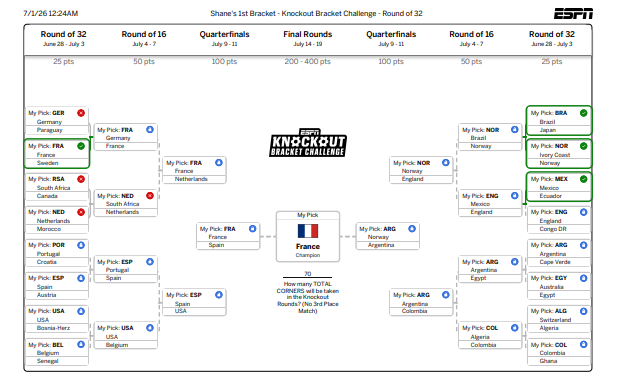
Erling Halland & the Row advancing to the Semi’s for the first time ever. Here’s the current https://www.espn.com/soccer/bracket
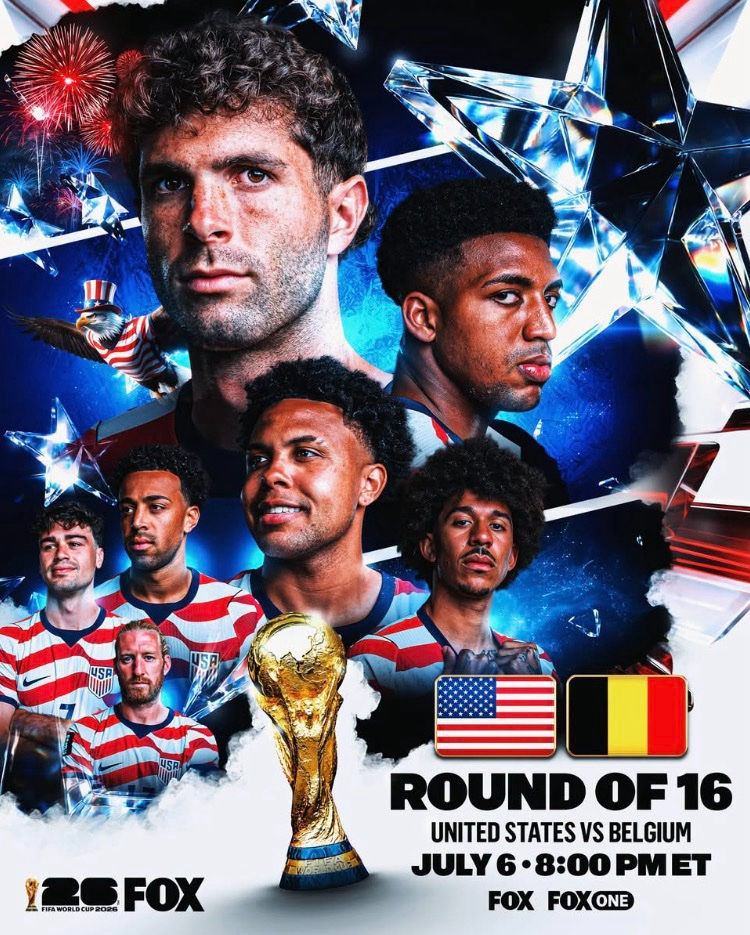
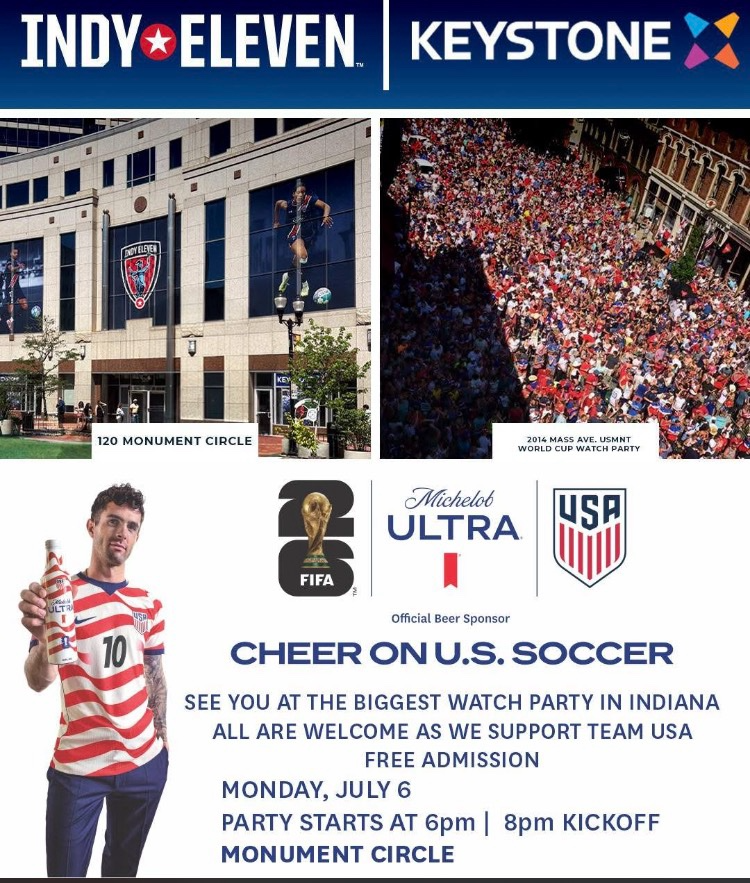
TV Schedule
Friday, July 3rd
2 pm Fox Australia vs Egypt (Salah)
6 pm Fox Argentina (Messi) vs Cape Verde
5 pm Victory Washington Spirit (Rodman) vs Houston NWSL
9:30 pm Fox Colombia vs Ghana
10 pm Prime Angel City vs Orlando Pride NWSL
Saturday, July 4 (Sweet 16)
1 pm Fox Canada (Davies) vs Morocco
5 pm Fox Paraguay vs France (Mbappe)
6:30 pm ION NC Courage vs Seattle Reign (NWSL)
7 pm Myindy Indy 11 vs Charleston Battery
8:45 pm ION San Diego Wave vs Gotham FC
Sun, July 5th (Sweet 16)
12 noon ESPN Boston Legacy vs Bay FC (NWSL)
4 pm Fox Brazil (Neymar) vs Norway (Haaland)
8 pm Fox Mexico vs England (Kane) (Azteca)
Mon, July 6 pm
3 pm Fox Portugal vs Spain (Dallas)
8 pm Fox,Tele USA vs Belgium
Tues, July 7
12 noon Fox Argentina vs Egypt
4 pm Fox Switzerland vs Croatia
Thurs, July 9 Quarter Finals
4 pm Fox
Fri , July 10 Quarter Finals
3 pm Fox USA/Belgium vs Spain/Portugal
8 pm Prime Orlando Pride vs KC Current NWSL
8 pm HBO Max Racing Louisville vs Bay FC NWSL
Sat, July 11 Quarter Finals
5 pm Fox W91 vs W92
6:30 pm Ion NC Courage vs Washington Spirit (Rodman)
7 pm ESPN+ Detroit City vs Indy 11
8 pm Fox W95 vs W96
8:45 pm Ion San Diego Wave vs Angel City (Thompson)
Tues , July 14 Semi – Finals
3 pm Fox Semi 1
Weds , July 15 Semi – Finals
3 pm Fox Semi 2
Sat, July 18
5 pm Fox 3rd place game
Sun, July 19
3 pm Fox WC FINAL
All games on Fox, FS1 & Telemundo
===RackZ BAR BQ ====Save 20% ===
Coming home from Practice or Games at Badger Fieldhouse? Need food for a Graduation, end of school party, World Cup or July 4th party? Call Ryan now to ask about catering options at 317-688-7290. Try out the Best BarBQ in Town right across the street (131st) from Northview Church on the corner of Hazelldell & 131st. RackZ BBQ

Save 20% on your order
(mention the ole ballcoach)
Need some good ole AMERICAN BarBQ for the US games or July 4th? Check out the BarBQ Ribs, pulled Pork and Chicken, Brisket and more. Sweet, Tangy or Spicy sauce. Mention you heard about it from the Ole Ballcoach — and Ryan will give you 20% off your next meal. https://www.rackzbbqindy.com/ Call ahead at 317-688-7290 M-Th 11-8 pm, 11-9 Fri/Sat, 12-8 pm on Sunday. Pick some up after for watch parties – Its good eatin! You won’t be disappointed and tell ’em the Ole Ballcoach Sent You!

======================RackZ BAR BQ ====Save 20% ======================
USA
How will the USMNT cope without suspended star striker Folarin Balogun?
USMNT’s multifaceted win vs. Bosnia-Herzegovina bodes well for World Cup hopes
USMNT shows it can play ugly, which is exactly what it needs to succeed
10-man USA gets Round of 32 win over Bosnia and Herzegovina
Analysis: 10-man USMNT defeats Bosnia & Herzegovina 2-0 to advance
USMNT player ratings: Tillman shines as U.S. books berth in round of 16
USA vs. Bosnia and Herzegovina, 2026 World Cup: Community player ratings
USMNT proves it’s built different with first World Cup knockout win in 24 years
Borden: USMNT shows it can play ugly at this World Cup, which is exactly what it needs to succeed
Balogun suspended for U.S.-Belgium, maybe more
Mauricio Pochettino Becomes Winningest USMNT Manager in FIFA World Cup
USMNT vs. Bosnia and Herzegovina: Match Recap & Highlights
U.S. Men’s National Team to Face Belgium in Round of 16 of FIFA World Cup 2026
U.S. World Cup win sets domestic ratings record
World Cup
Can the U.S. win without Balogun? One big question for every World Cup round-of-16 team
World Cup schedule, results: Egypt-Australia, Argentina-Cape Verde and Colombia-Ghana conclude Round of 32 on Friday
📉 From the World Cup to the dole, managers sacked after exits
Ronaldo nets first knockout goal as Portugal stage late fightback to dump out Croatia
Roberto Martinez describes ‘amazing’ atmosphere in Portugal comeback win over Croatia
Ronaldo pays ‘special’ tribute to Jota after WC win
🎥 From Rosalía to Lamine’s brother, the best of World Cup Thursday 🤣
Who has most goals in World Cup history? Lionel Messi ascends to top spot, Kylian Mbappé closing in
World Cup 2026: Julian Nagelsmann out as Germany manager as Jürgen Klopp emerges as replacement
Julian Nagelsmann resigns as Germany coach with Jurgen Klopp eyed as replacement
Where has Infantino been? FIFA president clocks up 39,000 miles on epic World Cup tour
Have Brazil lost the aura that made them the World Cup’s defining team?
Kane delivers for England at vital moment in dramatic win vs. Congo DR
Messi has another story to tell
Reffing
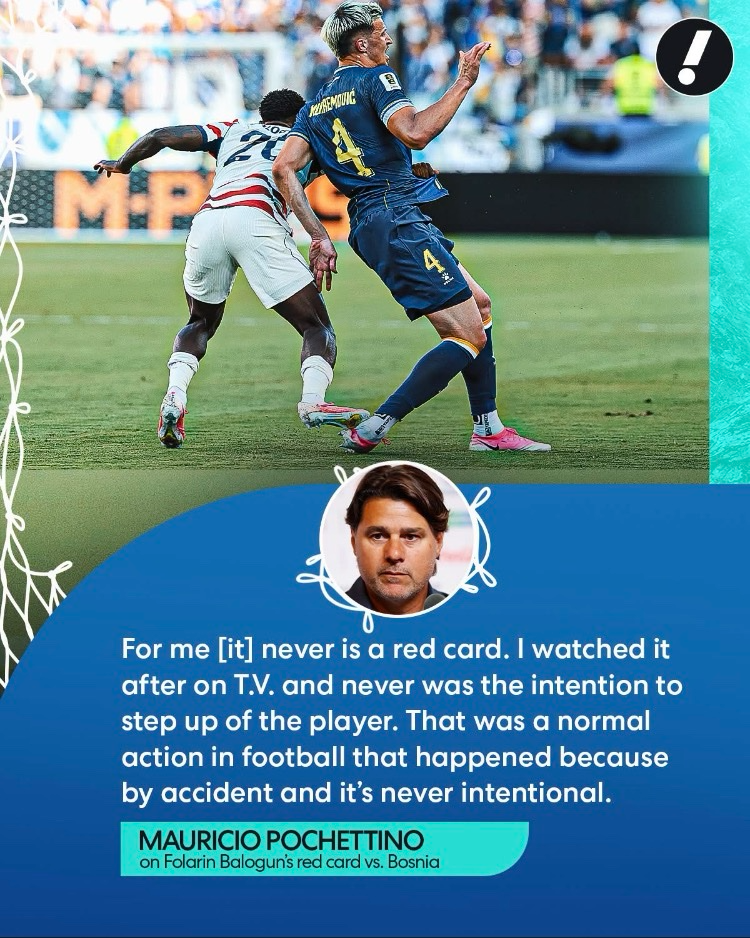
Balogun suspended for U.S.-Belgium, maybe more
USA Game Red Card Yes
Reasons U.S. World Cup star Folarin Balogun’s red card doesn’t sit right
Taylor Twellman Sounds OFF on USMNT’s Controversial Red …
Why Balogun’s World Cup Red Card Was Incorrect
US Red Unfair
World Cup VAR review: Misapplied protocols leave Balogun wrongly red-carded
Former USMNT coach Bruce Arena approves of Folarin Balogun’s red card
World Cup 2026: Was video replay misused to give red card to USMNT’s Folarin Balogun?
Messi, Balogun and why two tackles have sparked World Cup outrage
Croata Offsides
FIFA: Croatia VAR call vs. Portugal was correct
VAR is trying to kill the joy of this World Cup

Looking to Get a Professional Company Headshot? Check out https://capturely.com/ Tell Rob The Ole Ballcoach Shane Best sent you and he’ll give you a deal.
Proud Member of American Outlaws http://www.facebook.com/IndyAOUnite
Interested in advertising in TheOleBallcoach? Learn More shanebestsoccer@gmail.com
View of The Game
After our first game, I felt like this was the best USMNT of my lifetime. It was hard to tell much after the games against Australia and Turkiye, but this match left zero doubt this is indeed the best we’ve ever looked.
Realistically, BH is not at the level of the teams in front of us. Our likely path to the title is Belgium, Spain, France, Argentina. Yikes. However, we played outstanding in a game we were expected to win, and we were fearless and positive even after going a man down. We have quality in every position, we play the ball quickly, and most importantly, we make runs and move around for one another. In other words, we play as a TEAM. Sorry, England fans, you guys have way better players at every position, but you guys stand around and wait for the greatness of Harry Kane to bail you out.
The Balogen red card. Ugh. I hate that call (obviously). Balogen is not a dirty player. 100% there was zero intent- it was a simple coming together. I don’t think anyone even noticed anything in real time. However, that was a very nasty challenge. Raking your cleat on the opponents ankle and then coming down with your weight is how bones are broken and ligaments snap. In the same way that the red card to Paraguay’s Almiron for covering his mouth when talking to opponent was something all the players were aware of, players know that intent has nothing to do with it and a challenge like that is a straight red. These are designed to protect players, and defenders are routinely trained on how to go into challenges for this exact reason. Balogen as a forward probably does a lot less of this training. We will very much miss him against Belgium as no one else on the roster has the pace up front that Balogen has (ugh).
But let’s bask in the glory of this win. That free kick from Tillman is as much of a referendum on how far we’ve come as anything we’ve seen this tournament. To get that over the wall and to dip down on frame is an impossibly difficult task. The ideal position for a free kick is actually about 4-5 yards further away from the goal for this reason. We’ve never had a player in our pool that could execute a shot like that when it matters.
Finally, Weston McKennie might be the most fit player at this world cup. It’s not just the running he does for the ball- it’s all the runs he’s willing to make where the chances of him receiving the ball are well under 50% that makes him a marvel. But it’s those runs that create the space for his teammates, and the discerning eye notices. We see you, WM. And we salute you.
The World Cup gives America a unified look. The rest is complicated
By Jerry Brewer July 3, 2026 Updated 10:42 am EDT The Athletic has live coverage of Argentina vs Cape Verde in the Round of 32 at the 2026 FIFA World Cup.
SANTA CLARA, Calif. — We wear the same jersey. One size fits all, for a change, with clashing accents that we make match.We paint our faces and drape the flag across our shoulders, some like a cape, others like a shawl. We show up, loud and unashamed, suddenly immune to the rage baiters and social media bots. We find, for a moment, something better than ourselves. And then we act bigger than ourselves.A woman wears a bald eagle costume and flaps red, white and blue wings from the upper deck at San Francisco Bay Area Stadium. A man perches a toddler on his shoulders, the boy’s striped face an American canvas of potential. A girl holds a handcrafted “We Believe” sign on a poster half her size.In downtown San Jose, Patricia Vo cheers in bustling San Pedro Square, standing in the middle of a kind of joy that she envisioned to get through three surgeries and eight rounds of chemotherapy. Naseem Farooqi bounds out of the stadium after a 2-0 win over Bosnia and Herzegovina, draped in an American flag, cowboy hat and boots. He lights a cigar as soon as he clears the exit. Dressed in a USA crop top and flag-colored socks to her knees, Robin Roettger completes her look by sporting the shell of a soccer ball across her stomach, making it seem like she is with child. She stands with her mother, who is bedecked as the Statue of Liberty.These people look silly. These people look fabulous.

This United States fan is flying high at San Francisco Bay Area StadiumDavid Gonzales / Imagn Images
These are images of America, at 250 years old, hosting the world’s grandest sporting event and partying like it’s 1776. But the jersey has never been just a jersey. It is a visual manifesto of a complicated country, and in the upkeep of long-recited ideals, it becomes a battleground. The politics of exclusion have infiltrated these colors, this flag, narrowing perspectives about who counts as a real American and who does not. In response, the politics of inclusion have turned to elitist derision, partly as a shield, but that only makes it easier to exile the faction from national pride.This World Cup has become a bridge. It is not ideal to host a world reunion during a family feud, but it has been beneficial. The event has created a reprieve, delivering us from division and reminding us that patriotism can be inviting. Before large crowds that contain multitudes, the U.S. men’s national team takes the field, striving the way we are supposed to strive. And for a 90-minute respite, the arguing stops.This is not a constraining pride, either. A warm welcome has not been universal, but it has been prevalent. Some nations — such as Iran, whose team captain called this “a disaster World Cup” — and their fans could not escape the political shadows. But most have observed the difference between the government and the people. Most have witnessed an America that wants to wrap its arms around the globe.In a viral social media video, a Scotland supporter traveling with the Tartan Army cried on a Boston sidewalk, expressing what many visitors have felt the past few weeks. When she arrived, she expected hostility from a nation with a presidential administration that antagonizes the world. She found joy.May her tears irrigate the feeling.
A powerful force
Just a couple hundred yards from a parking lot asking for $200, the men danced in front of a vendor. One was Latino, the other White. Both wore USA overalls, stars on top, stripes on the bottom. They made up a bop: “Hot dogs! (clap, clap) Hot dogs! (clap, clap) Hot dogs!” Their steps were a hilariously poor approximation of the way Kid ‘n Play moved in the 1980s. The song “Whoomp! (There It Is),” a classic from 33 summers ago, blasted in the distance.Maybe that’s how we ought to picture freedom: warm in addition to weighty, a serious human right that shouldn’t have to take itself seriously.Sports have always been a powerful social force. At their best, these games give a multicultural invitation to a monocultural experience. The shared language requires no translation, no common background, no political agreement. A goal is a goal. A comeback makes every heart in the building lurch. The electricity of 70,000 people rising and screaming in unison jolts everyone. In a fracturing nation, in a fracturing world, this is no small accomplishment. It is among the few remaining gateways to human connection.

The World Cup has spread unity and a human connection across North AmericaDarren Yamashita / Imagn Images
But the unity does not happen by accident, and no one should assume it is protected by default. Those unifying elements — passion, tribalism, a deep and generational emotional investment — can be redirected. The stadium is not immune to society. It houses a sliver of it for a few excitable hours.Over the past decade in American sports, we have experienced an unsettling amount of conflict. When Colin Kaepernick started kneeling during the national anthem in 2016, he continued an old American tradition, leveraging his visibility to demand the country meet the high standards of its stated values. It was a demonstration as quiet as it was provocative. The reaction was loud and lasting. Early in his first term, Donald Trump seized on Kaepernick’s protest and made it into a quarrel about respecting the flag, a reframing from which sports have yet to fully recover.
The toxic environment has mangled a nuanced idea: Sport can promote belonging and hold dissent at the same time. It is possible to love the jersey and question what it sometimes represents. That criticism is not apostasy. Dissent and devotion are not adversaries. At their best, they are complementary.

U.S. fans show their colors during Wednesday night’s victory against Bosnia and HerzegovinaCatherine Ivill / AMA / Getty Images
In the last 10 years, the American flag has been co-opted in a way that makes the stadium feel more like a contested territory than sacred, common ground. The danger is that it hardens from a revolutionary symbol into one of submission.In this climate, the games cannot simply profit off obsession and call it a social good. The diverse audience it cultivates deserves more than empty ceremony and strategic neutrality. This is not a demand to take political positions or a call for athletes to become activists. The ask is simpler yet harder: Refuse to let these shared spaces get overtaken by those who wish to predetermine who belongs.Halfway through this World Cup, the people have done what the institutions couldn’t. It’s the triumph of a vast fandom that keeps choosing goodwill at a time when leaders incite a supremacy relapse.You saw the Tartan Army bringing the good vibes as those supporters romped through Boston and Miami; and the Kansas marching band learning the Algerian national anthem; and the Mexicans and Brazilians who lifted the weeping Japanese fan out of his disappointment. Staging a World Cup made this possible, but it did not manufacture compassion. People did not look to the sky, see a FIFA banner claiming “Football Unites the World” and consider it a bat signal. They are the inspiration for the slogan.Marketing is not a moral position. It is a well-researched enticement. People want to gather. They want to connect. And America still values hospitality.“It’s been great to embrace other countries, and it’s been great to see that other countries really embrace America for who we are,” said Amanda Ryan, a fan from Carlsbad N.M., who has traveled to matches in several cities. “We’re not what they see on the media or on social media.“We are more.”It’s not a boast. It’s a standard, one that necessitates intention and accountability.Sport did not create all these inequities, but the enterprise must decide whether to acknowledge them or look away. That choice does not make any political insinuation. It transforms a game into an institution, a pastime into a benevolent force.
Patriotism and sports
A hundred years ago, America also threw itself a 150th party. The word sesquicentennial taunts the tongue in the way that semiquincentennial does right now. In 1926, the birthday bash featured boxing and Philadelphia, the city where the founding fathers declared independence.Governors and dignitaries attended the spectacle. Charlie Chaplin came, too. At the center of the celebration, before 120,000 who ignored the pouring rain, the most famous athlete in the country was being booed.During the infancy of American sports stardom, there was Jack Dempsey. He was among the first athletes to see the flag turned against him. The debate about sports figures and their place in a patriotic society is not new. It is at least a century old. If Dempsey were still alive, he would recognize this conflict.He sprouted from nothing, a kid from Manassa, Colo., one of 13 children, who dropped out of school and became a vagabond. He rode freight trains, strutted into mining camp saloons and challenged the patrons. He slept in spittoons and boxed under the name Kid Blackie.Then — on July 4th, of course — he won the heavyweight championship in 1919.The next day, America’s most celebrated sportswriter called him a slacker.During World War I, Dempsey had received a dependency exemption from the draft board because multiple members of his family needed support. Still, he was ridiculed as unpatriotic. Fans mocked him. Grantland Rice also wrote in The New York Tribune: “It would be an insult to every young American who sleeps today from Flanders to Lorraine, and from the Somme to the Argonne, to crown Dempsey with the laurels of fighting courage.”He was a famous athlete and an infamous American. It was not about love of country. It seldom is. Dempsey was guilty of free will.The jingoism was loud. It also lacked stamina.During that anniversary fight in September 1926, Gene Tunney ended Dempsey’s seven-year reign as heavyweight champion. Tunney, a veteran and reader of Shakespeare, was nicknamed the Fighting Marine. After 10 rounds, Dempsey lost by unanimous decision and exited with his left eye swollen shut.In a rematch the next year, Dempsey knocked down Tunney for the first time in his career. Tunney wound up winning the fight, but America favored Dempsey afterward. People thought he had been robbed. The contempt evaporated. After all that, he walked away a beloved prizefighter.

American heavyweight boxers Gene Tunney, left, and Jack Dempsey pose before their bout in 1926Topical Press Agency / Getty Images
After the Pearl Harbor attack in 1941, Dempsey joined the Coast Guard. He enlisted at age 47 and rose to commander. In 1945, he boarded a transport bound for Okinawa.
An officer told him to stay behind. They couldn’t afford to lose him.
“I go where they go,” Dempsey replied, according to biographer Roger Kahn.
Kahn captured the boxer’s thoughts on his capricious fame: “They branded me a draft dodger in World War I and a hero in World War II. They got it wrong both times.”
Neither verdict was solely about him. Society changes. The jersey doesn’t. A century later, the friction persists.
‘Something bigger’
Mauricio Pochettino, the USMNT coach who insists he is still “200 percent Argentine,” jogged toward the stands, arms outstretched. Fans leaned over the railing. Pochettino stood on the tips of his toes. At last, they slapped hands. Elvis crooned “Can’t Help Falling In Love” over the stadium sound system.Pochettino could not help it, either.“You feel part of something bigger,” he said.In short bursts of English, the coach expresses American pride better than most. Sports fandom would make an ideal mentor for patriotism. The essential characteristics are there: commitment, unity, aspiration, hope, accountability.There is little blind devotion. It is a more demanding form of love, one that expects to outlast terrible seasons and decisions and owners. You feel part of something bigger.In every country, the flag should hold similar symbolism. It is an inspiration for relentless striving — Gave proof through the night that our flag was still there — not an endorsement of leadership.ride is non-partisan.Division is a choice. So is unity.Look across these democratic vistas. Eleven American cities, hosting the world, each one its own argument for what this country can be when it decides to shine.What song describes the USMNT’s World Cup so far?
As “Take Me Home, Country Roads” filled the stadium Wednesday night, more than 68,000 lingered and harmonized. Weston McKennie whipped his arms through the air, conducting the crowd. As other U.S. players took laps, the crowd shifted from singing to roaring and back to singing.And there was Pochettino again, 200 percent Argentine but so very American in celebration.
“It’s impossible not to sing,” he said.We wish this feeling could last forever. We know it’s fleeting joy, but we water it still.Jerry Brewer is a senior columnist at The Athletic. He has been a prominent voice across the national sports landscape for more than two decades, including stops at The Philadelphia Inquirer, Orlando Sentinel, Louisville Courier-Journal, Seattle Times and Washington Post. He was a 2025 Pulitzer Prize finalist in commentary.
USMNT shows it can play ugly at this World Cup, which is exactly what it needs to succeed
 Sam BordenJul 2, 2026, 06:44 AM ET ESPN
SANTA CLARA, Calif. — It wasn’t artistic. It wasn’t free-flowing, or creative, or the kind of soccer that makes your eyes wide and your heart race. In truth: It was ugly. And so, so beautiful.”It wasn’t a perfect day, by any means,” defender Chris Richards said. “But it was our day.”It was. The USMNT’s 2-0 win over Bosnia-Herzegovina on Wednesday night put Mauricio Pochettino’s team into the round of 16 — the bare minimum, by most pretournament standards, to consider this home World Cup a success. But if it is to go farther — to captivate this country even more and reach a quarterfinal for only the second time in history — it will need to embrace the grittiness it showed here. Knockout soccer demands it.”You do what you need to do to get a result,” Christian Pulisic said after the match.And that is exactly what the U.S. team has done. In the first match of this tournament against Paraguay, it played silky, sleek and scintillating soccer — a style so visually entertaining that midfielder Weston McKennie said it almost felt like the players were “playing pickup.”This performance, against a physical and resolute Bosnia-Herzegovina team, was braver. The Bosnia-Herzegovina defenders put hands (and sometimes shoulders, arms and feet) on every American who ran past, checking fullback Sergiño Dest and Pulisic whenever they tried to surge forward. Bosnia-Herzegovina striker Edin Dzeko set a pick on Tyler Adams that sent the U.S. midfielder sprawling and holding his neck; striker Folarin Balogun — before he scored and, also, before he was controversially sent off in the 64th minute — was grabbed, held and nudged wherever he went.Bosnia-Herzegovina’s strategy was effective, too. The U.S. completed plenty of passes and certainly controlled much of the possession, but the precision from the group stage’s best moments wasn’t there. Long balls went wayward; shorter connections were missed. Malik Tillman, who scored a gorgeous free kick eight minutes from time to give the U.S. some cushion to the scoreline, had an incredibly challenging first half in which he routinely looked out of rhythm.That the U.S. came through it all — that it adjusted and adapted, and got a little chippy when needed while still getting two balls into the back of the net — was what had Pochettino most pleased afterward.”It’s not only the victory,” he said, nearly beaming. “It’s the way that we earned the victory — how we identified the situations, when to play, when to fight, when to compete, when to be intelligent in how we defend deep and narrow. When we need to go and to press. I think the maturity of the team is amazing.”Certainly the reaction to Balogun’s sending-off reflected that. Up 1-0, that decision from the referee — a decision that Pochettino vehemently disagreed with — could have turned the game on its head.It wasn’t hard to imagine Bosnia-Herzegovina being buoyed, snagging an equalizer and taking the game to extra time and penalties. Defending a lead while playing down a man for more than half an hour has broken many teams far more experienced than this U.S. group.
Knockout Bracket Challenge
Create up to 25 brackets. $10,000 in prizes. FREE to play. Make Your Picks
Yet the U.S. didn’t wobble — not even close. It could have been angry at the referee, or frustrated by the situation. But at the second hydration break, which came shortly after Balogun departed, the players were pragmatic.
“We just said, ‘If we really want to be a good team, we have to dig deep in moments like this,'” Pulisic said. “We’re going to have to defend and that’s OK, and pick our moments to attack. I thought we did a good job of that.”
McKennie added there was even a sense of the team embracing a challenge.
“It’s kind of an adrenaline rush whenever you do go down 10 men,” he said, “because you’re like, oh s—, if we can pull off this win and hold them to zero goals, it’s even bigger. So everyone’s running everywhere and tackling, and just making sure we keep our structure, and we don’t want to give up a goal. It would be easy to have an excuse if they did score, but that’s not the type of team we are.”
Klinsmann: USA has quality to beat Belgium without Balogun
So what type of team is this USMNT side? The type that can win different ways. The type that can feed off a home crowd’s energy. The type that believes — even without a suspended Balogun — that it will be able to beat Belgium on Monday in Seattle in whatever way is necessary. There will surely be tactical changes; losing your top scorer to a suspension requires it. But Pochettino has shown he can mold his players to different circumstances, and the players have demonstrated they are comfortable with whatever comes.Play pretty? Fine. Play nasty? No problem.That reality is the most important element to emerge from this match. And it’s what gives the players overwhelming conviction as they fly back to Seattle.”We go into this tournament feeling confident that we can make something happen and beat anybody,” Pulisic said. “This is exciting — but there’s still more that we want to accomplish.”
Malik Tillman’s bloodied, clutch free kick, and the making of an iconic USMNT World Cup moment
By Paul Tenorio and Henry BushnellJuly 3, 2026 5:40 am EDT
SEATTLE – Malik Tillman’s voice barely lifted above a whisper as he pondered what to say about his approach to the coming year.That is normal. The midfielder’s reserved personality has become somewhat of a running joke around the national team. He doesn’t project. He makes you listen closely. But when you do, you find that what he lacks in volume he makes up for in conviction.It was May 2025 and Tillman was sitting in the lobby of the Peninsula Chicago. The German-born son of an American soldier was thinking about his place in the U.S. men’s national team. He was considering what the summer might bring and thinking about past disappointments. About the pain of missinut on the 2022 World Cup.“I’ve been struggling a lot for the U.S. team,” said Tillman, who at 23 felt he still had something to prove.“It’s about showing the real me,” he told The Athletic at the time. “I know I’m a good player, but I haven’t shown it for this team yet. If it comes to scoring goals, giving assists, fighting for the team, showing the right mentality. Just all in. Showing myself.”It is hard to imagine just more than one year later how much has changed for him.Tillman took on a big role under Mauricio Pochettino at last summer’s Concacaf Gold Cup, tying for the team lead with three goals — he even missed a penalty kick in a win over Costa Rica, yet pushed on — and he carried that through a first season at German club Bayer Leverkusen and into the World Cup.His superb play has amplified his place on this national team, and on Wednesday night in the World Cup’s round of 32, his knuckling, dipping free kick against Bosnia and Herzegovina sealed his team’s place in the last 16 — and his spot in U.S. national team history.

Malik Tillman (17) watches his free kick double the 10-man USMNT’s lead at a tense time late vs. Bosnia-Herzegovina.Michael Steele / Getty Images
Still, Tillman just smiled and glanced at the ground when asked if he could ever have imagined it one year ago. Then he spoke with that near-whisper voice.“Not really,” he said, as the media hoard craned their necks and reached their recorders closer to hear him in the mixed zone. “I think even yesterday I would (have said) no. But I’ve been dreaming about this game (as a kid). I’ve been dreaming about maybe taking a free kick and scoring a free kick. And then, like I said, I trained this in practices.”Tillman stood in that mixed zone with no shoes, his right sock ripped at the toe and bloodied. A Bosnian player stomped on his foot during the game, ripping through his cleat and socks.“I was in pain,” he said. “My shoe was cut. So this is why I changed the boot.”Then, in his new cleats, he lined up a free kick in the 82nd minute.The stakes were the highest in his career. The U.S., nursing a 1-0 lead, had been reduced to 10 men after Folarin Balogun’s red card, and Bosnia was threatening to pull level. But after Sergiño Dest drew a foul to set up the set piece, on the field, there wasn’t clarity among those around him regarding the best way to hit it. The ball was only 19 yards out. Getting it up and over the wall would be difficult.“We talked about going under the wall, we talked about going keeper side, we talked about going over the wall,” Tillman recounted. “And now I know some guys doubted me to go over the wall. But I practiced this in training.”That might be underselling it.Tillman has spent hours on the training field after team sessions during this World Cup practicing free kicks. The team uses Trackman technology to learn about his spin rate and the trajectory of his free kicks.“It’s kind of like golf, to be honest with you,” U.S. attacking midfielder Brenden Aaronson said. “The spin rate, the dip rate, all that type of stuff.”Tillman made the most of his reps. U.S. training goalkeepers Andrew Rick and Julian Eyestone, youth internationals not on the World Cup squad but getting a taste of the experience, stayed out on the field until he and his teammates were done.“He’s probably taken 150 to 200 free kicks since we’ve been here,” said midfielder Sebastian Berhalter, who often takes set pieces when he is on the field for the U.S. “And it’s something he does almost every day. It’s me, him and a couple other guys, and we talk about it, we go through it. And to see him hit that — it’s how you execute. Executing that under that pressure speaks volumes to the type of player he is, honestly.”Tillman worked tirelessly on a side-foot technique that could help the ball knuckle and move differently. Over the course of the sessions, he started to get better at it. And in the biggest moment, he went with that technique to deliver the U.S.’s first direct free kick goal in a World Cup since Eric Wynalda scored against Switzerland on home soil in 1994.

Malik Tillman’s USMNT teammates join in the cathartic celebration after his free kick (John Todd / ISI Photos / Getty Images).
“It’s so hard to hit that technique — people don’t understand how hard that is,” Berhalter said. “To deliver in that moment is incredible.”
The moment was so enormous for the host country that Tillman’s ripped right cleat was shipped off to the FIFA Museum in Zurich.
For Tillman, the cleat and bloodied sock were a sideshow to the moment. The goal was the latest example of what has become a breakout summer for a midfielder who not long ago wondered if he’d ever find a role on this team. Now, he has earned validation of everything he had been determined to prove.
“I’d argue other than (Balogun’s) goals, he’s been one of our best players,” U.S. captain Tim Ream said. “Everywhere on the field doing the dirty things, but then making hard things look easy.
“He just wanted to feel like he had a place. And he’s a quiet kid, but he’s just come on leaps and bounds. That Gold Cup was really huge for him. I think the adversity of the Costa Rica game penalty was really big for him. And now you look at him, and he looks like he’s just playing with such an ease and a calmness. And he’s all over the place.
“He’s had that in him all this time. It was just a matter of him finding the confidence and him believing in himself, and he’s doing that now.”
How can USMNT win without Folarin Balogun? Look how Mauricio Pochettino replaced Harry Kane

Mauricio Pochettino, left, gets a celebratory hug from an injured Harry Kane after success in the 2019 Champions League semifinals Craig Mercer / MB Media / Getty Images
By Henry Bushnell July 3, 2026 5:01 am EDT
SAN JOSE, Calif. — The star striker is sidelined. The stakes are immense. And Mauricio Pochettino steps into a spotlight.It sounds like 2026, like the challenge facing the United States World Cup team after Folarin Balogun’s red card Wednesday night in a 2-0 win over Bosnia-Herzegovina.But it is not. It’s April 2019. And this, a seven-year-old scene that suddenly feels pertinent, is evidence that Pochettino, now the U.S. men’s national team coach, has been here before.ochettino, then at English club Tottenham Hotspur, was preparing for a Champions League quarterfinal decider, perhaps the biggest game he’d ever coached. And the week before, he’d lost his leading scorer, Harry Kane, to an ankle injury. “It’s very, very sad,” he’d said.But when he walked into a news conference on the eve of this decisive second leg against Manchester City, he was calm, confident, even jovial.“We have the belief,” he said, “and we will be strong.”And sure enough, the following day, Tottenham stunned Man City. Kane’s backup, Fernando Llorente, scored the pivotal goal off the bench. A second forward, Son Heung-min, scored two as Spurs triumphed on an unforgettable night in Manchester.“Of course, (it’s) better to play with all the players fit and available,” Pochettino said afterward. “(But) you know, football is about the squad, it’s about the collective effort. It’s a collective sport.”A few weeks later, in the semifinals, that collective also stunned Ajax. Pochettino started Son and Lucas Moura, both natural wingers, as a makeshift front two. Moura scored a second-half hat trick to complete a three-goal comeback and send Tottenham, an oft-overshadowed club with a decade-long trophy drought, to its first Champions League final.

Son Heung-min and Lucas Moura show their disbelief after a famous result vs. Ajax in the 2019 UEFA Champions League semifinalsSimon Hofmann / UEFA / Getty Images
Pochettino leapt and ran euphorically onto the field. He eventually fell to his knees, overcome with emotion. And he proved the point he’ll surely try to make this week.
Yes, the USMNT will miss Balogun when it faces Belgium in the World Cup’s round of 16 on Monday. But it will adapt and can still rise to the occasion.His U.S. players were already sending that message Wednesday night, because it’s one that Pochettino has been preaching for more than a year.“We’re definitely a team, we’re more than just one player, we’re more than just 11 players,” defender Chris Richards said Wednesday night.It’s the message Pochettino sent during the second-half hydration break, minutes after Balogun was shown the controversial red card. “We need to show we are a team, that we are united,” Pochettino said. “That was the moment to show to everyone, to show ourselves, that it’s not only empty words when we say we are a family.”When asked who would replace Balogun in Monday’s starting lineup, Pochettino gave nothing away.USMNT will face Belgium without Folarin Balogun
And in this sense, the 2019 precedent offers few, if any, hints. Circumstances, personnel, tactics and opponents are distinct. Back then, Pochettino had one set of options to replace Kane; now he has another set. He has Ricardo Pepi or Haji Wright as something resembling like-for-like replacements. He has Christian Pulisic and Weston McKennie, two attacking midfielders who’ve played up front for their clubs. Moura doesn’t really help us guess which one he will pick — although a setup with Pulisic and McKennie up top, and an extra midfielder beneath them, similar to the team’s alignment against Portugal in March, feels most analogous.It’s the concept, however, that is most relevant. The Spurs example helps explain his mindset and approach — one that’s been at the heart of his USMNT rebuild.He has preached to his players that individual names get dwarfed by the collective, that “culture eats strategy for breakfast,” as he told them back in October, relaying a quote first shared with him by Chick-Fil-A chairman Dan Cathy.“This is one of his biggest things — the team culture, the team togetherness, is stronger than any individual,” U.S. midfielder Brenden Aaronson told The Athletic at the time. “If we’re a team, and we can play like a team, then we can beat anybody.”That’s why Pochettino took offense some nine years ago when Manchester City manager Pep Guardiola referred to Tottenham as “the Harry Kane team.”“It’s a sad comment,” Pochettino said at the time. “It was very disrespectful for many people.”AdvertisementHe’d later say that it “didn’t sit well with us because it seemed to diminish the work of the group,” which is part of why there was “enormous value” in Tottenham’s upset of City in the 2019 Champions League.

Folarin Balogun does LeBron James’ silencer celebration after scoring vs. Bosnia but won’t be available to face Belgium on MondayMaja Hitij / FIFA / Getty Images
Seven years later, to be clear, no one is describing the USMNT as “the Folarin Balogun team.”
But similar questions are coming. Balogun has elevated the U.S. with his off-ball movement and goalscoring. None of his backups can stretch and threaten Belgium as he could.
Within the team, though, there is a confidence instilled over many months. It has become almost automatic. It was evident when Pulisic missed time during the World Cup group stage with a calf injury. It reappeared instantly on Wednesday night.
“I mean, of course he’s a great player, he’s our top scorer so far, we’re gonna miss him,” midfielder Malik Tillman said of Balogun. “But I think we have great players who can replace him, give the best they can, and hopefully score some goals for us.”
Richards added: “We’re a team of 26, not just one. Ultimately, we’re gonna miss him for the next game, but we know that if it’s Pepi, or Haji, or whoever (else), they’re gonna do their job just as well as he did.”
And even with Balogun suspended, without any mechanism to appeal, Pochettino reiterated his message to players in a postgame locker-room speech.
“Everything is possible, guys,” he said. “Everything is possible.”
Henry Bushnell is a senior writer for The Athletic covering soccer. He previously covered a variety of sports and events, including World Cups and Olympics, for Yahoo Sports. He is based in Washington, D.C.
Analysing Cristiano Ronaldo’s reaction to Portugal substitution: ‘Ego, professionalism and love of his country’

Cristiano Ronaldo greeting head coach Roberto Martinez as he leaves the pitch Jose Breton/Pics Action/NurPhoto via Getty Images
By Andy Jones
July 3, 2026 10:59 am EDT
With Portugal and Croatia level entering the final 10 minutes of their round of 32 tie, Roberto Martinez sprung a surprise when he substituted Cristiano Ronaldo.The Portugal head coach has stuck with Ronaldo as his focal point in attack throughout his reign, even as calls have grown louder — including in this tournament — to move on from him.Yet at a pivotal point in the game, he removed him from the action, even though Ronaldo had kept his composure to score Portugal’s equaliser from the spot. Moments before that penalty kick, he had reminded everybody of his quality with a smart touch and finish. The only problem is that he was marginally offside.Only Ronaldo can speak to how he was feeling in these moments, but it is not difficult to look at how the Al-Nassr forward reacted and imagine what he was thinking when he saw his number up on the substitutes board.

It’s a reaction that is relatively common among elite players. They never want to come off the pitch regardless of the situation. Mohamed Salah, for example, is another player at the top of the game who isn’t scared to hide his feelings when he has to make his way to the touchline.
It seemed to take a moment for Ronaldo to register that he was actually being taken off as he took a couple of deliberate steps before eventually beginning to remove his captain’s armband.

That was then the cameras zoomed in on his face, and if there was any doubt about whether he was fine with the decision, that was eliminated…

…as we watched the realisation set in.

“To me it reads as internal conflict in the best possible way,” says sports psychologist Marc Sagal, the founder of The Winning Mind, who has worked extensively with top teams in the Premier League and beyond.“On one hand, he couldn’t possibly want to come off. His whole identity and being is about being competing on centre stage in the biggest moments. On the other hand, as much as he is about himself, as many great athletes must be, he loves his team and his country and knows the world is watching. He must have, in that moment, also wanted to show his ability to put others before himself.”ToWe see that play out in plain sight when Ronaldo pauses just as he is about to walk off and turns away from the touchline, as if he is still coming to terms with the decision made by his manager.

“You have to be careful attributing intent to a walk if you’re asking if the slow exit was to make a point,” says Sagal. “What I will say is that players at his level know every second of an exit is filmed, and the world could see he didn’t want to come off – the world saw his face.
Advertisement
“What I noticed in addition to his expression was what he did next. I didn’t see it so much as a protest, but as a raw emotional response paired with a professional obligation.”
It would have also been dawning on Ronaldo that he was potentially experiencing his final seconds at a World Cup because the game was finely poised. Croatia had the momentum, and he was now going to have no influence or control on the outcome.
Sagal referenced career mortality looming large over a number of the world’s greatest players at this World Cup. International retirement is being rumoured for Ronaldo, 41, and he would also be 45 by the time of the next World Cup, and even somebody like the attacker, who takes care of his body better than anybody, succumbs to father time eventually.
The battle between individual and collective is won by the latter because when he eventually makes his way towards Ruben Neves, who is replacing him, there is an encouraging nod towards his teammate…

…before he embraces him.

There is then a handshake with Martinez…

… and, after a brief shake of his head, high fives for his teammates…

…before he takes a seat on the floor at the end of the bench.

“His team-mates would not expect him to want to come off, and that type of competitive signal isn’t necessarily a bad thing,” explains Sagal. “The danger is that it can take focus off the team and make for an uncomfortable dynamic with the manager.
“He did a decent job of keeping things together. He did the right things — his embrace with Neves and handshake with Martinez kept this on the right side of the line. Players with less self-regulation might have skipped the handshakes.
“I suspect his quiet spell when he sat down was him processing everything. He must have been angry, and it probably got harder as he thought that those might have been his last World Cup minutes.”
Advertisement
He wouldn’t stay in that moment for long, though, and he was leading the penalty appeals from the touchline when Nuno Mendes went down in the area.

He then joined his teammates in celebrating Goncalo Ramos’ 89th-minute winner, sharing a moment with him. Progression was close; his and his team’s World Cup journey and dream were still alive.

It was not quite the 2016 European Championship final when Ronaldo, who went off injured early in the game, spent most of the game coaching alongside former manager Fernando Santos.
There were echoes of it when Francisco Conceicao hit a shot wide in the 115th minute, after Croatia’s late goal was ruled out for offside; he was on his feet marshalling his teammates to get back into position.

“We saw it all in those last few moments,” says Sagal. “Ego, professionalism and love of his country and team. The embrace with Ramos at the end, though, told us a lot.”

