
We are Down to 4-As France faces Spain Tues & England vs Argentina Wed 3 pm
So we are finally down to the best 4 teams in the World facing off in Semi-Final Action Tues & Wed. I will continue to say this is the BEST WORLD CUP Ever – as so many games have gone down to the last minutes. Despite all the upsets – we do get Chalk in the Final 4 as these are the top ranked teams in the World. For this first game today — France vs Spain – we have perhaps the best 2 teams in the World Currently – the finals of the Euro’s 2 years ago – which Spain won in the end. Somehow this year I see France with all its superstars getting the win. Lets call it 2-1 in a hard fought battle.
Now Argentina vs England – the Falkland’s War part 3 – remember Argentina and Maradona used the Hand of God Goal – and perhaps the best goal ever scored in the end to send England home from Mexico City in 1986. Now we get Messi – the GOAT vs England with Kane & Bellingham – is it time to bring it home for England. I really like England in this game – but I can’t root against the GOAT Messi – the best player to ever put on a pair of Cleats in soccer. I will take Argentina 3-2 in Extra Time of Course. Argentina vs England what is means.

World Cup Notes
Carmel FC 2013 Girls results in National League Cup in St. Louis they are now headed to Nationals. MLS is Back
Enjoy the power of 90,000 Norwegians doing a final Viking Row together in front of the palace in Oslo. The Row home for Norway. The ad machine: How David Beckham conquered America. I love how his World Cup has brought us together. This is EPIC. Is it coming home? Don ‘t Take me home
Indy 11 win – Travel to Miami FC Wed 7 pm on ESPN+
Indianapolis – Indy Eleven scored two goals in the final 15 minutes to extend its USL Championship home unbeaten streak to 10 (9-0-1) dating back to last August with a 2-0 shutout of Charleston Battery at Carroll Stadium. Indy Eleven forward Loïc Mesanvi ignited the sequence for a valuable insurance goal in the second minute of stoppage time by poking the ball away and providing a burst of speed and a sliding tackle to win a 50/50 ball that caromed to Jack Blake. Boys in Blue goalkeeper Eric Dick made four saves to record his 34th career shutout against the highest-scoring team in the league. Dick moved up to a tie for 13th on the USL-C all-time list in clean sheets. The Indy Eleven defense has recorded four shutouts in the team’s last five matches in all competitions, tied for second place in goals conceded with 12 goals allowed in 12 league contests. The Boys in Blue have won four of their last five in USL-C play to improve to 6-3-3. Indy Eleven travels to Miami FC on Wed. July 15 at 7 p.m. on ESPN+. The next home game for the Boys in Blue is “Princess Night” on Saturday, July 25 at 7 p.m. vs. Loudoun United FC. Fans can meet their favorite princesses including the 2026 Indiana State Fair Queen, create magical crafts, get their face painted, and join the halftime Princess Parade. Fans can purchase a “Princess Pack” with four tickets, free parking, $20 in Concession Vouchers, and a 20% Merchandise Discount, along with access to the Fun Zone/Kids Activation Area for just $49. Ticket options include the new Desnuda Tequila Deck, Family Four-Packs, and Flex Mini-Plans.
TV Schedule
Tues , July 14 Semi – Finals
3 pm Fox Semi 1 France vs Spain
Weds , July 15 Semi – Finals
3 pm Fox Semi 2 Argentina vs England
8 pm ESPN Gotham FC vs Washington Spirit (Rodman) NWSL
Fri, July 17
8 pm Amazon KC Current vs San Diego Wave NWSL
8:10 pm Fox Nashville SC vs Atlanta United MLS
10:25 pm Fox LA Galaxy vs LAFC El Traffico
Sat, July 18
12 noon ABC Gotham FC vs Seattle Reign NWSL
2 pm CBS Denver Summit (Heaps) vs Portland Thorns NWSL
4 pm CBS Bay FC vs NC Courage NWSL
5 pm Fox 3rd place game
6:30 pm Ion Tubi Chicago Stars vs Angel City (Thompson)
8:45 pm Ion Utah Royals vs Orlando Pride (Marta)
11 pm Uni Quertaro vs Toluca
Sun, July 19
3 pm Fox WC FINAL
7 pm Victory+ Boston Legacy vs Washington Spirit
All games on Fox, FS1 & Telemundo
Wed, July 22 MLS
7:30 pm Apple Free Columbus Crew vs NYCFC
7:30 pm Apple Cincy vs Vancouver
7:30 pm Apple Inter Miami vs Chicago
7:30 pm Apple Philly vs NY Red Bulls
8:10 on FS1 Charlotte vs Atlanta United
10;30 pm FS1 LAFC vs Real Salt Lake
Fri, July 24
8 pm Victory+ Houston Dash vs Bay FC NWSL
10 pm Prime Portland Thorns vs Gotham FC
Sat, July 25
5 pm Tubi, Ion Boston Legacy vs KC Current
7 pm FS1 Columbus Crew vs Cincinnati FC
Sun, July 26
5 pm CBSSN San Diego Wave vs Seattle Reign
7 pm Victory+ Washington Spirit vs Denver Summit
9 pm ESPN Angel City vs Racing Louisville
World Cup Semi-Finals
Why England vs. Argentina is World Cup’s best, angriest, most chaotic rivalry
Argentina scouting report: How can England stop Lionel Messi and Co. in the World Cup semifinal?
Hand of God, Beckham vs. Simeone: Ranking the most controversial England-Argentina moments
Kane: England can’t focus on Argentina history
Yamal: France SF most important match of career
Inside Spain’s World Cup camp: Can good vibes carry them to title?
France’s Deschamps predicts ‘spectacular’ semifinal vs. Spain
What’s it really like to face World Cup stars Yamal, Mbappé? We asked their opponents
Is he Messi’s good-luck charm?
World Cup’s breakout stars: Diomande, Manzambi, Saibari, more
World Cup
Will hydration breaks live on beyond the World Cup?
Hate extra time and penalties? Here’s how one man is on a mission to replace them
Haaland, Norway are rowing home, but this World Cup cemented them as superstars
Grades for every team eliminated from the World Cup: Norway get an A-
World Cup Daily live: Haaland latest star to inspire baby name boom
Haaland, Norway return home to heroes’ welcome
Are World Cup hydration breaks important? Or do they stop teams’ momentum?
Will hydration breaks live on beyond the World Cup?
USA
Grading the USMNT’s World Cup: Did Pochettino, Pulisic & Co. live up to expectations?
Let’s face it: The USMNT’s coach doesn’t matter — the players just aren’t good enough
Balogun: Red card ‘controversy’ affected USMNT
Balogun joins LeBron’s agency after breakout WC
The USMNT’s struggles at the World Cup can’t be fixed by overhauling youth development
Turning the page: 30 players who could represent the USMNT at the 2030 World Cup

Reffing
https://indianareferees.org/become-a-referee/
Preparing for penalties: How goalkeepers get ready for World Cup shootouts
Who is Ismail Elfath, the England vs. Argentina World Cup semifinal referee?
Dutch ref dies months after being dropped from WC

Goalkeeping
Integral as Argentina won the 2022 World Cup, a mischief maker and fine shotstopper.Read full profile ›
Kobel, Bounou & More | Best Saves | Quarter Finals | FIFA …
UNBELIEVABLE SAVES | Round Of 16 | FIFA World Cup 2026™
2026 World Cup Saves – Players Total Goalkeeper Saves
Tim Howard record | Most saves in a World Cup game
Revs re-sign USMNT’s Turner on loan from Lyon

Gk Moms. The world cup in a Keeper’s mom eyes
The days of celebration are about to come to an end—the days of sitting in front of the TV, yet somehow feeling connected to people all around the world, are almost over.
But this year, I experienced the World Cup differently—not just as a soccer fan, but as the mother of a goalkeeper who no longer just plays the game, but breathes soccer.
During these days, I felt so many emotions. And as a mom, there are moments I will never forget.
I was the mom of the Netherlands goalkeeper—the one who, after saving a penalty, accidentally knocked the ball into his own net. I knew he was going home devastated, and as a mother, I felt devastated too—not because of the loss, but because I knew he felt his dream had slipped away, even though he had given it his all.
I was also the mother of the Cape Verde goalkeeper, the one nobody knew just a couple of weeks ago, yet who proved that no one has the right to tell you that you’re not good enough. If you have a big heart and you’re willing to fight, sometimes… that is all it takes.
And of course, I was Courtois’s mom too—the mom of a legend, but still the mom of the little boy who needed a hug when he had to leave the field injured. I was also the mother of the goalkeeper who had to replace him. I could feel the pressure on that young man who never expected to wear the gloves that day, but when someone said, “It’s your turn,” he had no choice but to step onto the field and give everything he had. They didn’t win. But as a mother, all I could feel was pride in his courage to stand between the posts.
And for sure, I was the mother of Dibu Martínez, telling him to be respectful with everyone, but to keep dancing and enjoying the game as if he were playing with his best friends.
For a month and a half, I have been the mother of 48 men, young men, and boys who dared to dream of keeping the ball out of the net and becoming world champions but for the rest of my life, I will be the mother of one brave boy who wears the goalkeeper’s gloves.
So don’t tell me about failure, joy, injuries, or challenges. Every one of us who raises a goalkeeper already knows those feelings… We were not born to be stars—we were born simply to love one.
US Mid – Tyler adams statement
Tyler Adams sends USMNT fans a message following the home World Cup run to the Round of 16 🗣️
“When this journey begins, you don’t see it ending,” Adams said.
“Like, when you’re at the start of it, the finish line in your mind is July 19th. That’s when the final’s gonna be.
“In my mind, that was what I wanted more than anything. It’s gonna be a homecoming to play in MetLife in New York. Like, that for me would have been really, really special.
“But I think everything happens for a reason. I have this overwhelming sense of gratitude, belief, just grateful that we went through that journey together.
“The Belgium loss? It’s just one of those days. I think anyone that’s played sports at any level understands some days you got it, some days you don’t.
“And it was just one of those days where it just felt like anything that could go wrong went wrong.
“It wasn’t lack of competitiveness. It wasn’t lack of togetherness. It wasn’t lack of belief. I don’t think it was a lack of any of those things.
“It was the lack of just moments in a game that, you know, sometimes you get them right, sometimes you get them wrong, and it just felt like we just got them wrong on that day.
“So, we win together, we enjoy the best moments together, but we lose together and we suffer together.
“And that’s what makes this sport incredible in the best moments and horrible in the worst moments.
“So, you know, we have to stick together and continue believing that we did something special. Not as special as we wanted it to be, but, again, we’re changing how the game is viewed for sure amongst people in the U.S. and the world.
“The support I’ve received individually and as a team throughout this journey was incredible. The best support I’ve ever received.
“It’s great to see a nation rally behind you, have belief in you. The adjectives go on and on. But I think for me, it’s continued to have this belief now, right?
“It can’t stop here. We have an opportunity now to grow the sport bigger than it’s ever been in the U.S.
“It’s trending in the right direction. And not because of us. It’s because of everyone in the country, you know what I mean?
“It’s because of you guys, the fans that support us, watching the games, coming to the games. Thank you. It doesn’t go unnoticed. And let’s keep this thing moving.”
Good Morning Football Fans – Men in Blazers
| If you ask us, two whole days without World Cup football was two too many, but thankfully the most prestigious semifinals in the tournament’s history are here to rescue us all. In Spain, Argentina, France and England, for the first time ever, FIFA’s top four-ranked teams make up the World Cup’s final four. Lionel Messi will face the Three Lions for the first and probably last time in tomorrow’s war in Atlanta, but before that, a somewhat more neighborly affair between Spain and France in Dallas today. All of your El Clásico and Premier League favorites will congregate in a match that has the cachet of a final, as La Roja seek vengeance for a 3-1 schooling at the hands of Zinedine Zidane at the World Cup 20 years ago. Savor these mammoth matches, because time is the enemy of this tournament and the jeopardy couldn’t be higher. Didier Deschamps can become only the second manager in history to win this trophy twice, while Luis de la Fuente is on the verge of doing the Euros-World Cup double, something only two other coaches have achieved. Argentina won’t let go of their trophy easily, and if they retain, they’ll be the first nation to do so since Brazil in 1962, but there’s arguably no country more desperate to lift it than England. Despite insisting football’s coming home for the last seven tournaments, the Three Lions haven’t won the World Cup in 60 years, but they also haven’t had a player like Jude Bellingham before…  A World Cup Final Four Unlike Any Other In the first iteration of a 48-team field, FIFA’s top-four ranked teams have made the semifinals for the first time… ever, in any format. For context, all four No. 1 seeds have only reached the Final Four during March Madness twice since the 64-team bracket began in 1985. This is a rare sporting moment, and one where football fans should take a step back and soak it all in. Ahead of the tournament, FIFA announced that the four top teams were put in different quadrants and opposite sides of the bracket so that they couldn’t possibly meet until the semifinals to ensure a “competitive balance,” while also saving potential blockbuster matches for this stage. In five of the last six World Cups, one of the four top-ranked sides didn’t even make it out of the group stage, and the last time two played each other before the semifinals was in the 2010 competition. However, FIFA’s plan has worked out, and now the best of the best really are set to meet for a berth in the tournament’s epic finale next weekend in New Jersey. Gianni Infantino has also shared that FIFA is “exploring” the idea of an expanded 64-team field that would mimic the NCAA tournament’s size for 2030. With more nations participating, the potential for upsets expands and the likelihood of favorites making it to this stage theoretically lessens. But… is anyone really asking for a 64-team field? Let us know what you think at meninblazers@gmail.com. France  vs. Spain vs. Spain  (3 p.m. ET, FOX) (3 p.m. ET, FOX)In a week where Christopher Nolan’s “The Odyssey” debuts, it feels fitting that the World Cup’s own cinematic experience returns with a gargantuan clash between two European heavyweights gearing up for battle. Much like the city of Troy, both France and Spain have borderline impenetrable defenses, with just three total goals conceded between both teams across a combined 12 matches. But Les Bleus and La Roja also each have their own heroes heading into this one, which makes it all the more exciting. France’s Kylian Mbappé sits on eight goals, level with Lionel Messi in the Golden Boot race, while Michael Olise is just two assists shy of passing Pelé’s single-tournament record. The reigning European champions, however, have defeated Les Bleus in their past two meetings in the Euros and the UEFA Nations League. Lamine Yamal is the brightest footballing talent we’ve seen since teenage Mbappé in the 2018 World Cup, but even if he can’t make the stage his own, it seems Arsenal’s Mikel Merino is perfectly fine doing so with two consecutive late winners off the bench to lead them here. More: France vs. Spain: The 2026 World Cup’s best attack meets its best defense. |

| Fierce France attack vs Steadfast Spain defence (and other subplots) |
| It’s a classic clash of the unstoppable force coming up against an immovable object. This is a basic way of looking at the first semi-final of the 2026 World Cup later today (Tuesday). It’s a battle between France, who have the best attack in the tournament with Kylian Mbappe, Ousmane Dembele and Michael Olise battering most other teams into the ground, and Spain, the best defence, having only conceded once in six games, midfielder Rodri prowling in front of centre-backs Aymeric Laporte and Pau Cubarsi, setting the table for Pedri and Mikel Oyarzabal. A tense, cagey battle as one side hurls flaming boulders at the other’s city walls, and we all sit there nervously, waiting to see whether it breaches? Well, it could be. Or it could be a sensational clash between what are obviously the two best teams at this World Cup. Is it possible to have a dull game when Olise and Lamine Yamal are on the pitch? Stuart James has written about Olise, a “showman” one of his former managers compares to Lionel Messi, but is a different kind of superstar who doesn’t have a boot sponsor (he likes to match the colour of his footwear to the kit he’s wearing in a given game), doesn’t really give interviews and plays chess. And then there’s Yamal, who has been a little quieter than Olise over the past few weeks but still has the capacity to do something extraordinary and win Spain the match. Did you know his name isn’t actually Lamine Yamal? Well, it is… but he’s not ‘Mister Yamal’, because there’s a little more to it than that. And if you were to translate his name from Arabic into English, you might call him ‘Trustworthy Grace’… which is quite nice and fitting, isn’t it? Dermot Corrigan has more for you on that. Winner takes all? The chances are that the winners of the whole thing on Sunday will come from this first semi-final. And not just because of the trifling and spurious reason that ‘Both France and Spain are miles better than England and Argentina’. No. History says so, too. Because, as Michael Cox writes, 13 of the past 14 men’s and women’s European Championships and World Cups have been won by the team who played their semi-final first. That extra day of rest before the final might seem like a minor detail, but at the end of a gruelling tournament — this one more so than most, with the heat and the travel and the extra knockout-phase game — it really does seem to be crucial. And the exception, the 2017 women’s Euros, isn’t really much of an exception: the Netherlands won it after playing their semi-final second, but in that tournament both the semis were on the same day. |
2026 World Cup: Best bets for France-Spain and England-Argentina semifinal
Jul 13, 2026, 12:02 PM ET ESPN
The 2026 World Cup moves into the semifinal round on Tuesday, with the field having been winnowed all the way down to the final four teams — all ranked in FIFA’s top four.
There’s some exciting soccer left to play and that means plenty of opportunities still remain to make some wagers on the action.
With so many potential bets that can be made over these next two games, it might be a bit overwhelming to know where to begin. Fear not! Victoria Matiash and Liz Loza hvave looked over the options and landed on their favorites as the teams battle it out to make the 2026 FIFA World Cup Final.
*Odds as of time of publication. For the most updated odds, visit DK Sports
 Spain vs. France
Player shots, Ousmane Dembélé, 3+ (+100)
Kylian Mbappé‘s record-setting play has dominated tournament headlines. He leads the French team with 30 total shots taken, 20 shots on target, and eight goals successfully achieved. Close behind him, however, is the seemingly ambidextrous Dembélé, who has averaged more than three shots per game, recording 16 in total throughout the 2026 World Cup. Facing a staunch Spanish defense and in what’s projected to be a tight match, Les Bleus figure to stay on the attack with Dembélé remaining a primary offensive focus. — Loza
UNDER 1.5 total goals, 90 minutes (+275)
Even though this epic semifinal is being billed as a clash of footballing heavyweights in Kylian Mbappé versus Lamine Yamal (and others), it also pits the two staunchest defenses against one another. Guided by midfielder Rodri, Spain has conceded just one goal this entire tournament. Arguably the second-strongest unit defensively, France has surrendered all of two.
While most fans would like to see the stars put on a scoring show and a 2-1 final is the most popular prediction from ESPN’s expert panel, a 1-0 result after 90 minutes (or even nil-nil) hardly feels unreasonable considering how well both sides are defending. For the record, UNDER 2.5 total goals is currently offering -105. — Matiash
Total corners, OVER 10.5 (+140)
Spain leads the remaining contenders in corner kicks with a total of 44 taken. This makes sense given Luis de la Fuente’s possession-heavy approach. France is not too far behind with 41 total corners taken across six matches. Both teams registered exactly five corners in their quarterfinal matchups. Additionally, the last time these two teams faced each other (a little over a year ago during the UEFA Nations League finals in Germany) 10 total corners were recorded (six for France, four for Spain). Given the stakes, Spain’s defense, and France’s attack? A total of 11 corners is a reasonable outcome to anticipate. — Loza
 Argentina vs. England
Total team fouls committed, Argentina 14+ (+150)
Two exhausted powerhouses with decades of bad blood? This matchup figures to be equal parts ill-tempered and physical, likely leading to an abundance of fouls committed. While England’s cards have increased, the Three Lions’ infractions count has decreased since entering the knockout rounds as the squad has managed fewer than 10 fouls in back-to-back efforts. Meanwhile Argentina’s trademark “garra” has continued at a consistent clip with La Albiceleste registering exactly 14 fouls committed in three consecutive outings. With pressure and accusations of favoritism mounting, Argentina’s approach doesn’t figure to change. — Loza
Lionel Messi, anytime goalscorer (+135)
Defensively, England is not Spain or France. If Thomas Tuchel’s side performs as shoddily as it did for too much of their quarterfinal against Norway, Argentina is going to find the net. So, if you’re buying that hypothesis, why not side with the nation’s most dynamic scoring threat? Some are arguing that Argentina and their superstar are running out of steam. Others suggest No. 10 doesn’t have it in him to fade out quietly. After racking up eight goals over his first five matches, Messi failed to score against Switzerland. Running neck-and-neck with Mbappé in the race for the Golden Boot, expect the 39-year-old to get back on track against England — win or lose. — Matiash
Assists, Anthony Gordon 1+ (+500)
Gordon has, quite fittingly, outpaced Marcus Rashford, establishing himself as England’s top-option on the left wing. The 25-year-old effectively broke out during the Round of 32, logging two assists against Congo DR and becoming the first player in World Cup history to do so as a substitute in a knockout match. Gordon is now tied with Bukayo Saka for the most team assists (3), having successfully set up Jude Bellingham versus Norway. Gordon’s facilitating skills should “flash” again when facing an Argentinian defense that has allowed at least one assist per match since entering the knockout stage of the tournament. — Loza
France counterattack, Argentina set pieces: How World Cup semifinalists score goals
 Bill ConnellyJul 13, 2026, 09:58 AM ET
Despite a beautifully unpredictable group stage and a consistently dramatic set of three knockout rounds, we’ve somehow managed to land exactly where everyone thought we would at the start of the 2026 World Cup.
The four favorites from each quadrant of the bracket — France, Spain, England and Argentina — have crafted a star-studded set of semifinals. France and Spain will meet in Dallas on Tuesday, before England and Argentina face off on Wednesday in Atlanta.
While France has been mostly comfortable to date, each of the other three semifinalists have needed late-game excellence to hold on and get to this stage. But all four attacks have been pretty unique.
– Preview: What you need to know about World Cup semifinals
– Hate extra time, penalties? Meet the man trying to replace them
– World Cup’s breakout stars: Diomande, Manzambi, Saibari, more
As we prepare for the final four matches of an exhilarating tournament, let’s ask a simple question: How do each of these semifinalists score the goals that got them here?
 FRANCE: The second goal is a counterattack
– Goals: CF Kylian Mbappé 8, RW Ousmane Dembélé 5, LW Bradley Barcola 2, LW Désiré Doué 1
– Assists: CAM Michael Olise 5, Mbappe 3, Dembele 2, four players with 1
– xG+xA: Mbappe 6.3, Olise 4.5, Dembele 3.0, Barcola 1.9, DM Adrien Rabiot 1.4, Doue 1.3, CF Jean-Philippe Mateta 1.2, CB Dayot Upamecano 1.0
– Progressive carries (possessions ending in goal): Mbappe 4, Doue 4, Olise 3, Barcola 2, Dembele 2, LB Theo Hernández 2, RB Jules Koundé 2, CB Maxence Lacroix 2, five players with 1
– Progressive passes (possessions ending in goal): Olise 6, Mbappe 4, Rabiot 3, CB William Saliba 3, DM Aurélien Tchouaméni 2, four players with 1
– Duels won (possessions ending in goal): Mbappe 4, Doue 4, Olise 2, Tchouameni 1
No one in the World Cup has scored more goals from counterattacks than France’s three. All three came when France were up 1-0: Adrien Rabiot assisted Bradley Barcola against Senegal, Kylian Mbappe assisted Ousmane Dembele against Norway, and Michael Olise assisted Barcola against Sweden. For that matter, their second goal against Morocco — another Mbappe-to-Dembele job — wasn’t technically a counter, but it was sudden and vertical all the same.
A France goal is quite likely to involve transition in some way — a ground duel won, a progressive carry or a ball recovery in an opportune position and then sudden danger. France have always attacked more vertically than other dominant nations; it’s been the best way to get the most out of Mbappe, and in Dembele and either Barcola or Desire Doue, he has by far his most dynamic dance partners yet.
Honestly, you could even make the case that France’s most important attacker isn’t even Mbappe, no matter how many goals he has scored.
Olise hasn’t found his shooting range at all in the U.S. — he has attempted 17 shots worth 2.1 xG, but has yet to score — but he’s averaging 16 progressive carries per game in the knockout rounds. (For a frame of reference, he averaged 10.7 while absolutely dominating the Bundesliga with Bayern Munich this past season.)
And wherever Olise needs to go to fill a gap for the French attack, that’s where he is.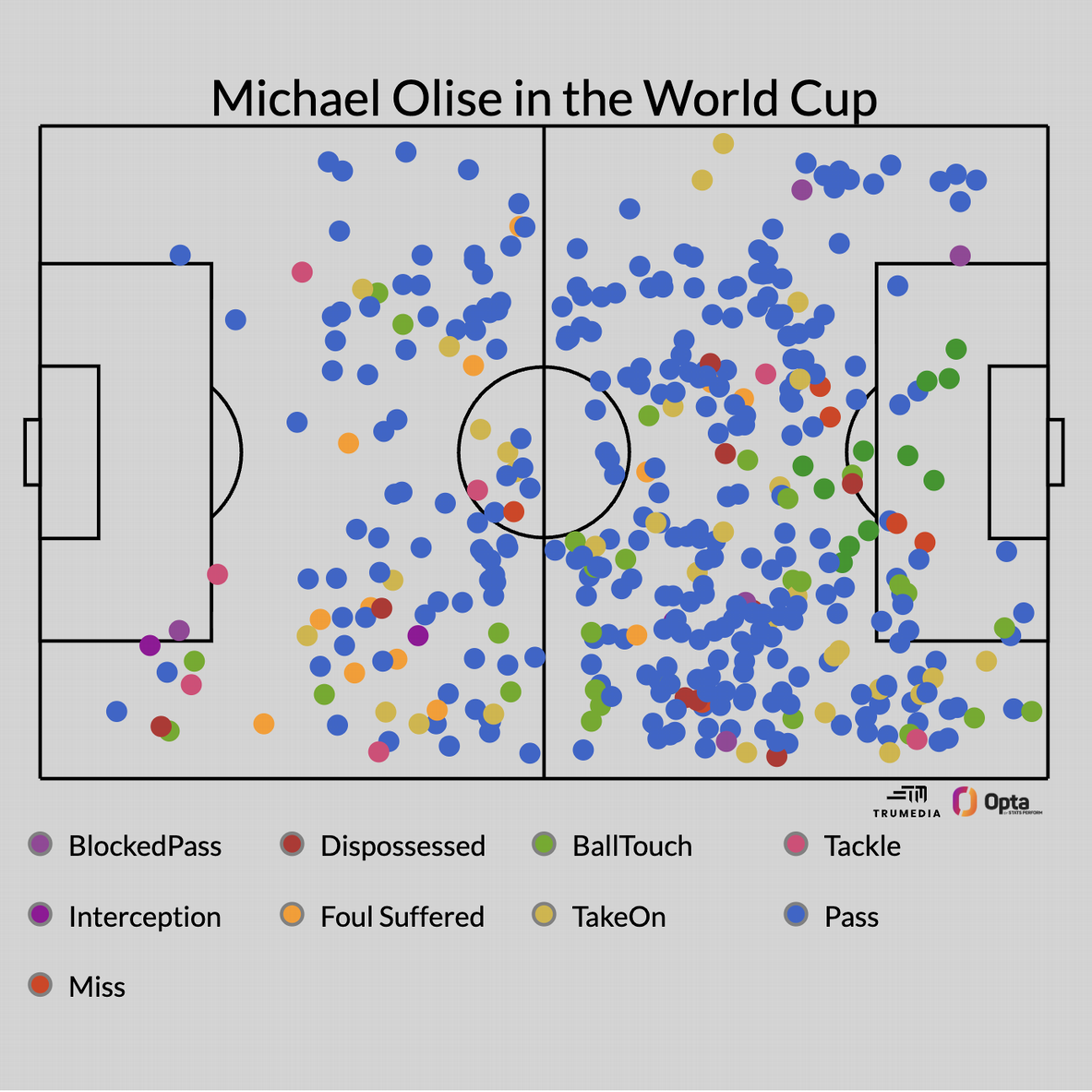
Once France open the spigot, it stays open. They scored three times in 30 minutes against Senegal, three times in 25 minutes against Norway, three times in 29 minutes against Sweden and twice in six minutes against Morocco. The first goal, however, has taken a while at times; after all, you can’t beautifully attack open spaces if they don’t exist. They needed until the 66th minute to score against Senegal, until the 70th against Paraguay in the round of 16 and until the 60th against Morocco in the quarterfinals.
They always break through, but sometimes it requires some extreme grinding (as against Paraguay), and sometimes it requires a moment of absolute magic, like Mbappe’s tiebreaker against Morocco.
That’s like the soccer version of a step-back jumper. He created space from nothing, but still got enough power on it to beat an excellent keeper.
Spain vs. France will be a ridiculously interesting semifinal for a million different reasons, but here’s one I’m really intrigued by: Spain aren’t going to park the bus. They defend with the ball in their possession, and they’re willing to make games extremely boring — a compliment, I swear — if it keeps you far away from their goal. They’ve allowed just one goal in six matches, and they could make France defend more and theoretically take their attacking legs away in the process.
Or they could leave exactly the spaces that France love to exploit and lose big. It could go either way, and I can’t wait to watch.
 SPAIN: Lamine Yamal as decoy
– Goals: CF Mikel Oyarzabal 4, CAM Mikel Merino 2, four players with one
– Assists: LB Marc Cucurella 2, six players with one
– xG+xA: Oyarzabal 3.7, RW Lamine Yamal 2.5, LW Ferran Torres 2.1, DM Pedri 1.9, CAM Dani Olmo 1.9, Merino 1.8, LW Álex Baena 1.7, Cucurella 1.5, DM Rodri 1.3, RB Pedro Porro 1.2, CM Fabián Ruiz 1.1
– Progressive carries (possessions ending in goal): Rodri 3, CB Pau Cubarsí 3, Porro 2, Pedri 2, seven players with one
– Progressive passes (possessions ending in goal): Pedri 6, Rodri 3, Cucurella 3, CB Aymeric Laporte 2, Porro 2, Yamal 2, three players with one
– Duels won (possessions ending in goal): RB Marcos Llorente 1, Merino 1, Oyarzabal 1, Rodri 1, Torres 1
Burley: France will punish Spain if they don’t improve
Spain’s eight goals in six matches are easily the fewest of any semifinalist. That would be more alarming if they had allowed more than one goal in the tournament, but even with their extreme talent and generally mistake-free play, they’ve left games dangerously close. They suffered a 0-0 draw with Cape Verde in their tournament opener and almost got hit by a shocking late counterattack; more recently, they weren’t able to put either Belgium (in the quarterfinals) or Portugal (in the round of 16) away until the 88th and 91st minutes, respectively.
Both goals were scored by substitute Mikel Merino, which is a cool story in itself. But Spain would benefit more from not waiting so damn long to find the winner.
Now, in other words, would be a good time for Lamine Yamal to get a little bit more connected to the rest of the attack.
Yamal’s been hard to evaluate in this tournament. He’s 18 years old, and he’s already the primary defensive focus for every opponent. He’s still led his team in shot attempts worth 0.2 xG or more (three), shots on goal (10), one-on-one attempts (48, with no one else over 13), ground duels won (36), fouls won (seven), fouls won in the attacking third (three) and crosses completed (six). He’s also second in average carry distance (6.1 meters), ball recoveries in the attacking third (eight) and, perhaps most surprisingly, tackles won in the defensive third (four). No one in the tournament has attempted more than his 78 ground duels, and only Morocco’s Achraf Hakimi has won more than his 36.
Yamal’s doing so many things and is putting in the work, but after producing five combined goals and assists at Euro 2024, he has produced only one goal with no assists in six World Cup matches. Opponents have kept him isolated on the wing, winning duels but finding nowhere productive to go with the ball. Therefore, goals have had to come from the other side of the pitch.
Against France, they could hog the ball and limit counterattacking opportunities, but the French back line is so incredibly destructive in one-on-one situations — center backs Dayot Upamecano and William Saliba and fullbacks Jules Kounde and Lucas Digne have won 62% of ground duels and 61% of aerial duels in this tournament — and Spain will need their very best attacker to do some incredible things.
You know, like he did two years ago against France.https://www.youtube.com/embed/7fq5-PfVlCg?si=8JWycaewaBPSJc3h&wmode=transparent
 ENGLAND: Leverage and rebounds
– Goals: CM Jude Bellingham 6, CF Harry Kane 6, LW Marcus Rashford 1
– Assists: LW Anthony Gordon 3, RW Bukayo Saka 3, four players with one
– xG+xA: Kane 4.56, Bellingham 3.52, RW Noni Madueke 2.07, LB Nico O’Reilly 1.27, Rashford 1.17
– Progressive carries (possessions ending in goal): Saka 4, Bellingham 3, DM Declan Rice 3, DM Elliott Anderson 2, O’Reilly 2, GK Jordan Pickford 2, four players with one
– Progressive passes (possessions ending in goal): Anderson 3, Rashford 2, eight players with one
– Duels won (possessions ending in goal): Gordon 3, five players with one
Burley: Bellingham believes ‘he can take England all the way’
England have had a journey over this past month. In six matches they’ve been about five different teams. The fun (and mostly healthy) team we saw thumping Croatia in the tournament opener spent their next three matches struggling mightily to break down low-block defenses and quickly cycling through a number of right backs looking for a healthy one. After surviving Congo DR in the round of 32, they got four goals from Jude Bellingham in two matches to beat Mexico and Norway: the former in the absurd elevation of Mexico City, the latter in the absurd midday heat and humidity of Miami.
England haven’t been the best team, but they’ve survived each unique test uniquely. As someone who married himself to the idea that It’s Coming Home, it’s been heartening, if stressful.
For a team that looks so different hour to hour, though, England have still produced some themes in their goal-scoring possessions.
– Six have involved headers — four goals, plus two more shots that created rebounds
– Five involved successful crosses
– Five involved set pieces, either directly or indirectly
There are plenty of rebounds involved — in the knockout rounds, they’ve averaged 1.4 shots per scoring possession, the most of any semifinalist. And for the tournament they’re averaging 4.7 box touches per scoring possession, also the most. Aside from a couple of breakaways against Mexico, they’ve been best at arranging bodies in advantageous areas and sending the ball in after them. It certainly worked to put away Norway.
As you can probably piece together from the fact that wingers Gordon and Saka have six of England’s 10 assists, crosses have been a pretty solid weapon for England as well. England have averaged 21.5 cross attempts per game, the sixth most in the tournament (among semifinalists, only Spain have attempted more), and looking specifically at open-play situations (no corners), their 3.8 completed crosses per game rank fifth.
There are some old-school, get-it-into-the-mixer vibes here, but when combined with top-to-bottom big-club talent and a willingness to bunker in to defend a lead, it has worked.
I’m curious if this works against Argentina. Their semifinal opponents have primarily allowed goals from sudden, brilliant strikes with no rebounds. Jordan‘s goal and Egypt‘s second came from high-percentage opportunities, but usually you need a great individual effort to score on the defending champs. Can England provide that?
 ARGENTINA: Either set pieces, lateness or both
– Goals: CF Leo Messi 8, CF Lautaro Martínez 2, CF Julián Álvarez 1, LM Giovani Lo Celso 1, CM Enzo Fernández 1, CM Alexis Mac Allister 1, CB Cristian Romero 1
– Assists: Messi 2, eight players with one
– xG+xA: Messi 8.67, Martinez 2.78, LW Nico González 1.63, Mac Allister 1.58, Fernandez 1.50, Alvarez 1.36
– Progressive carries (possessions ending in goal): CM Leandro Paredes 8, Messi 6, CB Lisandro Martínez 4, LM Thiago Almada 4, CB Nicolás Otamendi 3, RM Rodrigo De Paul 3, Alvarez 2, Romero 2, Mac Allister 2, Fernandez 2, two players with one
– Progressive passes (possessions ending in goal): Messi 6, Paredes 3, Martinez 3, De Paul 2, Mac Allister 2, Almada 2, CM Enzo Fernandez 2, RM Giuliano Simeone 2, 10 players with one
– Duels won (possessions ending in goal): Mac Allister 3, De Paul 2, Almada 2, Alvarez 2, five players with one
Klinsmann: Argentina vs. England semifinal will be 50-50
Argentina have scored 16 goals in this tournament. Leo Messi has scored eight of them and assisted two more, and he’s played a role in some of the others, too, like firing in a tough shot that Switzerland‘s Gregor Kobel could only parry, beginning the sequence that ended with Julian Alvarez’s game-winning goal in the quarterfinals.
Even beyond goals themselves, Messi has had a hand in almost everything threatening Argentina have done; he comfortably leads the tournament in combined xG and xA.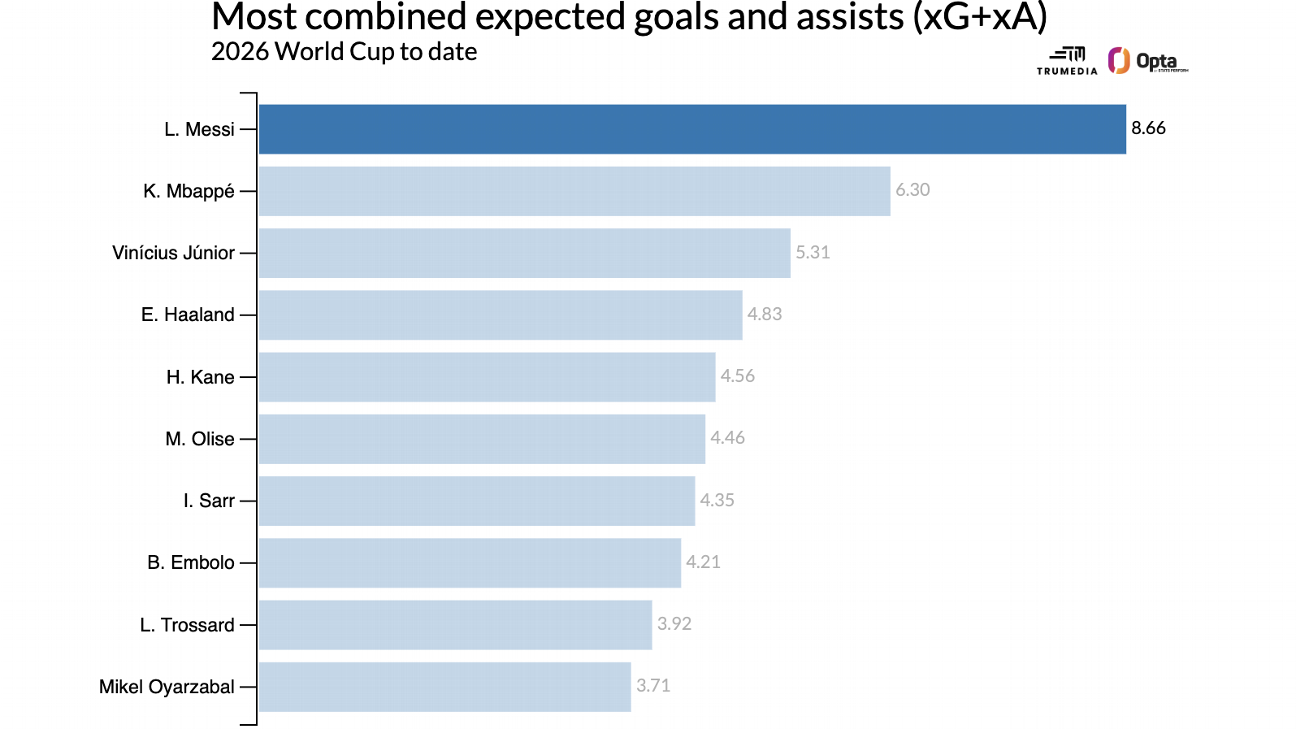
It would therefore have been pretty easy to just say “Argentina score because of the 39-year-old GOAT.” But there have been two other dominant Argentina trends:
1. They have dominated on set pieces. They’ve been officially credited with five set piece goals in six games, the most in the tournament. And it even goes beyond that: Three other goal-scoring possessions also featured corners, even if they didn’t directly lead to the goal.
Messi’s corners are effective enough that Argentina even maintain possession from them if they don’t score. Considering they scored only two set piece goals in 2022, this has been a life saver in 2026.
2. When they need a late goal, they score it. Argentina have certainly given themselves some work to do considering what looks on paper to be a pretty easy path to the semis — they’ve only beaten one team that ranks higher than 23rd in the FIFA rankings. They were down 2-0 against No. 24 Egypt in the 79th minute (and tied in the second minute of stoppage time) in the round of 16; they were tied in the 111th minute against No. 64 (but No. 1 in our hearts) Cape Verde in the round of 32; and they were tied in the 112th minute against Switzerland in the quarters.
In each instance, however, they ratcheted up the pressure until the goals came. They got a goal from Lisandro Martinez and an own goal against Cape Verde, then Cristian Romero, Messi and Enzo Fernandez all scored against Egypt. Messi couldn’t break through against the Swiss, so Alvarez and Lautaro Martinez did instead.
Considering Thomas Tuchel’s willingness to ask England to park the bus late in elimination games, it wouldn’t be a surprise to see a scenario in which England lead late in the semis, and Argentina are constantly searching for the equalizer with long, late possessions.
England vs Argentina at the World Cup means pantomime villains. Who will it be this time?

For English fans, the rivalry has centred around individuals. For Argentina, it runs deeper (Odd Andersen/AFP via Getty Images)
By Nick Miller July 14, 2026 12:00 pm EDT
The World Cup semi-final between England and Argentina in Atlanta will be the sixth time the two nations have met at the competition.The first was in 1962, a relatively routine 3-1 group-stage England win. But the others have each been marked by some kind of controversy caused by the supposedly nefarious actions of an Argentina player.his is why, from an English perspective, it is a rivalry that, for the most part, has been defined by individuals.In their 1966 World Cup quarter-final, it was Antonio Rattin, the Argentina captain who refused to leave the pitch after being sent off in a 1-0 win for tournament hosts England. This was painted in England as a cheating foreigner who refused to respect the authority of the referee, but the reality might have been a bit more nuanced.Rattin had been told that if anything was lost in translation between him and the German referee Rudolf Kreitlein, he could ask for an interpreter, but when he was given his marching orders for slightly unclear/spurious reasons, no interpreter was forthcoming, hence his protest. Still, that did not stop England manager Alf Ramsey calling the Argentina players “animals” in a TV interview, and a spiteful on-pitch rivalry was born.Two decades later, the villain was Diego Maradona following his ‘Hand of God’ goal, viewed in England as the lowest form of cheating (even after his sensational second goal in their 1986 World Cup quarter-final 2-1 victory). In Argentina, and by Maradona, it was celebrated for its cunning.Who to root for in the World Cup final four
“I am not sorry for scoring with my hand,” he wrote in his book Touched By God, about that game at the Estadio Azteca in Mexico City. “Not sorry at all! With all due respect to the fans, the players, the management, I am not the least bit sorry.”
To emphasise the point, Maradona claimed he had sued an English newspaper for falsely suggesting that he had apologised: he did, after all, have a reputation to maintain back home.What You Should Read Next England’s World Cup semi-final with Argentina is going to be glorious, furious chaosArgentina against England is much more than a football match. It’s a deep-rooted rivalry that’s full of enmity and transcends the sport
In 1998, it was Diego Simeone, who supposedly needled David Beckham into the fairly weak kick that earned him a red card in the 47th minute of a World Cup last-16 epic, which Argentina won on penalties following a 2-2 draw.“Let’s just say the referee fell into the trap,” Simeone said a year later, before facing Beckham again when his Inter side played Manchester United in the Champions League.

Simeone and Beckham clash in 1998Gerard Cerles/AFP via Getty Images
The pair reached a detente after that match, exchanging shirts (Beckham had Simeone’s jersey framed and hung in his snooker room).
But Simeone’s villain status in the wider English consciousness continued into the 2002 World Cup, when England and Argentina faced each other in the group stage. By that time, he was thoroughly sick of hearing about it, saying in a pre-match interview with the Guardian: “Can we speak about something else? I don’t like media games, and I really don’t want to be anybody’s monkey.”What You Should Read Next A history of Diego Simeone’s touchline anticsThe Atletico Madrid head coach is always a compelling watch, as he proved again in the Champions League semi-final first leg against Arsenal
For Argentina, the rivalry has never been so personalised, and the villain has rarely been an individual. One minor exception was England’s midfield hard man Nobby Stiles, who was singled out for opprobrium after his robust performance against Argentina in 1966, a reputation burnished when he was sent off during the 1968 Intercontinental Cup (a forerunner to the Club World Cup) final first leg in Buenos Aires between Manchester United and Estudiantes.
“Stiles had been goaded all game,” wrote Jonathan Wilson in Angels With Dirty Faces, his history of Argentinian football. “Suffering a cut eye from a headbutt, and with 11 minutes remaining, he finally snapped, flicking a V-sign at the linesman. Having already been booked for a foul on Carlos Bilardo, he was duly sent off.”
For Argentina, the ‘villain’ has been the concept of England, a national enemy rather than a personal one, an enmity which has taken a few different forms.

Maradona is synonymous with the England-Argentina rivalryLouisa Buller/AFP via Getty Images
One was the idea that England were part of an establishment who tried to screw them over in 1966. FIFA was, at the time, headed by the Englishman Sir Stanley Rous, and there were various complaints about Argentina’s training arrangements and the appointment of referees.
Advertisement
Another is the constant moaning from England about the individual Argentinian players mentioned above. But most significantly, it’s been about the Falkland Islands, and the war which was fought in 1982 when Argentina attempted to ‘reclaim’ the territory, which is around 300 miles from their coast but had been part of the United Kingdom since the 1800s.
So while the Argentinian players still sing songs about the Falklands (or Las Islas Malvinas, as they call them) and focus their attention on the wider idea of England, history suggests the English will still look for a pantomime villain at whom to direct their ire.
There are a few candidates in this Argentina side. Often in these cases the focus is on the opposition’s best player, but aliens cannot be cartoon baddies, so that rules out Lionel Messi. But there are plenty of other possibilities.
There’s Manchester United’s Lisandro Martinez, on the basis that anyone nicknamed ‘The Butcher’ is likely to ruffle a few feathers. Enzo Fernandez is not the most popular player in England — among Chelsea fans because he constantly seems to have one foot out the door, among non-Chelsea fans because he plays for Chelsea — and could take on the role.
Cristian Romero is a live candidate too. He’s an agent of chaos, the football equivalent of those balloons that fly in every direction when you let go of them. Only in his case, the balloon is stuffed with firecrackers.

Since making his Spurs debut in August 2021, Romero has been sent off six times in all competitions — more than any other Premier League player during that timeKyle Rivas/Getty Images
The Tottenham Hotspur centre-back is just as likely to score the winning goal as he is to cut Jude Bellingham in half with a ludicrous foul. At the moment, anyone who so much as harms a hair on Bellingham’s head will face the anger of a nation, and while Romero has been relatively quiet on that front during this tournament, there’s always a sense that his next outburst is just around the corner.
But let’s be honest: if we’re looking for a pantomime villain in the Argentina team, someone who could join the ranks of Rattin and Maradona and Simeone as players who have wronged the English in some way, there’s only one name.
Advertisement
Emiliano Martinez has made being a performative rotter his unique selling point. He’s part goalkeeper, part alpha dog, part troll, using whatever means he can to throw you off your game.

Martinez was an Argentina hero in the 2022 World Cup final penalty shootout against FranceDavid Ramos/Getty Images
The Aston Villa No 1 can be a menace to opponents at any stage of a match, a wind-up merchant extraordinaire, but he really comes into his own during penalty shootouts. His approach to these situations is to impose himself on them before a ball has been kicked, whether that’s through insults, crude psychological warfare, trying to convince the taker he knows where they are going, making a funny face — whatever works, whatever helps him gain mental control of the situation.
And it often does work, most famously four years ago at the World Cup in Qatar, when he psyched out France in the final.
For the most part, neutrals enjoy the brazenness of Martinez’s antics or are slightly irritated by them. He’s almost too cartoonish to properly dislike, a man whose intentions and tactics are so naked that hating him almost seems pointless.
Stars of SoccerEmiliano Martinez Argentina

But let’s say the game on Wednesday goes to penalties, he pulls his usual stunts — insulting Harry Kane, throwing the ball away from Bellingham, pulling Bukayo Saka’s shorts down — and Argentina win. He will become even more of a hero than he is in his homeland, and public enemy No 1 where he works, in England. There’s been a sense for some time that Martinez has an eye on the exit door at Villa: if he becomes a figure of hate by doing something… well… ‘Martinez-y’, he’ll be charging towards that door headfirst.
Perhaps this game, whatever the result, will come and go relatively peacefully, with no incidents to speak of and no new Argentinian ‘villains’ in the collective English consciousness.
But history tells us there’s a good chance the opposite will be true.
Nick Miller is a football writer for the Athletic and the Totally Football Show. He previously worked as a freelancer for the Guardian, ESPN and Eurosport, plus anyone else who would have him.
France vs Spain mega-preview: Predictions, form guide, key players and more

France’s Kylian Mbappe, left, and Lamine Yamal of Spain Getty Images
By Mark Carey, Jordan Campbell, Thom Harris, Eduardo Tansley and Graham Scott
July 14, 2026 Updated 8:22 am EDT
The Athletic has live coverage of France vs Spain in the 2026 FIFA World Cup semifinals.
France have a truly outrageous front line.
Didier Deschamps’ preferred attacking quartet is Kylian Mbappe (eight goals in this tournament), Ousmane Dembele (the reigning world footballer of the year), Michael Olise (one of the standout players at this World Cup) and Desire Doue (scored twice in the 2025 Champions League final).
Their bench is not bad either.
Good luck to Unai Simon, the Spain goalkeeper.
Of course, the Spanish have some wonderful talents of their own, including the best teenager in the world, Lamine Yamal. The Barcelona forward helped Spain win the European Championship in 2024, just a day after turning 17. Their midfield is superb, with Rodri pulling the strings and helping Luis de la Fuente’s team pass sides to death on their way to this semi-final.
Get free access to the most comprehensive World Cup coverage in The Athletic app
This match, at the Dallas Cowboys’ AT&T Stadium, pits the two teams at the top of the world rankings against one another, and the winners will face either England or Argentina in the World Cup final at MetLife Stadium, just outside New York City, on Sunday.
We take a closer look at this game and where it might be decided…
What’s the key info I need to know?
Round: World Cup semi-final
World rankings: France (FIFA ranking: first) vs Spain (Second)
Venue: AT&T Stadium, Arlington, Texas
Date: Tuesday, July 14
Kick-off: 12pm PT/3pm ET/8pm BST
How did France reach the semi-finals?
With greater ease than anyone else.
Their last-32 tie against Sweden was a 3-0 breeze in which they could have scored a few more had the woodwork not been their enemy.
Paraguay proved a tougher nut to crack in the round of 16 and managed to rile the French with an unapologetically cynical game plan. But a Mbappe penalty was enough to get the job done in regulation time.Daily PlayPlay Connections: Soccer EditionGroup soccer terms that share a common thread. A new puzzle is available each day.
France were felt to not have faced a proper test yet at this tournament. Morocco were meant to be the team that changed this in the quarter-finals, but opted for an uncharacteristically conservative approach, having lost star forward Ismael Saibari to injury, and barely laid a glove on the French, who won 2-0. Are Mbappe & Dembele the deadliest World Cup duo?
Liam Twomey
They have not conceded a goal in the knockout stage and have not really looked like doing so. In the opening group-stage game against Senegal, they were far from convincing and, even against a Norway second-string in match three, looked too open at the back. They have tightened up as the competition progressed, though. Crucially, France arrive at the semi-final stage having not expended any of the emotional energy of the others, who have all been embroiled in dramatic and prolonged battles.
Jordan Campbell
How did Spain reach the semi-finals?
Spain have won their last two knockout stage games against Portugal, in the round of 16, and Belgium, in the quarter-finals, through late Mikel Merino goals off the bench.
Against Portugal, they prevailed 1-0, reaching the quarter-finals without conceding a goal in five matches. Belgium were the first team able to breach their defence but lost 2-1 after Merino pounced on substitute goalkeeper Senne Lammens’ error in the 88th minute.

Mikel Merino pokes the ball beyond Senne Lammens to give Spain a late victory against BelgiumDavid Ramos/Getty Images
They started the tournament frustratingly when Cape Verde and inspired ’keeper Vozinha held them to a goalless draw, but Spain went on to top Group H with wins over Saudi Arabia (4-0) and Uruguay (1-0).
Mikel Merino – World Cup super sub & Spanish hero 🇪🇸
Felipe Cardenas
Round-of-32 opponents Austria provided no real challenge, as they eased to a 3-0 victory. Mikel Oyarzabal got his second goal double of the tournament in that match, having also scored twice against Saudi Arabia.
Eduardo Tansley
How to watch on TV
United States: 3pm ET / 12pm PT: Fox (English), Telemundo / Peacock (Spanish)
Canada: 3pm ET / 12pm PT: CTV, TSN / RDS (French)
Mexico: 1pm CST: TelevisaUnivision / TV Azteca, with streaming on ViX
United Kingdom: 8pm BST: ITV1 and ITVX
What should we expect from France?
A less philosophical approach to the game than Spain. While today’s opponents operate in a strict system with a near-religious commitment to possession and pressing, France are happy to adapt depending on what a match demands.
It is what makes them so dangerous and difficult to stop.
Sit off them and the front four of Mbappe, Olise, Dembele and Doue will pick holes where you thought there were none. Try to press them and they will tear you open with two passes through the middle. Take the game to them and they will kill you on the break.

Kylian Mbappe and Ousmane Dembele celebrate a goal against Sweden in the round of 32John Sibley/Reuters
They appear to have the answers to every equation, and are playing a more expansive game than at the three previous World Cups. Deschamps has found a way of platforming four attackers by having Adrien Rabiot and Manu Kone protecting the midfield behind them. So far, it has not posed them many problems, but against Spain, they will need to find the perfect balance. Jordan Campbell
What should we expect from Spain?
Passes, and lots of them.
No team have averaged a greater share of possession across their six games so far at this World Cup (65.8 per cent). They had even more of the ball at the previous edition in Qatar in 2022 (76.5 per cent), and also led the way at the one before that in Russia eight years ago.
Such a patient approach is embedded in Spain’s identity — they will look to control the flow of the game with the ball at their feet, pen their opponents back, and try to counter-press aggressively and win possession straight back the second they lose it.
All of that has led to a solid, if yet unspectacular, route through the tournament, conceding only once along the way and recording three of their five wins by a single goal. Rodri has shone at the heart of midfield, his innate sense of positioning and quality on the ball keeping them ticking in the final third.

Rodri has been essential to Spain’s passage through the tournamentCarlos Barria/Reuters
Full-backs Marc Cucurella and Pedro Porro have both pushed high and kept their wingers supplied, while Yamal’s threat has simmered, yet to truly bring his game-breaking talents to this World Cup.
Spain’s ambitious high line has yet to be truly tested by a clinical centre-forward; how they deal with the pace of Mbappe could make or break this game.
Thom Harris
Who is the star player for each team?
Mbappe is the obvious choice for France, with his eight goals being the joint-highest by anyone in this tournament. However, French fans could feasibly make a case that Olise has been the team’s most indispensable man this summer.

Michael Olise glides past a Paraguay challengeKyle Ross/Imagn Images via Reuters
Olise’s ability to glide across the pitch makes him one of the most aesthetically pleasing players to watch in the world, but there is an end product to his game that few opponents can live with. His five assists are more than any player in the tournament, while his punched balls between the opposition lines have been enough to knock most sides to the canvas.
Only Lionel Messi (15) has attempted more through balls than Olise’s 14, with nobody completing more than his seven. Mbappe will rightfully get the headlines, but Olise has been powering France’s attack.
For Spain, it is difficult to look beyond Yamal as the jewel in their crown. The teenager (he was 19 on Monday) continues to look at home on the biggest international stage, even if he has not reached the goalscoring numbers of his fellow elite global stars.

Lamine Yamal celebrates his goal against Saudi Arabia in the group stageJustin Setterfield/Getty Images
In truth, Spain’s biggest strength is their collective unit, but Rodri’s fingerprints have been all over anything they do well in and out of possession. A tempo-controller on the ball and an aggressive counter-presser off the ball, the 30-year-old is hitting the levels that we saw prior to his season-ending ACL injury in September 2024.
Mark Carey
Is there any history in this match-up?
France will become only the second European nation to reach three successive World Cup finals if they overcome Spain, but it is De la Fuente’s side who have had the upper hand in the teams’ two most recent meetings.
In June last year, Spain defeated the French 5-4 in an exhilarating UEFA Nations League semi-final in which they led 4-0 just before the hour but were very nearly reeled back in.

Yamal and Nico Williams celebrate during their Nations League final win in 2025Justin Setterfield/Getty Images
Eleven months before that, in a Euro 2024 semi-final, they also emerged the victors, coming from behind to win 2-1 and seal their place in the final.
France have had their own momentous wins in this fixture: in 1984, they beat Spain 2-0 in the European Championship final and also came out on top, 2-1, in the 2020-21 UEFA Nations League final.
The only World Cup meeting between the nations came in 2006, when Zinedine Zidane inspired France to a 3-1 victory in the round of 16.
Spain holds the lead in the overall head-to-head record with 18 wins to 13, alongside seven draws. They have the momentum from those recent meetings, but this is a France team which has rapidly evolved and has become more adventurous since Spain’s European title two years ago.
Jordan Campbell
Where will the match be won and lost?
Spain are likely to dominate possession to maximise control in the game, but that may play into the hands of France’s greatest strength at times.
The breakneck speed with which the French can spring forward is a potent weapon they have not been shy about using this summer. Their 32 direct attacks (a proxy of counter-attacking play) are already more than in their previous four major tournaments, dating to winning the 2018 World Cup in Russia. Even adjusting for minutes played, that rate of 5.3 direct attacks per 90 remains the highest.
A neat example of their devastating counter-attack was Bradley Barcola’s goal against Sweden in the round of 32. After Aurelien Tchouameni recovered the ball on the halfway line, a simple pass to Olise then released Barcola to finish at the near post within seconds of recovering possession.

Thankfully for Spain, they have been one of the best counter-pressing sides in this World Cup.
As The Athletic recently analysed, their defensive strength has been built upon excellent recovery work to sustain attacks and keep the other team far from goal on the rare occasion they do give up possession.
As shown below in their round-of-32 clash with Austria, Yamal loses the ball in the penalty area, but Rodri is quick to hound Marcel Sabitzer and regain the ball in seconds — with four Spanish team-mates congregated around him in support to keep those spaces tight and suffocate the opposition.

With so much individual talent on show, this game is likely to be decided by Spain’s counter-pressing to nullify France’s counter-attacking threat.
Mark Carey
Who do our experts think will win?
Colin Millar: France 2, Spain 1 (after extra time). The tournament’s best two teams. Spain’s connections, rhythm and control of both possession and territory are a step above anyone else in the tournament, but their key attackers, notably Yamal, are lacking form and full fitness. This is a side who have lost some of their sparkle from that European Championship win two years ago, while France have blown away their World Cup opposition to date.
Advertisement
Eduardo Tansley: France 2, Spain 1. We saw Morocco try to nullify the French with possession in the previous round, and it didn’t work. France’s performances have been too convincing and their attack too fluid to bet against them.
Mark Carey: France 2, Spain 1. I think Spain will try to control the tempo of the game as much as they can, but the attacking firepower of France’s front four will prove too devastating.
Thom Harris: France 1, Spain 1 (France win on penalties). Spain should be able to keep France at arm’s length with the ball at their feet. I see a moment of magic from both Mbappe and Yamal, before penalties decide the teams’ fate. France will make it through!
Amelie Claydon: France 2, Spain 1. Spain will probably have more of the ball, but that should suit France. Their full-backs push high and their midfielders commit numbers ahead of the ball, leaving space for the French to attack as soon as possession changes hands. France do not need to dominate possession to control the direction of a game. They are comfortable absorbing pressure and waiting for the moment when Spain overcommit.
Miller: France 2, Spain 1 (after extra time). If anyone has a good enough defence to stop France, it’s Spain, who have only conceded once in this tournament. But even they won’t be able to completely hold off Mbappe, Olise, Dembele and the ‘lobster thermidor or Wagyu steak?’ choice between Doue and Barcola. I think this will be the tightest game either will play — including the final — and much higher quality than their semi-final at Euro 2024, when France were weirdly, crushingly dull. I’ll say France, with a late Mbappe winner.
Dermot Corrigan: France 2, Spain 1. Spain’s chances in this game rely on their midfield — led by Rodri — dominating possession so they can keep the ball away from France’s tremendous attackers. I can definitely see them outnumbering and outplaying the French in central areas to have more of the ball, but it’s more difficult to see their attack really hurting Deschamps’ defence. Mbappe, Olise and Dembele are playing so well that, over the 90 minutes, logic says they will have enough opportunities to send France through to a third straight World Cup final.
Charlie Scott: France 2, Spain 3. Surely one of us has to back Spain?! Yamal scores twice in a performance for the ages, and Simon has a ridiculous game in goal. Mbappe and Dembele to both find the net for France.
How might they line up?


Tell me one thing about France that’s going to make me look clever to my friends
Mbappe scored an incredible opening goal in the quarter-final against Morocco, opening his body up to finish beyond Yassine Bounou to the far post.
One of Mbappe’s biggest strengths is being able to switch between a near-post and far-post finish depending on the situation — a skill he has developed since earlier in his career. When he gets himself into his favoured left zone of the pitch (see below), seven of his efforts have gone to the far post and six have gone to the near, with an unpredictability that can leave goalkeepers guessing until the very last second.
Contrast that with France’s right zone, where left-footed Olise and ambipedal Dembele typically reside, and a more predictable pattern emerges. Both tend to opt for a far-post finish when unleashing their efforts, and considering their success rate when they do, you can understand why.

If Simon is looking to play the percentages, he can be confident that France’s left-footers are going to shoot across goal when he is making a save.
When the ball is on Mbappe’s side, Simon might just have to pray that the goalkeeping gods are looking down favourably on him as France’s captain shapes to release his shot.
Mark Carey
Tell me one thing about Spain that’s going to make me look clever to my friends
Keep an eye out for cutbacks.
With opponents often sitting deep against De la Fuente’s side, space rarely opens up in central areas of the pitch, meaning Spain are frequently tasked with going around the defensive block as they cannot go through it.
Their 14 chances created via cutbacks are the most of the nations still in the tournament, and brought them a goal when Alex Baena’s pulled pass found Porro during the last-16 meeting with Austria.

France are more likely to go toe-to-toe with them today, meaning there might be more space to exploit through the heart of the pitch.
Advertisement
However, on the occasions when Spain do pin their opponent back and look to create, do not be surprised to see them reverse a pass backwards to find a free man when all others converge towards France’s goalmouth.
Mark Carey
Who is the referee?
If a referee can ever ‘shoot to fame’, the official in charge of the World Cup semi-final between France and Spain certainly had a shot at becoming an overnight sensation earlier in the tournament.
Ivan Barton, a 35-year-old from El Salvador, became the first referee to send off a player under the new law barring them from covering their mouths while confronting an opponent.
After watching the incident at the pitchside monitor, Barton returned to the field and delivered his verdict to Paraguay forward Miguel Almiron with considerable gusto.
“After review! Number 10! Paraguay! Cover his mouth! Decision is: red card!”

Darren Yamashita/Reuters
Almiron’s dismissal aside, Barton has kept a low profile through draws between Japan and Sweden in the group stage, and Switzerland (who advanced on penalties) and Colombia in the first knockout round.
This is his second World Cup. His games in Qatar four years ago included Germany’s shock group-stage defeat to Japan and England’s 3-0 win over Senegal in the round of 16.
While his card count is normally around average, Barton reduced the U.S. men’s national team and Mexico to nine men each in a 16-minute spell late in a 2023 Concacaf Nations League semi-final. He then blew for time early, due to homophobic chanting in the crowd.
He will be hoping for a quieter time of it on Tuesday and I wish him well, while secretly hoping he has to overturn a decision so we get to hear another on-field announcement.
Graham Scott
Who will the winners play?
The victors in Arlington today will face whoever wins the other semi-final between world champions Argentina and England, which is being played at Mercedes-Benz Stadium in Atlanta tomorrow (Wednesday) at 12pm PT/3pm ET/8pm BST.
That final will be played at New Jersey’s MetLife Stadium, a few miles west of New York City, this Sunday, July 19, with kick-off at 12pm PT / 3pm ET / 8pm BST.
How France are playing four proper attackers and not conceding chances at this World Cup

Ousmane Dembele, right, celebrates with his team-mates after scoring France’s second against Morocco Angela Weiss/AFP via Getty Images

By Michael Cox
July 10, 2026 Updated July 14, 2026 8:26 am EDT
The Athletic has live coverage of France vs Spain in the 2026 FIFA World Cup semifinals.
Get free access to the most comprehensive World Cup coverage in The Athletic app
Creating a World Cup-winning side is all about balance. As a disciplined defensive midfielder who won the tournament in 1998, and as a cautious manager who won it again in 2018, Didier Deschamps knows this better than most. This summer, his France team feel more attack-minded than usual. And yet, ominously, their defensive record remains excellent.
Advertisement
It’s not simply that France have yet to concede a goal in the knockout stage of this tournament, recording clean sheets against Sweden, Paraguay and Morocco. The real story is that they have barely even allowed any half-chances. Sweden looked meek when recording just 0.7 expected goals (xG, a measure of the quality of goalscoring opportunities a team creates) in their round-of-32 match, but that’s more than Paraguay (0.2) and Morocco (0.1) managed between them. In their 2-0 defeat on Thursday night, Morocco only had sights of goal from set pieces or hopeful long-range shots.
This is despite Deschamps continuing to use four attackers, a departure from his previous approach at World Cups, when he often favoured a more responsible central midfielder shifted out wide to help screen the defence.
Neither Adrien Rabiot nor Manu Kone is a world-renowned holding player: Rabiot is more of an all-rounder, Kone is an unheralded 25-year-old in his first international tournament. But they have been excellent together, patrolling the centre as a tight duo, and they are being trusted to cover the width of the pitch — sometimes without huge support from ahead.

But France are making it work, in part because of their boldness in attack.
France’s main task against Morocco at Gillette Stadium was coping with Achraf Hakimi, the best right-back in the tournament and familiar to the France players who have played club football with him at Paris Saint-Germain.
Hakimi has sometimes seemed like a right-back, a No 10 and a No 9 combined in this tournament, and here he carried Morocco’s main attacking threat, operating as their most advanced player on occasions.

France, in general, seemed happy for him to push forward, knowing that he would leave space to break into. That’s not quite what they would have done at previous tournaments — in 2018, box-to-box midfielder Blaise Matuidi played on the left and would have been practically man-marking an attacking full-back like Hakimi. But here, Desire Doue played a little deeper than usual, and Kylian Mbappe drifted over to that side, always ready to break. France’s passing network, below, shows the extent to which Mbappe took up inside-left positions.

Midway through the first half, there was the perfect example — Hakimi pushed forward and was tackled by Doue. Morocco’s key player was stranded upfield.

This was France’s dream scenario, and they broke quickly. Mbappe drifted left, sprinted in behind to get on a pass from Michael Olise…

… and was clumsily brought down inside the box by Noussair Mazraoui. Mbappe’s subsequent penalty was saved after a long VAR review.

France eventually went ahead 10 minutes into the second half with a classic Mbappe curler. It came after a good example of another element of the game France do excellently: counter-pressing. The heat has made it physically tough to spend all game closing down, but various top teams have been excellent at pouncing to regain the ball quickly after losing it.
Advertisement
For their opening goal, France effectively won possession in those situations three times within the space of 20 seconds — and as much as this period was scrappy, it showed how France’s attackers were simultaneously denying counter-attacking chances, and creating chances of their own. Their defensive work isn’t about shielding the back line, but about being proactive — Morocco were trying to launch a break here, but Rabiot stepped in to intercept and put France on the attack shortly before Mbappe curled home.


At 1-0, there was another incident where Hakimi got caught high up the pitch acting as a right-winger, while a France player — this time William Saliba — jumped in to make an interception. Mbappe was free to break into the space Hakimi had vacated, and a Morocco centre-back — this time Issa Diop — flew into a tackle to bring him down.


This was different to the Mazraoui penalty concession, in that it was a deliberate foul to halt a counter-attack, but the pattern was the same. Often, a team’s strength is also their weakness, and that was the case for Morocco and Hakimi.
The second goal came from a rare example of France attacking through the middle. The instigator was again Mbappe, who played a simple pass to Ousmane Dembele — coming off the right flank — to record an assist, but more crucially made a sudden burst that occupied both Morocco centre-backs and allowed Dembele the freedom to cut onto his right foot and squeeze a shot under Yassine Bounou and put the game out of Morocco’s reach.


You can argue that France haven’t been seriously tested yet — or, at least, not since their 3-1 win over Senegal in their opening fixture. A semi-final meeting with Spain, who face Belgium on Friday, would be a different challenge entirely. But to play two knockout matches without conceding even a sniff of a chance is hugely impressive — especially considering Deschamps hasn’t compromised on his unusually daring approach of using four proper attackers.
World

