12/21/22 A World Cup for the Ages 4-3 (Pks), Messi Wins the Cup for Argentina, Mbappe wins Golden Ball, Martinez Golden Glove, English Cup games this wk, EPL back 12/26

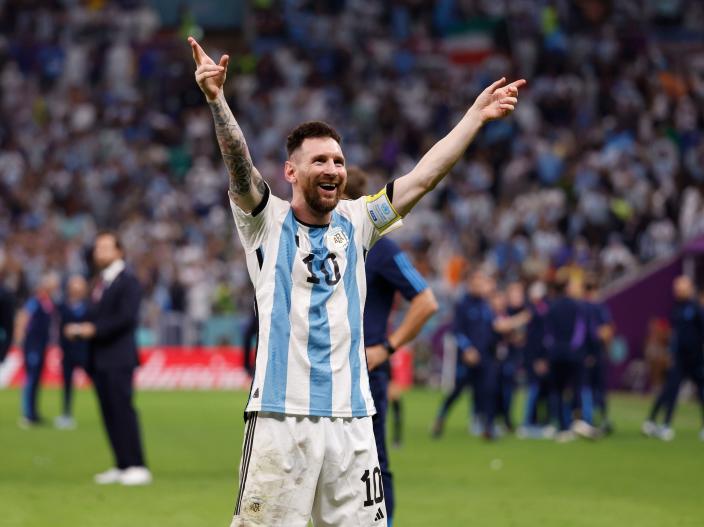
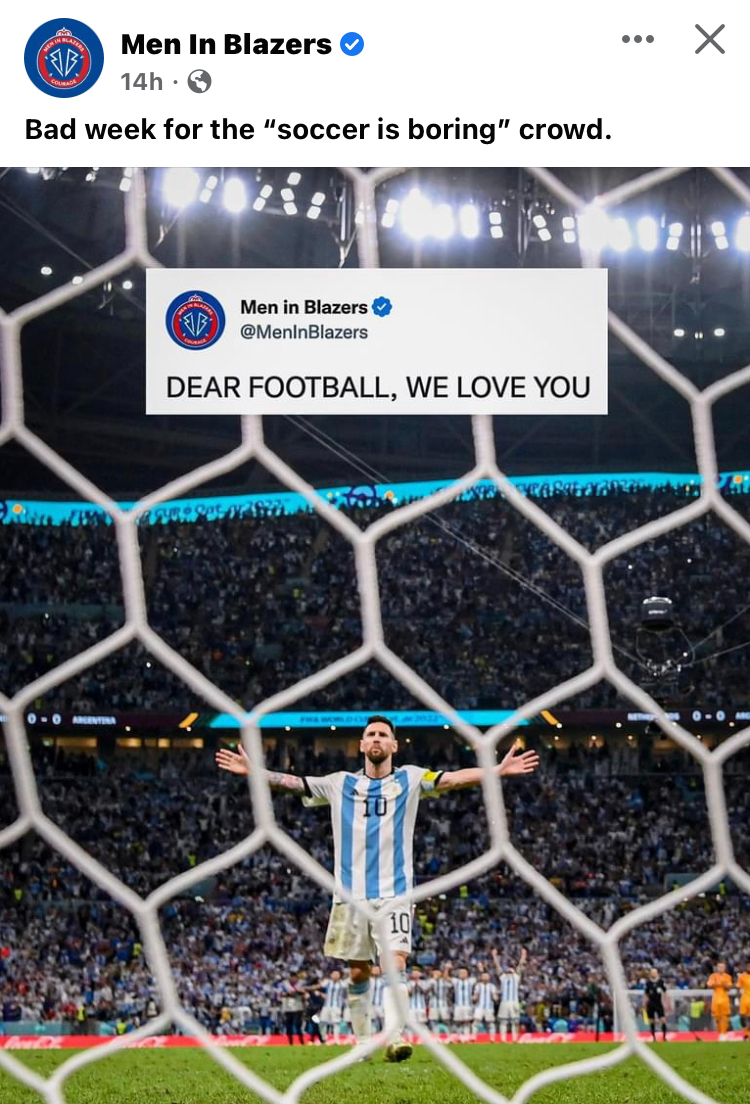
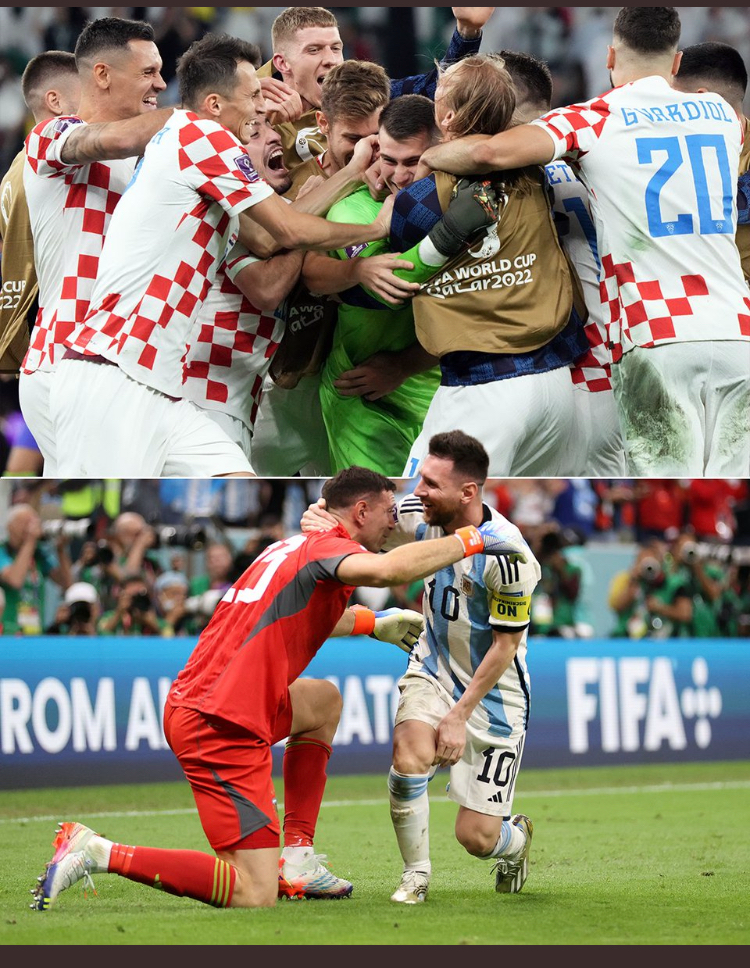
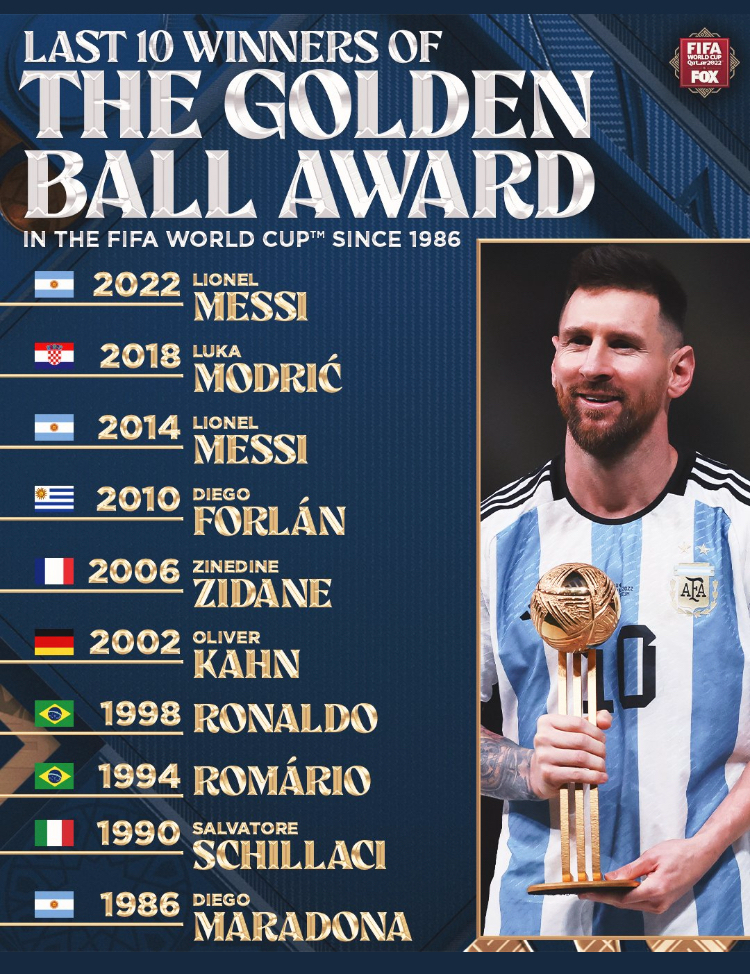
Wow I am pretty sure I just witnessed the Best World Cup Game Ever –much less Final.  It had all the elements – World Superstar Messi close to retirement from international football looking for his swan song performance and to lift the World Cup Trophy for his native Argentina to be rightfully mentioned at the GOAT of the sport.  Possibly the Best Player ever.  Champions League titles, Copa America Championship, multiple Balon D Or’s Player of the Year Trophies –but the one thing missing to be mentioned with reference to the Great Diego Maradona – Messi needed this Trophy and have it he does.  He claims the Golden Ball for a 2nd time in a World Cup. Versus France  – looking to become the first repeat Champ almost 60 years.  Mbappe – the heir apparent and certain GOAT in Waiting taking home the Golden Boot as he and Messi battled to the end to see who would win it.  Mbappe’s hattrick of 3 goals giving him the nod over Messi by 1 goal.  Mbappe’s 4th a PK making him the leading scorer in Finals history with 4 goals scored (only 3 count though). The 2-0 Argentina lead with a dominating performance so complete that French Manager Deschamps  Made 2 subs before the half and 2 more at the 65 minute mark.  Then like that it’s 2-2 as Mbappe explodes into action like only he can.  Then its 3-2 in Extra time – as Messi scores this spectacular goal that if the World Cup only had a 2nd ET of Golden Goal would have provided the storybook ending to Messi’s spectacular career.  But no – Mbappe would score another on a PK in the final minutes again to tie her up at 3-3 – then this SAVE OF THE GAME by Argentina’s Martinez saved the blue and white stripes and sent them into the 5th shootout of this World Cup.  In prime form Argentine GK Emilio Martinez (Aston Villa) bossed his way to a save and a forced miss and won the Shootout for Argentina sending the close to 100K in the stadium and around the grounds into a frenzy unmatched in World Cup’s Past. 1986 Was Argentina’s last World Cup title –a lifetime for some – for Messi a dream realized.  And for the largest TV audience to EVER WATCH A SPORTING EVENT – A CLASSIC FOR THE AGES.  Perhaps the Best ever Final, perhaps the Best Ever World Cup Game, in my mind one of the Greatest Sporting Events I have ever watched on TV.   Ton’s of stories all about the game and more below.   I had picked 3-2 win for Argentina. But 4-3 in PKs was even better.

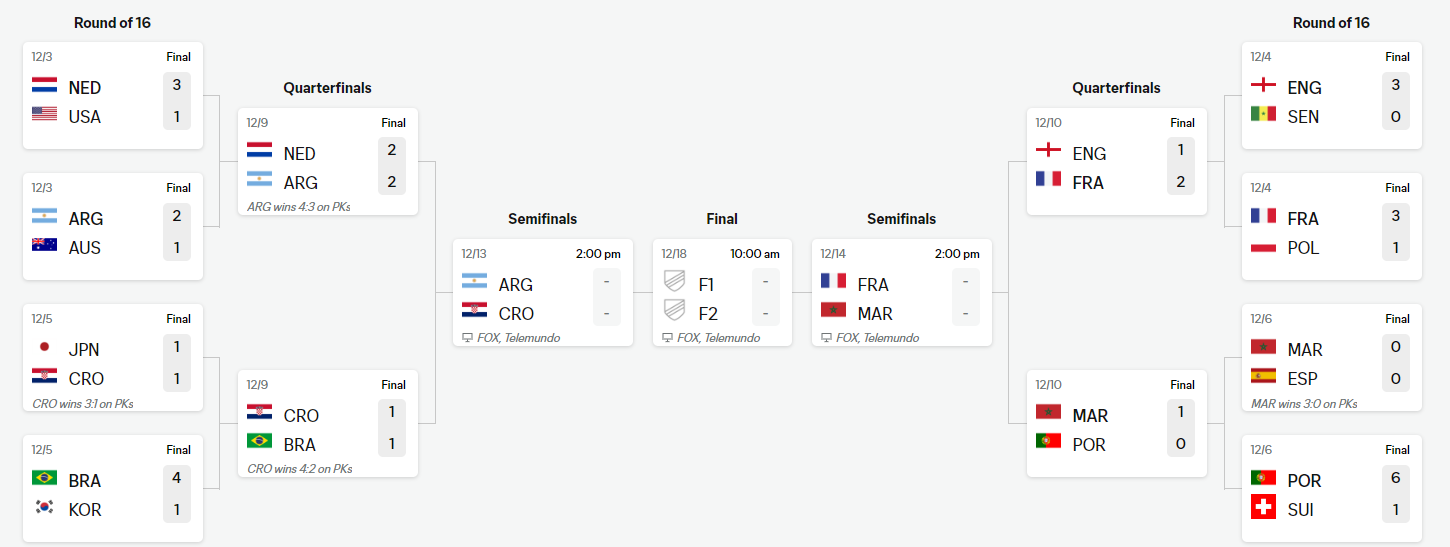
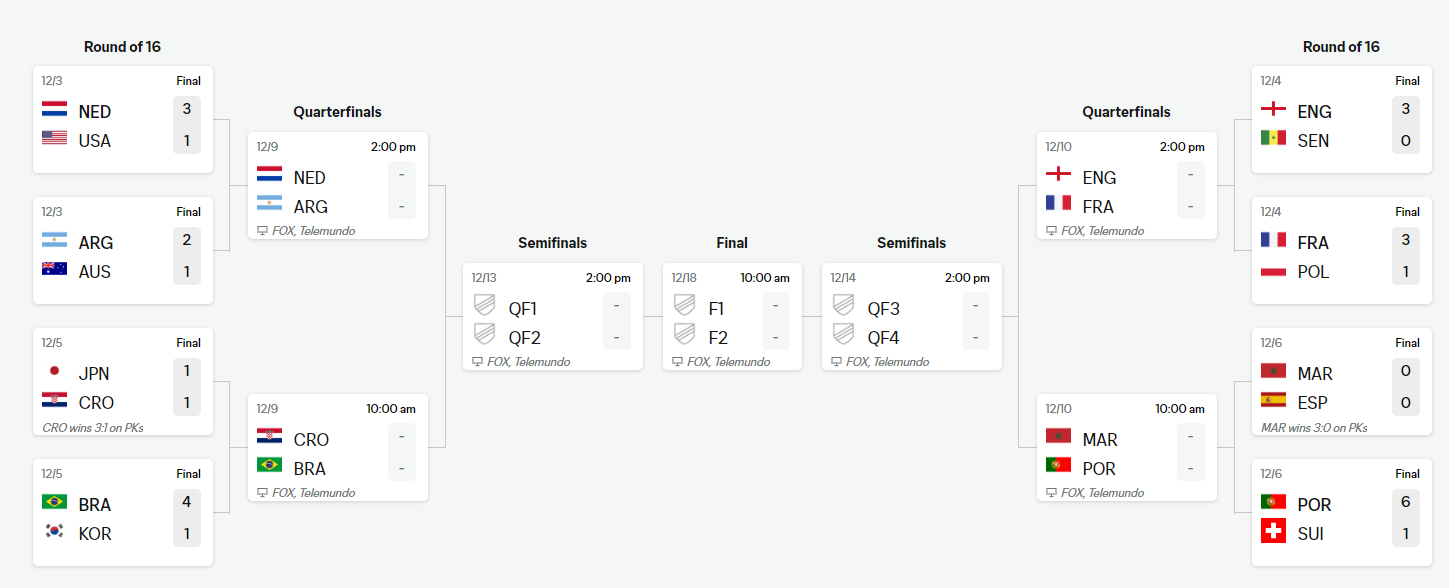
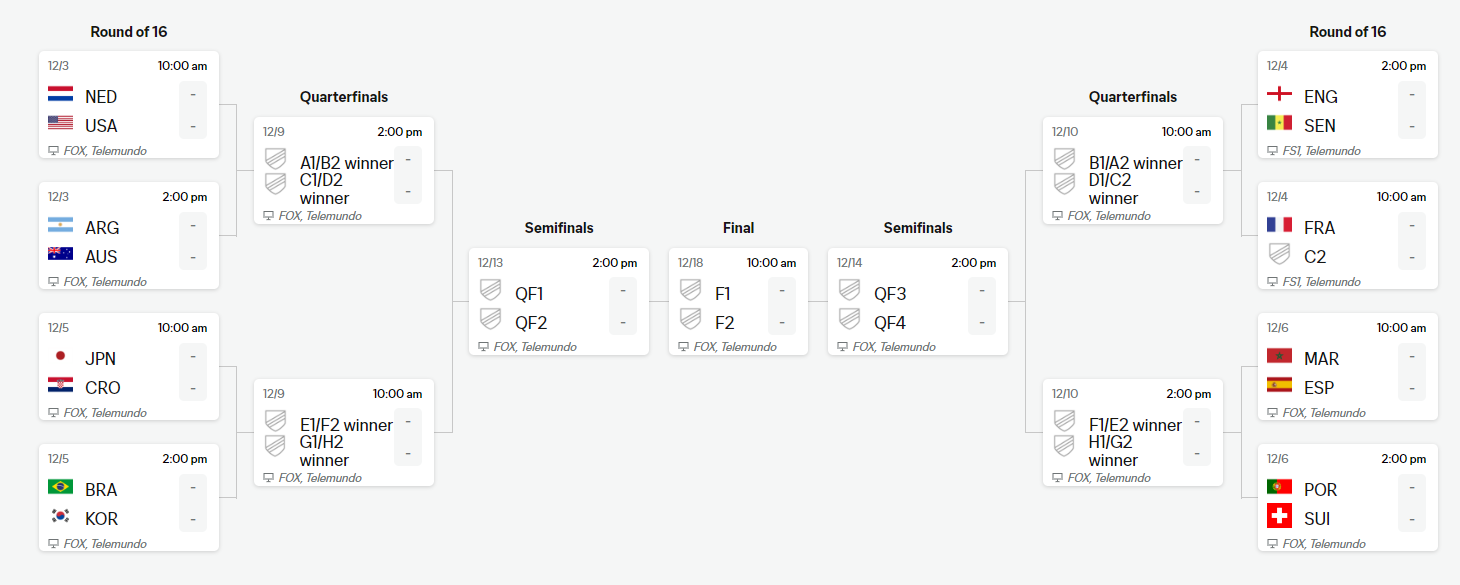
World Cup News  The Bracket

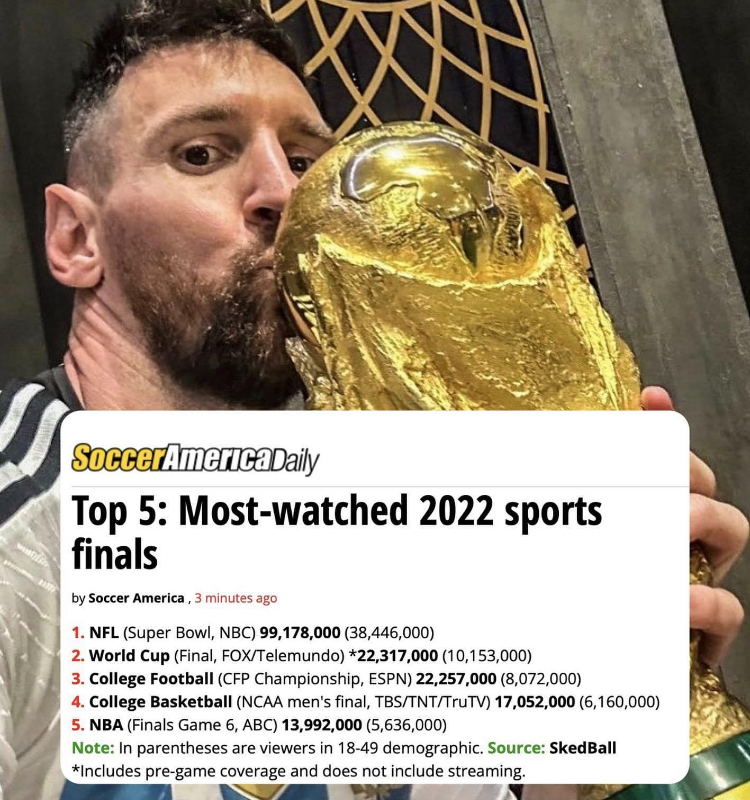
A record 25 million watched the World Cup Final in the US making it the most watched Soccer game on TV in the US ever. That’s more than the NBA Game 7 or NCAA Final or the College Football Final game last year. Yeah no one watches soccer. Here’s my Favorite Soccer Announcer Andre’s Cantor born in Bueno Aires but living in the US since his teenaged years as he calls the final whistle for Argentina.  Final Goals in Spanish  Messi being Carried Around the Stadium was classic!   Full 9 minute Highlights   Closing Ceremony World Cup

If you get a chance and you want to cry a little ESPN’s E60 Remember the Blue & Yellow is out now – about the Urkraine National Soccer team and their quest to make the World Cup in the middle of the Invasion by the Evil Russians.  Its definitely worth the watch. Oh and the Women’s World Cup is just 6 months away!

WORLD CUP GAMES ON TV

Wed, Dec 21                      League Cup

2:45 pm ESPN+                  Blackburn vs Nottingham Forest

2:$5 pm ESPN+                  Newcastle United vs AFC Bournemouth

3 pm ESPN+                      Man United vs Burnley

Thur, Dec 22                      League Cup

3 pm ESPN+                      Man City vs Liverpool

Mon, Dec 26                      Boxing Day

7:30 am USA                      Brentford vs Tottenham

10 am USA                         Leicester City vs Newcastle United

10 am Peacock                  Crystal Palace vs Fulham (Robinson, Ream)

12:30 pm NBC Aston Villa vs Liverpool

3 pm Peacock                    Arsenal vs West Ham United

Tues, Dec 27                     

12:30 pm USA                    Chelsea (Pulisic) vs Bournmouth

3 pm USA                            Man United vs Nottingham Forest

Wed, Dec 28                     

3pm  pm USA                   Leeds United (Adams, Aaronson) vs Man City 

Thurs, Dec 29                   

1 pm USA                            Queens Park Rangers vs Luton Town (US GK Horvath) 

Fri, Dec 29                         

2:45 pm USA                      West Ham vs Brentford 

3 pm Peacock                   Liverpool vs Leicester City

Soccer Saturday’s are every Sat 9-10 am on 93.5 and 107.5 FM with Greg Rakestraw

CARMEL FC PLAYERS : Winter Players League (WPL) – Badger Indoor Fieldhouse
As the fall season comes to a close over the next month, we wanted to let you know that we will be launching an indoor soccer league over two six week sessions within our new Badger Fieldhouse. Games will be played on either Friday night ( 6pm to 10pm) or Sunday afternoon (1pm-5pm) depending on age groups: U8s, U9&U10, U11&U12, U13-U15 and U16+ (Coed Teams allowed). Referees for each game, 50 minute games, 5v5, 7v7 and 9v9 matches.
Session One (6 weeks): Jan 6th, 13th, 20th, 27th / Feb: 3rd, 10th
Session Two (6 weeks): Feb 17th, 24th / Mar 3rd, 10th, 17th, 24th
Gather teammates and be ready to play!

 COOL STORY ABOUT MESSI & SOCCER

Born into poverty, Messi was a football prodigy from practically the day he could run. He was the talk of the town, attracting crowds even as a 5 year old. But at just age 10, Messi received some terrible news. He was diagnosed with Growth Hormone Deficiency, meaning that without expensive treatment, he would never grow normally and would never have the chance to live up to his talent.After local teams declined to pay for his $1000 a month injections, something that never before happened took place. One of Europe’s biggest teams, Barcelona, took a chance on this unknown foreign child and signed him, committing to pay for all his treatments, and providing him and his family with lodging. Remember, this is not an 18 year old star, this is sickly 12 year old child no larger than a 7 year old!

Messi’s treatment worked and boy did he repay Barcelona’s favor. He became the greatest player in its history (and any club history) winning them every possible trophy many times and weaving dizzying performances that made the entire world sing his name.That tiny boy who was born one year after the great Maradona stunned the world with his 1986 magical performances that last won Argentina a World Cup, overcame the odds of abject poverty and debilitating health to seal his legend as the greatest ever and launch millions into Argentina’s streets again. Even Hollywood could not write a story like this.

This is football. Mythical.

 Ten years ago, a Moroccan mother, Soad Al Affani felt all hope was lost after failing to find the funds necessary to help her 12 year old son, Waleed Kashksh, receive treatment for his Growth Hormone deficiency. Desperate, she took the long shot as only a mother could and wrote to Messi.To her surprise, Messi answered promising to help. And he kept his promise. He continued to consistently fund Waleed’s monthly treatment till only 4 years ago when he became 18 and no longer needed medical help.

This is football. Real.

I love football because it is a level playing field and an equalizer like no other, a truly global space like no other, a uniter of the world’s diversity in camaraderie like no other, a shared language of the people like no other, and a source of mass euphoria like no other. I love football because every side of every conflict in Argentina, Brazil, Italy, Egypt or Senegal – whether political or economic or social – will only stand shoulder to shoulder and together flood the streets in common purpose should their national team win a tournament.I love football because boys and girls who grow up playing barefoot with coconuts can be teammates with those born into aristocracy – and even get ahead. Because this is one space where your true value is in the joy you bring.
WORLD CUP FINAL

 Messis Status a GOAT Solidified but Mbappe proves he’s not far behind – Henry Bushnell Yahoo Soccer
Lionel Messi Argentina kits are sold out after historic World Cup victory
– that’s why I ordered mine a month ago – arrived Sat – a sign !
Lionel Messi Sets Instagram Record With World Cup Victory Post

Messi Emulates Maradona in Epic Fairytale Ending = The Guardian

World agrees that we’ve just witnessed the greatest World Cup final ever – the 18

Analysis: Most dramatic World Cup final caps a unique tournament in Qatar

No asterisk to Lionel Messi’s career. His brilliant resume now includes World Cup title. | Opinion
USA today
Lionel Messi, Kylian Mbappé among winners of World Cup. Not hard to guess the losers | Opinion
USA Today
Lionel Messi made to wear traditional Arab bisht for World Cup trophy lift

Lionel Messi finally wins a World Cup — and, after years of heartache, Argentina’s love

2022 World Cup awards: Best XI, Golden Ball, Golden Boot, Top Moments

Argentina vs France, player ratings: Lionel Messi dazzles with Kylian Mbappe perfect in defeat

Messi: “I wanted to close my career with this, I can no longer ask for anything else”

Messi Sits Atop a Different Mountain Now
‘Qatar put on maybe the best football tournament ever’

Argentina gets record $42 million for winning World Cup. See every team’s prize money

Goal of the Tournament Nominees Announced for 2022 FIFA World Cup

France fly out of Qatar as FIFA acclaims World Cup attendance

Thousands in Paris welcome France home after World Cup loss

Who are the best soccer players of all time?

Why Messi and Argentina can’t keep the trophy

World Cup rankings: How history’s previous editions were rated
Goalkeeping

 Best World Cup Saves – Vol 4

Shoot out Drama –
How Emiliano Martinez’s mind games created shoot-out glory for Argentina

Emiliano Martinez’s shoot-out shenanigans take gamesmanship to a new level

From Fan in 2018 to World Cup Savior in Qatar – Argentine keeper Martinez is Improbable Hero – Bushnell Yahoo
Pictured: Emiliano Martinez performs lewd trophy gesture after Argentina’s World Cup win

Emiliano Martínez shimmies, saves and secures Argentina’s World Cup with vital saves at the end

FIFA World Cup 2022: Argentina goalkeeper Martinez wins golden glove
Lloris says ‘time for Mbappe’s generation’ after World Cup final loss

MLS

Everything to know about MLS SuperDraft 2023: How to watch, order, more

WORLD

Ballon D’Or winner Benzema ends tumultuous France career after Qatar blow

Messi’s World Cup triumph leaves America his last frontier to conquer as Inter Miami waits | Opinion  Miami Herald
League Cup: How to watch live, schedule, scores, updates

Fantastic EPL Commercial Show’s what Erlend Haaland Has been Doing While Everyone is At the World Cup –the 18

Reffing

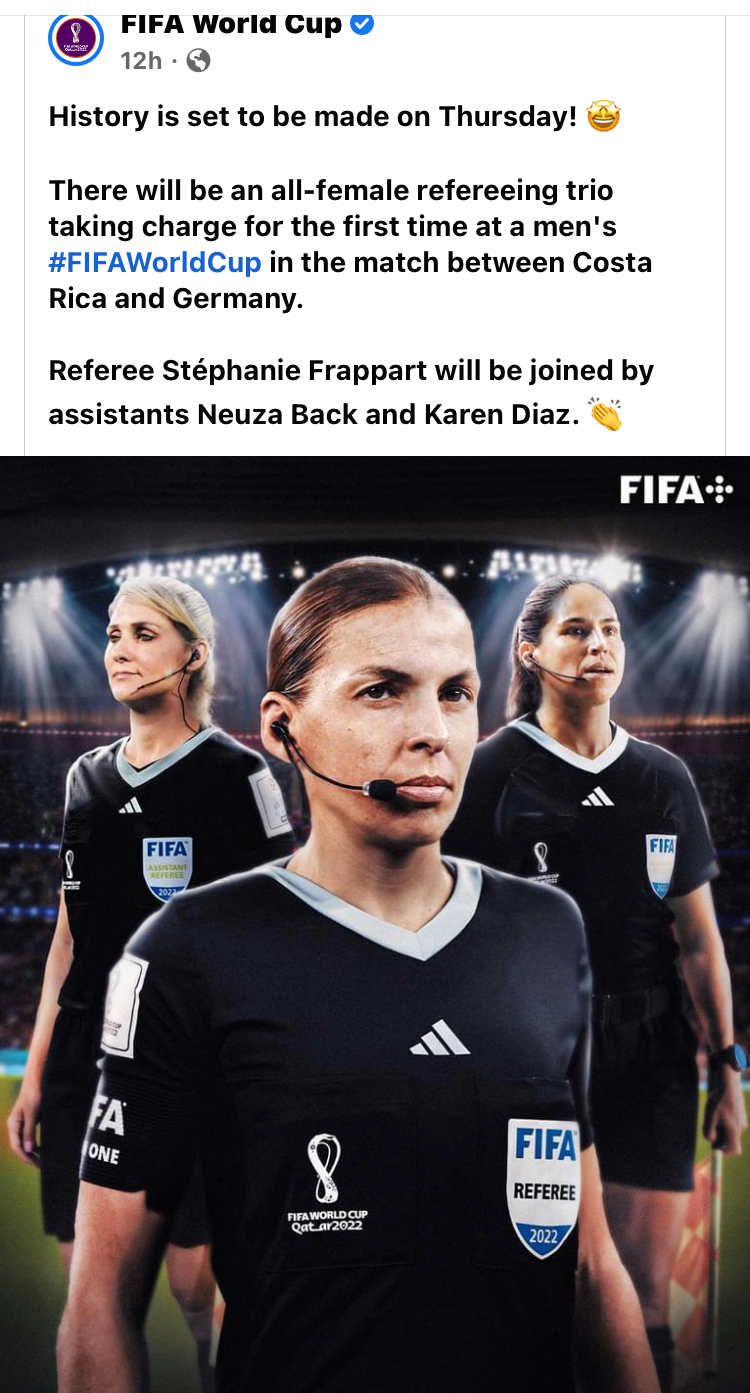
American MLS Ref Ismail Elfath: was the 4th official for the Final!

Austin Ref to do World Cup Final

U.S. Soccer referees to officiate FIFA World Cup Final for first …

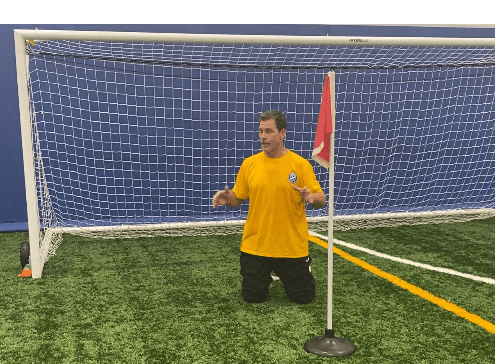
CARMEL FC GOALKEEPERS: NO TRAINING NEXT WEEK – Wednesday Night Trainings Jan-Mar – Badger Indoor Fieldhouse 5:30 pm U12//6:30 pm U13-U14//8:30 pm HS U15+. 

Not sure what other clubs have – but Carmel FC has former US Men’s National Team World Cup GK & Coach Juergen Sommer coaching the high school age, Hall of Fame Canadian World Cup GK Carla Baker coaching the U15s and myself coaching the U12s this winter. 
World Cup: A storybook ending
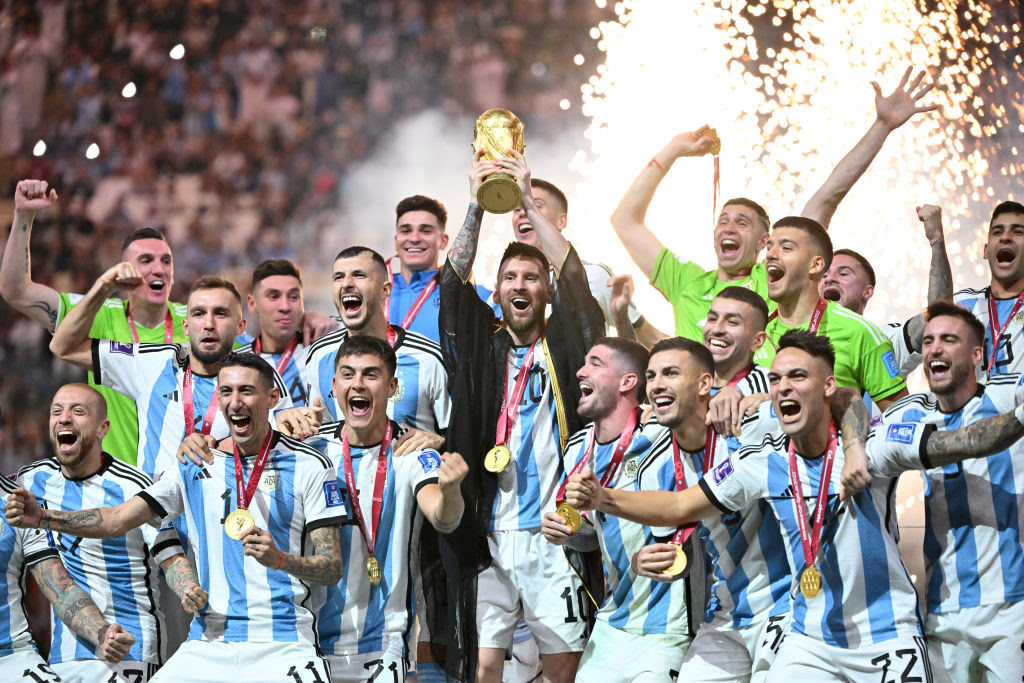
Lionel Messi of Argentina lifts the World Cup after winning the FIFA World Cup Qatar 2022 Final match between Argentina and France

The GIST: The legendary Lionel Messi and No. 3 Argentina are your 2022 FIFA men’s World Cup champions after taking down Golden Boot winner Kylian Mbappé and No. 4 France yesterday in perhaps the greatest sporting event ever. Couldn’t have written a better ending.

How it happened: With a 2–0 lead and less than 11 minutes to go in regulation, it seemed as if Argentina would sail to the title. But Mbappé took matters into his own feet, er, hands, scoring twice in under two minutes to send things to extra time.

  • That’s where both squads’ brightest stars traded late goals, with Messi netting what looked like the game-winner before Mbappé equalized, notching the first men’s World Cup final hat trick since 1966 to force anxiety-inducing penalty kicks (PKs).
  • It wasn’t too stressful for Argentina keeper Emiliano Martínez, though. He danced his way to a clutch save before Gonzalo Montiel netted the game-sealing PK to secure Argentina their third World Cup title and their first in 36 years. What a moment.

The significance: Yesterday marked Messi’s record-setting 26th and final men’s World Cup appearance, and he celebrated by nabbing the trophy that eluded him in his four previous tournaments. He also won the Golden Ball (aka tourney MVP), becoming the first man to do so twice. Consider that GOAT “debate” settled.

Off the field recap: As thrilling as yesterday’s action was, the confetti and fireworks can’t cover up Qatar’s atrocious human rights abuses in the lead up to and throughout the tournament. From quelling player protests to ignoring the deaths of migrant workers, Qatar and FIFA need to pay up and do better.

What’s next: FIFA will have a chance to do just that when the women’s World Cup kicks off from Australia and New Zealand in just 213 days. Not like we’re counting…

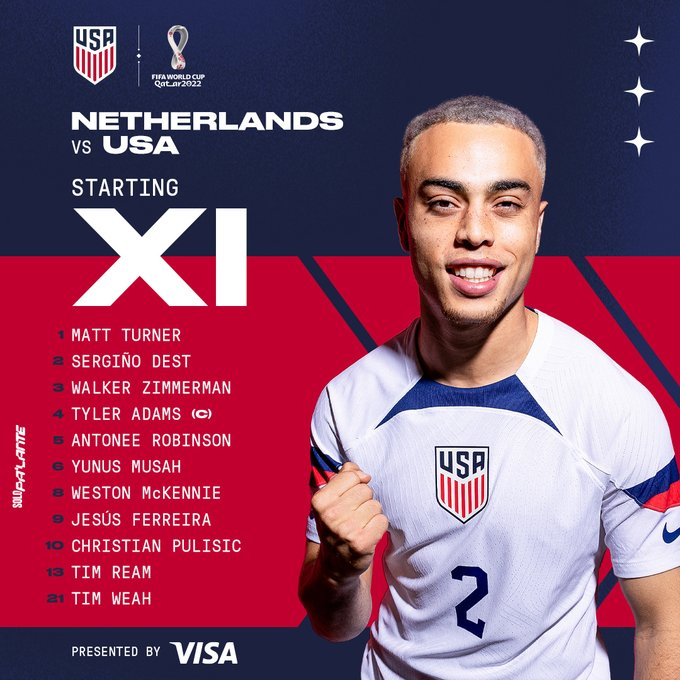
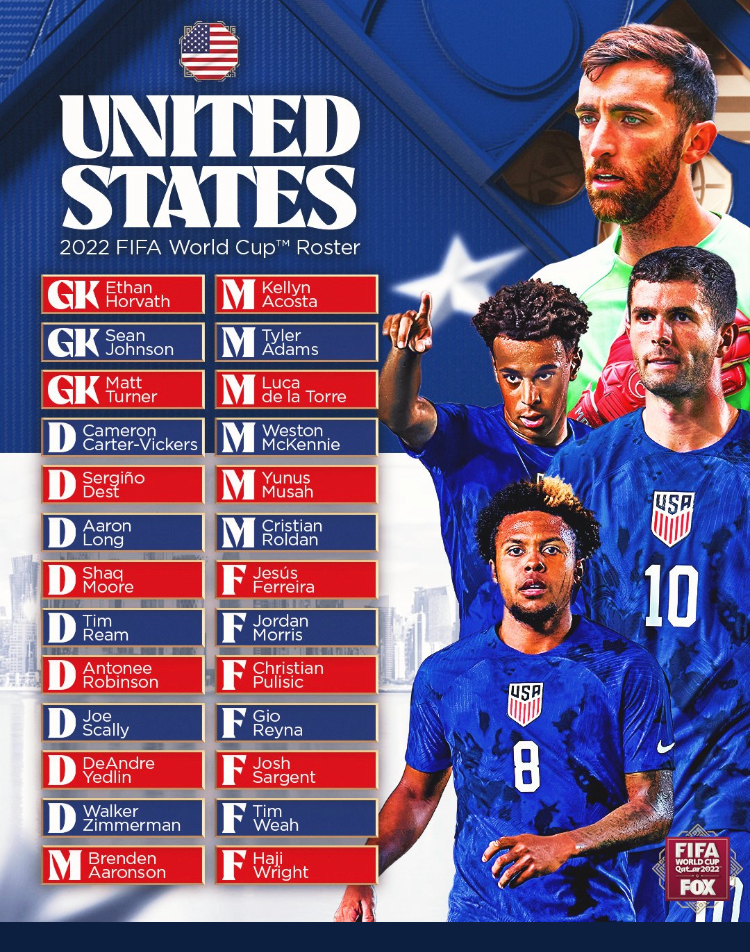
USMNT’s Christian Pulisic ‘still thinks’ about first-half chance during Netherlands World Cup loss

DOHA, QATAR - DECEMBER 03: Andries Noppert of Netherlands makes a save from Christian Pulisic of United States during the FIFA World Cup Qatar 2022 Round of 16 match between Netherlands and USA at Khalifa International Stadium on December 03, 2022 in Doha, Qatar. (Photo by Richard Heathcote/Getty Images)

By Jacob Whitehead5h ago6


United States forward Christian Pulisic has revealed he still dwells over a missed first-half chance over two weeks after his side’s loss to the Netherlands.In the third minute of the last-16 tie, Pulisic was through on goal, presented with a one-on-one chance against Netherlands keeper Andries Noppert.His weak effort was saved however, and the Netherlands took a 2-0 lead by the end of the first-half after goals from Memphis Depay and Daley Blind.Haji Wright’s goal could not spark a comeback, and the Netherlands completed a 3-1 win thanks to Denzel Dumfries. The Netherlands would lose on penalties to Argentina in the quarter-finals.Speaking on teammate Tim Ream’s ‘Indirect’ podcast, Pulisic revealed he still dwells on the moment.“Had I finished that chance, the game goes differently,” he said.“I would love that back. I still think about it. It’s a learning experience. I think there’s a reason why it didn’t go in, things happened the way it did. It all happens for a reason.”However, he revealed that results did give him optimism for when the United States host the World Cup alongside Canada and Mexico in 2026.“I think my most significant takeaway would just be the experience that a lot of this team now has under their belt,” Pulisic said. “Coming back here with my Chelsea teammates, for example, they’re all talking about like, ’You guys actually have a good team. We didn’t know. You guys looked good, you guys looked good against England, you guys have a strong team.“I knew we had a strong team, and once everyone kind of came together, you could see that. And also now with the World Cup in the States next time around, I think these experiences are so important.”

LUSAIL CITY, QATAR - DECEMBER 18: Lionel Messi of Argentina celebrates with teammates and the FIFA World Cup Qatar 2022 Winner's Trophy after the team's victory during the FIFA World Cup Qatar 2022 Final match between Argentina and France at Lusail Stadium on December 18, 2022 in Lusail City, Qatar. (Photo by Alex Pantling/Getty Images)

Ranking all 22 World Cups: How Qatar compares in unpredictability, goals and controversy to past editions

Dec 20, 2022

  • James Tyler
  • Bill Connelly
  • Phew! The 2022 World Cup is over, Lionel Messi has that elusive prize and Argentina have bragging rights over the soccer world for the next four years. So, it’s time to re-rank.

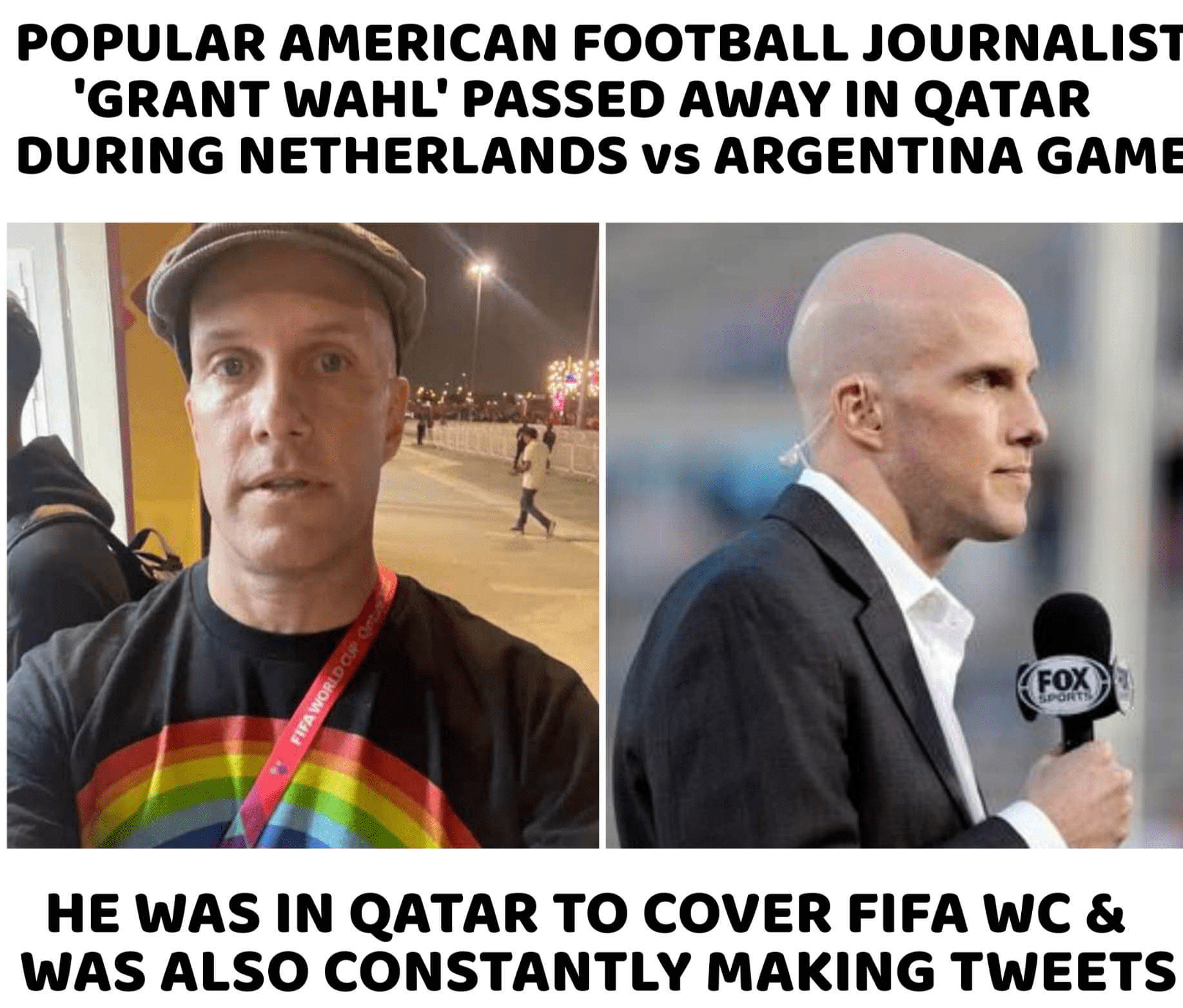
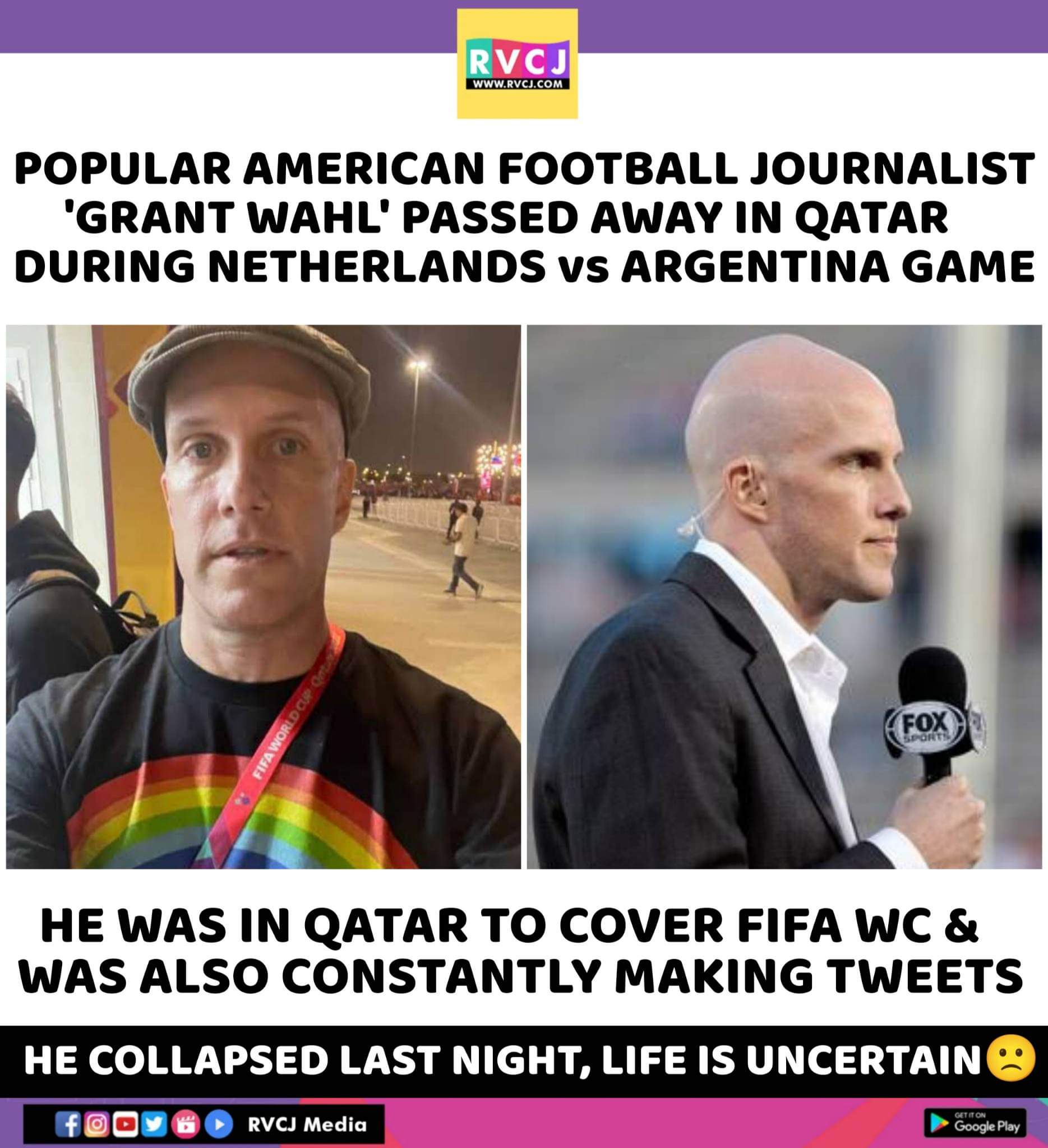
Every FIFA representative near a microphone has been quick to call this one of the best World Cups ever, but in one way or another, most of them have been pretty good. While recency bias will almost certainly play a role here, let’s go category-by-category and see how the last month shapes up with its historic peers.Before we begin, we must address the obvious. The World Cup is where sports and politics overlap and intersect in the messiest ways. This tournament was awarded in the shadiest possible fashion, hundreds (at least) of migrant workers are believed to have died during its preparation, and Qatar leaned too far for comfort into “Respect our culture!” when its criminalization of being gay was raised and rainbows threatened to appear on shirts or armbands. This isn’t a new thing for the World Cup: The tournaments in 1934 and 1938 were vehicles for Italy Prime Minister Benito Mussolini to promote fascism, while the 1978 edition in Argentina was held while the country was governed by a military junta.Also, on a personal note, the shocking death of journalist Grant Wahl at Argentina’s quarterfinal with the Netherlands was a reminder to all of us how fragile life is.Regardless prior to this tournament, Bill Connelly and I tried to put every previous edition into a highly scientific and rigorously analytic ranking from worst to best. With the festivities in Qatar wrapped up, now let’s figure out where the 2022 edition fits into everything.


Great players (1-10): 5

Bill Connelly: When the primary storyline of the final pits Kylian Mbappe vs. Lionel Messi, both playing at or near the peak of their effectiveness, that’s a pretty good start. And you certainly get some points for the number of incredible international talents almost certainly playing in their final World Cup — Messi, Luka ModricCristiano RonaldoRobert LewandowskiLuis SuarezSergio Busquets, et cetera.

The competition is also noteworthy, however, for who it lackedErling HaalandMohamed Salah and [pick your favorite player from the Italian team], plus injured stars like Karim BenzemaN’Golo Kante and Christopher Nkunku. There is always star power at the World Cup, but in the end I don’t feel like this competition had any more than others even if the two biggest stars shined particularly bright.

– World Cup rankings: How history’s previous editions were rated

James Tyler: I agree with you here. Also, this World Cup has been about the surprise packages (MoroccoJapan) as well as the more surprising names on various rosters. (Did anyone have Alexis Mac Allister as one of their players of the tournament? Me neither.) This has been a tournament where the collective has broadly outdone the individual talent, not to mention the drop in star power either through those injuries or through failure to qualify.

Oh, and some of the players to really impress aren’t quite at that level, either, from Hakim Ziyech to Julian Alvarez (he’ll be there someday, though) to Cody Gakpo. They might be on the billboard four years from now, but their performances in Qatar this winter certainly weren’t the ones we were watching for pre-tournament.

BC: And honestly? That’s the kind of tournament I tend to enjoy even more. I knew Messi was awesome, so nothing he could do here would have surprised me. Getting to know someone like Alvarez and getting a huge reminder of what Ziyech can do when he actually plays was delightful.

France sure could have used Benzema, Kante, Nkunku and Paul Pogba in the final, though, huh?


Goal quantity/excitement (1-5): 5

JT: I’ll take this one first. The excitement has been there from start to finish, with a number of knockout round games going to the wire and several others showcasing the best that soccer has to offer — that’s right: all-gas, no-brakes attacking soccer and heroic, last-ditch defending. But at the same time, we did get more 0-0 games than the past World Cup and I think more than 2014 as well, while some of the games (any involving CroatiaBelgium) were simply lacking in quality and finishing.

The US huffed and puffed but failed to blow anyone’s houses down, and if you take out some of the more lopsided results — Portugal‘s 6-1 rout of the Swiss in the round of 16, England thundering Iran and Spain laying waste to Costa Rica — it definitely lacked some of the pizzazz of tournaments past. I do think the midseason fit had an impact here, as players were a little tired at times and tactics were mercifully kept quite basic. Several games had the feel of something attritional rather than attractive.

BC: On the flip side, we got the most goals ever and a 3-3 final. Really, this was a “something for everyone” situation. The group stage gave us six 0-0s, nine 1-0s, three 3-2s, two 4-1s, a 3-3, a 4-2, a 6-2 and a 7-0. The knockout rounds gave us a shootout after 0-0 and two shootouts after 1-1 — so, four total goals in 360 minutes, plus a 1-0 after 90 minutes as well — along with two 3-0s, a 4-1, a 6-1 and a glorious final. In the end, I’d say the latter outweighs the former.


Upsets (1-5): 4

EDITOR’S PICKS

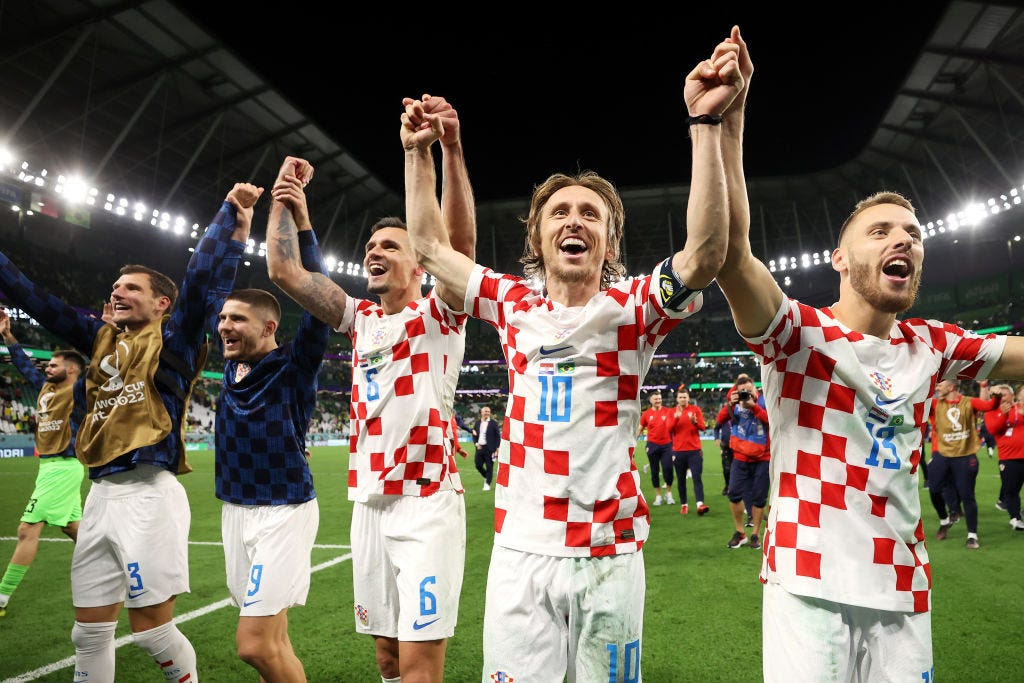
BC: Morocco beat Belgium, Spain and Portugal. Japan beat Germany and Spain. (In between, Costa Rica beat Japan.) Saudi Arabia nearly derailed Argentina’s title bid before it even got started with a 2-1 win. Croatia beat Brazil, which was an upset even though it was also a defending finalist beating a 2018 quarterfinalist. South Korea advanced over Portugal and Uruguay. If we’re including what amounted to dead rubbers, Cameroon beat Brazil and Tunisia beat France, which likely mattered quite a bit to Cameroon and Tunisia.

That’s a lot. Upsets were this competition’s calling card in the group stage.

JT: Even though we mostly got chalk in the knockout stages — with the notable and joyous exception of Morocco — the group stage had plenty of humble pie for overconfident superpowers.

BC: One more knockout upset, and it gets the full five points.


Location/Fans (1-5): 2

BC: When the host nation doesn’t bring an enormous and vocal fan base to the table — and a percentage of the fans it does bring are hired hands from elsewhere — and its team quickly exits the tournament (Qatar lost its three group stage matches by a combined 7-1), and the location itself is pretty expensive and hard for millions of fans to reach, it’s going to be difficult to give a score of more than 1.

LIVE ON ESPN+ (SELECTED GAMES)

The beautiful game lives here. Stream top leagues, tournaments and teams.
Sign up for ESPN+

FRIDAY, DEC. 23
• Gent vs. Standard Liege (2:25 p.m. ET)

MONDAY, DEC. 26
• Sunderland vs. Blackburn (7:25 a.m. ET)
• Sheffield Utd vs. Coventry City (10 a.m. ET)
• Cardiff City vs. QPR (12 p.m. ET)
• Luton Town vs. Norwich City (2:40 p.m. ET)

TUESDAY, DEC. 27
• Bolton vs. Derby County (10 a.m. ET)
• Reading vs. Swansea City (12 p.m. ET)
• Burnley vs. Birmingham City (3 p.m. ET)

I say we should add a bonus point, however, and for basically one reason: The Arab and North African fans showed the hell up. Morocco fans made this tournament. Tunisia and Saudi Arabia matches popped as well. And with the noise that Argentina fans made (as always), some of the most important matches had great atmospheres. That’s worth something, I say.

JT: The lack of visible fan groups definitely meant we were struggling for those defining images off the pitch of wild celebration or melting pot-like joyous collisions of culture and custom, as well as some of my fave World Cup stories around the journeys taken by fans simply to get to the games. That said, the stadiums were packed with regional support, the surprise teams were warmly embraced by the host nation, and the scenes of Morocco celebrations in particular will stick for a long time. Not to mention the Japan fans cleaning up after their games.

We still got some cool fan moments, but not as many.

Marcotti: Qatari fans’ disinterest disappointing for organisers

Gab Marcotti gives his thoughts on the reaction of Qatar’s fans after many were seen leaving the stadium from half time onwards.


On-field controversies (1-10): 10

JT: The use of semi-automated VAR did rub fans the wrong way on many occasions, and the officiating of Antonio Mateu Lahoz in that Argentina-Netherlands game was a kind of chaos we tend to expect from World Cups. (Eighteen yellow cards? Really?) But by and large, results were accepted as largely fair based on VAR reviews, officiating and the lack of any sinister subtext. From that perspective, we got a reasonably clean event on the pitch.

There were also more than a few gripes and frustrations with the revised approach for added time, too, with several goals scored after what seemed like 10 or 15 minutes tacked on at the end of the first or second half. Not to mention that players clearly struggled with it most of all, with several (namely Uruguay’s players after realizing they were eliminated) getting up close and personal with the officials.

BC: When we were putting together the initial rankings, this was the part I struggled with the most. I finally made peace with the idea when I realized we were ranking these competitions by memorability as much as anything else. And we’ll remember all of it as much as the exploits of Messi and Mbappe, and that’s FIFA’s fault.


Great final (1-5): 5

JT: OK, this wasn’t just a great final, but perhaps the best World Cup final ever? It wasn’t just the six goals and penalty shootout that makes me think this, but the flurry of narratives (Messi’s cruising to his first World Cup!), the explosion of those narratives in favor of crazier ones (Mbappe is about to win his second World Cup before turning 24!) and the eventual return to Messi finally holding that elusive trophy.

We had 79 minutes of Argentina control before 93 seconds of Kylian Mbappe brilliance — one converted penalty, one emphatic volley — took the game to extra time. We had two of the best nations in the world defending like deer on ice to stop further goals. We had dives in the box and legitimate penalties. We had Hugo Lloris and Emi Martinez conceding three times apiece but also making enough saves to feel like they could have won Player of the Match, with Martinez’s sprawling shin-stop to deny Kingsley Coman with seconds left in extra time the most crucial stop of all.

We had enough momentum swings to power the electricity needs of a small town, we had goals in extra time, we had a gripping penalty shootout and a partridge in a pear tree.

BC: I think only three finals have a claim for competing with what we just saw: 1974 (West Germany 2-1 Netherlands), 1954 (West Germany 3-2 Hungary) and 1950 (Uruguay 2-1 Brazil, which technically wasn’t a final, but whatever, it basically was). Both 1950 and 1954 were among the greatest upsets the sport has ever seen, all three had plenty of plot twists, and both 1954 (Ferenc Puskas, Nandor Hidegkuti) and 1974 (Johan Cruyff, Gerd Muller, Franz Beckenbauer) featured some of the greatest players in the history of the sport. At worst, this final was equal to those. We gave all those matches 5s, so this one is a 5 too. But that almost doesn’t feel like enough.

Moreno: World Cup final the best game I have ever seen

Ale Moreno says the World Cup final delivered on every level as Argentina took the trophy in dramatic fashion.


Bonus points (1-10): 4

JT: Richarlison‘s goal. The glut of 90-plus-whatever-minute goals that were either decisive or heartbreaking thanks to the revised guidelines around added time. (Like Iran over Wales thanks to not one, but two strikes in that injury time window.) Every single group (bar maybe A?) literally coming down to the final 5-10 minutes. Mexico‘s second half against Saudi Arabia, including that Luis Chavez free kick. The denouement of Group E in which every single one of Spain, Japan, Germany and Costa Rica was through or eliminated. Every game involving SerbiaJose Maria Gimenez‘s naked rage when Uruguay were knocked out by South Korea’s win over Portugal. England thinking It’s Coming Home until Harry Kane had other ideas, skying that second penalty against France into the heavens. Cristiano Ronaldo’s sadness juxtaposed by Lionel Messi’s joy.

In short, there were more than enough magical moments to merit a decent score, but a decade from now, I’ll remember this World Cup for who ended up holding it in Lusail and probably little else. (That said, this World Cup, the last one with 32 teams, actually made the best possible argument for why it should remain at 32 teams. Alas …)

BC: I say all that you just mentioned is worth a few bonus points, as is the fact that it was Messi and Mbappe driving the best final of our respective lifetimes. So … six points for all of that, and then a two-point deduction for the weird timing (and the fact that everything was crammed into the shortest possible time frame imaginable, which meant the whole thing just raced by us with minimal time to react), and we end up handing out four bonus points? How’s that sound?

JT: I’m good with this. The fact that I’m sitting here knowing full well I’m forgetting some other epic moments is all thanks to the dizzying speed at which this tournament went ahead. And I also feel like we could be stingy and knock another one off for all the superstars who simply didn’t turn up at this tournament, for one reason or another. We’ve talked Ronaldo, but Kevin De Bruyne was quiet by his standards, Romelu Lukaku had a hattrick of “how did he miss that” attempts, and Uruguay had three all-world forwards (Suarez, Edinson CavaniDarwin Nunez) who didn’t trouble the scoresheet.


Total: 35

So, after all of that, we’ve arrived at 35 points for this World Cup — some granted through raving, some through ranting. Here’s where that fits into the overall ranking:

1. 1982 (40)
2. 1986 (39)
3. 2006 (38)
4. 1998 (37)
5. 1970 (36)
6-T. 1994 and 2022 (35)
8. 1966 (34)
9. 1974 (33)
10. 1950 (32)
11. 2002 (31)
12. 2014 (30)
13. 1954 (29)
14. 1958 (28)
15. 2010 (27)
16-T. 1962 and 1990 (26)
18. 2018 (25)
19. 1978 (24)
20. 1938 (23)
21. 1934 (19)
22. 1930 (14)

BC: So, Qatar 2022 goes down as the second-highest-ranking competition of the 2000s and the second among competitions won by Argentina. Messi has tied or topped Maradona in just about every possible category now, but it appears we’re still giving Maradona’s run the higher billing in this regard.

JT: We should absolutely give Maradona a higher billing for the surrounding moments of his crowning accomplishment, though Messi has certainly etched his name in soccer lore by finally claiming this. And maybe there’s a weird bonus point in our scoring for Messi’s sake, too.

It’s also somewhat fitting that the US-hosted World Cup shares the same rarified air of sixth place — good enough for the Europa League! — given that it’ll be North America’s turn up next. Considering that 1994 was the USA’s real maiden voyage on the global soccer scene, and you look at the frenzied popularity of the sport here in 2022, it’ll be fascinating to see what comes next in 2026. I mean, 48 teams playing across three countries should be fun, right? Right?

The night Messi won the World Cup – told with some help from the man himself

Oliver Kay Dec 18, 2022

When the moment comes, Lionel Messi falls to his knees and looks to the heavens.Most of his team-mates have already set off in celebration, but Messi stays on the halfway line, overwhelmed not just by emotion upon reaching the end of his odyssey but by exhaustion after a breathless, enthralling, unforgettable World Cup final.Argentina are world champions for the first time since 1986, the year before Messi was born. At 35 it is the crowning glory of an extraordinary career that had never lacked mbellishment.Messi craved World Cup success because he felt he owed it to himself and his country. And now, after Argentina overcame France in a penalty shootout after a pulsating 3-3 draw in which he scored twice and his Paris Saint-Germain team-mate Kylian Mbappe hit a hat-trick for France, Messi has delivered that success, just as the great Diego Maradona did 36 years ago.

Messi lifts the trophy (Photo: Julian Finney/Getty Images)

In the build-up to this final, The Athletic wrote extensively about Messi’s journey through four World Cup tournaments, about the parallels with Maradona and about the way both players have redefined the meaning of greatness in football.We decided to approach Sunday’s final with a different perspective, reflecting Messi’s experiences — and the final steps of that odyssey before he leaves the World Cup stage for the final time — through his own words in the past as well as through his actions on a day which promised to define a glorious career.As he said on Sunday evening, “This was the trophy I wanted all my life. This was my dream from childhood.” At the fifth and final time of asking, he has fulfilled that fantasy — and he did so in a way which, among other things, called upon the joyous, free-spirited football of his youth.


“I have fun like a child on the street.”

The first two minutes go by without Messi touching the ball. Others seek to get an early touch, eager to impose themselves on the game and on the opposition. Julian Alvarez is charging everywhere, tryingo unsettle the French defence, but Messi looks passive. He often does.Then he comes to life: first a clever ball out to Angel Di Maria on the left-hand side, which becomes a recurring problem for France, and then, when the cross is overhit, an exchange of passes with Rodrigo De Paul. A minute later the Argentina captain is caught from behind by Dayot Upamecano while contesting an aerial ball.Suddenly Messi is involved in everything, helped by De Paul’s tenacity in forcing the play on Argentina’s right-hand side. Alexis Mac Allister, having tested Hugo Lloris from distance, looks up to be reminded that Messi was free five yards to his right. It is remarkable how often he is in space.

Argentina look so much more energetic all over the pitch. On eight minutes, receiving possession from Enzo Fernandez, Messi plays a lovely ball through the middle for the excellent Mac Allister to run onto. That leads to a De Paul shot which is deflected wide.Again and again, receiving the ball in the inside-right channel, Messi looks for that pass into space for Di Maria on the left wing. From one such move, Di Maria moves forward menacingly and Messi hangs back, ready to attack the ball when, as he anticipates, it will be cut back to the edge of the penalty area. Sure enough, that is where Di Maria delivers the ball, but Aurelien Tchouameni makes the interception, at full stretch, just as Messi is preparing to connect.

As well as that dinked pass to Di Maria, Messi is looking to make little lay-offs when he receives the ball in tighter spaces with his back to goal, very much having fun like that child in the street. One such lay-off, in the 17th minute, sends De Paul scurrying down the right-hand side and Messi goes off in search of the return pass. De Paul picks him out, but Messi overruns the ball. A let-off for France, but not for long.


“The penalties. I would like to be more effective. But when the moment comes it’s much more difficult to do it than it looks.”

Inside Lusail Stadium, you can sense the moment is coming for Argentina. Their attacks are in waves and France, the world hampions, have no idea how to stem the tide.On 21 minutes Di Maria moves in from the left-hand side, away from Ousmane Dembele, and Messi, having initially hung back, darts towards the near post in the expectation of cross. It doesn’t come because Di Maria is tripped. Szymon Marciniak immediately points to the spot — a soft penalty, but a legitimate one.And now it is Messi time.For the fifth time in this World Cup (the sixth if you include the shootout in the quarter-final against the Netherlands) he is about to take a penalty.

Messi scores his opening penalty (Photo: Dan Mullan/Getty Images)

The strange thing about Messi is that his penalty record, in contrast to just about every other aspect of his game, is distinctly average. His overall career record, going into the World Cup final, was 108 successful kicks out of 140 — a conversion rate of 77.1 per cent. To draw the obvious comparison, this is an area where Cristiano Ronaldo’s stats are far more impressive: 146 successful kicks out of 175, a conversion rate of 83.4 per cent.In the past 12 months alone, Messi has seen high-pressure penalty kicks saved when playing for PSG against Real Madrid in the Champions League and for Argentina against Poland in the World Cup group stage — and that is before we think back to the most painful miss of all, in the shootout against Chile in the Copa America final in 2016.Coaches and analysts have come to recommend two courses of action when taking penalties.The first is for the taker to absent himself or herself from the shenanigans that precede almost every penalty, when their opponents are arguing, remonstrating or trying to cause a distraction. Messi does that, removing himself from the scene until the inevitable fuss has died down. Only then does he step forward and pause, closing his eyes and composing himself, awaiting the referee’s whistle.The second is to take the penalty in your own time, not to regard the whistle as a starter’s pistol and rush the kick. Messi ignores that bit. Barely has Marciniak blown his whistle than the Argentina captain is on the move, but his kick is confident, stroked to the left of Hugo Lloris, who goes the other way. Off Messi goes in celebration, sliding on the turf in front of the cameras. Argentina are on course.


“What I do is play football, which is what I like. I do it because I love it — and that’s all I care about.”

There are few things in sport like watching Messi when the entire game is flowing through him. For the period of 15 minutes either side of the opening goal, he is irresistible.

As the first half goes on, everything he does seems to work perfectly: the lay-offs, the delicate passes out towards Di Maria, one of them preceded by a delightful body-swerve away from Antoine Griezmann in midfield.

As well as Messi’s deft touches, there is so much movement around him. On 36 minutes, with his back to goal, he controls the ball and plays it, with the perfect amount of back-spin, to Alvarez, who releases Mac Allister with a brilliantly weighted pass. The timing of Mac Allister’s run is matched by that of his pass to pick out Di Maria, who sweeps the ball home for a wonderful second goal that has Messi, his team-mates and their fans in dreamland.

Di Maria celebrates with Messi and others (Photo: Matthias Hangst/Getty Images)

At this point, it is beginning to feel like a procession, leading to a coronation. France coach Didier Deschamps has made a double substitution as early as the 41st minute, replacing Dembele and Olivier Giroud with Marcus Thuram and Randal Kolo Muani in search of more energy and industry on the wings, pushing Mbappe through the middle, but half-time comes and goes without, initially, any real improvement in France’s performance.

It is, however, no longer the Messi show. His contributions — and Argentina’s attacking threat — become more intermittent. Messi still seems to be having the time of his life, enjoying himself just as he did as a kid playing on the streets of Rosario.


“I get more nervous today than when I was younger. To lose today means so much more. When you lose as a 15-year-old, that’s part of growing up. But today we’re fighting for titles.”

France’s comeback seems to happen without warning. On 79 minutes Kolo Muani goes beyond the Argentina defence and is wrestled to the floor by a desperate Nicolas Otamendi. Mbappe dispatches his penalty even more confidently than his PSG team-mate had done earlier. Messi, walking back towards the halfway line, puts his hands on his head, as if to say, “Surely not. Please, no.”

Mbappe sprints back to restart the game after France’s first goal (Photo: Buda Mendes/Getty Images)

It gets worse for Argentina, though — and for Messi. Barely has the game restarted than the Argentina captain is dispossessed by Kingsley Coman, allowing France to set off on the counter-attack. Mbappe moves ominously down the left-hand side, plays the ball infield to Thuram, who sends it back to him. On the half-volley Mbappe strikes a shot of outrageous power and precision. France, almost unimaginably, are level, having scored twice in 97 seconds.

Messi looks dismayed, his shoulders sagging, his chin dropping to his chest. As France’s players celebrate, Messi looks up to the scoreboard and sees the replay of Mbappe’s equaliser. Seeing that, sensing that clear shift in momentum — and knowing better than almost anyone just how formidable his PSG team-mate is — he must be fearing the worst.

Messi looks on in disbelief (Photo: Buda Mendes/Getty Images)

The closing stages of normal time are chaotic. Both teams are going for it, as if desperate to avoid an extra half-hour let alone what might lie beyond. Mbappe threatens at one end, Messi likewise at the other, deep into stoppage time, with a rising shot that Lloris pushes over the crossbar.

Just as they had done in the quarter-final against the Netherlands, Argentina have let a 2-0 lead slip. Argentines of a certain age could be forgiven experiencing for a feeling of deja vu. In that 1986 final they led West Germany 2-0, only to be pegged back by two goals in quick succession.

On that occasion Maradona intervened, his superb through-ball releasing Jorge Burruchaga to score the winner. But Maradona was 25. Messi is 10 years older — and he looks utterly exhausted.


“You have to fight to achieve your dream. You have to sacrifice and work hard for it”

There have been occasions over the years, when huge matches in the Champions League and the World Cup have run away from his team, when Messi has appeared lost.

Against Croatia at the last World Cup, as Argentina fell to a 3-0 defeat, he looked like a man whose world was collapsing around him. When his team needed leadership, Messi looked like he needed someone to show him the way.

We have seen a different Messi at this World Cup — shouting, imploring, sometimes even snarling. He will never be a natural, dominant leader in the manner of a Daniel Passarella or an ebullient, outrageous personality like Maradona, but we have witnessed Messi becoming a quietly authoritative captain. It is as if the challenge of leading this young Argentina team has brought out another side to his character.

During a gruelling, anarchic period of extra time, both teams are scrapping for every ball and even Messi, who has usually been above such primitive stuff, is getting involved. At one point, having lost the ball to Eduardo Camavinga, he resorts to something like a rugby tackle to stop his opponent getting away. A yellow card would not go amiss.

Messi got stuck in to tackles (Photo: Lars Baron/Getty Images)

Messi looks spent, as if he is only being kept on in the hope of it reaching a penalty shootout. Is this a legacy of staying on until the end with the match won against Croatia on Tuesday night? That looked like questionable at the time. As that first period of extra time draws to a close, with Argentina hanging on and still looking to their tired leader for inspiration, it looks more so.

But he comes again. Four minutes into the second period of extra time, Argentina attack down the inside-right channel and Messi slips a first-time pass through to substitute Lautaro Martinez, racing into the penalty area. Lloris saves Martinez’s fierce shot, but the ball runs loose and Messi scores perhaps the scruffiest goal he will ever score, scrambling the ball over the line just before Jules Kounde can scramble it out.

Messi bundles in Argentina’s third (Photo: Julian Finney/Getty Images)

As Argentina’s substitutes flock from the bench, the celebrations that follow are those of a team who believe they have the World Cup in their grasp once more. Messi milks the moment for all it is worth. He is crying. Then, heading back to the halfway line, he gestures to the fans, imploring them to keep the noise up. He and his team-mates are going to need help to get through the next 11 minutes plus stoppage time.

Of course France fight back again. They — and Mbappe in particular — look irrepressible the way they responded at 2-0 and then 3-2 down. With time running out, Mbappe’s shot strikes Gonzalo Montiel on the forearm and Marciniak points to the penalty spot for the third time.

Mbappe lashes the ball past Martinez to make it 3-3, becoming the first player to score a hat-trick in a World Cup final since Sir Geoff Hurst in 1966. It is as if anything Messi can do, Mbappe can match it. Messi looks shattered. Mbappe, having taken so long to get going, seems to have plenty left in the tank.

Messi produces one lovely ball over the top for Martinez, who is crowded out, and then plays a part in one last incisive move, which ends with the Inter Milan forward missing the target. Marciniak signals the end of extra time and Messi shakes hands with Upamecano as he trudges across the pitch, confronted with the absurdity that his quest is going to come down to a penalty shootout.


“For me, the national team is over. I’ve done all I can. It was the thing I wanted the most, but I couldn’t get it.”

At the Copa America final against Chile in 2016, Messi took his team’s first penalty and he missed in what was to prove a traumatic defeat. It was his fourth final for Argentina and his fourth loss. Broken, it seemed, by the pressure of having to shoulder the febrile hopes of a nation, he announced his Argentina career was over.

But he soon changed his mind, believing he owed to himself and his nation to carry on. That decision was vindicated not by the chastening experience at the 2018 World Cup, but by the Copa America triumph that followed in Brazil last year, Argentina’s first title since 1993.

Now it is penalties again, this time with the World Cup at stake.

Messi takes his shootout penalty (Photo: Buda Mendes/Getty Images)

Messi, undeterred by his bitter experience against Chile at the Copa America final in 2016, prefers to go first. He believes that, by taking the responsibility, whether he scores or misses, he has set as an example for his team-mates to follow. It worked against the Netherlands in the quarter-final and he opts to do the same again here — as indeed does Mbappe, whose successful conversion increases the pressure on his PSG team-mate.

It is Argentina’s first penalty, but it is also the last ball Messi will ever kick at a World Cup. He needs to make it count.

This time he takes longer over his run-up. He stutters and slows down as he approaches the ball, as if expecting Lloris to move first, but the goalkeeper doesn’t commit himself. It is an awkward-looking penalty, not unlike one that Maradona had saved in the quarter-final against Yugoslavia in 1990, but Lloris can’t quite get to it. Argentina are level and Messi walks back to the halfway line, his job done. Now it is all down to his team-mates, particularly Martinez.

Martinez does the business, pulling off a great save to deny Coman. All of Argentina’s players on the halfway line celebrate, but none more than Messi. The same applies when Paulo Dybala converts their second kick. When Leandro Paredes scores their third, Messi walks 25 yards to meet and congratulate his team-mate.

Argentina scored their first three penalties, France just two of their first four. If Montiel scores, the trophy is heading back to South America.

As Montiel strokes the ball past Lloris, winning the World Cup for Argentina, the crowd lets out the most enormous roar and Messi, on the halfway line, falls to his knees. The quest is over.

Argentina celebrate their victory (Photo: Richard Heathcote/Getty Images)


“I wanted to close my career with this. I can no longer ask for anything else. Thank God, he gave me everything.”

The scenes at the final whistle — and for at least a couple of hours afterwards — will live long in the memory.

From being mobbed by a handful of team-mates on the halfway line, Messi eventually emerges from the scrum and walks towards where his family are sitting in the stands and he waves to them, grinning from ear to ear. He looks drained, but he also has the air of someone experiencing a sense of weightlessness, that burden lifted at last.

Every team-mate and every staff member embrace him. In those moments you are reminded of the unusual dynamic of this Argentina set-up. In an age when every coach wants to build his team around a system rather than around individuals, it is rare to see a team — every player, every staff member, the coach Lionel Scaloni — regard one individual with such a visible sense of awe and adulation.

Messi is hoisted up and mobbed (Photo: Matthias Hangst/Getty Images)

They hoist him on their shoulders. Whether or not they are consciously replicating the image of Maradona on his team-mates’ shoulders in the Azteca Stadium in Mexico 36 years ago, it is hard to say, but the image is equally evocative.

Likewise the images of Messi and his team-mates singing and dancing in front of their supporters, joining in with their chants, demonstrating that they share the same passion and fervour for the Argentinian cause.

Afterwards Messi confirms he will carry on. He had said this was his last World Cup, but he adds, “I love what I do, being in the national team, and I want to continue living a few more games being world champion.”


“It was never my goal to be the best. I don’t think about trying to be the best in history. Because that doesn’t change anything.”

That was something Messi said years ago, when the comparisons with Pele and Maradona felt a little premature and when, as well as trying to scale new heights with Barcelona on a weekly basis, he was locked in a perennial battle with Cristiano Ronaldo for the Ballon d’Or award.

These arguments should never be allowed to come down to success or otherwise in a knockout tournament in a low-scoring team sport. Evaluations of Messi’s greatness should not come down to which team held its nerve in a penalty shootout in his 36th year.

Messi is, quite simply, astonishing. To call him a once-in-a-generation talent probably does him a disservice. In future, there might be players — potentially Mbappe — who score more goals than Messi, score more spectacular goals than Messi, spot a pass better than Messi, weigh a pass better than Messi, dribble better than Messi, understand space and time better than Messi, but… surely we will be waiting a long, long time to see another player who does all of things as well as Messi and performs as consistently, relentlessly brilliantly for long as he has done.

Messi poses with the trophy (Photo: Lars Baron/Getty Images)

It has been an extraordinary career. This was not the greatest performance of his life, but it was his crowning glory, the one that secures his legacy not only as one of the greatest players of all time but one who led his nation to the World Cup — and who, like Maradona, did so by leading a group of largely unheralded players.

There have been times in his international career when Messi’s greatness has cast a shadow over others in the Argentina team. His greatest success in the twilight of his career has been to illuminate the team in a way that has lit the path. Finally his odyssey is over.

LUSAIL CITY, QATAR - DECEMBER 18: Randal Kolo Muani of France has a shot saved by Emiliano Martinez of Argentina  during the FIFA World Cup Qatar 2022 Final match between Argentina and France at Lusail Stadium on December 18, 2022 in Lusail City, Qatar. (Photo by Buda Mendes/Getty Images)

Emiliano Martinez’s starring role for Argentina: The spread saves, the penalties, the mind games

Liam Tharme and Matt PyzdrowskiDec 19, 2022

In psychology, the butterfly effect describes how small, seemingly insignificant moments can have huge, unforeseen long-term effects.A butterfly flapping its wings and causing a typhoon on the other side of the world is an example. As s Brighton striker Neal Maupay accidentally inflicting a season-ending injury on Arsenal goalkeeper Bernd Leno in June 2020 as the Premier League played out Project Restart after three months of pandemic lockdown.That paved the way for Emiliano Martinez, who had been at Arsenal for a decade but made only six league appearances for them before moving to Aston Villa, to become part of their starting XI and end up, 911 days later, lifting the World Cup with Argentina last night. He was central to not only the team that squeezed past France on penalties in Qatar, but also the side that won last summer’s Copa America in Brazil, winning the Golden Glove — the award for the best goalkeeper at the World Cup, and for most clean sheets at Copa America — at both events.So, what does Martinez bring to Argentina?


The spread

Big players are made by big moments. With the World Cup final deep into stoppage time of extra time, an Argentina error defending a long ball gave Randal Kolo Muani a chance to grab victory for defending champions France…

By holding his position, Martinez forces Kolo Muani to either lift the ball over him (curved black arrow) or beat him for power (white arrow); not rushing out meant he cannot be dribbled around either.

As analysed by John Muller using John Harrison’s model in March, goalkeepers should “wait and react” in one-v-one scenarios when the shooter is closer to the edge of the penalty area.

Kolo Muani opts to try to shoot past him — the pressure cooker of added time and a World Cup final means players must rush their decisions even more than usual, but Martinez spreads himself incredibly well and fully extends his left leg to make the save.

In a starfish-like spread that increases his surface area and maximises his chances of touching the ball, he can get a big surface (left-foot instep) onto the ball to deflect it away from his goal and so prevent a rebound or the concession of a corner.It is one of the saves of the tournament.In the round of 16 against Australia two weeks ago, Martinez made a similar spread save late in second-half stoppage time to preserve a 2-1 lead.Argentina fail to defend a cross and it drops to Garang Kuol at the back post…

… as the young forward swivels to control the ball, Martinez steps out to close the angle.Again, this narrows the finishing options to: one — chipped finish (black arrow), two — high finish to the near post (white arrow), or three — a shot through the goalkeeper (red arrow).Under pressure, Kuol fires straight at Martinez. The Argentina and Aston Villa ’keeper repeatedly forces opponents to make the least optimal decisions by narrowing their options and then rushing them to execute one.

You may have heard the goalkeeping term “make yourself big” before — Martinez’s use of the spread against Kolo Muani and Kuol are perfect examples of that phenomenon.When it’s impossible to predict the direction of the strike, the goalkeeper will cover as much of the target as possible by moving forward quickly and keeping their legs, arms and head between the ball and the middle of the goal.This should not only decrease the area of the goal for a player to shoot past them but should also decrease the saving area for the keeper, as well.Martinez’s consistency in big moments is borne out by the statistics — Argentina head coach Lionel Scaloni had played seven different goalkeepers in his first 49 games in charge before settling on him as first choice.Including Sunday’s World Cup final, Martinez has kept 17 clean sheets and conceded just 13 goals (excluding penalty shootouts) in 26 appearances for his country.


The penalty shootout

In penalty shootouts, Martinez is notably aggressive and disruptive to put pressure on the taker and encourage hesitation. And as we’ve seen time and again in recent years, it works — academic research shows that the longer players are forced to wait to take a penalty, the more likely they are to miss.

For every France penalty last night, Martinez came all the way out to the spot and was presumably engaging in some verbal warfare — the referee had to force him back and he was eventually booked for his antics and delaying tactics.

“We’d have conversations about what you can do to maximise your chances (against penalties),” said former Aston Villa goalkeeper coach Neil Cutler when speaking to The Athletic about the Argentinian last month.

“The plan, whoever took the penalty, was to get into their head.”

Martinez has routinely been disruptive, loud and effective for Argentina in his three international penalty shoot-outs.

Firstly against Colombia in last summer’s Copa America semi-finals, after which Lionel Messi called him a “phenomenon”, and in the quarter-finals of this World Cup as they beat the Netherlands.

Cutler stressed how central this is to Martinez performing at his peak: “He’s so emotional, he’s driven, he’s typical South American. He’s so driven to win and improve every day. The point you need to get Emi to is when his confidence is verging on arrogance. I don’t like to see Emi play dull.”And in terms of technical ability, Martinez’s detail is fantastic.His size (6ft 4in; 195cm) means he does not need to dive early and usually Martinez makes his move as the opponent takes their penultimate step, not giving them time to change their mind.

But when he dives, Martinez puts his body weight initially through the opposite leg to the side he is diving — see his left leg here when diving to the right to save Kingsley Coman’s penalty last night…

… but then initiates a power step, pushing off from the leg of the side he is diving to — in this case, his right leg — to generate extra force across the goal, but also propel him forward and closer to the approaching ball.

This use of power and smart footwork help Martinez consistently save penalties to either side of him and ensures he keeps one foot over the line as the ball is kicked, to stay within the game’s laws.

His reaction to saving Coman’s penalty — France’s second — would make you think Argentina had won the shootout already (it was only 1-1). Fist pumps. Kissing the shirt.

Perhaps he has read the academic literature that finds celebrations for saving or scoring penalties is linked to increased team success in shootouts.

Then, when it was Aurelien Tchouameni’s turn for French penalty number three, Martinez took the ball from the young midfielder and threw it away at the final moment, delaying the kick and disrupting his routine.

It is marginal but there were no such antics from opposite number Hugo Lloris when Argentina took their penalties, and the France captain made no attempt to secure the ball for his team-mates before they stepped up to take.

Martinez went the right way again — he guessed correctly on three of France’s four penalties — but did not need to make the save as Tchouameni dragged the shot wide.If the goalkeeping was David Seaman, the dancing was David Brent:

“There could not have been a World Cup that I have dreamed of like this. I was calm during the penalties,” said Martinez after the game. These celebrations are not a reflection of emotional uncontrollability; they are all part of his mind games.On their own, these actions, behaviours and details seem small, but add them together and they make a big difference.In Martinez’s three penalty shootouts for Argentina, opponents have scored only seven times from 14 attempts, a conversion rate of 50 per cent.Martinez has made a save against at least one of the first two takers in all three shootouts, too.Martinez — WC and Copa America penalties

OPPONENTPLAYEROUTCOME
FranceKylian MbappeScored
FranceKingsley ComanSaved
FranceAurelien TchouameniMissed
FranceRandal Kolo MuaniScored
NetherlandsVirgil van DijkSaved
NetherlandsSteven BerghuisSaved
NetherlandsTeun KoopmeinersScored
NetherlandsWout WeghorstScored
NetherlandsLuuk de JongScored
ColombiaJuan CuadradoScored
ColombiaDavinson SanchezSaved
ColombiaYerry MinaSaved
ColombiaMiguel BorjaScored
ColombiaEdwin CardonaSaved

Crosses

Dealing with aerial balls is challenging because it involves almost every attribute of goalkeeping — a combination of timing, technique and confidence, but making the right decisions at exactly the right times is equally important.

You only have a split second to decide whether you stay or go and must make your move (or not) as soon as the cross is hit. Then you have to judge the trajectory of the ball and be aware of where surrounding players are located, before finding a route to catch it at the highest point possible. All with bodies in the way.

It all makes this particularly difficult to do at set pieces.

Argentina’s zonal line of three provides aerial cover but also leaves space for Martinez to have a clear run at the ball…

… so that he can claim without pressure…

… and immediately launch a counter-attack.

Martinez’s confidence is evident in how he handles long, lofted balls from deep with total domination. He takes an aggressive starting position a few yards from his line and isn’t afraid to come and challenge for the ball anywhere in his penalty area.

See this take in the World Cup semi-final against Croatia, starting on the edge of the six-yard box before claiming the ball almost 12 yards from goal…

Martinez is incredibly effective at claiming the ball at the highest point of his jump, getting well above the heads of team-mates and opponents to take the ball cleanly.

He cleverly takes short steps to reposition and prepare as the cross is delivered, before making big strides to attack the cross at pace…

… and then laying on it to kill some time.

“I’m not being funny but no one catches more balls than me from open play,” Martinez told The Athletic in February 2021.

The 30-year-old is almost spot on.

His 11 crosses stopped and 16.4 per cent rate of stopping crosses were both the best of any goalkeeper in the 2021 Copa America and his 13.8 per cent stop rate was fourth-best at this World Cup.

This take against the Netherlands was pure Martinez — the timing of his exit, claiming at the highest point despite pressure from the opposition striker Luuk de Jong

… before squaring up to him.

Former Arsenal goalkeeping coach Gerry Peyton has said Martinez is a “natural” at defending crosses and ex-Wolves goalkeeper Carl Ikeme, a team-mate in 2015-16 during one of the Argentinian’s six loan spells while at Arsenal, has described the now-world champion as “really good” when defending his box.

A goalkeeper’s size and reach can give them an advantage when dealing with high balls, but more important than any physical trait is positioning. Martinez has both.

Proper positioning allows a goalkeeper to extend their range and minimise the distance between themselves and their defenders, which helps clarify the decision of when to come versus when to stay closer to your line. It helps with your timing and being able to attack the ball at its highest point.

Martinez has great hands, exceptional footwork and timing and unwavering bravery when balls are pumped into the box. His aerial ability gives confidence to the defence because they know that any pass in and around the box belongs to him and he can bail them out.

He was crucial to Argentina throughout their World Cup campaign, both in open play and at set pieces.

From a fan at the 2018 World Cup to a savior in Qatar, here’s Argentina’s most improbable hero

Henry Bushnell Mon, December 19, 2022 at 8:59 AM EST

LUSAIL, Qatar — Argentina’s World Cup life flashed before its collective eyes in the 123rd minute of the eternal game. This was before King Leo’s coronation and after most of the madness. In stoppage time of extra time of the World Cup final for all time, France’s Randal Kolo Muani had escaped from a drained defense and, 8,000 miles away, from Buenos Aires to Córdoba to Rosario, Argentine tears readied themselves beneath hope and faith.They’d been flowing for three decades, uncontrollably after successive soccer heartbreaks. Emiliano Martinez was one of the millions who’d cried them. He was, throughout the last decade, a journeyman backup goalkeeper scrounging together a career in the lower leagues of England. Four years later, after thoughts of retirement, he traveled with his brother to the 2018 World Cup as a fan. He was, and still is, in his own words, “Just a regular guy.”

But here at the Lusail Stadium on Sunday, with Kolo Muani racing onto a bouncing ball, and with Lionel Messi’s last World Cup chance suddenly imperiled, the 30-year-old Martinez crept out of his goal mouth, chopped his feet and spread his wings.He became an Argentine legend with a sprawling save, and then with his penalty-shootout heroics. With shenanigans and classic s***housery, he slithered into the minds of nervous French players, then repelled one penalty and saw another flash wide of the post. He punched the air in celebration. He shimmied, mischievously, to celebrate mind-games won and a World Cup trophy within reach.

And then he collapsed to the grass, to a stage he never even imagined he’d grace. He dabbed at tears as he scanned a delirious crowd for his family, and as he processed his critical role in Argentina’s first World Cup title in 36 years.“This,” Martinez said in a postgame interview, through a translator, “is beyond my dreams.”

LUSAIL CITY, QATAR - DECEMBER 18: Argentina goalkeeper Emiliano Martinez saves the penalty from Kingsley Coman of France in the shoot-out during the FIFA World Cup Qatar 2022 Final match between Argentina and France at Lusail Stadium on December 18, 2022 in Lusail City, Qatar. (Photo by Simon Stacpoole/Offside/Offside via Getty Images)
Argentina goalkeeper Emiliano Martinez saves the penalty from Kingsley Coman of France in the shootout during the FIFA World Cup Qatar 2022 Final match between Argentina and France at Lusail Stadium on Dec. 18, 2022, in Lusail City, Qatar. (Photo by Simon Stacpoole/Offside/Offside via Getty Images)

The need to support his family

Argentina’s latest flamboyant hero grew up in Mar del Plata, a port city on Argentina’s Atlantic coast where, as Martinez said this weekend, “You’re not born with a silver spoon in your mouth.”He was raised, instead, in a house without doors and toilets. Dinners sometimes consisted of white rice. His dad, Alberto, worked long hours as a truck driver delivering fish throughout the region. His mom, Susana, cleaned apartments, trying to provide for the young family. She’d drop off Emi and his brother, Alejandro, at the bus stop around 6:30 or 7 a.m. Or, at times, Emi would walk to school alone.He then ventured alone into the soccer world. He left home at age 12 for Buenos Aires, to join Independiente, one of Argentina’s Cinco Grandes, its Big Five clubs. He lived out of a hotel with youth teammates. His parents, hesitant to spend hard-earned pesos on gas, could only visit him twice a month.All of which is why he eventually left Argentina, like so many ambitious teens unfortunately must. At age 17, Arsenal invited him to England for a trial, then offered him a youth contract. His mom and brother cried and begged him: “Please don’t go.” But he’d also seen his dad crying, late at night, under the stress of unpaid and unpayable bills.

He remembered the evenings when his parents didn’t eat so that he and Alejandro could.He knew the Arsenal contract would change his life and theirs, even if the language would be foreign and the journey arduous.“I left when I was very young, before I got the chance to play for Independiente, because I needed to support my family financially,” he’d later explain.So he said goodbye, and promised his mom after settling in London“I don’t want to come back to my country with nothing. I want to make a career here.”What he soon learned, though, was that contracts did not guarantee opportunity. From his 2010 arrival through 2019, he made just six Premier League appearances at Arsenal. The club shipped him out on “emergency loans” to Oxford United, Sheffield Wednesday and Rotherham. His English debut ended in a 3-0 defeat in the fourth division.

He hopped from those clubs to Wolverhampton Wanderers, where he suffered an injury and subsequently lost his starting spot. He went to Getafe in Spain, where he barely played, and there, at age 25, he pondered giving up. “I was that low,” he recently told The Athletic. He pushed on, and went to Reading United on loan in 2019.And all the while, of course, he’d slipped far out of the national team picture. He watched the 2014 World Cup final at an asado, a barbecue, with friends back home in Argentina. He went with his brother in 2018 to Russia, where Argentina’s goalkeeping was calamitous.“That’s why I can and do relate to fans,” he’d later say here in Qatar, “because I’m just another Argentine.”

LUSAIL CITY, QATAR - DECEMBER 18: Argentina goalkeeper Emiliano Martinez aka Damian Martinez kissing the World Cup during the trophy ceremony following the FIFA World Cup Qatar 2022 Final match between Argentina and France at Lusail Stadium on December 18, 2022 in Lusail City, Qatar. (Photo by Jean Catuffe/Getty Images)
Argentina goalkeeper Emiliano Martinez kissing the World Cup during the trophy ceremony following the FIFA World Cup Qatar 2022 Final match between Argentina and France at Lusail Stadium on Dec. 18, 2022, in Lusail City, Qatar. (Photo by Jean Catuffe/Getty Images)

Martinez’s big break

His first break arrived, finally, in 2020, at age 27, when Arsenal lost a goalkeeper to injury and called on him as games resumed amid the COVID-19 pandemic. He started and won the FA Cup final that year, a trophy which brought him to a different type of tears.His exploits there earned him a transfer to Aston Villa, his current club — and the platform he needed to impress Argentina.“It wasn’t until I was 26 or 27 that Argentina saw me the way I deserved or wanted to be seen,” he said this past weekend.In fact, ahead of last year’s Copa America, 34-year-old River Plate keeper Franco Armani remained Argentina’s No. 1. Then Armani caught COVID. Martinez stepped in for his national team debut in a June 2021 World Cup qualifier. And he never looked back.He sustained Argentina’s breakthrough Copa America run with three saves in a semifinal shootout against Colombia. He shut out Brazil in the final, and he’d later realize that it was the first time, in his 28 years of consciousness, that he’d seen his nation, in unison, erupt into celebration. But it was nothing compared to Sunday.Martinez came to Qatar as La Albiceleste’s undisputed starter. He spared a few moments upon arrival to reflect, he said, on “the hard work needed to get here.” Then he toggled back into character, into the free-spirited smack-talker who has won over English hearts at Aston Villa. He first popped up in a quarterfinal shootout, pushing away two Dutch penalties. Then he repeated the feat in a frantic final.He made the stunning save on Kolo Muani at the end of extra time, then one-upped himself in the shootout. In the tensest of moments, with Messi’s legacy essentially in the palms of his — Martinez’s — hands, he danced side to side on his goal line, flapping his arms. He nearly clawed away Kylian Mbappé’s opening attempt. Then he smothered Kingsley Coman’s.As Aurélien Tchouaméni stepped up next, Martinez grabbed the ball and naughtily rolled it to the side of the penalty box, forcing Tchouameni to break stride and rhythm to retrieve it. Tchouameni then missed. Martinez gloated.Later, after claiming the golden glove award as the tournament’s top goalkeeper, he turned it into a prop for a lewd gesture, with hundreds of millions of people watching.Later still, he appeared to mock Mbappé in the locker room.He had won a World Cup for his people; for Messi, and the country they both left as teens. He had become one of the World Cup’s, and Argentina’s, most improbable heroes.

Comebacks, a virus and dastardly antics: The ingredients for a crazy World Cup final

LUSAIL CITY, QATAR - DECEMBER 18: Lionel Messi of Argentina celebrates with teammates after scoring the team's third goal during the FIFA World Cup Qatar 2022 Final match between Argentina and France at Lusail Stadium on December 18, 2022 in Lusail City, Qatar. (Photo by Catherine Ivill/Getty Images)

By Jay Harris Dec 18, 2022


Even before a ball was kicked, the 2022 World Cup final between Argentina and France had all the ingredients needed to become an all-time classic.Was Lionel Messi about to finally triumph in his last-ever appearance at the tournament or would he be denied by Kylian Mbappe? Could France become the first back-to-back champions since Brazil in 1962, or were Argentina going to win for the first time since a Diego Maradona-inspired victory in 1986?In the end it somehow smashed and surpassed all expectations, but for 80 minutes, Argentina were in complete control. Then Mbappe exploded into life. There was a hat-trick, a penalty shootout, an incredible counter-attacking goal and devious mind games.This final was the perfect antidote to all those tense, cagey finals we’ve been subjected to down the years — this is what made it so good…


The mystery sickness 

France faced the grim prospect of lining up against Argentina with a completely new defence. Centre-backs Ibrahima KonateRaphael Varane and Dayot Upamecano were all struggling with the symptoms of a mystery illness a few days ahead of the final. Left-back Theo Hernandez and holding midfielder Aurelien Tchouameni missed training on Thursday with minor hip and knee injuries respectively too.In the event, all five ended up playing a part in the final, but the uncertainty would surely have created tension within the camp as France sweated on the fitness of so many key players. Could this have been a factor in their sluggish start?


Lionel Messi’s last dance

Messi has had to live with the pressure of trying to match Maradona’s achievements with Argentina throughout his entire career. The biggest threat to his chances of finally lifting the World Cup trophy was Mbappe, his team-mate at Paris Saint-Germain and one of the potential heirs to his throne as the world’s greatest player.Messi lost the 2014 final with Argentina to Germany and history repeating itself was unthinkable. Maybe winning it would finally end the debate about whether or not he is better than Cristiano Ronaldo too…


Messi opens the scoring

The game seemed to be following the fairy tale as Messi opened the scoring from the spot after just 23 minutes. Angel Di Maria twisted Ousmane Dembele inside-out to win the penalty and Messi coolly strolled over to pick the ball up.He started bouncing it around the edge of the box without a care in the world as France’s players argued with the referee. The 35-year-old stared down Hugo Lloris and effortlessly sent him the wrong way.The goal made him the first player to score in the group stage, last 16, quarter-final, semi-final and final of a World Cup.


Di Maria’s special moment

It was the perfect counter-attacking goal. France were completely ripped apart by a couple of gorgeous passes. Alexis Mac Allister passed it to Messi and he elegantly flicked it around the corner for Julian Alvarez. The forward returned it to Mac Allister who played a no-look first-time ball for Angel Di Maria to slam past Lloris.Argentina fans inside the Lusail Stadium were sent into delirium as they tried to work out how they were outclassing France so easily. Any questions about why Di Maria started on the left wing instead of Marcos Acuna had been emphatically answered.

The strike went straight in at No.5 of The Athletic’s ranking of every World Cup final goal.


Deschamps’ early subs

France were in serious danger of getting humiliated by Argentina. Every time their opponents attacked, France’s defence creaked under the pressure. Messi and Rodrigo De Paul started toying with Adrien Rabiot as they flicked the ball over his head, while Jules Kounde looked vulnerable at right-back. Something had to change, so in the 41st minute Didier Deschamps took off Olivier Giroud and Dembele.

It was a brutal move. Giroud became France’s all-time top scorer at this tournament while Dembele is a consistent threat on the wing, but they had been completely anonymous. Randal Kolo Muani and Marcus Thuram came on, yet took a while to get warmed up.


Mbappe’s masterclass

At one stage in the second-half, it felt like Argentina had ruined the contest for the neutrals (not to mention their opponents). They were in complete control and France were overwhelmed.

ADVERTISEMENT

https://c97f18cdd5e993ab5ea1252826c7b0d1.safeframe.googlesyndication.com/safeframe/1-0-40/html/container.html

Aurelien Tchouameni was trying to single-handedly run their midfield while Adrien Rabiot and Antoine Griezmann looked completely lost. Kolo Muani and Thuram were energetic, but they lacked finesse in the final third.

France, the 2018 champions, were about to give up their crown without landing a single blow until, finally, in the 80th minute, Mbappe decided to turn up to the party.

Within the space of 97 seconds, Mbappe demonstrated why he is one of the best players of his generation. The 23-year-old tucked away a penalty to make it 2-1 before he produced a sublime equaliser.

Kingsley Coman had charged down Messi on the halfway line and initiated a counter-attack. The ball was switched out to the left and headed it into Mbappe’s path. It was a tight angle, but he volleyed it past Emiliano Martinez into the bottom corner. France were alive after all.


Messi’s moments of fear

Messi had one hand on the World Cup trophy and suddenly he had been tackled, France scored and the game’s momentum completely shifted. He stared up at the screen in disbelief at how Argentina, for the second time at this tournament, had blown a 2-0 lead.

When Thuram went down in the box in injury-time, Messi could not even look at what happened afterwards. He was looking at the floor, contemplating if his World Cup dreams were about to be shattered, when the referee booked Thuram for diving instead. To add insult to injury, the host broadcaster then cut to Thuram’s father — 1998 World Cup-winner Lilian — looking rather disappointed in the crowd.

Messi used that moment as fuel and a couple of minutes later had the entire stadium on their feet. He picked up the ball on the right wing, drifted past his markers and unleashed a shot towards the top corner, but he was denied by Lloris.

When the whistle blew to signal the end of normal time, Argentina’s squad gathered in a circle. Lionel Scaloni gave a passionate team talk while Messi was hunched over with his hands on his knees trying to process how Argentina collapsed.


Argentina chances in extra time

France dropped their intensity in extra time and Argentina started creating chances again. There was a beautiful sequence of play as Messi quickly exchanged a one-two with Mac Allister and then set up Lautaro Martinez inside the box. Martinez’s barren run at the World Cup continued though as he fired straight at Lloris.

Gonzalo Montiel volleyed the rebound towards the top corner but, just as it looked like this match was going to get another wondergoal, Varane headed it away.


Messi and Mbappe exchange blows again

Messi was never going to let his last shot at glory slip through his fingers so easily. Argentina burst through on the counter and Messi followed up Lautaro Martinez’s rebound to put them 3-2 ahead.

Incredibly, Martinez had only been played onside by the very extremity of Varane’s backside.

France looked desperate and ragged. Their tactic was to hit the ball long and hope they could unleash Mbappe’s speed. Deschamps’ side won a corner through sheer persistence which proved to be crucial. The corner dropped towards Mbappe and he fired a shot from the edge of the box which hit Montiel’s arm. The referee pointed to the spot, but a large section of Argentina fans wrongly thought he had awarded a goal kick.

Mbappe stepped up and scored again to force a penalty shootout.


Emiliano Martinez — sh*thouse king

If the people of Argentina ever decide to erect a statue of Emiliano Martinez, it will depict him trying to get into the head of one of France’s penalty takers. The goalkeeper’s antics during the penalty shootout were dastardly. As Coman approached the spot, Martinez picked up the ball and turned around to Argentina’s fans and demanded they make more noise. The sound was deafening inside the stadium and it was not a surprise Coman’s shot was saved.

Did Martinez’s antics put Kingsley Coman off? (Photo: Getty)

Martinez took it up another level for Tchouameni as he threw the ball away and made the midfielder retrieve it. It was a pure masterclass in mind games. He received a yellow card from the referee, but the damage had been done. Tchouameni’s shot went wide and Argentina were on their way to victory.

Who is reffing the World Cup Final between Argentina and France? American is AR4
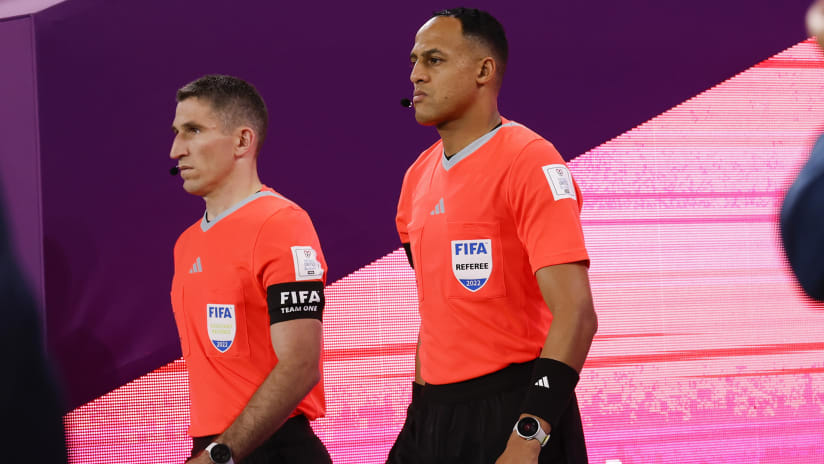
Ismail Elfath

© Yukihito Taguchi-USA TODAY Sports

The Professional Referee Organization (PRO) will have strong representation as the final places are determined at the 2022 FIFA World Cup in Qatar.

PRO refs in World Cup Final

Sunday’s marquee final between Argentina and France (10 am ET | FOX, Telemundo) will be overseen by Polish referee Szymon Marciniak, though four PRO officials are in various roles for the international game’s biggest match.

  • Ismail Elfath: 4th official
  • Katy Nesbitt: 5th official
  • Kyle Atkins: Offside VAR
  • Corey Parker: Standby AVAR

Elfath is a two-time MLS Referee of the Year award winner (2020, ‘22). While in Qatar, Elfath has been the center ref for Croatia vs. Japan (Round of 16), Cameroon vs. Brazil (group stage) and Portugal vs. Ghana (group stage).

Nesbit (2020) and Parker (2015, ‘17) are both MLS Assistant Referee of the Year award winners, while Nesbitt is part of a pioneering list of female officials who are the first women to officiate in a men’s World Cup.

PRO refs in World Cup third-place game

Saturday’s third-place match between Croatia and Morocco (10 am ET | FOX, Telemundo) will be overseen by Qatari referee Abdulrahman Al Jassim. But his crew includes one PRO official.

  • Armando Villarreal: Support VAR

Referees for World Cup knockout games are selected by FIFA, taking their performance and expertise into consideration.

A note from Grant’s Wahl Soccer SportsWriter who died at World Cup from his wife, Céline Gounder

CÉLINE GOUNDERDEC 14
 
SAVE▷  LISTEN
 

First and foremost, on behalf of myself and our family, I want to express our deepest gratitude for the outpouring of support, love, and sympathy from around the world. This continues to be a very difficult and painful time as we grieve a beloved husband, brother, and friend. It is some comfort to know that so many people Grant reached—countless colleaguesreadersathletescoachesfriends, and fans—are grieving alongside us. 

Grant arrived home Monday, December 12, and this transition was handled with the utmost care and sensitivity. This was an international matter that required coordination from multiple agencies domestically and internationally, and there was full cooperation from everyone involved. Our sincere gratitude to everyone involved in repatriating Grant, in particular the White House, the U.S. Department of State, FIFA, U.S. Soccer and American Airlines.

An autopsy was performed by the New York City Medical Examiner’s Office. Grant died from the rupture of a slowly growing, undetected ascending aortic aneurysm with hemopericardium. The chest pressure he experienced shortly before his death may have represented the initial symptoms. No amount of CPR or shocks would have saved him. His death was unrelated to COVID. His death was unrelated to vaccination status. There was nothing nefarious about his death.

While the world knew Grant as a great journalist, we knew him as a man who approached the world with openness and love. Grant was an incredibly empathetic, dedicated, and loving husband, brother, uncle, and son who was our greatest teammate and fan. We will forever cherish the gift of his life; to share his company was our greatest love and source of joy. Grant curated friends from all cultures and walks of life, for whom he was a generous listener, an enthusiast, a champion of others. To know Grant was to know a true renaissance man; he was endlessly curious about the world, and a lover of literature, art, music, food, and wine. He was equally in his element cooking a quiet dinner of sole provencal for two, walking his beloved Zizou and Coco through Manhattan, gathering friends for a raucous dinner party, and traipsing across Moldova chasing a story. 

Portrait by Grant’s collaborator, Dan Leydon

As a journalist, Grant began his career in 1996 at Sport Illustrated, straight out of Princeton University. As he grew into a feature writer, he captured some of the biggest stories in the sports world, like his celebrated cover story on LeBron James at age 16, his account of the US Women’s World Cup win in 1999, and his story of one soccer family’s loss and resilience. In 2009 he began covering soccer exclusively, and became an influential voice in elevating both men’s and women’s soccer in the U.S., becoming a New York Times bestselling author of two books on some of the greatest players in the game. 

In 2021, when he began working independently, he continued pursuing the same levels of journalistic rigor that had marked his career. Grant had a deep respect and appreciation for his audience. He devoted his work life to earning their—your—time and respect in turn. Above all, he expressed his values through his work: his commitments to seeking truth through reporting, supporting fundamental human rights, and fighting for equality. 

Grant radiated pride about my professional life, which he supported with all of his being, as I did his. But our lives together were about so much more than our work. What drew us together were shared values. Shaped by strong women like his mother Helen and the late New York Times war correspondent Gloria Emerson, Grant was a feminist, by which I mean a staunch advocate for equality, and not just on the basis of sex.

We were also both deeply invested in one another’s families. Grant knew when someone was in crisis and he needed to drop everything to be there for them—be that his family or mine. Grant and his brother Eric were the ballast to our family after my father passed away suddenly, just as I coordinated the care for Grant’s parents in their last years of life. 

Our families shared many fun times together, too. We gorged on his father Dave’s deep dish pizza over beers. My little sister Stephanie was eight when she met Grant and can barely remember a time when he wasn’t part of the family. The first time they met, they spent hours playing chess. Grant and I traveled to wine country with my sister Sabine and her husband. We shared a love of art house films with Grant’s brother Eric. We hiked with my uncles in the French Alps, picnicking on bread, saucisson, and wine. Grant joined me on my first trip to my father’s village in India, endearing himself to everyone. My family in France and India are mourning him, too. Grant wasn’t just my family. He was our family.

A memorial service to celebrate Grant’s life is being planned and details will be forthcoming.

from the referee, but the damage had been done. Tchouameni’s shot went wide and Argentina were on their way to victory.

Argentina are the most tactically flexible World Cup winners we have ever seen

LUSAIL CITY, QATAR - DECEMBER 18: Lionel Scaloni, Head Coach of Argentina, celebrates with the FIFA World Cup Qatar 2022 Winner's Trophy after the FIFA World Cup Qatar 2022 Final match between Argentina and France at Lusail Stadium on December 18, 2022 in Lusail City, Qatar. (Photo by Julian Finney/Getty Images)

By Michael Cox Dec 18, 2022 56


This is how World Cups are won. They are rarely won by truly legendary sides, and they are often not won by the outstanding side in the tournament. The World Cup isn’t about playing spectacular football all the way through; it’s simply about finding a way. It usually involves shutting down the opposition, and generally depends upon fine margins.Argentina were not a perfect side. They lost to Saudi Arabia in the group stage. On two occasions, against the Netherlands in the quarter-final and France in the final, they blew two-goal leads and relied on a penalty shootout to triumph. They were slightly fortunate not to suffer the same fate against Australia in the second round. But tactically, they neutralised the opposition for long periods, particularly at the start of matches. They also maximised the influence of their best player.Lionel Scaloni didn’t have a Plan A at this competition. He used a 4-4-2 against Saudi Arabia and Mexico, before moving to 4-3-3 against Poland. He then reverted to 4-4-2 against Australia — and after switching to 5-3-2 at the start of the second half in that game, stuck with the 5-3-2 against the Netherlands. He switched to 4-4-2 again against Croatia, and then to 4-3-3 against France. No other World Cup winning side has been this flexible.Even the one time he didn’t change formation between matches, for the win over Mexico, Scaloni changed half of his outfielders. And as often happens with the eventual winners, Scaloni suddenly found key players midway through the tournament.Alexis Mac Allister didn’t start the opening game, but started the other six, and was excellent in the final. Leandro Paredes started the first game in the holding role, and Guido Rodriguez started the second. It was the third choice in that position, Enzo Fernandez, who made the role his own. Julian Alvarez started the tournament on the bench, and came into the side in a left-sided position against Poland, before leading the line in the knockout stages, when Scaloni’s formation choices worked well.Against Australia the 4-4-2 was used, with Messi playing a more withdrawn role against an Australia side that spent long periods without the ball. He was able to exert his influence in deeper zones.

Against the Netherlands the 5-3-2 was introduced, providing a spare man at the back and using wing-backs against wing-backs. Nahuel Molina and Marcos Acuna didn’t simply nullify Denzel Dumfries and Daley Blind — Molina ran in behind to open the scoring from Messi’s pass…

…and Acuna won the penalty for the second.

The 4-4-2 used against Croatia in the semi-final featured a narrow midfield to essentially block up the midfield against Croatia’s wonderful passers in that zone, and Alvarez, full of running, dropped back onto Marcelo Brozovic without possession…

…and sprinted forward through the Croatia defence for the first two goals. He then finished the move for the third, courtesy of Messi’s wonderful assist.

ADVERTISEMENT

https://6256788993ba7ecd50b4d5506b9beb32.safeframe.googlesyndication.com/safeframe/1-0-40/html/container.html

That assist, surely the best of the tournament, summed up why Messi was allowed freedom from defensive responsibilities, allowed to save his energy for brilliant attacking bursts. This is ultimately Messi’s World Cup victory: seven goals, three assists. Scaloni based the side entirely around Messi’s needs, even if he was used in three different roles: second striker, right of a front three, false nine. Whatever the formation, Messi ended up in his favoured positions.

He is surrounded by good rather than great players, who understand his genius and happily do his running for him — Alvarez and Rodrigo De Paul in particular. The comparisons to Diego Maradona in 1986 are inevitable considering their shared nationality, but it’s appropriate even without them both wearing the albiceleste. No other World Cup-winning side in the intervening years has been squarely based around one player. Even Brazil in 2002 were generally billed as the ‘Three Rs’ of Ronaldo, Rivaldo and Ronaldinho until Ronaldo dominated the final.


Scaloni’s plan for the final was his most attack-minded, and his most effective from the outset.

It wasn’t a huge surprise that Di Maria returned for the final, in place of Paredes. But it was a surprise to see him deployed on the left.

Di Maria had played from the right in this tournament, and it was from the right that he was the match-winner in last year’s Copa America final victory against Brazil. It seemed most likely Di Maria would come into the side to help block up the flank occupied by Kylian Mbappe and Theo Hernandez. For all Di Maria’s attacking qualities, he’s always been a worker, accustomed to playing balancing roles to help Messi, Cristiano Ronaldo and Mbappe shine for Argentina, Real Madrid and PSG respectively over the years.

Instead, Di Maria played from the left of a 4-3-3, with Messi playing from the right. This was a significant gamble, leaving Hernandez free to fly forward and combine with Mbappe.

They combined dangerously just before Argentina’s opener, winning a free-kick by the byline, which Olivier Giroud headed over. De Paul, playing to the right of Argentina’s midfield trio, was overworked.

ADVERTISEMENT

https://6256788993ba7ecd50b4d5506b9beb32.safeframe.googlesyndication.com/safeframe/1-0-40/html/container.html

But there were two benefits to this approach. First, Messi — given freedom from defensive duties, as ever — was left free to wander into space behind Hernandez, and was regularly involved. Secondly, and more significantly, Di Maria had a stormer down the left. Scaloni’s precise logic for using him down that flank is a little unclear. France’s makeshift right-back Jules Kounde hadn’t struggled defensively in this tournament, whereas Hernandez on the other flank certainly had. Perhaps Scaloni, a former right-back himself, sensed that a regular centre-back playing out wide wouldn’t relish playing against speed and trickery.

If so he was right. Di Maria won the penalty for the opener, from Ousmane Dembele’s foul.

He then popped up to round off a brilliant move for the second, which stemmed from Argentina breaking into the space behind Hernandez again.

He was outstanding throughout the first half, whether going down the outside of Kounde or looking to combine with Messi. It brought to mind his strong performance in the 2014 Champions League final down the left.

The curious thing about Scaloni’s approach in the second half was that, having shown a determination to switch to a five-man defence earlier in the competition, he didn’t opt to do so here. Maybe he considered that his switch against Australia was too cautious, and invited too much pressure. There had, in truth, been minimal sign that France were set to launch a comeback, so you can understand why he opted to stick with his initial shape, and when Di Maria inevitably ran out of steam after 64 minutes, Scaloni brought on left-back Marcos Acuna to play in tandem with Nicolas Tagliafico. That was what Scaloni did at a similar point in last year’s Copa America final, albeit it made more sense in that match after Brazil’s change of formation.

Argentina continued to play in a 4-4-2, simply with a left-back on the left of midfield. And with Didier Deschamps having essentially switched to a front four boasting bags of pace — Mbappe, Randal Kolo MuaniMarcus Thuram and Kingsley Coman — it was surprising that Scaloni didn’t do what he did against Australia, bringing on Lisandro Martinez to provide a spare man at the back.

Suddenly, Argentina looked ragged.

The thrilling extra-time period felt like tactical anarchy. Whereas some have suggested that the increased number of substitutions available hands managers too much control, maybe it’s the opposite. By the end of extra-time, Argentina had made six substitutions and France seven, as Adrien Rabiot’s departure was as a concussion substitution. The more changes, the more fresh legs, the less managers seem able to control the game. After Messi put Argentina ahead, this time Scaloni did change to a back five for the last few minutes, although Argentina conceded another penalty when trying to see out the game.

To what extent do Argentina feel similar to recent World Cup winners? Before the tournament The Athletic listed six common themes from the last World Cup winners.

The first: you don’t need to impress in the group stage. Argentina lost their first game, and at half-time of their second game against Mexico, were only a goal away from elimination.

The second: managers tend to stick with tried-and-tested star players. Scaloni changed more players than most World Cup-winning managers, although in the final he was rewarded for showing faith in Di Maria, when others might have stuck with those who played well — or played at all – in the knockout stage.

The third: there’s often a major system change along the way. That box was very much ticked.

The fourth: knockout clean sheets are vital. This wasn’t the case here — Argentina only kept one in their four matches.

The fifth: you don’t need a prolific No 9. That largely applies here. Argentina’s strikers, Lauturo Martinez and Alvarez, managed only three goals. Funnily enough, the only game where Messi started as the central attacker, against Poland, was the only game he didn’t score in.

And finally: you generally need extra-time and/or penalties. Argentina needed two shootouts to win this World Cup, just as Italy needed two shootouts to win last year’s European Championship.

Still, you won’t find many who will suggest Argentina didn’t deserve it. They were the better side in all four knockout games. They ‘won’ in expected goals terms in all seven matches. Their boldness created possibly the greatest World Cup final, and their captain is surely the greatest footballer the game has seen. They will be remembered fondly.

Tim Weah’s famous name stands out, but an NYC neighborhood built his foundations in soccer

Tim Weah’s famous name stands out, but an NYC neighborhood built his foundations in soccer

Sam Stejskal Nov 11, 2022

To better understand the U.S. men’s national team before it begins the World Cup in Qatar, The Athletic traveled to the hometowns of several of its most important figures. We found a squad shaped not only by American society, but also influenced by traditions from every corner of the globe.Taken together, their stories provide a glimpse into a growing, increasingly vibrant American soccer culture that will be on full display between now and the World Cup final on Dec. 18.


For many people around the world, to think about Tim Weah is to think about his father.

It doesn’t matter that Weah is a talented 22-year-old who, despite his age, has already won three Ligue 1 titles and played 25 times for the U.S. men’s national team. It doesn’t matter that he may be poised for a breakout at the World Cup. Neither his achievements nor his potential can change the fact that he will begin the tournament in Qatar viewed through the lens of his famous dad, George.Though he never could carry his country to a World Cup, the elder Weah is one of the greatest players of all time. He is the only African to win either the Ballon d’Or or the FIFA World Player of the Year award, claiming both honors in 1995, smack in the middle of his decade-plus run of stardom at AS Monaco, Paris Saint-Germain and AC Milan. Today, he’s the president of his native Liberia, an office he’s held since 2018. He’ll watch games in Qatar not with the friends and families of other U.S. players, but from an official FIFA suite, as is custom for all attending heads of state.For years, his father’s high profile has put the younger Weah under a bright spotlight. There are advantages and privileges associated with that, to be sure, but there’s a burden, too. Weah has been dealing with outsized expectations from the moment he began to emerge with U.S. youth national teams as a teenager. He’s never run from any of that, consistently coming across as understanding and unbothered when asked about the dynamic. But, at this early stage in his career, many define Tim not by granting him his own identity but instead subsuming it under the legend of George.Those kinds of characterizations, of which there will no doubt be many made during the World Cup, miss so much of his story. Yes, Tim is the son of an all-time footballing legend, but his early path in the game was shaped less by his father than by his mother, Clar.“I give his mother a whole lot of credit,” said Michael Duncan, Clar’s older brother and Weah’s uncle. “She really dedicated her time to Timothy. Seventy-five percent of where he’s arrived is down to Timothy’s skill and dedication, but the other 25 percent to get him over the hump, it’s his mom.“His father, here and there, but he was busy, playing and then with his work. When he was here, he’d be giving Timothy directives and so on, but his mother did the lion’s share of the work.”Clar was born in Kingston, Jamaica, the youngest child of a large family that immigrated to Brooklyn in 1979. She and her siblings all grew up around the game, starting out playing in Jamaica and continuing after the family arrived in the U.S.She and George met in the early 1990s in New York City when George stopped at a bank branch in Manhattan where Clar was working. They married in 1993, not long after George had moved from Monaco to Paris, then had their first two children, George Jr. and Martha. Tim, the youngest, was born in 2000 in Brooklyn.Apart from a brief stint in South Florida, Tim spent his childhood in New York, mostly in the far southeastern corner of New York City in a part of Queens known as Rosedale. Sandwiched into a marshy stretch of land between John F. Kennedy International Airport and Nassau County, Long Island, Rosedale is an overwhelmingly Caribbean neighborhood. According to recent data collected by the U.S. Census Bureau, nearly 30 percent of Rosedale’s total population of just over 26,500 was born in non-Hispanic Caribbean countries like Jamaica, Haiti and Trinidad and Tobago. Another 10 percent was born in Guyana, which, though located in South America, is considered part of the Anglophone Caribbean.Around the time Clar and George got married, Rosedale became the home of the extended Duncan family. Clar, Michael and several of their siblings raised their children in the area. George’s political work meant he spent lots of time overseas during Tim’s childhood, but he was a presence, as well. The couple now lives in Liberia full-time, but they still own a home in Springfield Gardens, the neighborhood just to the west of Rosedale. It’s where Tim stays when he visits New York.Michael remains a local resident. He and Clar co-own a buffet-style restaurant in the neighborhood called Jamaica Breeze. It’s located on a stretch of Merrick Blvd. packed with Caribbean spots like Jerk Hut, Creole Plate, Irie Island and Home Chef Roti. He’s also the president of Rosedale SC, a long-running club where Tim and his cousin Kyle Duncan (Michael’s nephew), a former New York Red Bulls defender who now plays for KV Oostende in the Belgian top flight, both got their starts in soccer.One crisp Saturday morning in late October, I drove out to Rosedale to meet with Michael. As I pulled up, he was busy overseeing the club’s recreational program at their home field, which is tucked between P.S. 181 elementary school, a small pond backing up to a row of single-family homes and a wooded area that leads into the rest of Idlewild Park.A group of 20 or so 8-to-10-year-olds warmed up on one end of the turf field, decked out in an assortment of beanies, gloves and layered clothing to ward off the autumn chill. Michael wasn’t on the main field, but on a small, bumpy grass pitch located just off the far sideline.

The Rosedale SC side field. (Sam Stejskal)

He shepherded a group of what looked to be four- and five-year-olds as they played a small-sided game. Parents and grandparents were parked in lawn chairs on the sideline. A mix of New York and Caribbean accents floated through the air, encouraging and instructing the kids. Just about everyone at the field, Michael said, had a Jamaican background.That same tiny patch of grass is where a very young Weah got his first taste of soccer.“Timothy was here before he could walk, this little field here,” Michael said. “Clar was coaching Timothy’s older sister, and Timothy would be right there, she’d be holding him, even before he could walk. By a year-and-a-half, he really started kicking the ball. And I remember even then, saying, ‘For a little boy, he really kicks the ball hard.’ It was just amazing having Timothy out here.”As he grew older, Weah began playing on Rosedale’s travel teams. He and Kyle, who is two-and-a-half years older, would play up several age groups, often dominating their competition. They’d spend entire days together on Rosedale’s home field.“This was a family environment for them,” said Michael. “This still is a family environment. So Timothy and Kyle, after we finished their game, they would be out here from 11 o’clock in the morning until 7 o’clock in the evening. There’d be 11 or 12 of them playing, every man for himself. When you get the ball, 11 others are trying to get it from you.”Eventually, the boys progressed to the point where they needed a higher level of competition. Both ended up at BW Gottschee, a club from Ridgewood, Queens that now plays in MLS Next, the top academy league in the U.S. Weah joined up when he was about 10, along with Kyle and a few other Rosedale players including now-Trinidad and Tobago international Noah Powder.

Read more: What does USA draw against England mean for their knockout stage hopes?

But, even after they started playing for Gottschee, both Weah and Kyle continued to suit up for their family club in Rosedale.“There was one day when Timothy had a game with Gottschee, Kyle had a game with Gottschee and a few more of our boys had games with Gottschee at the same time we were playing a game here,” said Michael. “Five of them were late. The (opposing) team had us down 7-0, and then Timothy and Kyle and the others come in. The other parents start up, ‘Who are these players? Who are these players?’ Then the boys make it 7-1, 7-2, 7-3, we end up getting it to 7-7, then we ran out of time.”

Weah’s career from that point took him to the academies of the New York Red Bulls, then that of PSG. He moved to Lille in search of first-team minutes, which he got mostly off the bench in his second season – one that ended with a surprising Ligue 1 title. In time, he emerged as a key player for the U.S., putting in a man-of-the-match performance in the Americans’ 2-0 win against Mexico last November, assisting on Christian Pulisic’s opening goal and wreaking havoc all night with dangerous play down the right wing.The day after that game, the U.S. flew to Kingston to take on Jamaica. Weah met with traveling reporters the day before the match, offering stories about his mother, advice on where to find the best patties in New York City, the Jamaican-curriculum private school he attended as a kid and Rosedale SC (to which he recently made a significant financial contribution, according to Michael). The prospect of playing a World Cup qualifier just a few miles from where his mom grew up clearly meant a lot to him.“For me, it’s our national anthem that matters. I know on the pitch tomorrow, I’m going to be singing it like my heart’s about to pop out my chest. But hearing the Jamaican national anthem, seeing the players from the other team take pride in that culture, that’ll be huge for me, as well,” he said. “I take pride in the culture, too. It’s gonna be a fun game.”Weah said before the match that his parents joked with him about not going too hard on Jamaica in Kingston. He didn’t exactly listen, scoring an incredible goal to put the U.S. up 1-0 in the 11th minute of a match that ended in a 1-1 draw.While he’s been a regular starter for the U.S. for more than a year, it’s not a sure thing that Weah will be in the XI at the World Cup. He struggled with an injury to start this season, missing eight Ligue 1 games for Lille and the U.S.’s two friendlies in September because of a foot problem. He returned to action in early October, but the standout play of the now-healthy Gio Reyna at Borussia Dortmund and Brenden Aaronson at Leeds United means Weah might come off the bench against Wales on Nov. 21.We’ll no doubt see plenty of shots of George during match broadcasts, watching his son on a stage that he was never quite able to reach during his own playing career. Clar will be there too, of course — as will Michael, who flew to Liberia this week and will travel with his sister and brother-in-law to the Middle East ahead of the U.S.’s opening match.The world knows him now as the son of one of the sport’s all-time greats, but Tim Weah will take the field in Qatar having lived a beautiful, uniquely American soccer story. The child of an immigrant from Jamaica and a Liberian legend, a product of a close-knit family, shaped by a largely-Caribbean community in New York City who struck out and made his name abroad.He not only has a shot to add a chapter to his already-remarkable journey at the World Cup, but he also has a chance to make his narrative more his own, too.

Inside the school that prepared Gregg Berhalter to lead the USMNT in its return to World Cup

Inside the school that prepared Gregg Berhalter to lead the USMNT in its return to World Cup

Sam Stejskal

Nov 9, 2022

To better understand the U.S. men’s national team before it begins the World Cup in Qatar, The Athletic traveled to the hometowns of several of its most important figures. We found a squad shaped not only by American society, but also influenced by traditions from every corner of the globe.Taken together, their stories provide a glimpse into a growing, increasingly vibrant American soccer culture that will be on full display between now and the World Cup final on Dec. 18.


“You’ve come on the perfect day,” athletic director Tom Leahy says as he greets me in the lobby of St. Benedict’s Prep in Newark, N.J., the alma mater of U.S. men’s national team head coach Gregg Berhalter.Leahy doesn’t say much more, he just smirks and tells me to follow as he leads the way up a set of stairs, across a footbridge, into a cramped old elevator and toward the school’s indoor pool. We arrive on the deck a few moments after the entire sophomore class has filed in.A middle-aged man wearing black shorts, a black exercise top and a black baseball cap is standing near some scaffolding set up beside the deep end. He’s deadly serious, shouting through a megaphone at the 100-plus assembled students. Per his instructions, they break into designated groups of six to eight, sit in single-file lines spanning the length of the pool and face the nearest wall, backs to the water. Apart from the man in black, no one makes a sound.The mood is intense. The scene feels more like a military boot camp than a high school physical education class. After barking a few more pointed reminders, the man in black sets the megaphone down. Someone who seems to be his coworker hops in the pool and begins setting up a pair of lane lines.Leahy passes me off to head soccer coach Jim Wandling, whose son is among the sophomores sitting on the other side of the deck. Wandling explains that the students are about to begin the final test of a four-and-a-half week “water adversity challenge” run by Victory Road Leadership Development Group, which bills itself as “a dynamic organization committed to delivering advanced leadership solutions to driven leaders and high performance teams in the world’s most competitive environments.” They typically work with professional sports teams and Fortune 500 companies, Wandling says. The man setting up lane lines is a former Navy SEAL.The first group of students soon slink over to the deep end. Describing the kids as palpably anxious would be an understatement — they look petrified. They’re in hooded sweatshirts, sweatpants and sneakers. Two jump in, fully clothed. The man in black hands each a pair of goggles that are completely blacked out. The kids put the goggles on, shutting out the entire world, and begin their task of swimming two lengths of the 25-meter pool. Once each member of their group finishes, they return to the deck, sit down in their soaked clothes and resume staring at the wall. Apart from the sound of splashes and the occasional encouraging shout from one of the adults in the room, the pool remains mostly quiet.

Roughly 45 minutes later, after everyone is finished swimming their two lengths, the initial group marches back to the deep end of the pool. The first student climbs up the scaffolding to a platform stationed about six feet above the water. He puts on a weighted backpack, then the blackout goggles. The man in black pushes him into the pool. The former SEAL awaits.

The kid quickly sheds the backpack. Still blinded by the goggles, he takes off his shoes, then ties the laces together. He removes his sweatpants — they’re all wearing shorts underneath — then begins the arduous process of turning the clothing into a flotation device. It takes a minute or two, but he eventually succeeds, dipping his pants into the pool and tying them off to trap the air bubble that had formed inside. The bubble works surprisingly well, noticeably adding to his buoyancy as he continues to tread water.On the deck, I’ve made my way over to Father Edwin Leahy, brother of athletic director Tom. A member of St. Benedict’s class of 1963, Father Leahy became a monk in 1966 and has been headmaster of the school since 1973, when he helped reopen it following a brief closure. Now in his late-70s, he’s an incredibly engaging man, a physical and mental dynamo whirling in his cowl, cheering individual students by name, regaling me with stories of Berhalter as if the USMNT coach graduated from the school in 2021, not 1991.I’m thinking he’s the type of guy who could’ve been a U.S. senator had he not entered the Newark Abbey when Father Leahy stops mid-sentence and focuses on the pool.“Watch this,” he whispers.The first student has just finished turning his sweatpants into a life preserver. The former SEAL begins to swim toward him stealthily. He sneaks up on the kid and dunks him from behind, submerging the teenager, flipping over him and holding him under for a few seconds. The kid comes up for air. The former SEAL pushes the kid under a second time, then a third. The kid emerges, gasping, and the man starts splashing him in the face. The kid is still wearing the blackout On the deck, so stunned that I forget I’m standing next to a Benedictine monk, I mutter something about Jesus Christ.At some point during the attack, the improvised flotation device ceased being a flotation device. As he’s being splashed, the kid, who, like all of his classmates, trained for this specific test during the previous month-plus of the so-called “water adversity challenge,” begins trying to create a new air bubble in his sweatpants. He somehow does so in about 30 seconds. Job done, he lays back in the water, floating calmly, catching his breath. The former SEAL swims up, taps him on the shoulder and removes his blackout goggles. The kid has passed. The entire pool area erupts in applause.Father Leahy is beaming. I ask what on earth that exercise — either extreme or dangerously unhinged, depending on one’s perspective — is meant to teach the students who are required to complete it.“Determination, confidence, competence,” he says. “That in an adverse situation, I can figure out a way to get through it. No matter what it is, no matter how difficult it might be, I can find a way to accomplish it. It’s about dealing with adversity. Adversity comes in life, right? And building more and more confidence in being able to deal with adverse situations is what this does.”

The water exercise (Sam Stejskal)

Berhalter didn’t participate in the water adversity challenge during his time at St. Benedict’s — this year was the first that the school had its students go through the program. He was, however, exposed to an incredibly demanding and unique environment at the school.“What goes on in here is probably not what goes on in the rest of the world, but this is a different way of being and discovering who you are, and who you are for the sake of others,” Father Leahy said.Located in downtown Newark, St. Benedict’s was founded in 1868. The school boomed along with the city itself in the first part of the 20th century, but struggled to keep up as the area changed.Deindustrialization, suburbanization and prejudice contributed to Newark becoming the center of one of the worst examples of the White flight that affected many American cities in the mid-20th century. By the late 1960s, the majority Black population that remained was subject to racial profiling, redlining and a general lack of opportunities. The city became a powder keg. In 1967, after two White police officers brutally beat a Black cab driver, it erupted. Large parts of Newark burned in a four-day riot that left 26 dead. Monks watched the blaze from the roof of St. Benedict’s.After the riots, White flight accelerated, further eroding the school’s population base. In 1972, faced with an enrollment they deemed unsustainable, the monks closed St. Benedict’s.“Racism,” Father Leahy says when asked why the school closed. “That’s what I’d say. Others would say diminishing numbers and financial problems. I’d say racism.“The school was becoming more and more Black at that time and it scared the hell out of some people. Huge problems in the monastery, huge conflict. We lost 14 guys who dressed like me. Left and went to another place out in Morris County because they didn’t agree with the direction. So we were left here with no common work, which we absolutely need to live this life, and we said, ‘What are we gonna do?’”Father Leahy and the monks who stayed decided to take another shot at running the school. They came back in 1973 and, with a lot of help from local residents, dreamed up a reimagined approach. Instead of trying to cater to a White community that had left the city, the St. Benedict’s staff learned that it needed to try to be rooted in Newark. The school reopened with a student body that primarily consisted of children of color, many of whom came from disadvantaged backgrounds. The school, which now has an enrollment of nearly 1,000, has a similar makeup to this day.“People in town taught us and loved us, loved us into another way of being and living,” Father Leahy says. “They completely taught us how to do this. The community here reopened St. Benedict’s Prep. Not us. It was absolutely the community, the Black community.”From the start, the monks have been using experiential tactics at St. Benedict’s. All ninth-grader begins their time at the school with “freshman overnight,” a week-long program in which they sleep in the school gym, learn the school’s history and traditions and participate in activities that form a sense of community and dependence on each other. They close their first year by splitting into small groups and hiking a 55-mile portion of the Appalachian Trail in western New Jersey over the course of five days. Each student has an assigned role to perform for their team: cook, navigator, medic, etc. Like the water adversity course, the hike is mandatory. Anyone who doesn’t finish has to complete it at a later time.An overarching idea at St. Benedict’s is to build an environment in which students are individually empowered and a strong team ethic is emphasized. Kids here are granted a rare amount of autonomy. “Never do for students what they can do for themselves” is one of the school’s guiding principles. Teachers and administrators feel that the atmosphere can create a thriving community and allow for the development of real leaders.In some ways, it sounds pretty familiar to how Berhalter, who puts great emphasis on culture, tries to run the USMNT. He often goes for bonding exercises, once leading the team up a Swiss alp, another time introducing the players to a cheetah and having them listen to a brief lecture on African painted dogs.“We’re real heavy into team building,” says Wandling. “We spend a lot of time getting to know one another. Embracing each other’s differences. I think when you put as much time as we do into team building, and it’s something that we’ve been doing for decades now, it really allows kids to compensate for each other’s weaknesses, maximize each other’s strengths and make the most of their time together.”

The St. Benedict’s soccer field. (Sam Stejskal)

Sports, naturally, became a big part of the overall equation. After the school reopened, the student body was too small and funds were too limited for St. Benedict’s to field an American football team, leaving room for soccer to grow into one of the school’s main athletic pursuits. The soccer program took a massive step forward in 1980, when Father Leahy was tipped off to a teenage talent who had just moved to the States from Uruguay and was tearing up pickup games in nearby Harrison, N.J.“That was Tab Ramos,” Father Leahy says.

Ramos starred at the school for four years, leading St. Benedict’s to its first state championships in soccer before embarking on a career that would include representing the U.S. at three World Cups. The school became so determined to win that first state title that Father Leahy arranged for a helicopter to pick up Ramos from LaGuardia Airport and fly him to Newark so he could arrive in time for a playoff match following a late return from a U.S. national team camp.A year after Ramos graduated, Father Leahy hired Rick Jacobs as head coach. Jacobs brought a new level of sophistication to the team, whose previous strategy mostly entailed booting the ball toward Ramos and letting him do the rest. He also added a new level of intensity; Father Leahy fondly remembers the coach regularly losing his mind on the sideline about referee decisions as he brought even better results.Around the same time that Jacobs took over at St. Benedict’s, a preteen Berhalter and future U.S. star Claudio Reyna began playing together under Claudio’s father, Miguel, at a youth club called Union County SC. In the fall of 1987, when Berhalter and Reyna were freshmen at nearby high schools, Jacobs got a call from Miguel Reyna.“Miguel was looking around for places to potentially send Claudio to play in high school,” Jacobs says. “So I got to know Miguel, got to know Claudio, watched him play and, after a certain point, Miguel told me that he was comfortable, Claudio was comfortable, and they were going to send him to St. Benedict’s. And in one of those conversations, he told me, ‘Rick, Claudio is on this team in Union County, and one of his best friends might be interested in coming to Benedict’s, too.’ And that was Gregg. Both of them entered school together as sophomores.”From the moment Berhalter arrived at St. Benedict’s, Jacobs remembers him being ultra-competitive and serious about soccer. He wasn’t as talented as Reyna, and wasn’t as highly recruited by colleges as a couple of his other teammates, but, as a three-year starter at sweeper, he was always putting out fires, maintaining a cool head and keeping the defense organized.

“Gregg was always a step ahead,” Jacobs says. “Always analytical, always tactically sound. Probably the best compliment you could pay an athlete like Gregg is, when you play in the back and speed isn’t one of your top three or four attributes, you must be doing something else really well to be able to always be in the right position, always be in a place, where instead of having to run 14 yards, you only have to run 10. He was really smart in that way. His overall intelligence of the game was pretty special.”

Berhalter was never voted team captain in high school. In his senior season, that honor went to Reyna and stopper Richie Dunn, who played collegiately at Duke. Still, Leahy, Jacobs and Wandling, who was a year behind Berhalter at St. Benedict’s but played with him for parts of two seasons, all remember him as engaging both on and off the field, a great player and good student who had an easy way about him, and naturally commanded a certain level of respect.

He also had a good sense of humor. On the pool deck, Father Leahy, who attended Berhalter’s wedding, spends a minute or two imitating how Berhalter would typically react to something he disagreed with or found inconsequential. A slight turn of the head, a little tsk, a wily grin. He also reveals Berhalter’s high school nickname: Chuckles.

Father Leahy, Jacobs and Wandling couldn’t remember the origin of the moniker, which is a bit difficult to square with Berhalter’s typically understated public demeanor. Berhalter later clarifies that there wasn’t much reason behind it. A teammate gave everyone nonsensical nicknames early in his time at Benedict’s. Berhalter was dubbed Chuck, which later morphed into Chuckles.

“He was endearing to all the guys in the program,” says Wandling. “Regardless of their age, regardless of their level, he was just endearing. I think he embraced the differences here in the program.”

St. Benedict’s is significantly different from Berhalter’s hometown of Tenafly, N.J. He didn’t just find a high-level soccer team and demanding overall environment at the school; he also was exposed to a much more diverse group of peers than he would’ve been in Tenafly, which is Whiter and richer than Newark. Father Leahy, Jacobs and Wandling all think that exposure helped positively mold Berhalter, who has done a nice job with the USMNT of recruiting dual nationals of varying backgrounds and helping to create a strong, positive environment among a set of players with disparate life experiences.

“What I think he left with, what I think most guys who are not of color leave Benedict’s with, is they leave with a new, refined sense of who people are,” says Jacobs, who still keeps in regular contact with Berhalter. “How they can be judged by the world, how the world communicates to them, how the world can see them as unequal. And seeing that, having that experience of learning and relating to kids of color, adults of color, I think is one of those things that makes a guy like Gregg leave here a different person. The question is, do you allow that person to influence the rest of your life? And I think Gregg allowed Benedict’s to make him a better listener, a better learner, someone with more empathy, someone who can get guys to better trust him. And as a coach, when you get an entire group to trust you, that’s magic.”

In 1990, Berhalter helped make history at St. Benedict’s, marshaling from the back as it finished the season as the No. 1-ranked high school team in the country. It was the school’s first national title in soccer. St. Benedict’s has gone on to win 12 more since, with Jacobs running the show until he retired and was succeeded by Wandling in 2010.

The St. Benedict’s program has changed markedly from when Berhalter was a student. The facilities have been upgraded, for one thing. The school has two turf fields, a sizable grandstand and dedicated, well-appointed locker rooms and offices for the squad, which are a huge improvement on the broom closet-sized dressing room that Berhalter, Reyna and Wandling shared with the baseball team when they were in school.

The national championship-winning team featuring Berhalter (seated, third from left) and Reyna (seated, third from right). (Sam Stejskal)

The U.S. Soccer Development Academy, which Gregg’s older brother, Jay, who attended a nearby school, helped create when he worked for the federation, also shifted things dramatically for soccer at St. Benedict’s. The USSDA prompted top youth players to stop playing for their school teams so they could instead play year-round for clubs. St. Benedict’s wasn’t prepared to take that kind of step back in the sport, so the school formed a partnership with Cedar Stars SC, which competed in the old DA until it was shuttered. The club now plays in MLS Next, the new top youth league in the U.S. In the fall, St. Benedict’s players suit up for their school. As soon as that season ends, they begin playing for Cedar Stars, which trains and plays matches at St. Benedict’s.

Because many top local players still end up in the academies of the New York Red Bulls or NYCFC, the school also now recruits a high number of players from abroad, who live in dorms on school grounds. One such recruit, Ghanaian midfielder Ransford Gyan, was named 2021-22 Gatorade New Jersey boys’ soccer player of the year as a sophomore. Reyna won the same award in his senior season of 1990.St. Benedict’s has evolved in ways beyond the soccer team. When Berhalter attended, it was an all-boys high school. It now includes grades K-13 and recently welcomed its first female students.Back on the pool deck, as the sophomores continue to struggle in the water, Father Leahy calls over the man in black. His name is Chris Firriolo; he’s the founder and president of Victory Road. Firriolo tells me that one of the organization’s employees was hired by Berhalter a couple of years ago as the USMNT’s leadership and team dynamics coach. He’ll remain with the team through the World Cup.As Firriolo returns to his duties, Leahy begins to explain how he feels everyone and everything is interconnected.“Every experience in life helps to shape the way you view the world and the way you view others,” he says.Difficult circumstances shaped St. Benedict’s, which, in turn, helped shape Berhalter. Father Leahy doesn’t think it’s a coincidence that he’s now shaping the USMNT ahead of the World Cup.

12/17/22  WC Final Argentina vs France Sun 10 am Fox, Pregame 9 am

So its defending Champs France vs sentimental Favorite and Copa America Champion Argentina with the legendary Lionel Messi needing just this win to cement his legacy at the GOAT in the minds of many around the world.  The matchup of powers combined with Messi’s quest for immortality leads most to predict this will be the most watched ever World Cup game in History.  Over 1 billion worldwide are expected to tune with close to 20 million expected in the US.  Honestly this is much watch TV  !!  In case you had any questions about the GOAT – Lionel Messi and Argentina – put those concerns aside as Messi once again showed why he is the greatest – as he carried his Argentina to victory.  His PK goal and Assist moved him into a tie with his PSG teammate Mbappe for the Golden Boot with 5 goals and 4 assist.  This play where he challenges the Croatian defender Josko Gvardiol that many are calling the best defender in the World Cup – turns him and completely embarrasses him as he drives past him and tucks the assist for an easy goal for his teammate – just personified the game he had against the outmanned Croatians.  Play in the proper Spanish. Sad to see the warrior Luca Modric  lose his final World Cup game but the GOAT’s quest to win his first ever World Cup is still in reach.  Again I picked Argentina partial because I want so much for Messi to win it – but also because I think they are the BEST team in the World.  Messi finally has the type of players around him that can carry some of the load.  Of course Messi and Mmbape are neck and neck for the Golden Boot with the final likely to decide.  The Vote here is for Messi and Argentina to win it all 2-1 though I would love to see a 3-2 Argentina Win instead. 

World Cup News  The Bracket

The World Cup commercials are out – which ones do you like best?  Nike  Addidas  check them all out hereIts Called Soccer – Classic Commercial    Here are some of the Best World Cup Commericals of all time..

Still Devestated by Soccer Writer Grant Wahl’s passing at the World Cup but relieved to hear he died of natural causes.  This World Cup did not need more controversy.  If you get a chance and you want to cry a little ESPN’s E60 Remember the Blue & Yellow is out now – about the Urkraine National Soccer team and their quest to make the World Cup in the middle of the Invasion by the Evil Russians.  Its definitely worth the watch. 

CARMEL FC GOALKEEPERS : Wednesday Night Trainings Dec-Mar – Badger Indoor Fieldhouse 5:30 pm U12//6:30 pm U13-U14//8:30 pm HS U15+. 

Not sure what other clubs have – but Carmel FC has former US Men’s National Team World Cup GK & Coach Juergen Sommer coaching the high school age, Hall of Fame Canadian World Cup GK Carla Baker coaching the U15s and myself coaching the U12s this winter. 

WORLD CUP GAMES ON TV

Sun, Dec 18                       FINALS                

10 am  Fox                         Argentina vs France

Wed, Dec 21                      League Cup

2:45 pm ESPN+                  Blackburn vs Nottingham Forest

2:$5 pm ESPN+                  Newcastle United vs AFC Bournemouth

3 pm ESPN+                      Man United vs Burnley

Thur, Dec 22                      League Cup

3 pm ESPN+                      Man City vs Liverpool

Mon, Dec 26                      Boxing Day

7:30 am USA                      Brentford vs Tottenham

10 am USA                         Aston villa vs Liverpool

10 am Peacock                  Crystal Palace vs Fulham (Robinson, Ream)

3 pm Peacock                    Arsenal vs West Ham United

Tues, Dec 27                     

12:30 pm USA                    Chelsea (Pulisic) vs Bournmouth

3 pm USA                            Man United vs Nottingham Forest

Wed, Dec 28                     

3pm  pm USA                   Leeds United (Adams, Aaronson) vs Man City 

Thurs, Dec 29                   

1 pm USA                            Queens Park Rangers vs Luton Town (US GK Horvath) 

Fri, Dec 29                         

2:45 pm USA                      West Ham vs Brentford 

3 pm Peacock                   Liverpool vs Leicester City

Soccer Saturday’s are every Sat 9-10 am on 93.5 and 107.5 FM with Greg Rakestraw

CARMEL FC PLAYERS : Winter Players League (WPL) – Badger Indoor Fieldhouse
As the fall season comes to a close over the next month, we wanted to let you know that we will be launching an indoor soccer league over two six week sessions within our new Badger Fieldhouse. Games will be played on either Friday night ( 6pm to 10pm) or Sunday afternoon (1pm-5pm) depending on age groups: U8s, U9&U10, U11&U12, U13-U15 and U16+ (Coed Teams allowed). Referees for each game, 50 minute games, 5v5, 7v7 and 9v9 matches.
Session One (6 weeks): Jan 6th, 13th, 20th, 27th / Feb: 3rd, 10th
Session Two (6 weeks): Feb 17th, 24th / Mar 3rd, 10th, 17th, 24th
Gather teammates and be ready to play!

World Cup Final Sun 10 AM FOX


Argentina v France – Keys to the World Cup final

Three keys for Argentina and France to win 2022 World Cup final

Messi vs Mbappe final gives under-fire Qatar its dream World Cup showpiece

World Cup final predictions: Argentina vs France – who our experts think will win

France’s foot soldier Griezmann pivotal on run to World Cup final

Scaloni answers critics with Argentina’s World Cup final run

Lionel Messi’s Final World Cup: By the Numbers

The Maradona vs Messi Debate
Key points to how France can win another World Cup title

Deschamps, France feeling ‘alone’ ahead of World Cup final

France camp in chaos with Raphael Varane and Ibrahima Konate latest to be hit by virus

‘It’s already Messi’s World Cup’: How the world reacted to Argentina’s thumping victory over Croatia

Gritty Croatia edges underdog Morocco to win World Cup third-place match
Hakim Ziyech Donates 2022 World Cup Earnings to Poor in Morocco

Jose Mourinho considers taking Portugal job as he weighs up whether to quit Roma

FIFA may reverse World Cup change for 2026 tournament

===================RackZ BAR BQ ====Save 20% ====================== 

AFTER YOUR PRACTICE AT BADGER FIELDHOUSE

Try out the Best BarBQ in Town right across the street (131st) from Northview Church & Badger Field on the corner of Hazelldell & 131st. RackZ BBQ

Save 20% on your order 

(mention the ole ballcoach) 

Check out the BarBQ Ribs, pulled Pork and Chicken, Brisket and more.  Sweet, Tangy or Spicy sauce. Mention you heard about it from the Ole Ballcoach — and Ryan will give you 20% off your next mealhttps://www.rackzbbqindy.com/ Call ahead at 317-688-7290  M-Th 11-8 pm, 11-9 Fri/Sat, 12-8 pm on Sunday.  Pick some up after practice – Its good eatin! You won’t be disappointed and tell ’em the Ole Ballcoach Sent You!  

Save 20% on these Succulent Ribs at Rackz BarBQ when you mention the Ole Ballcoach – Corner of 131 & Hazelldell. – Call 317-688-7290.

=====================RackZ BAR BBQ ======Save 20% ======================

FIFA convinced soccer will become No 1 sport in North America — Gianni Infantino

DOHA, QATAR - DECEMBER 16: FIFA President Gianni Infantino speaks to media during the Press Conference ahead of the Third Place and Final matches of FIFA World Cup Qatar 2022 at the Main Media Center on December 16, 2022 in Doha, Qatar. (Photo by Alex Pantling/Getty Images)

By Jacob Whitehead


FIFA president Gianni Infantino has said the organisation “is convinced” that soccer will become the most popular sport in North America. The 2026 World Cup will be jointly-hosted by the United States, Canada, and Mexico.The president was speaking at a press conference in Qatar ahead of Sunday’s final between Argentina and France, but also looked towards the next edition. Projecting revenue of $11billion from the 2026 World Cup, Infantino said: “We are more than bullish (about the tournament’s potential success), we are convinced that the impact of the game will be massive. “We are bullish about the power of football (soccer). It will become the number one sport in North America.”

Infantino also discussed the format for the upcoming tournament, which is set to feature 48 sides for the first time, saying the plan to stage three-team groups may need to be “revisited”. As part of the move to 48 teams at the next tournament, the plan had been to have 16 groups, each containing three teams. The final round of group stage games at the 2022 World Cup — featuring simultaneous matches between the four teams — was praised for its excitement. Concurrent games would not be possible under a three-team group format. Discussing this, Infantino said: “Here the groups of four have been absolutely incredible; we have to at least revisit, or re-discuss”. He later confirmed this would be on the agenda at the next FIFA council meeting.

Three keys for Argentina and France to win 2022 World Cup final

USA TODAY

Fri, December 16, 2022 at 7:41 AM EST

This wasn’t the final many expected when the World Cup began almost a month ago, what with France hollowed by injuries and Argentina losing to Saudi Arabia in its opener. Yet here we are, the defending champions and Lionel Messi and Co. emerging as the class of a tournament as both chase history.

If Argentina wins, it fills the one blank space on Messi’s long list of accomplishments. If France wins, it becomes the first defending champion to repeat since Brazil in 1962 and makes Kylian Mbappé, at 23, the youngest player to win two World Cups since a 21-year-old Pelé.

WORLD CUP 2022: Schedule, scores and latest news

So how does each team win? Here are three keys for both:

ARGENTINA

Be ruthless 

The Netherlands scored two goals after the 83rd minute, including one in the final minute of stoppage time, to force extra time and then a penalty shootout. Argentina didn’t make the same mistake against Croatia, capitalizing on its early chances – a Messi penalty in the 34th minute followed five minutes later by the first goal of Julian Alvarez’s brace – and refusing to extend Croatia any lifelines.

France has shown a tendency to disappear for large chunks of time during games, and if it does in the final, the Albiceleste must pounce. Pour it on so a late comeback, if there is one, doesn’t matter.

Forget what’s at stake

Lionel Messi will play in his second World Cup final after Argentina was defeated in extra time in the 2014 final by Germany.

Messi desperately wants to win a World Cup title, and his teammates and coach are equally desperate to help him do it. They have to put that out of their minds, however, or they won’t be able to play with the ease and flow that they have since that loss to Saudi Arabia.

Messi has been tremendous at this tournament – go back and watch him spin Josko Gvardiol around to set up Alvarez’s second goal against Croatia – and his teammates, the young ones in particular, have fed off that.

“Argentina has grown in confidence thanks to Messi’s brilliant performances,” Morocco coach Walid Regragui said after losing to France in the semifinals.

Play free, without a thought of what a victory will mean, and Messi’s legacy will take care of itself.

Corral Kylian Mbappé

I know, I know. Easier said than done.

Like Messi, France’s young star has an otherworldly ability to create space where there is none, cut through defenses and do things with the ball even cats can’t imagine. Somewhere, Morocco’s players are still muttering about his run that led to France’s insurance goal.

Argentina’s defense must shut down the flanks and funnel Mbappé through the midfield. He can still do plenty of damage, but not nearly as much as when he has free range outside, and this will allow Argentina at put more numbers on him.

FRANCE

Stay present

As already mentioned, France has had a habit of disappearing, especially when it gets an early lead. It hasn’t cost Les Bleus yet, but Argentina is a different caliber of team. Lose intensity for an extended period of time, or lose track of Messi, and he and his teammates will take full advantage.

“We weren’t perfect against England, we weren’t perfect against Morocco,” France coach Didier Deschamps acknowledged.

“But in a final, against Argentina, both teams are playing a better team than they’ve played so far in the tournament,” Deschamps said. “We have two sides with a great deal of quality. It will be up to key players to make a difference, maybe a team who makes fewer mistakes is going to win the game.”

Let that be a word of warning to his players, not a prediction.

Don’t overlook Argentina’s youngsters

Sublime as Messi has been in this World Cup, Argentina isn’t playing for the title without its young stars. Of Argentina’s 12 goals, seven have come from players who are 24 or younger and are in their first World Cup.

Julián Álvarez, 22, leads the group with four, second only to Messi and Mbappe. Enzo Fernandez, who turns 22 next month; Nahuel Molina, 24; and Alexis Mac Allister, who turns 24 next week, each have one, and Fernandez and Molina both have an assist, as well.

That’s why Deschamps cautioned against reading too much into France and Argentina’s last meeting, a 4-3 win by Les Bleus in the round of 16 in 2018.

“This Argentina side is different to the side we faced four years ago,” he said.

Don’t mess with what’s working

Karim Benzema has recovered from the thigh injury that knocked him out of the World Cup, and Spanish newspaper Mundo Deportivo said Real Madrid has given the Ballon d’Or winner permission to rejoin France.

Tempting as it might be to bring back a player of Benzema’s quality for the World Cup final, France has been doing fine without him. More than fine, in fact. Benzema’s replacement, Olivier Giroud, had four goals in his first four games to become France’s all-time leading scorer, while Mbappé continues to do Mbappé things and Antoine Griezmann has turned back the clock.

Trying to work in a new player at this late stage, even Benzema, risks disrupting France’s chemistry and flow.

Follow USA TODAY Sports columnist Nancy Armour on Twitter @nrarmour. 

This article originally appeared on USA TODAY: Argentina, France in World Cup 2022 final: Three keys for each to win

France, the imperfect back-to-back World Cup finalists

AL WAKRAH, QATAR - NOVEMBER 22: Olivier Giroud of France celebrates with teammates after scoring their team's fourth goal   during the FIFA World Cup Qatar 2022 Group D match between France and Australia at Al Janoub Stadium on November 22, 2022 in Al Wakrah, Qatar. (Photo by Clive Mason/Getty Images)

By Oliver Kay Dec 15, 2022


L’Equipe called it un exploit venu des trefonds, a feat from the depths, and when you look at it that way, as a triumph over adversity as well as a valiant opponent, France’s progression to a second consecutive World Cup final looks that bit more impressive.The performance? Not so much, in truth. France coach Didier Deschamps admitted his team “weren’t perfect” in beating Morocco in Wednesday’s semi-final and that they “weren’t perfect” when they overcame England in the quarter-final either. Over the course of those two matches they rarely looked like reigning world champions, but, ultimately, with a squad ravaged by illness and injury, only the result mattered.France’s 2-0 win over Morocco means that this strangest of World Cups will end with the showpiece final its organisers would have desired beforehand. Argentina vs France means Lionel Messi vs Kylian Mbappe, which means the greatest player of his generation against his heir apparent, both of them under the employment of Qatari-owned Paris Saint-Germain.If the “dream final” was in doubt for a time in Al Khor on Wednesday evening it was because Morocco, the surprise package of this World Cup, made France sweat for it.For periods of the game, with Sofyan Amrabat outstanding again in midfield, Morocco pushed Deschamps’ team harder than England did on Saturday. After conceding the first goal to Theo Hernandez within five minutes, Morocco went on the offensive, taking risks, committing players forward and threatening an equaliser until Randal Kolo Muani came off the bench to tap home France’s second goal on 78 minutes.

(Photo: Catherine Ivill/Getty Images)

With that, Deschamps and his players could finally begin to focus on Sunday’s final. “We could have played better,” the coach said. “But we’re in the final and both finalists will be playing a better team than they’ve played so far in the tournament. Maybe the team who makes fewer mistakes will win the game.”hinking back to France’s last World Cup final four years ago, that 4-2 victory over Croatia in Moscow was a strange game, strewn with errors at both ends of the pitch. So was Wednesday’s semi-final as both teams played at a frantic pace and left large gaps for the opposition to exploit. If Morocco were left to pay the price, eventually, for allowing Mbappe too much space in the build-up to the second goal, similar could be said of France’s defending; they can’t afford to give Messi as much time, space and encouragement as they gave Azzedine OunahiHakim Ziyech and Youssef En-Nesyri.For France, there were mitigating circumstances. It is well-documented that they went into this tournament without Presnel Kimpembe, N’Golo Kante, Paul Pogba, Christopher Nkunku and Karim Benzema due to injury. Since then they have lost Lucas Hernandez to a ruptured anterior cruciate ligament and, on the day of the semi-final, Dayot Upamecano and Adrien Rabiot to what Deschamps called “an illness going round in Doha”. “We’re all trying to be careful so it doesn’t spread,” the coach said, adding that he expects both players to be fit for Sunday.


Where to go next on The Athletic


The France squad is much-changed from that in Russia four years ago, but by the time the team sheets dropped for the semi-final it barely felt recognisable. Only five of the starting XI against Morocco (Hugo LlorisRaphael VaraneAntoine GriezmannOlivier Giroud and Mbappe) had started in the 2018 final. Jules Kounde (24), Ibrahima Konate (23), Theo Hernandez (25), Youssouf Fofana (23) and Aurelien Tchouameni (22) represent a new wave, as do Marcus Thuram (25) and Randal Kolo Muani (24), who came off the bench to kill off Morocco’s resistance.Tchouameni has started all six of France’s games in Qatar. Kounde and Konate, who performed well in a makeshift defence against Morocco, are now up to four and three starts respectively. Griezmann is looking better and better in a roaming midfield role. Mbappe, without being at his best against Morocco, still provided moments of real quality.The concern was that Mbappe was too focused on going forward and offered Theo Hernandez insufficient defensive support. Achraf Hakimi was linking well with Ziyech and eventually Deschamps decided intervention was needed, replacing Giroud with Thuram, who came on at left wing under orders to track Hakimi when he goes forward and, where possible, to push him back. That worked well, as did the decision to replace Ousmane Dembele with Kolo Muani, who scored within 44 seconds of coming on.When you consider how many players are already missing, the strength in depth is particularly creditable. But how good is this France team? Good enough to beat Australia 4-1, Denmark 2-1, Poland 3-1, England 2-1 and Morocco 2-0, but their impressive progression through the knockout stages in Russia four years ago has not been matched. Maybe Mbappe and his team-mates are saving themselves for Argentina, whom they memorably beat 4-3 in Kazan in 2018.

Mbappe, France, ArgentinaMbappe in the win against Argentina in 2018 (Photo: Catherine Ivill/Getty Images)

How well do you have to play to win the World Cup, though? The accepted wisdom is that you have to reach the form of your life, but international football is not always like that. Sometimes it requires the squad with the best players simply to hold their nerve, work together and avoid doing anything stupid. A sensible squad with talented players and the right mindset will always have a chance. Under Deschamps, France are certainly sensible.France have reached this year’s final having hit top gear only briefly, against Australia. Against England and Morocco, they rode their luck slightly but had just enough quality, know-how and ruthlessness to see off an opponent without the same winning tradition.They will be expected to have to raise their game to defeat Argentina in the final, but Deschamps would happily accept any kind of performance just as long as they get their victory — especially in the circumstances of this tournament, when they have had to draw on deeper reserves in more ways than one.Morocco coach Walid Regragui, who was born and raised in the suburbs south of Paris, declared in the post-match press conference that “over the past 20 years you can say France is the top footballing country in the world. They have the best players and the best coaches and they are the best team in the world.”SpainGermany or Italy might have something to say about the past two decades if we are talking purely about international football, but France have become the first team to reach consecutive men’s World Cup finals since Brazil in 1994, 1998 and 2002. They will hope to become only the third team (after Italy in 1934 and 1938 and Brazil in 1958 and 1962) to win back-to-back titles. All of this — plus runners-up in the European Championship final in 2016 and winners of the Nations League in 2021 — would have been unimaginable when they were failing to qualify for the World Cup in 1990 and 1994.As for Deschamps, who was a France international in those dark days, he led Les Bleus to World Cup glory as captain in 1998 and as coach in 2018. A third winner’s medal would do him nicely, but when this was put to him on Wednesday evening, he said little beyond suggesting that “the team is more important than me”.Increasingly, he finds himself meaning the squad rather than the team he originally had in mind when France qualified for this World Cup. Barely a day seems to go by without France enduring some setback or another, but, from the depths of their squad and their depleted energy reserves, they have found enough to get the job done. If they are to overcome Messi and Argentina, they might have to dig deeper still.

Lionel Messi winning World Cup would define him but he’s already among the greatest of all

Lionel Messi winning World Cup would define him but he’s already among the greatest of all

Oliver KayDec 15, 2022

There have been times when the weight of a nation’s febrile hopes and dreams appeared too great a burden for Lionel Messi.

It made him anxious, sick with nerves. It made the fear of failure unbearable and the pain of defeat even worse.Fernando Signorini, Argentina’s former fitness coach, recalls seeing Messi stagger into their dressing room, zombie-like, after a crushing 4-0 defeat by Germany in the 2010 World Cup quarter-finals, and collapse to the floor. There he sat, slumped in a gap between two benches, inconsolable, shouting, wailing, howling, “almost convulsing”.

Messi never asked to be his country’s saviour. If Diego Maradona had the ebullient, rebellious personality to back up his extraordinary talent as a footballer, making him an Argentine cultural icon in the tradition of Che Guevara or Eva Peron, then Messi has always been a different type. His gifts earned him a status that was at odds with a quiet, shy, introverted nature.

Some mistook it for indifference to the national cause. Messi had left his homeland for Barcelona at the age of 13 and he mumbled his way through the national anthem before games whereas Maradona — in the stands, on the touchline, on grainy old VHS footage of his 1980s pomp — belted it out proudly and passionately. But Messi did care. Every failure on the international stage cut deep. If anything he cared too much.By 2016, the burden felt too great. He had been to three World Cups: twice a beaten quarter-finalist, once a beaten finalist. Now came a fourth consecutive failure at the Copa America: a beaten finalist for a third time when, after a stalemate with Chile,  he missed the target in the penalty shootout. Sergio Aguero said he had never seen his team-mate and close friend so “broken” as in the dressing room afterwards.Messi on his way to a soul-crushing collapse (Photo: Javier Soriano/AFP via Getty Images)

Messi couldn’t take it anymore.“For me, the national team is over,” he said after that Copa America final, holding back the tears. “I’ve done all I can. It’s been four finals; I tried. It was the thing I wanted the most, but I couldn’t get it. It’s very hard, but the decision is taken. There will be no going back.”Barely five days later, Argentine newspaper La Nacion reported that Messi had had a change of heart. Rather than listen to those who insisted he could never do what Maradona had done, he was desperate to defy them and lead Argentina to glory.He had felt he could no longer live with the burden of his nation’s hopes and dreams. But on reflection, he couldn’t live without it.


Spool forward to December 2022, a Tuesday night in Qatar, and Messi, aged 35, looked like a man free of the burden that had weighed so heavy on his shoulders for so long.

ADVERTISEMENT

https://8e4b4dfe273f58cc345c11c3b77c9031.safeframe.googlesyndication.com/safeframe/1-0-40/html/container.html

He had just produced another masterclass as Argentina swept past Croatia to reach his second World Cup final. At the end, standing on the halfway line, he doubled over, hands on his knees, looking down at the turf.

Was he crying? No, he was smiling — and his grin got wider and wider as Leandro Paredes embraced him and lifted him off the ground and then other team-mates, fellow veterans including Nicolas Otamendi and Angel Di Maria, flocked towards him to do likewise.

Watching Messi in those minutes after the final whistle was heart-warming. He looked so incredibly happy, linking arms with his team-mates in a celebratory throng as they bounced up and down and sang along with the supporters:

Muchachos

Ahora nos volvimos a ilusionar

Quiero ganar la tercera

Quiero ser campeón mundial

Y al Diego

Desde el cielo lo podemos ver

Con Don Diego y La Tota

Alentándolo a Lionel

Translation: “Guys, now we’re getting excited again. I want to win the third. I want to win to be world champion. And Diego, in the sky we can see him, with Don Diego and La Tota (Maradona’s parents), encouraging Lionel.”

The soundtrack to their campaign sounds better in Spanish, with an Argentinian accent. But then again, what doesn’t? There is another line about how “you will not understand the finals we lost, how many years I cried for them” but how victory over Brazil in the final of last year’s Copa America changed everything … and, yes, now they’re getting excited again.

Lionel Messi, ArgentinaMessi, triumphant, is heading for a World Cup final (Photo: Lars Baron/Getty Images)

So much of that excitement stems from Messi.

Enzo FernandezJulian Alvarez and others have impressed more and more as the tournament has gone on, but really Qatar 2022 feels almost as much like the Messi show as the 1986 World Cup felt like it was all about Maradona. Not quite the same — Maradona was 25, at the peak of his powers — but you don’t have to be obsessed with narrative and sporting history to recognise certain parallels.One significant difference is that we know Sunday’s final against holders France will be his last shot at glory in the World Cup. He suggested as much before the tournament and reiterated that when he spoke to reporters on Tuesday night.“It’s my last World Cup,” he said. “There’s a long way to go until the next one (in the summer of 2026), many years, and surely because of age I won’t get to it.”But in many ways, he defies age. He cannot dart between defenders as quickly or as frequently as he used to, but the run that set up the third goal on Tuesday was a thing of beauty. Up against Josko Gvardiol, the most coveted young central defender in world football, Messi bamboozled the 20-year-old once on the right-hand touchline, then again, then again, along the byline, before teeing up Alvarez to make it 3-0. It really was glorious.And now he stands on the threshold of… what exactly? Greatness? As subjective as the word might be, by any standard Messi achieved sporting greatness years ago. Greatest of his generation? To some of us, that also ceased to be a serious debate long ago, despite the brilliance, longevity and prolific strike rate of his great rival Cristiano Ronaldo.Greatest of all time? Now that is a debate, albeit impossible to answer definitively when comparing players from eras as different as Pele, Maradona and Messi.The lack of a World Cup winner’s medal has always been the one argument that can be held against Messi — for now at least. And here we come back to his struggle, in the past, to handle that suffocating pressure as confidently as, say, Maradona did. But is that a fair portrayal?


Remember Nike’s Write The Future advert before that 2010 World Cup? It proposed the tournament in South Africa as something that would define the lives of Ronaldo, Wayne Rooney, Didier Drogba, Franck Ribery, Fabio Cannavaro and others for better or for worse.

In Rooney’s case, the ad proposed that a misplaced pass might mean an angry boy tearing down his Rooney poster, England fans rioting in the street and the stock market crashing, leaving him to work as a groundsman while living in a caravan (a bit far-fetched, but the bearded version of this future self was, it turns out, spot-on), whereas racing back to retrieve the situation and tackle Ribery would see him knighted and his face carved into the White Cliffs of Dover.

We were never given a picture of what Ronaldo’s nightmare scenario might be, perhaps because anything less than a glorious future seemed inconceivable.

Instead we saw a glimpse of a future in which he cuts the ribbon on the Estadio Cristiano Ronaldo, makes a cameo in The Simpsons, is adored everywhere he goes and gets feted as he arrives at the premiere of Ronaldo: The Movie.

The ad concluded with Ronaldo standing over a free kick, a moment of truth, and imagining that a giant statue of him would be unveiled back home if he scores it. And as he struck the ball with that famous right foot — clad in a Nike boot, of course — the screen faded to black and we were left to contemplate how that World Cup might define the legacy of some of the game’s biggest stars.

It didn’t really, which is just as well. Rooney had a terrible tournament, lacking sharpness after injury, and got a lot of stick on his return home. Drogba scored one goal, against Brazil, but didn’t make the impact he had hoped as Ivory Coast failed to make the last 16. Cannavaro and Ribery also suffered elimination at the group stage with Italy and France respectively.

As for Ronaldo, he scored just once for Portugal — the sixth goal in a 7-0 victory over North Korea. After his team were eliminated in the round of 16, he looked down a TV camera’s lens and spat angrily. Afterwards he said, “I feel a broken man, completely disconsolate, frustrated, and an unimaginable sadness. I am a human being and I have the right to suffer alone.”

Messi, as mentioned at the start of this article, fared no better in South Africa. And the memory endures, having been beguiled by his performances for Barcelona that season, of him looking pale, almost ghost-like, as he walked through the mixed zone past the waiting journalists after that 4-0 thrashing by the Germans in Cape Town.

ADVERTISEMENT

https://8e4b4dfe273f58cc345c11c3b77c9031.safeframe.googlesyndication.com/safeframe/1-0-40/html/container.html

Reading Guillem Balague’s Messi biography, in which Signorini describes the harrowing scenes in the dressing room before that, it all adds up.


The World Cup is brutal.

Is the standard of the football as rarefied as it is in the later stages of the Champions League? Almost certainly not. But that is a double-edged sword. At Barcelona, particularly under Pep Guardiola, Messi played in one of the most fluent, cohesive teams ever to have played the game. Then he went to South Africa and played for an Argentina side which, under Maradona’s management, was predictably chaotic — just as it was, more surprisingly, under Jorge Sampaoli at the 2018 World Cup.

Unlike Olympic athletes, who work in four-year cycles, trying to build towards a peak of performance at that precise point, footballers typically tend to turn up at World Cups mentally and physically drained at the end of a long season at club level. And in teams that are often makeshift by nature, star players such as Messi and Ronaldo — and Rooney back in the day, when he always seemed to arrive at tournaments carrying an injury — are expected to work their magic under extreme pressure, knowing that every game is do-or-die.

That didn’t stop Maradona producing a series of superhuman performances as he dragged Argentina to victory in 1986.

Contrary to some of the revisionism, it was hardly a team of no-hopers; many of them, including Jorge Burruchaga, had previously won or would go on to win the Copa Libertadores, while Jorge Valdano had just won La Liga with Real Madrid. But, whatever you have heard or read about Maradona in Mexico, his performances in the first three knockout ties against Uruguay, England and Belgium in particular were every bit as jaw-dropping at the time as legend suggests.

But that is the exception. To expect or demand that Messi and Ronaldo perform like Maradona in 1986 is simply not realistic. Maradona’s own experiences tell you that.

Maradona’s first World Cup, in 1982, ended in disgrace; having spent a fortnight in Spain being kicked from pillar to post, he planted his boot into the groin of Brazil midfielder Batista and was sent off. The second, four years later, everyone knows about. At risk of labouring the point, it was magnificent.

Maradona’s World Cup triumph in 1986 defined him but other tournaments were far less glorious (Photo: Getty Images)

His third, in 1990, was perhaps a notch or two down from Messi’s 2014 one — excellent by anyone else’s standards, but a little disappointing by his own. And his last, in 1994 at age 33, ended in disgrace like the first, this time for testing positive for the banned drug ephedrine after a group-stage victory over Nigeria. The World Cup experience brought out the worst in Maradona, as well as the best.

You could say similar of Zinedine Zidane.

He, more than anyone, is synonymous with hosts France’s World Cup triumph in 1998, scoring twice in the final against Brazil, but he was sent off against Saudi Arabia in the group stage for stamping on an opponent and didn’t return until the quarter-final. Four years later, he missed France’s first two games through injury and was unable to spare them from defeat by Denmark and an early exit. His swansong in 2006 is much romanticised, but his red card in the final, for headbutting Marco Materazzi, seemed a classic example of a star player cracking under intense pressure as well as provocation.

go-deeper

GO DEEPER

Zidane’s best moment vs Brazil was in the first minute. Was he really that good in 2006 quarter-final?

The great Brazilian striker Ronaldo returned from career-threatening injury to score eight goals at the 2002 finals, ending up with the Golden Boot as well as a winner’s medal, but he too would identify with the pressure Messi and others have experienced on the biggest stake.

Four years before that, he was mysteriously withdrawn from Brazil’s team for the final against France, only to be restored to the starting line-up at the last moment. The situation was shrouded in secrecy at the time, but rumours persisted that he had suffered a seizure and been sent to hospital for tests on the morning of the final — a story he verified in the recent documentary about his career and in an interview with The Athletic.

“A phenomenon cannot fail, cannot feel pain, cannot stop scoring,” the Brazilian said, referring to the pressure to avoid showing weakness as a 21-year-old superstar. “What happened in France in 1998 was what happens at the World Cup. Everyone’s attention is focused on it. The whole world stops to watch it.”

And in those moments, even the greatest players — Messi, both Ronaldos, Zidane and, yes, even Maradona — have been known to find the pressure overwhelming.


It would seem a little too convenient to suggest this is the first time Messi has appeared free from the burden of carrying Argentina’s hopes and dreams. He certainly showed no sign of feeling the pressure as a teenager in 2006, making a series of eye-catching cameos before surprisingly being left on the bench as his team were beaten on penalties by Germany in the quarter-finals.

Without question the pressure got the better of him in 2010 — there was too much noise around him, and Maradona the manager was not exactly a calming presence — but in Brazil four years later he looked far more like his Barcelona self.

He scored four times in the group, including characteristically superb strikes to defeat Bosnia & Herzegovina and Iran, and then laid on the decisive goal for Di Maria against Switzerland in the last 16. Messi dominated the quarter-final against Belgium too, albeit without scoring, but he was quieter in the semi-final, as Argentina edged past the Netherlands on penalties, and in the final against Germany, when Mario Gotze broke the deadlock in the second half of extra time. Germany took their best chance and Argentina, specifically Gonzalo Higuain, missed theirs.

On such moments does history turn.

At Russia 2018, Messi clearly struggled. That was an old Argentina squad, mediocre in some areas, that had only narrowly scraped through the qualifying campaign thanks to his hat-trick in the final game away to Ecuador. In the group stage, he missed a penalty in a 1-1 draw with Iceland and then looked defeated and demoralised during a 3-0 loss to Croatia.

Back home, newspaper La Nacion quoted one squad insider as saying, “The Leo I know did not come to Russia. He is absent even when he is standing in front of you.”

Messi struck back decisively in the final group game against Nigeria, a sublime piece of control and equally adroit finish helping to take Argentina through to the knockout phase. Next they faced France, where Kylian Mbappe, more than a decade his junior, stole the show in a 4-3 win and Messi was left to wonder whether his last shot at World Cup glory had passed him by.

Messi was said to be present but absent in Russia as another World Cup slipped by (Photo: Getty Images)

Prior to his death in 2020, Maradona often spoke sympathetically about Messi, pointing out the challenges and pressures he faced. On other occasions, he was withering.

“We shouldn’t deify Messi any longer,” Maradona said in late 2018. “He’s Messi when he plays or Barcelona (…) and he’s another Messi with Argentina. He’s a great player, but he’s not a leader. It’s useless trying to make a leader out of a man who goes to the toilet 20 times before a game.”

This seemed a cheap shot, but it has been a recurring theme throughout Messi’s international career: his lack of leadership, his lack of personality, his inability to do as Maradona did. And yet he has produced world-class performances year after year after for Barcelona and now Paris Saint-Germain at club level and, at times, for Argentina.

Maradona was a phenomenal, generational talent whose temperament drove him to glory at one World Cup, undermined him at two others and sadly curtailed his career at the highest level. There is no perfect personality type for team sport, but is hard to embrace the notion that Messi, still irresistible in his mid-30s, is the one of the two men with a fatal flaw.

But maybe Messi’s less obvious faults have held him back on occasions when the stakes have been highest and the pressure at its most intense.

As Balague writes in Messi: The Definitive Autobiography, “Leo has to co-exist with anxiety, nerves, mistrust, mood, security, motivation, distress — and his handling of them can increase or decrease his performance levels. Well managed, they bring with them wisdom. Out of control, they ensure chaos.”

And never is the threat of chaos greater than when playing for Argentina at the World Cup.


Easy to forget now, but it is less than three weeks since Argentina were facing up to the threat of humiliation.

Beaten by Saudi Arabia in their opening game, they were deadlocked for over an hour against Mexico four days later and, as the pressure increased, Messi seemed to be having one of those games where, like against Croatia in 2018, he was getting quieter and quieter, as if retreating to his shell.

And then … one touch to control and BANG, a fierce left-foot driven past Guillermo Ochoa from 25 yards and Argentina were on a roll at last.

As he ran off in celebration, before being mobbed by his mostly younger team-mates, you could see the sense of wonder on his face, eyes and mouth wide open. It looked more like relief than joy. The joy only set in when he set up Fernandez to make it 2-0 with three minutes of normal time to play.

Messi and Argentina haven’t looked back. He didn’t score against Poland in the final group match — in fact, he had a penalty saved by Wojciech Szczesny — but his all-round performance was mesmerising. Likewise in the last 16 against Australia, when he scored one of those goals which he alone is capable of making look so easy.

He converted a penalty against both the Netherlands in the quarter-final (as well as one in the shootout) and Croatia in the semi-final, but in both of those matches his assists were what really took the breath away: a no-look pass threaded between Nathan Ake’s legs to set up Nahuel Molina against the Dutch and then that beguiling, bamboozling run past Gvardiol to set up Alvarez for the third on Tuesday.

Argentina have followed Messi’s character at this World Cup (Photo: Getty Images)

If you were watching Messi for the first time, those moments would bring you to your feet. When you have been watching him for years, you know they are second nature to him, even at this stage of his career, but they don’t happen quite as often as they used to.

The difference is that this time he is doing it in the knockout phase of a World Cup — somewhere, remarkably, he and indeed his great rival Ronaldo had never scored a goal before.

Messi puts his new-found sense of tranquillity with Argentina down to various things: maturity, fatherhood, even diet, but he also cites the spirit of his team-mates — a far less star-studded squad than in 2006, 2010 and 2014 — and the influence of the coach, Lionel Scaloni, who has brought a greater sense of calm and unity than Sampaoli in 2018 and in particular Maradona in 2010.

That victory over Brazil in the Copa America last year brought Argentina’s first trophy since 1993, a huge weight lifted from their shoulders.

“This brings us more calmness,” Messi said after that nervy win against Mexico. It wasn’t easy to detect much of that in the closing stages against Australia or the Netherlands, but it has been fascinating to see the way Messi has shaped his team’s mood in Qatar.

Against Poland he was frantic, setting the tone for a hyper-energetic display. Against the Netherlands, he was on a war footing, stung by perceived slights from Louis van Gaal and some of his players. Against Croatia, he appeared calmer and more sure-footed than ever before in a game of such magnitude for his country.


All of which brings us to Sunday, a World Cup final and an opportunity for… greatness? Immortality? In sporting terms, Messi is already there, at or very near the top of the pantheon, along with Pele, Maradona and, at a stretch, one or two others.

Imagine watching someone perform as Messi has done for the best part of two decades — not just a total of 791 goals for club and country but the range of his finishes, the beguiling dribbles, the slide-rule passes and the game intelligence to appreciate space and geometry in a way he couldn’t begin to explain — and trying to argue that his claims to greatness will hinge on one match he plays when he is 35 years old. He marked himself for greatness at a young age and has constantly underscored that status ever since.

Yes, it is tempting to look at it through the prism of that Nike ad from 12 years ago — this way greatness, that way oblivion — but there are a handful of players who are so exceptional that they have elevated themselves far beyond such conversations.

Cristiano Ronaldo is one of them.

He made history by becoming the first player to score at five World Cups, but his only real “Write The Future” moment across those five tournaments was a spectacular free kick to complete a hat-trick in a group match against Spain in 2018.

A disappointing total of eight goals across those five tournaments does not begin to reflect Ronaldo’s talent, but nor does it begin to define him. He is defined by being the record goalscorer in the history of Real Madrid, the Champions League and men’s international football and indeed by being one of the most famous people on the planet. That is all without ever coming close to winning a World Cup.

Messi could feasibly produce a vintage performance on Sunday but be unable to prevent a French victory. Or he could stay on the margins of the game and Argentina still win. In a team sport, conversations about greatness can never be reduced to a single match at the very back end of a player’s career — particularly when the player in question has proven his greatness over and over and over again.

But winning the World Cup final at this stage of his career really would be the crowning glory.

It would define an incredible career the way 1970 defined Pele and 1986 defined Maradona. It would mean achieving all he ever wanted — not just holding the World Cup in his hands at last but bringing joy to a nation which, perhaps more than any other, longs for success on the football pitch.

Messi has carried that burden for so long. As he nears the end of his odyssey, he finally looks comfortable with it.

Pochettino: This Argentina know that when you have Messi, you need to run for him

Pochettino: This Argentina know that when you have Messi, you need to run for him

Mauricio Pochettino Dec 16, 2022

I will always remember where I was the last time Argentina won the World Cup. It was June 1986 and they were playing West Germany in the final at the Azteca in Mexico City.I was 14 years old and just starting my career. I had been at Newell’s Old Boys for six months but I was back home in Murphy for the final. At my first club, Centro Recreativo Union y Cultura, they set up a big screen to show the game. There must have been 500 people, including me, my family and my friends.It was amazing to watch this game together, to watch my hero Diego Maradona and all the other players out there fighting for us, and winning 3-2. I will always remember that sight of Maradona lifting the trophy. It was really my first memory of a World Cup that I can still recall now in detail, coming at an age when I was just starting to feel football in different ways.Afterwards, we all went into the town to celebrate together. It was amazing: there was a queue of cars heading into town, and then in the main square — there is only one square in Murphy — we were celebrating, shouting, sharing the happiness. Just like you saw in Argentina on Tuesday night after the semi-final win.Our feeling was that this was our victory. Our own World Cup. And looking at the scenes in Argentina now, I think that is how the people will feel on Sunday if Argentina win our third World Cup. And there are a lot of similarities between this campaign and 1986.

A mobbed Maradona cradles the trophy in 1986 (Photo: David Cannon/Allsport/Getty Images/Hulton Archive)

I was talking with Mario Kempes (who played in 1978) and Jorge Valdano (who played in 1986) about exactly this. It feels like a similar history. In 1986, the team understood that if they built the team around the best player in the world — Maradona then, Messi now — then everything would be possible.For me, this is the most important thing about this Argentina team, and why they are in the final on Sunday. It is because the players fully understand their jobs: when you have Messi in your team, you need to run for him. And when you have the ball, you need to give it to him as soon as possible so that he can create something. So the players know what they need to do in every single moment, to give Messi everything he needs to be decisive, like he was on Tuesday night against Croatia.Of course, Argentina need Messi, but Messi needs the other 10 players to fight for him in every single moment. It has been one of the keys of this side, how they all believe that by playing for Messi, they can win the World Cup. And you can see the players are giving 120 per cent to do this. Different players: Rodrigo De PaulAlexis Mac AllisterEnzo Fernandez, Julian Alvarez, they are giving all they have and more, and they are doing it for Messi. They are giving everything because this is their dream, they are so close, and when they have Messi, they know everything is possible.And then there is Messi. I am Argentino, I played for Argentina, and always the dream when I was a kid was to win the World Cup. Messi is no different. I know very well that his dream is to lift that trophy. Everyone in Argentina and, I think, every single person who loves football wants Messi to do it on Sunday. Because Messi is football. And as he has said, this will be his last World Cup game.Watching Messi this World Cup, I feel he has arrived here in his best condition, both physically and mentally, to help win it for Argentina, even at the age of 35. Maybe this is because he knows this will be his final World Cup, but he is so mature now. He knows exactly how he needs to behave, not only on the pitch but off it as well. And I think that leadership he is showing is why people finally believe this could be the time when the World Cup comes back to Argentina.You can see it in how he manages the game, how he talks with the referees, with Lionel Scaloni, even with the opponents. After the quarter-final against the Netherlands, when Argentina won on penalties, I heard some people comparing Messi’s leadership with the leadership that Maradona used to show.Messi is now the leader that Argentina need, and for me, that is a massive step for him. It’s not just the performances, which are what we expect. People think he is quiet, but sometimes what you perceive from the outside is wrong. He has a very strong character. He doesn’t talk too much, but he talks when he needs to. Maybe we see him talking more now because of the cameras and the technology. We are seeing the real Messi. He was always like this. People like to talk in myths and we all know there are a lot of those in football.Right now, Messi is performing at his best in every single area, and when you have that on your side, only good things can happen.

Messi is excelling at this World Cup (Photo: Julian Finney/Getty Images)

Argentina deserve special credit because they arrived as one of the favourites and then started with that defeat against Saudi Arabia. There were plenty of doubts about the team then but they were very calm, very mature, and showed that game was an accident. And then they came back against Mexico and Poland, showing great unity and belief in their approach. And now after Australia, the Netherlands and Croatia, people believe they can win. Credit should also go to Scaloni and his coaching staff. They have built a really balanced team that respects Messi and respects the shirt.And respecting Messi is so important. He knows what he needs to do because he is the best player in the world and very mature. All the decisions he makes on the pitch are for him and for Argentina.

Is Messi the greatest? It’s OK to debate it – don’t let people ruin your fun

I know what it is like to manage Messi, I had him last season at Paris Saint-Germain. He represented the same things Maradona represented for me. You admire him from a distance and think he is the best player in the world. He is the type of player who, when he plays football, makes you smile and makes you feel proud. You can call him special, a superhuman or a super-player. And when you meet players like that — like Maradona — you can only admire them.So Messi is a player that knows everything. He has the ability to read exactly what is going on on the pitch and what the team needs him to do. And if you have him, just like with Maradona, you have to enjoy it. To have him there training for 90 minutes or two hours with you, it’s unbelievable. So for me, it was an amazing experience, to be able to share the training ground with him.Messi’s own motivation is amazing. You cannot find a more competitive player than him or Maradona. They hate to lose, even more than normal players. They have a capacity to be ready to compete in every single game, every single area of their life. Messi is competitive to arrive first at the training ground to be ready to be on the pitch. Even in a small-sided game in training sessions, there is another level of motivation.

‘To have Messi there training for 90 minutes or two hours with you, it’s unbelievable’ (Photo: Aurelien Meunier – PSG/PSG via Getty Images)

People talk about defensive work and pressing, but the point with Messi is that he does not need to press. When you have Messi, you need the other players to understand that they need to recover the ball and give it to him so that he can conserve his energy and then be decisive, just as Argentina are showing now. Honestly, I think the debate about Messi’s defensive work is so stale, almost silly. You cannot pretend that Maradona or Pele — along with Messi, the most important players in football — were focused on trying to win the ball back. He cannot be involved in that. He just needs to keep his position and for the others to run for him.So it is difficult to compare this Argentina team to PSG. There, Kylian Mbappe and Neymar needed their space, too, needed to feel like they were big guys at the club. And sometimes the other players had a difficult time to understand if they needed to play for Messi, or play for Mbappe, or play for Neymar. Mbappe needs to have a team behind him to play for him, but so do Neymar and Messi. That’s why they are all leaders in their national teams. Everyone knows that when those three are together, amazing, unbelievable things can happen on the pitch. But of course, it’s not easy to find the right balance.


I remember talking with Messi about Newell’s Old Boys, the club where we both started our careers. He told me he remembered his father Jorge taking him to Parque Independencia to watch Newell’s when he was really, really young. We talked about whether he would have come to watch Newell’s when I was still playing for them.Messi is a great ambassador for Argentina, but also for his hometown of Rosario, a city that smells of football. Rosario is a special place, the home of Che Guevara, the home of truly special and creative people (like Messi), and plenty of footballers.

Fans unveil a Messi banner at Newell’s Old Boys (Photo: Marcos Brindicci/Getty Images)

Football is the most important thing in Rosario. It is divided between two clubs, Newell’s Old Boys (my old team) and Rosario Central. I know Rosario Central fans will hate me for saying this, but I think now there are more Newell’s Old Boys fans there. Over the past 20 or 30 years, they have attracted more fans because of Messi, Maradona, the people who played there and the trophies we won.

I know it’s unbelievable, but I think in Rosario even more than in Buenos Aires, you feel that people are crazy about football, more than you could even imagine. First, it’s football, second it’s football, third it’s football. But it’s an amazing city, it grew up around the Parana river and it has the monumento a la bandera, the monument of the flag, because that is where the flag of Argentina was created. It’s an important place in the history of football and the history of Argentina. And if anyone from England has never been to Argentina, I recommend you go there. You will feel very welcome, it’s an amazing city, and you can go to the Parque Independencia to watch Newell’s Old Boys, just like Messi used to do as a boy.

Pochettino watched the 1986 final in his hometown of Murphy and played for Newell’s Old Boys of Rosario, where Messi is from

If I have one sadness about Sunday’s final it is that my hero Maradona is not here to see it. I think we all miss seeing Diego up in the stands celebrating the Argentina goals, whether from Messi or Julian or any of the other players. It is really sad because he was such a presence in Argentinian football, even after he retired playing. Remember that he was the Argentina coach for the 2010 World Cup in South Africa. He is also part of the history of football, and the history of Argentina, too. I don’t know what Maradona would say to Messi now if he had the opportunity, a genius is a genius, they are different from the rest of us people. I only know that Diego would want to give Messi a big hug and a kiss, and to bless him with his hands. It is amazing to think about that, but sad to remember Diego will not be there on Sunday to support Argentina. But I feel he is supporting Argentina from the other side and is present in our thoughts. He will help us all, and the national team, to play their best and to win.

Is Messi the greatest? It’s OK to debate it – don’t let people ruin your fun

Is Messi the greatest? It’s OK to debate it – don’t let people ruin your fun

Nick Miller Dec 13, 2022

And so, Lionel Messi has reached his second World Cup final with a dazzling performance people will be talking about for years. So have the rest of the Argentina team, but most of the discussion in the next few days is likely to ignore Angel Di Maria and Julian Alvarez and Enzo Fernandez, and centre on the man many believe to be the greatest footballer of all time. Many people also dispute that he is the greatest footballer of all time. There will be lots of talk, echoes from debates down the years, about whether Messi needs to win a World Cup to be considered the greatest. People will compare him to Pele, to Zinedine Zidane, and most pertinently to his Argentine countryman Diego Maradona. There will also be comparisons with Cristiano Ronaldo, the spicy old to-and-fro argument that will still be going aboard some spaceship somewhere long after our sun explodes and the Earth is consumed by the fires of the apocalypse. And as a counter to this line of debate, there will also be lots of sensible, centrist types who will say things along the lines of ‘Why can’t we just enjoy them both?’ or, ‘Does it matter who the best is?’, or ‘We shouldn’t compare players like this’, or ‘Let’s just all be friends and have a big hug’.Granted, that last one might actually be quite nice and we should all take note. But the others are best ignored. Essentially, that sentiment is telling you not to have an opinion. Walk the middle ground, don’t feel strongly about anything, drift on through life without committing to anything. It is, in a roundabout way, a method of shutting down debate. Is that a bit of a dramatic thing to say about what is a fairly frivolous football opinion? Maybe, but surely the frivolous things are the things everyone can have opinions about. Who are they going to harm?If you speak your mind about, say, Palestine, you’d better be sure you know what you’re talking about because otherwise, you could cause some damage. But an opinion on the best footballer of all time? Who’s that going to negatively impact in any material way?

Maradona and Messi worked together for Argentina (Photo: Stanley Chou/Getty Images)

Half the point of being a football fan is to have opinions about things. Whether that’s in conversations with friends, conversations with strangers, conversations with taxi drivers, builders, cafe owners, bar staff, people in the street. Radio phone-ins, Twitter, Facebook, Reddit, TikTok or whatever your social media of choice is. Before games, at games, during games, after games, outside games. At home, at work, at the pub, over dinner, in the street. To fill uncomfortable silences with your in-laws, to form bonds with your parents or siblings, to break the ice with a stranger at a wedding. To bore a partner, to fall out with a friend, to maybe even make new friends.Opinions about relatively frivolous football things are great. They’re also terrible. They’re often really entertaining. They’re also frequently tedious. But nobody should be able to tell you not to have an opinion, about things that matter and about things that don’t.The British radio hosts Danny Kelly (now of this parish) and Danny Baker used to say in terms of football opinion that they were “Sometimes right, sometimes wrong, always certain”. There’s plenty of value in that. We in the media are constrained by the often boring need for those opinions to be informed, relatively sensible and backed up with some sort of logic, facts and a foot in reality. But the rest of you aren’t bound by those shackles. Say what you think about football, make it outrageous, be polemical; forget moderation, facts are optional, leave logic behind.You’re allowed to be unreasonable, to have opinions without anything to back them up, to like someone because they share a name with your friend or to take against someone because you don’t like their face. 

Messi and Ronaldo at the Ballon D’Or ceremony in 2014 (Photo: Philipp Schmidli/Getty Images)

It’s absolutely fine to not have an opinion about whether Messi is the greatest. It’s absolutely fine not to care. It’s absolutely fine to watch the final few days of this World Cup without putting the action on the pitch into any sort of historical or contemporary context. It’s also absolutely fine to turn off the TV as soon as the final whistle goes, to not pay any attention to what happens next or about what people are saying. But if you have an opinion, express it. Don’t be made to think that your preference is invalid, or that everyone is just going to shout “BOOOOOOOOOORING!” at your face and insist that you sit on the fence. Does it ultimately matter who people think is the best player in the world? Not really. Is the constant comparison between players of the same or different eras boring? For a lot of people, yes.But settling on one side is far more interesting than the alternative. 

USMNT’s Tim Ream calls controversy surrounding Gio Reyna at the World Cup a ‘non-story’

Nov 29, 2022; Doha, Qatar; United States of America defender Tim Ream (13) celebrates after winning a group stage match against Iran to advance to the round of sixteen during the 2022 World Cup at Al Thumama Stadium. Mandatory Credit: Yukihito Taguchi-USA TODAY Sports

By Paul TenorioDec 16, 2022


U.S. national team center back Tim Ream said on his podcast, Indirect, that the controversy surrounding teammate Gio Reyna at the World Cup is a “non-story,” and that the situation was handled at the tournament by the team.

“I mean for us, it’s a non-story,” Ream said. “We dealt with it in camp, things moved on, we moved past it and that’s where we are. The players, there was no vote. So we can put that to bed. And like I said, we addressed it in camp and (Reyna) did what he had to do, and obviously came on against the Netherlands and played a pretty solid 45 minutes for us and helped to kind of drag us back into the game. So yeah for us, that’s it. That’s the end of it.”

ADVERTISEMENT

https://19dacdc60f902eaf6637475163aad456.safeframe.googlesyndication.com/safeframe/1-0-40/html/container.html

Here’s what you need to know:

  • Ream’s star U.S. teammate Christian Pulisic was a guest on the episode.
  • Pulisic did not address the situation.
  • Ream also shot down reports that the players voted on whether Reyna would stay in camp at the tournament.

Backstory

At a leadership conference, U.S. coach Gregg Berhalter spoke about the situation without naming the player under the off-record Chatham House Rule, but the full comments were published by the newsletter Charter. The newsletter later added an editor’s note that said the leadership forum erroneously greenlit their publishing of the comments.

The Athletic reported Sunday that Reyna apologized to the team for a lack of effort during training at the World Cup. Reyna confirmed in an Instagram post that he “let my emotions get the best of me and affect my training and behavior for a few days after learning about my limited role. I apologized to my teammates and coach for this, and I was told I was forgiven. Thereafter, I shook off my disappointment and gave everything I had on and off the field.”

Reyna also addressed Berhalter’s comments on the Instagram post, saying he was “disappointed” that the story was being covered and that he was “surprised that anyone on the U.S. men’s team staff would contribute to it.”

The podcast comments from Ream were the first from any member of the U.S. World Cup team about the Reyna situation.

What they’re saying

Pulisic and Ream both picked Argentina to win the World Cup on Sunday, backing Lionel Messi to secure his legacy against a very strong France team. They touched on the Ronaldo versus Messi debate and Pulisic spoke about how he sees Kylian Mbappe as the best player in the world, at the moment.

Pulisic and Ream spoke about the pressures of going through deadline day and rumors swirling about going to new clubs or new players coming in, managers they’ve played under — Pulisic praised his time under Frank Lampard — life in London, the season so far at their respective clubs and rule changes they’d like to see in soccer.

ADVERTISEMENT

https://19dacdc60f902eaf6637475163aad456.safeframe.googlesyndication.com/safeframe/1-0-40/html/container.html

Pulisic on what he took away from his first World Cup experience and what it could mean for the USMNT going forward:

“I think my most significant takeaway would just be the experience that a lot of this team now has under their belt. Coming back here with my Chelsea teammates, for example, they’re all talking about like, ‘You guys actually have a good team. We didn’t know. You guys looked good, you guys looked good against England, you guys have a strong team.’ And I said, ‘Yeah.’ I mean, I knew we had a strong team, and once everyone kind of came together, you could see that. And also now with the World Cup in the States next time around, I think these experiences are so important.

“People don’t understand, it’s just gaining that experience and having that bit of calmness next time around. And a lot of the core guys who will probably still be there (in 2026), is the best part about it. So I think that’s what I take away from it the most. Now that I feel like I have this experience, I feel even more comfortable out on the field. I’ve been in and played on the highest stage there is.”

Pulisic when asked where he sees himself playing in February:

“Right now, I’m absolutely back at Chelsea and focused and that’s where my mind is at. Ready to finish the season. But you know how things work in football, things change. Anything can happen. Things change quickly, for sure. We all know it. At the moment, I’m just pushing myself in training and working at Chelsea because that’s where I am right now.”

Ream on the best managers he’s played under:

“I think the best ones that I’ve had are really good at, and this goes along with what Christian was saying with Lampard, is that they’re really good at communicating with the players. The ones who, even if they didn’t play at that super high level, it’s the ones that will communicate with you good, bad or indifferent. Whether you’re not playing at the weekend or whether they’re asking about your family and how you’re doing off the pitch, or just having a random talk or random chat about life or football and everything in between. They’re the ones that are usually good at keeping the changing room happy. Because, listen, at the end of the day, players just want honesty. Whether they like it or not, at least they know where they stand. And so the managers who let you know where you stand, whether you’re in the team or out of the team, what their plans are, whether you’re in those plans or not in those plans, players may not be happy about it, but at least you know where you stand. And for me, those are the ones I’ve appreciated the most in my 14-year professional career.”

Prominent soccer journalist Grant Wahl died from aortic aneurysm, wife says

October 10, 2014: Grant Wahl. The Men's National Team of the United States and the Men's National Team of Ecuador played to a 1-1 draw in an international friendly at Rentschler Field in East Hartford, CT. (Photo by Fred Kfoury III/Icon Sportswire/Corbis/Icon Sportswire via Getty Images)

By The Athletic StaffDec 14, 202261


Prominent American soccer journalist Grant Wahl, who died last week while covering the quarterfinals at the World Cup in Qatar, suffered an aortic aneurysm, his wife said Wednesday.

In a post on her husband’s Substack site, Dr. Céline Gounder wrote that Wahl’s body was returned to the U.S. on Monday and an autopsy was performed by the New York City Medical Examiner’s Office.

ADVERTISEMENT

https://3e71fba4d234a60b43129aea55fd1e96.safeframe.googlesyndication.com/safeframe/1-0-40/html/container.html

“Grant died from the rupture of a slowly growing, undetected ascending aortic aneurysm with hemopericardium,” wrote Gounder, who is an infectious disease specialist. “The chest pressure he experienced shortly before his death may have represented the initial symptoms. No amount of CPR or shocks would have saved him. His death was unrelated to COVID. His death was unrelated to vaccination status. There was nothing nefarious about his death.”An ascending aortic aneurysm is a weak spot at the top of the aorta, the main blood vessel in the body, which may cause it to bulge, tear or break open. While many patients with aortic aneurysms don’t experience symptoms, the condition can cause chest pain, coughing or wheezing, and shortness of breath.

Wahl, who had just turned 49, wrote on his Substack a few days before his death that he’d been feeling ill with cold symptoms that had worsened and included pressure in his upper chest. He sought treatment at a medical clinic where doctors suspected he had bronchitis, he wrote. He was covering the World Cup quarterfinal between Argentina and the Netherlands on Friday when he collapsed. He received medical attention at the stadium before being taken to a local hospital by ambulance.

In an interview on “CBS Mornings,” Gounder said Wednesday the aneurysm had “been likely brewing for years.” The autopsy report puts an end to rampant speculation on social media about the cause of Wahl’s death.

https://3e71fba4d234a60b43129aea55fd1e96.safeframe.googlesyndication.com/safeframe/1-0-40/html/container.html

Throughout a career that spanned more than 25 years, with most of that time spent at Sports Illustrated, Wahl covered multiple World Cups and Olympic Games. In 2009, he wrote the bestseller “The Beckham Experiment.” On Monday, Wahl was among a group of 82 journalists who were honored for covering eight or more men’s World Cups.“For him, soccer was more than just a sport,” Gounder told CBS. “It was this thing that connected people around the world. There’s so much about the culture, the politics of soccer. To him, it was a way of really understanding people and where they were coming from.”Tributes to Wahl have poured in from around the globe.“It is some comfort to know that so many people Grant reached — countless colleagues, readers, athletes, coaches, friends, and fans —are grieving alongside us,” Gounder wrote.“While the world knew Grant as a great journalist, we knew him as a man who approached the world with openness and love,” Gounder wrote on Substack. “Grant was an incredibly empathetic, dedicated, and loving husband, brother, uncle, and son who was our greatest teammate and fan. We will forever cherish the gift of his life; to share his company was our greatest love and source of joy.”Gounder said details on a memorial service will come later.More on the life and career of Grant Wahl:

The World Cup trophy: Stolen by robbers, found by a dog, weighs the same as a cat

World Cup, trophy

By Nick Miller Dec 16, 2022


What do Franz Beckenbauer, Daniel Passarella, Dino Zoff, Diego Maradona, Lothar Matthaus, Dunga, Didier Deschamps, Cafu, Fabio Cannavaro, Iker Casillas, Philipp Lahm and Hugo Lloris have in common?

Granted, as quiz questions go, it’s not the most taxing. The captains to have lifted the World Cup from 1974 are a distinct and illustrious group — one of a small number of people that are actually permitted to touch FIFA’s most iconic prize.

ADVERTISEMENT

https://570eb2c07b87231b739b1298fcba03ad.safeframe.googlesyndication.com/safeframe/1-0-40/html/container.html

The trophy itself is theoretically just a symbol, a physical representation of success and something for the winners to hold up and goon about with after their victory. The real prize is the ephemeral notion of being world champions, but ephemeral notions don’t come across quite as well in photographs or on TV, so something shiny is required.

The current World Cup trophy made its inaugural appearance in 1974, after Brazil had won the first cup for the third time in 1970. As decreed by Jules Rimet himself, the first team to win the trophy that bore his name thrice would be allowed to keep it in perpetuity.

Jules Rimet (left) presents the original World Cup trophy to Dr. Paul Jude, the president of the Uruguayan Football Association, after his country win the first tournament in 1930 (Photo: Keystone/Getty Images)

But that trophy was stolen from Brazil in 1983 and its fate uncertain. Or maybe it went missing some time in the 1960s. Perhaps it was stolen in the 1950s and the one that we all thought was the real thing was actually a replica.

Whatever its end, its beginnings came in 1928. When our old friend Rimet thought that a quadrennial global football tournament was a good idea, he needed something to award the victors. He employed a Parisian sculptor named Abel Lafleur, who came up with a design loosely based on the ancient Greek sculpture the ‘Winged Victory of Samothrace’ (which is still available to view in the Louvre), with Nike the goddess of victory holding an octagonal cup with her wings.

To briefly defend the old boy against accusations of extreme egotism, the trophy was initially simply known as ‘Victory’, and was only named after Jules Rimet following his passing in 1956. The trophy was relatively modest in size, 35cm tall and made from silver, coated with gold: remember that latter piece of information, as it will be relevant in a few paragraphs.

The trophy was passed from the Uruguayans, after they won the first tournament in 1930, to the Italians before someone made a concerted attempt to steal it: those someones were the Nazis — up to no good again — who during the Second World War attempted to swipe it from Rome, where it was being held in a bank vault.

ADVERTISEMENT

https://570eb2c07b87231b739b1298fcba03ad.safeframe.googlesyndication.com/safeframe/1-0-40/html/container.html

Reasoning that would be the first place they would look, head of the Italian Football Federation Ottorino Barassi smuggled the trophy out of the bank for safe keeping. In his apartment. Those blundering Nazis did think of that, but in their search of his rooms they didn’t check the shoebox underneath his bed.

From the shoebox it went back to Uruguay after the 1950 World Cup, then to West Germany in 1954, but that’s where things get a bit complicated, and where some believe it went walkabout.

According to an Italian documentary called “The Rimet Trophy: The Incredible Story Of The World Cup”, it may have been stolen by thieves unknown around this time: a photojournalist called Joe Coyle reckons the trophy that made its way to Sweden for the 1958 tournament was 5cm taller and had a different base to the one the Germans won.

That does have the whiff of conspiracy theory, but an entirely unscientific survey conducted by The Athletic (we looked at some photos) suggests Coyle might have a point: the base does look quite different, but of course that doesn’t mean the whole trophy was spirited away somewhere. Perhaps the base was replaced for some reason. Perhaps another part was added. In short, nobody appears to know for sure, simply adding to the mystery of the trophy.

Then we get to 1966, the trophy stolen in London, Pickles the dog and all that. If you don’t know the story, the CliffsNotes version is that the Rimet trophy was on display at the Westminster Central Hall in London in March 1966 as part of a stamp exhibition, but on a Sunday lunchtime thieves forced open the back doors, undid the small lock on the display case and made off with it, leaving a pair of suitably red-faced security guards in their wake.

Pickles the dog and his owner David Corbett after finding the stolen Jules Rimet trophy in 1966 (Photo: Keystone/Getty Images)

There followed a slightly farcical hunt for the trophy, including a botched ransom exchange, before a week later a man named David Corbett took Pickles out for a walk in south London, and the hound sniffed it out from underneath a hedge. Corbett received a reward of around £6,000 (roughly $7,300), Pickles got a year’s supply of dog food and was officially recognised as a Very Good Boy, but he perished a year later, strangling himself on his lead as he tried to chase a cat.

ADVERTISEMENT

https://570eb2c07b87231b739b1298fcba03ad.safeframe.googlesyndication.com/safeframe/1-0-40/html/container.html

This is where things get interesting. According to the book “The Theft Of The Jules Rimet Trophy”, by Martin Atherton, the FA secretly got a replica made, to avoid chaos like the Westminster theft. So secret in fact that they didn’t even tell FIFA about it until a silversmith called George Bird had completed his task. When England won the tournament they were presented with the real trophy, but that was quickly taken from them by a police officer tasked with keeping it safe, swapped with the replica.

Pickles poses for photographers near the spot where he found the stolen trophy (Photo: Central Press/Getty Images)

So which one made it to Mexico in 1970? The short answer is: almost certainly the real one. But even FIFA weren’t sure — when Bird died in 1995, his family auctioned the replica, hoping that it would fetch around £20,000-30,000 ($24,500-36,700).

But a mystery bidder ultimately paid an extraordinary £254,500 ($311,000), and that bidder turned out to be none other than FIFA. Why? Well, they suspected it was the real Jules Rimet Trophy, that somewhere in the journey to 1970 a mistake had been made and the replica took its place, or perhaps it was deliberately switched by persons unknown.

This isn’t idle speculation: FIFA confirmed as much to Simon Kuper, writing about the Rimet in the Financial Times. “Yes,” a FIFA spokesperson told Kuper in 2012. “FIFA took the decision to buy this trophy as it was thought to be the original one.” An examination of the trophy revealed that to be untrue, so not for the first time in football, a very wealthy organisation had bought an expensive dud. That replica is now on display at the National Football Museum in Manchester.

Bobby Moore receives the Jules Rimet trophy from Queen Elizabeth II after England win the World Cup at Wembley in 1966 (Photo: Evening Standard/Hulton Archive/Getty Images)

The real trophy — unless you believe that it was switched in Germany at some point during the 1950s, or in England a decade later, which it probably wasn’t — was thus presented to Carlos Alberto in Mexico City in 1970, and then given to Brazil to keep following their third success.

It stayed in Brazil until December 1983, when it was stolen by gang of armed robbers from the Brazilian Football Confederation’s offices in Rio de Janeiro. It was displayed in a bullet-proof glass case but — and spot the error here — the case had a wooden back, which wasn’t especially difficult for the thieves to prise off.

Several people were arrested, but nobody was charged and the trophy was never recovered. The prevailing theory is it was melted down for gold bars, but as you’ll remember from earlier, the trophy wasn’t made of solid gold, but gold-plated silver, so that seems unlikely. So where is it?

Who knows? We may never know. Either way, after Brazil’s triumph in 1970, FIFA needed a new trophy.

West Germany captain Franz Beckenbauer holds the new World Cup trophy aloft in 1974 – the first tournament to feature the new design (Photo: Keystone/Getty Images)

And so, in 1971, they did what any large, enterprising organisation would do: rather than directly commission someone, they set up a competition. Designers, sculptors, trophy-makers and just about anyone who fancied having a go were invited to come up with a brand new World Cup trophy. 53 designs were submitted from seven different countries, but one stood out.

“While the others just sent sketches,” Giorgio Gazzaniga tells The Athletic, “which you have to interpret and imagine what the final result will be like, he sent a model made of chalk — it was fragile, but it was there on the table, so the judges could see what it was like to hold, to take a picture with.”

The “he” Giorgio references is Silvio Gazzaniga, his father and the man who designed the World Cup trophy we know today. Giorgio describes his dad as a ‘maniac of art’, who studied art in Milan, in particular art of the Bauhaus tradition — essentially the idea of incorporating art and aesthetics into everyday, functional items and buildings.

In the below video, part of The Athletic’s meeting with Giorgio starts at 3:50.

After the war Silvio went to work for Bertoni (now known as GDE Bertoni), a company that made medals and trophies, often for the military but also for religious items, for which he became very familiar with classical arts. He also worked for the 1960 Rome Olympic committee on the medals for those games. In short, by the time 1971 and the World Cup trophy contest came about, he had essentially been preparing and studying for the gig for a couple of decades. That experience is partly why the trophy looks nothing like most other football trophies.

Brazil captain Dunga receives the World Cup from U.S. Vice President Al Gore after his country’s triumph in 1994 (Photo: Mike Hewitt/Getty Images)

“He had been working on sports trophies for 20 years,” says Giorgio, “so he was willing to try something different. The Jules Rimet trophy was an expression of art nouveau. He wanted to give a new version of the spirit of art in the 20th century.”

Silvio made the initial model out of plasticine, helped by the then 14-year-old Giorgio, before making the chalk prototype that was sent to the judges. That’s still around: it’s currently being displayed in a museum just outside Milan.

Every element of the trophy was carefully thought through. The first thing is the globe, which serves a couple of purposes, as Silvio explained in 2013: “As this is the World Cup, it’s only logical that the world should form part of the Trophy. Of course the world is spherical and, as such, very similar to a ball. The human figures that emerge from the base material extend upwards and support the world, which I also imagined as a ball.”

The globe is held up by two men — and it’s important that there are two. “It was to show that football is not something for a single person,” says Giorgio. “The two men represent the two teams that play in a game.”

The idea of the characters raising their arms to the sky is to depict the moment of joy in victory, literally lifting up the world after winning the tournament. And not just the players, either.

“It’s also a symbol of those people watching the match: even in the stands people lift their arms up into the sky. It’s a vision of victory, in a lively and tough way. He was trying to communicate that sport is an effort, even painful when you’re going for victory.

“He wanted to show symbols that weren’t abstract. He wanted to give a symbol that everybody worldwide could read.”

He also didn’t want it to be static: while the Rimet depicts a still figure, there is movement in the more modern trophy,” Silvio said, “and it’s this ascension that gives it its harmony — or more precisely its powerful harmony, energy and dynamism.”

There’s more. The two distinct sections — the globe and the figures holding it — are supposed to depict the glory of victory but also the graft that goes into achieving that glory. Giorgio explains: “If you look at the cup, you can see that the continents on the globe are shiny, but the body is matte. The metal is expressing the effort of the athletes.”

Philipp Lahm and the Germany team celebrate with the trophy after winning in Brazil in 2014 (Photo: Martin Rose/Getty Images)

At the base of the trophy are two green bands, made from malachite. It was initially intended that the trophy would have a limited shelf life — until the 2030 tournament — so Silvio carefully included 20 rectangular spaces for the names of each winner to be engraved on it. The names of those winners are also now engraved on the bottom of the base.

Did you think it had some sort of secret, cool name? Sorry, no dice there: it’s officially called the FIFA World Cup Trophy. It’s made from 18-karat gold with those malachite bands at the base, it’s 36 centimetres tall and weighs 6.142kg. For reference, that’s about the same weight as a domestic cat, albeit one that probably needs to go on a short diet.

It cost about £7,690 ($9,390) to make, which is about £90,000 ($110,000) in today’s money. Not that Silvio saw much of that: as an employee of the company, he was given a small bonus, but the main reward was seen as the glory and the reputational enhancement of having made the World Cup trophy. That’s right — even the guy who designed the World Cup was paid in exposure.

And, in fairness, it did change Silvio’s life. He went on to become the go-to guy for anyone who wanted a football trophy. He designed the Europa League trophy, the European Super Cup, the European Under-21s Championship trophy and a host of others. His company, GDE Bertoni, still make the official replicas of the Champions League trophy, even though that wasn’t their design. He even designed the trophy for the baseball World Cup (not the World Series), plus for a range of other sports. “He became ‘The Lord of the Cup’,” says Giorgio.

Silvio passed away in 2016, but not before he was awarded the “Commendatore Ordine al Merito della Repubblica Italiana” — a bit like a knighthood — and a clutch of other honours. Giorgio and the rest of the family now work to ensure his name is remembered, not least because he wasn’t much of a self-publicist. “Usually my father was extremely shy,” Giorgio says. “Millions — billions — of people know his work, but almost nobody knows his name. He was a sort of secret designer.”

Giorgio is still immensely proud of his father’s achievements, even though every four years, as new groups of men get familiar with the trophy, he has to endure some fraternal pain. “I am the brother of the World Cup. Unfortunately everyone kisses my sister — I am the brother and I have to suffer.”

West Germany were the first winners of the new trophy, and have lifted it twice subsequently, but unlike the Jules Rimet they don’t get to keep the original. The winners don’t even get to keep the trophy at all these days: until 2006 the winners held the real thing until the next edition, but now it’s swiftly taken off their hands and they’re given a gold-plated — rather than solid gold — replica to display. The actual trophy otherwise stays at FIFA HQ in Zurich, and only a select few are even allowed to touch the thing, which includes former winners and heads of state. So, for most of you, unless you’re reading Lothar/Fabio/Hugo: unlucky.

The new World Cup trophy is kept under tighter security than its predecessor. If you’re a would-be thief bent on getting your hands on it as those did before, good luck. But just because its fate isn’t quite as mysterious as the Jules Rimet, that doesn’t mean its history and design isn’t as fascinating.

Zack Steffen: ‘I was shocked, I was sad, I was mad, I was heartbroken’

Michael WalkerDec 11, 202280

The Riverside Stadium in Middlesbrough, Saturday: barely five minutes after the final whistle had blown on Middlesbrough’s 2-1 win over Luton Town in the Championship, Zack Steffen was walking down a corridor to a small office adjacent to the home dressing room.

Steffen had removed his jersey but was still in the rest of his kit. Middlesbrough’s winning goal had come in added time and the noise from the two sets of players was still in the air. It was matchday.

ADVERTISEMENT

https://f9712f4f8e60bf7cd9c7d828880bb7db.safeframe.googlesyndication.com/safeframe/1-0-40/html/container.html

But Steffen was here to talk about something else – the World Cup. On November 9, Steffen had been big news, just not in the way the 27-year-old had envisaged. His name was the one missing from Gregg Berhalter’s USMNT squad; there were others, but Steffen was the shock omission.

Now, in this anonymous little room, he describes how he found out the day before, how it affected him and what it means for his today and his tomorrows. And Steffen concludes: “I was shocked, I was sad, I was mad, I was heartbroken.”

He also says: “Yeah, I would like to play again.”

If there is bitterness underlying his quietly delivered replies, it is well-hidden. There is, however, no disguising the anguish of a goalkeeper many expected not just to be in Berhalter’s squad, but in his starting XI in Qatar. “It hurt,” Steffen says.

On November 8, Middlesbrough were playing away to Blackpool in English football’s second tier, their fourth match in 12 days under newly-appointed head coach Michael Carrick. The squad were at the team’s hotel resting in the afternoon. After a short sleep, Steffen saw a text on his phone. It was from Berhalter.

Zack Steffen’s mental health meant he had to miss a camp (Photo: Hector Vivas/Getty Images)

Steffen called Berhalter, as requested. The two men go back a few years, to days together at Columbus Crew – when Steffen was MLS goalkeeper of the year in 2018, Berhalter was his head coach. Steffen had been in US camps under Jurgen Klinsmann, but he was viewed as Berhalter’s go-to ’keeper.

In March, Steffen played in the key World Cup fixtures that sealed qualification for Qatar, having also started in major games last November, such as the 2-0 victory over Mexico in Cincinnati. He seemed a certainty for the 26-strong finals squad; in March, it was Arsenal’s Matt Turner who seemed to be the US No.2. But Berhalter had news for everyone.

“It’s between him and I,” Steffen says of that phone call. “We had a 10, 15-minute conversation. I was shocked, I was mad. He said he wasn’t taking me on the roster.”

ADVERTISEMENT

https://f9712f4f8e60bf7cd9c7d828880bb7db.safeframe.googlesyndication.com/safeframe/1-0-40/html/container.html

Steffen’s answers are brief, sometimes halting. His tone is phlegmatic – “That’s just how it goes sometimes, that’s life, it has ups and downs and unexpected turns” – but November 2022 will clearly stick with him in a manner unanticipated earlier this year. As recently as late October, The Athletic had been to interview him at Middlesbrough’s training ground and he had been looking forward to the World Cup. He said it would be “cool” to meet up with England’s Manchester City players – Steffen is on loan from City.

“Obviously it was a big blow,” he adds, “I definitely was heartbroken and it takes time to get over.

“Now that it’s been some time and I’ve had some reflection, it’s in the past. I move on. I’m just using that as motivation.”

To another question, he responds: “Like I say, that’s how life goes, how football goes. There’s only 26 players who can go. It’s just how it is.”

And to another: “I was shocked, I was sad, I was mad, I was heartbroken. I had a lot of feelings, different feelings. At the same time, I believe God has a plan for me, for all of us. I trust him. I walk in faith with him.”

Things perhaps began to change when Steffen did not appear in the US games in June. He was then not included in September’s World Cup warm-up friendlies.

Here, he reveals why:

“That was through my choice.

“I was… I decided to call out of camp because I was having mental health issues back in May and June. That’s why I missed that. I’d missed it to be home with my family.

“He’s the coach and he makes decisions. So, yeah, I was there in March and April … he made his decision.”

Had mental health been an issue for him before?

“That was really the first time with that, and with them. They were understanding, they didn’t want me to be … they wanted me to be the healthy Zack Steffen.”

Steffen in action for Middlesbrough (Photo: Stu Forster/Getty Images)

That night in Blackpool, he put his conversation with Berhalter to one side, went out and kept a clean sheet. Carrick praised his professionalism and resilience. Steffen is at Middlesbrough for the rest of the season; he remains contracted to City until summer 2025. At club level, his career looks solid.

ADVERTISEMENT

https://f9712f4f8e60bf7cd9c7d828880bb7db.safeframe.googlesyndication.com/safeframe/1-0-40/html/container.html

Yet November 2022 will sting for a long time.

“It hurt,” he says, “I try to be understanding and see both sides of everything, but it was tough, the last month, to deal with this.”

Middlesbrough, supportive and considerate, gave him time to go home to Philadelphia to be with his family while the club season was paused for the playing of the World Cup. Did he get to see the USMNT matches at the tournament?

“Yeah, I was able to watch the games. It wasn’t easy. But I still wanted to support them, see them do the best they can, prove the world wrong – that we can play and we’re a force to be reckoned with.

“It was hard to do that, but we’re only in the World Cup every four years.”

Was he in contact with anyone?

“No, I was just going to let them do their thing.”

One person Steffen has spoken to is Luton counterpart Ethan Horvath. Horvath did go to Qatar as part of the US squad and the coincidence of the Championship fixture list brought the two men together in the middle of the pitch at the end of Saturday’s game, two American goalkeepers locked together in freezing fog in the north east of England.

It was quite a scene. Middlesbrough’s victory lifted them to 12th in the table, three points off the promotion play-offs after a surprisingly slow beginning to the season. Maybe this will signal the re-start of Steffen’s USMNT journey. He confirms that he wants it to continue.

“It was good to see him,” Steffen says of Horvath. “We have great camaraderie. The boys in that camp, in the squad, are just amazing. I hope it’s not the end. I would like to play on. We’ll see. All I can do is move on, eat it up and use it as motivation and work to be at the next camp.”

There is always 2026, the next World Cup, a tournament the US will co-host with Canada and Mexico.

“Yeah,” he says with a smile. “I’ll be 31 then. That’s the goal.”

12/12/22  WC Final 4 is Set Games 2 pm Tu/Wed, Grant Wahl dies covering WC, IU Men in 17th NC Mon 6 pm, WC Final Sun 10 am

World Cup News  The Bracket

Wow this World Cup has really been unbelievable – the QF games between Argentina and the Netherlands along with Croatia and Brazil – both going over 135 minutes played with penalty kicks finally deciding both games. The GKs for Croatia, the Netherlands and Argentina all made spectacular saves. Messi was well – Messi – that pass for the first goal and both PKs were magisterial. (Goal call Cantor) (Full highlights) PK shootout.  I thought the reffing in the Dutch/Argentine game was horrific – but both teams were way out of line. A lot of hate/disrespect in the game started by Dutch manager Van Gaal- great coach but an absolute arrogant a$$. Sets up a fantastic Semi with defending finalist Croatia and sentimental favorites Messi’s Argentina. Brazil vs Croatia was equally exciting – as the Samba kings were sent home on penalties. Look at these SAVES by Croatia’s GK Dominik Livakovic. More Great Saves in GK below.  In the other bracket Morocco surprised Portugal and Renaldo, while France held on to beat England (I guess its not coming home boys) when England Captain Harry Kane missed a PK in the final 10 minutes. It sets up Argentina/Croatia Tuesday at 2 pm on Fox, while Morocco enjoys being the first African Nation in the Semi-Finals ever vs France on Wed 2 pm on Fox. I picked Argentina to start and won’t back off now – like them 2-1 over Croatia and I think France will inch by Morocco 3-2. Then give me Argentina 2-1 in a classic over France as the World’s top player for this generation Lionel Messi finally lifts the trophy. (then comes to MLS in 2024).

Gio Reyna Almost Sent Home During World Cup

Wow it should like we all owe US Manager Gregg Berhalter an apology (myself included) as word comes out that Reyna was almost sent home for lack of effort in practices leading up to the first game. See stories below in US Section. Negotiations continue as it appears Berhalter is keen on finding a club job in Europe after the World Cup.

Grant Walh US Soccer and Renowned Soccer Writer Dies At World Cup

Hugely sad news that US Soccer Writer Grant Wahl, the pre-eminent soccer writer in the United States has died at the World Cup.  Evidently he developed a horrible chest cold while covering the World Cup 24/7 and died in the press room at the Argentina vs Netherlands game of cardiac arrest.  Devastating news – I have followed him for over 20 years at Sports Illustrated, Fox and CBS and included at least 1 story of his per week in this blog from his private blog https://grantwahl.substack.com. The Twitterverse is full of 100’s of folks writing nice statements about how Grant helped their life. For me he was the my goto writer when it comes to what’s happening in Soccer around the world and especially from the US soccer fans perspective. I honestly feel like a best friend has died – and I never met him. Here’s Fox’s Rob Stone and his eloquent announcement on Fox Coverage this AM.  RIP Grant Wahl and Best wishes to your wife CBS and CNN contributor and Epidemiologist Dr Celine GounderQuestions regarding his sudden death will no doubt continue, he wrote scathing stories about Qatar and their treatment of migrant workers but that’s for another time for now appreciation for the Best American Soccer Writer of our generation. Indy Star Gregg Doyel’s Story on Wahl More Stories and Tributes below.

ALSO Congrats to Indiana University’s Men’s Soccer who advanced to Monday night’s NCAA Finals (their 17th) vs Syracuse at 6 pm on ESPNU after being Pitt 2-0.  (Highlights)

CARMEL FC GOALKEEPERS : Wednesday Night Trainings Dec-Mar – Badger Indoor Fieldhouse 5:30 pm U12//6:30 pm U13-U14//8:30 pm HS U15+. 

Not sure what other clubs have – but Carmel FC has former US Men’s National Team World Cup GK & Coach Juergen Sommer coaching the high school age, Hall of Fame Canadian World Cup GK Carla Baker coaching the U15s and myself coaching the U12s this winter. 

Coach Sommer showing technique to the high school group of Carmel FC Goalkeepers at Badger Field House. Wed nights 8:30.

WORLD CUP GAMES ON TV

Mon,  Dec 12                      NCAA Mens Final

6 pm ESPNU                       IU vs Syr/Creight

Tues Dec 13                        Semis – Final 4                  

2 pm  Fox                             Argentina vs Croatia

Wed Dec 14                        Semis – Final 4                  

2 pm  Fox                             France vs Morroco  

Sat, Dec 17                          third Place                         

10 am  Fox

Sun, Dec 18                         FINALS                 

10 am  Fox

Wed, Dec 21                       League Cup

2:45 pm ESPN+                  Blackburn vs Nottingham Forest

2:$5 pm ESPN+                  Newcastle United vs AFC Bournemouth

3 pm ESPN+                       Man United vs Burnley

Thur, Dec 22                       League Cup

3 pm ESPN+                        Man City vs Liverpool

Mon, Dec 26                       Boxing Day

7:30 am USA                       Brentford vs Tottenham

10 am USA                          Aston villa vs Liverpool

10 am Peacock                  Crystal Palace vs Fulham (Robinson, Ream)

3 pm Peacock                    Arsenal vs West Ham United

Tues, Dec 27                      

12:30 pm USA                    Chelsea (Pulisic) vs Bournmouth

3 pm USA                            Man United vs Nottingham Forest

Wed, Dec 28                      

3pm  pm USA                     Leeds United (Adams, Aaronson) vs Man City  

Thurs, Dec 29                    

1 pm USA                            Queens Park Rangers vs Luton Town (US GK Horvath)  

Fri, Dec 29                          

2:45 pm USA                      West Ham vs Brentford  

3 pm Peacock                    Liverpool vs Leicester City

Soccer Saturday’s are every Sat 9-10 am on 93.5 and 107.5 FM with Greg Rakestraw

CARMEL FC PLAYERS : Winter Players League (WPL) – Badger Indoor Fieldhouse
As the fall season comes to a close over the next month, we wanted to let you know that we will be launching an indoor soccer league over two six week sessions within our new Badger Fieldhouse. Games will be played on either Friday night ( 6pm to 10pm) or Sunday afternoon (1pm-5pm) depending on age groups: U8s, U9&U10, U11&U12, U13-U15 and U16+ (Coed Teams allowed). Referees for each game, 50 minute games, 5v5, 7v7 and 9v9 matches.
Session One (6 weeks): Jan 6th, 13th, 20th, 27th / Feb: 3rd, 10th
Session Two (6 weeks): Feb 17th, 24th / Mar 3rd, 10th, 17th, 24th
Gather teammates and be ready to play!

US Men

Reyna Almosst Sent Home from World Cup – Yahoo Sports – Bushnell
Sources: US almost sent Reyna home from WC
5hJeff Carlisle

Contract Talks in Motion with US Coach Gregg Berhalter?  ESPN Jeff Carlisle

Will Berhalter be next US Coach? ESPN Jeff Carlisle
Where is the next FIFA World Cup? The 2026 tournament is coming to a city near you.

Despite World Cup exit, U.S. knows it’s heading in right direction

Culture USMNT built during this World Cup is central to its continued progress | Opinion

Grant Wahl

Grant Wahl, American Soccer Reporter, Dies at World Cup – Time Sean Gregory
American soccer journalist Grant Wahl dies at Qatar World Cup. Here’s what we know

FIFA joins tributes to journalist Grant Wahl after his death at the World Cup

‘This is a heartbreaking night’: Sports world reacts to death of soccer journalist Grant Wahl

LeBron James honors legacy of late soccer journalist Grant Wahl: ‘May he rest in paradise’

Indy Star Gregg Doyel’s Story on Wahl

Appreciation: Grant Wahl and the big, generous soccer life he …

World

Each Semifinalists’ Biggest Key to Winning the 2022 FIFA World Cup
Three Players From Each World Cup Semifinalist Nation Who Will Define Tournament

World Cup penalty records: How the 2022 quarter-finalists have fared through history

Croatia v Argentina: Keys to the World Cup semi-final

Mbappé to face good friend Hakimi in World Cup semifinal

Messi: Van Gaal ‘disrespected’ me before QF win
  14hESPN
Argentina revel in ‘home’ support at World Cup

Croatia’s mental strength has deep roots, says World Cup hero Petkovic

Croatia’s masterful midfield trio key to World Cup dream

Morocco makes history, becoming first African nation to reach World Cup semifinals | Opinion

Metronomic Antoine Griezmann proves why he’s France’s ‘go-to guy’

In winning the Kylian Mbappe battle, England lost the war

What happened to the great dispatcher? Harry Kane folded in the face of close friend Hugo Lloris

Southgate future in focus as England digest World Cup exit

‘It’s utter heartbreak’: How the world reacted to France’s quarter-final win over England

Kane sends penalty, England’s World Cup hopes, over the bar

Right-sided thinking and old-fashioned crosses: How the quarter-final was won and lost

England vs France score and final result: Harry Kane’s missed penalty condemns Three Lions to World Cup defeat

Ronaldo won’t make ‘heat of moment’ decision after Portugal exit

World Cup that began with controversy and uncertainty will end with history being made

Neymar ‘psychologically destroyed’ by World Cup exit

Germany captain Manuel Neuer breaks leg while skiing

Koeman’s next in Dutch bench after World Cup exit
  GOOD TO SEE VAN GAAL GO

Goalkeeping

SAVES by Croatia’s GK Dominik Livakovic.
Bounou takes long and winding road to Morocco stardom

Bono Brings Spain to Tears with Saves

Bono PK Saves vs Spain

Bono big saves vs Portugal

Morocco’s Bono with his son post game

A little love for the Great Goalkeeping in this World Cup

Reffing

Gary Neville calls Brazilian referee for England’s defeat to France ‘an absolute joke’
Pepe and Fernandes blast Argentine referee after Portugal exit

FIFA charges Argentina for disorder at World Cup match

===================RackZ BAR BQ ====Save 20% ====================== 

AFTER YOUR PRACTICE AT BADGER FIELDHOUSE

Try out the Best BarBQ in Town right across the street (131st) from Northview Church & Badger Field on the corner of Hazelldell & 131st. RackZ BBQ

Save 20% on your order 

(mention the ole ballcoach) 

Check out the BarBQ Ribs, pulled Pork and Chicken, Brisket and more.  Sweet, Tangy or Spicy sauce. Mention you heard about it from the Ole Ballcoach — and Ryan will give you 20% off your next mealhttps://www.rackzbbqindy.com/ Call ahead at 317-688-7290  M-Th 11-8 pm, 11-9 Fri/Sat, 12-8 pm on Sunday.  Pick some up after practice – Its good eatin! You won’t be disappointed and tell ’em the Ole Ballcoach Sent You!  

Save 20% on these Succulent Ribs at Rackz BarBQ when you mention the Ole Ballcoach – Corner of 131 & Hazelldell. – Call 317-688-7290.

=====================RackZ BAR BBQ ======Save 20% ======================

Gio Reyna apologized to USMNT during World Cup for his lack of effort, sources say

By Paul Tenorio and Sam Stejskal


Multiple sources close to the U.S. men’s national team have provided details to The Athletic that help explain attacker Gio Reyna’s lack of involvement at the World Cup.The sources, who requested anonymity because they were not authorized to speak publicly about the matter, said that Reyna showed an alarming lack of effort in training ahead of the U.S.’s opening match of the tournament against Wales on Nov. 21, including in a scrimmage against Qatari club Al Gharafa SC on Nov. 17. Reyna’s lack of intensity in the scrimmage — sources described him walking around throughout his time on the field during what was otherwise an intense session — caused significant frustration within the team. The lack of effort was so pronounced that it was unclear whether Reyna was protecting against an injury or just frustrated that he was not set to be a starter against Wales.The drama surrounding Reyna crescendoed during the Wales game, when Reyna threw his shin guards after not being subbed in, and then into a post-Wales training session in which Reyna’s lack of effort continued again. It prompted several veteran players to speak with Reyna, including DeAndre Yedlin and Aaron Long, who pulled him aside and urged him to show more effort moving forward.The sources said that the situation became untenable and that it had to be addressed multiple times, including with the coaching staff, until, finally, Reyna stood up before a video session and apologized to his teammates for his initial lack of intensity and said he understood he was part of a collective group. After the apology, several players on the team spoke up to hold Reyna accountable for his actions. Sources said players believed the group and its culture would be able to overcome the issues after Reyna’s apology, and that the 20-year-old turned a corner in regards to his effort in training. Within the team, the issues with Reyna ended there, the sources said.U.S. coach Gregg Berhalter appeared to reference the Reyna situation without naming the player at the HOW Institute for Society’s Summit on Moral Leadership in New York last Tuesday, comments that were published in a Charterworks newsletter this week. (UPDATE: A U.S. Soccer spokesperson said the summit in which Berhalter participated was supposed to be “explicitly off the record.”)

“In this last World Cup, we had a player that was clearly not meeting expectations on and off the field,” Berhalter said. “One of 26 players, so it stood out. As a staff, we sat together for hours deliberating what we were going to do with this player. We were ready to book a plane ticket home, that’s how extreme it was. And what it came down to was, we’re going to have one more conversation with him, and part of the conversation was how we’re going to behave from here out. There aren’t going to be any more infractions.“But the other thing we said to him was, you’re going to have to apologize to the group, but it’s going to have to say why you’re apologizing. It’s going to have to go deeper than just, ‘Guys, I’m sorry.’ And I prepped the leadership group with this. I said, ‘OK, this guy is going to apologize to you as a group, to the whole team.’ And what was fantastic in this whole thing is that after he apologized, they stood up one by one and said, ‘Listen, it hasn’t been good enough. You haven’t been meeting our expectations of a teammate and we want to see change.’ They really took ownership of that process. And from that day on there were no issues with this player.“As a coach, the way you can deal with things most appropriately is going back to your values. Because it’s difficult to send a player home. It was going to be a massive controversy. You would have been reading about it for five days straight. But we were prepared to do it, because he wasn’t meeting the standards of the group, and the group was prepared to do it as well.”Attempts to reach Reyna’s agent, Dan Segal, about an hour before publication and after Berhalter’s comments were published by Charter, were not immediately successful. Segal later provided The Athletic with the following statement.“Gio obviously did not have the experience anyone hoped for at the World Cup. The situation, relationships and interactions among parties are far more complicated than what has been reported. It is disappointing and disrespectful for certain parties to be commenting on private team matters publicly, especially when some do so without full knowledge of the facts and others do so in a self-serving manner.“At this point, our view is that nothing more is gained by those associated with the national team turning on each other, and we plan no further comment on this matter.”Some of the issues with Reyna leaked out into the public during the tournament after Reyna did not play against Wales.Berhalter used his first four subs while the U.S. led that match 1-0, then chose to bring winger Jordan Morris on for Tim Weah after Wales equalized in the 82nd minute. After the match, Berhalter explained his decision to opt for Morris over Reyna, saying that “in the phase of the game that we were at, we went with Jordan, who we felt could give us something with speed and power.” He noted that the team had done a “last-minute check” on Reyna, deemed him “OK” and said that he envisioned him playing a role against England in the U.S.’s second match of the group stage.Asked to clarify what the last-minute check was for, Berhalter said “you could see there was a little bit of tightness” during the scrimmage with Al Gharafa a few days prior, that the team had been “building him up” and that “we think he can play a big role in this tournament — question is when, and hopefully on Friday (against England) he’ll be one further step ahead.”A few minutes later, Reyna told reporters in the mixed zone that he was fully healthy.“I felt good, I felt ready to go,” Reyna said. “But it was just his decision.”On the day of the England game, former U.S. national team forward Eric Wynalda brought up Reyna’s lack of playing time during a Twitter Spaces with LA Times columnist Dylan Hernandez. Wynalda claimed that there was “internal strife” within the team about Berhalter’s decision to not play Reyna. He also alleged that Berhalter lied to the media when he told reporters after the Wales match that he held Reyna out of that match because of an injury. Wynalda claimed that he had spoken with Gio’s father Claudio, the former U.S. captain and Berhalter’s childhood friend and teammate at multiple World Cups.

“With Gio Reyna out of the lineup right now, which has been a massive controversy within the team — even his own teammates are wanting him on the field and it seems to be (causing) internal strife with the (team) and manager Gregg Berhalter,” Wynalda said. “I don’t know how much I should comment on that, but I’ve been trying to console Gio’s father, Claudio, for the last couple of hours, well, the last couple of days with everything that’s been going on. He was fit to play, Berhalter did lie to the media and say that it was an injury, ask the player to kind of go along with that story, which caused a rift between the two of them and now he’s on the bench which is really unfortunate. The situation should have been handled very differently.”Wynalda slightly backed off his initial comments in a tweet posted to his account the day after his initial comments.

Berhalter wasn’t asked about Wynalda’s claims in his press conferences before or after the England game, though he did clarify in an answer that it was a “coach’s decision” not to play Reyna against Wales. Reyna played seven minutes against England. Berhalter then was asked before the Iran game if there was any rift between him and Gio Reyna and if he had, as Wynalda alleged, lied to the media and instructed Reyna to tell reporters that he was hurt after the Wales match.

“Speaking of the four-year journey, right, there’s been also four years of interacting with you guys (the press contingent). And what I’d say is, you know, I’ll leave it to you to decide if I asked Gio to lie about it,” Berhalter said. “That’s just not who I am. That’s not what I represent. So, you know, if you have to take Eric’s word or my word or whatever, feel free, but I know what happened, that’s not what I represent. Like every other person, Gio is a member of this team that we care deeply for and we know can help the team. It’s a matter of when he can help us and how he can help us.”Shortly after that response, Wynalda walked back his initial statement even further on his SiriusXM show.Reyna didn’t end up playing against Iran on Nov. 29 as the U.S. spent the second half protecting a narrow 1-0 lead.“I think a lot of it comes down to timing and circumstance,” Berhalter said before facing the Netherlands in the round of 16. “If you look at how the games have unfolded, we’ve had the lead and had to hold on to the lead later in games. The only game that we didn’t have that scenario, we actually put him in to help get the victory. So it’s just how we can use him in the most effective way. Really talented player, and we’re looking for the right moment. But he can, no doubt, help his team.”Berhalter did use Reyna more significantly in the U.S.’s loss to the Netherlands on Dec. 3. Down 2-0 at halftime, he brought the Borussia Dortmund attacker on for the second half, then shifted him to the wing when he inserted center forward Haji Wright. Reyna largely failed to make an impact in the contest, ending his first World Cup having played a total of 52 minutes as the U.S. were eliminated having scored just three goals in four matches.Reyna scored for Dortmund in a shortened, 60-minute friendly against Rapid Bucharest, the fourth-place team in the Romanian SuperLiga on Saturday in the “Christmas Cup” in Bucharest.

World Cup semifinals: Key team factors, predictions, schedule and more

11:57 AM ET ESPN

The 2022 World Cup semifinals are here. After a thrilling round of 16 and quarterfinals, we’re into the business end of the tournament with four teams remaining. There’s plenty of star power, great matchups and top players who all have their eyes set on hoisting the trophy on Dec. 18.

The action begins Tuesday with Croatia and Argentina kicking off, then defending champions France take on underdogs Morocco a day later. But before the games begin, preview each team with key things to reaching the final, players to know and predictions from our ESPN writers.


Tuesday

Croatia vs. Argentina
Lusail Stadium; 2 p.m. ET

Have they met recently? This is their third meeting at a World Cup, but first in the knockouts. Argentina won the first meeting 1-0 in 1998’s group stage, with Croatia winning 3-0 in 2018.

Odds to win World Cup (via Caesars Sportsbook): Argentina +155; Croatia +650.

Argentina are -150 to advance from the semifinal, while Croatia are +450.

Why Croatia will reach the final

Coach Zlatko Dalic spoke a lot in the aftermath of Croatia’s quarterfinal victory over Brazil on penalties about their “fighting spirit,” and even though it’s not something you can quantify with statistics or data, it will be the one thing that worries Argentina most.

EDITOR’S PICKS

Croatia have a fantastic ability to stay in a game. Their midfield three of Luka ModricMateo Kovacic and Marcelo Brozovic have the technical ability on the ball to control large spells and when they have to defend, they are dogged and organised.

Argentina, even with Lionel Messi, will find it very hard to break them down and the longer the game stays even, Croatia will only grow in belief. Eight of their past nine knockout matches at major tournaments have gone to extra time, beating both Japan and Brazil on penalties during their run in Qatar. They also won two shootouts — against Denmark and Russia — on their way to the final in 2018.

Croatia will hope to disrupt Argentina and Messi long enough for panic to set in and then look to take advantage. Their record at the past two World Cups suggests it’s a well-formulated plan. If they can knock out Brazil, they can certainly do the same to Argentina. — Rob Dawson

Why Croatia won’t reach the final

The most obvious reason for Argentina reaching the final over Croatia is that, simply put, they have better players. There’s a reason that Argentina and Messi arrived in Qatar aiming to lift the trophy while Croatia and Modric turned up hoping to make it through the group stages — expectation based purely on the depth of talent each coach has available.

Aside from putting four past Canada in the groups, Croatia have found the net just twice in their other four games and scored in the 116th minute against Brazil with their only shot on target — and even that needed a significant deflection.

They had a marvellous run to the final in 2018, but once there, the final hurdle against France felt like one game too far. They conceded four goals in 65 minutes. It was hardly a surprise given they’d played the equivalent of an extra game in the knockouts after going for 120 minutes in the round of 16, quarterfinal and semifinal.

After extra time and penalties against Japan and Brazil, there is a danger Croatia might run out of steam against Argentina, particularly when coach Lionel Scaloni can turn to his bench and throw on a number of world-class players. — Dawson

Why Argentina will reach the final

Maybe it’s nothing more, or less, than fate. This is almost certainly Lionel Messi‘s last shot at winning a World Cup, and he has dragged Argentina to this stage by his brilliance and force of personality. He isn’t the player he was in his prime, with that electric burst of pace, but at 35, he has shown he is still capable of making the crucial difference.

His goals against Mexico and Australia set Argentina on their way to big wins, while his reverse pass for Nahuel Molina to score in the quarterfinal against Netherlands was one of the moments of this World Cup.

Messi will have to find something magical again to overcome a Croatia team that manages tournament football better than most. The 2018 World Cup finalists are a tough, proud team with Modric as influential as Messi. But there does feel a sense of destiny about Argentina this time around. — Mark Ogden

Why Argentina won’t reach the final

Take Messi out of the team and Argentina are a limited side. For a country that has produced some incredible players, there is a real shortage of world-class support for Messi. Julian AlvarezEnzo Fernandez and Alexis Mac Allister have all had a good tournament in Qatar, but they are not world beaters. How Argentina could use one of their former great strikers, such as Sergio Aguero or Gabriel Batistuta right now.

Argentina’s lack of pace and creativity hasn’t been a major issue so far, but as the tournament approaches its decisive stage, the key details matter and they will need to find something extra to beat Croatia.

Lionel Scaloni’s team need to find a way to stop Modric dominating the game with his movement of the ball in midfield, but that is the same challenge for all of Croatia’s opponents and few are able to pull it off. This game will come down to whether Argentina can stop Modric, but also how they can threaten Croatia in ways that don’t involve Messi. — Ogden

One Croatia player to watch: Luka Modric

Modric is the obvious choice because of his status and experience, but RB Leipzig centre-back Josko Gvardiol, 20, has been one of the best young players at the World Cup and Croatia will need him to be in top form again.

Goalkeeper Dominik Livakovic was the star against Brazil, and you would think he’s going to have to make at least a couple of saves against Argentina if there’s going to be another shock result.

If Croatia want to hurt Argentina, Celtic right-back Josip Juranovic is a good outlet. Argentina haven’t settled on their full-backs and Juranovic caused Brazil problems with his runs down the right flank. — Dawson

One Argentina player to watch: Emiliano Martinez

The Argentina goalkeeper has had his critics in this tournament, but he rose to the occasion during the penalty shootout win against Netherlands. And because no team takes games to penalties as often, and successfully, as Croatia, Argentina may need the Aston Villa No. 1 to produce heroics again.

But Martinez’s role goes beyond his ability with penalties. He is a commanding presence and one who will try to dominate the penalty area, so Argentina at least know they have a keeper they can rely on. — Ogden

Predictions

Argentina 2-1 Croatia (AET): It’s Croatia, so it’s going to extra time, but this time they’ll find Argentina have too much firepower and won’t be able to hold on for penalties. — Dawson

Argentina 1-1 Croatia (Argentina win on penalties): This game feels like it will be a tense battle for 120 minutes and will eventually go to penalties. If that happens, both sides know from recent experience how to win on spot-kicks. — Ogden

Burley lauds history-making Morocco

Craig Burley is full of praise for Morocco’s performance and resilience after they become the first African team to make it to a World Cup semifinal.


Wednesday

Morocco vs. France
Al Bayt Stadium, Al Khor; 2 p.m. ET

Have they met recently? This is the first time since 2007, when they drew 2-2 in a friendly. They have never met at a World Cup.

Odds to win World Cup (via Caesars Sportsbook): France +120; Morocco +1000.

France are -200 to advance from the semifinal, while Morocco are +625.

Why Morocco will reach the final

No team has the same momentum, no team has as much support locally and globally as these potential history-makers. This isn’t just the first African nation to reach the semifinal, it’s also the first Arab nation and only the second Muslim nation. In a sport that has traditionally been a closed affair between Europe and South America, much of the rest of the world is cheering them on … they’re not just playing for themselves here.

They also match up well with France. They’ve conceded just once all tournament (and that was an own goal), they’ve shown the ability to defend stoutly and concede very little space behind for Kylian Mbappe to run into. They have the World Cup’s outstanding keeper thus far (Yassine Bounou), they have two midfielders in Sofyan Amrabat and Azzedine Ounahi who are on fire in terms of quantity and quality, and they have wingers in Sofiane Boufal and Hakim Ziyech who can invent something out of nothing to get you a goal, which is often all it takes at this stage of the competition.

Most of all, they’re gritty and they’re hungry. You’d back them in a street fight and, let’s face it, this is knockout football. Games are tight and it’s so often about intensity, chutzpah and mental toughness.

Now, who do you think has more in that department? Morocco or France, who needed Harry Kane to blast a penalty over the bar and some slightly dubious calls to get past England? Look at the penalties Les Bleus conceded in the quarterfinal (especially the Theo Hernandez one), look at the way they were outplayed for much of the game and ask yourself: who is more focused right now?

That’s right. It’s Morocco. — Gabriele Marcotti

Why Morocco won’t reach the final

Let’s live in the real world here. France are the reigning world champions for a reason. They can throw up a stinker against England and still win. Morocco’s entire first-choice back four are physically hurting.

Achraf Hakimi is battle-scarred and hurting. Romain Saiss played carrying an injury against Portugal and had to come off. He may grit his teeth and play, but he’s held together by masking tape and adrenaline right now. Nayef Aguerd, the other outstanding centre-back missed the Portugal game, as did Noussair Mazraoui, the other fullback. Both are unlikely to feature, both would give a kidney to be there.

Next man up? Sure. But there’s a reason some stuff only works in movies. Battering ram cult hero supersub Walid Cheddira is also suspended after picking up two yellows in minutes against Portugal, which means Youssef En Nesyri, also banged up, will need to lead the line on his own.

What’s more is that France boss Didier Deschamps has no qualms about shutting up shop if he needs to. He won the last World Cup playing essentially counterattacking football. This time, France have been a little more expansive, but, fundamentally, they have so many one-on-one threats all over the pitch (Mbappe, Ousmane DembeleAntoine GriezmannKingsley Coman off the bench, Aurelien Tchouameni from distance) that a goal can come any time, from anywhere.

And, on set pieces, Olivier Giroud, France’s all-time leading goal scorer, who bagged the winner against England, plus the gigantic Dayot Upamecano are serious threats. There are a ton of ways France can win this game.

For Morocco, the path is far narrower. On paper, too narrow to squeeze through. — Marcotti

Why Mbappe is the best player at this World Cup

Mark Ogden gives his analysis on the best players in Qatar so far.

Why France will reach the final

France showed against England all their resilience, ruthlessness and mental strength. It will be a very different game against Morocco, but they have everything they need to beat them.

Morocco beat Spain and Portugal because these two teams were too one-dimensional. Les Bleus have so much variety. Giroud is the old school centre-forward always in the box. Mbappe and Dembele have the pace, skills and tricks to beat anyone on a one-vs.-one, which Spain and Portugal lacked. Griezmann will play between the lines, while you can expect Hernandez to bomb forward from his left-back position.

The French have been there before. They are used to playing big games, unlike the Moroccans. The current world champions have the experience and know-how in these kind of games when the pressure is high.

They are also fit. There are no injury worries (unlike for the Moroccans), no fatigue, no suspensions, no players missing either. They are full of confidence and momentum after the way they beat England in the quarterfinals. They have the best player in the world in Mbappe, who will face his best friend Hakimi, who he knows by heart and will want to beat so he can go back to scoring ways to clinch the Golden Boot award. — Julien Laurens

Why France won’t reach the final

It is well-known that this French team can get carried away and arrogant at times, and there is a risk that they could take this game a bit lightly and get surprised by a dangerous Morocco side. We saw it against Tunisia, albeit with a B team. It could happen again.

The French were under pressure against England. Harry Kane forced Dayot Upamecano to make some mistakes that could have proven costly. Morocco and En Nesyri will surely target Upamecano with long balls behind his back.They will also target Jules Kounde at right-back, the biggest weakness in the French defence. Boufal, the Morocco winger, is in great form this tournament and will have a go at Kounde.

On the other side, the pair of Ziyech and Hakimi will also target Hernandez and the not-so-keen-to-defend Mbappe. So France could suffer a bit defensively and they might not find the key offensively either against the best defence of the tournament so far.

Apart from Coman, Didier Deschamps doesn’t have an option off the bench who is as strong as the starters. He has good young forwards (Marcus ThuramKolo Muani) and midfielders (Youssouf Fofana) but no one who can realistically change the game. So the lack of depth could be an issue if France can’t break the deadlock. — Laurens

One Morocco player to watch: Achraf Hakimi

He’s arguably Morocco’s key attacking threat from deep, bursting down the right flank, overloading the midfield and delivering crosses. But he will also have the single toughest task on the day: containing his club teammate Mbappe, the fastest thing on two legs at this World Cup.

It’s a huge ask for any right-back, let alone one like Hakimi, a natural wingback who is more about technique than flat-out athleticism. You don’t shut down Mbappe, but you can contain him for most of the game, like Kyle Walker did for England. But there will be times he gets away from you. And that’s a problem. Hakimi will need to monster this game at both ends of the pitch. A huge task for a man who has been huge this tournament. — Marcotti

One France player to watch: Adrien Rabiot

The Juventus midfielder has been outstanding so far, and we don’t say it enough. He is complete. He defends, he attacks, he compensates, he shuffles, he tackles, he presses, he intercepts, he creates, he runs forever, he wins headers and he even scores goals and assists, too. He has been a revelation and such an asset for France in every single game.

In a match where Les Bleus will have a lot of the ball against a really low and compact block, his movement and impact with the ball will be important. France’s left hand side is the strongest with Rabiot, Hernandez and Mbappe, and Rabiot will have to make it work again. He will have to play high to bring a numerical advantage for the French to unlock the tight Moroccan defence. — Laurens

Predictions

France 1-0 Morocco: After the scare against England, you can expect Deschamps to get Les Bleus at their minimalist best. Finding a goal through one of their superstars and then bolting the door. — Marcotti

France 2-0 Morocco: Morocco have been outstanding so far, but France will be a step too high. I don’t think they can recreate a third miracle in a row. The French will be too strong. — Laurens

This Argentina picture has everything that makes the World Cup great – just enjoy it!

Sam LeeDec 10, 2022

More joyless carping about footballers showing emotion then, is it? Fresh from Brazilians dancing it’s now Argentinians celebrating.In fairness, it was more than just celebrating. There was plenty of aggro in it but surely the first time you saw the photo (the one at the top of this article) you didn’t think, ‘Oh that’s out of order’ but, ‘Oh I wonder what the story is there’?There’s always a backstory, although that’s not really the point here.The first part of that backstory is that it was obvious the Netherlands players had done something to provoke Argentina. You don’t celebrate a penalty shootout victory by rubbing the opponents’ noses in it without reason.It can be seen from the overhead cameras that the Dutch players were approaching Argentina’s penalty takers on their way to the spot. And that’s fine too!This isn’t an absolution of the Argentina players and demonisation of the Dutch. It’s a celebration of all of it.The Argentina players did it as well. Emiliano Martinez, the goalkeeper, waited at the penalty spot for Steven Berghuis, held the ball out for his opponent to grab, then tossed it to the side (before then saving the spot-kick). Hilariously petty.

Steven Berghuis took the Netherlands’ second penalty (Photo: Julian Finney/Getty Images)

This kind of stuff is part of the game and, more than that, it’s part of what makes the World Cup special.And even if teams act like that without provocation, isn’t that part of the fun, too? A lot of people don’t like Diego Simeone’s Atletico Madrid and their ‘dark arts’ — just listen to the British commentators for a Champions League game — and they don’t need any provocation, but it’s all part of the rich tapestry of football.What’s the alternative? No bad guys? No trouble? How boring would that be? In fact, you need bad guys.Was Leandro Paredes out of order to nail Nathan Ake with a foul and then boot the ball at the Dutch bench? Yes, absolutely, but it was great fun. He got his comeuppance when Virgil van Dijk bounced him to the ground. Nobody was hurt, yellow cards all around and on we go.Even the referee, Mateu Lahoz, who irritated nearly everybody with his determination to book everyone — apart from Lionel Messi for an obvious handball, strangely — was part of the entertainment.We would genuinely all love World Cups, Champions Leagues and everything else to be full of thrilling, end-to-end games where both sides give total disregard to closing spaces between their lines and try to score as many goals as possible, but that’s not how football is now, and it’s certainly not how it is in these seismic matches.And that brings us to the second point. When have you ever seen Messi saying anything controversial after a match, cupping his ears at an opposition manager even? It doesn’t happen. So why did it happen on Saturday?Pressure. And pressure does strange things to people.This is his last World Cup and the pressure on his shoulders is incredible. The pressure on the rest of his team-mates is incredible too, for what it means to them and for what it means to him. The emotional investment in this tournament at home in Argentina cannot be overstated.

The 40,000 Argentine fans who have stolen the show off the pitch in Qatar will have given you some idea of that purely from watching it on TV. So you can imagine the scenes at the Obelisco in Buenos Aires or the Monumento in Rosario.)Messi has been living that for more than a decade and the whole Messi-Diego Maradona debate is going to be decided by whether he wins the World Cup or not. He has been at the top of the game for 12 years, with barely a bad run of form, but it will be this World Cup that has the biggest say in how he is remembered. And had that penalty shootout gone differently, it would have been over.

No wonder he was the only player to run to the goalkeeper, ‘Dibu’ Martinez, as the rest of them headed for Lautaro Martinez. Dibu kept his World Cup alive. His legacy, in a way.In fact, Messi was one of the few Argentina players not to get involved in the baiting of the Dutch when Lautaro converted the winning penalty, but he was certainly part of the aftermath.They’re already selling phone cases and T-shirts with ‘que miras, bobo?’ on them in South America, the words Messi said to Wout Weghorst in the middle of a post-match interview — ‘What are you looking at, dummy?’. It could be dummy, it could be dopey, it could be idiot. You get the idea.Dibu didn’t hold back either. “I heard (Netherlands manager) Louis van Gaal saying, ‘We’ve got an advantage in penalties. If we go to penalties we win.’ I think he needs to keep his mouth shut.” He told him that in person, too.This part of the story is harder to understand. It all stems from the fact the Argentina players had felt slighted by Van Gaal’s comments in the build-up, but nothing really stood out as controversial outside the camp.The Argentinian media, who will talk about absolutely anything regarding their national team at this World Cup given all the air time afforded to it, ran Van Gaal’s quotes about Messi not working off the ball and the Netherlands’ penalty advantage but they didn’t go overboard on it. It wasn’t a big controversy by any means.Clearly, it was a different story inside the Argentina camp. In hindsight it might be easy to see why Dibu would be annoyed, given he has a reputation for saving penalties — as he showed on the night — but it was fairly innocuous stuff on the whole, certainly not enough to provoke that kind of reaction.So maybe Argentina weren’t right to take those sentiments into the game. Maybe the Dutch players weren’t right to provoke the Argentinians, maybe the Brazilian players were disrespectful in their dancing.Maybe the opposite is true in every case… but that’s not really the point. It’s part of the game, it’s part of the fun. Enjoy it.

Free to Read: My 3 Thoughts on Brazil-Croatia

GRANT WAHLDEC 9
 
SAVE▷  LISTEN
 
Luka Modric and Croatia are back in the World Cup semifinals after bouncing Brazil, incredibly, on penalty kicks (Photo by Hector Vivas – FIFA/FIFA via Getty Images)

This post is presented by TENLEGEND, The Gentlemen’s Football Brand


Croatia advanced to the World Cup semifinals past Brazil in a jaw-dropping game decided by penalty kicks (4-2) after a 1-1 tie in which the Croatians equalized late in extra-time after Neymar had put Brazil ahead earlier in the extra stanza. Here are my three thoughts on the game:

• Croatia’s steel is absolutely legendary. This game appeared over after Neymar’s brilliant 106th-minute goal finally broke through for Brazil, which had 11 shots on goal compared to Croatia’s one. But that one shot on frame was a beauty. In the 117th minute, Bruno Petkovic’s shot took a deflection off Marquinhos and beat Brazilian keeper Alisson to silence the celebrating Brazilian fans and give Croatia a lifeline. Croatia is unstoppable when it comes to penalty shootouts—this is the second straight World Cup in which it has won two knockout games on penalties—and goalkeeper Dominik Livakovic got things started off right by saving Brazil’s first spot kick from Rodrygo. The Croatians were uncanny in converting all four of their penalties, which kept the pressure on Brazil dialed to the max until Marquinhos cracked in Round 4 and hit his kick off the post to give Croatia the spot in the semifinals. Why Neymar didn’t take one of Brazil’s first four kicks is beyond me. You shouldn’t be “saving” him for Round 5 if that round never comes, and it didn’t. But let’s hear it for Croatia. This tiny country of 4 million people punches above its weight unlike any other soccer nation. It has eliminated tournament favorite Brazil (population: 216 million) to reach Croatia’s second straight World Cup semifinal appearance (and third going back to 1998). Incredible.

WE ARE GENTLEMEN FOOTBALLERS. TENLEGEND was born from the love of football and the elegance of the original number tens. TENLEGEND is an authentic brand that combines two passions, football and fashion. We merge the elegance of the most iconic players in history into a unique and timeless lifestyle brand. Confident and composed, full of finesse and class — TENLEGEND fashion brings the same qualities to you and your wardrobe.


• Going out in the quarterfinals is catastrophic for Brazil. This was viewed as a defining World Cup for the Brazilians heading into the tournament. They were the favorite to win it. They hadn’t won in 20 years, since 2022. And during that time the gap had grown wider between the top European teams and the rest of the world (including Brazil and Argentina). This World Cup was the chance for Brazil, which had gone out to European teams in four straight World Cups, to close that gap. But in the end, the Brazilians couldn’t do it, and they went out to a European team for the fifth straight time. Neymar’s phenomenal goal, which came after not one but two wall passes, appeared to make the difference and serve as a career-defining moment for the Brazilian No. 10. It was a classic Brazilian scoring sequence, and it tied Neymar with Pelé for the most international goals scored by a Brazilian man. But Brazil couldn’t kill the game after that, and those players will regret that for the rest of their careers. The fact is that Brazil should have capitalized more on its chances in a game that didn’t need to even go to extra time. Brazil’s expected goals advantage was 2.63 to 0.66. What a way to go out.


GrantWahl.com is reader-supported. Free and paid subscriptions are available. This is how I make a living, and quality journalism and traveling to Qatar require resources. The best way to support me and my work is by taking out a paid subscription now.

Upgrade to Paid

Give a gift subscription


• This side of the bracket is wide-open now. Of the four teams on this side of the bracket, Brazil was the on-paper favorite to reach the final ahead of Croatia, Argentina and the Netherlands. A lot of people here were already foreseeing a Brazil-France final. And Croatia? They looked like they might go out against Japan, much less Brazil, and now, two penalty shootout wins later, they’re back in the World Cup Final Four. Can they make it to another improbable final? Why not? No matter whether the opponent is the Dutch or Argentina, Croatia has shown time and again that it can go toe to toe with any team in the World Cup. It has shown twice in this tournament’s knockout rounds that it can come from behind to force penalties, and then slam the door during the shootout itself. I’ll admit it. I thought Croatia was too old heading into this tournament. But I was wrong. Luka Modric keeps showing at 37 that he has the energy to go all the way in these games, and the fight these Croatians show is legendary. I can’t tell you how much I admire them.

Grant Wahl was my idol and my friend. A selfless, wonderful man

Alexander Abnos Dec 11, 2022

Everyone working in or covering American soccer has a Grant Wahl story. Some, like me, are lucky enough to have several.Here’s one.In 2014, while covering the World Cup in Brazil as a freelancer, I was mugged at gunpoint in Rio de Janeiro. A man put a gun to my back, took me around an alleyway, then took my bag off my back and rode away. My laptop, wallet, phone, and several other valuables were gone. It was the first time anything like that had ever happened to me, and it was a shock to the system.Grant was one of the first people who found a way to contact me afterward. (I honestly don’t remember how he did it when I didn’t have a laptop or phone. I suppose there’s a reason he was such a good reporter.) He recommended we meet up at a nearby spot, Bar do Gomes in the Santa Teresa district. He greeted me warmly, and simply allowed me to talk about what happened, listening intently the entire time. He allowed me to process the experience in real time, on my own terms.Only at the end did he remind me of something I once read but had long since forgotten as a longtime fan of his work chronicling American soccer. He, too, was once mugged at gunpoint on a reporting trip.His experience was in Honduras in 2009, and he admitted to me that night in Rio that he went through a lot of the same feelings I was experiencing. He said that the things he lost that day were ultimately just material; he still had his life and the opportunity to continue living it fully.

The next morning, I woke up energized and hiked up the Corcovado, the 2,000-plus-foot high peak upon which rests the iconic Christ The Redeemer statue. At the top, I felt an exhilaration and triumph that simply would not have existed without Grant’s words the night before.

This sounds more like a story about me and less like a story about Grant, but that’s how Grant stories tend to go. Despite being one of the most prominent soccer journalists in the U.S. — someone whose rich, vibrant, and serious coverage on TV and in print helped grow the sports’ American popularity exponentially over his career — he had a way of making things about you.

Grant is honoured at England v France (Photo: Clive Brunskill/Getty Images)

Grant Wahl, my one-time idol, my former co-worker and my friend, died early Saturday morning in Qatar after being taken ill reporting on Argentina’s World Cup quarter-final against the Netherlands. So naturally, I’ve been thinking of a lot of my Grant stories, and how similar they are to others I’ve seen in the last 24 hours.My Grant stories aren’t special at all, and that’s the point: they are representative of his true nature. His habit. Search his name on Twitter and you’ll find countless others from hundreds more people — young writers who would get seemingly random compliments from him on recent work; editors who received his detailed recommendations on the up-and-coming talent to hire; behind-the-scenes producers who he treated like the professionals they are; fans who he engaged in enjoyable conversation.The people telling these stories come from women’s and men’s soccer at nearly every level and across most continents. They speak English and Spanish and French and all sorts of other languages. A mosaic of kindness big enough to cover at least 100 soccer fields — but that only became fully visible this weekend, when we all had the worst reason to share.

I remember being a teenager in the early 2000s, surprised to find out that the soccer guy at Sports Illustrated wasn’t just from the Kansas City area, where I grew up… he went to my exact high school. We profiled him in the school newspaper and he was gracious and kind to the reporter.If one professional soccer journalist could come from Shawnee Mission East High School, where at the time any semblance of soccer culture was minimal, why couldn’t there be another? My path was set instantly even if I didn’t know it yet, as were at least a few Kansas City-native soccer figures who realized the same thing, whose tributes I have been reading today. I am crestfallen every time I remember that Grant won’t be around to see the 2026 World Cup come to his hometown, played in the same stadium as his (and my) beloved Kansas City Chiefs of the NFL.

I remember moving to New York City in 2011, then taking nearly a full year to work up the nerve to email Grant out of the blue, explaining that I was a fellow Kansan just getting his start in soccer journalism, that my school newspaper did an article on him once, and that I’d like to buy him lunch and chat.He responded quickly and said congrats on what I’d been doing — though what I’d been doing was absolutely not worth congratulations.A week later, we were sitting in an all-but-deserted coffee shop on the ground floor of the Sports Illustrated offices, and he was asking me what I wanted to do in this business — and picked up the bill. It’s staggering how many times I’ve seen versions of that same story floating around in the past 48 hours, with different names, different focuses, different settings. I don’t know how the man had time to do anything else but offer young, soccer-mad people hope of a career working in or covering the sport.

I remember starting work at SI.com sometime later and occasionally being called upon to “edit” his stories for the website. I barely ever had to change a thing. I might have removed a double period once. His raw copy was as clean as a Lionel Messi first touch, and the ideas within it always crystal-clear and refined. I remember when he described Carli Lloyd’s half-field goal in the 2015 World Cup final as an “angry parabola”, and Mario Chalmers’ 2008 national title-winning shot as “a space capsule in low-earth orbit”.

Millions of people read his stories, which were replete with scenes and phrases just like that, to say nothing of the consistently informative content, which held power to account when need be. He built a huge platform and brought the world of soccer alive for a country that had been asleep to it for generations.

I remember his “congrats” and “nice work” or “good story” notes that would reliably accompany my professional milestones over the years, just like all the people here (and many more) probably do. I remember that these came regardless of whether the work I did was for Sports Illustrated or someone else. He was constantly checking in on my career; consistently interested in what I had to say… just like he did for so many others. He wanted the whole garden to grow, and it did.And yes, I also remember some of his less-glamorous moments — Twitter spats better left alone, occasionally-combative calls with PR officers and editors that I couldn’t help but overhear from his cubicle on the rare occasions he was in the SI office. Nobody’s perfect. But as I think back on those moments now, I realize that by and large they were based in a fierce protection of his work and his reputation, and it’s hard to blame him.I remember this past Wednesday night, when I visited Grant at the villa he was renting in Qatar. We discussed the tournament so far, his recent work, and new stories he found interesting. As always, he was quick to make connections, introducing me glowingly to those I did not know, and conveying the same about them back to me. At one point, he asked a colleague a version of one of his favorite questions, one he asked me in that first meeting in the coffee shop and one I’d heard him ask several people in the years we knew each other: “So, how’d you get into soccer?”Almost without fail, that question got people to open up about their lives. And it occasionally got him to return the favor. Grant truly fell in love with soccer in Argentina, he’d say — surely at least part of the reason he loved including “Fútbol” in his project titles. He finagled a way to travel there and write about it for college credit as an undergraduate at Princeton. He said in a few places over the years that, as a journalist, he isn’t really a fan of any soccer team in the world… except (Argentine club) Boca Juniors.The fact that an Argentina game is the last one he saw feels significant to me. Now, given his passing, even thinking about what my emotions might be if Messi and company win this World Cup next Sunday gets me teary-eyed.I don’t know what I’ll do if it happens.But thanks to Grant, I know I’ll be far from alone.

Out of respect for Grant’s family and friends we’d like to ask people to refrain from speculating about the details of his death and instead use the comments section to pay tribute or tell stories about his life. 

Doyel: Live like adored soccer writer Grant Wahl and smell those roses

Gregg Doyel Indianapolis Star

Editor’s note: This column was inspired by a series of tweets IndyStar’s Gregg Doyel wrote after learning of former colleague Grant Wahl’s death on Saturday morning.

Do yourself a favor, if you don’t know much about U.S. soccer journalist Grant Wahl, and search for his name online. See the response to his death early Saturday morning at the World Cup in Qatar, at 48. It is overwhelming. His death is overwhelming. His life was overwhelming.

This happens, though rarely, because Grant was rare. Someone dies unexpectedly, before the world has had a chance to give him or her their flowers, as the saying goes, and the outpouring is bittersweet. You love to see the impact, but wish they were here to see it too. To know.

But now I’ve decided: Grant knew. He wasn’t smug about it, but he knew the greatness he had shown, and I’m not talking about journalism, though he was GREAT, all caps. Quick aside: I met Grant in 1996. I’m the Marlins beat writer for the Miami Herald. He’s an intern.

I was 25, young and decent at my job and a bit cocky. Grant was 21, youngr and a lot better and so humble it hurt. He once wrote a sidebar from the Marlins game we covered together with some reference to the Pleistocene Era, and he made it sing. He had no idea how good he was.

https://5d60ddb484fd6d7076ac04bb07cf542d.safeframe.googlesyndication.com/safeframe/1-0-40/html/container.html

Sports Illustrated hired him out of college, which didn’t happen in 1996, when print journalism was still our main thing and SI was everyone’s dream job. But he was unusually great. Read him once, and you know. But this is about another kind of greatness.

This sort of reaction happens rarely, as I said. Happened in 2012 when one of my bosses at CBSSports.com, Craig Stanke, died in his sleep at 56, hours after running a 5K in 22 minutes, 41 seconds. Oh my gosh I just found the obit I wrote at CBS. It was one of many, which is why I started mine this way:

For years I fooled myself, lied to myself, that Craig Stanke and I had a special, unique relationship.Well, don’t get me wrong. It was special. Almost every relationship he’s ever had, near as I can tell, was special. But what we had wasn’t unique, and I thought it was — and that discovery doesn’t make me sad.It is uplifting, inspiring, something good to hold onto today as people like me — and apparently there are a whole lot of people like me — try to process the tragedy that was Craig Stanke going to bed on Monday night and not waking up on Tuesday morning.

https://cm.indystar.com/article-body/inline-desktop-anon_120622_EOYsale_A

It always hurt me that I’d never told Stanke what he meant to me, that I’d never given him his flowers. I’ve seen this outpouring in my business a few times since, when ESPN Falcons reporter Vaughn McClure died in 2020 at 48, and Yahoo Sports NFL reporter Terez Paylor in 2021 at 37.

This sort of nationwide or even global outpouring of love — mourning the underlying goodness of a great talent — happens in other areas, of course, but it’s rare. Actor Robin Williams (“Good Will Hunting,” among other films) in 2014 at 63. “Black Panther” star Chadwick Boseman in 2020 at age 43. Basketball coach Skip Prosser in 2007 at age 56. Singer Selena in 1995 at age 23. Princess Diana in 1997 at age 37.

Now, Grant Wahl. But only now, with Grant, have I come to decide: Truly good people like this don’t live their life needing their goodness rewarded. Their goodness is their reward. They get joy from it, and down deep, I suspect, they know how we feel about them.So read about Grant Wahl. See the life he lived, and the worldwide mourning — from friends and family, FIFA and the U.S. Soccer Federation, world-class players, LeBron James and Billie Jean King — he has inspired. How do you want to be remembered by your circle, whatever its size? Then live in a way that deserves it. Enjoy those flowers.

Reporter Grant Wahl, Who Died at the World Cup, Elevated Soccer in America

Journalist Grant Wahl (right) works in the FIFA Media Center before a FIFA World Cup Qatar 2022 Group B match between Wales and USMNT at Ahmad Bin Ali Stadium on November 21, 2022 in Al Rayyan, Qatar. He had been detained earlier by stadium security for wearing a rainbow-colored t-shirt before later being allowed to enter the stadium.

Doug Zimmerman/ISI Photos—Getty Images

BY SEAN GREGORY 

UPDATED: DECEMBER 10, 2022 11:43 PM EST | ORIGINALLY PUBLISHED: DECEMBER 10, 2022 9:44 AM EST

In 1998, when American soccer journalist Grant Wahl covered his first World Cup, at 24, for Sports Illustrated, soccer was seen as a sort of a JV beat at America’s most influential sports publication. While most young writers of his generation yearned to cover more established U.S. sports like baseball, basketball or football, Wahl— who died on early Saturday, while covering the World Cup in Qatar, at 49 years old, had fallen in love with the game. He foresaw a global beat he could own. And in the process, he helped elevate a game, cherished around the world but long dismissed in America, to once unimaginable heights in the States.

“For much of its history, Sports Illustrated, like most major media companies, had been pretty dismissive of soccer,” says former Sports Illustrated editor-in-chief Chris Stone, now a deputy managing editor at the Los Angeles Times. “A lot of people ride the wave of a sport’s popularity. Grant really helped create a great deal of the popularity around soccer in this country.”Wahl’s untimely death in Qatar, where he was writing daily World Cup stories for his own subscription website on Substack, shocked the soccer world. Wahl collapsed in the press box during extra time of the Argentina-Netherlands match on Saturday, and died in a Qatar hospital. Wahl was working around-the-clock in Qatar and had been sick during his time there. “My body finally broke down on me,” he wrote on Dec. 5. “Three weeks of little sleep, high stress and lots of work can do that to you. What had been a cold over the last 10 days turned into something more severe on the night of the USA-Netherlands game, and I could feel my upper chest take on a new level of pressure and discomfort. I didn’t have Covid (I test regularly here), but I went into the medical clinic at the main media center today, and they said I probably have bronchitis. They gave me a course of antibiotics and some heavy-duty cough syrup, and I’m already feeling a bit better just a few hours later. But still: No bueno.”“I’m coughing a lot,” Wahl also said in a podcast before he died. “It sounds like a death rattle sometimes.”

Wahl said he caught up on some sleep during the two-day break between the Round of 16 and the quarterfinals.

Wahl aggressively covered the struggles of Qatar’s migrant workers. “They just don’t care,” read a Dec. 8 sub-headline on Wahl’s Substack website. “Qatari World Cup organizers don’t even hide their apathy over migrant worker deaths, including the most recent one.” Before the United States’ opening World Cup game against Wales on November 21, Wahl wrote that security staff detained him at Ahmad bin Ali Stadium for wearing a rainbow shirt, in support of the LGBTQ+ community. Homosexuality is criminalized in Qatar. He was eventually granted access to the game, and Wahl said FIFA apologized. He wore the shirt in media center.

Stunned reactions poured out worldwide. “We offer our deepest condolences to Grant’s family, friends and his many close colleagues in the media,” a spokesperson for Qatar’s The Supreme Committee for Delivery & Legacy wrote in a statement. “We are in touch with the US Embassy and relevant local authorities to ensure the process of repatriating the body is in accordance with the family’s wishes.” FIFA noted Wahl had recently been honored, along with other journalists, for covering eight straight men’s World Cups. U.S. Soccer confirmed Wahl’s untimely passing. “Here in the United States, Grant’s passion for soccer and commitment to elevating its profile across our sporting landscape played a major role in helping to drive interest in and respect for our beautiful game,” U.S. Soccer said in a statement. “As important, Grant’s belief in the power of the game to advance human rights was, and will remain, an inspiration to all.” “I am so thankful for the support of my husband @GrantWahl‘s soccer family & of so many friends who’ve reached out tonight,” Wahl’s wife, noted epidemiologist Céline Gounder wrote on Twitter. “I’m in complete shock.”

‘Rural Church Mouse’

Wahl grew up in the Kansas City area, and attended Princeton University. For his senior thesis, he spent a summer in Argentina studying the political culture of soccer teams. Wahl excelled as a sportswriter at the Daily Princetonian, his preternatural talent clear to anyone reading his coverage of Princeton’s soccer and basketball teams. (I was one of those awed readers, as a student two years younger than Grant). “Long after Pete Carril leaves the coaching profession, last night’s scene here will remain imprinted in the national consciousness,” Wahl wrote, in his senior year, about Princeton basketball’s now-famous upset win over UCLA in the 1996 NCAA basketball tournament. Princeton was led by Carril, the school’s irascible, diminutive coach who passed away in August. “Here was Carril, college basketball’s rural church mouse, scurrying about in some postmodern, ethereal dome, outcoaching the 1995 Coach of the Year, UCLA’s Jim Harrick.”

After college, Wahl turned down an offer from the Miami Herald for a fact-checking job at Sports Illustrated. But he quickly rose through the writing ranks, and was assigned to his first World Cup just two years after college graduation. For many years, Wahl split his time between soccer and college basketball. In 2002, he even wrote SI’s first LeBron James cover, headlined “The Chosen One.” (James was a high school junior when the piece came out).“He was always pretty cool to be around,” James said on Friday night. “He spent a lot of time in my hometown of Akron covering me over the course of time before that cover story came out. And I’ve always kind of watched from a distance. Even when I moved up in the ranks and became a professional and he kind of went to a different sport and things of that nature over the years, anytime his name would come up I would always think back to me as a teenager and having Grant in our building down at [St. Vincent-St. Mary High School]. So, it’s a tragic loss. It’s unfortunate to lose someone as great as he was and I wish his family, like I said, the best. And may he rest in paradise.”

Covering The Beautiful Game

Around 2010, Wahl convinced Sports Illustrated’s editors to let him cover soccer full-time. “For Grant, there was something about the sport and the internationalism and the excitement of a rocket ship about to take off,” says his long-time Sports Illustrated colleague L. Jon Wertheim. “For Grant, when the game started, it was the least interesting time. It was everything surrounding it—the politics and the force of good and the corruption. It was this prism for humanity.”

He built an enviable following, of nearly 855,000, for example, on Twitter, covering the game from all angles. He wrote profiles and books about the stars, like David Beckham and Leo Messi, while also sharing with readers stories of being robbed at gunpoint in Honduras and running for president of FIFA. Besides writing cover stories for Sports Illustrated, he worked in television, for Fox Sports and more recently, CBS Sports. In 2020, Wahl and Sports Illustrated parted ways under less than amicable circumstances, but Wahl went out on his own, building his subscription website into a must-read for any halfway serious soccer fan.

It’s not a coincidence that, for example, while Wahl’s career took off, Americans could watch Saturday Premier League Games on NBC, or began to follow the U.S. women’s team with great intensity. As the most prominent soccer reporter in America, he sparked interest in the machinations of international club teams, and analyzed the women’s game with the same care he did on the men’s side.

“He always covered the game with a conscience,” Leeds United coach Jesse Marsch tells TIME, through tears, after hearing about Wahl’s death. Marsch met Wahl in the winter of 1994, while they were stuck in the Princeton infirmary, watching the Lillehammer Olympics together. Wahl covered Marsch throughout his career in Major League Soccer, and his coaching stops in the U.S. and overseas. “He tried to talk about the women’s game as much as he talked about the men,” says Marsch. “He talked about the important topics, like the fight for LGBTQ rights, up until his death. He was aware that it’s a global game and knew how important it is to treat it as such. He did it with a heart, he did it with integrity. He did it the right way.”Wahl always made time to give back, whether it was speaking to journalism classes, or mentoring young reporters looking to follow in his footsteps. He singlehandedly elevated American soccer reporting. Those who follow Wahl can only try to meet his standard. “The one thing you can never say about Grant, was that he didn’t care,” says one of Wahl’s mentees, ESPN soccer analyst Luis Miguel Echegaray, who worked with Wahl at Sports Illustrated. “He cared so deeply, not just about the sport, but what the sport can do to communities. And that’s so deep, because we live in a day and age where everybody’s just about clicks. He didn’t give a shit. And that to me is the most important thing. We will never have another Grant Wahl.”

USA passed and pressed like a modern club side. Will they have convinced the world?

John Muller Dec 6, 2022

“On day one,” Gregg Berhalter said before the World Cup, “when I got the guys together, I said, ‘We want to change the way the world views American soccer’.”As mission statements go, that sounded pretty ambitious. Can you imagine some congressman getting appointed to a term as Secretary of Transportation and being like, “We want to change the way the world views the American commute?”. Sure, dude, you’ll probably make some strategic investments in light rail or whatever, but we’re still going to drive lifted F-250s with truck nuts. It’s just who we are as a people.In Berhalter’s case, however, the moment seemed ripe. A restructured youth development system and booming Major League Soccer academies were turning out better American players younger than before, and European scouts were noticing. Throughout this World Cup cycle, Berhalter rarely fielded a line-up that couldn’t have qualified as an Olympic under-23s squad, but these kids were playing for Champions League heavyweights such as ChelseaJuventusBorussia Dortmund and RB Leipzig.

So why shouldn’t the USMNT play like those clubs?

Turns out there were a lot of reasons why not, ranging from “Have you seen international football?”, to “A global pandemic locked down the world at unprecedented scale and it was kind of hard to train for a year there”. (Not ideal, from a coaching perspective. Lot of tactics talks on Zoom. Lot of learning to bake sourdough.)Along the way, Berhalter’s vision for how exactly the world ought to view American soccer started to get a little hard to pin down.At first, the mantra was “disorganise the opponent with the ball to create goal-scoring opportunities”, which apparently meant “be Manchester City, but against Curacao”.By year two, the emphasis shifted to “a dynamic three in midfield who can cover ground, press in a 4-3-3, aggressive”. Be Liverpool — who, coincidentally, had just won the Premier League — but against El Salvador.Last year, “verticality” was the buzzword du jour (Bayern Munich ought to be able to handle Honduras, right?) and Berhalter’s line-ups favored the kinds of players Jesse Marsch might have liked (and some he actually did recruit when he got the Leeds United job).The road to Qatar 2022 had some memorable highs (beating Mexico in a final that one time; beating Mexico in a final that other time) but also lows (any game against Canada). The identity thing never seemed totally sorted out. Inconsistent qualifying performances were understandable from a liquid line-up that could never get the team’s highly-breakable best players on the field all at once, but that made it hard to know what to expect come tournament time.In the end, it was deja vu all over again.At the 2010 World Cup, the United States advanced out of the group stage with a plus-one goal difference from one win and two draws, including a ballyhooed stalemate against England, and then lost in the round of 16. Sound familiar?In 2014, they advanced with four points, including a respectable draw with Portugal, but lost in the round of 16 again.

Kevin De Bruyne scoring Belgium’s opening goal against United States in the 2014 round of 16 (Photo: Michael Steele/Getty Images)

This time around, for all the world-changing talk, the result was more of the same: five points, a draw with England, got out of the group, and you can guess how the round of 16 tie went.

So was the whole Berhalter project a disappointment, a diaphanous dream of some idealised football altogether too beautiful for a country that remains one hundred per cent sure LeBron James could be the world’s best attacking midfielder if he ever felt like it?

Actually, you know what, maybe not.

Results aside, this team really did look different than before. They played like they knew what they were about, and what they were about wasn’t the scrappy counter-attacking game that’s kept the USMNT punching above its weight for the last 20 years. Maybe, just maybe, American soccer had changed.

“What I see is a vision,” Netherlands manager Louis van Gaal said after prepping to face Berhalter’s team in that round of 16 game, and that’s coming from a guy who knows a thing or two about coaching. “What I see is a team that is keen to execute that vision, and that is of the utmost importance.”

But what exactly was that vision, in the end, and how is America supposed to measure progress?


Warning: weird data ahead

First, a word of caution.

Taking stock of a World Cup side using stats is always a tricky business. There are only a handful of games to go on, and this is a chaotic sport where even a full club season of 30-plus matches is barely enough to draw conclusions from data.

https://9a05fe7b92f0df3d85bd66eac31fe665.safeframe.googlesyndication.com/safeframe/1-0-40/html/container.html

World Cup games are especially wacky, too. Opponent strength varies widely. The schedule is cramped. One team might be fighting for its life while the other lets its third string stretch their legs. Penalties and red cards up-end matches. Even in close games, the stakes are so high that a single goal can dramatically change how teams play, as this year’s USMNT repeatedly reminded us.

Each new edition of the World Cup brings new, potentially data-distorting innovations, such as draconian digital offside mannequins and footballs that need charging. And since we only get a snapshot every four years, it’s tough to compare stats across tournaments in a game that’s always evolving.

Phew, that’s a lot of caveats.

Despite it all, there’s something to be said for trying to stake out a little patch of objective ground truth in the world’s most mythologised, most argued-about and probably most misremembered sporting event. Data has its limitations, but so too — and please don’t tell him this, it’s not worth it — does that extremely loud man at the end of the bar.

So sure, whatever, let’s try it.

In search of the cold, hard facts of Berhalter’s new American soccer, the play-style that was supposed to change the world’s mind about whether my editors should let me get away with not typing “football” there, let’s see what did and didn’t show up in the numbers…


Possession

Surprise! The one stat everybody thought would be synonymous with Berhalter’s preferred style of play didn’t stand out at the World Cup. The United States ranked 13th out of the 32 teams with 53 per cent possession — which is, by definition, just a little above average.

That did make them a more ball-dominant side than their Jurgen Klinsmann-managed predecessors in 2014, who took only 43 per cent of the attacking touches in their games, but not that much more than Bob Bradley’s 2010 team, who had 49 per cent possession.If the new American footballing identity was just “We will have slightly more of the ball than the other team, whereas before we had ever so slightly less”, you could maybe forgive the world for not snapping to attention.


Long balls

They did at least try to play like a principled possession side. The Americans only launched a little over four per cent of their passes at least 30 yards forward, good for eighth-lowest at the World Cup so far in a category where the six outliers are the powerhouses everyone liked to win this thing.

This stat is noteworthy in part because the US spent a lot of the group stage defending a lead and didn’t trail for the first time until 10 minutes into the knockouts.Teams that aren’t confident in their passing might protect a lead by shipping it long distance and taking their chances on second balls. This team tried to play through pressure on the ground instead. It didn’t always work, but it was ambitious in a betting-on-yourself sort of way.It also marked a cultural shift. The United States ranked in the bottom half of the 2010 and 2014 World Cups for their frequent long balls. Hitting and hoping has always been a cherished part of the national identity, like scratch-off lotto tickets and fireworks-related trips to the emergency room. We’re a nation of ill-advised gamblers.Score this one for Berhalter winning hearts and minds.


Field tilt

The United States may not have had a ton of possession but they had it at the right end of the pitch. By field tilt — a name for one team’s share of both sides’ touches in the attacking third — they ranked eighth again, just below some heavy hitters.

Berhalter said after the 3-1 loss to the Netherlands that his team “were clearly on top, clearly dominating” early in the game, which triggered a million arguments about what it means to control a football match. As a simple proxy for what he may have had in mind, you could probably do worse than field tilt.It’s good to have the ball near your opponent’s goal. It’s bad for them to have it near yours. If you can maximise one and minimise the other, you’re in control.There’s more to football than that, sure, and the struggle between field position and control on one side and space and speed on the other is part of what keeps things fun. But it’s pretty clear which side of that argument wins more games.Spain ranked first at the 2010 World Cup for field tilt. Germany in 2014 ranked second. Even 2018 France, an unusually counter-attacking champion with a dysfunctional midfield and Kylian Mbappe doing zoomy-motorcycle noises up the wing, still came in 12th for their share of final-third touches. Sort any competition by field tilt and the best teams are almost always toward the top.Against World Cup competition, the US has always been squarely in the “space and speed” camp. Even a pretty good 2010 team ranked a little below average for field tilt at the World Cup, and Klinsmann’s 2014 version finished second to last, between Algeria and Iran.If the USMNT really does become a field-tilt side after 2022, that could change the way even America views American soccer.


Possessions reaching the final third

Berhalter’s World Cup 2022 team may not have been great at scoring goals (three in four games, and the expected goals numbers weren’t that much better) but they were very good at getting the ball close to goal. As of the day they went out, only three teams in the tournament had successfully taken a higher share of their possessions into the final third than the Americans’ 46 per cent.

That’s not a totally new thing for the program — the US’s 37 per cent final-third entry rate ranked 10th at the 2010 World Cup — but it’s a reassuring sign of life from this year’s attack, which couldn’t put it all together in front of goal.“When you look at the difference of the two teams, to me there was offensive quality, offensive finishing quality, that Holland had that we’re lacking,” Berhalter said after the round of 16 loss. As in: we did all the other stuff — don’t blame me. He may have had a point.


Cross entries

This team’s inability to turn final third possession into chances wasn’t just bad luck, though. It also had to do with the way they tried to create chances.More than just about any team at the World Cup, the Americans’ approach to putting the ball in the box looked like a Texas jewellery store: lots and lots of crosses.

Compared to the other stats on this list, a low cross entry share isn’t really that related to winning. Croatia, for example, made the final of the previous World Cup four years ago with the third-highest cross entry share in the tournament. But they also had Mario Mandzukic up top, whereas Berhalter tended to prefer strikers who were good with their feet but didn’t exactly strike terror into opposing centre-backs as target men.Relying on crosses is nothing new for the USMNT, but this year’s team turned those balls into the box into just over one expected goal per game, much less than in 2010 or 2014.


Counter-pressing

If it wasn’t generating chances, what was the point of that whole high-and-wide possession game? Well, it made the US pretty good at the other part of football: keeping the ball out of their own net.

In particular, they joined some elite company as the fifth-best team in Qatar at winning the ball back quickly after losing it in attacking areas.

When other World Cup coaches looked at the Americans, that front-foot defending was the first thing they saw.Van Gaal called them “energetic”. England’s Gareth Southgate praised them as “a very athletic team who are very well organised defensively”. Their counter-pressing when they lost the ball could make it hard for opponents to get out of their half.This was another big shift from 2010 and 2014, when the US were bottom half for their counter-pressing. This team has always been athletic and energetic, but that energy has never been this organised and concentrated on winning the ball back fast and high.


Changing the way the world views American soccer

You know that old Jurgen Klopp line about how a good counter-press is the best playmaker in the world? Yeah, well, obviously it didn’t work out like that for Berhalter’s anaemic attack, but the sentiment does sort of tie together the different parts of the United States’ tactical identity at this World Cup.They passed well enough to tilt the field toward the opponents’ goal. They overloaded wide areas and crossed a lot because they didn’t really have a central playmaker. They pressed loose balls in the middle to cut off counter-attacks, then hoped for a few bounces to go their way.That’s exactly how they produced their tournament’s what-might-have-been moment in the opening minutes against the Netherlands, when a Sergino Dest cross led to Weston McKennie winning a loose ball in the middle and a big chance fell at Christian Pulisic’s feet…

It’s true that, as Michael Cox writes elsewhere on The Athletic, the chances the Dutch had on Saturday “came from more deliberate play and more obvious combination football” compared to the American opportunities, which “tended to come from freak events”. But this whole sport is made out of freak events.The new American style, if that’s what we saw at this World Cup, is about trying to control the chaos everywhere else on the pitch so that accidents will happen where they’re more likely to help than hurt.Was it successful? That’s up for debate. Results were same old-same old, and expected goals (another fraught measure of success for all the reasons caveated earlier) still had the US middle of the pack…

…but something had definitely changed.This traditionally counter-attacking side played on the front foot for long stretches of all four of its games, including against a couple of major European powers. The United States passed and pressed like a modern club side, which helped them take full advantage of a new crop of kids playing at some of the best clubs in the world.You could see the new style literally taking shape, as Berhalter’s emphasis on building from the back gave the US a series of well-structured pass networks in its adjustable 4-3-3 that captured the new tactical identity…

And you could see the new American soccer in the numbers, as metrics like long ball share, field tilt, and counter-pressing rates captured a style that has a lot more in common with the best teams in the world than it used to. The results may not be there yet, but the signs are encouraging.“I think the American public should be optimistic,” Berhalter said after what may be his final game in charge of the national team. “I think when you look at the way that we want to play — and did play — it should be positive. Guys should gain confidence about the fact that we can play with anyone in the world the way we want to play.”We’ll see if they managed to convince the world of that, too.

How Argentina vs Netherlands descended into chaos – taunts, tantrums and tears

Craig ChisnallLuke Brown and more Dec 10, 2022

There was a game of football amid the mayhem of a World Cup quarter-final between Argentina and the Netherlands that had it all. If feisty is your thing, then this was the match for you.Seventeen yellow cards, two of them to coaches, a red card after the final whistle, an all-in melee, and somehow Argentina’s hero Emiliano Martinez avoided a caution of any kind. Whether he does get punished for his post-match comments about referee Antonio Mateu Lahoz remains to be seen.The actual football will be remembered for an assist for the ages from Lionel Messi and a brilliant Dutch comeback that was inspired by Wout Weghorst, the 6ft 6in (197cm) striker who flopped in the Premier League at relegation-bound Burnley last season.But you’ve not got this far to read about that…


The first flare-ups

A sign of things to come came two minutes before half-time when Lahoz booked four players, including Weghorst, at the time a substitute yet to enter the action, and Argentina assistant coach Walter Samuel, no stranger to a yellow in his days as a no-nonsense defender. Marcos Acuna’s booking for fouling Jurrien Timber will cost him a place in Tuesday’s semi-final against Croatia.

But that was only a precursor of things to come. Ten minutes into the second half, Messi was penalised for the most deliberate of handballs but somehow avoided a caution, something Netherlands captain Virgil van Dijk was quick to query with Lahoz.

(Photo: Richard Heathcote/Getty Images)

Dutch goalkeeper Andries Noppert showed he wasn’t afraid to indulge in the trash talk as Messi prepared to take his second-half penalty.

Messi ignored that and doubled the lead but that only ramped up the tension — as team-mate Martinez, no stranger to gamesmanship, went on the offensive.

The Argentina goalkeeper claimed a cross under pressure from Luuk de Jong before he stood over the striker and baited him. Those histrionics would come back to bite him before the end of normal time.

Tensions spill over 

But it was the 89th minute when the simmering tensions really came to a boil.

Leandro Paredes was rightly booked for clattering Nathan Ake

…but he wasn’t done. He sprung to his feet and hammered the ball into the Dutch dugout from close range. The defender hit the ball so hard that both his feet were off the ground — fortunately for the Netherlands’ coaches and substitutes, his time-wasting clearance strikes an empty seat, rather than an opponent.

(Photo: Dan Mullan/Getty Images)

Dutch bench personnel emptied onto the pitch in reaction and a melee broke out, with Paredes lucky not to receive a second yellow and Van Dijk a similar fate after body-checking him to the ground in the aftermath. Steven Bergwijn, who had already been substituted, was booked for his part in the incident.

The fouls kept coming and Argentina were punished in the 11th minute of added time as Weghorst levelled from Teun Koopmeiners’ clever free kick.Messi was booked for dissent, which would have meant a red card if he had not avoided punishment for that handball earlier, and the Argentina bench staff and players could not contain their anger at the final whistle. Angel Di Maria had to be held back from remonstrating with Lahoz while his manager Lionel Scaloni confronted the Spanish referee face to face.

(Photo by Dan Mullan/Getty Images)

(Photo: Catherine Ivill/Getty Images)

Penalty shootout chaos

A semblance of calm descended during the 30 minutes of extra time before the penalty shootout became a free for all — with Martinez again front and centre with his antics.He saved the first two Netherlands penalties, but they were a sideshow compared to his mind games.Having kept out Van Dijk’s opening spot kick to give Argentina an instant advantage, he walked towards the second Dutch taker, Steven Berghuis, before lobbing the ball off to the side to delay the Ajax midfielder.

martinez kicking ball away

He is told off by Lahoz, but not booked.

martinez getting told off

The goalkeeper then came out on top again by saving Berghuis’ shot to leave the Netherlands up against it. Spurred on by that and his side’s two successes from 12 yards, Martinez then tries to get in the head of Koopmeiners, who took the third Dutch penalty.

The 24-year-old ignores him and finally gets Louis van Gaal’s team on the board in the shootout but Martinez continues to push his luck when fourth taker Weghorst steps up with some delaying tactics by his left post.

martinez told off again

Again Mahoz speaks to him, but again there is no card for the Aston Villa man.

Clearly rattled, Denzel Dumfries attempts to get back at Argentina with some mind games of his own but is accosted by Di Maria.

final penalty

Yet despite all of Martinez’s mayhem, Lahoz now books Dumfries.

This all proves to be the warm-up act for what follows, Lautaro Martinez converting the winning penalty as the victors get in the faces of the Dutch and goad them.

(Photo: Stefan Matzke – sampics/Corbis via Getty Images)

And it is all too much for Dumfries, who is shown a second yellow in the ensuing chaos.

Even Messi could not help but become embroiled in it. Apparently irked by the Netherlands coaching staff, the Argentina captain has a clear disagreement with head coach Van Gaal and assistant Edgar Davids.

Messi and Davids clash

For those watching from home, it was easy to miss that, after scoring his second-half penalty, Messi celebrated with his team-mates before walking on his own to the dugouts’ side of the pitch.There, and in full view of the Netherlands coaching staff, he did this:

Messi’s second-half celebration (Photo: Getty Images)Messi’s second-half celebration (Photo: Getty Images)

Which doesn’t seem so inflammatory until you see it from the opposite angle…

The pose — with both hands held around his ears — bears a remarkable similarity to former Argentina forward Juan Roman Riquelme’s trademark goal celebration, a fact not lost on Argentine fans who quickly began speculating as to the reason why Messi had adopted it.

Riquelme celebrating a goal in 2002 (Photo: Getty Images)Riquelme celebrating a goal for Barcelona in 2002 (Photo: Getty Images)

Messi did not elaborate on the reasons why after the match. But Riquelme’s short-lived Barcelona spell was effectively ended by Van Gaal in his 2002-03 debut season, starting him only six times in La Liga before he was sent to Villarreal on a two-year loan the next summer following the signing of Brazil international Ronaldinho. Messi was a Barcelona youngster by then and will have seen how his countryman was treated. After Lautaro’s match-winning penalty, as Argentina players continued their celebrations and Dutch players began to peel themselves off the turf they had fallen to in dismay, Messi calmly walked in the direction of the Netherlands coaching staff.

Television cameras caught Messi making a beeline for Davids, while pointing towards the tunnel and moving his thumb and fingers together in a ‘talking’ motion. 

Messi confronted the Netherlands bench after the game (Photo: Getty Images)

Davids — another who was a Barcelona player in Messi’s youth-team days — then placed a hand on the Argentina captain’s back, as the three engaged in an apparently heated conversation. Di Maria then led his skipper away, towards the tunnel.

Messi later told Mexican television network DeporTV: “I was angry because a coach like Van Gaal is, with the experience he has… That he talks the way he spoke, that he lacks respect.  “It didn’t have to be like that, it didn’t make sense. I feel like he had disrespected the Argentine national team.”

Messi and Martinez take aim at FIFA

Not content with picking a fight with the Netherlands, Messi and Martinez next turned their attention to referee Lahoz.Messi was up first, interviewed on the pitch by FIFA. “It’s very frustrating, very frustrating. (The match) didn’t have to end that way,” he said.

“I do not want to talk about the referee, because you’ll (himself) be punished. You cannot be honest. You can’t say what you’re thinking. If you do, they’ll sanction you for a match.”Messi then proceeded to… say exactly what he thought about the referee anyway:

“We were scared before the game because we knew what this was. I think FIFA must think about it, they cannot put a referee like that for these important games, for such a pivotal game — a referee who isn’t up to the task.” Martinez went even further when he was interviewed by beIN Sports a few moments later. “The referee was giving everything to them. He gave 10 minutes (of second-half stoppage time) for no reason,” he said.

“He gave a free kick outside the box to them two or three times. He just wanted them to score, that’s basically it. So hopefully we don’t have that referee anymore, because he’s useless.” FIFA’s disciplinary code forbids players from calling the integrity of match officials into question.The Athletic has contacted FIFA for comment.

Messi’s media round continues

The next incident came when Messi was shepherded over to Argentine sports channel TyC Sports. The interview began but Messi cut short one question by becoming involved in another altercation.“What are you looking at, fool?,” he says to somebody behind the camera. “Go on that way, fool. Go away.”It’s unclear exactly who Messi was talking to. But given the numerous on and off-pitch incidents before, during and after the game, there is no shortage of contenders.

What the USMNT needs if they’re going to have a better showing at the 2026 World Cup

By Christopher Kamrani Dec 4, 2022


In the immediate aftermath of the U.S. men’s national team getting eliminated from this World Cup, one report for The Athletic phoned fans speckled all around the country — from Manhattan to Missoula — to hear about their match day experience. These USMNT fans exuded pride and belief that, going forward, this young core has the makings to achieve something the team has never done before, even in the minutes after the U.S. were bounced 3-1 by the Netherlands in the round of 16.But there was one frustrating topic each fan volunteered to discuss unprompted. It’s one that’s all too familiar to American fans: the striker position. These fans lamented the what-could’ve-been aspect of this team, had there been a formidable goal-scorer installed in the spine of this, at times, tantalizing and youthful group.But as USMNT fans painfully know: It’s so much easier said than done.Yes, it’s still very early on the heels of the World Cup exit, but it’s never too early to peek forward in time through the looking glass at 2026 when the tournament will be held in the U.S., Mexico and Canada. One could argue the USMNT has never been this stocked with top-end talent across the senior team pool, but that doesn’t negate the reality of serious gaps that must be addressed in this next cycle in order for the U.S. to be a more well-rounded team against the world’s powerhouses.Of course, it starts with the position tasked with scoring and setting up goals.

A dire search for a reliable striker

Immediate caveat here: Some of this may depend on who the manager of the USMNT is in this next cycle. If it’s Berhalter, we already understand how he wants to play by primarily attacking down the wings, with the luxury of talented wingers the U.S. have. If it’s not Berhalter, then we will have to wait and see.But if you watched the U.S. through four matches in Qatar, you saw an attack that often had an easy time building up in possession toward the attacking third and then stalling out quickly. The Americans quickly became an easy scout. They were going to stick to their strengths out wide and overlapping with their attack-minded fullbacks. There was never a serious threat through the middle of the field, though, and that often led to stale launches forward.In this post-Jozy Altidore existence, the U.S. have been on the prowl for a go-to No. 9 in whatever system managers have trotted out, and they have yet to find one. The experimental stages of Aron Johannsson to Gyasi Zardes were maddening, but perhaps most frustrating is that, in theory, there is a cluster of young forwards playing overseas who haven’t yet risen to establish themselves as the primary option.Haji Wright (24 years old, seven caps, two goals) had his Julian Green moment in the Netherlands match, but overall he had a tournament to forget. Josh Sargent (22, 23 caps, five goals) had bright moments, but most soccer purists would agree he isn’t the type of center forward option needed. At Norwich, Sargent has carved out a spot in a system that either starts two forwards up top or he plays out wide as a right winger. Jesus Ferreira (21, 16 caps, seven goals) was a Berhalter favorite in the qualifying process, but the false 9 approach rarely works out on a stage like the World Cup (unless you’re, say, Spain!).

Revisionist history exists for a reason, but one can’t help but wonder how this U.S. team would have fared having Ricardo Pepi (19, 12 caps, three goals) on the roster. Wright over Pepi was the most dissected Berhalter decision when the World Cup roster was revealed and, yes, Wright scored a goal in a knockout match against the Dutch, but ultimately there was just so much left to be desired from the position.In four matches, the U.S. scored three times. Not all of that is due to lack of a primary threat down the middle, but having one the opposition has to account for undoubtedly helps. The Americans need a target man to develop in the coming years. Hell, even an opportunistic poacher who is a consistent thorn in the side of opposing defenders would do. Will Jordan Pefok (26, nine caps, one goal) be in the mix during this next cycle? What about Daryl Dike (22, eight caps, two goals), who suffered a serious thigh injury in August that derailed his hopes of being part of the roster? Had he been healthy, Dike could’ve provided a fascinating alternative for Berhalter, considering his mix of size (6-foot-2) and speed to keep a backline honest.Beyond that? There isn’t much in the youth pipeline. The U.S. U-20s won the CONCACAF Championship in July playing without a true striker. Either Berhalter or the next manager will surely comb the globe for potential dual nationals, too.Arsenal forward Folarin Balogun (21) was born in New York City to Nigerian parents but raised in England and can represent any of the three national teams. Balogun has represented England’s the youth national teams at the U-18, U-20 and U-21 levels. Loaned to Ligue 1 club Reims in August, Balogun has scored eight goals and notched two assists in 15 appearances so far this season.Moving forward, the U.S. has to build depth at this position because it’s obvious fans no longer want to see Gio Reyna thrust into a false 9 role in the final 45 minutes of a win-or-go-home match. Whether that’s Berhalter’s task once again or someone else’s, it is the paramount necessity ahead of the next World Cup on home soil.

A new generation of (healthy!) center backs

Is it fair to be critical of a central defense that conceded four goals in four matches at a World Cup? It is, unfortunately, when three of them came in an elimination match in the round of 16. At 35, Tim Ream played in his first and likely only World Cup in Qatar and fared well serving as a veteran left-footed presence on a back line that was, like the rest of the starting lineup, very green. Walker Zimmerman (29) unwisely conceded the penalty to Wales in the opener and had a decent tournament, but isn’t the caliber of technical center back the U.S. needs moving forward.

Zimmerman became a staple under Berhalter during qualifying and served a vital role in a backline that routinely suffered injuries to other potential starters. Who is the ideal center back pairing, though?Presumably it’s Miles Robinson (25) and Chris Richards (22), both of whom missed this World Cup through injury. Cameron Carter-Vickers (24) started in the 1-0 win over Iran and was solid. He should be part of the conversation during this upcoming qualifying cycle.

Depth behind the indispensable MMA midfield

The “MMA” midfield of Weston McKennie, Yunus Musah and Tyler Adams overall had a very strong tournament. The trio struggled against the Dutch and it was impossible to not notice the heavy legs the trident had early on in the match. You have to achieve the primary goal of advancing out of the group stage, though, and Group B of Wales, England and Iran wasn’t easy, but it wasn’t as difficult as it could’ve been, either. Berhalter understandably kept the MMA midfield out there together as often as he could, but having reliable depth in the midfield could’ve helped keep the trio fresher ahead of the round of 16.As the most indispensable player of the tournament, Adams went the full 90 minutes in all four matches, but McKennie (233 minutes out of a possible 360) and Musah (345 minutes played out of a possible) were nowhere near as effective against the Dutch as they had been in group stage play. While more attack-minded in nature, could Brenden Aaronson have earned a start against either Wales, England or Iran to spell either McKennie or Musah? While this starting midfield combination proved to be as formidable as hoped, there isn’t enough depth waiting in the wings to sustain the team through a series of matches in a compact tournament format or a significant injury to one member of the main trio.

Kellyn AcostaLuca de la Torre and Cristian Roldan were taken as potentially supplemental players in case of emergency, but as we move into this next qualifying cycle, who else should emerge? Gianluca Busio, Paxton Pomykal and the younger Aarsonson, 19-year-old Paxten, who recently was transferred to Eintracht Frankfurt come to mind. The Berhalter regime has also been high on Johnny Cardoso, who at 21 is a regular for Internacional in Brazilian Serie A, but Cardoso has struggled in senior-team caps.But again, the true game-changer for the U.S. is finding a striker. Over the next three and a half years, someone has to emerge…right?

The origin of penalties – and the dreaded shootout

By Michael Walker Dec 8, 2022 37


Were FIFA, or anyone else, making a film this week on the delicious, delicate subject of penalty kicks, the opening could go something like this:

Scene 1 – Morocco versus Spain, 2022 World Cup; as Achraf Hakimi steps forward confidently to dink the most audacious of penalties beyond Unai Simon and win a dramatic, historic last-16 shootout watched by multimillions from Casablanca to Caracas, the camera pans to Sergio Busquets 50 yards away, hands on hips, trying to comprehend the magnitude of his miss before Hakimi’s hit. Around the two men is vibrant colour and incessant noise, global noise.

ADVERTISEMENT

https://50bafa3bef0a1684dbda628fe4a1f148.safeframe.googlesyndication.com/safeframe/1-0-40/html/container.html

Scene 2 – Silence. A church in rural Ireland. It is Saint Mark’s, Armagh. A grave. A white iron fence surrounds a family plot. It belongs to the McCrums, of nearby Milford. In the middle is a replica black and white football, World Cup 1970 vintage, on a small plinth. More silence. Pause.

What connects these two very different scenes is the man who lies buried in this seldom-regarded corner of County Armagh. His name was William McCrum and he invented the penalty kick.

McCrum grew up two miles away, down the Monaghan Road, where today the entrance to the village declares you are now in, ‘Milford: Home of the Penalty Kick.’

It feels a long way from Doha — from a World Cup, from Antonin Panenka, Roberto Baggio and all the penalty kicks that have ever been taken in the game — but this is where it began, between the ears of a young man dismayed at the lawlessness of early amateur and professional football.

William McCrum saw this first-hand, because he was a player. He was under-protected in a sport emerging from the physicality of rugby. He felt this sharply because he played in goal.

Yes, the penalty kick was the creation of a goalkeeper.


Who was William McCrum, and how did he come to change the nature of the most popular sport in the world?

McCrum was born in 1865 into a wealthy family whose fortune came from the linen industry. The McCrums built Milford — a model, redbrick village — for their workforce to live in. William, a keen sportsman and theatre-lover, left to attend university in Dublin and when he returned he joined Milford FC, founded in 1885.

Football, or soccer, was an embryonic sport then — the Irish League, which Milford would play in, was not yet formed. McCrum’s club were small but ambitious and were accepted into the league in its inaugural season, 1890-91. Centred on Belfast, the Irish League is the second-oldest national league in the world behind only England’s.

ADVERTISEMENT

https://50bafa3bef0a1684dbda628fe4a1f148.safeframe.googlesyndication.com/safeframe/1-0-40/html/container.html

To McCrum’s dismay, Milford struggled. They played 14 games, and they lost 14 games; in those games, they conceded 62 goals (over four per match on average). These statistics were one source of frustration for the 25-year-old, another was the general roughness and inadequate protection given to players, particularly he and his fellow goalkeepers.

Concerned about these sporting crimes, McCrum took his thoughts of how they might be punished via some sort of ‘penalty’ to the Irish Football Association (IFA). He had seen enough with his own eyes with Milford but will have also heard tales of brutality over in England — in Leicester, a player died following a deliberately violent challenge. The perpetrator was charged with manslaughter.

As he was involved in local amateur dramatics in Armagh, McCrum may also have recognized the theatre his invention could bring to the game.

In Jack Reid, general secretary of the IFA, McCrum found an ally.

Reid was a player as well as a key administrator — he was a centre-forward for Belfast club Cliftonville. Crucially, Reid’s position at the IFA gave him a seat on the International Football Association Board (IFAB), the administrative group which still oversees the Laws of the Game.

In 1890, Reid took McCrum’s idea to the IFAB annual meeting in London.

It was not well-received.

There were worries about the game’s flow and lines on the pitch. ‘Gridiron’ said one, others called it ‘the death penalty’, while CB Fry, perhaps the most prominent sportsman of the era being captain of England at cricket and of the famed Corinthians FC, lamented loudly the perception that players would foul one another intentionally. “A standing insult to sportsmen,” he called it.

Thus McCrum’s proposal was rejected, labelled sarcastically as ‘the Irishman’s Motion’.

ADVERTISEMENT

https://50bafa3bef0a1684dbda628fe4a1f148.safeframe.googlesyndication.com/safeframe/1-0-40/html/container.html

McCrum and Reid still believed in it, though, and some months later, Stoke City and Notts County met in an FA Cup quarter-final in Nottingham. County led 1-0 when Stoke had a shot cleared off the line by a player’s hand. The score should have been 1-1 but instead an indirect free kick was awarded, as was the ruling then. County massed their players on the line and the free kick was blocked. County went on to win 1-0 — they were jubilant, but the injustice was obvious to all.

Consequently, a year on from the previous IFAB annual meeting, the Irishman’s Motion was again placed on the table.

This meeting was in the Alexandra Hotel on Bath Street in the Scottish city of Glasgow. McCrum’s idea was given a more understanding hearing this time and his motion was passed.

‘The Penalty Kick’ became Law 14 of the sport.

So it remains.

There have been amendments — on its 1891 introduction, a line was drawn 12 yards from goal across the whole width of the pitch, the penalty taker could place the ball anywhere on this line and either dribble it or shoot. The goalkeeper was allowed to advance six yards off the goal line.

That lasted until 1902, when the ‘penalty spot’ was brought in. At the same time, the rectangular 18-yard line box we know today replaced the 12-yard line.

Three years later, goalkeepers were instructed not to move from their line.

In 1930, Manuel Rosas became the first to score a penalty kick at a World Cup — for Mexico against Argentina. McCrum had changed the geometry and language of sport.

The concept of a shootout — five penalties for each team and continuing ‘sudden death’ thereafter — came later. It was used in some minor tournaments and domestic cups in the 1950s and 1960s and gained credibility at senior level after the 1968 European Championship semi-final between Italy and the old Soviet Union.

ADVERTISEMENT

https://50bafa3bef0a1684dbda628fe4a1f148.safeframe.googlesyndication.com/safeframe/1-0-40/html/container.html

That game ended 0-0 after extra time and the two teams then tossed a coin. Italy guessed right, and went on to win the competition.

There was a lack of sporting justice.

IFAB subsequently adopted the shootout proposal, in 1970, after the World Cup in Brazil. In England that year, the pre-season tournament known as the Watney Cup introduced the new system. Manchester United won the first shootout and George Best, McCrum’s compatriot, scored the first shootout penalty.

In 1976, the first major tournament to be decided on penalties was the European Championship. West Germany faced Czechoslovakia in Belgrade and the Czechs won with Panenka scoring their fifth kick with that unforgettable and much-copied chip over Sepp Maier.

That type of penalty became known as a ‘Panenka’. Hakimi would probably agree it is arguably the greatest ever taken.

Six years later, West Germany were also involved in the first shootout at a World Cup — the semi-final against France in Seville — and 1994’s final was the first in World Cup history to be decided by penalties after extra time. Against Brazil, Roberto Baggio struck Italy’s fifth shootout kick over the bar in California’s Pasadena Rose Bowl and would later say: “It affected me for years. I still dream about it.”

In Baggio’s defence, there were nine penalties taken in that climax and four of them were either missed or saved.

As has been seen this week in Doha, it gets no easier.


As for William McCrum, he went into the family business only to squander its fortune gambling in Monte Carlo. He died back in Milford, penniless, in 1932, was buried in Saint Mark’s graveyard and as his invention grew in sporting significance, faded from memory.

In 1997, the green space at Milford where McCrum had first kicked a ball was threatened with a new housing development; locals fought against it and today a bust of McCrum sits there instead. The grave at Saint Mark’s has been restored and the literary editor of British Sunday newspaper The Observer, one Robert McCrum, has added to the increasing recognition.

ADVERTISEMENT

https://50bafa3bef0a1684dbda628fe4a1f148.safeframe.googlesyndication.com/safeframe/1-0-40/html/container.html

This McCrum discovered that William had been his great-grandfather and wrote:

“The penalty kick… is the kind of penalty that only a goalkeeper could have invented, a supreme moment of drama and self-sacrifice that places the goalkeeper, generally a bystander, at the centre of the stage. Yes, it stacks the odds against the goalie, but it does make him, heroically, even tragically, the star of the show.”

Morocco’s Yassine Bounou now knows the supreme moment, the noise. It contrasts with what Chris Waddle said after missing the final penalty in the World Cup semi-final shootout for England against the Germans in 1990: “I felt I was stepping off the edge of the world into silence.”

William McCrum came with a solution and delivered a drama. Noise and silence; elation and despair.

He left his mark. It’s there, 12 yards out, on every football pitch on the planet.

12/6/22  US loses to Netherlands, Semis Fri/Sat 10&2 on Fox, England v France Sat 10 Fox, Great WC Saves, Carmel FC GK Coach in NC Game

Grant Walh US Soccer and Renowned Soccer Writer Dies At World Cup

Hugely sad news that US Soccer Writer Grant Wahl, the pre-emminent soccer writer in the United States has died at the World Cup.  Evidently he developed a horrible chest cold while covering the World Cup 24/7 and died in the press room at the Argentina vs Netherlands game of cardiac arrest.  Devestating news – I have followed him for over 20 years at Sports Illustrated, Fox and CBS and included at least 1 story of his per week in this blog from his private blog https://grantwahl.substack.com.  Here’s Fox’s Rob Stone and his eloquent announcement on Fox Coverage this AM.  RIP Grant Wahl and Best wishes to your wife CBS and CNN contributor and Epidemiologist Dr Celine GounderQuestions regarding his sudden death will no doubt continue, he wrote scathing stories about Qatar and their treatment of migrant workers.

World Cup News  The Bracket

So the US is out – but man this World Cup is still hugely exciting!!  Brazil just makes me happy – wow the Brazilian Samba dances are just fun !!   Here’s Brazilian Coach Tite dancing here is one of the most spectacular goals ever by Richarlison of Tottenham.  I agree with Alexi Lalas Dancing YES.  Here are the full highlights. Croatia v Japan went to shootout.  France on a roll highlights.  Tons of stories below – on each of the Final 8 in the Quarterfinals. Keep on scrolling to find your team.

The World Cup commercials are out – which ones do you like best?  Nike  Addidas  check them all out hereIts Called Soccer – Classic Commercial   

USA loses to Netherlands 3-1

The US just didn’t have the firepower to hang with the Netherlands –disappointing to me that the very thing that got us to the knockout stage – our defense – is what let us down.  Our Captain Tyler Adams stayed on the grass for a good 15 minutes postgame with his head in his hands.  He knew his not tracking back on the first goal is what gave the Dutch the lead.  Tyler Adams who covered more ground than any player in this World Cup from his Dmid spot had relaxed on 1 play and it cost us dearly.  The 2nd goal was Dest being lazy – we know he’s not the best defender – and the 3rd just a boneheaded misplay by Robinson who had really gotten banged up a few minutes before.  

Think about this would anyone on the US team start for the Netherlands?  NO!!  The Dutch have no fewer than 5 players worth close to 100 million Van Dyke, Mephis, DeJong  – and 5 more worth more than 50M – we have 1 in Pulisic who might be worth 40M. We are young, talented but inexperienced.

I laugh at the folks calling our Manager Gregg Berhalter the complete reason we lost.  Do I disagree with some of his man decisions? Yes. I would never have even brought Jesus Ferraira on the plane – but Portugal brought their 21 year old home league playing star Ramos and started him over the legendary Renaldo then scored a hat trick.  Sometimes it works – sometimes not.  I did love his 2nd half move of Weah to the #9 and Reyna on the right (finally) – Reyna served no fewer than 5 balls that could have resulted in a score.  The bottom line is the US outpossessed and outshot the Dutch, and had twice as many corners – we just couldn’t finish.  What’s new – we have ZERO #9s in this country.  But Berhalter has us playing on the front foot, taking possession and controlling the tempo. We used to bunker – a la Iran last 30 minutes and pray for a Landon Donovan 2 v 1 counter or head ball goal on a Corner. That was it. That’s all the US scored in World Cups EVER.  At least now we are trying to possess and control the game.  This is partially because we have better young players playing at top clubs in Europe and partially because Berhalter has forced us to change our style of play.  I am ok with that.  Honestly this World Cup was about preparing our young stars for 2026 at home.  Now we have to hope the Olympics (we should be sending our A team U-23s) and the Copa America 2024 can help prepare us.  Should Berhalter be the guy to carry us there?  Not sure – But I would re-sign him hoping he carries us thru 2024 COPA then re-evaluate.  We’ll see what Berhalter and US Soccer decide though.  In the meantime – Bravo Boys !!  We got back to the World Cup we got thru the toughest Group Stage, we outplayed England – mission accomplished  – Overall Grade B-

US vs Iran highlights   US vs England Highlights US Highlight vs Netherlands 5 min    Matt Turner Double save vs Dutch 

stories 26 players going to Qatar its awesome See tons of Great World Cup Saves and Interesting Ref Decisions below.

Heartbreak City for Carmel FC GK Coach Noelle Rolfsen  and the Marian University Lady Knights in Indianapolis who got to the National Championship game in Alabama before losing a 1-0 game to Spring Arbor Monday night.  Still a Fantastic season for our favorite College Goalkeeper- GK Coach Noelle and the National Semi-Finalist Marian U. Knights!

IU’s 22nd College Cup – Fri 8:30 pm on ESPNU

Huge Congrats to CFC Director Juergen Sommer’s Alma Mater Indiana University as they have advanced to their 22nd Final 4 of Soccer they play Friday night vs Pittsburgh in Cary, NC at 8:30 pm on ESPNU. The Bracket

CARMEL FC GOALKEEPERS : Wednesday Night Trainings Dec-Mar – Badger Indoor Fieldhouse 5:30 pm U12//6:30 pm U13-U15//8:30 pm HS U15+. 

Not sure what other clubs have – but Carmel FC has former US Men’s National Team World Cup GK & Coach and first American GK in the EPL Juergen Sommer coaching the high school age, Hall of Fame Canadian World Cup GK Carla Baker coaching the U15s and myself coaching the U12s this winter. 

WORLD CUP GAMES ON TV

Fri, Dec 9                             Quarter Finals Final 8–                  

10 am Fox                            Netherlands vs Argentina (Messi)

2 pm Fox                              Brazil vs Croatia

6 pm ESPNU                      #3 Syracuse vs Creighton Final 4 Men

8:30 pm  ESPNU               #12 Indiana U vs Pittsburgh Final 4                               

Sat Dec 10                           Quarter Finals Final 8–                  

10 am Fox                            Portugal (Renaldo) vs Morocco

2 pm Fox                              England vs France (Mbappe)

Mon,  Dec 12                      NCAA Mens Final

6 pm ESPNU                       IU/Pitt vs Syr/Creight

Tues Dec 13                        Semis – Final 4                  

2 pm  Fox

Wed Dec 14                        Semis – Final 4                  

2 pm  Fox

Sat, Dec 17                          third Place                         

10 am  Fox

Sun, Dec 18                         FINALS                 

10 am  Fox

World Cup Schedule

Soccer Saturday’s are every Sat 9-10 am on 93.5 and 107.5 FM with Greg Rakestraw

CARMEL FC PLAYERS : Winter Players League (WPL) – Badger Indoor Fieldhouse
As the fall season comes to a close over the next month, we wanted to let you know that we will be launching an indoor soccer league over two six week sessions within our new Badger Fieldhouse. Games will be played on either Friday night ( 6pm to 10pm) or Sunday afternoon (1pm-5pm) depending on age groups: U8s, U9&U10, U11&U12, U13-U15 and U16+ (Coed Teams allowed). Referees for each game, 50 minute games, 5v5, 7v7 and 9v9 matches.
Session One (6 weeks): Jan 6th, 13th, 20th, 27th / Feb: 3rd, 10th
Session Two (6 weeks): Feb 17th, 24th / Mar 3rd, 10th, 17th, 24th
Gather teammates and be ready to play!

US Men

USMNT’s World Cup run ends in Round of 16  By Donald Wine II

2022 World Cup: USA 1-3 Netherlands – Faulty defending and missed chances eliminate the Americans  By Parker Cleveland

USA vs. Netherlands, 2022 FIFA World Cup: Community player ratings
USMNT finally looks its age in World Cup loss to the Netherlands | Opinion

Same Results – Different Outlook for USMNT – Henry Bushnell Yahoo Soccer

Two big questions swirling around Berhalte

Analysis: The USMNT bows out of Qatar with 3-1 loss to the Netherlands

USMNT left pondering missed World Cup opportunity: “It’s going to hurt for a while”

USMNT can’t solve Netherlands’ tactical wrinkle in Word Cup elimination

USMNT may “lose some sleep” over World Cup elimination to Netherlands

USA Player Ratings: What follows the World Cup exit vs. Netherlands?

Three takeaways as USA suffer World Cup exit against Netherlands

USA heartbreak in Qatar: World Cup run ends against Netherlands

Video – Where does the US go from here?  MLS.com
What did the US lack most at the World Cup? Football intelligence

USA’s World Cup report card: best and worst players, plus predictions for 2026

USA bid farewell to Qatar. Now thoughts turn to a home challenge in 2026

American soccer success in men’s World Cup remains a dream

Where is the next FIFA World Cup? The 2026 tournament is coming to a city near you.

World

TONS OF STORIES BELOW KEEP SCROLLING TO READ STORIES ON EACH FINAL 8 TEAM


France scouting report: How England can stop Les Bleus and reach another World Cup semi-final

Foden, Kane shine as England handles Senegal to set up France meeting

Morocco to ‘come out swinging’ against Spain at World Cup

England’s Bellingham ‘has everything’ but now comes biggest test yet

Sterling leaves England World Cup camp after home break-in

Record-breaking Giroud brings goals to France’s repeat World Cup bid

World Cup is my obsession says Mbappe after firing France into quarter-finals

Mbappé is bringing soccer to a new dimension at World Cup

Believe the hype, Bellingham is lighting up the World Cup

Lewandowski exit with Poland looks like World Cup farewell

Pelé’s family: COVID caused infection, death not imminent

World Cup without booze makes for ‘different’ atmosphere

Goalkeeping

Great Saves Croatian GK Dominik Livakovic

Morroco Keeper Bono PK Saves vs Spain

Matt Turner Double save vs Dutch

Life of A Keeper – France’s Loris Bobbles

Great Saves Loris – France

Top Saves Round 3 World Cup  

Best World Cup Saves Round 2

Best World Cup Saves Round 1

US Goalkeeper Sean Johnson Story

US Goalkeeper Matt Turner 

The Matt Turner Story

Reffing


What is offside in soccer? Explaining the rule so you’re prepared to watch the 2022 World Cup.

‘A little taste of Sunday league’: France’s Jules Kounde has to remove necklace during Poland match

Who says Reffing is not fun in the Winter – indoors at Grand Park College Showcase with Mohammed, Blake and the Ole Ballcoach (L -R). 12/4/22


It was cold outside this past weekend at the Boys College Showcase at Grand Park with Aaron, Munib and Shane Best Reffing.


Julianne Sitch 1st woman to coach men’s soccer to NCAA title

===================RackZ BAR BQ ====Save 20% ====================== 

AFTER YOUR PRACTICE AT BADGER FIELDHOUSE

Try out the Best BarBQ in Town right across the street (131st) from Northview Church & Badger Field on the corner of Hazelldell & 131st. RackZ BBQ

Save 20% on your order 

(mention the ole ballcoach) 

Check out the BarBQ Ribs, pulled Pork and Chicken, Brisket and more.  Sweet, Tangy or Spicy sauce. Mention you heard about it from the Ole Ballcoach — and Ryan will give you 20% off your next mealhttps://www.rackzbbqindy.com/ Call ahead at 317-688-7290  M-Th 11-8 pm, 11-9 Fri/Sat, 12-8 pm on Sunday.  Pick some up after practice – Its good eatin! You won’t be disappointed and tell ’em the Ole Ballcoach Sent You!  


Save 20% on these Succulent Ribs at Rackz BarBQ when you mention the Ole Ballcoach – Corner of 131 & Hazelldell. – Call 317-688-7290.

=====================RackZ BAR BBQ ======Save 20% ======================

Same old result, different outlook for USMNT after World Cup exit: ‘We can be giants eventually’


Henry Bushnell Sat, December 3, 2022 at 8:34 PM

DOHA, Qatar — Frustration crippled Tyler Adams in the first few minutes of the next four years. It knocked him down to a knee here at the Khalifa International Stadium, shortly after a final whistle had foiled his World Cup dreams. It forced him into a crouch as the Netherlands huddled and celebrated a 3-1 victory over his United States. It eventually pulled him all the way to the grass.But as he sat there, head bowed, amid somber stares and heartfelt condolences, his mind steered toward the future, and his mood shifted.“It’s probably the first time in a long time where people will say, ‘Wow, this team has something special,’” Adams thought, and later said of the U.S. men’s national team and public perceptions of it. “Potential is just potential, but we could see that, if we maximize it in the right way, it can be something good.”He was speaking, though, after a familiar World Cup result brought on by familiar failings, a Round of 16 exit, the same as 2014 and 2010 and, heck, 1994. So I asked Adams: Why is this different?

“Uh, I mean, I think you could probably make that assessment for yourself,” he said. And he was right.“With the players that are on our team compared to past teams — I wasn’t on 2010 team, I wasn’t on 2014 team, so I can’t sit here and judge the potential of those teams,” he continued. “But, I mean, being the second youngest team in the World Cup and getting the same result, it speaks for itself.”Their four starting lineups, in fact, have been the four youngest of any at this World Cup. They were full of still-rising stars who’ve already risen beyond many of their USMNT predecessors. Adams, perhaps out of respect for those predecessors, wouldn’t quite say that his team had more talent than theirs. But it clearly does.Its current talent, though, is not the sole reason for unprecedented optimism. Talent, as a vast majority of soccer-playing nations can attest, tends to arrive at senior level in fits and starts, via random ebbs and flows.The hope within American soccer, however, is that this generation is not just a golden one primed to shine on home soil in 2026; it’s the beginning of a carefully crafted trend, and a sign of even better generations to come.

Soccer Football - FIFA World Cup Qatar 2022 - Round of 16 - Netherlands v United States - Khalifa International Stadium, Doha, Qatar - December 3, 2022 United States players applaud fans after the match as United States are eliminated from the World Cup REUTERS/Annegret Hilse


United States players applaud fans after the match as United States are eliminated from the World Cup. (REUTERS/Annegret Hilse)

USMNT still a work in progress

The seeds of change, and of the 2022 USMNT, were planted back in the mid-2000s, when the men who run American soccer essentially realized that their youth development model was, as former U.S. Soccer president Sunil Gulati told Yahoo Sports, “completely flipped.”It was backward. Kids were playing more than training, effectively taking more tests than classes. In a way, longtime FC Dallas academy director Chris Hayden told Yahoo Sports, “we were sort of developing players by accident.”

So in 2007, as Major League Soccer upped its investment in youth programs, U.S. Soccer launched its controversial Development Academy. The DA, as it became known, was a nationwide league that pitted America’s best teenage boys against one another weekly. It also mandated three, then four training sessions per week. It sputtered early, and ruffled feathers, and outright enraged some youth soccer directors around the country. But it reformed a “broken” system and, especially as it expanded last decade, it began to produce.It helped produce 17 of the 26 players on this year’s World Cup roster, including Adams, Christian Pulisic, Weston McKennie, Gio Reyna and Brenden Aaronson. U.S. Soccer shuttered it in 2020, but by then, MLS was ready to assume control of the boys soccer pyramid. The pro league’s 29 clubs now invest over $100 million annually in homegrown player development. They maintain reserve teams, which bridge the gap from youth to pro, and provide for their first teams — and also, by extension, for the U.S. men’s national team.They increasingly attract European scouts and send teens off to top European clubs. There are flaws, of course, many flaws, but “the quality of the [American] players increased significantly over the last five or 10 years,” Bayern Munich academy chief Jochen Sauer told Yahoo Sports in 2018. Many believe that it has continued to increase since, and that the country’s developmental systems are “just scratching the surface.”By extension, so is the USMNT. Its 2022 World Cup ended on par with expectations, but several people interviewed for a pre-tournament story on youth development cautioned against obsessing over four games. The better evidence, many believed, would emerge four years from now and beyond.“We will see the final result in five to 10 years,” another Bayern youth coach, Sebastian Dremmler, said. “[In 2026], you will have a very strong national team.”

Weston McKennie (far right) consoles midfielder Tyler Adams (4) after the United States lost to Netherlands in the World Cup Round of 16 at Khalifa International Stadium on Dec. 3, 2022 in Al Rayyan, Qatar. (Yukihito Taguchi-USA TODAY Sports)


Weston McKennie (far right) consoles midfielder Tyler Adams (4) after the United States lost to Netherlands in the World Cup Round of 16 at Khalifa International Stadium on Dec. 3, 2022 in Al Rayyan, Qatar. (Yukihito Taguchi-USA TODAY Sports)

‘The American public should be optimistic’

The 2026 World Cup felt a long way off as gloomy faces marched out of the Khalifa on Saturday night. Reyna declined interviews. Pulisic’s voice was weak and pained. Tim Ream welled with emotion as he realized that he, unlike many teammates, at age 35, likely wouldn’t get another shot on this stage.But underneath the gloomy faces was perspective.“The future’s bright,” Ream said selflessly. “I mean, this core group — and when I say core group, I mean, it’s guys who are 22, 23, 24 years old who are not even hitting their prime yet — the potential is just huge going into this next cycle. The program’s in good hands with these guys. Good characters. Good players. Good people. … I’m excited for what they’re gonna be able to do on the world stage.”DeAndre Yedlin, the one holdover from the 2014 squad, was asked whether this felt like a step forward or a step sideways, and said: “I think it’s a step forward.”Matt Turner said, unprompted: “There’s a tremendous potential, and if you don’t see that” — well, he doesn’t know what to tell you. “We played England, we played Netherlands, and we gave both teams really hard, hard times.”And perhaps most importantly, they did so proactively rather than reactively. They wanted the ball. When opponents won it, they wanted it back. They sparred physically and tactically with England. They made a top 10 team in the world, the Netherlands, essentially decide that its best hope to beat the U.S. was to concede possession and counter.“They should gain confidence about the fact that we can play with anyone in the world the way we wanna play,” head coach Gregg Berhalter said. “That’s the important thing.”It does not mean the USMNT has reached Dutch or English levels. There remains a gap in quality that revealed itself on Saturday night in decisive moments.But quality will rise with experience and age. The youth system should provide more of it.“To be fielding the youngest lineups in the World Cup four times in a row, and still be able to play the way we are — the American public should be optimistic,” Berhalter said.He and his players had, as a collective, set out four years ago to “change the way the world views American soccer,” as McKennie reiterated Saturday night. “I think we accomplished a piece of that in this World Cup,” McKennie said. Berhalter felt they “partially achieved” it.But the holy grail has always been changing the way America views American men’s soccer. They will do that almost solely by winning. And here in Qatar, although they only won once, they showed that they will, someday, surely, win plenty more.“I think this tournament has really restored a lot of belief, restored a lot of respect to U.S. Soccer, and to soccer in our country,” McKennie said. “I think we’ve shown that we can be giants eventually. We may not be there yet, but I think we’re definitely on our way.”

USMNT’s World Cup exit prompts one final report card for Gregg Berhalter

DOHA, QATAR - DECEMBER 03: Gregg Berhalter, Head Coach of United States, reacts after the team's defeat during the FIFA World Cup Qatar 2022 Round of 16 match between Netherlands and USA at Khalifa International Stadium on December 03, 2022 in Doha, Qatar. (Photo by Clive Brunskill/Getty Images)

By Jeff RueterDec 3, 2022212


It wasn’t a pop quiz, but the United States’ 3-1 defeat against the Netherlands in the round of 16 served as Gregg Berhalter’s final exam for this cycle.

So often, analyzing a match requires highlighting the heroes on the pitch and putting player performances under the microscope. With Paul Tenorio and Sam Stejskal expertly handling that angle from Qatar, we’re going to take a different approach and focus on the man on the touchline.

ADVERTISEMENT

ttps://395a7222d3a8d00bea6fa8e4c3f7384b.safeframe.googlesyndication.com/safeframe/1-0-40/html/container.html

After earning a C-grade in his World Cup coaching debut against Wales, a B+ against England and a sub-skewed B against Iran in the group stage, let’s take a look at the decisions Gregg Berhalter made against the Dutch and the whole of his team’s 360 minutes of action.


Line-up/initial tactics

First impression against Holland: As has been the case for nearly all three games following the Wales draw, Berhalter only really had two lineup decisions to make. At center back, he reinstated Walker Zimmerman after a capable shift from Cameron Carter-Vickers against Iran. Zimmerman represents a slightly more mobile alternative to Carter-Vickers, which is necessary given the pace of Cody Gakpo and Memphis Depay on the break.Less-convincing was the decision to give Jesús Ferreira his World Cup debut. The FC Dallas striker looked like the first-choice option up top for nearly all of 2022 before Josh Sargent cut ahead of him for pole position and the start against Wales. Once Haji Wright checked in for the Norwich striker on that day and then started against England, it was clear that the pressure which plagued Ferreira throughout the MLS postseason was as worrying to Berhalter as it had been to scores of U.S. fans. To see him leading the line in a knockout match without a minute to his name in the group stage didn’t instill much confidence.Lasting impression: It got overlooked for the most part, but Zimmerman deserves an immense amount of credit for shaking off his gaffe against Wales and returning to his dependable self for the ensuing three matches. He and Ream did well to keep the Dutch from threatening in the air. Unfortunately, the duo was often forced to make decisions in numerical disadvantages as Holland was on the break. While we can appreciate his intention with the late bicycle kick as the U.S. was 3-1 down, it’ll ultimately serve as no more than a meme-worthy sendoff for this U.S. side.Regardless, Zimmerman’s inclusion wasn’t nearly as much of an issue as Ferreira’s one and only World Cup involvement. In the first ten minutes, he gave glimpses of why he was on the roster as he pulled Virgil Van Dijk all the way into the center of the field to create pockets of space for Christian Pulisic and Timothy Weah. Unfortunately, the Liverpool defender caught on by the time Depay opened the scoring, and the gambit never resurfaced after the U.S. restarted play.From there, Ferreira looked like a player whose confidence had been shattered. One has to hope he can bounce back in the 2023 season; however, few players on this team have seen their stock plummet as mightily over the past three months. Hindsight is 20/20, but Haji Wright may have been a wiser choice to start simply due to the fact that he had already played between Pulisic and Weah.As a whole, this match was the first time in which it appeared that Berhalter’s approach was overshadowed by his opposite number. Unlike Rob Page, Gareth Southgate and Carlos Quieroz, Louis van Gaal entered with a game plan which dictated the flow of the game. No matter how the U.S. tried to add width, Holland wrestled the game back into the central channel of the field to play into their numerical advantage. When the U.S. sent Antonee Robinson and Sergiño Dest further up to add options further out, the Dutch (and Denzel Dumfries in particular) were enabled to exploit the open areas.That, coupled with the Netherlands’ confidence in allowing the ball to funnel towards Ferreira in the box, kept the U.S. from fully getting under their skin even as they made final third entry after final third entry. While individuals like Pulisic and Yunus Musah can take some solace from their performances, this is not the type of game where you want to be focusing on individual performances over the collective.Just look at Tyler Adams, whose only glaring mistake of the tournament — taking a brisk jog behind Depay as he entered the box unmarked to open scoring — ended up flipping the entire gameplan on its head.The initial gameplan wasn’t wrong, per se; the Netherlands were just the team which studied the tape closest and found ways to exploit individual matchups.

Grade: C-


Tactical tweaks/half-time adjustments

First impression: We’ll count the halftime inclusion of Giovanni Reyna here, as his introduction in place of Ferreira represented more of a tactical tweak than a like-for-like substitution. Unfortunately, what Reyna does best (breaking lines either on the dribble or with a pass to create chances) wasn’t what the U.S. was struggling to achieve.

ADVERTISEMENT

https://395a7222d3a8d00bea6fa8e4c3f7384b.safeframe.googlesyndication.com/safeframe/1-0-40/html/container.html

Lasting impression: In the group stage, Berhalter often took a conservative approach to adjusting his gameplan at the break. It was for understandable reasons, as the U.S. never trailed at any point in their first three matches. If the game had stayed 1-0 after stoppage time, it may have even been understandable to just emphasize areas to improve with such a young side rather than knocking them sideways with a last-ditch overhaul.

Once Daley Blind doubled the lead with the first half’s final kick, however, something more drastic was necessary. The thing is: if a team’s kitchen sink approach can’t change the tide, what does that say about either the personnel called in or the manager’s ability to necessarily deviate from Plan A? Van Gaal dared the U.S. to bring its lines of engagement further up the pitch, recognizing the young opponent’s desire to strike on the break, and also recognizing that few nations have as good and deep of a defensive pool as the Netherlands. If the U.S. forced a turnover with their press, Holland was comfortably set up to keep threats at bay. When the U.S. failed to take the ball, they were caught out of shape and with ample room for Gakpo, Depay and Steven Bergwijn to operate.

The Dutch were conceding ample space in the wide areas of the middle third of the pitch, a space which the U.S. dominated against England. It was by design, again a credit to Van Gaal, as a way to create more room for Dumfries on the break — and it worked. The U.S. sprung the Netherlands’ trap and were left hanging upside down by their feet for most of the last 80 minutes and stoppage.

So did Berhalter miss a chance to flip the game on its head? Few managers have achieved as much as Van Gaal, and even he tempered expectations of an international coach’s inclination to deviate from their team’s base ideology.

“We’ll have to wait and see,” Van Gaal said when asked if he expected future World Cup opposition to tailor their tactics more specifically to Holland. “I would assume that the stronger the country is, the less they’ll adjust to the system. The USA didn’t adjust. We based our tactical plan to that, and that allowed us to win. We don’t expect FranceArgentina, or Spain to adjust to us.”

Reyna mostly did Reyna things, creating a couple of chances (0.16 expected assists) while sending a couple of speculative shots. It still confounds me that Berhalter wouldn’t at least try Weah centrally, instead having Reyna and Pulisic alternate faux-line-leading responsibilities. As usual, chance creation and entering the final third was not the issue for the U.S. today. It was finishing its chances and not allowing the defense to be caught unawares due to individual mistakes.

Even if Van Gaal agrees that Berhalter didn’t need a different approach to his usual initial gameplan, there were a couple of potential ways out of the early hole which the U.S. dug.

Grade: D+


Substitutions

First impression: Bringing Reyna on for the full second half was the right call, as it was pretty clear to all watching that Ferreira wasn’t going to work back into the game. I would’ve liked to see Wright (as a necessary formation-settler since the team had no option at the heart of the attack) and Aaronson (to exploit the tiring Dutch defense and wreak havoc in transition) before the 67th minute, but both are equipped to fill the roles being asked of them today. DeAndre Yedlin and Jordan Morris make sense for their responsibilities, but both full backs seemed ready to tap out well before the 75th and 92nd minutes, respectively.

Lasting impression as a whole: Not a lot to say about this one, but it was good to see Reyna and Aaronson involved at the same time for once. While he had little to do defensively due to the scoreline, Yedlin looked more comfortable in the role than Shaq Moore had in the group stage, and it still confounds me how the depth chart shook out with the Nashville man ahead of the only U.S. player with World Cup experience entering the tournament.

There was a bit more urgency from Berhalter to change the personnel than in past games, which seemed like a necessary evolution. Still, bringing on another true No. 9 and the chaos-inducing Aaronson halfway through the second half left a lot of time without a clear approach to light up the U.S. half of the scoreboard.

Grade: B-


Final marks

It’s a bit simplistic to chalk this up as “Louis Van Gaal beat Gregg Berhalter today,” but… yeah, Louis van Gaal beat Gregg Berhalter today.

There’s no shame in being outclassed by a manager who has won a UEFA Champions League, several European league titles, an FA Cup and led the Netherlands to third place in the 2014 World Cup. The U.S. should also take comfort from the fact that they were still able to create chances and stay in the final third against such a stout defensive unit.

Ultimately, however, van Gaal’s post-match assessment is pretty damning: the U.S. didn’t adapt. Berhalter trusted the players that got the team into the knockouts, and it wasn’t enough. There were maneuvers which would have helped, but some simple mistakes in both boxes and failures to react to the Netherlands’ gameplan did the young Yanks in on the day.

Grade: C-


End-of-term reflection

Thinking back on all four matches, this doesn’t feel like the United States’ elimination had much to do with Berhalter’s approach.

There are genuine questions to be asked about what Ferreira’s role in this team was compared to, say Ricardo Pepi, who would’ve been a good hybrid alternative to Josh Sargent’s sorely-missed pressing acumen and Wright’s line-leading chops. I might have started Carter-Vickers on Saturday given how well he and Ream worked together to neutralize attackers while better progressing the ball out of the defensive third.

Entering the cycle, many viewed this tournament as a necessary step toward being very competitive when the 2026 World Cup is (mostly) played on home soil. Leaving goalkeeper Zack Steffen off the roster allowed Matt Turner to feel confident in his standing atop the goalkeeper depth chart, and the 28-year-old’s form should keep him in the 1 shirt moving forward. It’s impossible to know if Musah would have committed to the program without Berhalter involved, and his decision to not represent England after doing so at the youth international levels is still a sore spot for Southgate. Conversely, the decision to bring Reyna but keep him to a single seven-minute shift in the group left him pretty untested before a big shift on Saturday.

There weren’t many times where Berhalter’s decision-making (whether it’s his lineups, his tactics or his substitutions) set this U.S. side back. Aside from Ferreira’s start and a coin-flip proposition between Zimmerman and Carter-Vickers against the Dutch, one could argue the coach got 42 of his 44 lineup decisions right. However, after not having to recalibrate due to strong initial tactics in the group stage, Berhalter didn’t adjust his side convincingly or quickly enough when his team was down 2-0 in a knockout game. Even after three pretty strong showings, that matters in a World Cup format.

Final grade: C

Analysis: The USMNT bows out of Qatar with 3-1 loss to the Netherlands

The USMNT is out of the World Cup after a 3-1 loss to the Dutch. ASN’s Brian Sciaretta writes about all that he saw from this game as well as some big picture thoughts as one cycle ends and a new one begins. 

BY BRIAN SCIARETTAPOSTED DECEMBER 03, 2022 11:00 AM


THE UNITED STATES national team bowed out of the 2022 World Cup following a 3-1 loss to a powerful Netherlands team on Saturday in Qatar. The Dutch scored two first half goals before the U.S. cut the deficit in half, but a late Dutch goal sealed the U.S. team’s fate to conclude the cycle.The U.S. team opened with a similar starting lineup to the one it opened against Wales with the lone exception is that Jesus Ferreira got the start in place of the injured Josh Sargent.The U.S. team started well, with Christian Pulisic forcing a big save from Andries Noppert in the opening minutes. But it was the Netherlands who struck first in the 10th minute when Denzel Dumfries struck down the right wing and hit a cross that was back towards the top of the box. It found a streaking Memphis Depay in the middle who beat Matt Turner.As the U.S. team was beginning to pick it up, the Dutch stomped on the U.S. momentum with a second goal just before the break. On this play. Daley Blind cut in past Sergino Dest from the left side and beat Turner.In the second half, Gregg Berhalter made a string of changes and the U.S team fought back. In the 76th minute, the U.S. team pulled a goal back when they forced a turnover and DeAndre Yedlin played Pulisic into the right side of the box. Pulisic’s hard cross hit Haji Wright’s heel and past Noppert.The U.S. team looked as if it would be aggressive the rest of the way, but the Dutch put the game out of reach in the 81st minute when Dumfries capped his big day off when he was completely wide open and got on the end of a cross from Blind to send it past turner. It was a blown defensive assignment from the U.S. team and the Netherlands moved ahead for good.Here are some thoughts on it all.

DUTCH MASTERCLASS IN MATURITY

While the average age of the entire roster put the U.S. team as the third youngest team in Qatar, in terms of functionality of minutes on the field, the U.S. was the youngest. When looking at the midfielders and the forwards (the front six), none of the players who started for the U.S. team in these positions had yet to turn 25.

The Dutch had an edge in talent but the bigger difference in this game was in the edge of maturity. The Netherlands made better decisions, they knew how to change the pace of the game, and they scouted the U.S. team well. Most importantly, however, they knew how to respond to adversity better than the U.S. team.

The U.S. team played well for stretches in each of its four World Cup games. But note the difference when faced with adversity. When Wales found a stretch where it was playing well, the U.S. team was on its heels and couldn’t get into a better fun until after Wales equalized. Then against Iran, the U.S. played very well for the first 60 minutes. Then when Iran started to play better, the U.S. team again was on its heels – this time they were able to see the game out.

The Netherlands put on a masterclass about how to respond. When the U.S. team was playing well, the Dutch doubled down on their approach and found a way to be better. Each of the three Dutch goals came at a period when the U.S. had been playing well and was creating dangerous chances.

The U.S. was the better team the first nine minutes, but the Netherlands scored in the 10th minute. The U.S. team was pressing for an equalizer late in the first half, but it was the Netherlands who scored just before halftime – beating Dest on the goal after it was Dest who was the U.S. team’s best player for long stretches that half. Then the final Dutch goal came just minutes after the U.S. team pulled one back.

The Dutch team didn’t retreat in the face of adversity. They knew how to raise their game. That is the mark of a talented team, but also a smart and confident team through experience.

There were also several other extremely positive traits the Netherlands displayed that the U.S. team didn’t have an answer. The Netherlands knew that the U.S. team liked to play the game at a frantic pace full of energy.

Dutch manager Louis van Gaal and his players knew how to slow the pace of the game down and turn it into a slog. They would turn up the tempo occasionally on counters and when they had the chance to be dangerous, but the mix of tempos threw the U.S. team off.

Tactically, the Dutch also scouted the U.S. team very well. They knew the U.S. team had dangerous wingers but had been struggling with crosses. They were also aware that the Weston Mckennie-Tyler-Adams-Yunus Musah midfield was at the heart of whatever the U.S. team wanted to do. The Dutch man-marked the midfield with precision and forced the game out wide – knowing the U.S. team isn’t crossing well and doesn’t have great targets in the box either.

The good news is that the U.S. team will certainly learn from this. The Dutch are very good but have a very mature team. The U.S. team needs to grow up a little and this was a step in that direction.

FATIGUE: MENTAL AND PHYSICAL

The U.S. team looked fatigued in this game – both mentally and physically. First touches were off and there were positional mistakes. The U.S. team was at a disadvantage in the timing of this tournament where so much of form was dictated by club play as opposed to the traditional four-week camps that national teams normally spend together prior to a World Cup.

The U.S. team had too many players coming into this tournament uneven form. McKennie and Dest hadn’t played much leading up to the tournament due to injuries. Gio Reyna and Tim Weah had been in and out of the rosters at their club due to injuries. Jesus Ferreira and Walker Zimmerman hadn’t played in a month before the start of the tournament. Things weren’t that much better for the bench options either.

Then when the team must shift into four games that are extremely intense in quick succession, it was extremely draining – both mentally and physically. The physical exhaustion was easy to see. There were tired legs late in the first half. But mentally, the team was making mistakes it did not make in the group stages.

Yes, there were heavy touches earlier in the game than in the group stages. But there was

Throughout the group stages, one of the best attributes was the team’s defense in the midfield. Adams, McKennie, and Musah were all key to the U.S. team’s group stage success because of their commitment to defense. They helped shield the U.S. team’s backline and force turnovers in the midfield.

In this game, it was a different story. There were stretches where the U.S. team was winning the ball back in the midfield but were also caught napping at other times.

The first goal from the Netherlands was on the midfield. With the defense picking up the front attacking runners, the midfield is responsible to pick up the trailing runners.

A POSITIVE WORLD CUP

After any exit from a major tournament, there is always disappointment. For American players, coaches, and fans, this was no exception. But when we talk about whether this was a successful World Cup, the answer is, without a doubt, yes.

In each of the four games, the U.S. team played long stretches of playing well. Even in the lone loss of the tournament against the Netherlands, the U.S. played well for significant periods. This wasn’t a case where the U.S. team was pinned back and tried to bunker out a result. The chances were there for the U.S. team to score more goals.

Sure the U.S. team needs to improve in areas and in some areas of the field, the options weren’t there for most of the cycle. But the foundation is there. This team has both technical ability as well as speed and athleticism in key areas. While it would be nice to have Tim Ream be 10 years younger, the entire front six will be 24-27 years old in 2026. On top of that, there will be others emerging to push these players to prevent complacency.

In every game, there were periods where the U.S. team was right there even with some very good teams. Putting it together for a complete performance still wasn’t there, and that will be the job of whoever coaches the next cycle. But for where the U.S. team was four years ago to where it is now, it is very encouraging. This is not the end of a cycle where the team needs to cut dead weight and rebuild, this is the end of a cycle that sets up the next cycle.

Overall, it was a good past two years for Gregg Berhalter. He built the “MMA” midfield which has a lot of chemistry. He also did well to establish the two fullbacks. He also leaves with accomplishments – Nations League, Gold Cup, and advancing to the knockout stages of the World Cup all while trying to build a young team.ost importlantly, people have begun to feel better about soccer in this country after a tough run. That is the best thing to happenWhether or not Berhalter returns to the program as his contract is up, he got a lot done this cycle.

MOVING FORWARD

Moving forward, the U.S. team needs to build up depth. A big thing for the federation will be the continued production of good players from the youth national teams. These teams draw heavily on improved MLS academies and that has been a huge source of the team’s improved player pool.

The U-20 World Cup next summer is important but the biggest opportunity for the U.S. program will come in 2024 for the Olympics. If the U.S. can get its top players released, it will be an important hybrid team of key U.S. players (Reyna and Musah), full national team backups (Ricardo Pepi, Joe Scally, Gianluca Busio), and some very promising up and comers (Jack McGlynn, Gaga Slonina, John Tolken, etc).

A big challenge, however, for the national team will be getting meaningful games. There won’t be any World Cup qualifying next cycle and in future cycles World Cup qualifying will be watered down with a 48-team World Cup. That leaves the U.S. team with two Nations Leagues and two Gold Cups every four-year cycle. That’s a lot of CONCACAF and pushing for something outside this federation beyond friendlies. The standard Copa America is nearly impossible for the U.S. team to get involved (like they used to) as they are a guest team and clubs are never required to release players for guest teams at tournaments. The U.S. team needs more Confederations Cup or Copa American Centenario-type tournaments (which were on the international calendar). But the Olympics, while a youth tournament, does help. For now, these are big picture things moving forward. For now, the U.S. federation needs to made decisions on its head coach and if Berhalter does not come back (and he might not want to), U.S. Soccer needs to get that hire right and then figure out an Olympic coach. While the U.S. has friendlies set for January, it can go with an interim head coach into 2023 to see what options open up moving forward.

The U.S. is in a much better position now than it was after any World Cup. It doesn’t need to go back to the drawing board and rework things. The number of players who need to get phased out of the pool is small. The team has confidence, momentum, and the lessons it needs to learn are obvious. The player development path is as strong as ever in this country, and this cycle did well to set up the next. The 2026 cycle starts off in a good place.

USA's goalkeeper #01 Matt Turner concedes a goal by Netherlands' defender #17 Daley Blind (C top) during the Qatar 2022 World Cup round of 16 football match between the Netherlands and USA at Khalifa International Stadium in Doha on December 3, 2022. (Photo by Jewel SAMAD / AFP) (Photo by JEWEL SAMAD/AFP via Getty Images)

Netherlands, Argentina, Brazil and Croatia: A World Cup bracket full of recent heartbreak

<img src="data:;base64,” alt=”” aria-hidden=”true” data-airgap-id=”83″ />JOHANNESBURG, SOUTH AFRICA - JULY 11:  Arjen Robben of the Netherlands (R) reacts after missing a goal scoring chance with team mate Robin Van Persie during the 2010 FIFA World Cup South Africa Final match between Netherlands and Spain at Soccer City Stadium on July 11, 2010 in Johannesburg, South Africa.  (Photo by Michael Steele/Getty Images)
By Jeff Rueter   Dec 7, 2022 Save Article

After all of the thrills we had and the unpredictable results we saw in the group stage and round of 16 in this ongoing World Cup, one side of the quarter-finals bracket manages to feature an interesting collection of teams, all with a potential motivation in common. 

The quartet includes the runners-up from the three most recent men’s World Cups, along with a fourth combatant with an ax to grind from the 2014 installment. If one half of the draw, Morocco aside, is increasingly marked by unpredictability, the other is indeed the bracket of redemption, between four programs looking to overcome recent (or semi-recent) near-misses.


The Netherlands

The heartbreak: 

In 2010 the Netherlands made a bold run to the final, boasting global stars including winger Arjen Robben, defender Giovanni van Bronckhorst, Wesley Sneijder at his peak, and Robin van Persie from his Arsenal heyday. 

Unfortunately, they ran into a near-unparalleled juggernaut in that final. Spain had unbelievable depth and the benefit of chemistry from a squad which had won Euro 2008 (and would win Euro 2012) and was predominantly selected from FC Barcelona and Real Madrid’s rosters. 

It was among the most ill-tempered finals in men’s World Cup history, with Howard Webb showing 14 yellow cards — with a staggering nine alone to Dutch players. Somehow, Nigel de Jong wasn’t shown red for a horrific challenge which saw him plant his cleat firmly into a standing Xabi Alonso’s sternum. Johnny Heitinga suffered the ignominy of getting sent off in extra time, after being shown a second yellow. 

“I think it was good there was no VAR,” Heitinga told The Athletic this week. “Otherwise there was some more red cards.”


Less than 10 minutes after Heitinga headed to the dressing room, Andres Iniesta was able to get a shot past Maarten Stekelenburg, and the Dutch went home without the title. 

The aftermath: 

While manager Bert van Marwijk stuck around for the next cycle, he was swiftly dismissed following his side’s three defeats in as many group matches at Euro 2012. He was succeeded by Louis van Gaal, who had also briefly held the post from 2000-01. The key players from 2010 returned for the 2014 World Cup campaign, supplemented by up-and-comers including Memphis Depay, Stefan de Vrij and Georginio Wijnaldum. This time, their run ended in the semi-finals against Lionel Messi in his prime, settling for a win in the third-place match over hosts Brazil.

As Van Persie and Robben aged, the Dutch lost their way. They failed to qualify for both Euro 2016 and the 2018 World Cup, returning to major tournament action for Euro 2020 but falling in its round of 16. 

The holdovers:

While the entirety of that 2010 runners-up squad is out of the picture 12 and a half years on, two of the 2014 bronze medallists are on this current roster in key roles: Depay, 28, and 32-year-old Daley Blind. Van Gaal himself has returned for a third term at the helm, despite undergoing prostate cancer treatment in April.

What they’re saying

“In 2014 we finished third with a squad I would say was of lesser quality. With this group, I would expect more.” – Louis van Gaal

 
(Jamie McDonald/Getty Images)

Argentina

The heartbreak: 

As alluded to in the “aftermath” section on the Netherlands, Messi was in blistering form heading into the 2014 World Cup. After winning the Ballon d’Or every year from 2009-12, he was in the midst of the Messidependencia era of Barcelona as they adjusted to life without coach Pep Guardiola. 

Similarly, Argentina funnelled absolutely everything through their icon as play kicked off in Brazil that summer. His four goals in the group stage helped harvest all nine points and set them on a run to the final. Sure enough, the knockouts served as a crash-course to pit the world’s best player against Germany, the world’s best team. After a first-half goal was whistled offside and Gonzalo Higuain missed a gifted one-on-one with Manuel Neuer, it was Mario Gotze who joined the rank of World Cup match-winning scorers rather than Messi.

The aftermath: 

That World Cup eight years ago was the first in a series of major tournament letdowns for Messi, followed by losses to Chile in successive Copa America finals, after which he briefly retired from Argentina duty before a coaching change and nationwide demonstrations convinced him to return for the 2018 World Cup cycle. 

It was hardly a storybook comeback story, as Argentina labored to get out of a middling group before falling to title-bound France in the round of 16. After finishing third in the 2019 Copa America, it seemed as if Argentina would never win a major tournament in the Messi era. That all changed at last year’s Copa America, of course, as Angel Di María stepped up with the final’s lone goal to give Argentina a famous 1-0 win over tournament host Brazil in Rio de Janeiro. 

The holdovers:

Messi is playing in Qatar 2022, as you’ve likely heard by now. But he’s one of just two holdovers from Brazil 2014, joined as usual by Di Maria. Nicolas Otamendi wasn’t involved then, while the two strikers younger than Messi on that runners-up roster (Higuain and Sergio Aguero) have both retired over the past year. 

What they’re saying

“It’s a pity given all the chances we had in that game. We had the better chances and, well… we’ll regret the chances we had but couldn’t score for the rest of our lives.” – Lionel Messi on the 2014 World Cup final.

 
(Matthias Hangst/Getty Images)

Croatia

The heartbreak: 

Is it fair to call a surprise run to a final and an ensuing defeat “heartbreak”? It’s up for debate with Croatia, which finished third in 1998 but had exited in the group stage in all three subsequent World Cup appearances. A round of 16 exit from Euro 2016 gave little reason for further optimism, even with Luka Modric in otherworldly form with Real Madrid and a pair of Ivans (Rakitic and Perisic) capably leading the transition into the final third. After appointing head coach Zlatko Dalic (without a contract unless they qualified for the 32-team field), the players put aside a cycle’s worth of animosity to reach newfound cohesion — and, ultimately, secure a place in Russia. 

They hardly found it easy to book a date with France in the final. Croatia needed all 120 minutes and penalties to get past both Denmark and Russia in the first two knockout rounds before finally taking care of the result in extra time against England, having fallen behind, in the semifinal. Perhaps due to their series of advancements on the finest of margins, France entered the final as a decided favorite. Les Bleus ultimately toppled the tournament dark horse by a 4-2 margin.

The aftermath: 

It wasn’t always convincing, but their silver-medal showing in Russia changed global perceptions of Croatia. Dalic was awarded an extension through 2022, and he’s given no reason to abdicate his post. It was surprising, then, to see them fall in the round of 16 for a second consecutive Euros last summer. They navigated a tricky group in Qatar, finishing second behind fellow quarterfinalist Morocco as Belgium went home early.

The holdovers:

Modric is one of the sport’s truly ageless wonders, still an essential starter for the 2021-22 Champions League-winning Real Madrid side. While he’s given second-billing status with Croatia, Ivan Perisic is one of just four players to score in the three most recent men’s World Cups, alongside Messi, Cristiano Ronaldo and Xherdan Shaqiri. In total, nine players from the 2018 side are back for redemption in Qatar, with Andrej Kramaric especially stepping up for the now-retired Mario Mandzukic (who is with the team as an assistant coach).

What they’re saying

“Something special was taking place. Suddenly, and out of nowhere, had come Dalic. Now everything was falling into place. People believed in us once again.” – Luka Modric.


Brazil

The heartbreak: 

While Croatia (and, to a lesser extent, the 2010 Dutch side) are a stretch to give the “heartbroken” descriptor, there’s no question that applies to Brazil in 2014. 

Heading into their first World Cup on home soil since finishing second in 1950, all focus was on righting that generations-old wrong. Brazil won Group A and bested Chile in a round of 16 shootout, setting up another CONMEBOL showdown with Colombia in the quarterfinal. A 2-1 win hardly felt satisfying as the final whistle blew — Colombia had taken the heart out of Brazil as Neymar suffered a tournament-ending injury.

An emotional team faced its date with Germany in the semifinal, and what was supposed to be a de facto title game quickly devolved into chaos, gifting one of the most iconic scorelines in World Cup history and, indeed, the history of organized sports: 7-1. You’ve surely seen the images, with men, women and children all equally likely to grace the broadcast with tears smearing their impeccably painted green-and-yellow faces. What was supposed to be the party of a lifetime had devolved into a nightmare, an even greater humbling than when Uruguay executed its “Maracanã Smash” to win in 1950.

The aftermath: 

That Germany humiliation kicked off a rare down spell for Brazil, which exited in the Copa America quarterfinal in 2015 before failing to even advance from a group with Ecuador, Peru and Haiti in the 2016 Copa America Centenario, spelling the end for coach Dunga. With Tite appointed as manager afterward, Brazil fell in the quarterfinal to Belgium in the 2018 World Cup. 

The slump was finally busted as Brazil won the 2019 Copa America on home soil at the Maracana in Rio, around 300 miles south of the site of their 2014 house of horrors in Belo Horizonte. While they lost the same fixture in the same stadium to Argentina last year, they finished atop CONMEBOL qualifying for the 2022 World Cup.

The holdovers:

Neymar is arguably in even better form now than he was enjoying in 2014. He’s one of three returning members from that squad, joined by defenders Dani Alves and Thiago Silva (though Alves’ role at this point is as a reserve). 

What they’re saying

“Now he’s in a very good point, a good moment for him to show the real quality and the leadership, because he has big, big character and can be a leader that Brazil expects. We’re in a moment that’s going to be very interesting because Messi is in his best moment, Neymar is in his best moment and they are two kings.” – Neymar’s former Paris Saint-Germain coach Mauricio Pochettino

2022 World Cup Quarterfinal rankings: Using expected goals to rank the remaining eight teams

<img src="data:;base64,” alt=”” aria-hidden=”true” data-airgap-id=”87″ />DOHA, QATAR - DECEMBER 04: Kylian Mbappe #10 of France celebrates after scoring the team's third goal in the second half against Poland during the FIFA World Cup Qatar 2022 Round of 16 match between France and Poland at Al Thumama Stadium on December 04, 2022 in Doha, Qatar. (Photo by Elsa/Getty Images)
By David Sumpter  Dec 8, 2022  

David Sumpter is an English mathematics professor and author based in Sweden who wrote the book “Soccermatics” to make sense of the numbers and patterns of the sport. He will be contributing his perspective on betting and analytical trends throughout the World Cup for The Athletic.


The 2022 World Cup has reached the quarterfinal stage. There was only one upset in the Round of 16, with Morocco beating Spain on penalty kicks to advance so we get a top-heavy quarterfinal round which is topped off with France playing England in the last game on Saturday.

Which nations are the best and worst expected goals performers in the quarterfinals? I rank each team based on their xG for and against performance in the tournament.

1.  Brazil

It is the favorite to win the World Cup for a reason. Brazil has scored six goals in open play but is (equal) top-ranked in expected goals, with 9.1. There is still much more to come from RicharlisonNeymarVinícius Júnior and company.

The left-hand graph shows Brazil’s chances. The bigger the circle, the better the chance (higher xG). Goals are shown as stars. The right-hand graph shows xG For and xG Against in four matches. Brazil has dominated all of its games.

2. France

France equals Brazil in terms of shot quality, with 9.1 xG For, but unlike Brazil, France has let the opposition (especially Poland) create chances against them.

3. Argentina

At +600 to win the tournament, Argentina currently offers the best value. Not just because of the chances they have created (7.3 in total, 2.1 from Lionel Messi alone) but also because they have given so little away defensively.

4. England

A focus on quality over quantity in this tournament has seen England average 0.14xG per shot from only 41 shots (5.5 xG in total). It will be tough against France, but a draw after 90 minutes (at +227) is worth a shot.

5. Portugal

The Portuguese have created better chances than their opponents in all four matches, but they have still conceded 0.9xG per match. So while the headlines are about their choice of striker, the real question is whether their defense can take them further than the semi-finals.

6. Netherlands

Like England, the Netherlands has taken a pragmatic approach to the tournament, soaking up pressure and focusing on creating high-quality chances. But the only match it has been substantially better than their opponents was against Qatar. I can’t see how it can find a way past Argentina.

7. Croatia

The most striking aspect of Croatia’s xG map is that it hasn’t scored on its best chances (larger circles) but has managed to score a few lower-quality chances (small stars). Croatia struggled against Japan, and it will struggle even more against Brazil.

8. Morocco

Only 2.9 expected goals, but scoring in open play isn’t the key to Morocco’s strategy. It is an example of a team that overperforms expected goals by defending well in the box. The question is whether they can do it again against Portugal. The answer is probably not.


USMNT’s World Cup run ends vs. Netherlands thanks to three defensive lapses

Sam Stejskal Dec 3, 2022 Athletic

The U.S. men’s national team built their run to the World Cup knockout rounds on defensive rigidity. During the group stage, they were disciplined, organized and always engaged, pressing wonderfully and limiting their opponents’ opportunities. The few big chances they did concede came mostly through set pieces or direct aerial play. The only goal they allowed was on a penalty kick. Not once did it feel like they switched off mentally. That was necessary for them to get out of Group B. Their generally inefficient attacking play meant that the young U.S. team had an extremely thin margin for error in the back. If they had even one defensive lapse in their round of 16 match against the Netherlands on Saturday, they would have a hard time advancing. In the end, they didn’t make just one mistake — they fell asleep on three different occasions. The Dutch scored each time, going ahead in the 10th minute, doubling their advantage in first half stoppage time, then adding a third late in the second half. Their ruthlessness in front of goal stood in stark contrast to the finishing of the U.S., who failed to put away a pair of huge chances en route to a 3-1 loss that brought their World Cup to a bitter end.“In the past three games, I’d say we defended the moments really, really well,” said U.S. defensive midfielder and captain Tyler Adams. “And today the three goals come from moments where we’re probably sleeping a little bit.”The first of the missed opportunities for the U.S. to score came in the third minute through Christian Pulisic. Adams latched onto a partially-cleared cross just outside of the box and immediately clipped a ball over the onrushing Dutch defense into the left side of the box to a wide-open Pulisic. It was an incredible look, but Pulisic ended up hitting his one-on-one effort directly at Netherlands goalkeeper Andries Noppert. The Americans were punished for failing to take advantage of the opportunity just seven minutes later. The Dutch strung together a fabulous sequence, progressing the ball out of the back and up the left before finding attacker Cody Gakpo, the star of their tournament, in the center of the U.S. half. Gakpo quickly found wingback Denzel Dumfries on the right flank, setting him up for a wonderful cutback ball to forward Memphis Depay, who buried his open shot from 15 yards with his first touch. 

It was a lovely move by the Netherlands, a vintage Dutch buildup that included 20 passes, the most ever for the country since at least 1966 on a play that led to a goal at a World Cup. It was also helped along by some uncharacteristic mistakes by the U.S. Adams didn’t do a good enough job of tracking Depay after he played a pass to Gakpo, losing him as he ran through midfield and arrived in the box. It didn’t help the U.S. that center backs Tim Ream and Walker Zimmerman both went with midfielder Davy Klaasen on his hard run to the near post, but it was hugely unusual to see Adams fail to track his man after he covered so much ground and defended so tirelessly during the group stage. 

Something similar happened on the second goal. Dumfries lofted a throw-in from deep in the U.S. third to midfielder Marten de Roon, who immediately played the ball back to Dumfries. U.S. striker Jesus Ferreira couldn’t win his attempt to take the ball off Dumfries, who drove into the area and cut another ball back to the top of the box. This time, left wingback Daley Blind ran onto it, blowing past inattentive U.S. left back Sergiño Dest and hammering a first-time shot past goalkeeper Matt Turner. Blind’s shot ended up being the last kick of the first half. Switching off as in either of the first two goals is always a huge error, but the second mistake was compounded by the fact that it came so close to the break — and after the U.S. had started to build a bit of momentum. It was a poor moment in an otherwise strong tournament for Dest, who wasn’t at his best in what was no doubt an emotional match against the country he was born and raised in.“That was brutal,” said Turner. “Giving up that second goal was brutal. It was off a throw-in, I mean, there’s no real excuse for it. Everything that could have went wrong on that play, did.”The Americans made yet another mental error on the third goal. The Dutch played the ball out of the U.S. box and then out to the left flank for Blind, who curled a cross to a wide-open Dumfries at the back post. He took the ball out of the air and hammered it past Turner for an easy finish. 

The U.S. weren’t actually outnumbered on the play, they just completely failed to account for Dumfries, who was named man of the match for his one-goal, two-assist performance. Ream and Zimmerman were matched up in the middle of the box with Gakpo and substitute forward Steven Bergwijn. Left back Antonee Robinson, normally so solid defensively with the U.S., was free to move wide and mark Dumfries, but he never noticed him and instead shaded centrally to help cover Bergwijn. When Dumfries scored, Ream could only turn to his Fulham and U.S. teammate and put his arms out wide, as if to ask Robinson what the hell just happened.“The first two goals, normally we’d have someone in that cutback space, they’re very similar goals, they just found someone there and they’ve got quality players that can finish them chances,” said Robinson. “And then (on the third, Dumfries) gets in behind me, I’m too focused on (Bergwijn) being in the box seemingly alone and he’s behind me and he’s done very well. Been very effective for their team tonight, and it’s disappointing for us.” Adams, Dest and Robinson making those kinds of errors was unexpected. Adams was probably the U.S.’s best player all tournament. In the group stage, he was immense defensively, covering so much ground and ending so many opposition attacks before they turned dangerous. Robinson was uneven offensively, but he did well without the ball in the U.S.’s first three games. Dest, meanwhile, was something of a revelation, quieting anyone who doubted his ability to stay disciplined in defense with solid performances against WalesEngland and Iran. After the loss, Adams, Robinson and several other U.S. players were asked why they struggled in those big defensive moments against the Netherlands when they’d been so solid in those moments earlier in the tournament. A couple of players were asked directly if they thought fatigue played a role. They didn’t buy into that line of thinking, but, watching how the World Cup played out for the Americans, it was hard to write off tiredness as one reason for the errors we saw Saturday. The U.S. played an incredibly physical style in Qatar, pressing their opponents high and covering huge distances each group game. Adams, Dest and Robinson were asked to run more and run harder than most of their teammates. It’d only be natural if they were a little bit worse for wear in their fourth game in 12 days.Things weren’t much smoother in attack. The Dutch didn’t allow the Americans to get into rhythm in possession, especially in the first half. Netherlands manager Louis van Gaal lined up in his customary 3-4-1-2 formation. When the U.S. had the ball, Gakpo and Depay remained wide, cutting off the passing lanes between the center backs and fullbacks, who the U.S. attacked through frequently during group play. That funneled play to the middle, where the Dutch midfielders were tightly man-marking Adams, Weston McKennie and Yunus Musah. Ferreira didn’t present any sort of outlet for direct balls out of the back, and the U.S. didn’t look to play long to Pulisic or fellow winger Tim Weah until the final minutes of the opening 45. 

All of that allowed the Dutch to keep their defensive lines very compact in the first half. Combined with some general sloppiness on the ball, that led to some pretty rough times in possession for the U.S.“They were smart to limit those guys because we get a lot of chances from our outside backs,” said Adams. “So that’s why we needed to be able to navigate a different way, maybe put Timmy a little bit (wider), put Christian a little bit wider. But it’s hard in those games when you know your attackers want to get touches on the ball, when you’re playing man against man and you’re kicking it around the back, they’re going to come down naturally. We had a little bit of difficulty finding spaces sometimes.” 

Things opened up a bit in the second, but, by that time, the U.S. were already down 2-0. With their scoring issues, that always felt like too big of a mountain to climb. The Americans certainly weren’t clinical with their chances on Saturday, with Pulisic failing to connect on his early look and substitute striker Haji Wright missing a golden opportunity that would’ve made it 2-1 in the 75th. 

Wright scored a minute later on perhaps the most bizarre strike of the entire World Cup, an awkward, unintentional goal that, in a way, underlined the lack of talent the U.S. has up top. Had Wright done what he was intending, there’s no way he would’ve scored. He only found the net because he made a mistake with his touch. Josh Sargent, who started two of the three group games, being unavailable due to an ankle injury was a big loss for the U.S., as both Ferreira and Wright struggled. Sargent, though, hasn’t exactly filled up the net for the Americans, who still have a huge question mark at striker going forward. 

“When you look at the difference of the two teams, to me, there was some offensive quality, offensive finishing quality that Holland had that we’re lacking a little bit,” said U.S. head coach Gregg Berhalter. “And that’s (due to) time. I mean, it’s normal. We have a very young group of players that are beginning their careers and they’re gonna catch up to that, we’re gonna get to the same thing. But we don’t have a Memphis Depay right now.” 

There’s no way to know if the U.S. players will actually ever hit that level, of course. They have potential, but they have limitations, too. At times in the group stage, we saw that they can contend with some of the better teams in the world when they’re at their best. They are and should be proud of that. But on Saturday, we saw some of their weaknesses come to the forefront. The hope is that the Americans will grow stronger over the next three-and-a-half years and emerge as a much bigger threat in time for the 2026 World Cup that will be hosted by the U.S., Canada and Mexico.

There was some talk about their promise on Saturday, but, for the most part, the players were understandably preoccupied with the disappointment of the loss. They genuinely believed they could take out the Netherlands. Failing to do so stings, no matter how bright their future may be.

“It hurts, man. It hurts,” said Pulisic. “It’s going to hurt for a while.”

USA 1-3 Netherlands: USMNT poor in possession, Depay’s finesse and roll on 2026

AL-RAYYAN - Frenkie de Jong of Holland, Nathan Ake of Holland, Cody Gakpo of Holland, Jurrien Timber of Holland, Memphis Depay of Holland, Davy Klaassen of Holland, Marten de Roon of Holland, Daley Blind of Holland, Kenneth Taylor of Holland , Xavi Simons of Holland, Jeremie Frimpong of Holland celebrate the 2-0 during the FIFA World Cup Qatar 2022 round of 16 match between the Netherlands and the United States at the Khalifa International stadium on December 3, 2022 in AL-Rayyan, Qatar. ANP MAURICE VAN STONE (Photo by ANP via Getty Images)

By Paul TenorioSam Stejskal and more Dec 3, 2022


The World Cup is over for the United States after losing 3-1 to the Netherlands.

The USMNT went behind after just 10 minutes from a sharp Memphis Depay finish and Daley Blind scored a second just before half-time.In a game that looked increasingly comfortable for the Netherlands, the U.S. got a fortuitous goal back via Haji Wright’s heel, but that was cancelled out just five minutes later thanks to a full-back to full-back combination with Blind supplying an expert cross to Denzel Dumfries to volley home a third for the Dutch.Paul Tenorio, Sam Stejskal, Michael Cox and Simon Hughes analyse the key talking points


Focus moves to World Cup 2026

There has been an understanding — sometimes stated aloud, other times not — that part of this four-year cycle was about building a core that could carry momentum forward into the 2026 World Cup, which the U.S. will co-host with Mexico and Canada.“As you move into 2026, if our players continue to progress at the rate that they have been, we’re going to be dealing with a really, really talented player pool with experience and having the home field advantage,” U.S. coach Gregg Berhalter told The Athletic for the narrative podcast, From Couva to Qatar: Remaking the USMNT.“And we know the home field in the World Cup is important. I think it’s a great opportunity for us, without getting ahead of ourselves, everything that’s been done has been laying this foundation, and this World Cup will help do that as well.”

The U.S. was the second-youngest team in the tournament here in Qatar, and may have been the youngest if not for the inclusion of 35-year-old center-back Tim Ream. There was just one player on the roster, DeAndre Yedlin, with any World Cup experience. The task over the past four years was to give this young core crucial experience, both in CONCACAF qualifying and in a World Cup, that might transfer as they age into their primes.In that way, it’s difficult to say that this cycle has been anything but a success. The U.S. has been built around players like Tyler AdamsWeston McKennieYunus MusahChristian PulisicSergino Dest and Brenden Aaronson. Gio Reyna’s injury has slowed his integration into the group some, but he’s played a role in important games, including a Nations League final and Saturday’s round-of-16 loss to the Netherlands. All of those players are 24 years old or younger.The U.S. showed in the group stage that they are capable of playing good soccer at times. They were the better team for large stretches against WalesEngland and Iran. They also were able to survive and see out a win against Iran despite being under pressure for much of the second half. If there was an obvious weakness, it was an inability to create dangerous chances and to score. That was much the same as it was in qualifying, and it will be a crucial part of the next four-year cycle.

It’s uncertain what this team will look like in the short term. There is a Gold Cup in 2023, but one of little consequence. The U.S. will compete in the Olympics in 2024. Perhaps they can look to play in the Copa America as they seek higher levels of competition. As hosts, it’s unlikely the U.S. will have to qualify for the World Cup, though FIFA has not officially announced that yet. It will be important for this team to find competitive games ahead of the World Cup, however.When casting your eyes toward 2026, there is plenty to be excited about in regards to this player pool. The expectations were high around this young team in Qatar. They just about met them by getting out of the group and into the knockout stage. A win over the Netherlands would have been the program’s first trip to the quarter-finals in two decades. This U.S. team fell short. In four years’ time, this performance will be the baseline for success.As Leeds’ American head coach Jesse Marsch wrote in a column for The Athletic, there will be real belief that the U.S. can make history in 2026 by challenging in a way they haven’t before.Paul Tenorio


Crying out for an elite striker

With Josh Sargent unavailable due to an ankle injury he suffered on Tuesday against Iran, Berhalter had a big decision to make at striker. Would he turn to Wright, who was decent in a start against England but struggled massively off the bench against Iran? Would he start Jesus Ferreira, who was the No 1 for much of the period between World Cup qualifying and the start of the tournament? Or would he look elsewhere and move an ostensible winger like Reyna, Tim Weah or Pulisic to the No 9? Ultimately, Berhalter, who said ahead of the Iran game that he hadn’t really considered starting anyone up top besides one of the three players listed at striker, chose Ferreira. It didn’t work out. The 21-year-old didn’t play in the group stage and hadn’t appeared in a competitive match since FC Dallas were eliminated from the MLS Cup Playoffs on October 23. His last goal came all the way back on September 10, making him goalless in his last seven games for club and country heading into SaturdayHe showed all of that rust against the Netherlands. He didn’t take up good spaces, often clogging room in midfield for Pulisic, Weah, McKennie and Musah by regularly dropping centrally. He didn’t get on the ball often, but when he did, his touches were poor — he committed dangerous, sloppy turnovers on a couple of occasions. Just 5ft 9in, he was no match physically for Dutch center-back Virgil van Dijk and wasn’t at all an outlet for direct balls from the U.S. defense.He was poor enough that Berhalter chose to replace him at half-time, bringing him off for Reyna. Wright was eventually inserted about midway through the second half, with Reyna shifting out wide for the departed Weah. Wright missed a golden opportunity not long after coming on, then scored what looked like an incredibly accidental, fortunate goal to pull the U.S. within 2-1 before the Dutch found their third. The performances of Ferreira and Wright were a real illustration of the USMNT’s huge problem at the No 9. For as much talent as they have elsewhere on the field, the Americans aren’t close to having a top-level striker.

Sam Stejskal


How far can the Dutch go?

The Netherlands have eased into the quarter-finals but none of their performances have necessarily been easy to watch.

This is a counter-attacking team which relies heavily on the pace of Cody Gakpo, as well as the width provided by Dumfries.

Memphis Depay celebrates his first goal of the 2022 World Cup (Photo: Marvin Ibo Guengoer – GES Sportfoto/Getty Images)

There is talent and experience in defence, which so far has been difficult to get past — though it is yet to be tested by the most significant strikers on the planet.

It seems as though the team needs to find more of a connection between midfield and attack. It may find a way past Argentina but Brazil in the semis is another matter.

Simon Hughes


U.S. struggle in possession

Throughout the World Cup, the U.S. had significantly frustrated their opponents in possession with their excellent pressing play.

On Saturday, it was the Netherlands that stymied the U.S. with their disciplined defensive work. Starting forwards Gakpo and Depay remained wide when the U.S. were in possession, cutting off the passing lanes from American center-backs Ream and Walker Zimmerman to full-backs Dest and Antonee Robinson and funneling play to the middle.

The Dutch midfielders were all over their U.S. counterparts in that area of the field, man-marking them at times and denying them time and space, especially in the first half.

Although the U.S. was having trouble building out from the back, they rarely looked to play over the top and stretch the Dutch’s compact lines in the first half. Starting striker Ferreira has never been an outlet for direct play — that remained painfully true on Saturday. Pulisic and Weah have the speed to run behind, but the U.S. didn’t look to play anything long to them until the final moments of the first half.

All of that led to a really poor display in possession in the first half. It was far more reminiscent of the U.S.’s miserable matches in September than it was any of their group-stage games in Qatar, when they were pretty cohesive — if not always efficient — with their attacking movements.

The U.S. got into better spots after going down 2-0 just before half-time, but their play with the ball didn’t really improve. The few half chances they were able to generate mostly came via transition.

Sam Stejskal


Van Gaal’s tactical masterclass

No other side at this World Cup is playing like the Netherlands. Louis van Gaal’s template from the Dutch run to the 2014 semi-final has essentially been redeployed here: strict man-marking in midfield until an opponent drops back into his own defence and near man-marking from defenders on attackers, with one centre-back often happily dropping 15 yards behind the other two.

It’s a simplistic approach, largely out of keeping with Van Gaal’s general philosophy. But in the slightly simplistic world of international football, it seems to work. The best U.S. chance came from slightly freak incidents, rather than from the Netherlands truly being opened up.

The U.S. could perhaps have tested the Dutch approach slightly more. Weah’s movement was good, but passes weren’t forthcoming. Weston McKennie made a couple of unnoticed runs from midfield in behind the Netherlands backline. Lots of teams at this World Cup seem almost afraid to knock long passes from back to front.

And then, in attack, the Netherlands basically had two approaches. They could roar forward on the break through Gakpo and Depay. Van Gaal added extra counter-attacking threat at the break, bringing on Steven Bergwijn. And, of course, there were the runs of the wing-backs. The second and third goals featured both – Daley Blind and Denzel Dumfries – combining from flank to flank,

The first goal was a bit special, and almost out of keeping with the general approach.

Not a bad bonus, eh?

Michael Cox


Ferreira disappoints

With Josh Sargent unable to play on Saturday due to an injured ankle, U.S. coach Berhalter opted to start Jesus Ferreira up top.

Unfortunately, the FC Dallas forward proved to be completely ineffective against the Dutch. Ferreira was dropping in to find the ball and hardly spent any time near the Netherlands goal. He completed 84.2 percent of his passes, but was little threat to score.

Jesus Ferreira’s touch map (attacking right to left) against the Netherlands

Looking for a spark in the second half, Berhalter opted to bring Reyna in for Ferreira and play the 20-year-old as a false 9. Reyna had played just seven minutes going into the knockout stages, entering as a substitute in the 0-0 draw with England. According to Transfermarkt, Reyna had not played as a No 9 since starting there in the 2019 Under-17 World Cup. Coincidentally, it was in a 4-0 loss to the Netherlands.

Reyna lasted about 22 minutes as the No 9 before Berhalter brought Wright off the bench for Weah in the 67th minute, moving Reyna out to the right wing.

Paul Tenorio


Depay brings the finesse

To understand Memphis Depay’s importance to the Netherlands, look at the top-tier company he shares.

Only five players still active in this World Cup have scored more international goals than him.

In order, they are Cristiano RonaldoLionel MessiRobert LewandowskiNeymar and Harry Kane.

Depay’s record, which is better than one in two, is not far off Kane, and this means that he is an essential part of the Dutch team.

Although Gakpo has generated more headlines because of his impact in the group stages, Depay showed against the U.S. that he is finding his rhythm.

https://theathletic.com/report/podcast-clip/?clip_id=6646

The opening goal came just when the Netherlands needed it. An awkward looking start was quickly forgotten after Depay swept a wicked shot past Matt Turner in the tenth minute.

The forward, who has barely played for Barcelona this season because of injury, tends to be judged in England by his failure at Manchester United.

Yet it has been five years since his departure from the Premier League.

He would not be the first striker to leave the United before emerging as a world-class talent elsewhere, having also proven himself on the international stage.

Remember Diego Forlan? Sixty-three Premier League appearances at United yielded just ten goals.

Five years after his last game at Old Trafford, he helped Uruguay to the World Cup semi-final in a tournament where he was voted as the best player, having finished as the joint top scorer.

Depay is a different type of player, but he is just as relevant for the international team that he represents. While Gakpo gives the Dutch power and speed, Depay has finesse.

His performances against better defences will be key as the competition progresses.

Simon Hughes


Netherlands’ record-breaking goal

Berhalter’s side were chasing the game from the 10th minute after a ruthless break from Gakpo, Dumfries and Depay made it 1-0.

Depay’s first-time finish from near the penalty spot ended a sequence of 20 uninterrupted passes, the most on record for a Netherlands goal at the World Cup (1966 onwards).

Gakpo started the move in the U.S. half, turning and moving it backwards. Netherlands were happy to move the ball in short passing combinations and from side to side, drawing the U.S. team into their half. Then, bang, Depay pushed forward over the halfway line and slipped it to Gakpo.

He took the pass in his stride, kept it away from the recovering McKennie, and then slid the ball into the path of Dumfries, the wing-back pushing high on the right…

The Inter Milan wing-back shapes to whip a first-time cross into the box, with Davy Klaassen attacking the penalty spot…

But instead Dumfries plays a disguised cutback into the run of Depay, who is hurtling into the penalty area having lost Tyler Adams…

And the Barcelona forward sweeps a neat finish past Matt Turner and into the bottom corner…

Charlie Scott


Manuel Neuer, Matt Turner, Emi Martinez: World Cup group-stage goalkeeping highs and lows

DOHA, QATAR - NOVEMBER 30: Poland goalkeeper Wojciech Szczesny saves a penalty from Lionel Messi of Argentina during the FIFA World Cup Qatar 2022 Group C match between Poland and Argentina at Stadium 974 on November 30, 2022 in Doha, Qatar. (Photo by Simon Stacpoole/Offside/Offside via Getty Images)

By Matt Pyzdrowski Dec 3, 2022


Poland goalkeeper Wojciech Szczesny put his hands on his hips and laughed. He clearly felt the penalty awarded to Argentina by Dutch referee Danny Makkelie was a soft one, but rather than dwell on it and plead his case like some of his team-mates, Szczesny went to his goal line and prepared himself for Lionel Messi’s spot kick.me/1-0-40/html/container.html

Standing on his goal line, Szczesny remained calm despite the chaos around him, focusing on the task at hand — there was even a moment when he put his hand out to his team-mates, winked at them and mouthed the words: “I got this.”

As Messi made his approach, Szczesny took a quick step to his right and launched himself back to his left. With the ball headed toward the upper half of the goal, Szczesny extended his top hand and pushed it around the post for a corner. It was about as good a penalty save as you will ever see and it turned out to be quite an important one, as well.

Though Argentina would go on to win 2-0, the save was ultimately the difference in Poland, instead of Mexico, advancing out of the group stage.It wasn’t Szczesny’s first spot-kick stop of the tournament, either. The first one was just as important. In Poland’s second group-stage match against Saudi Arabia, Szczesny came up big, saving Salem Al-Dawasri’s penalty in first-half stoppage time, helping Poland keep the lead they had taken a few minutes earlier. Poland would go on to win the match 2-0.

At this year’s World Cup, there have been five penalties saved: the two from Szczesny (matching Brad Friedel’s record for most ever in a World Cup), one from Belgium’s Thibaut Courtois against Canada, one from Mexico’s Guillermo Ochoa against Poland, and one by Uruguay’s Sergio Rochet on Friday against Ghana. What’s been exciting about these penalty saves is they have come in crucial moments with the game on the line. It’s not often that a save can have the same impact as a goal being scored.Throughout this year’s tournament there have already been many goalkeeping-related talking points, and penalty saves have been just one of them. With the group stage over, let’s analyse some of the things that have caught my eye. Each of these examples showcase just how fine the margins can be for goalkeepers.


Marcus Rashford’s free-kick goal v Wales

It was the 50th minute of England’s group-stage match against Wales and they had just won a free kick in a dangerous position. Goalkeeper Danny Ward went over to his post, set his wall, then returned back to the centre of his goal. The referee blew his whistle and Marcus Rashford whipped in a curling effort.

ADVERTISEMENT

https://0971e1b7e999e56083ef6738db8586be.safeframe.googlesyndication.com/safeframe/1-0-40/html/container.html

Ward, who was anticipating the ball going over his wall, took two quick steps to his right to get a jump on the shot. However, the ball wasn’t heading over the wall — it was flying toward the far corner of the goal. By the time Ward finally saw the ball swerving around the wall, he quickly got set and attempted to throw himself back in the direction he just came from, but it was already too late. As he was fully stretched, the ball flew past his hands and into the back of the net.

This was not the first time we have seen this — the goalkeeper accurately sets their wall, second guesses themselves at the last moment, jumps behind the wall and gets caught on the wrong foot, exposing the corner they were tasked with protecting.

In a controlled environment, the keeper has two of the most important things they crave when facing a shot: time and a clear sight of the ball to make the save. However, during matches that changes as several other variables come into play: how many players are over the ball, who is going to shoot, how many are needed in the wall and how to position it. Get any of these things wrong and you’re likely to concede.

To offset many of those variables — and to provide the best chance to make the save — the goalkeeper’s use of a wall is incredibly important.

A wall set correctly helps block a portion of the goal (ideally half of it), reducing the area the keeper has to cover and allowing them to focus their attention on the shot to the far corner. If the keeper is positioned correctly, and remains patient in their approach, then shots to the side netting can be saved with relative ease. As a goalkeeper, the last thing you want to do is abandon your responsibility — the far corner.

In a perfect world, Ward would like to be set up centrally here so he has a chance to react to a shot to either corner, but that becomes impossible because of the additional wall by England.

ADVERTISEMENT

https://0971e1b7e999e56083ef6738db8586be.safeframe.googlesyndication.com/safeframe/1-0-40/html/container.html

Knowing that the extra English players were in position to obstruct his view, and would likely break away as the shot came in, Ward elected to position two extra players behind the English wall (one player a few yards to the side of the main wall and one player marking Harry Kane a few yards deeper of the wall), hoping that if the ball came low enough, one of them could clear it away from danger. So the four-person wall he set — which was correct considering the near central position and distance of about 26-27 yards — essentially turned into a wall of nine, as you can see below.

The nine-player wall Ward needs to contend with

Ward was forced to take up a position further to the left than he would have liked to get a better view of the ball. It is ultimately his positioning that makes him a bit insecure. Ward likely fears the ball over the top of his wall, and knowing that he has a bit more ground to cover should Rashford elect to go up and over, he wants to get a quick jump on the ball. However, this was the worst thing he could have done.

Once the referee blew his whistle, and Rashford began to approach the ball, Ward took a quick step to his right. Though it wasn’t ideal, at that moment, he was still in a favourable position to attack the shot. Unfortunately for Ward, his uncertainty didn’t stop there. He then took another small step behind his wall, which blocked his sight of the ball and opened up the space at the far corner that Rashford was looking to exploit. This was Ward’s step of no return — the one that took him so far out of position that he was never going to be able to save a quality shot from Rashford.

Danny Ward attempting to quickly change direction after over committing to his right post.

At a crucial moment when Ward needed to have a clear head, he instead questioned the work he had done earlier. By the time Rashford approached the ball to shoot, Ward had already taken two steps too far to his near post, left his far post completely exposed, and put himself in a disadvantageous position to see the strike.

Rashford whipped the ball toward the far post, just out of reach of Ward’s left hand, and into the top corner.

Ward struggling to get to Marcus Rashford’s strike

While it’s understandable why Ward made the moves that he did, he’s got to resist the urge to come across prematurely, and instead stay rooted to his initial position, trust his work, and wait to react to the shot.

If Ward had trusted his wall,  and himself, and stayed in his initial set position, we most likely would be looking at a different result. Two small movements was all it took.


Kasper Schmeichel’s one-on-one save v Tunisia

At his very best, Kasper Schmeichel’s reflexes in the tightest areas really shine. While a keeper’s footwork gets them from point A to point B to save shots from distance, a bigger factor in a one-on-one is the ability to change direction quickly and make small adjustments at a moment’s notice.

When the opposition broke through, Schmeichel had a defined approach, quickly closing the area between him and the striker while keeping his chest and body square to the ball. It was clearly in his head to stay as big as possible up until the point where he had to commit. In the time it took the forward to drop their gaze and shoot, Schmeichel quickly closed the space between them and limited the space beyond him to the most narrow angles.

His approach is uniquely similar to that of his father, Manchester United great Peter Schmeichel. When he arrived at Manchester United in 1991, Peter possessed a mix of attributes not seen from a goalkeeper in English football. Although seeing a keeper come out from goal to close down the attacker while spreading themselves to cover as much of the goal as possible is commonplace now, he was the first to employ the spread technique with such regularity that it became one of his trademarks.

As a goalkeeper, if you’re on or near the goal line and someone has a header or shot inside your own six-yard box, the chances of reacting to where it goes are slim. You may have heard the goalkeeping term “make yourself big” before — Peter Schmeichel’s use of the spread is a perfect example of that phenomenon. Chest and head square with the ball, arms wide at your side and feet shoulder-width apart.

In order to make the save, it’s important to keep your frame as big as possible for as long as possible. When it’s impossible to predict the direction of the strike, you cover as much of the goal as you can by moving forward quickly and keeping your legs, arms and head between the ball and the middle of the goal. This should not only decrease the area of the goal for a player to shoot past you, but should also decrease the saving area for the keeper, as well.

In the 42nd minute it was Schmeichel’s excellent use of the spread technique and his ability to “make himself big” while remaining flexible in his approach, which allowed him to pull off what is, in my opinion, the best one-on-one save we have seen at this year’s World Cup.

Tunisia’s Issam Jebali was through on goal just before half-time with the score still 0-0, so Schmeichel rushed forward and splayed out his limbs. 

Kasper Schmeichel quickly closing the space and “making himself big.”

Admittedly, Schmeichel did appear to go to the ground a bit quickly, which opened up the possibility of a chip from Jebali, a move which Tunisia’s striker attempted to perform. However, Schmeichel had other plans.

Just as it looked like the ball was about to glide up and over Schmeichel and into the back of the net, his giant right palm came flying out of nowhere and swatted the ball out for a corner. All Msakni and Jebali could do was put their heads in their hands in disbelief that Schmeichel managed to turn away what they believed was a sure goal.

Schmeichel’s big right hand clawing the ball away from goal.

What’s most impressive here was Schmeichel’s incredible ability to keep his head and chest square to the ball while remaining flexible in his approach. It’s what ultimately allowed him to improvise as quickly and seamlessly as he did by throwing his right arm to the ball. Had he committed and turned his head and chest away from the ball, anticipating the impact from the strike, he never would have made the save.

Sure, his huge frame and reach also played a big role here, but more important was his athleticism. I think it’s safe to say, this is one of those saves that his dad would certainly be proud of.


Manuel Neuer’s inefficient block technique v Japan

Manuel Neuer is one of, if not the most, technically efficient goalkeepers to ever play the position, but on Japan’s winning goal against Germany in the 83rd minute of their opening match, it was Neuer’s poor technique in a crucial moment that let him down and resulted in a goal being scored rather than a save being made.

It all started with what should have been a harmless long ball from a free kick in Japan’s own half.

After the referee whistled for a free kick, Japan defender Ko Itakura was quick to realise that Germany were out of position and sent a long ball deep into the Germans’ final third. Aware that he was already behind the defence, Takuma Asano expertly took his first touch into space and accelerated into Germany’s penalty area.

With one kick, Japan suddenly bypass all 10 German outfield players and find themselves in their opponents’ penalty area.

With Asano free on goal, Neuer had just a split second to determine what he should do next. Generally, he had three options: 1) Engage and spread — close the angle while throwing his arms and legs towards or in front of the ball, like we saw from Kasper Schmeichel, 2) Engage and block — close the angle with one knee up and the other leg down to prevent nutmegs, and keep his arms low, facing the ball, or 3) Wait closer to his goal line and react.

While closing the space between the goalkeeper and the attacker can be beneficial from closer distances, doing so from longer distances inadvertently makes the finish easier for the attacker because it exposes the very thing the goalkeeper is attempting to protect — the goal — and it significantly reduces the goalkeeper’s reaction time without affecting the outcome of the play. It also decreases his chances of making the save. If Neuer elected to engage and spread, he would have never impacted the play and inadvertently made himself vulnerable between the legs and around the arms in a crucial moment.

Asano being wide of the goal with a tight angle to shoot and a defender on his back was Neuer’s signal that the correct option was to remain calm and get into the stalking position (knees bent, chest over his toes and hands down at his sides) while waiting to react to Asano’s next move.

Manuel Neuer with his hands low awaiting Takuma Asano’s next move.

It wasn’t until Asano was almost at the corner of Neuer’s six-yard box that it became clear to Neuer that the correct option was to engage and block.

Initially Neuer’s technique and positioning were sound as he stayed low and waited until the final moment before the strike to drop his trailing leg down to the ground to block the area past him between his legs while keeping his arms and chest forward and toward the ball.

Neuer in the low block.

It was not until the ball left Asano’s foot that it all started to go wrong for Neuer.

Sensing the distance between him and Neuer was closing, Asano quickly pulled his right foot back and rifled the ball over Neuer’s shoulder, squeezing it into the tightest of areas between the goalkeeper and the near post.

Neuer turning his chest at the last minute and exposing his near post.

Rather than keep his chest and head square with the ball, Neuer flinched, turning his body and right shoulder in the process, opening up the gap for Asano to slip the ball past him. Neuer is usually so good at keeping his body square to the ball, but this time he got it wrong.

You can see in the screenshot above just how close he was to making the save and how keeping his chest square to the ball and arms down at his sides would have benefited him and most likely changed the outcome of the play.


Emiliano Martinez incorrect hand choice v Saudi Arabia

It was the 53rd minute of Argentina’s opening group match against Saudi Arabia and the score was 1-1. Saudi Arabia had equalised only minutes earlier and the entire momentum of the match had suddenly changed. Argentina were on their back foot.

After chasing down a high bouncing ball in the penalty area, Saudi Arabia’s Salem Al-Dawsari gained control of it near the right side of the box. Following some nifty footwork, Al-Dawsari expertly turned two Argentine defenders and then juked another to set himself up for his strike. Seeing an opening in front of him yet sensing the defending pressure closing in around him, Al-Dawsari rifled the ball toward the right corner of the goal.

Martinez was seeking out the ball while simultaneously keeping his eyes on the play developing in front of him, with his chest forward and hands down low at his sides.

When Al-Dawsari pulled his leg back and it became clear that he was going to shoot, Martinez began to bring his hands up towards his waist and prepared himself for his dive. As the ball jumped off of Al-Dawsari’s foot, Martinez took a big step with his left leg and launched himself towards the left corner of his goal. Right as it appeared that he was about to make a breathtaking full-extension save with his top (right) hand, the ball rolled over his fingertips and into the back of the net to give Saudi Arabia a stunning 2-1 lead and victory against Argentina.

Though credit must definitely be given to Al-Dawsari for the quality of his strike, there were still a few small tweaks that Martinez could have made, which may have ultimately changed the outcome of this play.

First, the top hand versus bottom hand debate.

In a perfect world every keeper will always get two hands on the ball, creating the strongest and biggest area behind the ball to make the save, but sometimes that isn’t possible. It is typically in situations where the goalkeeper has to stretch themselves to the furthest corners of the goal to make the save where extending one arm can be the preferred option.

There’s a big debate in the goalkeeping community as to what hand is the best for shots in the upper half of the goal. Some believe the keeper should use their most dominant hand, others advocate to always use the top hand, while some encourage the use of the bottom hand.

When facing shots with a predictable path and a rising trajectory towards the top corner of the goal, I’ve found the bottom hand holds a distinct advantage because it typically only requires a slight deflection to push the ball away from goal. Whether it is a strong palm or fingertip save, the bottom hand shooting upwards matches the trajectory of the ball allowing you to tip it wide or over the goal with a slight flex/push of the wrist.

Additionally, the most obvious advantage of using the bottom hand is that it’s often easier to line up the hand-to-ball coordination the closer the hand is to the ball and whichever post the goalkeeper is diving towards.

Due to the ball’s trajectory and the fact that it was drifting away from Martinez (wider) rather than up and over him (higher), the top hand was less powerful and ultimately less effective in this instance and thus the incorrect choice for Martinez. The bottom hand would have crucially allowed him to meet the ball at a more favourable angle as it drifted away from him and helped him to redirect the ball with a smaller deflection/push of the wrist than the top hand ultimately would have in this instance.

Emiliano Martinez reaching for the ball with his top hand, but was unable to make the save.

Martinez’s lower than normal set position from this distance also played an important role.

For shots from longer distances, the goalkeeper wants to have their body more upright, with the hands around stomach height, giving themselves adequate time to react to shots from every direction. As the striker gets closer to goal, the keeper brings their chest forward and more over their toes, leading to the hands dropping lower toward their waist/knees. The closer the shot, the quicker they will need to react and adjust their body shape, allowing them to better cover the goal while being ready to react at a moment’s notice.

Martinez’s lower set position with his hands below his knees.

From this distance, Martinez was far too low. If his hands were positioned higher here he would have been able to take a more direct path to the ball, shoot his hands out towards the ball, and execute the play much faster than he ultimately did. The low hand position didn’t only mean that he had to move his hands a longer distance to make the save, it also meant it was going to take more time before his hands would get there, and he would lose precious seconds of reaction time in his save attempt. And in goalkeeping, every second counts.

Martinez’s lower set position also explains why the shot would initially appear to be going up and over him (higher), rather than up and away from him (wider), and resulted in him using the top hand. Had Martinez been a bit more upright and balanced in his approach, it’s quite possible that the decision to go with the top hand instead of the bottom would have been easier for him, and we would be looking at a save here, rather than a goal.


Matt Turner’s reaction save versus Wales

With the U.S. clinging onto a 1-0 lead in the 64th minute of their opener, Wales had a free kick and a dangerous chance on goal. Harry Wilson stood over the ball and U.S. goalkeeper Matt Turner took up a position in the back half of his goalmouth and a few yards off his line, while his teammates set their defensive line near the top of the box.

The high defensive line was important because it afforded the U.S. more space to defend the ball, while making it as difficult as possible for Wales to time their runs and attack the ball successfully. If the defensive line was lower, the U.S. backline would have been static and flat as a unit, creating traffic/chaos in a vulnerable area of the field, while Wales would have been able to build up the momentum into their runs and time their attack from a more advantageous position at the top of the box. While the high line isn’t foolproof, it does prevent many of these potential defensive issues from arising.

The U.S.’s high line.

From Turner’s perspective, the high line was advantageous because it created more space between him and his backline (and Wales’ attacking players) to come and claim the ball if it was in an area where he felt he could impact the play, or to adjust his positioning and get himself into a proper set position to save an attempt on target.

As Wilson swung the ball in, and it began to dip towards the penalty spot, it became clear that this wasn’t going to be a ball that Turner could claim. Rather than getting himself set at his position five yards from his goal, he took three quick steps backwards towards his goal line and quickly got himself set. The steps and retreat to his line gave Turner the precious reaction time — and the correct angle — he was going to need to make the save.

Matt Turner retreating to his line.

The ball dipped, dove and made contact with Walker Zimmerman’s head about eight yards from goal, redirecting it back towards the top of the box. After a pinball sequence in the box resulted in the ball bouncing back up in the air, Wales’ Chris Mepham sprinted towards the ball, leaped into the air and won the duel over the U.S. captain Tyler Adams, sending the ball back towards the far post where an onrushing Ben Davies leaped and launched himself at it, redirecting it on target in search of Wales’ equaliser.

Ben Davies redirecting the ball on target.

Already in the perfect position to impact the play after retreating to his goalline, Turner made one small bound and jumped to the ball as it was looping over his head and to the back of the net.

Right as it looked like the header was going to sneak over the top of him, the Turner extended his right hand and pushed the ball over the crossbar for a corner kick.

The save was more difficult than it would appear at first glance. There were a lot of small movements Turner needed to get correct at exactly the right moment. These weren’t decisions every goalkeeper gets correct. If Turner would have tried to rely on his reach or hands and stayed in his original set position four or five yards from goal, he would have likely been picking the ball out of the net.

What Turner crucially understands is that it is your feet and footwork, not your hands or reach, that gets you to the ball in order to make the save.

The tools that you use to make the save are more important than any physical trait. Without proper positioning, power, agility and footwork to get you from point A to point B to make the save, it doesn’t matter how tall you are. How a person plays the game and makes decisions is far more important.

It would be wrong to assume that a taller keeper with a longer reach would have made this save any easier than Turner did. It’s just as likely that a taller keeper would have taken their height/reach for granted, failed to adjust their position in goal and found themselves helpless as the header from Davies went up and over them and into the back of the net.

Though Wales would equalise through a Gareth Bale penalty in the 82nd minute, without Turner’s save it’s quite possible that the U.S. would have been looking at a loss rather than a draw.

Heading into Qatar there was some degree of uncertainty surrounding the goalkeeper position for the U.S., but with two clean sheets in three group-stage games, Turner has officially put those doubts to rest and emphatically proven that he belongs on the game’s biggest stage.

Alan Shearer World Cup Q&A: England v France, Kane, Mbappe and much more

Alan Shearer World Cup Q&A: England v France, Kane, Mbappe and much more

Alan Shearer  Dec 6, 2022 
Save ArticleWell, that was fun. And frenetic. And, as always, a little bit left-field.

I suppose by now I should expect the unexpected where The Athletic and our brilliant subscribers are concerned, but you certainly kept me on my toes during our live discussion about the World Cup (and pretty much everything else). Thank you to everybody who contributed and apologies if I didn’t get to your question or point.


If you didn’t see it at the time, some of the highlights are below. Also a few lowlights! I’ve tidied up a few of my answers and corrected some errors — this was a hectic hour and my typing fingers are still a work in progress — but everything else is more or less as it was.


We began, understandably enough, with this weekend’s huge World Cup quarter-final between England and France …

Big call for Gareth Southgate on Saturday. Back five or back four, for you? — Matt S.

Alan Shearer: It’s a back four for me, definitely. Gareth has made some big decisions so far but they’ve all worked and so he has done enough to earn our trust, but I’d stick with what England have been doing. The danger with a five or a three, if you prefer, is that you invite teams on to you, which wouldn’t be advisable against Kylian Mbappe and company. The four allows us to play on the front foot a bit more.

Who do you think will have the better chance to win this one? — Rishabh G.

My prediction before the tournament was that England would reach the quarter-finals, but there is a strong argument to be made for both teams in a positive sense and an asterisk against both in terms of frailties. Naturally, I hope it’s England’s day, and I think that’s one key aspect — it feels like a 50/50 game to me, one which will come down to the day itself, a moment of quality or a bit of luck. Both will feel as they have enough to win it and then go on to the semi-final, the final and even win the tournament. I’m sorry if that’s a cop-out, but it’s too close to call.

Everyone is talking about Mbappe’s form and quality, and how to stop him. When you were on a hot streak, full of confidence, what, if anything, could other teams do to throw you off? Were there particular opposition players that just had the knack of making you feel less in the groove? — Rowan L.

As an individual, when you’re firing and playing well, you honestly don’t care about stuff like this. You feel invincible, as if nothing can stop you. Yes, there were certain defenders I didn’t particularly enjoy playing against — you were always guaranteed a hard time against Arsenal’s Tony Adams and Martin Keown, for instance — but the system and personnel you’re facing didn’t really matter much to me and I’m sure Mbappe feels that way, too.

But it’s not just Mbappe. I’ve watched France a couple of times live at the World Cup and Antoine Griezmann is going under the radar, as is Adrien Rabiot in midfield. There are fascinating battles all over the pitch. It’s going to be a shoot-out.

To widen the conversation slightly, France haven’t been tested defensively yet and look at who we’ve got to do some testing of them; Bukayo SakaPhil FodenJude Bellingham and Harry Kane. I think they will have a bit to worry about.

What would be your starting line-up for England against France? — Hamza O. 

I think it will be the same line-up as against Senegal, Hamza.

 
Jude Bellingham and England beat Senegal convincingly in the round of 16 (Photo: Getty Images)

If you could give Kane one piece of advice, striker to striker, for the rest of the tournament, what would it be? — Tom A.

Harry doesn’t need my advice, Tom. He’s proved himself many times over, in club football and on the international stage. I think he’ll be happy with the way he’s played. I know he would have liked more goals, but he’s got one in the knockout stages and has more than played his part in terms of captaincy and assists. Knowing him as I do, he would love to be up there challenging for the Golden Boot, but a World Cup for England would more than compensate. It’s not as if the team have been struggling in attack, is it?

On James Maddison, while it’s very hard to criticise anything with England right now, do you feel him only getting 34 minutes for his country, three years ago, is an incredible waste of a unique talent? And could he yet play a part in this World Cup? — Kevin U.

Sure, he could play a part. I think we all appreciate he’s a very good talent, but others have played well and England are in the quarter-finals. We know Gareth is loyal and that will come into his thinking and, as you say, it’s difficult to criticise him when England got to the final of the Euros last year and the World Cup semis four years ago. They have a great pool of players in forward and midfield positions, but he’s one of them, certainly.

What are your thoughts on Declan Rice? — Asa C.

I’m a big fan. He can do a bit of everything in midfield, he can surge forward with the ball and he can give you a bit of protection, too. He’s a great, driving force but also a calm head. You might not always notice him having a good game, but take him out and you do notice it. He was one of our better players the other night.

You have mentioned that England should fear nobody at this World Cup. I’m interested in your view on how common fear is among teams and players generally — Matt X.

When I say “fear”, I don’t mean it literally. Brazil gave us a thrilling first 45 minutes against South Korea, arguably the best of the tournament, but when you look and analyse, Alisson had to pull off three unbelievable saves for them. They have one or two issues defensively and what I mean is that every team left in the tournament has a flaw, a weakness, and they all have plenty of positives, too.To answer your question more generally, no, I don’t think any team ever goes onto the pitch worrying or afraid, certainly not at this level. You might have respect or admiration for your opponents, but you always believe you can and will win. Otherwise, what’s the point?

England have been playing nice football in this World Cup. But what is the factor that makes us believe that this team can make it to the end compared to the teams of 1998, 2002 and even 2006, which had some of football’s giants on the team sheet? — Stathis C. 

Two things. One, it’s not about names, not solely anyway. We’re a better team now in terms of experience than we were in 2020 and 2018, our two most recent tournaments. We’re better in terms of Bellingham coming through. He is a huge plus. The other point is that there hasn’t been any single outstanding team in the tournament. Some very good ones, yes, but each one has a flaw or two. That gives England (and the rest) an opportunity. But competitions like this are always a thin line. I still maintain that our squad in 1998 was good enough to win the World Cup and if we’d gone through against Argentina, we might well have. But in football, “if” is a very big little word!

Do you believe the winners between England and France on Saturday go on to win this World Cup? — Chris M.

I think whoever wins will end up in the final, either against Argentina or Brazil. And then it’s another tough ask.

After the last two tournaments, in some peoples’ thoughts anything less than England winning this World Cup would be a failure. What are your thoughts? — Jamie P.

It’s a tricky one, Jamie. This isn’t a ”normal” tournament in terms of where it is and when it is. England have shown they’re capable of better than the quarter-finals, which was my prediction, but they also have big tests ahead of them.

Perhaps it would depend on how they went out. If they get stuffed, yes, that would represent a failure. But it’s difficult to answer the question. By any standards, Gareth has done really well over a decent period, but that’s the jeopardy of international football. You get judged every two years on a handful of games. It’s a knife-edge!


And then we had some wider World Cup questions …

Who are you backing for the Golden Boot? — Jack B.

Mbappe has a bit of a lead, doesn’t he? It’s very difficult to look past him because if he gets one against England as France get knocked out, it would put him on six goals — three more than anyone else at the time of writing. Shall we take that as our bargain? Mbappe to get one kind of Boot, France to get another and England to progress? I would take that!

Didi Hamann on (Irish TV channel) RTE was very critical of Brazil showing a lack of respect due to their celebrations after their goals (against South Korea), finishing off by saying “they won’t be dancing in two weeks time” (after the final is decided). Is that a lack of understanding of Brazilian culture vs his native Germany? — Darren H.

Look at how Brazil have been arriving at the grounds — dancing and singing on the coach and with music blasting out. It’s what they’re about. That’s the yellow shirt, isn’t it? Fun and flamboyant and noisy and outgoing. No, not once in that first half did I think they were being disrespectful. They were just being very good. Why the hell not?

If you could make one change to the World Cup, what would it be? — Eric B.

In footballing terms, it would be to use VAR as we were originally told it would be used years ago. I hate this constant re-refereeing of games.

What is it like out in Qatar? Does it feel safe and welcoming? Are you happy with how you have covered the event with the BBC? — William S.

I would like to think the BBC have covered the issues of human rights sensitively and in depth (as we have done at The Athletic, as well), particularly on our opening show. Yes, I have felt perfectly safe and yes, we’ve all been welcomed, but this is a World Cup and none of that stuff is an issue. You don’t get a real or accurate view of a host country. I’m also very aware and conscious of all the conservations surrounding the tournament being held here. Those feelings have never gone away.


And now the club-related questions, the personal (and the weird) …

Regarding your first club, Southampton, where you’re still loved: how do you think we’ll do in the second half of the season? Many of us are concerned by the new manager’s (Nathan Jones) lack of experience and especially the absence of a true goalscorer (feel free to lace your boots one last time…) — Graham W.

If only I could! I wouldn’t have had the career I had without my time at The Dell. I grew and learned there and I loved it. I think it depends on who they sign in January, if anyone. But I’m slightly concerned, I have to say.

Looking back, what moments stick out from your career as the most pressure-filled? — Dakota C.

Penalty shootouts in the quarter and semi-finals of Euro 96. Penalties for England in the round of 16 against Argentina in the 1998 World Cup. And my last ever kick of a football, a penalty (for Newcastle) against Sunderland at the Stadium of Light. You’ll notice a theme there! Thankfully, they all went in!

 
Shearer dispatched his penalty against Argentina in 1998 (Photo: Getty Images)

What is the best football song of all time in your opinion? World In Motion for me — Loz N.

There aren’t many great ones! World In Motion, yes. Three Lions, definitely … After that, I’m struggling.

Does it annoy you that the goals you scored pre-Premier League for Southampton are never included when your stats are talked about? It’s almost as if they don’t exist — Dean T.

If you think it annoys me, just imagine how Gary Lineker feels — by that criteria, he doesn’t exist at all! No, it doesn’t irritate me. It’s just the way it is. Although maybe I’ll feel a bit differently when Harry Kane gets closer to my Premier League record! I’ll be demanding a recount.

Have you ever had any “What if I miss this?” moments? What does that feel like in the middle of a big match? — Andy B.

Most strikers play on instinct and repetition. You’ve got to be strong mentally and you also have to accept as a forward that you’ll miss. It’s natural, it happens. You’ll miss an easy chance now and again, but because you believe in your ability and you have experience, you trust yourself to keep going and keep getting into those areas. And, trust me, that feeling of scoring a goal drives you on. Nothing compares to it. The closest I came to the feeling you describe is the long walk to the spot during a penalty shootout, which feels as though it will never end. But again, you have to trust yourself to get through it.

Do you think old-school No 9s will ever return to the game? — Nick S.

They haven’t quite gone away! Erling Haaland is a pure No 9. So is Robert Lewandowski, so is Olivier Giroud, who is now France’s record goalscorer. Richarlison is playing as a nine for Brazil and doesn’t even do that for Spurs. But Haaland is carrying the torch for this generation, certainly. As someone who played the position and loves goalscorers, I would hope people would want to emulate him or find another one. These things are often cyclical.

How do you eat your steak? — Deniz O.

Medium.

Who would you say was the best player you ever played alongside and why? — Jerome T.

At club level, Les Ferdinand at Newcastle. We only had one season together but we scored 49 goals between us.

The most unforgettable match of your career? — Leo T.

When I broke Jackie Milburn’s goalscoring record for Newcastle United — 2-0 at home to Portsmouth in 2006.

What was your favourite kit (that you wore?)? — Joseph B.

The 1996 Newcastle strip, which had the big Brown Ale logo on it.

Alan, if this is really you that writes for The Athletic, I need you to weave three Police song titles into your next BBC pundit spot — Will B.

Who else do you think is writing this, Will? Roxanne? You must be mad — like, Walking on the Moon mad — if you think it’s anybody else. Now I feel like the King of Pain. I’m So Lonely, but I really don’t want to Fall Out. I’m Wrapped Around Your Finger after all, just an Englishman in Qatar. But, sorry, I’m not saying any of that on the telly!

Antoine Griezmann – England would be foolish to neglect France’s lesser-sung hero

<img src="data:;base64,” alt=”” aria-hidden=”true” data-airgap-id=”83″ />Antoine Griezmann
By Amy Lawrence  Dec 7, 2022

When Antoine Griezmann pulls on his No 7 jersey on Saturday, the feeling could not be more familiar.

His club situation might have been irregular for a while, but there is nothing more constant than his presence for France. That World Cup quarter-final against England will, we assume, see Griezmann represent his country for a 72nd consecutive game.

It is a crazy statistic.Over a five-and-a-half-year period, he has started every single France fixture, be it the World Cup final, a qualifier in Kazakhstan, or a friendly against Bolivia. He has never been injured, never had a twinge or a moan, never needed a rest. He is France’s whirring dynamo. Just watch him play — light on his feet, on the move all the time, eyes scanning for where to be and how to affect the game.Griezmann has also, in this World Cup, taken on a role of particular importance. When it was clear France needed a rethink because of the injuries ruling N’Golo Kante and Paul Pogba out of the tournament, few imagined the key to restructuring midfield in a workable way was one of the country’s all-time top scorers (he is third on the list). Yet coach Didier Deschamps has found a midfield solution by asking one of his most trusted players to alter his game.Griezmann has remodelled himself in a deeper role, lending technical security, game intelligence and tireless work rate to help Aurelien Tchouameni and Adrien Rabiot. “It’s quite freeing,” Griezmann says, “being there in the relationship between defence and forwards, defensively switched-on and helping my team-mates offensively.”France’s strategy during this tournament — something that has had to click very quickly given how their new defensive and midfield units have been, to an extent, thrown together — owes a lot to Griezmann being a central hub. It might not catch the eye quite as much as Kylian Mbappe (well, nothing does), but it matters. Griezmann is the lesser-sung hero of the defending champions’ run to the last eight.

Antoine Griezmann, Kylian Mbappe
 
Griezmann and Mbappe celebrate a goal that was eventually ruled out during France’s match against Tunisia (Photo: Ryan Pierse via Getty Images)

Here’s the nugget that tells us a lot not just about Griezmann, but also about the collective attitude within the camp: despite all his experience, he has been taking tips on positioning from Youssouf Fofana, the 23-year-old Monaco midfielder whose call-up for this World Cup came a little out the blue, having only won his first cap in September. Griezmann is happy to listen and learn from anyone who might raise his game. (Incidentally, the pair have also stepped up as the main DJs among the French party — another symbol of how young and old alike in this group are all doing their bit to help with bonding and a good atmosphere.)

Griezmann relishes his role as a creator of happy buzz around the camp; a joker, easy to talk to, somebody who brings important value on and off the pitch. He is one of life’s optimists.It is not a complete shock for him to be working a little further away from goal — tracking back and ferreting to retrieve possession has always been a natural part of his game, even when used as a forward.

What is evident in his performances at this World Cup is his ability to have an impact all over the pitch.He has an innate sense of where to be to enable him to pickpocket the ball in defensive areas, spray passes to maintain possession in midfield, and dart upfield to join forays into the opposition box. Griezmann brings a certain poise to the team’s makeup. “We need to be balanced,” he says. “Without a great defence, you don’t win the big competitions. We’re all focused on that, even if we have attacking players.”Against Poland in the first knockout game on Sunday, he produced a midfield masterclass.The variety of his involvement was startling. Beautifully crafted long and short passes, dangerous set-piece deliveries, neat flicks and tricks, darting dribbles, harassing and pressing, and busting a gut to get back to intercept or tackle. France’s third and final goal of the match was instigated by Griezmann lofting the ball out of his penalty area. A few seconds later, Mbappe bludgeoned it into the net.He has always had the flexibility to play in different positions (usually across the front). When he started playing for France in the 2013-14 season, he was a left-sided attacker. After a couple of years, he shifted to the right, also having spells centrally and even as a false nine.Heat maps of his positioning at the past three World Cups, below, show his changing role. They tell us that in 2014 he was busier on the left, while in 2018 he played higher up the pitch more frequently, as he has done in 2022.

Griezmann has evolved over the World Cups he has played for France.


In 2014 he was the poster boy for a side trying to recover from the wreckage of the soul-destroying tournament four years before in South Africa. France were on a path then, but not ready for greatness. By 2018, he was one of the protagonists of the World Cup triumph, sharing the moment with Mbappe, Pogba, Kante et al. Now, he is the team’s glue.

go-deeper

GO DEEPER

England’s Walker confident he can stop Mbappe against France

The graphic below shows that against Poland he had strong passing links with Tchouameni and Rabiot in midfield, as well as Mbappe and Ousmane Dembele further forward. Griezmann and Mbappe have made the biggest impression when it comes to valuable passes so far in this World Cup.

With Mbappe casting high-voltage spells and Olivier Giroud breaking records, the impact of Griezmann Version ’22 has arguably passed below the radar. England would be very foolish, though, to take him lightly.

It is strange to think of how central he is to France’s success when in his youth he was overlooked by his national team. He even endured a ban from international football for curfew-breaking misdemeanours as an under-21 player. It is fair to say he has learned from his youthful mistakes.

In France’s 118 internationals since his March 2014 debut, Griezmann has only not figured four times (twice out injured, twice an unused substitute).

If anyone knows what it means to keep the games coming for his country, it is him.

AL RAYYAN, QATAR - NOVEMBER 30: Kylian Mbappe of France during the FIFA World Cup Qatar 2022 Group D match between Tunisia and France at Education City Stadium on November 30, 2022 in Al Rayyan, Qatar. (Photo by Visionhaus/Getty Images)

Are England actually good? We will find out on Saturday against Mbappe Jack Pitt-Brooke Dec 4, 2022

The good ship Gazball sails serenely on. England are through to the World Cup quarter-finals against France after dispatching Senegal 3-0 at the Al Bayt Stadium. They had to negotiate some choppy waters at the start but then cut through Senegal twice on the break at the end of the first half. The ease with which they managed the second half of the game, scoring a third goal, making changes, conserving energy, no drama, no fuss, was a sign of Southgate’s steady hand on the tiller.If you are looking for something more definitive, then you will have to wait. Because this win showed nothing that we did not already know about Southgate’s practical, realistic England. This was the England we have seen a lot of over the past few years, at their efficient best. So far, so Gareth.The wait for a clearer answer will take less than a week. Is this actually real? Is this actually new? Are England actually good? Or is all of this just a convenient coincidence of a nice man, some good players and some easy draws? All of this will be answered in the biggest litmus test of all, back here on Saturday night against France. A game that already feels so big that you can barely see the edges of it from up close.Lose that and England will fly home honourable quarter-finalists. It will feel like 2002 or 2006 and the question will be asked whether the Southgate era has run its course, whether England have reverted to the mean and need a fresh start. Win that, though, and everything is possible. Win that and they would certainly hope to be in the World Cup final less than two weeks from now.

For now, these are still very much chartered waters. What was so striking here was how different this felt from England’s last win at this stage. Anyone who was at their last World Cup last 16 game against Colombia in 2018 will recall it as an evening of emotional exhaustion and late-night fear. It was — we can say with the distance of time — a truly awful game. England were nervous, Colombia were cynical. England should have won it, then blew it, then nearly lost it in extra time, then nearly lost it on penalties, but somehow got over the line at the end.It was a huge achievement at the time – the first time England had won a knockout game in a major tournament since they beat Ecuador in the last 16 of the 2006 World Cup, back when Tony Blair was prime minister and David Beckham England captain. In truth — and Southgate admitted this again this week — winning a knockout game was England’s main aim in Russia and everything else was a bonus.

England are in a different place now. This was their sixth knockout win under Southgate, so this had a routine quality that made it almost unrecognisable from that draining night in 2018. That game was a marathon. This one was over at the end of the first half. That night depleted the England players so much it inhibited performances in the next games. Southgate made five changes, preserving his key players ahead of the quarter-final. By the end, it was a stroll.In that sense, this felt like a triumph — or at least a reminder — of Southgate’s best qualities. He understands tournament football and what it takes to progress. He thinks clearly about strategies and plans. He does not get too up when England win or too down when they do not. Some people clearly think Gazball is too cold, too planned, too rigid, but as a methodology for guiding England teams through major tournaments, it is more effective than any other set of methods that have been tried before.

What sometimes gets lost with Southgate is his powers of resource allocation. (Remember when Carlos Queiroz, on the eve of the tournament, memorably pointed to how this England team, in contrast to others, “take a realistic approach to every game”.) Sometimes they win the game from set pieces, sometimes they win it from out wide, sometimes from running in behind. Today they won it through Jude Bellingham and Jordan Henderson breaking through the middle of the pitch.

You might say, well, it was only Senegal, and Senegal without Sadio Mane or Idrissa Gueye. Of course, this is true. But tournament football is not played on paper and plenty of other teams with lots of talent have sunk in difficult waters recently. Just look at Germany, the great tournament professionals, dumped out of the last two World Cups in the group stage. Southgate is a master navigator of these games, which is why England’s record in them is so much better now than it was.

But there are knockout games and there are knockout games, and of the six that England have won under Southgate, only one of them has come against what you could describe as another top team. And that was the last 16 win at the Euros against Joachim Low’s tired old Germany team, seven years after they won the World Cup and in what was Low’s final match in charge.

Harry Kane celebrates with Raheem Sterling and Jack Grealish after scoring their side’s second goal against Germany (Photo: Eddie Keogh – The FA/The FA via Getty Images)

France will be different. They are not a used-to-be-good team. They are a good-now team. They are the reigning world champions. And in Kylian Mbappe they have one of the two men who has played like a god since the start of this tournament. There is no bigger test in world football right now than them: not Spain, not Brazil, not even Lionel Messi’s Argentina. “It’s the biggest test that we could face,” as Southgate put it afterwards.

Will England be up to it? We all know that Germany were well on the way down when England beat them last year. So are they able to knock a team off the top of the world?

There are some reasons to be optimistic. England have kept three clean sheets so far and the only two goals they have conceded came when Iran were already well beaten in the opener. (Southgate knows clean sheets win World Cups: just look at France in 2018). England have started to find their form in front of goal, too – 12 goals in four games, scored by eight players, only one of them for Kane, and none of them from the penalty spot. If you want another big improvement from 2018, then here is one. Four years ago they struggled to score from open play. Now it comes very easily to them.

And yet despite all of this, it was impossible not to watch the first half here and not start to have some worrying thoughts about Mbappe. It only took four minutes for Boulaye Dia to run straight through in behind Harry Maguire, into those big empty spaces behind the England defence. Half a dozen times in the first half Maguire or John Stones — usually so good with the ball — gave it straight back to Senegal. If Mane had been playing, England would surely have been punished. If Mbappe, Antoine Griezmann and Ousmane Dembele benefit from those turnovers on Saturday, they will not hesitate to take the game away from England. If Stones and Maguire are this sloppy on Saturday, the game will be over at half-time.

Which is not to say that England will definitely lose. The game feels weighted in France’s favour because of their experience and because of Mbappe, but not by much.

What it offers is something we have been searching for with England for years: a glimpse of a clear answer at the end of a long journey, whether this is the end of their horizon or not.

Why France look like the World Cup’s best team again: ‘More freedom, more fresh air’

DOHA, QATAR - DECEMBER 04: Olivier Giroud of France celebrates after scoring the team's first goal during the FIFA World Cup Qatar 2022 Round of 16 match between France and Poland at Al Thumama Stadium on December 04, 2022 in Doha, Qatar. (Photo by Alex Grimm/Getty Images)

By Adam Crafton Dec 4, 2022


For the French national team, this was just about the perfect evening. A 3-1 victory over Poland sealed smooth passage into the quarter-final of the World CupOlivier Giroud became his country’s all-time men’s top scorer and Kylian Mbappe confirmed once again that he has arrived at this tournament in tip-top shape.

At the final whistle, members of the French backroom staff even formed a little tunnel of love for their players to walk through as they left the pitch to a parade of backslapping and hair-ruffling.

Now, France go into a game on Saturday against England in confident fashion and dreaming of becoming the first nation to defend the World Cup for 60 years, when Brazil won the trophy both in 1958 and 1962. Didier Deschamps would be the first coach to do it since Vittorio Pozzo of Italy in both 1934 and 1938.

For Deschamps, this must all be rather liberating after a European Championship campaign last year that descended into all sorts of rancour and discontent.

France exited the competition at the round of 16 stage against Switzerland. Mbappe did not score a goal and missed the decisive penalty in the shootout against Switzerland. Giroud, meanwhile, was relegated to the substitutes’ bench to make way for Karim Benzema. In the stands, disputes broke out between the parents of French players, most notably between the mother of midfielder Adrien Rabiot and the parents of Mbappe. There were complaints about the location and quality of the French hotel base in Hungary and, on a far more serious note, Mbappe felt under-supported by the French Football Federation when he was subjected to foul racist abuse on social media for the crime of missing a penalty.

Deschamps, meanwhile, endured a torrent of speculation around his future. He has coached France since 2012 and despite World Cup success in 2018, not everybody has appreciated the team’s efficient approach to tournament football.

Zinedine Zidane, the former Real Madrid coach, has long been expected to replace Deschamps after this competition in Qatar. In the months leading up to this tournament, it did not appear to be getting much easier for Deschamps.

At one point, Paul Pogba’s brother, Mathias, surreally claimed that Paul had asked a marabout — technically a Muslim holy man, but with connotations of a north African witch doctor — to inflict an injury on Mbappe. It was denied by Paul Pogba but created a slew of headlines around two of France’s most famous players. Deschamps’ problems appeared to multiply when injuries derailed his pre-tournament plans: Pogba, N’Golo Kante, Presnel Kimpembe, Christopher Nkunku and Karim Benzema have all been forced out of the World Cup.

Yet the pool of French talent runs deep and the absence of senior players has presented opportunities for emerging ones such as Jules Kounde and Dayot Upamecano in defence and Aurelien Tchouameni in midfield. We say emerging, but these players play for Barcelona, Bayern Munich and Real Madrid respectively, which underlines the embarrassment of riches at Deschamps’ disposal.

Perhaps, too, a slightly diminished selection has made the man-management of his squad that little bit easier. If there were any issues between Pogba and Mbappe, they have not been tested out in Qatar, while Giroud, even aged 36, has thrived after being restored to the No 9 position. Tchouameni, only 22, has formed a stylish partner to the conscientious Rabiot, who appears to have healed any prevailing wounds with other members of the squad. Antoine Griezmann, a different kind of player to the rapid forward of yesteryear, is working hard in an advanced central midfield position, while France still retain their explosive pace on the counter-attack with Ousmane Dembele and Mbappe.

Antoine Griezmann celebrates with Kylian Mbappe (Photo: Ryan Pierse/Getty Images)

Mbappe, for his part, appears liberated by the absence of other headline names and prepares to dovetail more neatly with Giroud than he has at times previously with Ballon d’Or winner Benzema. Not that it has always been straightforward between Giroud and Mbappe, with the former upsetting the latter before last year’s Euros by complaining in a press conference about the quality of the service. After this victory against Poland, Giroud actually referenced, in a positive manner, Mbappe’s passing and crossing when speaking to journalists.

When asked by The Athletic to explain the difference between this tournament and Euro 2020, Giroud said: “It was a weird game against Switzerland. We were 3-1 up and then we lost in a penalty shootout. If we went through, we wouldn’t talk about (other things). With COVID-19 requirements (at the time), it was so unpleasant. It was the same for every team but we could not see our families. It was a weird time, it was not the best to play a competition. So I can say this World Cup, it’s more freedom, more fresh air.”

Mbappe, in particular, is standing out and scored two more stunning goals to reach five for the World Cup this year. Matty Cash, the Poland and Aston Villa full-back tasked with marking Mbappe on the night, said: “He is obviously unbelievable, my toughest opponent by far. I spent the afternoon watching his clips and knew it would be a tough test. But when he gets the ball and then stops and moves, he is the quickest thing I’ve ever seen.” Cash may have endured a chastening evening but he did at least claim Mbappe’s shirt, which he will frame at his home back in England.

Mbappe, along with Hugo LlorisRaphael Varane, Griezmann and Giroud are the five French players who started both the World Cup final win over Croatia in 2018 and the victory over Poland on Sunday night.

Kounde, a relative newcomer to the starting line-up, says his team are dangerous opponents because they can create chances both through built-up possession and on the counter-attack. He also explained the fresher atmosphere. “We have spent more time with each other, we have more experience and more games together,” he said. “It’s how you build a group. The spirit is really good, the mix of generations is going well.”Lloris is now yearning after a second World Cup. He says: “When you arrive, you don’t want to fix a limit. You want to push as far as you can.”

England’s predictable World Cup results suggest beating France would be a surprise

England's forward Harry Kane reacts after the Russia 2018 World Cup semi-final football match between Croatia and England at the Luzhniki Stadium in Moscow on July 11, 2018. - Croatia will play France in the World Cup final after they beat England 2-1 in extra-time on Wednesday thanks to a Mario Mandzukic goal in the second period of extra-time. (Photo by MANAN VATSYAYANA / AFP) / RESTRICTED TO EDITORIAL USE - NO MOBILE PUSH ALERTS/DOWNLOADS        (Photo credit should read MANAN VATSYAYANA/AFP via Getty Images)

By Michael Cox Dec 8, 2022


The most enigmatic team at World Cup 2022 were clearly Japan. They were eliminated in the second round, and their basic record of two wins, one draw and one loss is, on paper, fairly unremarkable.

The peculiarity, of course, came from assessing those results against specific opponents. Japan’s scores were essentially a mirror image of what you would have expected. They defeated Spain and Germany — two of the top-six favourites heading into the competition — but managed to lose to Costa Rica, considered the 32nd-favourite. It was a curious, almost illogical sequence of results, and yet it’s the kind of situation football throws up regularly. There are, presumably, lots of Japan supporters saying things like “typical us”, and “we never do things the easy way”. Football results regularly confound expectations.

Historically, though, England are the complete opposite of Japan at World Cups. England aren’t a brilliantly unpredictable outfit who outwit the big boys, then flop against minnows. They are very simple, and do precisely what you expect. They don’t wobble against small sides. They roughly match the performance of fellow sides on the fringes of the favourites. They tend to be eliminated by the first serious contender they face.

To test this theory, we can compare England’s World Cup results to the position of their opponents in FIFA’s world rankings at the time. Those rankings aren’t perfect and because they were introduced in the early 1990s, we can only use them as a measure from the 1998 World Cup onwards. But that still takes into account 32 matches, a decent sample.

Here, in chronological order, are the results. The colour coding is simple — green for victories, orange for draws, and red for defeats. The strength of the opposition is denoted by red for a team with a single-figure ranking, orange for a side ranked between 10th and 19th, and green for a team ranked 20th or below. A penalty shootout loss is denoted by an asterisk, a penalty shootout win is donated by two asterisks.

England World Cup results, 1998-2022

YEAROPPONENTRANKRESULT
1998Tunisia252-0
1998Romania131-2
1998Colombia172-0
1998Argentina52-2*
2002Sweden191-1
2002Argentina31-0
2002Nigeria270-0
2002Denmark203-0
2002Brazil21-2
2006Paraguay331-0
2006Trinidad and Tobago472-0
2006Sweden162-2
2006Ecuador391-0
2006Portugal70-0*
2010USA141-1
2010Algeria300-0
2010Slovenia251-0
2010Germany61-4
2014Italy91-2
2014Uruguay71-2
2014Costa Rica280-0
2018Tunisia212-1
2018Panama556-1
2018Belgium30-1
2018Colombia161-1**
2018Sweden242-0
2018Croatia201-2
2018Belgium30-2
2022Iran216-2
2022USA150-0
2022Wales183-0
2022Senegal203-0

This table is sortable on desktop. If you click on “rank”, you can order those 32 games by the opposition’s world ranking. And, when you do that, a fairly obvious pattern emerges. When England face “green” opponents, they generally win. When they face “red” opponents, they generally lose.

And here’s the tally of whether the two categories match up. The three pink rows account for the results you would expect, the four silver rows show when there was something of a surprise, and the two blue rows indicate how many genuine shocks there have been.

OPPONENTRESULTMATCHES
GreenGreen11
GreenOrange3
GreenRed1
OrangeGreen2
OrangeOrange5
OrangeRed1
RedGreen1
RedOrange2
RedRed6

And from those 32 matches — World Cup 1998 onwards — in 22 (69 per cent) of them, England’s result is precisely what you would expect according to the strength of the opposition.

There have been three occasions when England have faced weak opposition and only drawn — all of them 0-0. The first was actually a perfectly good result, as a goalless draw against Nigeria in 2002 meant England qualified for the knockout stage, and the third was essentially a dead rubber against Costa Rica in 2014, as England had already been eliminated and fielded a reserve side. Therefore, of the draws, only the 0-0 with Algeria in 2010 can be considered a truly poor result.

The only time England have completely flopped against (on paper) weak opposition came in the semi-final at the last World Cup. Croatia were ranked just 20th in the world, and England were defeated in extra time. Perhaps that ranking slightly underestimates Croatia’s quality, but it does illustrate quite how simple England’s path to the final was.

In eight matches against “orange” opposition, England have, sure enough, drawn five. The positive results came against Colombia in 1998 and Wales this year. The defeat came at the hands of Romania in 1998.

And in nine matches against “red” opposition, England have won only one — the 1-0 group-stage victory over Argentina in 2002, thanks to David Beckham scoring a penalty won by Michael Owen from The Athletic columnist Mauricio Pochettino.

In fact, even the two draws against serious opposition were ultimately defeats on penalties, against Argentina in 1998 and Portugal in 2006. So if you consider those games to be losses, then England have lost eight of their nine matches against top-ten opposition since the FIFA rankings were introduced.

What’s the reason for this pattern? Maybe that’s a silly question, trying to find a reason for things generally going as you’d expect. But the experience of Japan (or Spain and Germany) shows that’s not always the case. England don’t suffer defeats as shocking as Argentina’s against Saudi Arabia, nor do they defeat stronger opponents the same way Belgium, for example, did against Brazil four years ago.

Maybe it comes down to the fact England are, in tactical terms, always rather beige. They’re not a high-risk attacking side who pile forward in numbers and leave themselves exposed at the back — that type of approach probably increases the chances of a shock result.

Equally, they’re usually not a flexible side who vary their approach in response to the approach of their opponents. Teams who work backwards from the opposition are often effective at blunting strong sides, but lack a positive identity to break down weaker opponents.

England are always just themselves; their approach is designed to suit their own players. There’s rarely enough tactical ingenuity to defeat a stronger side, but the quality of individuals is usually good enough to defeat weak opponents. It doesn’t bode well ahead of a meeting against fourth-ranked France, and perhaps demonstrates that some tactical flexibility, and a focus on blunting the opposition, might be in order.

DOHA, QATAR - NOVEMBER 30: Lionel Messi of Argentina controls the ball surrounded by eight players of Poland during the FIFA World Cup Qatar 2022 Group C match between Poland and Argentina at Stadium 974 on November 30, 2022 in Doha, Qatar. (Photo by Matthias Hangst/Getty Images)

This is how you can stop Lionel Messi

John Muller Dec 3, 2022

This article doesn’t matter.The way to defend him isn’t some big secret. Every player in the World Cup has been watching him half their lives.Teams will study this stuff. They’ll practise it. And then they’ll get out there on the pitch and 11 minds will go blank, like that nightmare about showing up to a final exam you completely forgot about. Because that’s just what playing against Lionel Messi does to you. He has too many ways to beat you.But if you’re unfortunate enough to try to stop Messi in a World Cup knockout game — and teams have to prepare for him now, because he’s coming — here’s how to do it.

Squeeze him out to the wing

The first thing you’ll need to know is where to find him. That’s easy: he’s the little guy trudging around with his head down like he lost a contact lens in the grass somewhere around the right half-space. Some years he plays more on the right wing, others more at the top of the box, but in this World Cup, Messi’s passes received have been pretty evenly distributed around the middle and right of the attacking half.

He isn’t a right-winger for Lionel Scaloni’s Argentina, but he isn’t a false nine either. He’s more like the right-forward in a striker pair alongside Lautaro Martinez or Julian Alvarez. As always, Messi has licence to go anywhere he wants when Argentina have the ball, but Angel Di Maria to his right and Rodrigo De Paul behind him in midfield have helped him get cosy in his favourite position.

Step one for stopping Messi: crowd the middle and don’t give him space between the lines. If he’s dropping outside the defensive block to receive on the wing, you’ve already forced him away from the most dangerous part of the pitch.

Track the overlapping left-back

Argentina’s lopsided formation — a right winger pushed up alongside two forwards, but no one out wide on the left — is a little puzzling if you’ve ever watched Messi at Paris Saint-Germain, where his favourite passes are through-balls to Kylian Mbappe running in behind from the left wing. Who’s he supposed to play that ball to for the national team?

It’s not just an Mbappe thing. As a famously left-footed passer, Messi has always been at his most dangerous when he’s moving right to left and looking for long diagonals behind the defence.

The lack of a target for those passes was a real problem in Argentina’s first group game, against Saudi Arabia, when the 34-year-old Papu Gomez started in left midfield but didn’t have the pace to run onto Messi diagonals over the top.

Since then, Scaloni has found a solution in the overlapping left-back Marcos Acuna. Messi will start to curl around the defence on the dribble, drawing the opposing right-back inside to stop him, and then just like he used to do with Jordi Alba at Barcelona, he’ll loft the ball over the top for Acuna’s well-timed overlapping runs.

If anything, this year’s Argentina are actually more reliant on long Messi diagonals to the left despite not playing with a fixed left-winger. Tracking Acuna’s runs is key to denying Messi his pet pass.

Actually, just don’t let Messi go left at all

Even if you take away the diagonals, you still haven’t stopped Messi’s main target: the left forward cutting behind the centre-backs. Through the three games of the group stage, Messi’s most valuable passes by far have been to Lautaro Martinez.

Plugging the inside channel to Martinez or Julian Alvarez while also tracking the overlapping runner — and, oh, by the way, also not letting Messi dribble straight into the box and shoot because you’re too busy worrying about his passing — is a hopeless task.

Instead of trying to stop Messi’s playmaking, it might help not to let him turn onto his left foot at all. Remember those pass sonars we saw a minute ago, how Messi’s passes are shorter when he’s forced to move to his right? Do that.

Easier said than done, of course, but there are a few strategies teams have used to force Messi to his weak side.

One is to pressure him from behind when he drops to receive the ball. There’s always the risk that he’ll spin around the pressure, but usually if he can feel a man at his back keeping him from turning the way he wants to go when he receives a pass, Messi will do the responsible thing and lay the ball off.

Another thing defenders can do is literally just stand to his left. This feels kind of dumb, because it lets Messi simply dribble straight ahead toward goal, but taking away his ability to cut inside onto his left foot is just that important.

The ideal way to stop him is with a two-man flanking manoeuvre where one guy gets goalside and another comes around to keep Messi from cutting left. You’ll often see Messi lose the ball in situations like that. Unfortunately, you’ll also see him find all kinds of creative ways to take advantage of the space created behind and around the double-team.

Don’t let him lurk at the back post

If you plotted all the bajillion shots Messi has taken in his career, they would form a beautiful little rainbow of destruction arcing from the right half-space outside the box to the left corner of the six-yard box, along the path he dribbles as he looks for a shot.

At this World Cup, he’s looking more for the pot of gold at the end of that rainbow: high-percentage close to goal, to the left side of the penalty spot.

Since Argentina’s attack leans so heavily to the right — Di Maria, De Paul and the right-back Nahuel Molina are among the top creators — Messi will sometimes wander around to the other side of his centre-forward and lurk at the back post.

All things considered, defences would probably rather have Messi as a target man off the ball than a playmaker on it, but they should keep an eye on that lurking. Seven of Messi’s 11 non-penalty shots at this tournament have been inside the box, his highest ratio at any World Cup.

Stop Di Maria and De Paul

Say this all actually works. Say you actually do manage to take Messi out of the game. Who do you have to worry about then? Same as usual: Di Maria and De Paul.

Even if you remove Messi’s actions and the two actions after that — effectively looking at plays that didn’t involve him — Argentina’s ball progression is still heavily up that right side. Molina’s crosses have been the team’s most dangerous passing option without Messi, and Di Maria and De Paul stand out as two-way creators on or off the ball.

Marking those two isn’t as hard as stopping Messi, and breaking up the triangle that supports him and creates most of Argentina’s threat apart from him is key to any good Messi-stopping strategy.

If all else fails, give Messi a penalty

He’s only average at those. Good luck!

Louis van Gaal’s Netherlands are a tactical outlier at this World Cup

Louis van Gaal’s Netherlands are a tactical outlier at this World Cup

By Michael CoxDec 5, 2022 43


On the one hand, it was a game that came down to finishing. If Christian Pulisic had scored his very presentable early chance, this would have been an entirely different contest. The U.S. had other fine chances, and the Dutch were simply more clinical.

On the other hand, the Dutch were also superior tactically. Yes, the U.S. scored, and they had chances, but they tended to come from freak events. The Netherlands’ goalscoring opportunities came from more deliberate play and more obvious combination football.

Louis van Gaal’s approach at this tournament is very familiar to anyone who watched his Netherlands side at the World Cup in 2014. It bears little resemblance to the type of football Van Gaal has preached throughout his club career, which is possession-based, features structured defending and proper wingers.

At international level, Van Gaal favours counter-attacking, man-marking and wing-backs sprinting forward. It worked pretty well in 2014 — the Dutch only lost to Argentina in the semi-finals on penalties — and it might well work again here.

(Photo: Clive Brunskill/Getty Images)

The Netherlands play football unlike anyone else at this tournament. Their man-marking in midfield feels like something out of a different sport entirely, and the approach of their back line just feels bizarre to watch, with one defender regularly 10 yards behind his colleagues in response to the movement of the U.S. attackers.

Here’s one example of the midfield marking: Frenkie de Jong, Marten de Roon and Davy Klaassen simply picked up the nearest of the three U.S. midfielders, and stuck with them across the pitch. The U.S. knew what the Dutch game plan was, and it was common for two of their players to rotate in an attempt to drag the Netherlands out of position. But it was still extremely difficult for the U.S. to play through the middle.

It’s pretty much the same approach in defence. Here, you could look at the Netherlands and think they’re playing with two lines of three — a classic old-school 3-3-1-3, perhaps? Not quite. The third ‘midfielder’ here is actually Virgil van Dijk, pushing high up the pitch to close down Jesus Ferreira…

…while, out of shot, left-sided Nathan Ake is about 15 yards behind right-sided Jurrien Timber, because Timothy Weah was playing higher up than Pulisic. It meant the Netherlands’ defensive line was extremely lopsided, but there were few runs in behind from anyone other than Weah to exploit this.

And of course, when Weah dropped deep, Ake followed him. Here’s an extreme example — the Netherlands are without the ball, but their left-sided centre-back Ake is higher up the pitch than their No 10 Klaassen, because Weah has dropped back behind holding midfielder Tyler Adams.

In possession, the Netherlands tended to play on the break. But their first goal was magnificent, a sublime passing move from back to front that might go down as the goal of the tournament. It’s impossible to analyse every aspect of the move, but it’s worth pointing out that it started when De Jong dropped into defence before twisting and turning away from pressure…

… and ended with this measured pull-back from Denzel Dumfries, when others might have flashed a ball across the box.

That gave the Dutch licence to play on the break. They kept Memphis Depay and Cody Gakpo in clever positions, in the channels. They weren’t acting as a proper front two, nor where they tracking back with the U.S. full-backs, who were the spare players. Instead, they simply remained in a position to counter.

And, on a couple of occasions, they nearly did so to devastating effect. Here’s Depay dropping deep and playing in Gakpo…

…who couldn’t quite take the ball in his stride to speed past Tim Ream.

And Van Gaal actually increased the level of counter-attacking threat at the break, introducing a third attacker in Steven Bergwijn, in place of Klaassen, more of a midfielder. This meant Gakpo dropping back to play the No 10 role, and situations like this, where the Netherlands attacked with a speedy front three.

Here’s another example, this time joined by a fourth runner.

And, to a certain extent, the Netherlands became a broken side. Five defenders, two to shield them — and then three attackers left high up the pitch to attack.

Of course, the goals didn’t actually come on the break — they came from the wing-back. Dumfries, the game’s key player, was a constant threat down the right. Here’s a cut-back he played 20 minutes after his assist for the opener — almost the same ball.

And here, on the stroke of half-time, is his second assist of the game, for Daley Blind, the opposite wing-back. Johan Cruyff always used to say his favourite goal was one full-back crossing for the other. It’s debatable whether that applies to wing-backs, and Cruyff didn’t go out of his way to praise Van Gaal, to put it mildly. But this was, from a Dutch perspective, a lovely goal.

And, of course, Blind returned the favour to put the game to bed, playing a deep cross for Dumfries to volley home at the far post.

From a U.S. perspective this goal was far too simple. We’ve seen examples of a back four being overloaded by a fifth attacker at this tournament, most obviously in Japan’s comeback against Germany. But the U.S. had the numbers to cope, and the time to realise where the threat was.

The Netherland always seemed likely to impress more against opponents who came onto them, rather than sitting back. It remains to be seen whether their clash with Argentina produces such a good performance. Yes, Argentina are a good side, but they’re a side who are up for a fight as much as they’re up for an open game.

The meeting between the sides in 2014 produced no goals in 120 minutes, and very few chances. We could be in for the same thing again.

Michael Cox concentrates on tactical analysis. He is the author of two books – The Mixer, about the tactical evolution of the Premier League, and Zonal Marking, about footballing philosophies across Europe. Follow Michael on Twitter @Zonal_Marking

Brazil 4-1 South Korea: Richarlison wondergoal, Tite’s dancing, Neymar one short of Pele’s record

DOHA, QATAR - DECEMBER 05: Neymar of Brazil celebrates with Raphinha, Lucas Paqueta and Vinicius Junior after scoring the team's second goal via a penalty during the FIFA World Cup Qatar 2022 Round of 16 match between Brazil and South Korea at Stadium 974 on December 05, 2022 in Doha, Qatar. (Photo by Francois Nel/Getty Images)

By James Horncastle and more Dec 5, 2022 88


A rampant Brazil dominated South Korea at Stadium 974 to emphatically seal their spot in the World Cup quarter-finals.

Tite’s side were full of confidence as they put four past the South Koreans in the first half, including another outrageous goal by Richarlison. There was so much to like about that third goal: Richarlison dribbling with the ball on his head, the two Brazil players involved in the build-up on the edge of the box being their centre-backs Marquinhos and Thiago Silva, and then there was their 61-year-old manager throwing shapes in the dancing celebrations.

The superb performance took the attention away from what was quite a risky selection decision by Tite — starting Neymar after the forward had missed the final two group games with an injury to his right ankle. But Neymar looked chirpy throughout, dancing, dribbling, nutmegging and showing no signs of discomfort when he stuck a penalty past Kim Seung-gyu to make it 2-0.

South Korea scored a late consolation goal through Paik Seung-ho, beating Alisson from long range.

James Horncastle, Felipe Cardenas, Charlotte Harpur and Maram Al Baharna analyse the key talking points…


Brazil have arrived

Horncastle: The legendary Brazilian commentator Galvao Bueno was sat a couple of rows down from The Athletic at Stadium 974. He spent half-time mopping his brow over and over again, as if he needed to cool down after Brazil’s performance against South Korea. It was 4-0 Brazil at the interval and could have been six.

On the eve of the game, Tite had been telling reporters to consult the statistics. Brazil were creating plenty without taking their chances. That changed tonight by the waterfront in Doha. A team that hadn’t scored a first-half goal yet at this World Cup made up for lost time — and in what style too.

Richarlison’s scissor-kick in the opening win over Serbia was an early contender for goal of the tournament. He is his own competition now. His team-mates might be his closest competition. Brazil didn’t score an ugly goal tonight — even Neymar’s sauntering, stutter-step spot kick reduced Kim Seung-gyu in the South Korea goal to a jittery mess.


Another Richarlison wondergoal

Al Baharna: Even Tite got involved in the dancing following the goal that made it 3-0. That says everything about Richarlison’s screamer.

It wasn’t just the final shot, but everything leading up to it.

Everything about it was so Brazilian.

It begins with Richarlison challenging for a loose ball and morphing into the seal-dribble sensation, Kerlon, as he flicks the ball up, balances it on his forehead and juggles it.

All Lucas Paqueta can do is hold his hand to his head and watch as Richarlison then lays it off to Marquinhos, the first centre-back involved in the goal but certainly not the only one.

From there, everything moves so quickly…

A sharp pass arrives at the feet of Thiago Silva, their other centre-back, also up on the edge of the South Korea box (what was he doing there?), and he delivers the perfectly-weighted assist to Richarlison making a run in behind.

It was fast and it was furious. And the football was just as entertaining as the dancing that came after.

Was starting Neymar worth the risk?

Harpur: On the whole, yes. Neymar appears to have come through unscathed after playing 80 minutes here. Of course, more minutes means more opportunities for him to pick up another injury and Brazil fans will have been relieved to see his number come up on the substitutes’ board.

Tite would be damned if he did and damned if he didn’t start Brazil’s star forward. He obviously felt confident Neymar was fit enough to get into duels, knowing he’d be heavily marked. Take Brazil’s first goal, for example — Raphinha’s cutback fell to Neymar, but he was met by a sliding challenge and missed the ball, Vinicius Junior taking his chance instead. 

Neymar stepped up and coolly slotted home from the spot for Brazil’s second and there were plenty of glimmers of his change of pace and forward balls to Vinicius, but at times his decision-making was poor.

That goal takes him just one short of Pele’s all-time record of 77 for Brazil, and Neymar will have his eyes on that in what could be his final World Cup (he’ll be 34 years old by the time the 2026 finals kick off).

Brazil didn’t need it to be the Neymar show tonight, but he was still part of a superb team performance. 


Raphinha repays Tite’s faith

Cardenas: How important is Raphinha for Brazil? We all see his long strides. We marvel at the cannon he has for a left foot. And when Brazil turn on the style, like they did here against South Korea, Raphinha wants to be invited to the party. 

But a lot of what he does for Brazil goes unnoticed, and that’s why he’s keeping other talented wingers on the bench. Raphinha is tireless on that right flank. 

Raphinha looks comfortable in a wing-back role, which comes as no surprise after playing for Marcelo Bielsa at Leeds United. He pokes balls away in midfield, cuts off passing lanes and tracks back to defend. On top of all that, set pieces are his specialty. 

He is a constant threat in the attacking third, in spite of all the work he does off the ball. Brazil’s first goal of the game came from a darting Raphinha run down the right. His pass scattered into the box and found Vinicius, whose tidy finish opened the floodgates and started the dancing. 

Antony, Rodrygo and Gabriel Martinelli are quality wingers. Each offers something special for Brazil. But it’s clear that Raphinha does so much more for Tite. 


Tite uses every player in his squad

Tite introduced his third-choice goalkeeper Weverton for Alisson with 10 minutes to go; in doing so, he has now used every player in his 26-man squad.The 34-year-old Palmeiras player is very much third in line behind two of the best goalkeepers in the world — Liverpool’s Alisson and Ederson of Manchester City — but it was a nice gesture from the Brazil coach to a player who has now appeared nine times for his country since making his debut six years ago.Weverton had little to do during his time on the pitch, but did complete three of his five passes.

Playing for Brazil for 10 minutes (plus added time) at a World Cup? I don’t think anyone would say no…


Brazil fans send support to Pele

Harpur: In the 10th minute of each half, the sea of yellow Brazilian shirts was temporarily covered by an even bigger expanse of yellow. 

A huge tifo with the image of Brazil’s iconic No 10 rippled over 20 rows. The message read: “Pele, Get Well Soon.”

(Photo: Michael Steele/Getty Images)

The 82-year-old tweeted earlier that he would watch the match from hospital, where he has been since Tuesday to treat a respiratory infection aggravated by COVID-19. He is also undergoing chemotherapy to treat cancer.

Who knows if the Brazilian fans got the banner printed in Doha or if they were so prepared they brought it over from South America with them. 

What is certain is that the Brazilian legend will be very pleased with his country’s masterclass tonight — even if Neymar is ever closer to surpassing his all-time goalscoring record. 

(Additional contributors: Maram Al Baharna, Felipe Cardenas)

Portugal – Cristiano Ronaldo + Goncalo Ramos = Freedom

LUSAIL CITY, QATAR - DECEMBER 06: Cristiano Ronaldo of Portugal reacts during the FIFA World Cup Qatar 2022 Round of 16 match between Portugal and Switzerland at Lusail Stadium on December 06, 2022 in Lusail City, Qatar. (Photo by Etsuo Hara/Getty Images)

By Tim Spiers Dec 8, 2022


It’s the year 2000, folks. The millennium bug hasn’t destroyed the planet, Tony Blair’s really popular, Bradford City v Charlton Athletic is a top-flight fixture and people using this newfangled internet thing (i.e. geeks and nerds) are dubious as to whether Ian McKellen will make a good Gandalf.

If you weren’t too busy listening to Macy Gray on MiniDisc you may have watched Euro 2000. It was a great tournament and in one of the semi-finals Portugal played France, losing 2-1 to a golden goal in extra time.

What’s the significance of this and why won’t you just get to the damn point, I hear you ask. Well, dear reader, before Tuesday night, that was the last time Portugal played a knockout-stage match in a World Cup or Euros without Cristiano Ronaldo in the starting XI.

Laurent Blanc played in that match. He’s 57 years old now.

It’s important to bear in mind that weight of history when dissecting Fernando Santos’ decision to drop Ronaldo, who — let’s not forget — is the top scorer in the history of international football.

Fernando Santos made the big call to drop Cristiano Ronaldo to the bench against Switzerland (Photo: Mike Egerton/PA Images via Getty Images)

It wasn’t the only bold call Santos made with his line-up — he left out one of the foremost full-backs in world football in Joao Cancelo, he benched Ruben Neves and he placed his faith in a 21-year-old striker with 33 minutes of international experience to his name in Goncalo Ramos — but it was the most seismic. Ronaldo isn’t just a player, he’s an entity and a demigod. He also carries an increasingly farcical circus around with him, one which Santos has undoubtedly had enough of.

Agonising over the call probably added a few more wrinkles to Santos’ asperous, brow-beaten 68-year-old mush. Once, rightly, seen as a pragmatic, and rather dour, safety-first manager (particularly after Portugal’s Euro 2016 triumph, described in some quarters as anti-football), Santos’ team are now the joint-top scorers at the tournament with 12 goals.

https://theathletic.com/report/podcast-clip/?clip_id=6697

Ronaldo isn’t the first Portugal hero he’s dispensed with lately. Twelve months ago, the team’s spine comprised Rui Patricio in goal, Joao Moutinho in midfield and Ronaldo up front. All the wrong side of 34 but all cap centurions with vast experience and having done great things for their country. All three are now out (Moutinho isn’t even in the squad) and the one old-timer Santos has retained, Pepe, has been solid so far and scored against Switzerland.

Is Santos liberated, perhaps in the same manner as Gareth Southgate, because he/they know this is probably their last tournament? Maybe. Or maybe they’re both just playing to their team’s strengths. To add an early caveat, Switzerland were awful and Portugal (like England) are yet to face top-class opposition in the competition, against whom the temptation will be to go safety-first.

But for now, Portugal look free. And it seems fair to suggest that Ronaldo not being in the side played a sizeable part in that.


What difference does it make when Ronaldo doesn’t play?

Here’s their pass matrix in their previous ‘proper’ game against Uruguay (Santos rested half the team for the defeat to South Korea with Portugal having already qualified).

One of the things that immediately sticks out is Ronaldo’s proximity to Joao Felix, whose job it was to dart inside from the left. Ronaldo would often come deep and roam, alongside Bernardo Silva and Bruno Fernandes.

He would pop up in the penalty area occasionally, but as you can see from his heatmap below, he spent most of the match in deeper areas linking with Bernardo, Fernandes, the rest of the midfield and the full-backs.

This was a fairly typical picture of how Portugal would build up play against a defensive-minded Uruguay, with Ronaldo dropping not just in front of Uruguay’s defence but also in front of their midfield to get involved in play.

A few seconds later the attack isn’t really progressing and Ronaldo catches the attention of William Carvalho, asking for the ball. He duly gets it, recycles possession and then does finally head for the penalty area, but the attack comes to nothing. It’s a relatively easy situation for Uruguay to defend when a lot of the play is in front of them.

While Portugal won the game pretty comfortably 2-0, they did so by scoring from a left-wing cross which went straight in and a penalty (both courtesy of Fernandes). While it was a satisfactory result, it wasn’t a particularly fluid attacking performance.

And passing to Ronaldo is a theme that many think has inhibited Portugal. He wants the ball a lot and his standing in the group dictates that they pass to him. If they don’t, he’ll have a strop. Likewise when the ball ricochets off his back from a corner and South Korea score in Portugal’s final group game, he immediately starts blaming others.

His personality is all-encompassing and there’s been a growing school of thought for some time that Portugal play better without him (a poll in Portuguese paper Record on the eve of the Switzerland game resulted in 70 per cent voting that he shouldn’t start). They have enough vibrant young talent that they can cope without him. The Switzerland performance and result only added to that theory.

Tactically, the introduction of Ramos, a penalty-box striker, facilitated a change in the team’s attacking dynamic.

Ramos is not really involved in build-up play and his zippy presence around Switzerland’s centre-backs means Felix no longer has to play off the last man (Felix wasn’t doing this constantly in Portugal’s previous games but it was part of his remit). So from being (fractionally) Portugal’s highest attacker against Uruguay, Felix was the fourth highest against Switzerland.

He played a deeper playmaker role which mean he could do stuff like this…

In other words, idle sensually past one man, play a give-and-go and then caress a first-time love bomb on to Ramos’ toes.

Felix was excellent, but, more importantly, Ramos’ position on the last man occupied Switzerland’s back line, stretched play out and created a hole behind their midfield in which Felix, Fernandes and Bernardo operated whenever Portugal advanced.

Their back line was in disarray when Ramos darted through at 2-0 to collect Fernandes’ through ball.

In fact he really should have scored from here.

The goals he did score saw him take the ball in the penalty area. Here’s the first, when he turned and fired through the narrowest of gaps at the near post.

This was his second goal when he fired in Diogo Dalot’s low cross.

And this is the hat-trick goal when he took Felix’s pass (occupying that space in front of the defence again) and dinked over Yann Sommer.

Given where Ronaldo had been stationed earlier in the tournament, it’s hard to imagine he’d have replicated Ramos’ positioning for all three of those goals, if any. The fact Switzerland would have prepared their game plan with Ronaldo in mind is another factor worth taking into account. They just didn’t know how to cope with Ramos, or how to plug the gaps that his presence helped generate.

Again here, Ramos (the central of the three attackers) is eyeing up a dart beyond the last man, as are full-backs Raphael Guerreiro (left) and Dalot (right). If Fernandes (in possession) spots this and plays to Felix, he can turn and immediately have three runners to find with a through ball.

Ramos’ heatmap against Switzerland is vastly different to Ronaldo’s against Uruguay.

And that’s the way he’s tended to play his football. He is a striker who comes alive in the penalty area with exceptional movement, a natural instinct for where the ball is going to be and a clinical finishing ability.

He’s the top scorer in Portugal this season (nine in 11), he’s scored 14 in 18 for Portugal Under-21s in the past couple of years and he was top scorer at the Under-19 Euros in 2019.

All of which makes it feel pretty unlikely that Ronaldo will be drafted back into the side for Portugal’s quarter-final against Morocco.

That game will be a totally different proposition — for a start, Sofyan Amrabat can cover the cavernous hole Switzerland left behind their midfield on his own — and, in what could be a tight game of few chances, Ronaldo may very well come off the bench to score the winner, perhaps with a header, perhaps from the penalty spot (probably not a free kick though).

https://theathletic.com/report/podcast-clip/?clip_id=6692

Morocco will likely find Portugal a much tougher side to deal with than Spain, though. The prospect of Bernardo, Fernandes (two goals and three assists in three appearances this tournament) and Felix buzzing behind Ramos, with support from two attacking full-backs, is an exciting one.

In one fell swoop, Santos has loosened his own shackles to produce an attacking performance which will be one of the most eye-catching and memorable of this World Cup while also taking off the Ronaldo-shaped shackles too. And Portugal looked much better for it.

The World Cup of tiredness: Who is running fast or slow, playing most and resting least?

Mark Carey

Dec 8, 2022

29

Today I feel… pretty tired.

It takes a lot of energy to keep across all 56 games played so far during the World Cup

And it takes far more energy to actually play international football in a humid climate — for many of those being asked to do so, in the middle of a gruelling domestic season with just a few days’ preparation time.

The party line from FIFA has always been that player welfare is of utmost importance, but an ever-growing fixture schedule across all competitions suggests otherwise. Players are pushed to their limits, with many at serious risk of injury within this tournament — and the managers are not happy.

“It is impossible to prepare for such a game after 72 hours, I don’t think anyone can do it after the physical burnout there was in the previous games,” said now former South Korea manager Paulo Bento before their last-16 clash with tournament favourites Brazil, which came three days after a draining final group match against Portugal

“There is also the emotional burnout and that’s why the players had the day off yesterday and started to train this morning. This is uncomfortable for the teams.”

This multifaceted effect of fatigue is supported by research. 

An annual player workload report conducted by FIFPRO, the sport’s global players’ union, outlined the consequences of frequent match exposures toward player welfare, which included mental health effects alongside sleep disruption, training consistency, travel fatigue, and increased injury risk.

The scheduling within this World Cup is one thing, but many players arrived in Qatar last month with an already increased risk of injury. A second FIFPRO report, published on the eve of the World Cup, highlighted just how challenging the schedule is for all players compared with previous years.

Using the Premier League as an example — as the league with the most player representation at this World Cup — the time between the final league fixture and the first World Cup game was just seven days; one week, including long-haul travel, for players to prepare for a major tournament is simply not enough time when compared with a gap of at least three weeks, as was the case in years gone by. 

Similarly, there is just an eight day turnaround between the World Cup final and the return of the Premier League on December 26, putting strain on players and coaching staff during an always-congested festive schedule. 

Yes, this is an unprecedented winter World Cup for northern hemisphere nations, but the warning signs are there that players are simply at risk of breaking down.

One obvious case study is Sadio Mane, who was forced to withdraw from the Senegal squad on the eve of the tournament with a leg injury picked up on club duty. FIFPRO’s findings revealed that Mane had played the third-most minutes of any player named in squads for the tournament since the start of last season, for club and country. 

Above Mane? The Netherlands’ Virgil van Dijk and Joao Cancelo of Portugal — both of whom will expect to rack up more minutes this tournament with their teams having progressed to the quarter-finals. 


At squad level, Portugal were the most overworked of the 32 squads arriving in Qatar since the start of the 2021-22 season, based on the combined minutes played by those named in the final 26-strong squad — closely followed by Brazil.

Both countries faced a combined workload of more than 30,000 minutes since the start of last season, which was more than double some squads in the tournament. Indeed, with both Brazil and Portugal progressing to the knockout stages early after winning their first two group games, coaches Tite and Fernando Santos rung the changes in their third match to rest some key men and manage the squad.

This was a luxury also afforded to France in their group finale. The defending world champions have had the highest volume of changes among the tournament’s quarter-finalists.  

Rotations within games are also interesting here, with Brazil and Portugal two of only three sides to have used all five permitted substitutes across all four of their games. Indeed, Tite took this to the very extreme by introducing third-choice goalkeeper Weverton with 10 minutes to go in the last-16 win over South Korea, becoming the first manager at this World Cup to use every player in his squad.

At the other end of the scale, England and Croatia are the only two sides across the tournament to have named an unchanged side so far. A wise or naive choice to put the strain on a specific starting XI? Time will tell.

When looking at the distribution of minutes played among the eight quarter-finalists, it reflects the squad management approach by each manager. Where Brazil and Portugal have been able to rotate, the likes of England, the Netherlands and Croatia in particular have relied upon a core group of players to play nearly every minute.

Of course, Morocco and Croatia’s last-16 triumphs via extra time and penalties do shift their players’ average minutes played (white line), but it’s clear Brazil, France and Portugal have looked to keep things fresh as we get to the business end of the tournament. 

This is not by accident.

Tite is acutely aware of the demands placed on each squad and has seen the weaknesses play out across the other sides in the tournament.

“I watched the third match from Group C, Poland against Argentina, and we saw how the intensity from Poland was getting weaker, but they needed a good result,” Tite said.

“Almost 40 per cent of their high-intensity actions were worse than normal. I don’t know how to say this, but the World Cup is very demanding mentally. It absorbs and drains you.”

Using data from FIFA, we can quantify this across Poland’s games.

They made 452 sprints in their first group game against Mexico and 509 sprints against Saudi Arabia in the second one. Their third game? Against Argentina they were down to 369 sprints.

Game state, game importance and tactical setup must play a role here, as physical data is intrinsically difficult to interpret in a vacuum, but the notable drop-off in high-intensity running was telling for Poland. They simply ran out of steam and were beaten comfortably by France in the first knockout round.

So, what of the eight surviving teams? How has their high-intensity running changed across each game so far? Using FIFA’s dataset, we can track the high-speed running distance per game that each team got through.

As you can see below, Argentina’s high-speed running is particularly low — fuelled by a certain 35-year-old strolling around the pitch. Their average high-speed running distance of 12.3km is the lowest of any side remaining in the competition.

Meanwhile, the Netherlands and Portugal look to have a higher average across their games so far. Aside from Croatia — whose numbers are boosted by 30 minutes of extra time against Japan — the Netherlands’ and Portugal’s average high-speed running distance of 15.5km each is the highest of the remaining sides.

With the Dutch now playing Argentina in the quarter-finals, the difference could simply come down to the intensity of the two sides at either end of the scale.


The drama has certainly built across the tournament, but I leave you with this question: could we have seen an even better spectacle?

Precisely half of the 48 group games were goalless at half-time — a potential quirk of the early stages of the tournament, sure, but could one explanation be that the players are simply shattered?

Whatever the answer, expect this issue to continue into the domestic seasons when they resume over the coming weeks. FIFPRO has highlighted that the lack of recovery time among those who reach the final stages in Qatar will increase mental stress when they return to their clubs.

Quite simply, something has to give.

Currently, it’s the players’ welfare.

12/3/22 USA vs Dutch Sat 10 am Fox, Great WC Saves, CFC GK Coach in National Championship Sat

USA vs Holland 10 am Sat on Fox – 9 am coverage starts

Gameday – update

Lets start with giving some credit to our manager

Let’s start with giving some credit to our manager Greg Berhalter he has pulled the right strings to get this youngest team in the World Cup thru to the knockout stage.  Teams like Germany, former #1 Belgium, Mexico and Uruguay are all at home while the United States is playing with house money. Now my thought is for the US to get the experience they need to contemplate a run to the Final 4 and beyond in 2026 we need to win today’s game and give Argentina a run in the Elite 8.  That would give our young team the experience they need to possibly make a run at the finals in 2026 at home in 4 years.  That is why today is so important.  News out of the Netherlands is they are battling the flu.  Maybe things are lining up for us to win today.  Now the huge questions that Berhalter must decide.  Who does he start?  Do you save an injured Pulisic for a 2nd half run that could very likely see Extra Time and a possible shootout?  What about center forward with Sargent hurt?  I see Weah at the #9 slot finally with Reyna sliding into the right and Aaronson on the left up front.  MMA in the middle and Vickers back in the line-up at centerback with Ream.  That gives you Pulisic coming off the bench to give you that 2nd half lift if needed.  Or do you start Pulisic try to score first – the US has never won in the World Cup without scoring first – and roll the dice you can win it in full time? . Does Dest score against his home country – the country who did not select him for national team duty as a youngster?    Cool by the Prez    Serginio Dest Story —  US Hype Video  

US Men Sat 10 am vs Netherlands on Fox – Winner Advances

Shane’s Starters for Sat

Aaronson, Weah, Reyna

Musah, McKinney

Adams

Robinson, Ream, Vickers, Dest

Turner

First off bench Pulisic, Ferriera,

These 5 teams are undefeated in the group stage – USA, England, Netherlands, Morocco, Croatia

OK I was wrong – -here’s the starters

12/1/22

Wow – so after 8 years of suffering the US Men are back in the Round of 16 knockout stages for third time in the last 4 World Cups. Captain America Pulisic was brilliant scoring the team’s only goal on a sprinting effort into the Goalkeeper injuring himself in the process.  He gutted out the final 10 minutes before being subbed a the half and heading to the hospital.  Word is contusion on his hip-listing his status for the next game as day-to-day.  On the day the US played brilliant football in the first 40 minutes as they possessed almost 80% of the ball during the first half – outshooting Iran 8-0 in the process.  Center forward Josh Sargent returned to the starting line-up and was helpful in control and build-up even if he himself did not get  a shot on goal before retiring on what looks like a tourney ending ankle injury in the 2nd half.  Centerback Cameron Carter-Vickers also showed started in the back for Zimmerman as Berhalter was looking for better distribution from the back.  Zimmerman did come on late and had 13 clearances in the final 20 minutes as the US bunkered down to protect the lead.  I thought the gameplan by Berhalter was fantastic and even his 1 for 1 sub Aaronson for the injured Pulisic was perfect.  But his refusal to use Gio Reyna in at the midfield perplexes me – when we brought Acosta on for McKinney – the US basically signified we were going to bunker in rather than try to score the 2nd and decisive put-away goal.  I thought Vickers was lucky not to get called on 3 potential fouls in the box – that could have cost us the game especially the one in the final minute.  Honestly the last 20 minutes was excruciating as the US held on as ball after ball was sent in against our 5 man backline bunkering.  I had faith that Turner would protect his net – and he did fantastically late as Zimmerman and Ream headed ball after ball out.  I still think the bunker mentality subs at the 82 minute mark were wrong – and why Shaq Moore over Scally at wing back continues to perplex me.  Did Scally and Reyna get busted smoking in the boys room – I have no idea what Berhalter is thinking there.  Lets be honest though in the past the last 20 minutes and the angst that joined it was entire halfs if not entire games for the US when we would bend but no break and counter.   But credit where credit is do – Berhalter has his team in the Knock-out stages with a team that out-possessed Wales and Iran in this tourney and was literally 50-50 with England.  This is not the way the US has ever played in past World Cups – yes we have the players to do it now – but they are YOUNG.  Musah is 20, Weah, Dest and Adams are 22, Mckinney and Jedi 24, these are young players who need to get this taste of World Cup play as long as they can – if we expect to make a Final 4 run when we host in 2026.  Everything is right there for the taking we have a decent match-up with a good but not great Netherland’s team on Saturday.   GO GO USA!   So my prayer – US 2-1.  Reality – US and Dutch tie 1-1 we go to PKs and ???               

US Men Sat 10 am vs Netherlands on Fox – Winner Advances

Shane’s Starters for Sat

Pulisic, Weah, Reyna

Musah, McKinney

Adams

Robinson, Ream, Zimmerman, Dest

Turner

First off bench Aaronson, Ferriera, Sargent

Lets start with Reyna has to get on the field – I move Weah to the #9 slot – lets be honest none of our forwards has really shown anything this WC – let stop and get our best 11 on the field especially with Sargent out. With Reyna on the right wing – I go with Joe Scally at right back – Reyna and Scally are best buds so their chemistry should translate – with Scally a much better defender to cover for Reyna not coming back as much. The rest of the team stays steady with Pulisc (if he can go) and Musah on the left – I would still consider the 4-4-2 here again with Pulisic sliding to the 10 slot. McKinney played his best game in months and of course Adams is our BEST player period. The back line held steady last game with Centerbacks Ream and and Carter Vickers playing together of course Zimmerman can in as the center of the back 3 with 20 min to play and had 13 (yes 13 clearances). I thought Carter Vickers had 3 chances where he could have drawn a PK – I think Zimmerman flips back in as a starter. Of course Turner while making us nervous with his feet was still solid in the back.  Shane likes the the US to tie the Netherlands 1-1 and go to shootout where the US will win on penalty kicks.  I hope!!  

Oh and England – NO US TEAM HAS EVER LOST TO ENGLAND IN A WORLD CUP BY THE WAY – Men or Women’s !!   US vs Iran highlights   US vs England Hilights  Your US Captain Tyler Adams Story  US Defender Carter-Vickers Story    US Goalkeeper Matt Turner  these 26 stories on our 26 players going to Qatar its awesomeLove this answer by our Captain Adams

World Cup News The Bracket

Wow the Sweet 16 is getting closer – Mexico and Belgium are out?  Wow – the DRAMA was dripping as both Mexico and Belgium pushed for late goals to advance only to have their dreams die.  Nothing like World Cup Drama !!   How About 3 Women reffing a World Cup Game for the First time ever  – love it – today’s 2 pm game Germany vs Costa Rica. 

The World Cup commercials are out – which ones do you like best?  Nike  Addidas  check them all out hereIts Called Soccer – Classic Commercial   

I am going to continue to add stories daily thru kickoff on Saturday morning so check back in for new stories. Below

CARMEL FC GOALKEEPERS : Wednesday Night Trainings Dec-Mar – Badger Indoor Fieldhouse 5:30 pm U12//6:30 pm U13-U14//8:30 pm HS U15+.

Carmel FC GK Coach Headed to National Championship Game Sat

Carmel FC GK Coach Noelle Rolfsen  GK for the Marian University Lady Knights in Indianapolis is headed to the NAIA National Championship game. Sat, Dec 3 at 5 pm after defeating Tennessee Southern 4-1 behind a hat trick for Naomi Walters. ALSO Congrats to IU Men’s Soccer off to their 28th Elite 8 on Saturday at UNC Greensborough. IU Manages Marshall, Moment in Sweet 16 Win

American Outlaws Watch Party Sat 10 am Union Jack Pub in Broad Ripple. https://www.facebook.com/IndyAOUnite

WORLD CUP GAMES ON TV

Thur, Dec 1 –                        

2 pm  Fox                             Japan vs Spain 

2 pm Fox                              Costa Rica vs Germany 

Fri, Dec 2 –                            

10 am FS1                            Ghana vs Uruguay

10 am Fox                            Portugal vs South Korea

2 pm  Fox                             Cameroon vs Brazil 

2 pm Fox                              Serbia vs Switzerland

8:30 pm ESPNU NCAA Women’s Semi Finals Bama vs UCLA

Sat, Dec 3 –                           Sweet 16 Knockout Rounds

10 am Fox                Holland vs USA  

 2 pm  Fox                            Argentina vs Australia

6 pm ??                                Indiana U Men vs UNC Greensboro Elite 8

Sun, Dec 4 –                       

10 am Fox                            1D France vs 2C Poland

 2 pm  Fox                            1B England vs 2A Senegal

Mon, Dec 5 –                     

10 am Fox                            1E Japan vs 2F Croatia

 2 pm  Fox                            1G Brazil vs 2H Korea

Tues, Dec 6–                      

10 am Fox                            1F Moracco vs 2E Spain

 2 pm  Fox                            1H Portugal?  vs 2G Switzerland

Fri Dec 9

Fri, Dec 9                             Quarter Finals Final 8–                  

10 am Fox                           

2 pm                     

Sat Dec 10                           Quarter Finals Final 8–                  

10 am Fox                           

2 pm                     

Tues Dec 13                        Semis – Final 4                  

2 pm  Fox

Wed Dec 14                        Semis – Final 4                  

2 pm  Fox

Sat, Dec 17                          third Place                         

10 am  Fox

Sun, Dec 18                         FINALS                 

10 am  Fox

World Cup Schedule

Soccer Saturday’s are every Sat 9-10 am on 93.5 and 107.5 FM with Greg Rakestraw

CARMEL FC PLAYERS : Winter Players League (WPL) – Badger Indoor Fieldhouse
As the fall season comes to a close over the next month, we wanted to let you know that we will be launching an indoor soccer league over two six week sessions within our new Badger Fieldhouse. Games will be played on either Friday night ( 6pm to 10pm) or Sunday afternoon (1pm-5pm) depending on age groups: U8s, U9&U10, U11&U12, U13-U15 and U16+ (Coed Teams allowed). Referees for each game, 50 minute games, 5v5, 7v7 and 9v9 matches.
Session One (6 weeks): Jan 6th, 13th, 20th, 27th / Feb: 3rd, 10th
Session Two (6 weeks): Feb 17th, 24th / Mar 3rd, 10th, 17th, 24th
Gather teammates and be ready to play!

US Men

·Pulisics Injury ouch  

What We Learned US vs Iran – Stars and Stripes

 Scouting the Dutch

Analysis: USMNT defeats Iran 1-0 in a grueling battle to advance to knockouts ASN

Dest has Date with Destiny Against his Birth Country ESPN Jeff Carlisle

5 Things to Know USA vs Netherlands  
USA’s win over Iran a relief for Berhalter amid a tense and bizarre build-up
dSam Borden

Injured Pulisic: ‘I’ll be ready’ to face Netherlands 20hESPN

Pulisic punches US into World Cup knockouts, but injury adds to attack concerns  Jeff Carlisle

Inserting Cameron Carter-Vickers into lineup helped propel USMNT
USWNT to earn more from men’s WC than 2019
22hAssociated Press

World


Mexico coach ‘Tata’ Martino out after WC exit
18hCesar Hernandez

FIFA investigate Mexico anti-gay chants again  3hCesar Hernandez

Milan Borjan howler perfectly sums up Canada’s nightmare World Cup campaign

Romelu Lukaku distraught after his series of terrible misses eliminates Belgium

When is the 2022 World Cup final? Date and kick-off time in the USA

‘El Diablo’ Luis Suárez refuses to apologize for role in Ghana’s 2010 exit ahead of rematch

Netherlands need to show they’re not all talk against USA in round of 16

The Pat McAfee Show have the funniest reaction to Christian Pulisic’s goal against Iran

FOX World Cup commentary teams, ranked

Mexico is out of the World Cup, but at least they scored a goal of the tournament contender

Mexico is out of the World Cup on goal difference!

Goalkeeping

Best World Cup Saves Round 2

Best World Cup Saves Round 1

Check this Save 

Great World Cup Saves

‘He always shows up.’ How Memo Ochoa became Mexico’s consistent World Cup hero
Morocco’s Abdelhamid Sabiri Beats Thibaut Courtois for Free Kick Goal

US Goalkeeper Matt Turner 

 Reffing

So this was the coldest I have EVER reffed a game- in the teens just above zero Wind Chill Nov 11 at Grand Park – snow on the fields. Here with Dmitry Z and Phrosini and the Ole Ballcoach Shane.

All Female Ref Crew to do Germany vs Costa Rica WC Game first time ever
Offsides rules at 2022 World Cup: Explaining how VAR technology impacts referee calls

World Cup Refs

Reffing at the World Cup

Was this ball in or Out? Japan scored a goal on this play knocking Germany out of the Cup.

===================RackZ BAR BQ ====Save 20% ====================== 

AFTER YOUR PRACTICE AT BADGER FIELDHOUSE

Try out the Best BarBQ in Town right across the street (131st) from Northview Church & Badger Field on the corner of Hazelldell & 131st. RackZ BBQ

Save 20% on your order 

(mention the ole ballcoach) 

Check out the BarBQ Ribs, pulled Pork and Chicken, Brisket and more.  Sweet, Tangy or Spicy sauce. Mention you heard about it from the Ole Ballcoach — and Ryan will give you 20% off your next mealhttps://www.rackzbbqindy.com/ Call ahead at 317-688-7290  M-Th 11-8 pm, 11-9 Fri/Sat, 12-8 pm on Sunday.  Pick some up after practice – Its good eatin! You won’t be disappointed and tell ’em the Ole Ballcoach Sent You!  

Save 20% on these Succulent Ribs at Rackz BarBQ when you mention the Ole Ballcoach – Corner of 131 & Hazelldell. – Call 317-688-7290.

=====================RackZ BAR BBQ ======Save 20% ======================

USMNT predicted XI vs. Netherlands: The World Cup round of 16 awaits

DOHA, QATAR - DECEMBER 02: Gregg Berhalter, Head Coach of United States, reacts during United States Training Session ahead of their Round of Sixteen match against Netherlands at  on December 02, 2022 in Doha, Qatar. (Photo by Christopher Lee/Getty Images)

By Sam Stejskal and Paul TenorioDec 2, 2022120


U.S. men’s national team coach Gregg Berhalter sounded optimistic when asked Friday whether star winger Christian Pulisic would be available for Saturday’s World Cup round of 16 game against the Netherlands after suffering a pelvic contusion in the group-stage finale against Iran.That optimism was warranted: Pulisic was cleared to play on Friday after both he and striker Josh Sargent (ankle) tested their respective injuries in training.But while Pulisic is officially back in the picture, things felt a bit more complicated for Sargent.“I think with (Sargent we’re) a little less (hopeful than with Pulisic), but we’ll see,” said Berhalter. “He’s gonna test it. … At this stage, it’s go-time. If you can push through it, you do. So I’m sure he’ll have that mindset.”Sargent has been effective if not overly involved in two starts at this World Cup. He was a part of the build-up in the goal in the 1-1 draw with Wales and put in a solid shift in the 1-0 win over Iran on Tuesday. Sargent exited with an ankle injury in the 77th minute after landing awkwardly on the ball when avoiding a tackle. He was replaced by Haji Wright.Wright was not as effective in his substitute role, as the U.S. mostly defended against Iran’s push for an equalizer. Fellow forward Jesús Ferreira has yet to play in this tournament, but could be an option to start against the Dutch. Berhalter said ahead of the Iran game that he had not considered using another player, such as Tim Weah or Gio Reyna, as a center forward.

While he wasn’t officially announced as cleared to play, it is worth noting that in the 15 minutes open to reporters at training on Friday, Sargent looked relatively healthy.He took part in warm-ups, which included passing and juggling the ball between lines of teammates and sprints that started with cuts around a mannequin. If optimism for his play felt low after Berhalter’s press conference, it was decidedly higher after those 15 minutes — though you have to remember that the players and team are keenly aware of the many, many cameras out during that portion of training.The U.S. relied on nine players to start all three group games. We don’t expect much to change in that respect.Midfielders Tyler Adams, Weston McKennie and Yunus Musah are the core of this team. Left back Antonee Robinson has been solid, center back Tim Ream has had a standout tournament, while Weah and Pulisic have been effective on the wings.Right back Sergiño Dest may be playing his best soccer in a U.S. uniform and now will get a chance to face the country where he was born and raised.“What I’ve seen from Sergiño in this World Cup in particular is just him tak(ing) it to another level with his mindset and his mentality,” Berhalter said. “He has been fantastic for us this camp. I can’t say enough about his defending in the penalty box, his ball security. Everything’s been really good. Really happy for him, and I hope tomorrow he has a great game.”

Here are the two main questions we think Berhalter and his staff will debate before Saturday’s match.

Walker Zimmerman or Cameron Carter-Vickers?

Berhalter made a somewhat surprising decision in his starting lineup against Iran when he opted to bench center back Walker Zimmerman, who had been a constant in the U.S. lineup for most of World Cup qualifying and through the first two games of the tournament, in favor of Cameron Carter-Vickers.

Carter-Vickers had never started alongside Ream, nor had he played a role at all in qualifying for Qatar 2022. But, in a must-win game, Berhalter saw Carter-Vickers’ experience playing against a low block for Scottish champions Celtic as important to have on the field. That decision paid off. He was good on the ball — he went 10-for-10 in line-breaking passes — and helped the U.S. control the game in the first half. In the second half, Zimmerman entered to help the U.S. close out the result.

It will be a different task against the Netherlands than against Iran. The Dutch are not expected to sit back in a low block. They have much more size and can be effective from attacking set pieces. This match-up may suit Zimmerman better. Berhalter didn’t provide much of a hint on Friday when asked about the pairing at the position.

“We’re looking at Holland, looking at what they do, how they create chances, how they press, every phase of the play we’re analyzing, we’re looking at set pieces, the whole thing,” Berhalter said. “So we’ll put all that together and we’ll pick someone based on that.”

Sargent’s health

If Sargent is not able to start or play significant minutes, Berhalter will have an interesting decision to make.

ADVERTISEMENT

https://4868771c019997c14978c56e7a334c64.safeframe.googlesyndication.com/safeframe/1-0-40/html/container.html

Wright was solid enough in his start against England, but left much to be desired with his performance against Iran. Ferreira is solid in possession and tends to put himself in good attacking positions to score goals — though he has yet to prove he can be a finisher at this world-class level.

Wright also adds significant size to the U.S. roster, though he’s not very physical nor overly effective in aerial duels. Berhalter may also want the option of bringing Ferreira off the bench to press and run and work in the late stages of a game that could require a half-hour of extra time if the score is tied after 90 minutes having seen Wright struggle in that role against Iran.

Berhalter could think about moving Weah up top and starting Brenden Aaronson or Reyna on the wing, but he seemed unlikely to consider such a move just a few days ago when asked. The update on Sargent didn’t inspire much confidence on Friday, however, and that means Berhalter is probably considering every option.

USMNT World Cup Daily, Day 18

Pulisic says he’ll do everything in his power to play Saturday against the Netherlands

GRANT WAHLDEC 2∙PAID
 
 
Christian Pulisic seems in good spirits despite his physical issues ahead of USA-Netherlands (Photo by Brad Smith/ISI Photos/Getty Images)

DOHA, Qatar — Christian Pulisic, the U.S. World Cup goal-scoring hero who came off with a “pelvic contusion” after providing the game-winner against Iran, said today that he will “do everything in my power to be out there on the field Saturday” in a Round of 16 match against the Netherlands. 


GrantWahl.com is reader-supported. Free and paid subscriptions are available. This is how I make a living, and quality journalism and traveling to Qatar require resources. The best way to support me and my work is by taking out a paid subscription now.

Upgrade to Paid

Give a gift subscription


And Pulisic made a statement of intent that he wants the U.S. not just to surprise the Dutch but to make a deep run in this tournament. When asked if he now had his “World Cup moment” to match Landon Donovan’s 2010 goal against Algeria, the 2020-21 UEFA men’s Champions League winner said: “I’m hoping I haven’t had that moment yet, to be honest. I’m hoping it’s in front of me. So it feels great to be where we’re at right now, but there’s still more to come.”

For a guy who has been dealing with a painful ailment, Pulisic seems like he’s in a much better mood in general than he was during the September window, when the U.S. was playing poorly and Pulisic’s funk was deep enough that I wrote about it. The joy on his face was palpable as he welcomed the U.S. players back to the team hotel on Tuesday, and Pulisic’s demeanor today was full of smiles and confidence. Forget the injury. He looks like a man reborn.

Pulisic welcoming his teammates back to the hotel on Tuesday after the victory over Iran (Photo courtesy U.S. Soccer)

Speaking publicly for the first time since the injury, Pulisic took us through what happened from the moment he scored his first World Cup goal and instead of celebrating ended up keeled over in the Iranian goalmouth with his worried teammates gathering around him.“I realized the ball went in,” Pulisic said. “I was a bit confused because the guys around me, I think they were just trying to keep their distance and make sure I was okay. But it didn’t really feel like a celebration, so I was worried I was offside. You never know nowadays. So I wasn’t sure what was going on.”After a few minutes on the side of the field receiving treatment, Pulisic made his way back into the game for the final minutes of the first half. But in the halftime locker room the decision was made to remove him from the game and send him to the hospital as a precautionary measure.“It was a crazy kind of experience for me,” Pulisic said. “Obviously the emotions were running so high, so I was doing everything I could to continue playing, and it all was kind of a blur to be honest. But then once I was told I was being taken to the hospital, I was able to follow it because a guy with me had it on his phone. It was the hardest thing. They were checking my blood sugar and it was flying through the roof, but it was just me stress-watching the game. But once I got through that and the final whistle blew, I was obviously very happy.”

Pulisic was helpful in explaining a bit of his injury situation when asked what a “pelvic contusion” actually meant. “Like, I didn’t get hit in the balls,” he explained sheepishly. “I’m all right. It was very painful. That bone is there for a reason to protect you, I think, and I hit it.”There was a time not that long ago—a bit more than a year maybe—when Pulisic didn’t seem to trust his U.S. teammates very much. It would cause him to overdribble in attacking situations and often lose the ball. But he has come to rely on the other U.S. players more often since then. That has been a process of growth on a young team.“This team helps me so much to take the pressure off of me,” he said today. “More so a couple years ago, there were times where maybe I felt like I needed to do more. But with these guys, I don’t feel that way at all, to be honest. I know they have my back. I know when I went down and I see Brenden [Aaronson] running on the pitch, I’m not worried at all.”Sometimes it’s good to see things from the perspective not just of the hardcore soccer fan (which I know most of you are), but rather from that of the Americans who are just falling in love with this team. We’re a growing soccer country still, and so many new USMNT fans are being created every day now. Pulisic is aware of that as well, that a not insignificant number of Yanks will now find out when he’s playing on Boxing Day after this World Cup is over and seek him out. Those people are already in for World Cup 2026 in North America. “I hope that they can see just the unity and the team spirit that we display,” he said today. “I hope that’s what’s helping us gain fans. I hope people watching, especially back home in the States, can see, wow, these guys would really give everything for each other, for this country. And that’s what really makes us special. You can see all the individual talent. You have guys playing at top clubs across the world, but without the brotherhood, without this family aspect, we wouldn’t be in this position.”

There’s something about Pulisic’s commitment to the national team, to the national idea, that is special. Certain athletes have it, this devotion to playing for their country. For all of Diego Maradona’s otherworldly talents, his overwhelming feelings for the national team were remarkable. The same was the case for John McEnroe when he represented the U.S. in the Davis Cup. Pulisic is in that realm, and it’s rare, and it’s exciting to see it revealed in the crucible of the World Cup. On Saturday, we find out if the U.S. journey continues. I expect Pulisic to play a significant role.

IN OTHER NEWS

• Germany is out. Mexico is out. Belgium is out. And all of those things should remind everyone that the U.S.’s advancement to the knockout rounds was never guaranteed. This is a big deal. A new tournament starts now.

• I wrote a new USMNT mailbag column for CBS. You can read it here

• Things at our Doha townhouse are fine. I’m a little worried that with Germany’s elimination my housemate Rafa Honigstein might go home, but I’m hoping he gets a reprieve. Last night at 3:30 am water suddenly started coming through my bedroom ceiling. I think it’s fixed, but not sure. And it’s my birthday today. Never thought I’d spend a birthday at the World Cup, but here we are. 

Have a good evening!

Dutch-born USMNT star Sergino Dest has date with destiny vs. Netherlands at World Cup

11:43 AM ET Jeff CarlisleU.S. soccer correspondent

DOHA, Qatar — The United States are set to square off against Netherlands on Saturday in a World Cup round-of-16 match, and while it’s an occasion that will be special for all involved, for defender Sergino Dest, it will carry extra significance.Dest was born in the Dutch town of Almere, about 12 miles east of Amsterdam. He came through the famed Ajax academy and turned professional there. But thanks to his American father, Kenneth, Dest has played his international soccer with the US, so when the two sides line up on Saturday, he’ll see plenty of familiar faces.”I know almost every single guy over there,” Dest said through a team spokesperson following Tuesday’s 1-0 win over Iran that secured the US’s passage into the knockout rounds. “Yeah, it’s going to be fun of course. I was born there, I speak the language, I know all these guys. They want to go through, but we have the same dream. It’s going to be a fight again.”Dest featured prominently against Iran. The Group B standings heading into the final round of games meant the US had to win to advance, while Iran required only a draw. As such, Iran were content to sit back and soak up pressure and try to strike through counterattacks. And for the first 35 minutes or so of Tuesday’s match, the US were banging their collective heads against Team Melli’s defense. The approach work was fine, but then the US seemed content to play it safe. It was going to take something a bit special to break Iran down.That’s where Dest came in. The US right-back began taking initiative, creating havoc in the 17th minute with a low cross that goalkeeper Alireza Beiranvand could only push away, and later with a dynamic run that ended with his shot getting blocked. But the pathway to goal had been established, and it was with the help of Dest that the breakthrough finally occurred in the 38th minute. Weston McKennie‘s lofted pass out to Dest was headed across goal by the defender, allowing Christian Pulisic to knife in and finish from close range.

EDITOR’S PICKS

The US had to do more defending in the second half, and endured tense moments, but a collective effort allowed them to see the game out and clinch a massive victory that sealed the second spot in Group B.

“I’m really proud of the guys,” Dest said. “The way we played all the three games, we really fought for each other. We have a brotherhood. Iran was pressing us a little bit in the second half, but we got the job done. We are happy. We can relax now.”

That Dest was involved in the goal isn’t a surprise. His attacking instincts have long been his greatest asset. And he’s shown a knack for popping up for big plays in important games, such as his goal against Costa Rica in a World Cup qualifier.

But heading into the World Cup, there were issues. Dest has logged just 373 minutes for AC Milan in all competitions since being loaned from Barcelona in September. The move came about as Barcelona struggled to balance their books. And in terms of his playing time at Milan, it didn’t help that his competition at the position, Davide Calabria, is Milan’s captain. Even without the worry about accumulated rust, Dest’s defending hasn’t always been consistent, with his positioning also a concern. During his Barca days, then-manager Ronald Koeman stressed that Dest would too often switch off in games.

“He needs to be more aggressive, he needs to be more concentrated,” Koeman said in February of 2021, following a Champions League encounter with Paris Saint-Germain‘s Kylian Mbappe. “He had too many periods in the game where he’s not 100% focused.”

That hasn’t been an issue in Qatar. Dest has been impressive on both sides of the ball at this World Cup, including instances when he was isolated against Iran’s attackers. It’s been noticed by the man with the best seat in the house to judge defenders: US goalkeeper Matt Turner.Herculez Gomez and Sebastian Salazar debate the biggest storylines and break down the best highlights that soccer in the Americas has to offer. Stream on ESPN+ (U.S. only)“He was unbelievable, free flowing up and down the field,” Turner said. “I think what I’ve noticed the most about Sergino is he always seems to show up defensively in the big moments, and he’s tracking runners in the box really, really well.”The same could be said about the entire US defense, which conceded just one goal and none from open play in its three group-stage matches. For US manager Gregg Berhalter, it’s been a collective effort, although the backline has excelled. And full-backs Dest and Antonee Robinson have been giving the manager what he wants.”The full-backs have been doing a good job,” Berhalter said. “We want them to be a little bit more offensive today. And we got an assist from [Dest]. So it’s a good thing. We need our full-backs to be aggressive, and it was good that they showed that today.”The Dutch have a talented team, finishing atop Group A with seven points, although there is a sense that Louis van Gaal’s side haven’t hit top gear yet. The same can be said for a US team that scored only twice. But for now, Dest and his teammates can look forward to taking on former Ajax teammates like Frenkie de Jong and Jurrien Timber.”I can’t wait to play the next match because it’s going to be a pretty fun one, playing against the country I was born in,” he said. “I have full confidence.”

Christian Pulisic reveals extent of pelvic injury, says he ‘didn’t get hit in the balls’

Henry BushnellThu, December 1, 2022 at 10:33 AM

DOHA, Qatar — Christian Pulisic said Thursday that he is “feeling better” after suffering a “pelvic contusion” in the U.S. men’s national team’s Tuesday win over Iran, but did not commit to playing in Saturday’s knockout-round game against the Netherlands.

He also explained what, exactly, a “pelvic contusion” is. After a team spokesman suggested that “it’s what it sounds like,” Pulisic said: “No, but at the same time, it’s not.”“Like, I didn’t get, like, hit in the balls,” he said with a laugh. Tim Weah and others in the room chuckled as well.“It was very painful,” Pulisic continued. “You know, that bone is there for a reason, to protect you, I think. And I hit it well. And it was sore, but like I said, I’m getting better.”Pulisic suffered the injury while scoring the only goal of the USMNT’s must-win game against Iran. “I took a knee … to a nice pelvis area — it was not nice,” he said Thursday. He stayed down in the mouth of the goal for minutes while receiving treatment. He returned to the game and gutted out a few minutes until halftime, but winced in pain while he moved gingerly. Head coach Gregg Berhalter later said that Pulisic was feeling some “dizziness.” Berhalter removed him from the game, and trainer Harris Patel accompanied him to a nearby hospital.While en route, Pulisic followed the game on Patel’s phone, “and it was like the hardest thing,” he said. Medics checked his “blood sugar and everything, and it was flying through the roof,” but not because there was anything wrong with him; “it was me stressed watching the game,” Pulisic said.A USMNT spokesman also said that Josh Sargent, who left Tuesday’s game in the second half with an ankle injury, was “day to day.”If Sargent can’t play, Haji Wright or Jesús Ferreira would likely start in his place up top.

If Pulisic can’t, Brenden Aaronson would be the most analogous replacement on the left wing. Aaronson has started in the past when Pulisic hasn’t been fit — including against Mexico last November in World Cup qualifying — and replaced Pulisic at halftime of Tuesday’s game. Gio Reyna would also be an option, but has only played eight minutes off the bench all tournament.

Pulisic and Sargent will likely remain “day to day” until lineups are announced within 90 minutes of kickoff on Saturday. U.S. Soccer has no incentive to give the Netherlands a jumpstart on preparing as if either player will or won’t start. After initially saying that the first 15 minutes of Thursday’s training session would be open to media, it closed training entirely.

USMNT to Face a European Hurdle It Hasn’t Cleared in 20 Years

European teams in the World Cup have largely been kryptonite to the U.S., and another, the Netherlands, stands in between the Americans and the quarterfinals.

AL RAYYAN, Qatar — The American men have won a single World Cup knockout game in 92 years, and make no mistake, the opponent on that famous day mattered. 

There was next to no anxiety when the U.S. kicked off the 2002 World Cup’s round of 16 against Mexico. There wasn’t a team in that tournament that was more familiar, or less intimidating and venerated. The U.S. arrived in Jeonju, South Korea, having beaten El Tri in four of their previous five meetings. And then the Americans won again, 2–0, to reach the World Cup quarterfinals for the first and only time in the modern era.There, in that rarified air, a team featuring current U.S. coach Gregg Berhalter, GM Brian McBride and sporting director Earnie Stewart lost to Germany, a three-time (and now four) world champion. That defeat, albeit by a one-goal margin, became another data point in a long-term trend even more reliable than “dos a cero.” The U.S. struggles mightily to beat European sides at the World Cup.To be fair, lots of teams do—especially lately. As more and more TV and sponsorship money flows from around the world into Europe, especially Western Europe, the clubs and federations there have widened the developmental gap with the rest of the planet. From the inaugural World Cup in 1930 until the 2002 edition won by Brazil, South America had won nine titles compared to Europe’s eight. But then the tide turned emphatically. The past four tournaments were won by four different UEFA nations, along with 11 of the 12 medals (Argentina’s 2014 silver is the only outlier.)

Tyler Adams and Weston McKennie celebrate the USA’s win over Iran
Adams and McKennie celebrate the USMNT’s win over Iran.Ashley Landis/AP

Meanwhile, the U.S.’s record against Europe has been a stark reminder of its place in the global pecking order. The 3–2 defeat of Portugal that catapulted the Americans to the 2002 knockouts is the only World Cup win over European opposition in 19 tries since the U.S. men returned to the World Cup in 1990. The record is 1-11-7, and the winless streak is now 11 following the two group stage draws against Wales and England here in Qatar.

You don’t need to beat a European team to get out of the group. The U.S. leveraged wins over Algeria (2010), Ghana (2014) and then Monday’s dramatic 1-0 decision against Iran to book a second-round berth. But you do have to beat a European team—probably teams—to go on a deep World Cup run. And so the test begins Saturday against Group A winner Netherlands here in Al Rayyan. This Dutch side isn’t considered one of the country’s best, but it’s still loaded with talent and the sort of experience and pedigree that has proven so difficult for the U.S. to overcome. Its coach, Louis van Gaal, managed the Netherlands to the bronze medal at the 2014 World Cup and has won major trophies at the helm of Ajax, Barcelona, Bayern Munich and Manchester United.

“Traditionally European teams are very strong and that’s just how it is,” Berhalter said following the World Cup draw. “So when you play them in a World Cup, it means they got through European qualifying, which means they’re a very good team. I can see a lot of teams struggling with that.“That’s a great opportunity,” he said of facing UEFA opposition. “There’s always opportunities to be the first team or do something that teams haven’t done and for us, we just look at each opponent, we analyze their strengths and weaknesses and we try to figure out how to beat them.”The Americans will feel good about the fact that they outplayed both England and Wales for significant stretches of those group-stage contests. The two points earned helped the U.S. (1-0-2) finish second in what was, statistically, the toughest group at this World Cup. The Netherlands won the tournament’s easiest group based on average ranking with wins over Senegal (minus Sadio Mané) and lowly Qatar and a draw with Ecuador. The Oranje’s efficient but unconvincing run has been sparked by breakout World Cup star Cody Gakpo, a 23-year-old PSV Eindhoven attacker who’s scored in all three games.“It’s huge opportunity for us,” U.S. captain Tyler Adams said after beating Iran. “It’s gonna be an amazing game, I think. We’ve obviously played against good competition here like England, [and the] Netherlands could be another favorite to win the World Cup.”Berhalter has significant exposure to the country. He left the University of North Carolina after his junior season and spent six years playing professionally in the Netherlands with PEC Zwolle, Sparta Rotterdam and Cambuur Leeuwarden. The bonds with Saturday’s opponent don’t end there. Sporting director Stewart and right back Sergiño Dest are Dutch natives. U.S. striker Haji Wright and midfielder Luca de la Torre also played in the Netherlands.

Sergiño Dest will play against his birth country in the World Cup
Dest was born in the Netherlands and chose to play for the USMNT over his birth country.Ebrahim Noroozi/AP

The U.S. will be banking on the hope that its increased familiarity with European soccer—17 of the 26 men on Berhalter’s team play there—will help UEFA teams feel less foreign.“We play in Europe, so we played against a lot of these guys, week-in, week-out,” Adams said ahead of the England game. “It’s not easier to play against European teams, but you’re more familiar with how they’re gonna play probably than Concacaf teams. So it is what it is. You have to be prepared for all the teams that you can play against.”This U.S. team, the second youngest here in Qatar (and it’s fielded the three youngest starting lineups), isn’t burdened by predecessors’ shortcomings or global trends older than they are. Almost all grew up as immersed in soccer as their Dutch counterparts, and they’ve worked their way into an echelon of the sport that was out of reach for so many compatriots who came before. Berhalter’s squad is full of men with Champions League experience. There’s a measure of confidence with this group that may be unprecedented.https://0c5c726ab65d35ea87a4c77c8529966e.safeframe.googlesyndication.com/safeframe/1-0-40/html/container.html

“I came here saying to everybody in the media and everybody [else], that we’re coming here to try to win,” forward Brenden Aaronson said. “We may be the underdog. The Dutch are a world power and they’ve been that for many, many tournaments. So I think for us, it’s just going in there with no fear and playing the way we have been this entire tournament, and I think good things will come out of it.”Midfielder Weston McKennie added, “We’re here for a reason. … We know that a lot of people have [the Dutch] as the favorites. But a lot of people didn’t think that we would make it out of the group as well. This team is young [and] has a lot of energy, and this team has a lot of people that doubted us. But we continue to prove them wrong. So we’re just looking forward to going out against the Netherlands and playing a good game.”

Since sealing qualification in March, Berhalter has talked about splitting the World Cup into two tournaments. The first, the group stage, was about navigating three matches in nine days, managing form and fitness and playing for points. The second tournament starts Saturday, and it’s one where he’s said repeatedly that “anything can happen.” It’s just one game, which can be decided by one play, one bounce, one inch. There’s a sample size that suggests those small margins will still somehow fall the European team’s way. But no UEFA nation has played this specific U.S. team on this stage.“It’s great to be in this knockout format. We relish this. It’s an opportunity for our guys to keep grinding and to stick together and enjoy this experience,” Berhalter said Tuesday.“It’s a great opportunity, but it’s not something that we’re going into it thinking it’s an honor,” he continued. “We deserve to be in the position we’re in and we want to keep going. And we don’t want to be home on [Sunday]. So for us, it’s about how do we recover from [the Iran] game and prepare to play against a very, very good Dutch team—very, very well coached, a ton of quality all over the field. And we have to come up with an idea of how to beat them.”

World Cup last 16: Why every team that escaped the group stage will, won’t win it all in Qatar

6:22 PM ET Bill ConnellyESPN Staff Writer

A typical World Cup can feel like a marathon, but this one feels like a sprint. After a nonstop, 13-day group stage ends on Friday, there are no days off before the round of 16 begins with Netherlands vs. USA and Australia vs. Argentina on Saturday.

Therefore, we shouldn’t wait to preview the knockout rounds. While the dance card continues to fill in, let’s talk about each qualifying team’s biggest strengths and weaknesses: basically, the reasons they advanced, the reasons they could make a run and the fatal flaws that will probably trip them up at some point.

Let’s go!


Argentina (first place, Group C)

Title odds, per FiveThirtyEight: 12%
Round of 16 opponent: Australia (Saturday, 2 p.m. ET)

Why they will win it all: They’ve recovered from losing to Saudi Arabia. As incredible as the Saudis’ 2-1 win was last Tuesday, it was a clear and obvious “sports are dumb sometimes” outcome. Argentina attempted 15 shots worth 2.3 xG, and Saudi Arabia attempted three worth 0.2, but the latter trumped the former, and the Saudis — to their credit — defended wonderfully down the stretch.

– Marcotti: The seven tendencies of Messi vs. Poland

That match almost ruined two matches; manager Lionel Scaloni made a ton of lineup changes for what turned out to be a dire and unimpressive performance against Mexico. Somehow a lineup with Lionel Messi, Lautaro Martinez and Angel Di Maria attempted only five shots worth 0.3 xG, but Messi’s wonderful long-range goal in the 64th minute allowed them to relax. They saw off Mexico, then dominated Poland 2-0 in a match that was closer to about 4-0 than 2-1.

There was tension and there were unforced errors, but they finished the group stage atop Group C, with the second-best xG differential in the tournament to date (behind only France). Their defense barely allowed any decent looks over three matches, and they looked the part of the contender they were supposed to be all along.

Why they won’t: Boy, the vibes got dark for a minute, didn’t they? Indeed, despite the fluky nature of the Saudi Arabia loss, Scaloni made five changes to his lineup to bring a performance boost to a side that probably didn’t actually need one. They played far worse, according to both the stat line and the eyeballs. Messi bailed them out, and they may have gotten a long-term boost with how well younger guys like Alexis Mac Allister and Julian Alvarez played against Poland. But another bout with that sort of panic likely won’t be rewarded.

Australia (second place, Group D)

Title odds, per FiveThirtyEight: <1%
Round of 16 opponent: Argentina (Saturday, 2 p.m. ET)

Why they will win it all: They take their chances. If we were being particularly cynical (or perhaps realistic), we would call the Socceroos lucky. In three group stage matches, they attempted 21 shots worth just 1.8 xG but pulled three goals from them and stole a pair of 1-0 victories from Tunisia and Denmark. They attempted fewer than half the number of shots (21) as their opponents (50) in the group stage, but advanced

Dawson: Nobody will want to play Australia in World Cup knockouts

Rob Dawson reacts to Australia’s 1-0 win over Denmark and speaks about their chances in the World Cup knockout stages.

However, one man’s lucky is another’s clinical. All three of their goals — Craig Goodwin’s counter-strike against France, Mitchell Duke’s flick of a header against Tunisia and Mathew Leckie’s weaving counter against Denmark — were beautifully taken. Against both Tunisia and Denmark, they cluttered shooting lanes and left their opponents with low-percentage opportunities while maximizing the danger they created from minimal looks. If you don’t need many chances to score, you don’t need many chances to pull an upset.

Why they won’t: Okay, fine, they’re lucky. You don’t get outshot more than 2-to-1, with the second-worst xG differential (per-match) of the 32 teams, and advance very far. They got their doors blown off by France, they allowed Tunisia to attempt three of the match’s four most high-value shots (per xG) while scoring on a low-percentage flick, and they have completed just 73% of their pass attempts, second lowest in the competition (ahead of Iran, who still attempted way more shots and created far more shot value). The upsets were awesome to watch, as was the giddy reaction of Australia fans both in the stands and back at home. But this run of fortune isn’t going to last four more matches.

Brazil (qualified from Group G)

Title odds, per FiveThirtyEight: 25%
Round of 16 opponent: TBD

Brazil join France in the knockouts, but who’s looking stronger?

Luis Miguel Echegaray reveals whether he favours Brazil or France as the two sides in the World Cup knockouts.

Why they will win it all: Party in the front (eventually), veterans in the back. Hiring a conservative coach (Tite) to lead a squad full of flamboyant attackers can easily backfire without the right balance and man management. You play away from your strengths, the attackers get frustrated, and things fall apart.

In his six-plus years in charge of the Selecao, Tite has mostly found said balance. Brazil have allowed just 27 goals and lost only five times in his 78 matches in charge. Four of the five losses were by one-nil margins — which hints at how things look when they go wrong, but they don’t go wrong often.

The veteran base of defenders Thiago Silva (38) and Marquinhos (28) and midfielder Casemiro (30) was an unsolvable puzzle for both Serbia and Switzerland, who combined to attempt just 11 shots worth 0.48 xG, putting none on target. And as both opponents grew tired and frustrated, the Brazilian attack eventually kicked in, and they booked their last-16 spot with two wins. What has worked for six years under Tite has worked in Qatar.

Why they won’t: The attack runs through Neymar (who’s hurt once again). Brazil overwhelmed Serbia with 19 shots and two goals in the second half. The ball was constantly at Neymar’s feet — he had the most touches of any non-defender — and the eventual goals, both from Richarlison, felt inevitable.

Neymar left the match after 80 minutes, however, after suffering damaged ankle ligaments. Without their focal point, Brazil resorted to aimless crossing against Switzerland (25 of them, with only a 16% completion rate) and attempted only 13 shots. They eventually took control with a scruffy late goal from Casemiro, but the attack wasn’t nearly as smooth without its center of gravity, whose return to the competition is unknown.

England (first place, Group B)

Title odds, per FiveThirtyEight: 9%
Round of 16 opponent: Senegal (Sunday, 2 p.m. ET)play

0:40

England fans erupt as the Three Lions score two quick goals

England fans at Boxpark by Wembley Stadium celebrate the two goals early in the second half.

Why they will win it all: Set pieces. They were England’s secret weapon in the 2018 World Cup, where the team scored six set-piece goals (four from corners) in seven matches, two of which put them ahead in both the quarterfinals and semifinals.

They’ve only got two such goals so far — one from Bukayo Saka on a corner against Iran and one from a scorching Marcus Rashford free kick that opened the scoring against Wales — but it remains a clear advantage as they’ve created 10 shots from set pieces, and opponents have yet to attempt one. (The US created seven corner-kick opportunities but got no quality looks from them.)

When you’ve got as much talent as anyone in the competition, and you’ve got a cheat code for creating solid scoring chances, you’re in great shape.

EDITOR’S PICKS

Why they won’t: The subs are doing too well? It’s an odd critique, admittedly, but the England attack is in a strange place at the moment. The Three Lions scored nine goals in the group stage with Gareth Southgate’s first-choice attacking trio of Harry Kane, Saka and Raheem Sterling performing relatively well, scoring three goals and creating a combined 2.18 expected goals (xG) and expected assists (xA) in a total of 512 minutes. That’s a rate of 0.38 combined xG+xA per 90 minutes. The trio of Rashford, Phil Foden and Jack Grealish, however, combined for a torrid five goals and 3.37 xG+xA in just 271 minutes, 1.12 per 90.

History suggests Southgate will stick to his guns when it comes to lineup selections, and having prolific bench players who are commanding a higher workload is a great problem to have. But it can still be a problem if you aren’t putting your most in-form and effective lineup on the pitch as the matches increase in importance. The last thing you want to do is leave available goals unclaimed while trying to bring the World Cup trophy home.

France (first place, Group D)

Title odds, per FiveThirtyEight: 11%
Round of 16 opponent: Poland (Sunday, 10 a.m. ET)

Why they will win it all: Kylian Mbappe. France quickly secured advancement to the knockout rounds by taking care of Australia and Denmark by a combined 6-2 — which allowed them to field an extremely rotation-heavy squad against Tunisia — but that score line doesn’t do justice to the levels of domination in those two matches. They outshot their opponents by a combined 44-14 and created 6.8 xG while allowing just 1.2; while Australia were obviously outmanned, Denmark were considered a World Cup sleeper by many and could manage just two shot attempts in the first 67 minutes.

At the heart of France’s success, of course, has been Mbappe, the FIFA Young Player Award winner at the last World Cup and the current front-runner for Golden Ball winner at this one. As ESPN’s Ryan O’Hanlon laid out after two matches, the best player in the world is playing some of his best-ever ball at the best possible time.

Furious Laurens lets rip on ‘disgraceful’ France performance

Julien Laurens doesn’t hold back as he rips into Didier Deschamps and the French players after their 1-0 loss to Tunisia in Qatar.

Why they won’t: The wrong kind of conservatism. The modern game is one of pressing and possession, and it would make sense that most of the tournament favorites do those things well. There are currently eight teams with betting odds of +1400 or better to win the World Cup, and six of them currently rank in the top eight in passes allowed per defensive action (PPDA, a common measure of defensive intensity), all averaging under 12.0 PPDA. Brazil (12.2, 11th in the competition) is close. France (18.5, 26th) is not.

For all of their absurd talent, they were downright passive against Denmark, allowing the Danes to average 6.4 passes per possession and end 50% of their possessions in the attacking third. This opened up space for transition attacks — something that the impossibly fast Mbappe and his teammates can thrive in at times — but it also raised a question: How will the French fare among the best possession teams in the field if they can’t (or won’t) take the ball away from them?

Netherlands (first place, Group A)

Title odds, per FiveThirtyEight: 5%
Round of 16 opponent: USA (Saturday, 10 a.m. ET)

Why they will win it all: They turn you over. Louis van Gaal’s Dutch team is active. They lead the competition with the fewest passes allowed per defensive action (9.3) and despite leading for the majority of each group stage match, they started 29 possessions in the attacking third to opponents’ 17. Midfielder Frenkie de Jong leads the team in ball recoveries, but the pressure is a full-team effort: Netherlands have commanded 57% of overall touches in the attacking third with a 57% possession rate.

They’ve got the raw defensive talent — Virgil van Dijk, Nathan Ake, Jurrien Timber, Matthijs de Ligt — to safeguard them while pressing heavily (goalkeeper Andries Noppert has been excellent, too), and they put the ball in more dangerous areas than opponents.

Ogden names Senegal, not Netherlands, the best in Group A

Mark Ogden explains why he think Senegal are the stronger of the two sides to advance from Group A at the World Cup.

Why they won’t: No creativity. For such an active team, the Dutch sure are stolid in attack. Despite all that possession in dangerous areas, they managed just 10 shots worth 0.7 xG against Senegal and two worth 0.1 against Ecuador; they were fortunate to win the former match and draw the latter, and if Cody Gakpo hadn’t scored with his only shot in each match, they wouldn’t have.

Gakpo, the increasingly sought-after PSV Eindhoven attacker, has scored three goals from four shots worth just 0.3 xG. The rest of his teammates have scored just two goals from 21 shots worth 2.5. They neither create high-quality or high-volume shots — they averaged just 0.3 big chances created (“a situation where a player should reasonably be expected to score,” as defined by Stats Perform) in the group stage; only two teams averaged fewer, and that will eventually become a clear issue if it does not change.

This makes their matchup with the United States an interesting one: the teams have a lot of the same strengths and same weaknesses.

Poland

Title odds, per FiveThirtyEight: <1%
Round of 16 opponent: France

Why they will win it all: They’ve got the hottest goalkeeper in the competition. Stat Perform’s Goals Prevented measure compares the goals you’ve allowed to the post-shot xG value of the shots opponents put on your goal. Based solely on that xG figure, Poland should have allowed about six goals in the group stage; they allowed only two because Wojciech Szczesny stood on his damn head. He stopped penalties from both Messi and Saudi Arabia‘s Salem al-Dawsari, he stopped close-range efforts from al-Dawsari and Argentina‘s Rodrigo De Paul, and he saved 18 total shots on goal in three matches.

Allow even three goals instead of two — which would have still been overachieving — and Poland would be on a plane home right now.

Why they won’t: They can’t create opportunities for one of the best strikers in the world. In 19 matches with Barcelona this season, Robert Lewandowski has averaged 4.5 shots, 0.8 xG and 1.1 goals per 90 minutes. In three World Cup matches, he has averaged 2.3 shots, 0.6 xG and 0.3 goals. He scored his first ever World Cup goal against Saudi Arabia, but missed on a late chip in the same match and had a penalty saved against Mexico. Those were his only three shots on goal in three matches. He barely touched the ball against Argentina and attempted zero shots.

Lewandowski isn’t Poland’s only high-level player, of course — 14 other members of the roster play for clubs in Europe’s Big Five leagues — but when your headliner is neither getting the service he needs nor taking advantage of the opportunities he gets, your ceiling isn’t going to be very high. He could unleash a hat trick at any time, but if he couldn’t do it against Saudi Arabia, it’s fair to assume the odds aren’t high that he will do it against France.

Portugal (qualified from Group H)

Title odds, per FiveThirtyEight: 8%
Round of 16 opponent: TBD

Why they will win it all: Where passing is harder, Portugal is better. One would assume that a squad featuring Bernardo Silva, Bruno Fernandes, Raphael Guerreiro and Joao Cancelo would be one of the more creative in the competition, and that has played out thus far. They have been fortunate in the finishing department — they created shots worth 3.3 xG in their first two matches but scored five goals from them, and they scored one of their goals when Cristiano Ronaldo whiffed on a Fernandes cross (which fooled the Uruguayan goalkeeper) — but they still created plenty of chances, and they made sure that they were the only team regularly completing passes into dangerous areas.

Pass completion rate into the attacking third:

  • Portugal 81%, Ghana 57% (Portugal won 3-2)
  • Portugal 79%, Uruguay 64% (Portugal won 2-0)

Fernandes and Silva have both completed 40 passes into the final third (with a ridiculous 86% completion rate), and the stalwart Portuguese defense, led by cent-backs Ruben Dias along with veterans Danilo Pereira (31) and Pepe (39), has fended off most threatening buildups. Even one of Ghana’s goals came on a cross that a defender deflected.

Why they won’t: You have to hold onto leads to win it all. When their first two matches were tied, Portugal dominated, controlling 69% of possession, attempting 19 shots worth 2.0 xG, allowing just six shots worth 0.7 and scoring three times. Dominant.

Once they were ahead, however, they sacrificed a dangerous amount of control. They allowed two goals to Ghana (one to tie the match at 1-1, one to make it 3-2), and in those two matches their possession rate fell to 45% with opponents attempting 14 shots to their seven. While Brazil’s Tite has pulled off a solid balance of conservatism and attacking flair, one could argue that Portugal’s Fernando Santos hasn’t quite found that same balance.

Ogden: Portugal means more than Cristiano Ronaldo

Mark Ogden gives his analysis on the 2-0 win over Uruguay in Group H that takes Portugal into the round of 16 at the World Cup.

Senegal (second place, Group A)

Title odds, per FiveThirtyEight: 1%
Round of 16 opponent: England

Why they will win it all: Transition. Tuesday’s Senegal vs. Ecuador match pitted two of the best transition teams in the competition. In their first two matches, Ecuador had scored two of their three goals from what I call “transition possessions” — possessions beginning outside of the attacking third and lasting 20 or fewer seconds — and had not allowed opponents a single shot in those possessions. But against Senegal, the shoe was on the other foot. Senegal created two early high-quality transition opportunities and allowed Ecuador none.

That’s been the story of the competition for Senegal. Their xG differential in transition possessions is +0.8, fourth best among teams in the knockout rounds, and while they were decent in transition attack (one goal, 0.96 xG), their primary strength was in completely snuffing out opponents’ opportunities. The defensive spine of keeper Edouard Mendy, center-backs Kalidou Koulibaly and Abdou Diallo and defensive midfielder Nampalys Mendy is as stout as just about any in the World Cup.

Why they won’t: You’ve got to finish. When the news came down that star Sadio Mane was going to miss the World Cup because of injury, it was fair to wonder how the heck Senegal was going to put the ball in the net.

It’s still fair to wonder, too. While they handled Qatar with ease, and they attempted plenty of shots against higher-level opponents Netherlands and Ecuador, the finishing indeed lacked. They attempted 28 non-penalty shots worth 2.14 xG in those two matches but scored just once from them, via a deflection to Koulibaly on a free kick. (They also scored on an Ismaila Sarr penalty against Ecuador.) They have been decent at generating set-piece opportunities, but in open play they are creating almost no threat against solid opposition.

United States (second place, Group B)

Title odds, per FiveThirtyEight: 1%
Round of 16 opponent: Netherlands

Why they will win it all: The midfield is relentless. Wales couldn’t move the ball through the midfield, so they started booting long balls to a tall forward. Jude Bellingham had 10 touches in the first 13 minutes but only 40 thereafter as England found passing lanes through the midfield hard to come by. (Mason Mount had only 45 total touches in 90 minutes.) Iran only created 60 total touches in the attacking third until Weston McKennie went off the field in the 65th minute. (They created 64 in the final 25 minutes.)

– Stream on ESPN+: LaLiga, Bundesliga, more (U.S.)

Relentless running and pressing from the trio of McKennie (24), Yunus Musah (20) and captain Tyler Adams (23) and fullbacks Sergino Dest (22) and Antonee Robinson (25) have made advancing the ball into dangerous areas almost impossible and allowed the US to control large portions of games — granted, without generating a large number of quality scoring opportunities — against not only Wales and Iran but also England. And if they were able to control Bellingham and Mount, they can control most of the midfields in this competition.

Why they won’t: Matches are 90 minutes long. One problem with relentless running and pressing: It wears you out, especially when some of your most important players came into the World Cup with recent injuries and fitness concerns. McKennie is only averaging 69.3 minutes per match, Dest 78.0. And as these players begin to tire, the Americans’ effectiveness vanishes.

  • xG, first 60 min: USA 2.19, opponents 0.91 (actual score: US 2-0)
  • xG, last 30 min: opponents 2.23, USA 0.35 (actual score: opponent 1-0)

Fatigue has indeed limited certain key players, and manager Gregg Berhalter’s substitution decisions (both timing and personnel) have been, to put it diplomatically, shaky. When things move into game management mode, the US quickly fray. The fatigue isn’t going to suddenly get better as the tournament progresses.

TIL: The World Cup soccer ball needs to be charged before games

By Luis VidalDecember 1, 2022

facebook sharing button
twitter sharing button
reddit sharing button
email sharing button
Featured Image

It’s a new era.

Getty Images

Technology has taken the reins in the soccer world. The VAR system is the clearest example of the takeover, but it’s not the only one. Al Rihla, the soccer ball created by adidas for the 2022 World Cup, incorporates chips and sensors that are revolutionizing the game. 

And it also brings a new reality: soccer balls that need to be plugged in before a game.

Does the World Cup ball need to be charged before games? Why?

The idea is weird. However, you can find pictures online showing the Al Rihla ball connected to a power source, charging up before the game as you would with your phone.Yeah, it’s a new dawn.But why? Because of that chip and those sensors, of course.

The combo captures different types of relevant data about the game. The chip is connected to cameras around the stadium and, according to adidas, “contributes to FIFA’s semi-automated offside technology and offers Video Assistant Referees instantaneous information to help optimize decision-making.”Recently, the sensors also determined that Cristiano Ronaldo didn’t touch the ball in one of the two goals scored by Bruno Fernandes against Uruguay, despite CR7 claiming he did. 

All this info requires energy, thus the need to be charged.

According to an adidas press release, the system “in the center of the ball hosts and stabilizes a 500Hz inertial measurement unit (IMU) motion sensor, which provides unprecedented insight into every element of the movement of the ball, while making this technology unnoticeable for players and not affecting its performance whatsoever”. 

The document also says “the sensor is powered by a rechargeable battery,” which now makes total sense. 

The ball doesn’t have a USB port or something like that. It is charged up by induction, which means it needs a tray or pedestal to complete the process.

Grant Wahl 3 Thoughts on USMNT-Iran

GRANT WAHL OV 29 ∙ PAID


Matt Turner celebrated Christian Pulisic’s first-half goal that ended up making the difference in the U.S. advancing to the World Cup Round of 16 (Photo by Dan Mullan/Getty Images)

DOHA, Qatar — The USMNT beat Iran 1-0 on Matchday 3 of the World Cup on Tuesday. The win gave the U.S. (five points) a second-place finish in Group B behind England (seven points) and set up a Round of 16 clash on Saturday between the U.S. and the Netherlands. Here are my three thoughts on the game:


GrantWahl.com is reader-supported. Free and paid subscriptions are available. This is how I make a living, and quality journalism and traveling to Qatar require resources. The best way to support me and my work is by taking out a paid subscription now.

Upgrade to Paid

Give a gift subscription


• Christian Pulisic delivered in a game he’d been waiting his entire life for. This was a must-win game for the U.S. to stave off elimination and advance to the World Cup knockout rounds, and the U.S.’s best player scored the difference-making goal when his team needed it most—and with significant bodily sacrifice. With Iran playing 10 men behind the ball and needing only a tie to advance, the U.S. finally broke through in the 38th minute when Weston McKennie sent a gorgeous ball over the top to Sergiño Dest, whose delicate header across the goalmouth was met by an onrushing Pulisic in time to direct it past goalkeeper Alireza Beiranvand. The goal was reminiscent of the one Pulisic scored against Mexico in Cincinnati 12 months ago, in which he also anticipated the ball’s location more quickly than defenders and barely beat them to the ball. Unfortunately for Pulisic, he couldn’t celebrate his goal because he took a blow to the midsection from Beiranvand while sacrificing his body and ended up being attended to for several minutes before returning to cheers from U.S. fans. (Pulisic came off for the second half and was replaced by Brenden Aaronson.) The U.S. has been struggling to score goals this World Cup. It needed its superstar to do superstar things, and Pulisic most definitely did in a career-defining game.

• Even when the U.S. gets a goal, they don’t make it easy afterward. In an ideal world for U.S. fans, the Yanks would have pushed to score again and make things less stressful, much like England poured it on over Wales in a 3-0 victory after breaking through the first time. But just as it did against Wales in Game 1, the U.S. wasn’t able to add to its lead and risked paying the price. Tim Weah had a gorgeous goal disallowed for offside at the end of the first half, but scoring chances came few and far between for the U.S. in the second 45 minutes. The game changed in the second half. With Iran now needing a goal, Team Melli stopped time-wasting (it was getting bad even in the first half) and keeping 10 men behind the ball, started to try and create some attacks on the counter and eventually threw everyone forward as the U.S. played the last 20 minutes with a five-man back line. (Walker Zimmerman came on and seemed to win every ball in the air, though he had to make a scary clearance in the final moments of a ball that had squirted behind goalkeeper Matt Turner.) But the U.S. had a major advantage in athleticism in this game and a slight one in skill and possession, and Iran found it difficult to break through a U.S. defense that has been solid in this tournament with the exception of the penalty conceded to Wales. Which brings us to….

• The U.S. defense is putting the team in a position to succeed here. Not conceding a single goal during the run of play in three World Cup games is phenomenal and better than anyone would have expected entering the tournament. U.S. coach Gregg Berhalter made a surprise choice opting for Cameron Carter-Vickers in the central defense against Iran, replacing Zimmerman, but the idea made sense. While I’m always a little queasy about changing up centerback tandems in the middle of a tournament, Carter-Vickers is faster than Zimmerman, and the U.S. was pushing forward in the attack more this game and thus leaving itself more exposed to counterattacks. CCV showed that speed in a couple important moments. Who would have thought a month ago that Tim Ream and Carter-Vickers would be the starting centerbacks for the U.S. in a must-win World Cup game? Not me. And now Ream and Tyler Adams have been the best U.S. players of the tournament. But beyond the centerbacks, the overall 11-man team defending by the States has been exemplary. If you can post clean sheets at the World Cup, you give yourself a chance to advance against any team in the tournament. And you know what? The U.S. will be an underdog against the Netherlands, but I think they’ve got a real shot to advance based on what I have seen here so far. This was a great day for U.S. soccer.

Analysis: USMNT defeats Iran 1-0 in a grueling battle to advance to knockouts

The U.S. national team defeated Iran on Tuesday in a 1-0 win that was a hard-fought test of wills. The U.S. prevailed after Christian Pulisic delivered his biggest international goal and the U.S. defense closed the game out as a desperate Iran searched for an equalizer. The U.S. is now in the knockouts and ASN’s Brian breaks the game down with his thoughts and analysis.

BY BRIAN SCIARETTAPOSTED
NOVEMBER 29, 2022
3:05 PM

THE UNITED STATES national team is through to the knockout stages of the 2022 World Cup after a hard fought 1-0 win over Iran on Tuesday night in Qatar. While the U.S. team did not need the last-minute heroics of 2010 or the fortunate results in other games to break their way like they did in 2002 and 2014 to qualify for the knockouts, this game ended with a grueling final 20 minutes to close it out.

Gregg Berhalter started with a similar starting lineup to England with the only two changes coming with Cameron Carter-Vickers replacing Walker Zimmerman in central defense to partner with Tim Ream and Josh Sargent replacing Haji Wright at center forward.

The U.S. team was strong to start the game and had the better of chances. Tim Weah had the first two very good opportunities of the game with the first coming in the 28th minute when a deflected shot from Sargent popped up to him. Instead of taking a volley, he headed it weakly to Iranian keeper Alireza Beiranvand. Then in the 35th minute, Weah hit an open 12 yard shot over the goal.

Then in the 39th minute, the U.S. team moved in front when a long sequence touched eight players and it ended with Sergino Dest heading the ball to Christian Pulisic for a close-range goal.

The goal came at a huge price to the U.S. team as Pulisic collided with Beiranvand and was down with an abdominal injury. He tried to play through it and made it to the half but was subbed out to start the second half for Brenden Aaronson.

In the second half, the U.S. saw Iran grow into the game albeit not to the degree Wales did in the group stage opener.

The last 20 minutes of regulation and the 10 minutes of injury time went by slowly and Iran sent a few dangerous balls into the box that came to nothing. They had two weak penalty appeals (one on a handball to Shaq Moore and a second for a foul on Carter-Vickers) but Spanish referee Antonio Miguel Mateu Lahoz quickly called for play to continue.

Here are some thoughts on the game.

Advancement caps a huge year

Advancing to the knockout stages was the minimum goal for success for the U.S. team in Qatar. They could soon turn this into a monumental success if they advance past the Dutch, but they won’t leave Qatar without pointing to moderate success.

But there is no way that the greater American soccer community can’t point to 2002 as being a very successful year on the men’s side. The resume is impressive

  • The Seattle Sounders became the first MLS team to win the CONCACAF Champions League.
  • The U.S. team qualified for the 2022 World Cup
  • The U.S. U-20 team qualified for the U-20 World Cup
  • The U.S. U-20 team then ended the 16-year Olympic drought to qualify for Paris 2024
  • Americans abroad continued to have a big presence in Europe’s “Big 5” leagues
  • MLS playoffs were a success and MLS Cup was arguably the best edition ever
  • The U.S. team defeats Iran to advance to the knockout stages of the 2022 World Cup.

The World Cup success is not necessarily groundbreaking. The U.S. team has now advanced out of the group stages in four of the last five World Cup in which it has participated. That’s no small accomplishment.

But after the disappointments of the World Cup qualifying failure in 2017 and then trying to rebuild the team with an extremely young group of players, this success is, to many fans, as sweet as the wins over Portugal and Mexico in 2002 or the Landon Donovan heroics against Algeria in 2010.

Regardless of how the knockouts play out, this tournament will set the stage well for the upcoming cycle where the U.S. team will co-host the World Cup in 2026.

Adams was immense

It sounds like a broken record, but Tyler Adams put in yet another incredible performance. It’s no overstatement that he’s been perhaps the best defensive midfielder at the tournament, so far. Against Iran, he had perhaps his best outing. His numbers were eye-opening.

Tyler Adams: raw numbers in 1-0 win vs. Iran
90 mins
84 touches
62/69 passing
7/8 long balls
12 recoveries
3/3 tackling
6/9 ground duels won
1/2 aerials
1 clearance
11 passes into the final third
2x fouled
1 foul also a YC.
– WOWzers— Brian Sciaretta (@BrianSciaretta) November 29, 2022

But beyond his stats, it was the eyeball test. Just by watching him, he kept the game under control for the U.S. team on both sides of the ball. He broke up plays. He was key in the transition between the defense and the attack. He covered so much ground to get back into the defense and cover the entire field. He rarely touched the ball into the attacking third, but he was everywhere.

Adams’ touchmap is below (attacking left)

Adams has been one of the tournament’s breakout players and for long-time American fans it has been fun to watch as he has gone through so many of the country’s modern developmental channels: U.S. U-17 World Cup, MLS homegrown, USL Championship (winning the title with the Red Bulls II), MLS (winning the Supporters Shield), the U.S. U-20 World Cup team, the Bundesliga, Champions League semifinals, the Premier League, and the U.S. World Cup team where he’s been the captain.

When you list it all, it’s remarkable. When you realize he still hasn’t turned 24 yet, it’s incredible.

Pulisic’s big moment

There has been so much written about Christian Pulisic and when it comes down to his club career, it isn’t always pretty. While he is at a huge club in Chelsea, we’ve seen him move in and out of the lineup under various managers. The British press has been on him about missing chances. There is speculation about whether he will get sold or replaced in the lineup.

But lost in all of this is that he is finding a way to deliver regularly when the U.S. team needs him. He is regularly there to deliver big goals or hit big assists – against Mexico in Cincinnati or the Nations League final in Denver. His assist to Weah against Wales was monumental. But he delivers the most for the U.S. team when needed and this was his big moment in the 39th minute when he risked injury on a dangerous play to ensure the U.S. team found a goal against Iran.

Pulisic puts it away! ????

???? » @FOXSoccer
pic.twitter.com/HPId4hsu4a— U.S. Men’s National Soccer Team (@USMNT) November 29, 2022

It was his “Landon Donovan” moment and it resembled how Donovan was always there for the U.S. team when needed, scoring in two World Cup group stages and knockouts along with the Confederations Cup and Gold Cup wins.

But this was a moment where Pulisic stepped into being an all-time U.S. player. Yes, his club career has been groundbreaking for an American. But in terms of delivering for the U.S. team, he needed goals at the highest of stages and he did that here.

Christian Pulisic sends a message of support to his USMNT teammates ??????????

(via @AreaSportsNet@Adimitri24pic.twitter.com/Vk0yculZfA— FOX Soccer (@FOXSoccer) November 29, 2022

Dest and Robinson

The U.S. team’s fullbacks were a big source of the attack. The U.S. clearly felt most comfortable going out wide. While the wingers in Weah and Pulisic often would cut into the middle, it was Antonee Robinson and Sergino Dest who pushed forward and stayed out wide. For the first 60-70 minutes, they helped stretch Iran’s defense and open the game up.

For Dest, what has been important regarding him has been his defense. His offense has always been first-rate, but his defense has been in question. Against Iran, was beaten a few times but otherwise had a great defensive performance.

Dest’s touchmap is below (attacking left)

For Robinson, his engine and work-rate were among the best in the tournament. The left-back position has historically been an Achilles Heel for the U.S. team, but Robinson is using this tournament to be the best natural left back the program has had. His crossing still needs to be better, but his pure athleticism requires so much attention that it opens doors.

Robinson’s touchmap is below (attacking left)

Against Iran, Robinson’s crossing was scattered but he had nine recoveries, won 4/6 of his total duels, and had nine passes into the final third. He also had 70 touches in 90 minutes. Meanwhile, Dest had 4/5 successful dribbles, had 76 touches in 82 minutes, was 37/42 passing with seven passes into the final third. Then, of course, Dest had the assist on Pulisic’s goal via a header.

Both players had Iran at their heels but according to the stats, Robinson was 1/8 in crossing and Dest was 0/4. If these two can find a way to complete more than 1/12 combined crossing, the U.S. team would be even more dynamic offensively.

Yes, the team needs to get better in set pieces to score more. But having better fullback crossing would also pay big dividends. It doesn’t change the fact, however, that both have been big net positives for the team.

Closing out the game

Closing out the win was tough for the U.S. team and if the team scores the opener against the Netherlands, it will need to be better controlling the tempo or else a good Dutch team will find an equalizer.

Losing a player like Pulisic puts Berhalter to the test but Berhalter made substantial changes to mixed results.

The injury replacement for Josh Sargent in the 77th minute was Haji Wright, and Wright struggled immensely to connect with players, to shoot properly, or even to take the ball to the corner to seal out the win at the end of stoppage time.

The decision to replace Dest might have been necessary as Dest is not in the best fitness given the time he missed in October and early November at AC Milan with his injury. He has rarely gone 90 minutes in a game this season. Shaq Moore is seen as a defensive 1v1 replacement but he was out of synch with his team getting forward.

The change in formation starting in the 82nd minute (for a total of 18 minutes, including stoppage time) was the toughest decision. When he brought Walker Zimmerman into the game, it was not a like-for-like sub and he went to five in the back. Iran had resulted to sending hopeful balls into the box to find a shot.Zimmerman did what Berhalter wanted in that he was clearing balls out of danger by winning headers. But a five-man backline left the U.S. team out-manned in the midfield. Kellyn Acosta came into the game in the 65th minute and he won some important duals and defensively forced Iran outside, but the U.S. team ceded a lot of possession and was too weak on its counterattack in missing open runners and not executing passes that create good chances.The U.S. ended up making this much harder than it had to be.

Looking ahead to the Netherlands

Looking ahead to Saturday’s game against the Netherlands in the Round of 16, Berhalter will likely want to continue to keep most of his lineup in-tact. Their chemistry is an asset at this point.But will he be able to?The good news is that the U.S. team has no suspensions, but it has two injuries with Sargent and Pulisic.Following the game, it was announced that Pulisic went to the hospital for observation for a pelvic contusion. Pulisic has said that he will be ready for Saturday, but a little bit of perspective is necessary in that players are typically unreliable when talking about their own health for huge games. Players often say they are 100% or will be 100% for big games but this will come down to how Berhalter, his staff, and the U.S. medical team views him.

The injury to Sargent is not yet clear and he left the game holding his ankle/leg. Unlike Pulisic, he was unable to continue for even a brief period.

If Pulisic can play, he starts in this game. If he can’t, Berhalter will have to make decisions. Does he go with Aaronson again or does he try someone else like Gio Reyna or Jordan Morris? For Aaronson, if he starts out wide for Pulisic, it removes the most important backup midfielder from the bench. Aaronson has begun to thrive in the midfield (his natural position) after playing as a winger for Berhalter.It also raises the question over Reyna’s health who did not play against Iran and has only made one brief appearance (against England) in this tournament. He’s one of the most talented players on the team, but if he is not playing right now the likely assumption is that there are questions over his fitness and health. He has suffered numerous reinjuries since his original September 2021 injury and last just a half in his recent game before the break with Borussia Dortmund. If he is not coming off the bench in must win game against Iran, it seems like a stretch he will start four days later against the Netherlands.

Another area where Berhalter will have to decide is in central defense. Ream has been excellent in Qatar but Berhalter has played him with Zimmerman and then Carter-Vickers. One of the reasons why Berhalter started Carter-Vickers against Iran is that he expected Iran to sit back similar to how Scottish opponents sit back against Celtic. But against the Netherlands, the U.S. will be back on its heels more. Does that then make Zimmerman the preferred option as he was against England?

Finally, what does Berhalter do about center forward? Sargent worked very hard against Iran, connected with his wingers, and was an asset in defense. He could be a good option against the Netherlands if he is healthy.

But if Sargent isn’t healthy (which is a real concern), then it will come down to either Haji Wright or Jesus Ferreira. Wright hasn’t played well in Qatar either off the bench against Wales and Iran or when he started against England. Because of that, Ferreira could have a realistic chance to start against Holland. He presses well, connects well with his teammates, and moves well. He had a great season with FC Dallas but struggled in the final weeks. Still, Berhalter might be looking for a different look.

Against the Netherlands, Berhalter is facing some serious decisions and ways to get the most out of his squad amid serious concerns over the health and form of several key players. If the U.S. team plays up to its ability, an upset is realistic.

Gregg Berhalter report card: How USMNT coach fared in World Cup win against Iran

By Jeff RueterNov 30, 2022120


The United States men needed all of their collective resolve to see out a 1-0 win over Iran, securing a place in the round of 16. So often, analyzing a match requires highlighting the heroes on the pitch and putting player performances under the microscope. With Paul Tenorio and Sam Stejskal expertly handling that angle from Qatar, we’re going to take a different approach and focus on the man on the touchline.After earning a C-grade in his World Cup coaching debut against Wales and a B+ against England, let’s take a look at the decisions Gregg Berhalter made against Iran. You’ll get brief first-take reactions from during the action before longer insight from the hours following the match.And, for your peace of mind as you get beyond the first section: no, the Vibes grade does not impact his weighted final average, just as it didn’t against England. Reframe your inevitable jokes accordingly. 


Line-up/initial tactics

First impression: Long derided as “an MLS coach” by his critics among the fanbase, Berhalter broke from tradition by playing a line-up devoid of players from the domestic league. The final MLS regular, Walker Zimmerman, made way for Celtic defender Cameron Carter-Vickers, while Josh Sargent returned to the starting striker role after Haji Wright had played against England. 

It’s oddly assuring to see so much of the line-up unchanged for a third straight game. It’s clear that Berhalter has established (most of) his first-choice team and the cohesion showed in their interplay and pressing against England. Sargent will need to do better than he did against Wales (when he was largely ineffective beyond early build-up) and it’s a big call to trust Carter-Vickers for his World Cup debut in this spot.

Lasting impression: Throughout qualifying, the theme was that Berhalter entered a game with one idea and, too often, needed to make radical changes at the break. For a third straight match in this World Cup, it was his first impression which proved stronger than what was to come.Line-up consistency has been a major advantage for the U.S. in close games — use Iran for contrast, as only six starters from their win against Wales began the match on Tuesday. International soccer is often less tactically astute than its club alternative due to the lack of training these teams get before a tournament.Still, cementing a (high-level) midfield trio of Tyler Adams, Yunus Musah and Weston McKennie has ensured the United States don’t get caught up in overly stretched games. The game management approach may make close contests intensely stressful in the final minutes, but it has lulled all three Group B opponents into playing as a worse version of their usual selves.

The real gambit was unleashing Sergino Dest and Antonee Robinson in the first half. Held in a more defensive mindset against Wales, the two were vital to keeping Iran from settling into a compact low block as they had intended. It stretched Iran’s defense and forced marking shifts which unsettled their shape in the first half, allowing for several great scoring opportunities. It was just dessert that Dest got credit for the assist for Christian Pulisic’s decisive goal, even if McKennie ought to get his flowers for an impeccable ball from deep.Out of possession, Berhalter kept the 4-4-2 shape which nullified England, but this time it was Musah moonlighting as a right midfielder rather than McKennie. The defensive awareness of the midfielders helped buy Dest and Robinson some time as they returned to their defensive positions and kept the relatively slow center-backs Carter-Vickers and Tim Ream from being overrun on the break.That first half was as sturdy as it was sexy. I can’t think of a much more encouraging way to approach a must-win game.

Grade: A+


Vibes

We got a good omen early on, as Berhalter managed his first televised behind-the-back bounce pass of the tournament in the fourth minute. It came with some poetic justice, as Ream — who played just once in qualifying but has been beyond dependable in Qatar — was the recipient of his coach’s standby gimmick.Berhalter was on his A-game for an elimination match. He stuck with a T-shirt, this time pairing a black shirt with black pants. Respected kicks artist The Surgeon gave a crucial assist by making some custom red-white-and-blue Air Jordan 1s for the occasion.

(Photo: Claudio Villa/Getty Images)

I agree with colleague Caoimhe O’Neill’s assessment that the underdressed approach can often do his shoe game a disservice. Personally, a tee-and-blazer look would up that ante. Still, The Surgeon recognized the moment and came through.

Grade: If I say F, will you hold your comments?


Tactical tweaks/half-time adjustments

First impression: Once again, Berhalter took a pretty reserved approach to in-game management. If anything, the U.S. played a more conservative approach to the second half after Pulisic gave his body up for a goal late in the first. They created fewer clear-cut chances and were trying to control the match to avoid letting Iran back in. The big pivot came as stoppage time neared, leaving the team with just one true attacker and running out the prevent defense. 

Lasting impression: I’ve got to show my hand here for posterity: I’m not a proponent of throwing in extra defenders and embracing a flurry of crosses. I’ve seen far too many examples of a team absorbing that pressure and wilting, losing points in the process. It would’ve been one thing if a draw would have taken the U.S. through but when a single goal would’ve turned triumph into tragedy, it was a gamble that seemed unnecessary to make.

Look, Iran waited a long time to turn the temperature up. Pulisic’s injury and the related delay may have eliminated any chance of a quick response but the U.S. was as responsible as Iran in dictating the tempo of events for the first 20 minutes or longer of the second half. It wasn’t until Timothy Weah (who was excellent again on the right and nearly added the second goal if it weren’t for the finest of offside margins) and Dest made way for Nashville SC duo Zimmerman and Shaq Moore in the 82nd minute that Iran really put Matt Turner under duress.

There were ways to avoid this and nearly all of them will be more relevant in the next section. It still seemed like an unnecessary risk, the scale of which could have been lessened with a slightly less fortifying approach.

Grade: D


Substitutions

First impression: The first chance was one of necessity but I like the call for Brenden Aaronson in Pulisic’s place. The Leeds United man is an expert at pressing and brings interplay potential with his midfielder’s mentality, which could free up McKennie even more in attack. Kellyn Acosta makes sense to keep the engine room whirring in McKennie’s stead and is the U.S’s best set-piece specialist. It’s unfortunate to see Sargent — whose hold-up play was invaluable on Tuesday — leave due to injury but Wright does offer better hold-up play than Jesus Ferreira. 

But the bunkering in… must we?

Lasting impression: There are three mentalities of substitutions made in this game, so let’s separate them accordingly.

The first is the most obvious: those necessitated by injuries. It was downright heroic to see Pulisic limp across the field until half-time to ensure Berhalter didn’t need to use one of his three sub windows and Sargent was similarly dinged up by the time his number graced the fourth official’s board. Aaronson made an immediate impact with his pressing, nearly creating a chance off a defender’s heavy touch within the first two minutes of play resuming. Wright did little to change the game up top but became a vital outlet once stoppage time began. 

The only example of the second type — that is, a coach being free to choose who comes off and who replaces him — was when McKennie made way for Acosta. The Juventus midfielder had started to look leggy as the second half progressed. Given how vital his work rate is to his overall effectiveness, a tired McKennie is undeniably a worse version of himself. Acosta kept up the intensity that the U.S. needed to carry them through the next 20 minutes.

The third came from a place of desperation, yearning to see out a 1-0 result when a single conceded goal would have knocked the United States out. Zimmerman made up for his gaffe against Wales with a result-saving clearance inside the six-yard box and was mostly imperious at heading away crosses.

As for Moore… I’ll leave it up to U.S. legend and The Athletic columnist Clint Dempsey, working as a FOX analyst: “I saw him raise his arm saying, ‘My bad’ more than he completed a pass.”

Grade: C+


Final marks

It was effective but it’s easy to envision that a stronger attacking team would have done better with the chances Berhalter’s side handed Iran late in the match.

The Iran manager Carlos Queiroz will understandably be wishing that Alireza Jahanbakhsh had kept himself free of suspension as the Feyenoord winger could have done wonders to help his team’s attack in the second half. Queiroz worked with who he had. Even if they were clearly chasing a goal, it didn’t seem effective until the U.S.’s response.

The decision to go for a prevent defense doesn’t instil me with much confidence, especially when the U.S. had created so many chances for the opening hour of the match. 

Ultimately, the U.S. didn’t seem overpowered by Iran until Berhalter’s changes let the opposition back in. It worked out this time and he’s had a pretty good tournament to date, but one has to wonder if we really needed to bite through so many fingernails late in the game.

Grade: B

The key U.S. talking points you may have missed at the World Cup…

By Sam Stejskal 6h ago


The U.S. men’s national team’s dramatic 1-0 win against Iran on Tuesday will likely go down as one of the most memorable victories in their history: A must-win game, an intense atmosphere, a white-knuckle period of stoppage time and, ultimately, relief.We looked at the big picture of what the win meant for the World Cup here in Qatar and for a squad that is meant to grow together before a 2026 World Cup to be played largely on home soil.There were so many pieces to the Iran victory that, when looking back, were crucial in how the game played out. Walker Zimmerman’s standout substitute performance, Cameron Carter-Vickers’ solid first start of this entire World Cup campaign, including the qualifiers, at center-back, Sergino Dest’s continued good play, and the U.S.’s inability once again to take full advantage of their attacking moments.There were also some controversial decisions from head coach Gregg Berhalter that dropped the U.S. into a more defensive posture in the second half. But the coach has had a very good tournament on the whole…


Berhalter’s bold move at center-back paid off

Berhalter made a significant change to his starting XI on Tuesday, dropping Zimmerman and inserting Carter-Vickers alongside Tim Ream at center-back.Zimmerman has been one of the U.S.’s steadiest players since October, when he was called into the squad and inserted into the line-up after Ream and fellow center-back John Brooks withdrew from that window of qualifiers.He captained the U.S. in their final qualifier in March, then again in their second to last game before the World Cup in September. As expected, he then started the first two matches here in Qatar.

 cameron-carter-vickersCameron Carter-Vickers battles for the ball against Iran (Photo: John Dorton/ISI Photos/Getty Images)

For the most part, he played well, but he had a few shaky moments, including the costly penalty he gave up against Wales and a few errant passes and giveaways against England.To see Zimmerman benched for such a crucial game was still surprising. Berhalter said he felt Carter-Vickers’ extensive experience playing against low blocks in the Scottish Premiership with champions Celtic would help the U.S. in its distribution against an Iran team that figured to sit deep. He was right. Carter-Vickers put in a solid shift and looked comfortable on the ball, completing 58 of his 65 attempted passes and, crucially, not committing any dangerous turnovers.Berhalter said it was difficult to let Zimmerman know he was being benched, but they spoke about an important role he could play in the late stages. “We talked to him beforehand about the plan to come into a back five,” Berhalter said. “And we said it was gonna be really important for him to win the aerial duels — he did just that.”Indeed, he did. Zimmerman came on with eight minutes of the 90 to play and was immense in the middle of the back five, dominating aerially and crucially clearing the ball off the line after it popped toward goal following a 98th-minute challenge between goalkeeper Matt Turner and Iran striker Mehdi Taremi. Zimmerman said after the match that he was naturally saddened when Berhalter told him on Monday he wasn’t starting, but that he quickly shifted his approach to being as good a team-mate as he could while remaining focused on the job he might have to do off the bench to help the U.S. close out the match.That kind of mindset is critical in a tournament setting. It is natural for players to be disappointed when they are not on the field, especially those such as Zimmerman, who have been a big part of a team for so long, but being able to positively contribute from a reserve role can still make a difference. His performance did not go unnoticed by his colleagues.“Obviously, he played well in the first game but gives away a penalty, then bounces back against England, has a really good game, keeps a clean sheet,” said left-back Antonee Robinson.“After that, he would have been disappointed to not be starting, but he comes on and I just remember seeing him jumping up and winning about three or four headers in a row and thinking, you know, ‘That’s someone not thinking about himself, that’s someone giving everything, putting his body on the line for the team’.“That’s what’s got us through — the overriding feeling that it’s just everyone giving their all for the team.”

Along with Turner, full-backs Robinson and Dest and midfielders Tyler AdamsYunus Musah and Weston McKennie, the center-backs once again put in a top-tier defensive performance.The U.S. has defended excellently all tournament, with two clean sheets and only conceding through that Gareth Bale penalty.According to FBref.com, they have only allowed 2.3 expected goals in the group stage — the third-lowest total among the eight teams who had played all three group matches as of Wednesday morning. That number is also lower than 10 of the 24 teams who had played just twice. It has been impressive.

Are USMNT’s World Cup last 16 opponents called Holland or the Netherlands?


Dest continues to dazzle

Entering the World Cup, there were zero doubts about Dest’s talent, but there was a question about whether he would play with enough discipline to get the most out of his substantial gifts.

For club and country, Dest has a tendency to freelance. The right-back, on loan at AC Milan from Barcelona, is a skilled attacker but can sometimes become a bit too enamoured with that side of the game, dribbling into trouble or neglecting his defensive responsibilities in a manner that can cost his team.None of that has shown up in Qatar. Dest has been rock solid defensively, doing a good job of remaining organized and in touch with his fellow defenders and winning key challenges.

“He was unbelievable,” goalkeeper Turner said after the win over Iran. “Free flowing, up and down the field. And what I’ve noticed the most about him is he always seems to show up defensively in big moments. He’s tracking runners in the box really, really well.”

Dest has also contributed plenty to the attack, teaming up with McKennie and Timothy Weah to control the right side against England before being involved in a few chances on Tuesday.His most notable involvement came with the goal. Dest made an excellent run in behind the left side of the Iran defense. McKennie played a lovely ball over the top that Dest got on the end of in the area. Instead of heading the ball toward goal, he smartly angled it towards the onrushing Christian Pulisic at the opposite post, allowing the winger to bury the chance from a few yards out for what turned out to be the winner which brought qualification for the knockout phase.It came through different players but, remarkably, the goal was a carbon copy of one the U.S. scored way back in the 2019 CONCACAF Gold Cup.It was a move the U.S. worked on explicitly ahead of the Iran match. They have drilled it repeatedly, drawing Iran to one side of the field, then dropping the ball back to a midfielder who has enough time to pick his head up and hit a diagonal ball to an advancing full-back on the opposite side.“We talked about it before the game. That exact, exact play was how we were going to score,” Ream said. “Credit to Serg, seeing that he could hit the ball back across. And Christian was told before the game. ‘Crash that back post’. That’s exactly what he did and it happened. Perfect, perfect, perfect setup.”


Chances need to be taken in attack

The U.S. got themselves into some excellent positions against Iran. As The Athletic’s Ahmed Walid outlined in his tactical breakdown on Wednesday, the Americans worked extremely well down the left flank, with the wide rotations between Pulisic, McKennie and Robinson unbalancing Iran.

Those rotations helped create space for McKennie to find Dest in the build-up to the goal.

 TIM-WEAH-USAWeah was one of the forward players guilty of missing a good chance (Photo: Claudio Villa/Getty Images)

Despite all of that, the U.S. still struggled once they arrived in the final third. That has been a common theme throughout their World Cup campaign. They have done well to control the run of play but have largely struggled to turn their pressure into chances and goals.Some of that is understandable — it’s difficult for just about every team to score goals at a World Cup. Some of it, though, has been down to poor decision-making and execution in the most important areas on the field. We saw that again versus Iran.

The misfires started in the second minute, when Pulisic squandered an opportunity to play Josh Sargent through into the box, instead dribbling and losing the ball after a lengthy run forward.

There was another poor decision in the 19th minute, when McKennie did not see and failed to play a relatively easy through ball that would have put Pulisic in for a one-on-one with the goalkeeper. Weah had a chance that should have been far more dangerous in the 28th minute, heading a weak attempt on goal when he had the time and space to take the ball down and hammer a shot.

The U.S. made all the right choices five minutes later, but an open Weah missed the target entirely from about 12 yards. He and Sargent also failed to even attempt a shot on a two-on-two break they had on the stroke of half-time.

That came just before some excellent combination play between Weah, Musah and McKennie ended with Musah dribbling into trouble instead of playing a simple square pass that would have put an onrushing Weah into the area.

Excluding the Weah goal disallowed for offside, that’s six different moments in the first half alone where the U.S. was in a great spot to attack, but failed to capitalize because of poor choices, poor execution or a combination of the two.

No team is ever going to finish every solid attacking movement, but the U.S. would have had a much, much less anxious evening had they been just a little bit more efficient against Iran.

If they want to make a run in the knockouts, they will need to be more clinical.

USA vs. Iran, 2022 World Cup: Man of the Match

One performance soared above all the others. By Donald Wine II@blazindw  Dec 1, 2022, 10:11am PST  Stars and Stripes

Iran v USA: Group B - FIFA World Cup Qatar 2022

The United States Men’s National Team qualified for the knockout stage of the 2022 FIFA World Cup with a 1-0 victory over Iran in their final group stage match on Tuesday. Christian Pulisic’s first half goal was the difference in a match that had USMNT fans everywhere pacing with anxiety for much of the match.

The only chance for the USMNT to advance to the knockout stage was with a win, so it was important that Pulisic was able to score, and give up his body in the process. He left the match at halftime with what was diagnosed as a pelvic contusion, after he collided with Iran goalkeeper Alireza Beiranvand while scoring the game-winning goal. His performance in the first half was enough for the SSFC community, who voted him the Man of the Match with an average 8.40 rating.

We know that most of you already have a rooting interest in the World Cup. But that’s probably just habit. SB Nation has devised a quiz based on your style of sports fandom that will scientifically* decide which team you really should be rooting for. Take it here!

*no actual science was used, your mileage may vary

The full set of community ratings:

Christian Pulisic – 8.40

Tyler Adams – 8.19

Sergiño Dest – 7.97

Tim Ream – 7.62

Yunus Musah – 7.49

Matt Turner – 7.35

Weston McKennie – 7.15

Josh Sargent – 7.15

Cameron Carter-Vickers – 6.94

Walker Zimmerman – 6.72

Tim Weah – 6.71

Antonee Robinson – 6.68

Brenden Aaronson – 6.45

How USA’s left-side rotations wreaked havoc against Iran

By Ahmed Walid Nov 30, 2022 54


Perhaps the biggest compliment a national team can get nowadays, from a technical perspective, is for them to look like a domestic team.This winter World Cup has meant there is little preparation time; most countries only had a week before the tournament started. Therefore, it doesn’t look out of place that we are witnessing poor attacking solutions with mid-blocks and off-ball organisation taking over.However, there are a few sides who do look like a domestic team. One of those is the United States, who are not only showcasing their organisation off the ball, but on it, too.

A feature of Gregg Berhalter’s side in possession is their rotations out wide, and this aspect of their attacking game was essential in their win against Iran to secure a place in the round of 16.

The U.S. started in their regular 4-3-3, while Iran’s shape without the ball was initially a 4-4-1-1.

Throughout the first half, it was common to see Weston McKennie in a left-back position with Christian Pulisic moving inside and Antonee Robinson, the actual full-back, ahead of both down the touchline.

Robinson is so high, below, that he isn’t even in the frame.

McKennie regularly notified Robinson about these rotations, constantly signalling to the Fulham left-back to push forward so they could switch positions…

… and this disrupted Iran’s right side. With Robinson pushing forward and Pulisic on that side, Ali Gholizadeh, Iran’s right-winger, was unaware whether he should drop or keep his positioning…

… and Pulisic’s movement inside into the half-space just added more confusion regarding who should pick up who.

Ahmad Nourollahi’s movement towards McKennie could have created a gap in the centre of the midfield because Iran played with only two central midfielders.

That is why McKennie was always signalling for Robinson to push forward, so he could drop into that free left-back position (Berhalter, below, can be seen pointing for Robinson to push up).

Because of the threat of Pulisic in the half-space, Ramin Rezaeian, Iran’s right-back, and Gholizadeh were dragged out of position…

… Nourollahi had to drop to defend the centre of the pitch, which allowed McKennie free reign.

Here, the Juventus midfielder signalled for the ball to be played into him because Nourollahi was dropping and Gholizadeh was dragged away by Robinson’s movement up the pitch…

… but the ball isn’t played into him and Tim Ream decides to go for the longer pass towards Robinson.

In the first half, McKennie was orchestrating the U.S. build-up, providing instructions to Robinson and telling his back line where he wanted the ball.

Once Robinson’s movement forward dragged Gholizadeh away, McKennie became free to receive the ball…

… as Nourollahi couldn’t leave the centre of the pitch; his starting position was often too far from the ball.

So, a pass from Tyler Adams into McKennie here was collected easily by the latter with room to take his time and pick the pass. These rotations didn’t only allow McKennie more time and space, they created space out wide, with Pulisic’s movement dragging Rezaeian inside the pitch as Robinson pushed forward.

Nourollahi’s starting position in the centre of a midfield four positioned him too far from McKennie when the American dropped into that left-back position.

This meant McKennie had all the time he needed to ping those long passes.

And when the Iran midfielder pushed up, the smart movement from Pulisic and Robinson forced his right-back, Rezaeian, and right-winger, Gholizadeh, into uncomfortable positions…

… so he had to drop and protect the centre of the pitch, which meant McKennie was free to receive the ball.

In this attack, Adams played the pass first into Ream…

… who then found McKennie with Gholizadeh unable to move up because of the threat of Robinson and Nourollahi being too far from the American midfielder.Another effect of these rotations was that with Pulisic dragging Rezaeian with him…

… it created a gap in the Iranian defensive block, which McKennie played passes through.

Carlos Queiroz and his staff probably identified the problem as the switch to a 4-5-1 made sense. In this shape, Nourollahi moved up freely to press McKennie as there was now central cover behind him.

The problem for Iran was that Mehdi Taremi was late to arrive in the press on one occasion. So the five-man midfield became a four-man midfield and the U.S. rotations kicked in.

In the attack that led to the winner, Pulisic’s inside positioning dragged Rezaeian with him. Out wide, Gholizadeh dropped even before Robinson did to fill the gap created because of Rezaeian’s movement. This forced Nourollahi to retreat, especially with Taremi’s late recovery making it a four-man midfield…

… which increased the distance between the Iranian midfielder and McKennie.

Adams’ pass into Robinson dragged Nourollahi further away to support his right-winger…

… so the quick pass backwards from Robinson meant Adams and McKennie had more time on the ball without any pressure.

After McKennie received the pass from Adams, he plays it over the Iranian defence to the advancing Sergino Dest. While that was occurring, Pulisic’s position in the left half-space allowed him to put himself in a good scoring position when Dest heads the ball into his path…

… and he eventually scored the priceless winner.

The U.S.’ wide rotations have been a key theme for Berhalter’s side during the World Cup and it helped in breaking down the Iranian defence.

Now the question is, can it help the Americans reach their first World Cup quarter-final in 20 years?

How Sergiño Dest, a ‘different’ sort of Dutchman, was drawn to the USMNT

How Sergiño Dest, a ‘different’ sort of Dutchman, was drawn to the USMNT

Sam Stejskal Nov 14, 2022

To better understand the U.S. men’s national team before it begins the World Cup in Qatar, The Athletic traveled to the hometowns of several of its most important figures. We found a squad shaped not only by American society, but also influenced by traditions from every corner of the globe.


“Art for the sake of art,” bestselling Dutch author Auke Kok once said, means nothing in the Netherlands.

“It’s not appreciated,” Kok told David Winner in “Brilliant Orange,” Winner’s seminal work on the intersection of Dutch football, history and culture. “Art must have a goal. We say: What is the function? That’s a very deep Dutch principle. What’s the use? What’s the purpose? What’s it for?”That sort of mindset is borne of the Netherlands’ geography. A full 26 percent of the country’s land mass is below sea level. Most of that terrain was man-made, reclaimed from the water and now kept dry by a massive network of canals, pumping stations and dikes. It’s a small and crowded nation, with nearly 18 million people squeezing into an area not much larger than the state of Maryland. The never-ending fight with the sea and the sheer number of humans in such a tiny country mean space is at a premium. Every slice of land must be accounted for, every building and public area meticulously designed and planned. “The Dutch are pragmatic, right? That’s in our history,” said New England Revolution assistant coach Dave van den Bergh, a native Amsterdammer who came up through the famed Ajax academy and earned one cap for the Netherlands before ending his playing career and beginning his coaching journey in the U.S. “We had to be pragmatic with space, with architecture. We had to be pragmatic in our battle with the water, to find new land, all that stuff.”When Van den Bergh was growing up, that pragmatism governed the country’s football. He graduated from Ajax’s academy to its first team in 1995. That squad, which had won the UEFA Champions League weeks before Van den Bergh was promoted, is still considered one of the best in the history of the sport. But while the group was immensely talented, it didn’t play with too much flair. Manager Louis van Gaal built the team more around clever solutions than fantastical visions. “Everything was very, very functional,” Van den Bergh said. “There was not a whole lot of, let me say, YouTube-worthy moves. As a team, the soccer was really good, the spacing was good, everything was good about that team. They were world champions for a reason. But you do not go and watch that team to go for an individual highlight reel.” Things have of course changed over the years, but Ajax, understandably, still broadly sticks with the same approach. With few exceptions, players are expected to understand their position and those of their teammates, to really think about their movements and actions, to play quickly and simply. It’s largely the same for the Dutch national team, which is now led by Van Gaal. In Holland, in both soccer and life, function generally dominates form and egalitarianism usually takes precedence over individuality.Sergiño Dest never fit with that mindset. Perhaps that’s part of why the Ajax product won’t be suiting up for his native Netherlands at the World Cup. Instead, he will represent the homeland of his father, the United States.In 2016, Van den Bergh, then the head coach of the U.S. U-15 team, led the initial effort to bring Dest into the U.S. program in 2016 after a contact at Ajax told him about an academy player who happened to be an American citizen.“He’s different,” said Van den Bergh. “That’s a strength of his. Hopefully it doesn’t become a weakness.”


Dest’s hometown of Almere. (Photo: Sam Stejskal)

Dest’s story began in Almere, a city of slightly more than 200,000, about 25 miles east of central Amsterdam. Almere is the Netherlands’ newest city. The land on which it sits wasn’t reclaimed (through damming off portions of a body of water and then pumping all of it out) until the late-1960s. The first residents didn’t move in until 1976. Where old Amsterdam is tight, cramped and vertical, with the tall, narrow buildings on some of the inner city’s cobbled streets seeming to lean in toward each other, Almere is spread out, modern and colorful. The buildings here have an almost whimsical quality to them. Some of the homes wouldn’t look out of place in a Dr. Seuss book. Almere has served as a fascinating laboratory for city planning, a destination for architecture enthusiasts and an illustration of how municipalities can successfully integrate nature into an urban environment. It’s experimental — residents are regularly encouraged to give input and make choices about land use and infrastructure design. Politicians, architects and planners from every corner of the globe travel here to look at and learn from the city.The core of town, though, is a bit antiseptic. The exit from the central train station deposits riders into what amounts to an outdoor mall populated with international chains like Zara, H&M and Burger King. There are still canals and bikes everywhere. It’s still Dutch. It’s just a bit different than the norm.“It was built up more or less like an American city, with suburbs,” said Van den Bergh. “It’s like suburbia, almost.”Things get a little bit more interesting once you move out of downtown. De Fantasie, a cluster of about a dozen homes located across a small lake from central Almere, became reality through a contest commissioned by the city to build the simplest houses imaginable. There were a few parameters, including a rule banning the use of any foundations in construction.One of the most well-known homes there was designed in 1982 by architect Jan Benthem, who was responsible for modernizing Amsterdam’s Schiphol Airport. It consists of four tiny, windowless box rooms and one large, open living space encased in glass walls overlooking a canal. It’s held up by a latticework of radiant green steel triangles. It’s a striking, modern home, a monument to simplicity. Benthem, whom Winner interviewed in “Brilliant Orange,” still lives in it.

Architect Jan Benthem’s home in De Fantasie. (Photo: Sam Stejskal)

“I think it is very Dutch to look for a simple solution,” Benthem told Winner. “And the biggest thrill in our work is to find an even simpler solution. That is what we like. In the end the most satisfying solution is the one where you have cleared everything away and there is no solution at all any more but, at the same time, the problem has been solved.”

Dest grew up not far from De Fantasie. His father Kenneth, now 74, was born in Suriname, which at the time was a Dutch colony, but he moved with his family to Brooklyn as a youngster. After playing soccer at SUNY Canton in upstate New York, the elder Dest was drafted into the U.S. Army and served in the Vietnam War. He remained in the military after Vietnam, and was eventually stationed in Germany. While there, he’d occasionally travel to Amsterdam for leisure time. He met Sergiño’s mother, a Dutchwoman of Surinamese origin, on one such trip. They began dating, broke up due to the strains of long distance, but later ended up back together, with the couple ultimately settling in Almere, where they had Sergiño. At school, Dest stood out to his teachers from a young age — not because of any special talent, but for the way he held himself apart from the group.“They always noticed that whenever the students had to do things together, he always was outside the circle a bit, observing the people, not really in the middle of it,” said Kenneth Dest. “That was his nature. Seeing what type of individuals they were, not always jumping in, a bit quiet.” Although he kept some distance at school, Dest was always comfortable with a ball at his feet. But even his football preferences were a bit unusual for a Dutch kid coming of age in the 2000s. Growing up, he didn’t idolize Wesley Sneijder, Arjen Robben, Robin van Persie or the other stars who led the Netherlands to a runner-up finish at the 2010 World Cup. Rather, he latched on to a trio of big-name, flashy Brazilians.“I watched little movies from Ronaldinho, from good soccer players — Robinho, Ronaldo Lima — and I was always practicing them outside of my home,” Dest said from outside Zonnewiel in a video produced by U.S. Soccer in 2020. “I trained myself really hard, I tried to do every trick and I couldn’t go inside ’til the trick worked out.”

To anyone who has seen Dest play for Ajax, Barcelona, AC Milan or the U.S., the fact that he spent a good chunk of his youth trying to emulate Ronaldinho will come as no surprise. The 22-year-old, who spent part of his youth career as a winger, is masterful with the ball, capable of sublime tricks uncommon for any player, nevermind a right back. 

Read more: England 0-0 USA: All-action McKennie, retreating Kane and how USMNT dominated right side

It’s a special talent, but it’s also antithetical to the classic Dutch approach. Dest can play simple, one- and two-touch soccer. Watching some of his better performances, it’s clear that he understands tactics and knows how to play the role that his coach asks of him. But the strong undercurrent of individualism in his game rises to the surface fairly often. Dest sometimes looks uninterested in playing the role that his team requires of him. Occasionally, he’ll neglect his defensive duties or dribble into trouble. His game is rarely simple. Sometimes that works in his favor, other times it burns him. Either way, Dest is decidedly not pragmatic.

“He works his ass off every single day, whether it’s on the field, whether it’s off the field, he does a lot of stuff for himself,” said Van den Bergh. “Now, whether it is always the right thing? He loves to do tricks and all that kind of stuff, sometimes I think coaches would like to see him put a little bit more effort into the tactical part of his game, or functional technique instead of the tricks. When you’re a right back, maybe you don’t want to do too many of those in your own 18-yard box.” 

That kind of approach made things difficult for Dest at Ajax. He joined the club’s academy from the youth system of second-division side Almere City FC in 2012 at the age of 12. He didn’t start regularly for the club until he reached the U-17s, though. Part of the reason that Ajax staffer tipped Van den Bergh off to Dest in 2016 was because, as a reserve in the Ajax academy, Dest wasn’t seen as a legitimate prospect for the Dutch youth national team setup. To them, his unpredictable style made him expendable. 

Dest ended up joining and sticking with the U.S., in part because of the pride that both he and his father, who served in the U.S. military for roughly 25 years before retiring from the Army in 1994, feel in their Americanness, and in part because the program prioritized him in a way that the Dutch national team never did.

“He felt a sense of loyalty,” said Kenneth Dest. “He played in the youth World Cup with the U.S. He got his chances with the U.S., not with the Netherlands. Only after he started growing as a player, then all of a sudden they had an eye for him. But you could always see the steady line with the U.S. The loyalty, that matters to him.”

Dest with Ajax’s U-19 team. (Erwin Spek/Soccrates/Getty Images)

His freewheeling tendencies weren’t the only thing that put him at a disadvantage at Ajax. Dest, to this day, has a habit of questioning everything. His queries extended well beyond trying to understand tactics and his role in the team. Every drill, every task and every gym session at De Toekomst would be accompanied by him asking why he had to perform it, no matter how much the inquiries broke protocol or annoyed staffers.

In small doses, that curiosity is a great trait for a kid. It shows a natural desire to understand more about one’s surroundings. But to do so every hour of every day? In an environment that puts as much emphasis on adherence to systems as Ajax? It wore on people.

“They’re looking at you like you’re here to learn, and you’re not to question why,” said Kenneth Dest. “You’re just to do what we ask. Sergiño is not that. Maybe it’s like me, his mother, we’re both kind of headstrong, too. And in the States, the question in the States, when I went to school, you always ask ‘why?’ And the teacher gave you an answer. But not in the Netherlands. They don’t like it if younger people are asking questions. And he did it in a naive way, which brought him into trouble with some of them at Ajax.”

Dest, of course, didn’t let anyone’s negative perception of him close any doors. The bullheadedness that so aggravated some of his coaches at Ajax is the same quality that kept him working so hard when it seemed as if he didn’t have much of a chance of making it to the big time. “He literally does not care about what anyone thinks of him,” Van den Bergh said. “That is a really good trait to have, because he was told no a million times when he was younger at Ajax. ‘No, you’re not good enough. No, you’re not a starter. No, no, no.’ And he just didn’t care. He kept on going. That’s a great quality to have.

“The downside of that, what I hope doesn’t become his downfall — he can be, how shall I put this politely, he can be difficult to deal with when he feels treated unjustly. That’s a little bit of a Dutch trait in him, I think. The part where his mentality can work to his benefit, the part where he never gives up, is an American trait.”

Up until now, Dest has gotten the balance mostly right. He stuck with it at Ajax, broke through with the club’s reserve side early in the 2018-19 season, then, after well-regarded academy product and current Bayern Munich defender Noussair Mazraoui suffered an injury later that fall, Dest emerged with the first team. He was a regular starter as Ajax finished first in the pandemic-shortened 2019-20 Eredivisie season, performing well enough to secure a €21 million transfer to Barcelona in October 2020. 

It was a dream move for Dest, a longtime Barcelona fan who, according to fellow U.S. defender Chris Richards, showed up to one of his first training camps with the U.S. U-20s wearing a full Barça tracksuit despite the fact that he hadn’t even yet made his senior debut with Ajax. 

Things didn’t go all that smoothly for him in Spain, however. He played 30 up-and-down matches in his first campaign, had a famously weird moment in August 2021 in which he showed up to Leo Messi’s farewell press conference straight from the beach and wearing a knockoff Chicago Bulls basketball uniform, then fell out of favor last season after Dutchman Ronald Koeman was fired as manager and replaced by Xavi. 

This summer, with the club in financial turmoil, Barça made clear to Dest that he wasn’t in their plans and that they would look to move him elsewhere. For a while, according to a source briefed on the situation, Dest was determined to stay in spite of that stance. He understood that he probably wouldn’t play, but he’s building a house in Spain and enjoyed life in the country. He eventually opted for a season-long loan to Milan that was sealed on the final day of the transfer window, but the fact that he even considered remaining at Barça after the club told him that he wasn’t in line for any minutes was bizarre. For most players, that would have been completely out of the question, particularly in a World Cup year.

Dest, of course, isn’t most players. Though he grew up in a country that prizes functionality and simplicity, he was born and raised in a town that’s different from the national standard. To borrow the line from Kok, on the field, Dest creates art just for the sake of it. To him, there’s plenty of meaning in that. 

That approach probably fits better with the U.S. national team than it would with the Netherlands, but it doesn’t mean Dest’s style is a perfect match with that of U.S. head coach Gregg Berhalter, who spent much of his playing career in the Netherlands. He has a system, too, and he’d no doubt like Dest to not stray too far outside of it. 

When his freewheeling style works, Dest can be transcendent, generating moments of brilliance like the thunderbolt he scored in the U.S.’s win against Costa Rica during World Cup qualifying last October. When it backfires, like it did in a disengaged performance he had in the U.S.’s qualifier at El Salvador last September, it can cause problems. At the World Cup, where the U.S. could very well end up playing the Netherlands if they advance to the round of 16, the Americans will be hoping Dest finds a way to do what the best players do: Effectively blend his creativity with just a little bit of pragmatism so that he’s both secure and electric. 

Dest, Van den Bergh said, is “atypical, regardless of nationality. He’s not typical American, he’s not typical Dutch. You can’t characterize him fully either way. He’s his own person, and he’s in his own world.” 

Playing for Louis van Gaal: What USMNT can expect from a unique Netherlands coach

Playing for Louis van Gaal: What USMNT can expect from a unique Netherlands coach

Nick Miller and Daniel TaylorDec 1, 2022 45

You don’t get away with much under Louis van Gaal.Not even if you’re literally the best player in the world.In 1999, during Van Gaal’s first spell as Barcelona coach, Rivaldo had just won the Ballon d’Or, partly down to his performances in Catalonia, and partly down to his performances just behind Ronaldo in the Brazil side that reached the World Cup final. Thus, Rivaldo thought he could throw his weight around a bit: he made an oblique reference to being “abused” after collecting the Ballon d’Or and demanded that he play as a No 10 for his club, rather than on the left of a front three as Van Gaal’s system dictated.No dice. Rivaldo was told that no such positional switch would take place and he was promptly dropped. The Camp Nou crowd took the side of their manager, whistling the planet’s top player when he next appeared.“He hates it if you are an individualist and only think about yourself,” says Ronald de Boer, who was in that Barca team and first worked with Van Gaal in the late 1980s when they were both at Ajax.“The newspapers were saying, ‘He’s the best player in the world, he should be playing No 10′. Louis thought, ‘He’s a No 10, but not in my team’. He’s very strong against that: even if you’re a star, he doesn’t want you just to do your own thing.”

Louis van Gaal, RivaldoVan Gaal with Rivaldo in happier times in 1997 (Photo: Owen Humphreys/PA Images via Getty Images)

Cut to 2002 and after an unsuccessful first spell as coach of the Netherlands, Van Gaal was back at Camp Nou, which was the Brazilian’s cue to leave. “Van Gaal is the main cause of my departure,” Rivaldo said. “I don’t like Van Gaal, and I am sure that he doesn’t like me either.”

Van Gaal confirmed the latter statement. “He lacked commitment to the club, he was only interested in making more money and playing less… he had illusions about Barca and was requesting to take holidays when important Champions League games were approaching. He then hides back home in Brazil.”

This is the man whose Netherlands team will face the USMNT in a World Cup round-of-16 game on Saturday. Van Gaal is older, now 71, and perhaps more aware of his own mortality after disclosing he has been treated for an aggressive form of prostate cancer. He is still, however, as uncompromising as ever.

Tim Krul will know the feeling Rivaldo once had. One of the stars the last time the Netherlands were at the World Cup under Van Gaal, he might have expected to be in Qatar even though he’s playing in the second tier for Norwich. Not so.

Van Gaal invited Krul to what was essentially a penalty training camp but the Norwich keeper, not selected in the main squad, declined. Van Gaal recognised that was Krul’s prerogative while explaining his own: “There is no future for him with the Oranje. That is the consequence of his decision.”

ADVERTISEMENT

https://af74995170d76188727be1153bacf20c.safeframe.googlesyndication.com/safeframe/1-0-40/html/container.html

This ruthlessness has not come with age. Nor is it a tactic to take egos down a peg or two. Just ask Bryan Roy. He was a fan and media darling when Van Gaal took charge of the Ajax first team in 1991 — fast, technical and perfectly suited to the front three that Cruyffian fundamentalists demand in Amsterdam.

Van Gaal was not convinced. By the summer of 1992, Roy was out. “I feel pain when I see that Roy is not working on things he should be working on,” said Van Gaal as the winger was waved off to Foggia. “I have tried to improve his effectiveness. But I do not see any improvement. I no longer believe in Roy.”

Louis van GaalVan Gaal shows his, er, eccentric side at Ajax in 1995  (Photo: Neal Simpson/EMPICS via Getty Images)

It’s easy to conclude that the popular image of Van Gaal is correct: an intimidating, semi-authoritarian figure who will not take anything approaching s*** from anyone, whether Ballon d’Or winner or academy graduate. He is the hard-nosed autocrat Luca Toni once accused of treating “players like interchangeable objects”.

And yet, for every story you can find to back that up, there are two others about him being a big cuddly softy.

“He’s a demanding coach, but if you know him he’s a lovely man,” says De Boer. “On TV, sometimes he looks like a stubborn man who hates talking to the press, but overall he’s a very warm person, a family person.

“He came for dinner at my house a couple of months ago. My partner has nothing to do with football. If you asked her where Louis was a coach she probably wouldn’t know, but she loves him. It’s an aspect people don’t see. On the outside, he puts on a hardness, to maybe protect himself from the angry press.”

Boudewijn Zenden, who played under Van Gaal for Barcelona and the Netherlands, agrees: “He’s the type of manager who is really interested in the person behind the player. He will know when it’s your missus’ birthday, or your kids’ birthdays, or if there’s a problem on a personal level — he will always be there and support you, give you a day or two off if you need it. He’s definitely not the same as the image you have from the outside.”

ADVERTISEMENT

https://af74995170d76188727be1153bacf20c.safeframe.googlesyndication.com/safeframe/1-0-40/html/container.html

“I’ve seen how it genuinely affects him when he has to disappoint players,” said Arjen Robben in a recent documentary about Van Gaal. “He believes in his principles. What you see is what you get. And he’s not going to go behind your back and slag you off to one of his assistants or hide behind a mask. In football, people often put on a show. But he’ll tell you things face to face because he’s straightforward and he’s genuine.”

Maarten Martens, one of the key men in what was arguably Van Gaal’s greatest domestic success, winning the Eredivisie with AZ Alkmaar in 2009, backs that up. “Sometimes he was really hard. He was not always friendly. But what I really liked is that he was as much interested in his two- or three-star players as his No 18 or No 19 from the squad. The No 19 is also a human he wants to improve, or feel good, or make better if it’s not good enough.”

Thomas Muller, who was given his senior debut by Van Gaal at Bayern, was even more succinct: “Van Gaal and I have a relationship that goes beyond that which is normal between a player and a coach.”

Thomas Muller, Louis van GaalVan Gaal comforts Thomas Muller after Bayern lost to Inter Milan in the Champions League final in 2010 (Photo: Sascha Schuermann/DDP/AFP via Getty Images)

One element of his public image that does seem right is the size of his ego. “Louis is damned arrogant and we like arrogant people here,” was how Ajax chairman Ton Harmsen introduced his new appointment to the media back in 1992. Former Bayern president Uli Hoeness, who sacked Van Gaal in 2011, said: “His problem is that Louis doesn’t think he’s God, but God the Father. Before the world came into existence, Louis was already there.”

De Boer offers another story: “We were in the kit room when I was about 17. He looked at me and said: ‘Ronald, are you going to be a good footballer?’ He said it in that way, right in your face, like you could not dare to say no. ‘Because I know I’m going to be a great coach’.”

But there’s a subtle difference between arrogance and iron-clad self-assurance. The former is difficult to warm to, the latter is easier to respect. “I sat in my car and suddenly I realised, ‘I am trainer of Ajax’. I began sweating profusely,” he once said, of the moment he stepped up to his first big job. “That lasted for only one minute. Afterwards, I never again had that feeling.” In the mid-1990s, Van Gaal said he wanted to become the national team manager, commenting: “Even if it were just to prove my way is right, I would like to give it a try.”

There are also eccentricities: complaining that Robert Huth pulling Marouane Fellaini’s hair was an act only acceptable in “sex masochism”; throwing himself to the ground at Manchester United to illustrate an apparent dive; the infamous story of him taking a literal approach to showing his Bayern Munich players he had the balls to drop all of them, undoing his trousers during a team meeting to display the goods.

Louis van GaalVan Gaal takes a dive while managing Manchester United against Arsenal in 2016 (Photo: Simon Stacpoole/Mark Leech Sports Photography via Getty Images)

To call him demanding is an understatement. “He would see every small detail,” says Martens. “He would not accept a lack of concentration or a lack of intensity. He would expect this from everyone — staff, players, everybody.”

Detail is a word that keeps coming up. “He makes you really aware of everything — all aspects of the game,” offers Zenden. “He always has a proper game plan, and whenever you face an opponent, I can assure you there will be no surprises.”

“Behind each exercise, there is an idea,” said Daniel van Buyten, who played under him at Bayern. “We have worked well and we have had fun doing it.”

De Boer adds: “I once said, ‘Coach, I did my best’. He said, ‘What? Doing your best is what you should do always. You have to do more than only doing your best. Doing your best is nothing. It’s what you should bring along always. I expect more. I want more. I demand more’. That was typical Louis.”

That sort of thing can lead to friction, and you won’t struggle to find players who dislike him. Brazilian defender Lucio, who was sold to Inter Milan as one of Van Gaal’s first acts as Bayern coach, said that he “hurt me more than anyone else in football”. Zlatan Ibrahimovic, who was at Ajax when Van Gaal returned for a brief and relatively ill-advised spell as technical director, called him a “pompous ass” who “wanted to be a dictator”.

There are two places you’re most likely to find criticism of Van Gaal, one of which is among the non-Dutch players from his spells at Barcelona. You’ve already heard what Rivaldo thought of him, Hristo Stoichkov called him “mediocre” and centre-back Oleguer said that “when the performances declined, there was only attention for his image”. But the spiciest take came from Brazilian forward Giovanni.

“My life with him was horrible,” he said, shortly after leaving Barcelona for Olympiacos. “The Brazilians did not want him; he put me down and also fought with Rivaldo and Sonny Anderson. He always gave us the excuse that we were not training well. I know that he must have some trauma. He has no idea of football, does not know anything. In the time I was with him he always did the same training. He’s crazy.” On another occasion, Giovanni said Van Gaal was “the Hitler” of the Brazilian players.

Giovanni, Louis van GaalVan Gaal with Giovanni during training at Barcelona in 1998 (Photo: Matthew Ashton/EMPICS via Getty Images)

The other is from his spell at Manchester United, where his restrictive tactics and abrasive nature were not well received. His edict that first-time shots were not allowed baffled players, a symbol of how he — in the view of the players there at the time — completely stripped all semblance of individuality from them. The ‘straitjacket’ he placed on players was seen as one of the reasons Angel Di Maria failed in Manchester.“He hated tricks,” said Rafael da Silva in The Sunshine Kids, a book written with his brother Fabio. “He hated instinct. Everything had to be done by instruction. It felt like everything positive was being undone in these moments. Under Sir Alex, the emphasis had been on moving quickly. If you could go in one touch, go in one touch. Van Gaal hated that. He hated it. ‘No, no, control the ball.’ The difference seems so small but it had an incredible impact on the way we played. It slowed it down so much that it was unrecognisable.”Even more unpopular was Van Gaal’s habit of harshly criticising players in team meetings in front of their team-mates: it reached the point where some senior players met the manager to protest, which worked to a point, but led to a slightly comic to and fro. He took to emailing his criticism, complete with clips and extensive notes, but the players were so sick of his hectoring by this point that many of them would ignore the emails. However, Van Gaal got wise to this, so put a tracker on the emails that told him who did and didn’t open them. So the players would just open the emails and just leave their phone for 20 minutes or so. Few tears were shed when he left Old Trafford after two seasons.There’s little doubt that Van Gaal believes he’s right about most things, but those who have worked with him suggest he’s a little more open to feedback than you might expect.“I always found a manager that was open for discussion,” says Zenden. “If you thought that something was wrong, you could knock on his door, which was already open. You could have a conversation about the whole idea you have. He’s the type of manager who is more likely to convince you that he’s got it right, but it’s not like he will be against you because you have a different opinion.”Although, come prepared, warns Martens: “You had to have good arguments if you wanted to come to him with something or persuade him of something. You could not bring bullshit.”That openness perhaps feeds into his willingness to select young players, often ahead of established stars. The list of youngsters to whom he gave senior debuts is impressive: Xavi, Muller, Edgar Davids, Carles Puyol, David Alaba, Clarence Seedorf, Marcus Rashford. Granted, some were so talented he can hardly claim to have spotted something everyone else missed, but Muller wasn’t especially heralded before Van Gaal threw him into the Bayern team, and Alaba was a midfielder in their youth system before being told in no uncertain terms he was a defender. Van Gaal, it turned out, had a point.He’s continued this approach even now. Twenty-year-old Kenneth Taylor has barely established themselves in the Ajax first team but was handed a place in the Dutch squad for Qatar.He’s not averse to the new. “He’s definitely a coach that listens,” says De Boer, “and sees where he can make improvements, whether that’s with a penalty coach, or with new technology, or a throw-in coach. The details can make a huge difference, and he’s always open to that. He trusts his gut feeling, but he listens also.”So what’s it like to play for Louis van Gaal? Demanding, surprising, potentially stressful, occasionally unpleasant, happier and more light-hearted than you might think, frequently rewarding, rarely boring. It feels like it should be a players’ rite of passage, something everyone should experience just for a bit.

This World Cup is his last hurrah. He had retired before being tempted back for one last job, and Ronald Koeman will replace him as the Netherlands’ ‘bondscoach’ after Qatar. We’ll miss him when he’s gone.

It’s over: Three thoughts as Mexico fails to qualify for the World Cup knockout round

Jon Arnold 

November 30, 2022 7:18 pm ET

It’s over. Mexico’s World Cup. El Tri’s streak of making it out of the group stage. Tata Martino’s time leading the group.

A 2-1 win over Saudi Arabia wasn’t enough for Mexico to secure passage to the round of 16, which saw El Tri’s coach announce immediately after the game that his time in charge had come to an end.

“I’m the one responsible for this terrible disappointment we have,” Martino said. “I totally take on the responsibility for this huge failure.

“My contract expired when the referee ended the match, and there’s nothing more to do.”

It will now be a long winter for Mexican soccer fans, even as Liga MX teams play a friendly tournament in December and rumors begin to emerge about who will replace Martino as the head of the men’s national team.

But before thinking about the future, let’s take a look at three things from Wednesday’s match that sends Mexico home from Qatar:

Mexico’s elimination was of its own making

It’s easy to say results didn’t go right for Mexico after El Tri nearly pushed into the second spot in the group with a convincing victory Wednesday. The North Americans were smashing Saudi Arabia essentially from the opening kickoff, creating chances and keeping the Saudi attack from seeing any of the ball.

But Mexico also put itself in this situation. It didn’t convert any opportunities against Poland and settled for a draw in the opening game that always was going to be key.

In addition, Mexico conceded late to Argentina, failing to close down Enzo Fernandez as the Argentine scored a wondergoal in the 87th minute. That, combined with a 82nd-minute Robert Lewandowski goal against Saudi Arabia, meant Mexico was going to need a huge win and some help on the last day to get out of the group.

It almost happened, but the fact that it didn’t doesn’t come down to anyone other than Mexico for its approach and results from the first two matches.

“There’s a lot of frustration. The first two games we didn’t do enough, and that’s what leaves us out. We didn’t do what we’d been doing normally,” Mexico midfielder Luis Chávez said after Wednesday’s match.

Mexico’s elimination was confirmed Wednesday, but it’s not because of how it played against Saudi Arabia. It’s out because the Poland game wasn’t good enough for Mexico to get the result and the tactics were wrong against Argentina.

“We accept the failure we had in this World Cup. With Poland we couldn’t show the superiority we had and with Argentina we could’ve faced the second half in our typical way,” Martino said. “During tonight’s match you saw Mexico was better all game.”

Though Mexico got its only win of the tournament against the Saudis, Martino still pointed to this game to explain why advancement slipped from Mexico’s reach.

“It was lost today. Tonight it was lost. Tonight was the day we played best, that we most were able to beat the opponent, we created the most chances and I dare to say we could’ve scored the quantity of goals we needed to not depend on the other result,” he said. “But we failed. I don’t find the elimination in the other games. I find it tonight.”

Maybe so, but the job could’ve been so much easier by doing the needed work in the first games.

(Photo by Francois Nel/Getty Images)

Mexico still missed those attacking stars

We knew Jesús “Tecatito” Corona wouldn’t make it to the World Cup because of his summer ankle injury. We thought Diego Lainez and Santi Giménez might be there, but Martino didn’t select them. And we’ve known for a while Carlos Vela and all-time leading scorer Javier “Chicharito” Hernández simply aren’t in the picture for their own reasons.

And we knew Raúl Jiménez’s injury that kept him out of action for more than a month before the tournament meant he only would be able to make cameos.

Henry Martín did what he could, getting two starts at this World Cup, while Hirving Lozano may end up feeling that he had too much asked of him. Alexis Vega started hot but failed to be the perfect replacement for Tecatito that Mexico needed him to be.

Mexico exits the tournament having scored only two goals. It doesn’t take a tactical genius to say something might be wrong in the attack.

It’s hard not to think that had a few of the players who were missing — whether because of injuries, manager’s decision or external circumstances — been there, it would’ve been a huge boost for Mexico and maybe even made the difference between elimination and going through.

Luis Chávez is that dude, but who will help him in 2026?

For a player who wasn’t in the Mexico picture until this year, it’s remarkable just how crucial midfielder Luis Chávez ended up being for the national team. Chávez played the full 90 minutes of all three matches and in addition to showing strength both defending and getting forward, added one of the goals of the tournament with his free kick in the 52nd minute.

Martino called him the best player on the field in Wednesday’s match, and he’s right. In addition to the goal, he also created a scoring opportunity, put four of five shots on target and made seven recoveries. Bayer Leverkusen was openly flirting with him during the contest.

AP Photo/Moises Castillo)

Chávez is a late bloomer who surged this season as a 26-year-old helping Pachuca to a title. His 27th birthday is next month. Another Chávez may come from off the radar for Mexico in the next cycle.

But there is so little youth in this current Mexico team. Just four players on the roster are under 25.

Compared to North American rivals United States and Canada, who along with Mexico will host the World Cup in 2026, it’s a huge lack of players who now have the seasoning of a World Cup as they enter the primes of their careers.

“We’ll see what’s going to happen, who has to go from this national team because this can’t happen” Chávez said. “Mexico has to get out of the group. We put the quinto partido as the goal and we couldn’t do it. The goal and the result leaves me with a bittersweet feeling.”

One of the few sweet moments in this tournament is Chávez’s emergence. Mexico now needs to find a way to get the most out of Liga MX stars like him and get more talented young players to the top levels of the club game in Europe, or else it will once again be set up for disappointment.

===================RackZ BAR BQ ====Save 20% ====================== 

AFTER YOUR PRACTICE AT BADGER FIELDHOUSE

Try out the Best BarBQ in Town right across the street (131st) from Northview Church & Badger Field on the corner of Hazelldell & 131st. RackZ BBQ

Save 20% on your order 

(mention the ole ballcoach) 

Check out the BarBQ Ribs, pulled Pork and Chicken, Brisket and more.  Sweet, Tangy or Spicy sauce. Mention you heard about it from the Ole Ballcoach — and Ryan will give you 20% off your next mealhttps://www.rackzbbqindy.com/ Call ahead at 317-688-7290  M-Th 11-8 pm, 11-9 Fri/Sat, 12-8 pm on Sunday.  Pick some up after practice – Its good eatin! You won’t be disappointed and tell ’em the Ole Ballcoach Sent You!  

Save 20% on these Succulent Ribs at Rackz BarBQ when you mention the Ole Ballcoach – Corner of 131 & Hazelldell. – Call 317-688-7290.

=====================RackZ BAR BBQ ======Save 20% ======================

11/28/22 USA vs Iran Tues 2 pm Fox, WC final Group Games thru Fri, Great WC Saves, CFC GK Coach on Way to NAIA Finals

It all comes down to Tuesday vs Iran – if the US wins – they advance to the knockout stages this weekend – if Iran (1-0-1) wins or ties they advance. This is a game the US needs to win if we want to continue to show the growth of the Golden Generation for the US before we host the World Cup in 2026. I thought US Manager Gregg Berhalter got everything right in his initial line-up vs England – going with a 10 of 11 starters from game 1 and an adjusted 4-4-2 look with a high press driving England crazy early. The US should have scored – our control of the ball vs a top 5 team in England was impressive (45-55) and we outshot them, bullied their midfield and honestly should have won this game. With the tie – the game sets up a winner take all game with Iran. We are going to half to score this game – which leads me to change line-ups below.

US Men Tuesday 2 pm vs Iran on Fox – Winner Advances

Shane’s Starters for Tues

Pulisic, Weah, Reyna or Aaronson

Musah, McKinney

Adams

Robinson, Ream, Zimmerman, Scally

Turner

First off bench Aaronson, Ferriera, Dest

Lets start with Reyna has to get on the field – I move Weah to the #9 slot – lets be honest none of our forwards has really shown anything this WC – let stop and get our best 11 on the field. With Reyna on the right wing – I go with Joe Scally at right back – Reyna and Scally are best buds so their chemistry should translate – with Scally a much better defender to cover for Reyna not coming back as much. The rest of the team stays steady with Pulisc and Musah on the left – I would still consider the 4-4-2 here again with Pulisic sliding to the 10 slot. McKinney played his best game in months and of course Adams is our BEST player period. The back line held steady last game vs England with Centerbacks Ream and Zimmerman both playing especially well. Of course Turner while making us nervous with his feet was flawless with his saves. Shane likes the US in this one over Iran 2-1 in a tension packed match. The US has to score first – so we better press early.

Oh and England – NO US TEAM HAS EVER LOST TO ENGLAND IN A WORLD CUP BY THE WAY – Men or Women’s !!

US vs England Hilights Your US Captain Tyler Adams Story  US CB Walker Zimmerman Ga Boy Story  US Goalkeeper Matt Turner    these 26 stories on our 26 players going to Qatar its awesome

Full U.S. Men’s roster for 2022 World Cup:

GOALKEEPERS (3): Ethan Horvath (Luton Town/ENG; 8 appearances for U.S./0 goals), Sean Johnson (New York City FC; 10/0), Matt Turner (Arsenal/ENG; 20/0)

DEFENDERS (9): Cameron Carter-Vickers (Celtic/SCO; 11/0), Sergino Dest (AC Milan/ITA; 19/2), Aaron Long (New York Red Bulls; 29/3), Shaq Moore (Nashville SC; 15/1), Tim Ream (Fulham/ENG; 46/1), Antonee Robinson (Fulham/ENG; 29/2), Joe Scally (Borussia Monchengladbach/GER; 3/0), DeAndre Yedlin (Inter Miami CF; 75/0), Walker Zimmerman (Nashville SC; 33/3)

MIDFIELDERS (7): Brenden Aaronson (Leeds United/ENG; 24/6), Kellyn Acosta (LAFC; 53/2), Tyler Adams (Leeds United/ENG; 32/1), Luca de la Torre (Celta Vigo/ESP; 12/0), Weston McKennie (Juventus/ITA; 37/9), Yunus Musah (Valencia/ESP; 19/0), Cristian Roldan (Seattle Sounders FC; 32/0)

FORWARDS (7): Jesus Ferreira (FC Dallas; 15/7), Jordan Morris (Seattle Sounders; 49/11), Christian Pulisic (Chelsea/ENG; 52/21), Gio Reyna (Borussia Dortmund/GER; 14/4), Josh Sargent (Norwich City/ENG; 20/5), Tim Weah (Lille/FRA; 25/3), Haji Wright (Antalyaspor/TUR; 3/1)

World Cup News

So over 20 million people watched the US vs England making it the largest ever TV crowd for a :Men’s Game in the US – of course the 1999 World Cup Finals US Women’s World Cup still holds the record with 25 Million US viewers.

The World Cup commercials are out – which ones do you like best?  Nike  Addidas  check them all out hereIts Called Soccer – Classic Commercial   Oh and how about this stunner if true Lionel Messi set for richest deal in MLS history, summer move to Beckham’s Miami.  Congrats to IU Men’s Soccer off to their 28th Elite 8. IU Manages Marshall, Moment in Sweet 16 Win

Carmel FC GK Coach Headed to National Championships

Carmel FC GK Coach Noelle Rolfsen  GK for the Marian University Lady Knights in Indianapois is headed to Alabama next week for the NAIA National Championships.  They play Thurs Dec 1 at 5 pm and again on Sat, Dec 3 at 5 pm if they win. 

CARMEL FC GOALKEEPERS : Wednesday Night Trainings in Dec – Badger Indoor Fieldhouse 5:30 pm U12//6:30 pm U13-U14//8:30 pm HS U15+.

American Outlaws Watch Party Tuesday 2 pm Union Jack Pub in Broad Ripple. https://www.facebook.com/IndyAOUnite

WORLD CUP GAMES ON TV

Mon, Nov 28

11 am Fox                            Brazil (1-0) vs Switzerland (1-0)

2 pm Fox                     Portugal (1-0-0) vs Uraguay (0-1-0)  

Tues, Nov 29

10 am Fox                            Netherlands vs Qatar

11 am Fox Sport 1            Ecuador vs Senegal  

2 pm Fox                              USA vs Iran

2 pm FS1                              Wales vs England  

Wed, Nov 30

10 am Fox Sport 1            Tunisia vs Frane  

10 am Fox                            Australia vs Denmark  

2 pm FS1                              Poland vs Argentina

2 pm Fox                              Saudi Arabia vs Mexico  

Thur, Dec 1 –                        

10 am FS1                            Croatia vs Belgium

10 am Fox                            Canada vs Morroco

2 pm  Fox                             Japan vs Spain  

2 pm Fox                              Costa Riaca vs Germany  

Fri, Dec 2 –                            

10 am FS1                            Ghana vs Uruguay

10 am Fox                            Portugal vs South Korea

2 pm  Fox                             Cameroon vs Brazil  

2 pm Fox                              Serbia vs Switzerland

Sat, Dec 3 –                           Sweet 16 Knockout Rounds

10 am Fox                            1A vs 2 B  USA?

 2 pm  Fox                            1C vs 2 D

Sun, Dec 4 –                       

10 am Fox                            1D France vs 2C

 2 pm  Fox                            1B England? vs 2A

Mon, Dec 5 –                     

10 am Fox                            1E Spain? vs 2F

 2 pm  Fox                            1G Brazil? vs 2H

Tues, Dec 6–                      

10 am Fox                            1E Spain? vs 2F

 2 pm  Fox                            1G Brazil? vs 2H

Fri Dec 9

Fri, Dec 9                             Quarter Finals Final 8–                  

10 am Fox                           

2 pm                     

Sat Dec 10                           Quarter Finals Final 8–                  

10 am Fox                           

2 pm                     

Tues Dec 13                        Semis – Final 4                  

2 pm  Fox

Wed Dec 14                        Semis – Final 4                  

2 pm  Fox

Sat, Dec 17                          third Place                         

10 am  Fox

Sun, Dec 18                         FINALS                 

10 am  Fox

World Cup Schedule

Soccer Saturday’s are every Sat 9-10 am on 93.5 and 107.5 FM with Greg Rakestraw

CARMEL FC PLAYERS : Winter Players League (WPL) – Badger Indoor Fieldhouse
As the fall season comes to a close over the next month, we wanted to let you know that we will be launching an indoor soccer league over two six week sessions within our new Badger Fieldhouse. Games will be played on either Friday night ( 6pm to 10pm) or Sunday afternoon (1pm-5pm) depending on age groups: U8s, U9&U10, U11&U12, U13-U15 and U16+ (Coed Teams allowed). Referees for each game, 50 minute games, 5v5, 7v7 and 9v9 matches.
Session One (6 weeks): Jan 6th, 13th, 20th, 27th / Feb: 3rd, 10th
Session Two (6 weeks): Feb 17th, 24th / Mar 3rd, 10th, 17th, 24th
Gather teammates and be ready to play!

===================RackZ BAR BQ ====Save 20% ====================== 

AFTER YOUR PRACTICE AT BADGER FIELDHOUSE

Try out the Best BarBQ in Town right across the street (131st) from Northview Church & Badger Field on the corner of Hazelldell & 131st. RackZ BBQ

Save 20% on your order 

(mention the ole ballcoach) 

Check out the BarBQ Ribs, pulled Pork and Chicken, Brisket and more.  Sweet, Tangy or Spicy sauce. Mention you heard about it from the Ole Ballcoach — and Ryan will give you 20% off your next mealhttps://www.rackzbbqindy.com/ Call ahead at 317-688-7290  M-Th 11-8 pm, 11-9 Fri/Sat, 12-8 pm on Sunday.  Pick some up after practice – Its good eatin! You won’t be disappointed and tell ’em the Ole Ballcoach Sent You!  

Save 20% on these Succulent Ribs at Rackz BarBQ when you mention the Ole Ballcoach – Corner of 131 & Hazelldell. – Call 317-688-7290.

=====================RackZ BAR BBQ ======Save 20% ======================

US Men

 US has clear World Cup task against Iran: win or go home
US Soccer’s biggest misstep with Iran support was mistaking the World Cup for a bubble | Opinion

Lalas: US overlooked importance to Iran of ’98 Cup match

US Soccer shows support for Iranian women, briefly displays Iran flag without Islamic Republic emblem
Political foes Iran, US ready for World Cup battle

United States v. England, 2022 FIFA World Cup: What We Learned By Adnan Ilyas S&S

USA vs. Iran, 2022 World Cup: Scouting Iran  By Brendan Joseph  S&S

2022 World Cup: USA 0-0 England – it was a draw that felt like a draw By Parker Cleveland

Largest Crowd to See a Men’s Soccer Game on US TV

World Cup

World Cup Advancement: Knockout Stage Scenarios for Each Team

Why do Soccer Players Dive – Master of the Dark Arts – Yahoo Soccer –
Iran football legend Daei targeted by ‘threats’ after backing protests

Kevin De Bruyne said Belgium is too old to win the World Cup. Seems like he’s got a point

Spain vs Germany result: Niclas Fullkrug earns Germans vital draw to keep World Cup hopes alive

Netherlands under Van Gaal on cusp of advancing at World Cup

Vincent Aboubakar leads Cameroon comeback in six-goal draw vs Serbia

Canelo slams Messi over Mexico team World Cup jersey

Left-leaning and loved by Brazil fans: How Richarlison became the anti-Neymar

Canada Eliminated
‘The politics are finished’: Germany abandon World Cup protest gestures to focus on football

Top Three Moments From Day 8 of 2022 World Cup

GK


‘He always shows up.’ How Memo Ochoa became Mexico’s consistent World Cup hero

Morocco’s Abdelhamid Sabiri Beats Thibaut Courtois for Free Kick Goal

 Reffing


Offsides rules at 2022 World Cup: Explaining how VAR technology impacts referee calls

VAR Review Wipes Out Moroccan Goal Vs. Belgium

Clint Dempsey: Be brave USA. Take risks and go out and play with no fear

Clint Dempsey: Be brave USA. Take risks and go out and play with no fear

Clint Dempsey Nov 28, 2022

I remember the night before my first World Cup start against Italy in 2006.I woke up from a nightmare that I played badly. That fear fueled me.Growing up, I didn’t have a league to dream about playing in. I had a highlight tape of the 1986 World Cup and I remember watching Diego Maradona and other greats. That’s what I dreamed about as a kid, the international game. That one day I’d be able to play in packed stadiums and represent my country and impact matches. At night before I’d go to bed, I prayed, man. I prayed that hopefully, I’d get that chance.So when I woke up from that nightmare, I thought about that kid in Nacogdoches, Texas. I didn’t want to have that feeling of going out there and not making a mark. I had felt that way once before: the Under-20 World Cup in 2003. I played maybe 20 minutes all tournament, coming off the bench in a game we had already won. That’s something that always sat with me. I didn’t want to let another World Cup go by that I wasn’t able to get on the field and make an impact. I didn’t want to have that feeling of going out there and not leaving it all on the field. You know what I mean?In Germany, that was something that was on my mind. You better believe I was fighting in training. I was gonna make sure I was gonna get on that field. I was gonna make them play me. I was gonna make them remember me.On Tuesday against Iran, the U.S. has to have that mentality. One game to go forward. It’s one thing to represent your country and be here, right? That’s dope. In a sense, you’ve made it. But there should be another side. You don’t wanna let this World Cup go by and you didn’t put your mark on it. You’re fighting for your country. For the people who didn’t make it back home. You’ve got to remember what it’s like to be that kid sitting at the TV, wondering if you’d ever get that chance. Hoping you’d get that chance.

Dempsey celebrates his goal in 2006 (Photo: Stu Forster/Getty Images)

You don’t get a lot of opportunities in your life to truly do something special. And guess what? Here it is.This team, the way they played against England — with confidence, with style, taking the game to them, the way they moved, passed the ball, how they dominated midfield — it was great. Now it’s just about getting goals.There isn’t a secret to finishing. Look at the goal, pick your spot, look at the ball, make sure you hit it how you want to hit it. Sometimes things happen so quickly you don’t have a chance to think too much. But just trust it. That’s why you give everything you have in training, to replicate what it’s like in the game. It’s just a matter of time before it translates, one to the other.You can see it’s coming. The chances are there. It’s about converting. Like that Weston McKennie chance. I’m sure if he had that back, it’s in the net. You can’t put any outside pressure on it. Trust in the work you’re doing, keep shooting. Be brave. Take risks. If you don’t shoot, you don’t score. We’re getting the chances. We just got to make sure we’re putting them on frame. And if they keep doing what they’ve been doing, especially like they did in the last game, they’re gonna get the opportunities.Watching the England game made me feel real confident, because England in the last two major tournaments has done a great job. If you would have told England fans that Gareth Southgate was going to do what he was going to do — semi-finals of the World Cup, finals of the Euro — they would have bitten your hand off. And a lot of the guys on this England team had that experience. They played in a World Cup semi-final. They know what it’s like to get to a Euro final. We got guys who only know what it’s like to be in the finals of a CONCACAF Nations League and a Gold Cup. For almost everyone on this team, it’s their first World Cup. They’re learning on the go.

That shows that the future is bright for this team.

McKennie can’t believe he missed his chance (Photo: Tim Nwachukwu/Getty Images)

I don’t think there are many midfields that can compete with ours. I’d take Yunus Musah, McKennie and Tyler Adams up against almost any midfield in this tournament. Christian Pulisic had an assist in his first game. Weston played great against England. Tyler has been great in both. Tim Ream has done a great job, he gives calmness to our team. Matt Turner has shown that he’s that No 1. Tim Weah getting our first goal is something he’ll remember for the rest of his life. And then you’ve got Brenden Aaronson and Gio Reyna, they want to make a mark on this tournament and they’re waiting in the wings.Now it’s about all these guys stepping up and showing why they should be here. You’ve got to go get out of the group. You get out of the group, people remember that. You win games, people remember that.This last game against Iran is not going to be easy. You look at our political history as countries, everybody is going to be up for that. Iran knows they likely only need only a tie to advance. The task will be made more difficult. And you could see against Wales the togetherness this Iran team has. They have a lot going on, on and off the field, back home. And that can either make you weaker or stronger. I think it’s making Iran stronger.I’ve been in these kinds of games before. Against Ghana in 2006, I scored to tie the game — a goal that changed my life — and Ghana got a penalty that I didn’t think was much of a penalty and we got knocked out. Against Algeria in 2010, I had a goal called back for offside and I wasn’t offside, and then Landon Donovan gets the goal and we go through. I remember every game and every goal of my World Cups. These are games of thin margins and big moments, and sometimes you’re on the right side of those moments and sometimes you’re not.On Tuesday, this U.S. team has got a chance to make history. We went from not making the World Cup in 2018 to being here but now, can you take it a step further? Can they take it to the next level?

What I would say is make sure you don’t leave this World Cup thinking, ‘Man, I wish I would’ve done this. I wish I would’ve done that’. Go out there and take it with both hands. Go out there and play with no fear.Make them remember you.

Iran players will not use flag controversy as motivation for USMNT game — Carlos Queiroz

Carlos Queiroz, Iran, USMNT

By Amitai Winehouse35m ago


Carlos Queiroz believes his players are not taking any motivation from the controversy around Iran’s flag ahead of their game against the United States.The US States Soccer Federation posted a graphic that included Iran’s flag without the emblem of the Islamic Republic. A U.S. Soccer spokesperson previously told The Athletic on Sunday that the federation made the change to “show support for the women in Iran fighting for basic human rights”.However, they have since deleted the posts. A USSF spokesperson said: “Clearly the decision we made was to show support for the women in Iran. That stands.“This is our decision, not anyone else’s or pressure from anyone else.”Iran head coach Queiroz, though, insisted he would not be motivating his players with the controversy.He said: “If after 42 years after this game I believed I could still win games with these mental games, I think I learned nothing about the game. This is not the case.”Widespread anti-government protests have raged across Iran since the death of 22-year-old Mahsa Amini in mid-September. Amini was arrested in Tehran by morality police for allegedly not covering her hair properly; she died in police custody three days later.Iran’s theocratic government has responded to the women-led protests with a deadly crackdown. According to Human Rights Activists in Iran, an advocacy group that has been monitoring the demonstrations, more than 450 people have been killed and more than 18,000 arrested as a result of the protests. Iran has not released arrest or casualty figures in months. Last week, the country blasted the UN’s announcement that it would set up a fact-finding mission to investigate the government’s response to the protests as an arrogant political ploy.U.S. Soccer removed the emblem from posts on Twitter, Facebook and Instagram updating the Group B standings following the U.S. men’s national team’s 0-0 draw against England at the World Cup on Friday. The third-place U.S. must beat second-place Iran in their group stage finale on Tuesday in order to advance to the knockout rounds. Iran will advance with a win or with a draw if Wales loses or draws against England on Tuesday.A USSF spokesperson said that federation had not been contacted by FIFA about removing the emblem from the flag.

The federation only made the change for its most recent social media posts that would’ve otherwise included the Iranian flag. U.S. Soccer has not removed the Islamic Republic emblem from the Iranian flag on its official website, including it on several different pages. The federation included the emblem on the Iran flag in social media posts it made on November 21.Iran introduced the Islamic Republic emblem onto its flag in 1980, one year after the Islamic Republic was established via revolution. The emblem includes four curves with a sword between them and is meant to represent the Islamic saying: “There is no god but God.”The flag has become a significant issue at the World Cup. The Associated Press reported that confrontations broke out between Iranian fans at Friday’s match between Iran and Wales in Doha, Qatar. Pro-Islamist Iranian fans, some waving the Islamic Republic flag, reportedly confronted other supporters of the national side who wore pre-revolutionary flags or shirts emblazoned with “Woman. Life. Freedom”, which has become a rallying cry for the protest movement.Queiroz did, though, heap praise on the US as a team.

Queiroz said: “Tomorrow will be a very very special game for us, for me particularly to be with the national team of Iran for the third time and to be able to move to the chance to qualify is something that makes us proud.“Once again we want to try to do our best against without any doubt, in my opinion, the most consistent and regular team that makes the best two performances in the group.“They played very well against Wales, very well against and England. All the other teams, including ourselves, were not so consistent.”The USMNT need to beat Iran to reach the last-16, while Iran could progress with a draw but would guarantee their advancement with a win.

USMNT rewatch: More struggles in front of goal, another Tyler Adams masterclass

AL KHOR, QATAR - NOVEMBER 25: Weston McKennie of United States reacts after missing a chance during the FIFA World Cup Qatar 2022 Group B match between England and USA at Al Bayt Stadium on November 25, 2022 in Al Khor, Qatar. (Photo by Tim Nwachukwu/Getty Images)

By Sam Stejskal Nov 27, 2022 TJHe Athletic


The U.S. men’s national team had one of its best performances in recent memory in their 0-0 draw on Friday against England, but, for all of the different ways it played well, the team once again struggled in front of goal.The U.S. was shut out, recorded just one shot on target and finished the England match with only 0.66 expected goals. Those totals came four days after the U.S. recorded one shot on goal and tallied just 0.79 expected goals in their 1-1 draw against Wales. The Americans’ two total shots on goal are the lowest of any of the 16 teams that played two matches at the World Cup prior to Sunday.The U.S.’s scoring issues aren’t isolated to the team’s run in Qatar. Dating back to a 2-0 loss at Canada in January, the U.S. has been shut out in seven of their last nine matches against World Cup opponents. The only goals in that stretch came on Monday against Wales and in a 3-0 home win against Morocco in a friendly in June.With all that said, the U.S. has actually done a much better job of getting into good positions at the World Cup than they did in their final two matches ahead of the tournament in September against Japan and Saudi Arabia, but they’ve continued to struggle with their final ball.“It’s difficult to score goals, that’s the starting point,” U.S. head coach Gregg Berhalter said after Friday’s match. “And when you’re going against some top defenders in the world, it’s going to be even more difficult. For us, we were happy with the positions we got into, had some close opportunities. At times, we want to be even deeper, get the ball in front of goal, give them some problems, but at this level, goals aren’t easy.”Against Wales, Christian PulisicJosh Sargent and Tim Weah combined for an excellent team goal in the first half, a textbook play in which the U.S. disorganized the Welsh center backs with some smart movement that created space for Weah to run into for a solid finish. In the second half, the U.S. had chances to punish Wales in transition but struggled with their execution and decision-making.Opportunities were rare against England, but that was to be expected. Though they gave up a couple of consolation goals in their 6-2 win against Iran in the Group B opener, England has been excellent defensively at major tournaments under manager Gareth Southgate, conceding just eight times in 13 non-third-place games in the 2018 World Cup and Euro 2020. The U.S. knew they’d have to be clinical in order to find the net on Friday. They weren’t.Weston McKennie had the U.S.’s best chance of the match in the 26th minute. McKennie was heavily involved in a well-worked, 15-pass buildup that ended with Weah whipping a cross to him in the middle of the penalty area, but he skied his right-footed attempt over the bar from eight yards.Pulisic nearly scored on a relatively innocuous opportunity in the 33rd, when he fired a speculative-looking shot from the left side of the area through a pair of England defenders, past goalkeeper Jordan Pickford and off the crossbar.McKennie didn’t get over the ball and paid the price for his poor technique; he should’ve buried his chance. Pulisic made a good play out of nothing and got a little bit unlucky. Both near-misses illustrated the old truism about tight margins at the World Cup. A slip-up in one moment or an inch or two in another can make the difference between advancing to the knockout rounds or going home early.“Obviously, every player that gets an opportunity wants to put it in the bck of the net, but sometimes it’s not in the cards,” McKennie said on Friday. “That’s how it is. You can’t really change it after it happens, you can just try and keep getting goalscoring opportunities. But we still believe. If you get 100 chances, you create 100 chances, at least one of them’s going to go in eventually. I think the most important thing is that we created the chances and that we can be a threat.”There were a couple of plays later in the England match when the U.S. was once again let down by their decision-making. The first came in the 49th minute. Pulisic latched onto the ball on the left side and launched a counterattack, dribbling into the final third before finding striker Haji Wright on the flank. Wright cut in on his right foot and arrived into the box, eventually firing a shot that was blocked by England center back John Stones.ADVERTISEMENT

That was probably the wrong decision. Wright never had much of a chance of getting his shot past Stones and fellow center back Harry Maguire, who was providing cover closely behind. As you can see in the below screenshot, the U.S. likely would have had a better look if Wright had laid the ball off to an onrushing Weah at the top of the area.

That image doesn’t even show McKennie steaming into the open space to the right of Weah. Had Wright passed to him, Weah would have had the option to dummy the ball, leaving it for an unmarked McKennie, who might have been able to stroll into the box unimpeded.The U.S. made another poor choice in a big spot in the 89th minute, though it will be remembered more for the heart palpitations that it prompted than the promising attack it launched. Goalkeeper Matt Turner’s wild dribble out of his own area in that moment led to the U.S. progressing the ball up the left wing before swiftly moving it centrally, with Brenden Aaronson eventually playing fullback Shaq Moore into the right side of the area. The ball was begging to be hit first-time to Pulisic, who was making a hard run toward goal.

Inexplicably, Moore decided to set himself with a touch. That cut off his angle to play a pass across the face of goal, removing Pulisic — who, you’ll see below, had beaten Maguire — as an option. Moore ended up attempting to cut the ball back to Gio Reyna near the penalty spot, but his pass was easily dealt with by England.

Iran doesn’t have as much talent in the back as England, but they’ll probably be tough to break down in Tuesday’s must-win match for the U.S. Iran allowed just eight goals in 18 matches in Asian qualifying, the third-best mark in the entire confederation behind Japan and South Korea. Manager Carlos Queiroz started a number of normal reserves in their 6-2 defeat to England on Monday, but re-inserted his starters against Wales on Friday. They did a good job of locking down the Welsh as Iran emerged with a dramatic 2-0 win.Berhalter might consider changing his personnel for Tuesday’s match. It’s unlikely that Reyna will start ahead of McKennie, Weah or Pulisic, who have all been solid in Qatar, but Berhalter should go to him earlier than he has thus far if the Americans need a goal in the second half against Iran. It’s at least worth considering using him at striker, as well, with the Americans getting little production out of Wright and Sargent in their opening two games of the tournament. Reyna didn’t feature against Wales and only played seven minutes off the bench against England.While he may switch up his lineup, Berhalter doesn’t need to shift his tactics much. The Americans have gotten themselves in good attacking positions this tournament, but thanks to some poor execution in the final third, they haven’t turned their pressure into clear chances. When they did get good looks, they weren’t precise enough with their finishing.Opportunities are always at a premium for all but the very best teams at a World Cup. The U.S. simply need to start doing a better job with theirs.“Just need a little better luck,” Weah said after the game on Friday. “We definitely do have the opportunities, we just have to keep getting our shots off, keep doing what we do and the goals will definitely come.”

Tyler Adams shines again

He probably didn’t get as much attention after Friday’s game as Pulisic or McKennie, but captain Tyler Adams was excellent for the U.S. against England. The holding midfielder led all players with eight recoveries, making several big tackles to end promising attacks and teaming with Musah to completely stymie any attempt by England to play through the middle.This graphic from The Athletic’s John Muller was meant to be a joke, but we all know the best humor includes an element of truth. Adams was snuffing out attacks before they even began on Friday.That last feat is even more impressive when you consider that the U.S. was playing with one fewer central midfielder than usual due to Berhalter’s decision to shift from his customary 4-3-3 to a 4-4-2. McKennie was shifted out wide on Friday, meaning Musah and Adams had to patrol the middle of the field mostly on their own.The Adams-Musah duo had a particularly good play in the 20th minute. England lofted a long ball to striker Harry Kane between the midfield and defensive lines a few yards inside the U.S. half. Adams immediately made a strong run back to body the star striker, who was forced by the pressure to play a square ball to Bukayo Saka. The Arsenal winger quickly found Jude Bellingham in the middle of the field, but Musah quickly closed him down, forcing him to turn backwards before taking the ball off of him.The play was a good illustration of the defensive impact that Adams and Musah had on Friday. The situation could have been dangerous for the U.S., but their effort, intensity and defensive ability allowed the U.S. backline to drop and remain in control before Musah eventually won the ball.Adams had a couple of highlight-reel defensive plays of his own, with the best coming in the 52nd. Pulisic made a sloppy turnover in the middle third, losing the ball just as left back Antonee Robinson was making a long run up the flank. England quickly found Saka in the space Robinson had vacated. He looked likely to break into the penalty area, but Adams, who stayed with Kane just long enough to prevent a pass inside, broke at the perfect moment, riding Saka into the box then winning the ball with a perfect slide tackle.

Adams got up from the challenge yelling. It wasn’t clear if he was screaming at his teammates to clean things up or simply celebrating a tackle, but it was a big moment for the U.S. and for Adams, his biggest declaration yet that the captain’s armband should be his not just for the World Cup, but beyond.

USMNT Has Showed Promise at This World Cup—Now it Needs the Payoff

The USMNT walks away from a World Cup draw with England feeling good about its impressive performance. But without a win over Iran, its meaning diminishes.

AL KHOR, Qatar — It was prime time in Europe and the U.K. and the middle of Black Friday back in the U.S. And so there was a sense inside this stunning stadium designed to resemble a nomad’s desert tent that everyone on at least two continents, and probably more, was ensconced comfortably at home watching this narrative-rich World Cup match unfold.This was England-U.S., big brother against little brother, a high-profile tournament favorite that for many remains the arbiter of all things authentic in the global game, and an ambitious up-and-comer hoping to make a statement. You want to “change the way the world views American soccer,” as U.S. coach Gregg Berhalter and his players have claimed for the past three years? This was your chance. The world was watching.It saw a young, ambitious American team find its footing after a nervy opening quarter hour, bedevil England with a tactical wrinkle that took the favorites more than a full half to only sort of solve, dictate much of the match and create a couple glittering scoring chances. It saw a 0–0 draw—the first in U.S. World Cup history—that was as engrossing as a goalless game can be. And if it was listening closely, the world heard the mighty Three Lions booed off the field by a section of their own fans here at the Al Bayt Stadium in northern Qatar.“We went toe-to-toe with them and put in a really good performance,” U.S. “We went into this game to the outside world obvious underdogs. But for us, we didn’t feel like an underdog at all because we know our capability,” midfielder Weston McKennie said.But respect, acclaim, deference—those remain pending. What the Americans did with their thorough and memorable presentation was secure the chance to play for those things next Tuesday against Iran. 

Christian Pulisic and the USMNT drew England at the World Cup
Pulisic and the USMNT had their chances but couldn’t break through vs. England.Piotr Kucza/Newspix/Imago Images

World Cup success for the U.S. means advancing to the knockout rounds (and playing well there). Proving that you were England’s equal for 90 minutes on a humid evening in Qatar won’t mean much if you’re packing your bags five days later. Those moments on Friday evening when the U.S. had England pinned back, flailing and confused, will be reduced to ephemeral moral victories unless something substantive comes from them. The U.S. didn’t win and didn’t score, but it did earn the opportunity to be the author of its own World Cup story. If it wants to collect cachet abroad and stoke passion at home, it’ll have to take this 0–0 draw and use it as a springboard to the second round.“We’re chipping away at it and you need games like tonight to be able to do that,” Berhalter said. “We’re not done. Our focus is to keep going and I think hopefully, by the end of the tournament, we’ll give people something to talk about.“We want to capture the public’s attention,” he added. “We want to perform at a high level. We want to give them something to be proud of, and a night like tonight helps. But there has to be more to come, and that’s the focus as of right now.”The U.S. (0-0-2) will meet Iran (1-1-0) in their Group B finale on Tuesday at Al Thumama Stadium in Doha. England (1-0-1) will face Wales (0-1-1) simultaneously. The formula for the Americans isn’t complicated. Win or go home. Iran will be playing with a new lease on its World Cup life after responding to its 6-2 thrashing by England with Friday’s deserved 2-0 defeat of Wales.“If you told me beforehand we were gonna draw [England], I would’ve probably taken it. … All we can ask is for us to have destiny in our own hands and we have that. The job is definitely not finished, because Iran looked really, really good today,” said goalkeeper Matt Turner, who made three saves.”We obviously had to earn that right, so we know what we’re gonna have to do going into the last game and I think that’s important that you have that in your mentality,” captain Tyler Adams added. “But we know that we’re playing a good team at the end of the day, so it’s not going to be an easy win by any means. We’re gonna have to compete and be ready for them.”

The Americans haven’t had much trouble finding their will to compete at this World Cup. The net—that’s another matter. But once the U.S. got warmed up at Al Bayt, it put its emphatic stamp on the game. The early key was a shift from Berhalter’s customary 4-3-3 in defense to a 4-4-2, with winger Tim Weah joining striker Haji Wright up top, Pulisic drifting to left midfield and McKennie to the right. The adjustment messed with England’s build-up, created numerical advantages for the U.S. on both flanks and offered multiple targets when the ball turned over. Multiple players said the plan was unveiled and installed after the Wales game, but there had been some familiarity with the set-up from previous training sessions and camps.“It’s’ called the ‘amoeba,’” Brenden Aaronson said. “I think it worked tonight. I don’t think England had very many answers for it.”

USMNT manager Gregg Berhalter directs his side vs. England
Berhalter directs the USMNT against England at the 2022 World Cup.Paul Chesterton/Focus Images/Imago Images

But when those answers came, the U.S .was able to seamlessly return to its typical alignment. England had a couple looks at goal once the Americans started to tire in the waning minutes, and star striker Harry Kane launched a stoppage-time header that looked dangerous for a split second. In the end, however, the threat was minimal. The shutout was the first for the U.S. against a World Cup opponent from Europe since the famous 1–0 upset of England in 1950, Berhalter said.“It was super important against the ball that we had two forwards that were able to go to their center backs, and they did an unbelievable job tonight,” Adams said. “Controlling those center backs, allowing them to have time and space but not really any options, is important.”Pulisic and McKennie then created havoc on the flanks. Several U.S. threats emerged from the right, where defender Sergiño Dest, McKennie and Weah overwhelmed England with their movement and precision. Pulisic then had space on the left to find the ball. They had the Americans’ two best scoring chances. McKennie curled a one-time shot off a 26th-minute cross from Weah over the crossbar, and then Pulisic hit the bar with a near-post bid seven minutes later. Those were the moments where the game could’ve been won. Open looks were rarer in the second half as England adjusted, and center back Harry Maguire, often under fire for his uneven performances at Manchester United, was excellent.“It’s difficult to score goals. That’s the starting point. And then you add some of the top defenders in the world and it’s going to be even more difficult,” Berhalter said. For us, we’re happy with the positions we got into. We had some close opportunities. … but at this level, goals aren’t easy.”Yunus Musah, who played for England’s youth national teams before switching allegiance two years ago, Adams and McKennie were imperious. They covered ground, contested every ball, won tackles, put the clamps on young English star Jude Bellingham and dragged the opposition with them via dribbling or runs off the ball. The game was played to the rhythm of the U.S. trio.

The USMNT put the clamps down on England’s attack
The USMNT largely put the clamps down on England’s attack in a scoreless draw at the World Cup.Lan Hongguang/Xinhua/Imago Images

“Those guys have ridiculous engines, ridiculous quality with the ball and tenacity without it,” U.S. center back Tim Ream said. “Once they got their foothold in the game and we started to settle down on the ball, they dictated the tempo and the play.”

It was an impressive showing—perhaps even a statement. Shutting out England’s vaunted attack, establishing the pace and rules of engagement, playing without fear or hesitation—the U.S. did what many doubted. Several players walked through the postgame mixed zone underneath Al Bayt and said they were disappointed with the draw. They thought they deserved more, or that they at least had more in their grasp. Those extra two points and the potential headlines are gone, however. Still, all the points they need are available against Iran.England, somehow, remains winless against the U.S. at the World Cup. The Three Lions are now 0-for-3. But their status is intact. England is the birthplace of the game and the home of its most popular league. It’s one of only eight nations to have won the World Cup, a 2018 semifinalist and a regular in the knockout rounds. The U.S. isn’t there yet. Friday’s display is a promise—a sign of potential. A win against Iran represents the necessary payoff.“I think this team has come a very long way and I think we should be proud of the performance,” Pulisic said. “But most of all, it should spark confidence and it should give us a great feeling going into this last match that’s a must-win for us.”Adams said, “We have to look at our performances in the first two games and take the positives away and know that we’re making progress and moving in the right direction. It’s been a three-year journey of a lot of ups and downs. “So now that we’ve gotten here and tested ourselves against good quality opponents, it feels good. But we can’t be too happy with ourselves. We have to find some negatives and continue to iron them out before the last game.”

More World Cup Coverage:

Gregg Berhalter report card: How USMNT coach fared in World Cup vs England

Gregg Berhalter USMNT England World Cup

By Jeff RueterNov 26, 2022


The United States men held firm with World Cup contender England on Friday, playing out a scoreless draw.

So often, analyzing a match requires highlighting the heroes on the pitch and putting player performances under the microscope. With Paul Tenorio and Sam Stejskal expertly handling that angle from Qatar, we’re going to take a different approach and focus on the man on the touchline. After earning a C-grade in his World Cup coaching debut against Wales, let’s take a look at the decisions Gregg Berhalter made against England. 


Line-up/initial tactics A+


First impression: It’s a bit surprising to see just one change from the first game, but the line-up is still largely the first-choice XI. Haji Wright has been the pool’s hottest striker since joining Antalyaspor last season and should match up well with England’s center-backs. The real risk with running back most of the same starters is two-fold: risking injury and excessive wear-and-tear without rotation (which can be alleviated with his substitutes) and the fact three of the starters (Sergino Dest, Weston McKennie and Tim Ream) would be suspended if they were shown a yellow card after getting cautioned against Wales.

Lasting impression: A largely unchanged line-up masked an effective tactical modification from the Wales match. Rather than playing in Berhalter’s preferred 4-3-3, the U.S. mostly operated in a 4-4-2 shape with McKennie drifting wide on the right and Pulisic dropping further back on the left while also pressing further up. McKennie and Dest were tasked with providing most of the width down the right, as the Juventus man was largely trailed by England’s midfielders due to his more customary role.Pulisic’s work rate and threat from the left was essential to pulling this off, and he was also able to keep stride with Kieran Trippier and limit his crossing. So were the shifts of all three first-choice midfielders, with McKennie popping up on both ends to clear the ball in front of Matt Turner while also having two of the U.S.’s most dangerous shooting chances.Perhaps the real game-breaker was a more subtle change in approach. So often, Dest’s finest moments come when he’s given free roam, either as a facilitator in attack or when he cuts inward to line up his own shot. While he did manage to make one run of the latter type against England, he was particularly devoted to staying back and allowing McKennie to handle most of the attacking responsibilities from wide. The result was a U.S. side that overloaded that channel and targeted Luke Shaw and left center-back Harry Maguire. In total, the approach wasn’t flashy, but it was very effective to ensure England didn’t get off to a quick start as they had against Iran.


Vibes

Berhalter inverted his look from the opener, swapping khakis for black pants and trading his black “STATES” Nike T-shirt for another of the company’s offerings in grey. After seeming to anger some on Twitter for wearing nothing clarifying that the States he represented are United, today’s top did so a bit out of order, with “States” stacked atop “United” underneath the company’s swoosh. That should clear that up.

Berhalter’s kicks were a pair of Supreme x Nike Air Max 98 TLs. The lower rise of these helped give a better look than his high-tops and khakis against Wales, making his strides along the touchline look less clunky on the broadcast. In contrast to Southgate’s customary suit (which was admittedly more casual than usual with a zip-up shirt underneath his jacket instead of a waistcoat), Berhalter cast a relaxed image for his players in a big game. 

Grade: B


Tactical tweaks/half-time adjustments:

First impression: Once again, Berhalter didn’t need to radically change things as he did so often during qualifying. The U.S. kept up its 4-4-2 base formation and made the subtle changes necessary to mirror its effectiveness as England looked to its left in hope of a breakthrough. Instead, the emphasis seemed to be not to let the game get out of hand. After controlling just one of nine five-minute intervals of the opening 45, the U.S. won the possession battle for five such windows in the second half. Wales were able to equalise in the last game, but that came down to overloads, slow substitutions and a couple of individual errors on the penalty and its lead-up. Here’s hoping the tried-and-true route fares better today.

Lasting impression: Bend, but don’t break. Keep it under control. Whichever mantra he prefers, the consistency worked. England saw the shot count dip from five in the first half to just three in the second; correspondingly, the Three Lions’ expected goals (xG) halved from 0.36 to 0.18 per half. Granted, so did the United States’ (0.43 in the first, 0.19 in the second), and the U.S. failed to threaten much on their seven corner kicks.Still, the decision to test Southgate’s often-questioned ability to adjust mid-match paid off. England’s best moments came after Jack Grealish was introduced in the 68th minute, at which point the U.S. had largely slowed England’s attempts to rekindle the attacking flame. With 90 minutes to show for this approach to a 4-4-2, the result was a front line which forced England to work the ball up from wide, while Yunus Musah and Tyler Adams did tireless work to prevent their opponents from shifting centrally once they broke that initial line of engagement.When play resumed, England shifted more of its attacking emphasis to the left. It did little to reignite the attack until Southgate brought Grealish in, at which point the Manchester City man was a pest as he worked into the flow of the game. I would be surprised to see this more conservative shape against Iran as the U.S. will feel a win is there for the taking, even after their 2-0 win over Wales earlier on Friday. Still, the players showed they could fit a more reserved style and that bodes well if this team advances beyond the group stage to face similarly stout opposition.

Grade: B+


Substitutions

First impression: *censored*

Lasting impression: When a team plays with as active of a press and as athletic of a defensive approach, players are bound to get gassed. When 1o of your 11 starters are making their second starts in five days, players are bound to get gassed. For all of their blunders, FIFA recognized this potential problem in conjunction with the (for most leagues) midseason World Cup and afforded coaches five substitutions across three in-match windows (so, excluding half-time).By the 65th minute, a few players looked ready for the hook. Wright and Weah had done well to force England’s center-backs to play it wide but were trading that peskiness for some of their usual effectiveness on the other end. McKennie and Dest were under greater duress as England switched its emphasis to the left, and with both Serie A players on a yellow card, neither could challenge Luke Shaw, Raheem Sterling or Grealish with full confidence. There were plenty of capable alternatives, too. The nature of the game could’ve suited Jesus Ferreira’s deep-lying approach to striker if the U.S. wanted to win on the counter, while Brenden Aaronson and Giovanni Reyna could both capably play in McKennie’s hybrid right/center midfield role. Berhalter brought four right-backs, so it isn’t as if there wasn’t an alternative to Dest with Shaq Moore, DeAndre Yedlin and Joe Scally on the bench.And yet, Berhalter didn’t make his first change until the 77th minute, when McKennie and Dest were replaced by Aaronson and Moore. Six minutes later, Wright and Weah made way for pressing expert Josh Sargent and Gio Reyna’s brief World Cup debut. At that point, there was little time for any of the quartet to work into the flow of the match. Reyna got just five touches to acclimatize after not playing against Wales, with England the stronger aggressors by the time he took the field. It isn’t that any of the four changes were bad calls or even remotely questionable. With how late they were made, however, it didn’t seem like any were made to change the game and go for a win. With the lack of urgency, it felt like the U.S. was looking to see out a draw in the final 15 minutes. Given such a golden opportunity to snatch control of Group B, it’s a rare letdown in an otherwise strong managerial display.

Grade: D+


Final marksGrade: B+

In all reality, this was one of Berhalter’s better days since taking over the United States. Only the trio of wins against Mexico in 2021 (Gold Cup final, Nations League final, home World Cup qualifier) come to mind as alternative picks. Still, the tardiness in changing out players didn’t convey confidence that the team could snatch a late win. In fact, the delay may have allowed England back into control for the final 20 minutes. Any U.S. fan would’ve taken a draw heading into the day. With a sharp tactical adjustment and his players’ buy-in, only an aversion to his bench blemishes this report card.

Gregg Berhalter addresses Wynalda comments on Gio Reyna: ‘That’s not what I represent’

SAN JOSE, COSTA RICA - MARCH 30: United States manager Gregg Berhalter talks with Gio Reyna #11 of the United States before a FIFA World Cup qualifier game between Costa Rica and USMNT at Estadio Nacional de Costa Rica on March 30, 2022 in San Jose, Costa Rica.

By Sam Stejskal and Paul Tenorio Nov 28, 2022


On Friday, former U.S. men’s national team striker Eric Wynalda set off a portion of the American fanbase with some inflammatory claims about how head coach Gregg Berhalter is treating attacker Gio Reyna at the World Cup.

Speaking with LA Times columnist Dylan Hernandez on a Twitter Spaces ahead of the U.S.’s scoreless draw against England, Wynalda claimed that there was “internal strife” within the team about Berhalter’s decision to not play Reyna in the 1-1 draw with Wales last Monday. He also alleged that Berhalter lied to the media when he told reporters after the Wales match that he held Reyna out of that match because of an injury. Wynalda claimed that he had spoken with Gio’s father Claudio, the former U.S. captain and Berhalter’s childhood friend and ex-teammate.

“With Gio Reyna out of the lineup right now, which has been a massive controversy within the team — even his own teammates are wanting him on the field and it seems to be (causing) internal strife with the (team) and manager Gregg Berhalter,” Wynalda said. “I don’t know how much I should comment on that, but I’ve been trying to console Gio’s father, Claudio, for the last couple of hours, well, the last couple of days with everything that’s been going on. He was fit to play, Berhalter did lie to the media and say that it was an injury, ask the player to kind of go along with that story, which caused a rift between the two of them and now he’s on the bench which is really unfortunate. The situation should have been handled very differently.”Wynalda, for his part, appeared to slightly back off his initial comments in a tweet posted to his account on Saturday.Berhalter wasn’t asked about the claims in his press conference after the England game, but was asked on Monday if there was any rift between him and Gio Reyna and if he had, as Wynalda alleged, lied to media and instructed Reyna to tell reporters that he was hurt after the Wales match.

“Speaking of the four-year journey, right, there’s been also four years of interacting with you guys (the press contingent). And what I’d say is, you know, I’ll leave it to you to decide if I asked Gio to lie about it,” Berhalter said. “That’s just not who I am. That’s not what I represent. So, you know, if you have to take Eric’s word or my word or whatever, feel free, but I know what happened, that’s not what I represent. Like every other person, Gio is a member of this team that we care deeply for and we know can help the team. It’s a matter of when he can help us and how he can help us.”

Multiple sources familiar with the team’s dynamic who were granted anonymity in order to speak about internal issues told The Athletic that Wynalda’s claims don’t appear to be having any effect on the players. Another characterized it as nothing more than a parent, Claudio, being frustrated by a lack of playing time for his son, Gio.

In the press conference after the Wales game, to which Wynalda referred, Berhalter was asked why Reyna did not play. He said that “in the phase of the game that we were at, we went with Jordan (Morris), who we felt could give us something with speed and power.” He noted that the team had done a “last-minute check” on Reyna, deemed him “OK” and said that he envisioned him playing a role against England.Asked to clarify what the last-minute check was for, Berhalter said “you could see there was a little bit of tightness” during a scrimmage with Qatari club Al-Gharafa a few days prior, that the team had been “building him up” and that “we think he can play a big role in this tournament, question is when and hopefully on Friday he’ll be one further step ahead.”

A few minutes later, Reyna told reporters in the mixed zone that he was fully healthy.“I felt good, I felt ready to go,” Reyna said. “But it was just his decision.”Berhalter was asked about Reyna again on Nov. 24 in his pre-match press conference ahead of the draw against England.“I think I was pretty clear after the game saying he was available for the match and it was a coach’s decision that he didn’t play,” Berhalter said. “And he will be available for tomorrow’s match and we’ll see what happens.”Berhalter ended up bringing Reyna off the bench in the 83rd minute against England.It’s unlikely that this situation would have blown up as much as it did if not for the specific individuals involved. Wynalda, a member of the National Soccer Hall of Fame who played in three World Cups, ran for U.S. Soccer president in 2018 with what the New York Times called, “an aggressive outsider approach,” pushing back against the “establishment.” He has coached in the lower divisions and worked as a broadcaster, and is known for his willingness to stir things up with blunt statements and criticisms. He embraces that role.Wynalda played with Claudio Reyna in the 1994 and 1998 World Cups. He was a teammate of Berhalter’s on the national team, as well. Berhalter and Reyna have a long history of their own, playing together on youth teams in New Jersey under Claudio’s father, Miguel, teaming up in high school at St. Benedict’s Prep, then reuniting on the national team at the 2002 and 2006 World Cups.

Gio Reyna is one of the U.S.’s most technically gifted attackers, but injury issues prevented him from playing in most of the Americans’ qualifying campaign. He missed the team’s four matches in June because of injury, then had to be removed in the first half of their friendly against Saudi Arabia in September after feeling some tightness in his hamstring.

His lack of availability has made it difficult for Reyna and Berhalter to find where the 20-year-old fits best on the field for the U.S. ahead of the World Cup. As he’s shown with Borussia Dortmund, he’s capable of playing as a winger and in central attacking roles. The solid play of wingers Christian Pulisic and Tim Weah and midfielders Weston McKennie and Yunus Musah, along with the defensive duties Berhalter gives to his No. 8s, have made it difficult to justify taking any of them out of the starting lineup at the World Cup.Weah scored the opening goal for the U.S. in the 1-1 draw with Wales, Pulisic assisted that goal and hit the crossbar against England, and McKennie was one of the most important and best players on the field for the U.S. in the game against England.

There’s been some speculation that the U.S. would move Reyna to striker for their must-win match against Iran on Tuesday, but Berhalter said Monday that he and his staff “haven’t necessarily thought” about putting anyone up top other than listed No. 9s Jesus FerreiraJosh Sargent and Haji Wright. According to Transfermarkt, Reyna has never lined up as a center forward in his professional career, playing as an attacking midfielder, right winger or left winger in every game for which he has appeared for Borussia Dortmund.“We’re comfortable with the three that we have,” he said.

United States v. England, 2022 FIFA World Cup: What We Learned

The USMNT played England to a scoreless draw. But don’t let the scoreline fool you, this was a really impressive performance from the US against a very talented team.

By Adnan Ilyas@Adnan7631  Nov 27, 2022, 10:48am PST  Stars and Sstripels

England v USA: Group B - FIFA World Cup Qatar 2022

The USMNT took on England and walked out with a 0-0 draw. The scoreline is probably fair, but this was a really impressive performance for the USMNT. Depending on how you model the expected goals stat (xG), you either have a small edge for the US in attacking chances, or a fairly significant one. Either way, the US were visibly better than England.This of course gets hedged a little as England played conservatively. A draw was likely enough to put them through to the next round and avoiding nasty injuries or suspensions became the priority. Still, England has quality across the field, and yet, the US was there with them every step along the way, if not a half step ahead. Let’s break it down.

Coach’s Plaudits

The way that I write these columns is descriptive, not proscriptive. I write about which decisions are made, why, and how that reflects on what happens on the field, both the strengths and flaws. I generally avoid writing about what I think should be done. This approach allows room for the coach and the players to make unexpected decisions.This game vs. England was one of those games where the coach’s decisions surprised me. Going into the World Cup, it seemed like the choice of formation was already long decided. The USMNT played in a 4-3-3, and that was it. The formation was so stable, the biggest considered change was pushing a midfielder a little bit deeper. Berhalter has tried out a back-3 on a few occasions, but those experiments never yielded particularly memorable results.Given this record, a 4-4-2 was nothing less than a shock. Instead of a midfield 3, Weston McKennie shifted over to the right, similar to how he is used at Juventus. In turn, Tim Weah pushed up to striker, with Yunus Musah and Adams making up the two-man midfield. Christian Pulisic took up the left wing spot and Haji Wright played as the other striker (in place of Josh Sargent).In general, the 4-4-2 had fallen out of favor over the last ten years. But huge credit to Gregg Berhalter; against an England side stacked with attacking talent, it was the USMNT’s attacking 4 who had more touches, higher up the field.

The USMNT’s shape was quite flexible and asymmetric. McKennie on the right played deeper and tracked back more aggressively than Pulisic, who was more likely to keep high. This meant that the US could shift into a lopsided 4-3-3 shape, with Pulisic high on the left. As a result, Pulisic was more often already high up the field when he received the ball. The team still lacks that finishing moment (The thing about the US is that they always try to walk it in), but they are getting into those dangerous parts of the field.

On top of that, they are doing all this without conceding many real chances. England’s star striker, Harry Kane, had more touches in his own box than in the US’s. Obviously, a big part of that is the backline, which, to a man, was defensively solid. But the core of that defensive performance was in midfield. Yunus Musah and Tyler Adams were diligent and disciplined in pressing the English midfield. Thanks to Musah and especially Adams, the USMNT were consistently able to get 3 or 4 players to press and squeeze the English attacking and midfield players. As a result, the likes of Mason Mount, Raheem Sterling, and Jude Bellingham were left entirely quiet.

I’ve said this after the Wales game, but I will say this again. Berhalter deserves a lot of credit for the team he’s put out there. This team is impressive, even if the goals haven’t quite been there yet.

Player Performances

While the entire starting XI played superbly vs. England, I just wanted to spotlight a few specific players.

This game really let Weston McKennie shine. You know that heat map above, with so many touches on the right side inside England’s half? Yeah, that’s McKennie.

It’s a shame he didn’t really get a goal, but McKennie really stood out as the key to driving up the field.Also, this is hilarious.Matt Turner did not have too many saves to make in this one, but he looked assured when coming out to catch crosses. On top of that, his passing has taken a step up.There was also the moment at the end of the game where Turner came dribbling out of his box. All around, he looks confident and proactive, and I absolutely love it.For me, Tyler Adams was Man of the Match. There’s not much else to say here, but Adams was a huge part of why England had so little going on for a solid hour of the game. don’t have a particular stat or storyline for it, but Tim Ream was, once again, immense. My take away is that Ream

Thin Roster

It has become apparent that Berhalter only really trusts about half his roster at this World Cup. Through two games, we have had minimal rotation. The only starters to change from Wales to England was Josh Sargent for Haji Wright, with Wright making his first ever start v. England. And even in that case, you merely had a role reversal, with the players substituting for each other in the respective games where they started. The other consistent move has been to bring Brendan Aaronson on for Weston McKennie in the second half. No other player has gotten so much as 15 minutes of play, excluding added time.This is unusual compared to Berhalter’s past substitution patterns. In friendlies, Berhalter would frequently make several halftime substitutions. But even in qualifiers, Berhalter was far more aggressive with his subs. For instance, against Mexico, he made a pair of attacking substitutions at the 60th minute, bringing on Reyna and Jordan Pefok to refresh the attack. Given that there are high-intensity games every 4 days and that McKennie and Sergiño Dest only recently recovered from injuries, you would expect a more aggressive substitution and rotation policy. Instead, Berhalter appears very committed to his starting XI + Wright (or Sargent) and Aaronson.

Let’s talk about Gio Reyna’s minutes for a moment. Reyna has not played very much in this World Cup so far, with his only participation thus far manifesting as a substitution in the 83rd minute against England. This has many people anxious, or even openly pushing conspiracy theories, about the situation. Now, let’s take a step back.

Reyna has mostly been injured since appearing for the USMNT in their first qualifying match away v. El Salvador in September last year. This season, according to WhoScored, he has played a scant 661 minutes between the Champions League and Bundesliga for Borussia Dortmund out of a possible 2070, less than 13 of the time possible. Last season, Reyna played a mere 442 minutes, approximately 5 games worth. All told, Reyna has had just over 12 games worth of playing time with his club in about 112 seasons. In the friendly v. Japan, Reyna played just 45 minutes, while against Saudi Arabia, he had just 30 before coming off due to an injury. 30 minutes v. Costa Rica, 45 v. Panama, 30 v. Mexico. This is not a player who has a record of health, or even a record of consistent match fitness.Now, I should stop for a moment to acknowledge that a major source for this angst is Berhalter himself. He said that Reyna had a little bit of tightness the day before the Wales game and that he left Reyna off as precaution (and that Jordan Morris better fit the game at that point v. Wales). Afterwards, Gio Reyna was asked and he said that he was healthy and that it was the coach’s decision. Finally, before the England game, Berhalter had this to say:

“I think I was pretty clear after the game saying he was available for the match, and it was a coach’s decision that he didn’t play,” said Berhalter. “And he’ll be available for tomorrow’s match, and we’ll see what happens.”

I personally think this is very straightforward. Gio Reyna is healthy, but Berhalter is skeptical that he can maintain that health.

The consternation for this is understandable given that Reyna is such an outstandingly talented individual. However, at this point, he is not a core part of this USMNT squad. All that missed time, nearly the entirety of the qualifying campaign, forced the team to move in a different direction, specifically with Tim Weah on the right. As the team is currently set up, the style complements Weah’s skillsets, not Reyna’s (and explains Berhalter’s preference for Morris v. Wales). Reyna is a very ball-dominant player; he wants the ball at his feet while facing goal so that he can dictate play. Weah, on the other hand, is more about driving at goal, making threatening runs off the ball, in behind the opponent’s backline. While Reyna’s not a defensive slouch, he does not come close to the kind of intensity that Weah brings on the press. You put the question of team fit and fitness together, and what do you get? Well, a coach’s decision.


In Closing

The USMNT needs a win to progress vs. Iran. A loss or a draw will see them go home, regardless of what happens in the England v. Wales game. Iran themselves can progress with a win, and probably also with a draw, though a large enough Welsh win would hypothetically bounce Iran in that scenario. This makes for a tough game for the US. That said, the MNT has already shown their quality; they merely need to execute and they will be through.

Regardless of what happens on Tuesday, I am proud of how this team had played.

After suffering from a severe case of the Mondays in a 1-1 draw with Wales, the USMNT would take on England. The Americans would head into the match with the knowledge that a win would put them at the top of the group, a draw would let them control their destiny as far as advancing and a loss would make things complicated.

Going into the game there were questions: would England be picked over and left on the ground in a heap of broken dreams like so many shoppers trampled by their compatriots at 2 am on Black Friday? Or would Tim Ream’s experience in watching English players score goals over the course of his career would be a decisive factor? Perhaps the match would be like a fried turkey – either 90 minutes would pass and it would end with something completely perfect that succeeded in making turkey edible or a series of small errors would add up to a gigantic fireball that consumed an entire residential neighborhood. In any event, the Thanksgiving references would mercifully end after the match.

The USA would try to exert its freedom over the tyranny of the newly crowned king with just one change from the game against Wales as Haji Wright lined up at striker.RANT WAHL USMNT World Cup Daily, Day 14

Explaining all the tensions surrounding the USA-Iran World Cup showdown.

U.S. Soccer removed the Islamic Republic symbol from the Iranian flag that it posted on the official USMNT Twitter account in support of women’s rights in Iran.

DOHA, Qatar — It’s fair to say there’s a lot happening around Tuesday’s USA-Iran showdown at the World Cup. You’ve got two teams fighting for one spot in the knockout rounds. You’ve got decades of political history (Iran’s taking of 52 U.S. hostages for 444 days in 1979-81) and soccer history (Iran eliminating the U.S. from World Cup ‘98 with a 2-1 victory).

And as of Sunday you’ve got a present-day conflict between the two countries over women’s rights in Iran that has the Iranian federation protesting to FIFA about U.S. Soccer, as well as a public spat involving former U.S. coach Jurgen Klinsmann and current Iran coach Carlos Queiroz, who once wrote a blueprint for U.S. Soccer on how to win the World Cup by 2010.

Got it? I know, it’s complicated.

Let’s break it down.


GrantWahl.com is reader-supported. Free and paid subscriptions are available. This is how I make a living, and quality journalism and traveling to Qatar require resources. The best way to support me and my work is by taking out a paid subscription now.

Upgrade to Paid

Give a gift subscription


ON THE FIELD

The stakes couldn’t be much higher in pure soccer terms on Tuesday. The U.S. has to beat Iran to advance to the knockout rounds. Nothing less will suffice. Being eliminated in the group stage would be a major disappointment for the USMNT. As for Iran, it needs only a tie to eliminate the U.S. and move on to the knockout rounds for the first time in its nation’s history at a World Cup.

WOMEN’S RIGHTS IN IRAN

On Sunday, U.S. Soccer confirmed that it had posted an Iranian flag without the Islamic Republic symbol on the official USMNT Twitter account as a show of “support for the women in Iran fighting for basic human rights.” U.S. Soccer added it was a one-time display and it will restore the Islamic Republic symbol moving forward.

The gesture is connected to nationwide protests in Iran over a woman named Mahsa Amini, who died in custody in September after being detained by Iran’s morality police for not wearing a hijab in accordance with regime standards. Protests have been constant inside Iran ever since, along with a crackdown by Iran’s hard-line rulers.

Iran’s players responded on Matchday 1 by not singing their national anthem, causing the Iranian regime to insist that they sing it for Game 2. Iranian fans in the stadium could be seen crying as the players half-heartedly mouthed the words.

Meanwhile, Qatar World Cup security was trying to prohibit fans from entering the stadium for Iran-Wales on Friday who were wearing Woman-Life-Freedom patches in support of Iranian women. My friend Camellia Senemar, an Iranian American who played soccer at Cal, posted this from the game:

Camellia Senemar @CamelliaSen

At #Iran #Wales game & so-called @FIFAWorldCup security harassing us & trying to stop us from entering the stadium for wearing #WomanLifeFreedom patches. We’re hearing undercover police were sent here by Islamic regime. They didn’t back down until I started recording on my phone.

Image

10:19 AM ∙ Nov 25, 202236Likes14Retweets

Ciarán Fahey @cofathaigh

It was tense. Fans supporting the Iranian regime harassed people protesting against it as Qatari security seized flags, shirts and anything expressing support for #WomanLifeFreedom. With @IsabelDeBre for @AP #IranProtests #MahsaAmini #WorldCup #Qatar2022 apnews.comIran government supporters confront protesters at World CupAL RAYYAN, Qatar (AP) — Tensions ran high at Iran’s second match at the World Cup on Friday as fans supporting the Iranian government h…5:25 PM ∙ Nov 25, 202213Likes5Retweets

Iranian state-affiliated media reported on Sunday that the Iranian federation would file a complaint with FIFA over the U.S.’s action posting an Iranian flag without the regime symbol in it:

Subscribe to GrantWahl.com @GrantWahl

Iran’s state-affiliated media is now saying the Iranian soccer federation will file a complaint with FIFA over US Soccer posting an Iranian flag without the Islamic Republic symbol as a show of support for women’s rights in Iran.

Tasnim News Agency @Tasnimnews_EN

The legal advisor of the Iranian Football Federation says the sports association will file a complaint against the US Soccer Team to FIFA’s Ethics Committee after the US Men’s National Soccer Team disrespected the national flag of Islamic Republic of Iran. https://t.co/z7uOrykk9k1:01 PM ∙ Nov 27, 202253Likes20Retweets

KLINSMANN AND QUEIROZ

On Friday, the ex-U.S. coach Klinsmann repeatedly said on the BBC that “this is their culture” when discussing what he considered gamesmanship by Iran and in Latin American countries. He also took several shots at Queiroz, the Iran coach, in this clip that went viral:

Negar Mortazavi نگار مرتضوی @NegarMortazavi

This is unbelievable… Watch @J_Klinsmann dismiss brown athletes, from Iran to Guatemala, repeatedly saying “this is their culture”, while the host and other guests are sitting there listening to him go on and on, live on @BBCSport.

Image

5:38 AM ∙ Nov 26, 20226,427Likes1,732Retweets

The obvious response is that Klinsmann himself once had such a reputation as a diver that he made fun of himself in England as a Spurs player in a goal celebration. And nobody said “this is their culture” about Germany at the time.

In response, the Iranian soccer federation—which has been really busy issuing press releases!—released a statement calling for FIFA to remove Klinsmann from the FIFA Technical Study Group for this World Cup, and Queiroz wrote an open letter to Klinsmann on his Instagram that’s plenty spicy as well.

carlosqueiroz_

A post shared by Carlos Queiroz (@carlosqueiroz_)

All the back and forth makes you wonder how anyone is watching or preparing to play soccer at this point. But we’ve got two more days left ahead of USA-Iran to see what else might happen.

What’s your sense of all this? Share your thoughts in the comments below.

USMNT goalkeeper Matt Turner’s idyllic hometown that fueled an improbable World Cup dream

USMNT goalkeeper Matt Turner’s idyllic hometown that fueled an improbable World Cup dream

Sam Stejskalv Nov 10, 2022

To better understand the U.S. men’s national team before it begins the World Cup in Qatar, The Athletic traveled to the hometowns of several of its most important figures. We found a squad shaped not only by American society, but also influenced by traditions from every corner of the globe.Taken together, their stories provide a glimpse into a growing, increasingly vibrant American soccer culture that will be on full display between now and the World Cup final on Dec. 18.


There’s a place like Marc’s Deli and Pizza in just about every town in this part of the world. The scene is standard issue: A few Formica tables in the front, a deli case in the middle, pizza boxes stacked to the ceiling atop an oven churning out slices and pies in the back.Tucked between the colonnaded facade of the town’s high school and its post office, Marc’s is a standalone red brick building a short drive down the hill from Matt Turner’s childhood home in Park Ridge, New Jersey. Turner has been a regular at the shop most of his life. The owner, Marc Moschello, greets Turner’s mom, Cindy, by name when she walks in on a hot August afternoon. Marc’s son Anthony is running the counter. He jokes with Cindy about the floor hockey team that he and Matt played on as six-year-olds, laughs that he needs to send some Marc’s T-shirts to London for Matt to give to his Arsenal teammates, then makes sandwiches for me and Vinny Macaluso, Turner’s best friend from high school.We both get the Italian: ham, salami, provolone, lettuce, tomato, onions, peppers, oil and vinegar. As we wait for our heroes, Macaluso shows me a note on his iPhone. Turner had called the day before and told Macaluso to make sure I ordered the Italian, his usual.“That was the place that you go in, they know your name, they know what you get every time,” Turner told me over the phone from London a few days before I headed to Park Ridge. “Really just one of my favorite spots. Every time I go back to Jersey, it’s destination No. 1, for sure.”

Marc’s Deli and Pizza in Park Ridge. (Sam Stejskal)

Though only 30 miles from Times Square, Park Ridge seems like a world apart from New York City. Located in the northern reaches of Bergen County, nestled into the woods lining the border of New Jersey and New York, the town has been home to roughly 8,000 people for the last 50 years. The population isn’t the only thing that hasn’t changed much. The street that Marc’s sits on, Park Ave., may as well be straight out of the 1950s, with a local insurance agency and popular diner bookending opposite ends of a strip that includes Park Ridge High School, borough hall, a stationary shop/convenience store, a nail salon, a few nicely-maintained old colonials and an aquamarine train station that’s on the National Register of Historic Places.Park Ridge is the kind of town that was readily dreamed up by mid-20th-century Hollywood executives as their siloed version of idyllic America: suburban, small, mostly White, well-to-do, right-of-center. Richard Nixon spent his final years here, living in a gated community called Bears Nest located just around the corner from where Turner grew up. It’s not the type of place where sports are viewed as a way out. For many, towns like Park Ridge are where you go when you make it out.“It’s quiet. Peaceful,” Cindy said. “Everything is compact. When he was a little kid, Matt would wear his baseball hat backward, ride around town on his bike, go fishing in the brook, play on the field. It’s a nice place to grow up; it’s a really good place to raise your kids.”If a few things had broken just a little bit differently, Turner could easily be back here now, working an ordinary job, living an ordinary life close to his family and friends, many of whom remain in the area. Instead, he’s a goalkeeper headed to the World Cup with the U.S. men’s national team. The backup at Arsenal, he’ll likely start for the Americans in Qatar with Zack Steffen left off the squad entirely.

Any player’s odds of making a World Cup roster are incredibly long. For Turner, they were almost singularly astronomical. He didn’t even start playing soccer until he was 14, an age at which some of his U.S. teammates were already on the brink of turning professional. He never played high-level club soccer as a kid. He didn’t start for his high school varsity squad until midway through his junior season. Same for his time at Fairfield University, where a viral, embarrassing mistake made him briefly consider quitting the sport. He wasn’t drafted into MLS, only making the New England Revolution as an unproven trialist. It took him three-and-a-half years to become their regular starter, then another two to break in with the national team.

In many ways, the privileges of Park Ridge helped Turner overcome his late start to reach the highest levels of the sport. His parents could afford to send him to St. Joseph Regional High School — a well-regarded, sports-mad Catholic school a few minutes up the road from Marc’s and Park Ridge High. While there, his dad, Stu, shot and edited highlight videos that Turner would send out to college coaches in hopes of being offered a roster spot. Stu and Cindy provided enough so that Matt could spend his summers training instead of working. Park Ridge itself has a first-class public park that allowed him the space to hone his skills. Without all that, Turner may not have eked out his lone offer to play Division I. Without a place in D-I, MLS would have been a pipe dream, nevermind the World Cup.

Read more: What does USA draw against England mean for their knockout stage hopes?

There was the work, too. Countless hours of it. Much of it took place at Memorial Field. Located just off Park Ave., wedged between the small brook where he’d fish as a youngster and the town fire station, Turner has been coming to Memorial for as long as he can remember. At first, he was a spectator, tagging along with his parents to watch his older sisters play softball and soccer at the multi-purpose field. As he grew older, he’d bike past the public library and meet friends there for touch football games. As a teenager, when he began to fall in love with soccer, he’d head to Memorial many mornings to train.

Turner would often be on his own for those sessions, working through agility drills and goal kicks, launching ball after ball from the artificial surface into the netting that extends upwards behind one of the goals, shielding the playground behind. On weekends, he’d do his best to drag a buddy or two down to the field with him. Macaluso, who grew up and still lives close by in Emerson, N.J., was a regular partner.

“We’d start early,” he said from a picnic table next to the Memorial Field playground, not far from a banner promoting a softball and cornhole tournament that took place the previous weekend. “He’d always want to wake up and practice before the Arsenal game or whoever was playing, so he could watch them at 9, 10 o’clock. We’re coming out at 7, 8 a.m., get a quick workout in, and this was after, for me, a night out, doing whatever, staying up late, and he’d drag my butt up, get me out here. He was great with that.”

After the sessions, the pair would hit Marc’s for sandwiches, then head back to Turner’s house to watch Premier League matches. The ritual continued throughout college, with Turner heading to Memorial every day he could when Fairfield was out of school, logging more and more training time in hopes of one day becoming a professional player.

For a long time, that quest looked quixotic. His late start in the game meant that hoping for a spot in MLS was, charitably speaking, unrealistic. But places like Park Ridge breed optimism. Growing up here, surrounded by nice homes, attending nice schools, supported by a loving family, succeeding in school and in sports, a young Turner would have little reason not to be hopeful. Little reason not to think that as long as he had faith in himself, he could be anything he wanted. The circumstances in which he grew up contributed to his uncommon sense of self-belief, every drop of which was needed as he chased a dream many would have deemed delusional.

“The town shaped me in that way,” Turner said. “I always think to myself, without growing up in that town, I don’t think I would be where I am today.”

Of course, Park Ridge is also part of the reason he got such a late start in the sport. As is the case in all but a few parts of the U.S., including a couple of other pockets of northern New Jersey, soccer isn’t the main game in town. Even in Turner’s own family, it was at best secondary.

I’m reminded of that shortly after Cindy, Macaluso and I leave Marc’s, sandwiches in tow, and drive to Turner’s childhood home where the family still lives, a pale yellow house with a long front porch located at the end of a short cul-de-sac. As I walk past the basketball hoop in the driveway and enter through the garage, one of the first things I see is a framed illustration of home plate, a visual marker that this was a softball and baseball household.

Cindy was an accomplished softball player when she was growing up in nearby Westwood, N.J., coached Matt’s sisters in the sport at Park Ridge High and still plays for an over-50 team that competes nationally. True to his familial roots, Matt’s first love was baseball. A middle infielder, he devoted himself to the game as a kid, taking individual hitting lessons and playing for a local travel team. When it came time to decide if he’d go to public Park Ridge or private St. Joe’s for high school, baseball was a determining factor. A few friends from his travel team were headed to St. Joe’s, which had just hired their youth coach to lead the school’s JV squad. The program had a much higher profile than the one at smaller Park Ridge.

“If I played soccer, basketball and baseball at Park Ridge, I would have been a stud, but I wouldn’t have been taken seriously by universities because I would’ve been at a school with 60 kids per grade,” he said. “You really would have to stand out above and beyond in order to even sniff an opportunity. And this is my thought process for baseball, by the way. I wasn’t thinking about soccer. Whereas at St. Joe’s, if I just made it to the varsity there, I would have had a better chance of playing college baseball than I would have if I was a star at Park Ridge.”

Still, at least in one way, St. Joe’s was a bit of an odd choice for Turner. It’s a Catholic school, and while Cindy was raised Catholic, Stu, his father, was brought up Jewish. Turner was neither baptized nor did he ever become a bar mitzvah, but he identifies more with Jewish traditions than Christian ones. Turner had some trepidation about how he would fit in, but he ended up feeling more comfortable there than he ever did when he attended secular Park Ridge Middle School, where he said he was occasionally teased by classmates for having a Jewish parent.

The multipurpose field at Memorial where Turner trained on his own. (Sam Stejskal)

“Park Ridge is pretty much just a White town,” Turner said. “White people all over the shop. If you’re a little bit different, you can be looked at as an outsider. Going to St. Joe’s, I was in school with a lot more Black people, Asian people, guys that have now come out of the closet as gay, and everybody always gave each other an equal amount of respect.”

But even given that respect, soccer wasn’t exactly held in high regard at St. Joe’s.

“Football was king, then baseball, then basketball, then wrestling,” said Macaluso. “Soccer was a distant fifth.”

Macaluso, a holding midfielder, made the varsity team straightaway, but he remembers Turner and the other kids on the freshman team being trained by a coach who would walk around the practice field barefoot. Their sessions consisted of two types of drills: conditioning and shooting. That was it. Not exactly the best way to develop field players, though not necessarily the worst thing for a budding goalkeeper. Things got a bit more sophisticated by the time Turner moved up to varsity, but it wasn’t as if the team was dominant. St. Joe’s compiled a decent record, but only because of what Macaluso described as some otherworldly goalkeeping from Turner. There certainly was never any significant emphasis put on the sport, with St. Joe’s cutting the freshman soccer program during Turner’s junior year.

“We were probably like a .500 team or something. We were OK,” said Macaluso, who Turner, driven in part by superstition, part by routine, still makes a point to call in the hours before every single one of his matches. “But Matt was the only reason for that. He would save, it felt like, 30 to 40 shots a game.”

Thirty or 40 a game? Truly?

“Oh yeah. Oh yeah,” he said. “We would tie people 0-0, 1-1. We were not good, but we had an OK record because Matt kept us in every game. We would let up so many shots, penalties, it was so, so bad.”

Turner continued playing baseball and basketball into his upperclassmen years, but he didn’t stand out in those sports at St. Joe’s like he thought he would have at Park Ridge. Paradoxically, that worked in his favor. Had he stayed at Park Ridge and starred in baseball and basketball, he thinks he wouldn’t have taken soccer all that seriously. That he wasn’t a big player in those sports at St. Joe’s probably helped nudge him more towards goalkeeping, putting him on the path that, a decade after he left home, has him at the World Cup.

“If he stayed at Park Ridge, I don’t really know if he plays soccer all that much,” Macaluso said as we tucked into our sandwiches in the Turners’  kitchen. “100 percent,” added Cindy. “100 percent agree. He probably would’ve played, but this? This wouldn’t have happened for him.”

Turner’s story is riddled with those kinds of anecdotes. There were countless inflection points that could have changed the course of his career, innumerable moments when he could have easily quit soccer. That’s true of many players who reach this level, of course. Talent alone is never enough. Luck and timing and doggedness are always required. Turner had all that — and he had his hometown.

World Cup mystery solved: Why soccer players dive, as told by the master of the ‘dark arts’

Henry Bushnell Sat, November 26, 2022 at 2:23 PM

DOHA, Qatar — Alejandro Moreno has been labeled a “cheater” and a stain on soccer. He, like hundreds of other players who tend to fling themselves to the ground, has been branded a “diver” and a “flopper,” and had expletives hurled his way. He could preach for hours about why the criticism reeks of double standards, and at times racial bias, but we’ll get to that — for now, class is in session.

“I thought of it as a skill set,” Moreno, a former Venezuelan international and 11-year pro, says of soccer’s most fiercely derided tactic. Whether you call it diving or “drawing fouls,” as he euphemistically does, it’s “an art form.”

It is widely viewed as immoral, and Moreno, a master of the “dark arts,” would like to clarify: He does not condone the outright inventing of contact and conning of referees. But soccer, he argues, is “a morally flawed game, where players will do whatever is necessary to win.” They will shirt-pull and elbow and forearm-shiver. Defenders will do all sorts of illicit things that impede attacking players but don’t get penalized — unless, that is, the attacking player embellishes the impact of the shirt-pull, or feels a tap on the shin and theatrically tumbles to the turf.

“When a defender has taken the advantage away, maybe by a nudge, a push, a grab, slight hold — now you’re off balance; now, whatever advantage you had, it’s gone,” Moreno explains. “And so what are you supposed to do?

“You’re encouraged to fight through a challenge. But,” he continues, passion bubbling in his voice, “the way I see it is, if you’re gonna touch me, if you’re gonna nudge me, if you’re gonna push me, and you’re gonna take my advantage away? I have a recourse. And my recourse is, I’m gonna sell that contact, and I’m gonna make sure that I get a call out of it.”

This, above all, is the reason that soccer players flop and flail. Their diving not only works; at times, it’s necessary. Enduring contact downplays the severity of it — but the contact still mitigates the potential of an attack. Diving, on the other hand, is often a player’s only alarm bell, a means to alert refs to the true severity.

In situations that provoke uncertainty, refs tend to use a player’s reaction, their fall or lack thereof, as a hint. And this tendency, Moreno argues, implicitly tells players: “If you wanna get this call, you’re gonna have to go down.”

A couple months ago, Jose Mourinho made the same point. After one of his Roma players stayed up and didn’t get a call, the Portuguese manager ranted: “I have to change my advice to my players. I have to tell them, ‘Don’t try to stay on your feet, don’t play the ball, be a clown the way many who dive like they’re in a swimming pool do in this league.’ Because that is evidently how you get penalties.”

Moreno, though, would supplement that advice: “You sell the call without overselling the call,” he says. “And that’s where it becomes an art form.”

You don’t dive like you’re at a swimming pool. “You see the guys that throw their arms up in the air, and are rolling around,” Moreno says. “That’s not gonna get it done.” He advocates for a “natural fall” that, over time, for masters of the dark arts, becomes instinctive — but “it’s a natural fall because you’ve been impeded, not a natural fall because you’re being shot,” he notes.

“You don’t need to throw your arms up in the air. You don’t need to make the noise,” he says, adopting a professorial tone. “All of that takes the reality factor out of the challenge.” The goal, he says, is to “draw enough attention to it to where now you put doubt in the referee’s mind. Now, in that split-second, he’s gotta be able to figure out, did I see what I think I saw? And if you’ve done that, if you’ve created that doubt, then I think you’ve done your job.”

And if you don’t? “If you exaggerate and the referee deems that you have done so? That’s on you as a player for not being able to execute an art form the way you should,” Moreno scolds.

“If people were to attend my diving camp,” he jokes, “they’d be better at it.”

Mexico's Alexis Vega and Argentina's Gonzalo Montiel collide during the World Cup group C soccer match between Argentina and Mexico, at the Lusail Stadium in Lusail, Qatar, Saturday, Nov. 26, 2022. (AP Photo/Darko Bandic)
Mexico’s Alexis Vega and Argentina’s Gonzalo Montiel collide during the World Cup group C soccer match between Argentina and Mexico, at the Lusail Stadium in Lusail, Qatar, Saturday, Nov. 26, 2022. (AP Photo/Darko Bandic)

Moreno: Diving ‘is all over the game’

The reason Moreno feels so comfortable talking about and even extolling such a taboo tactic is that, well, he doesn’t think it should be so taboo. Why, he wonders, is flopping so reviled but cynical fouls that chop down counterattacks aren’t? Why is flopping unethical, but appealing for a corner after the ball blatantly touched your own foot isn’t?

“We seem to be able to separate diving as a form of cheating,” he says. “But the elbow the defender throws, apparently that’s not cheating. Or the grabbing of the jersey, that’s not cheating.”

The collective recoiling of soccer purists has led leagues, including MLS and the English Premier League, to fine and suspend players for diving. Moreno believes it represents a double-standard, wherein other forms of dishonesty or illegality are accepted as “part of the game,” yet diving isn’t.

“If you start paying attention to everything that happens on the field, you can hang on to very many different things, and say, ‘well that seems wrong; well that’s not right,’” he says in a weasely voice, chiding uptight traditionalists. “’Well that’s regrettable behavior there. That’s putting the game in disrepute.’ And then somehow we manage to forget all those things and focus all our attention on a very specific subject, and that is diving.”

What are some of “those things,” you ask? Well, there’s the occasional oil check, Moreno says. There are all sorts of nasty, vulgar insults. There are maulings every time a corner kick is taken, and pleas of innocence to referees when the subject is very much guilty.

And yet, Moreno points out, in European and especially Anglo soccer, “the ‘cheater’ tag seems to be exclusively reserved for attacking players. When a defender is shielding the ball towards the endline, feels minimal contact from the opposition, goes down, and draws the foul, somehow, that is acceptable and even praised as ‘clever,’ ‘good defending,’ ‘showed his experience.’”

Diving, Moreno says, is far less “frowned upon” in South America. Growing up in Venezuela, it “was very much part of the game, and there was no negative connotation to it,” he says. Problems only arise when cultures clash — and that’s where the biases kick in.

It’s perhaps true, Moreno says, that, due to those cultural differences, a disproportionate number of South American players at the top of the sport are prolific divers. “But what I find just so ridiculous is that, we seem to believe that it’s a Latin American issue, it’s a South American issue,” he says.” The belief turns one dive into a full-fledged sour reputation for a Latino player, when in reality, Moreno argues, diving “is all over the game. Arjen Robben is not from Tegucigalpa. He’s not.”

And he’s not judging Robben, a former Dutch star, he clarifies. His point is that nobody should be judged, or branded morally bankrupt, for trying to win a game — and certainly not based on their country of origin.

DOHA, QATAR - NOVEMBER 24: Cristiano Ronaldo of Portugal is brought down by Mohammed Salisu of Ghana during the FIFA World Cup Qatar 2022 Group H match between Portugal and Ghana at Stadium 974 on November 24, 2022 in Doha, Qatar. (Photo by Clive Brunskill/Getty Images)
Cristiano Ronaldo of Portugal is brought down by Mohammed Salisu of Ghana during the FIFA World Cup Qatar 2022 Group H match between Portugal and Ghana at Stadium 974 on November 24, 2022 in Doha, Qatar. (Photo by Clive Brunskill/Getty Images)

Is VAR changing the game?

What Moreno never had to account for, and what today’s players must, is video review. Since VAR’s implementation late last decade, it has served as both a deterrent and a refereeing safety net that, at least in the penalty box, divers often can’t sneak through.

Although there’s little empirical evidence that it has begun to do away with diving, multiple players interviewed for this story — though not all of them — believe it has. “Sadly, yes,” Moreno said with a hearty laugh.

“I think it took some time,” U.S. defender Aaron Long told Yahoo Sports. “I think there’s a lot of habits that attackers get into. I think more than anything, guys know how to work the system. And once VAR came into the picture, I think it mighta took a half a season or a season, but you can’t really trick it. So I think it’s curbed a lot of that stuff. I haven’t seen as much.”

Defenders generally like VAR; attackers less so.

“VAR does a lot of things, and one of the things that it does is that it’ll highlight your ability, or in many cases inability, to draw the contact necessary for you to go down,” Moreno says. “And when you slow things down, you can highlight that a tackle looks worse than it is, but you can also highlight that a tackle is not nearly as bad as you thought it was.”

So, although diving will continue to be an attacker’s “recourse” between the penalty boxes, it is destined to subside where it’s most consequential, inside the area. It won’t punish the grabs and the nudges, but will detect the con artists. And “the high-morality crowd will say, ‘well yes, exactly, this is what we’re looking for,’” Moreno laments.

“What I would say is, it’s not gonna go away,” he says of diving. “And the guys that are really good at doing this, the guys that can really sell a foul, the guys that can draw contact, those guys will not go away. I hope it’s an art that is not lost.”

Andre Onana leaves Cameroon World Cup after disagreement with manager

AL WAKRAH, QATAR - NOVEMBER 24: Andre Onana of Cameroon reacts during the FIFA World Cup Qatar 2022 Group G match between Switzerland and Cameroon at Al Janoub Stadium on November 24, 2022 in Al Wakrah, Qatar. (Photo by Stuart Franklin/Getty Images)

By Dermot Corrigan

4h ago

9


Cameroon came back to draw with Serbia 3-3 in the World Cup Group G match.

Andre Onana has left the Cameroon World Cup squad ahead of their group-stage fixture against Serbia after a disagreement with his manager over the weekend.

Onana, 26, was omitted from his nation’s matchday squad on Monday. He and Rigobert Song discussed Onana’s style of play at Saturday’s training session, with the former defender wanting the Inter Milan goalkeeper to play more direct and not take any risks near his own goal.

ADVERTISEMENT

https://70a8112232a67142f2670a6f0c33d1f4.safeframe.googlesyndication.com/safeframe/1-0-40/html/container.html

After the conversation, Song decided it was better if Onana was not even on the bench for the rest of the World Cup, and the one time Barcelona youth team player has left the camp to return home.The Athletic has contacted the Cameroon FA for comment.

The goalkeeper played the entire 90 minutes for Cameroon during their narrow 1-0 defeat to Switzerland on their opening matchday, but his place in the starting XI has instead been handed to Devis Epassy.

Onana, who has 35 caps for Cameroon, signed for Inter Milan on a free transfer this summer following his time at Ajax. He started the season behind the veteran captain Samir Handanovic but has established himself as Inter’s No 1 since October, featuring in the last seven league matches before the World Cup break. In total, Onana has played 13 times for Inter this season, keeping five clean sheets.

Cameroon will be eliminated from the World Cup with a game to spare if they lose and Brazil avoid defeat against Switzerland later on Monday.

The Athletic has contacted the Cameroon FA for comment.

Cameroon’s next fixture is against Brazil on Friday.

11/25 USA vs England Today 1 pm on Fox, US Outlaws Watch Party at Union Jack’s Broadripple, Carmel FC indoor training starts next Week

So Black Friday has arrived – the largest ever TV Audience expected for a US Soccer game and the US could really use a tie here vs England.  With Iran’s win today – a tie vs England and win over Iran should put us thru to the next round. Honestly even a close lost it ok sh don’t tell our team.  I am going to pick England 2-1 still – I just don’t think we have the fire power to win this one.  We’ll see if the Berhalter way has the US with 45-55 possession and continued high press vs England’s back line.  I think we go right at McGuire and his lack of speed.  I look for Weah to really try to take advantage of that.  If it was me – I would put Weah up top in the #9 and have Reyna on the right wing with our MMA or MAA midfield.  But this is what I see below.  Bottom line we would love the tie – NO US TEAM HAS EVER LOST TO ENGLAND IN A WORLD CUP BY THE WAY – Men or Women’s.  We’ll see if that holds true today. 

US Men Friday 2 pm vs England on Fox

Shane’s Starters for Friday

Pulisic, Sargent, Weah

Musah, Reyna

Adams

Robinson, Ream, Zimmerman, Scalley

Turner

First off bench McKinney, Aaronson, Ferriera

So I start with the same front line as before – Pulisic and Weah combined to score and Sargent is bigger and stronger and more used to EPL play.  We have to get Reyna on the field however so I look for Musah or McKinney to get the rest – it could be McKinney as he is on a yellow card and is still somewhat injured – or it could be Musah as he was a bit overwhelmed vs Wales I thought.  I don’t think Berhalter will do this but I would go with Scalley on the right side back today – as Dest is on a Yellow Card and we need THE BEST DEFENSE we can have vs England.  I think Zimmerman stays a starter but I would not be upset to see Cameron-Carter Vickers he’s a starter at Rangers and has Champions League experience. 

I am sorry but I wish our American’s loved their national anthem the way Mexico does.   US Highlights – 5 minutes   England vs Iran hightlights    Your US Captain Tyler Adams Story   Our CenterBack Captain Tim Ream   Matt Turner Save   US Goal by Tim Weah  these 26 stories on our 26 players going to Qatar its awesomeMore hype videos

Full U.S. Men’s roster for 2022 World Cup:

GOALKEEPERS (3): Ethan Horvath (Luton Town/ENG; 8 appearances for U.S./0 goals), Sean Johnson (New York City FC; 10/0), Matt Turner (Arsenal/ENG; 20/0)

DEFENDERS (9): Cameron Carter-Vickers (Celtic/SCO; 11/0), Sergino Dest (AC Milan/ITA; 19/2), Aaron Long (New York Red Bulls; 29/3), Shaq Moore (Nashville SC; 15/1), Tim Ream (Fulham/ENG; 46/1), Antonee Robinson (Fulham/ENG; 29/2), Joe Scally (Borussia Monchengladbach/GER; 3/0), DeAndre Yedlin (Inter Miami CF; 75/0), Walker Zimmerman (Nashville SC; 33/3)

MIDFIELDERS (7): Brenden Aaronson (Leeds United/ENG; 24/6), Kellyn Acosta (LAFC; 53/2), Tyler Adams (Leeds United/ENG; 32/1), Luca de la Torre (Celta Vigo/ESP; 12/0), Weston McKennie (Juventus/ITA; 37/9), Yunus Musah (Valencia/ESP; 19/0), Cristian Roldan (Seattle Sounders FC; 32/0)

FORWARDS (7): Jesus Ferreira (FC Dallas; 15/7), Jordan Morris (Seattle Sounders; 49/11), Christian Pulisic (Chelsea/ENG; 52/21), Gio Reyna (Borussia Dortmund/GER; 14/4), Josh Sargent (Norwich City/ENG; 20/5), Tim Weah (Lille/FRA; 25/3), Haji Wright (Antalyaspor/TUR; 3/1)

American Outlaws Watch Party Friday 2 pm Union Jack Pub in Broad Ripple. https://www.facebook.com/IndyAOUnite

Carmel FC GK Coach Headed to National Championships Carmel FC GK Coach Noelle Rolfsen  GK for the Marian University Lady Knights in Indianapois is headed to Alabama next week for the NAIA National Championships.  They play Thurs Dec 1 at 5 pm and again on Sat, Dec 3 at 5 pm if they win. 

Indiana U Men – Advance to Round of 16  with Win over St Louis

IU men’s soccer advanced to the round of 16 with a 1-0 win over St. Louis at Bill Armstrong Stadium in Bloomington on Sunday afternoon. Here’s the Winning Goal

WORLD CUP GAMES ON TV

Fri, Nov 25

5 am FS1                              Wales vs Iran

8 am FS1                              Qatar vs Senagal

11 am Fox                            Ecuador vs Netherlands

2 pm Fox                     USA (0-1-) vs England (1-0)  

Sat, Nov 26

5 am FS1                              Tunisia vs Australia

8 am FS1                              Poland (0-1-0) vs Saudi Arabia (1-0)          

11 am FS1                            France (1-0)  vs Denmark (o-1-0)

2 pm FS1                              Argentina (0-1) vs Mexico (0-1-1)  

Sun, Nov 27

5 am FS1                              Japan (1-0) vs Costa Rica (0-1)

8 am FS1                              Belgium (1-0) vs Morocco (0-1-0)  

11 am FS1                            Croatia (0-1-0) vs Canada (0-0-1)  

2 pm FS1                              Spain (1-0) vs Germany (0-0-1)

Mon, Nov 28

5 am fS1                               Cameron (0-0-1) vs Serbia (0-0-1)

8 am FS1                              South Korea ((0-1-0) vs Ghana (0-0-1)  

11 am Fox                            Brazil (1-0) vs Switzerland (1-0)

2 pm Fox                     Portugal (1-0-0) vs Uraguay (0-1-0)  

Tues, Nov 29

10 am Fox                            Netherlands vs Qatar

11 am Fox Sport 1            Ecuador vs Senegal  

2 pm Fox                              USA vs Iran

2 pm FS1                              Wales vs England  

Wed, Nov 30

10 am Fox Sport 1            Tunisia vs Frane  

10 am Fox                            Australia vs Denmark  

2 pm FS1                              Poland vs Argentina

2 pm Fox                              Saudi Arabia vs Mexico  

Thur, Dec 1 –                        

10 am FS1                            Croatia vs Belgium

10 am Fox                            Canada vs Morroco

2 pm  Fox                             Japan vs Spain  

2 pm Fox                              Costa Riaca vs Germany  

Fri, Dec 2 –                            

10 am FS1                            Ghana vs Uruguay

10 am Fox                            Portugal vs South Korea

2 pm  Fox                             Cameroon vs Brazil  

2 pm Fox                              Serbia vs Switzerland

Sat, Dec 3 –                           Sweet 16 Knockout Rounds

10 am Fox                            1A vs 2 B  USA?

 2 pm  Fox                            1C vs 2 D

Sun, Dec 4 –                       

10 am Fox                            1D France vs 2C

 2 pm  Fox                            1B England? vs 2A

Mon, Dec 5 –                     

10 am Fox                            1E Spain? vs 2F

 2 pm  Fox                            1G Brazil? vs 2H

Tues, Dec 6–                      

10 am Fox                            1E Spain? vs 2F

 2 pm  Fox                            1G Brazil? vs 2H

Fri Dec 9

Fri, Dec 9                             Quarter Finals Final 8–                  

10 am Fox                           

2 pm                     

Sat Dec 10                           Quarter Finals Final 8–                  

10 am Fox                           

2 pm                     

Tues Dec 13                        Semis – Final 4                  

2 pm  Fox

Wed Dec 14                        Semis – Final 4                  

2 pm  Fox

Sat, Dec 17                          third Place                         

10 am  Fox

Sat, Dec 18                          FINALS                 

10 am  Fox

===================RackZ BAR BQ ====Save 20% ====================== 

AFTER YOUR PRACTICE AT BADGER FIELDHOUSE

Try out the Best BarBQ in Town right across the street (131st) from Northview Church & Badger Field on the corner of Hazelldell & 131st. RackZ BBQ

Save 20% on your order 

(mention the ole ballcoach) 

Check out the BarBQ Ribs, pulled Pork and Chicken, Brisket and more.  Sweet, Tangy or Spicy sauce. Mention you heard about it from the Ole Ballcoach — and Ryan will give you 20% off your next mealhttps://www.rackzbbqindy.com/ Call ahead at 317-688-7290  M-Th 11-8 pm, 11-9 Fri/Sat, 12-8 pm on Sunday.  Pick some up after practice – Its good eatin! You won’t be disappointed and tell ’em the Ole Ballcoach Sent You!  

Save 20% on these Succulent Ribs at Rackz BarBQ when you mention the Ole Ballcoach – Corner of 131 & Hazelldell. – Call 317-688-7290.

=====================RackZ BAR BBQ ======Save 20% ======================

US Men 

Why USMNT Needs to Go for Win vs England Now – Yahoo Sports

Late red card changes everything for Iran, Wales — and USMNT

hy the USA can find vindication in World Cup’s two big upsets

World Cup 2022 odds: Expect record-breaking betting on USMNT-Wales match

USMNT embracing underdog role against England ahead of Friday’s match

Jedi Robinson has personal motivation to summon the force vs. England

What’s up with England star Harry Kane’s injury?

USMNT remains confident ahead of match vs. England

3 positives from USMNT’s draw with Wales

Get to know the USMNT’s 26-man World Cup roster


U.S. men disappointed with tie in World Cup. But young team can learn from it. | Opinion

USA’s European elite sparkle then fizzle on World Cup return against Wales

USMNT player ratings: Weah, Ream star as win slips away late

Player Ratings — – the18
Three talking points from USA v Wales at World Cup

Goalie Matt Turner’s Iconic Save Keeps USMNT Alive

Who is Tim Weah? What to know about the first USMNT player to score in the World Cup since 2014

America’s First World Cup Goal in 8 Years Ignites Instant Celebration

History of FIFA World Cup Matches Between USMNT and England

26 Stories See How our 26 Players Made it to Qatar

World Cup

Wales vs. Iran Highlights | 2022 FIFA World Cup

 Ronaldo Makes History as Portugal Holds On to Defeat Ghana in World Cup

Wednesday World Cup recap: Belgium outlasts Canada; Spain routs Costa Rica 7-0

Neymar Injures Right Ankle During Brazil’s World Cup Win


Report: Neymar Could Miss Rest of Group Play for Brazil

GK

‘He always shows up.’ How Memo Ochoa became Mexico’s consistent World Cup hero

special guests. Wear your kits. Bring your signs. Raise a Tifo inside the theater if you want. And be ready for a can’t miss night.

USMNT World Cup group scenarios: What does USA need to qualify for the round of 16?

By Jacob Whiteheadh ago


In Friday’s first game, Iran beat Wales 2-0 after sensational late goals from Rouzbeh Cheshmi and Ramin Rezaeian at the Al-Rayyan Stadium.Iran had the better of the chances, hitting the woodwork on several occasions, but luck seemed to be smiling upon the Welsh, despite Wayne Hennessey’s late red card. However, Cheshmi’s 99th minute strike from outside the area gave Iran a famous win, with Rezaeian then finishing a counter-attack.Although England vs United States needs little more significance — more of that later — the result has clarified what the USMNT need to do if they are to escape the group stages.The USMNT has successfully reached the knockout stage at six of the 10 World Cup tournaments that have qualified for.

Will they be through if they beat England?

Not quite — but almost. That will put the USMNT on four points, England on three points, Iran on three points, and Wales on one point.

Group B if USMNT win

TEAMWDLPOINTS
United States1104
England1013
Iran1013
Wales0111

The USMNT play Iran in their final group game, and a point in that match would guarantee progression, while a win would see them win the group. England play Wales in the group’s final fixture.

However, if Iran beat the USMNT, Gregg Berhalter’s side would be knocked out if England beat Wales.

What about a draw?

It makes the situation fairly stark. England would have four points, Iran would be on three, the USMNT will have two points, and Wales only one.

Group B if USMNT draw

TEAMWDLPOINTS
England1104
Iran1013
USMNT0202
Wales0111

Simply put, a win against Iran will put the USMNT through, though whether that would be as group winners depends on England’s result against Wales.

However, any other result will see the American team knocked out.

Are the USMNT out with a loss?

This is where it becomes more difficult. Their fate would be taken out of their hands.

Group B if USMNT lose

TEAMWDLPOINTS
England2006
Iran1013
USMNT0111
Wales0111

England will be through as group winners on six points, with Iran on three points, and Wales and the USMNT each on one point.The USMNT need to beat Iran, and then hope that Wales fail to beat England. If Wales do beat England, the USMNT require their goal difference (goals scored minus goals conceded) to be better than Wales, as both teams would be tied on four points.

Who could the USMNT play in the knockouts?

They will play one of the teams from Group A — which includes hosts Qatar, the NetherlandsEcuador, and Senegal.

If the USMNT finish second their most likely opponent will be the Netherlands. They have lost four of their five games to the Dutch, but won the most recent 4-3 in 2015If the USMNT win the group, the most likely opponents are Ecuador or Senegal, who play in the final round of group games on Tuesday to decide progression. They have won five, drawn five, and lost five to Ecuador, but have never played Senegal.

What’s the history of England vs USMNT at the World Cup?

England did not play in their first World Cup until 1950, and their first ever game at the tournament was against the United States, who entered the match in Belo Horizonte as massive underdogs.However, a 38th minute goal from USMNT forward Joe Gaetjens gave his side a famous victory, and led to England being knocked out in the group stages.England have only lost on one other occasion to the United States — a friendly in 1993 — but faced them again in the World Cup in 2010. Though Steven Gerrard gave England an early lead, a mistake from Rob Green allowed Clint Dempsey to equalise. The USMNT would go on to win the group.The Athletic’s Oli Kay has explored the rivalry in more detail here.

Predicted US line-up

We brought you some early US team news earlier but, according to men in the know, Sam Stejskal and Paul Tenorio, it’s doubtful there’ll be much rotation after three days to rest, recuperate and prepare.The fitness of Sergino Dest and Weston McKennie remains a topic to watch, though all 26 players were participating in the portion of training open to the media on Thursday nightGio Reyna is considered one of the most talented players on the US roster but our USMNT experts think it’s unlikely Gregg Berhalter will bench Tim Weah or Christian Pulisic; we’re more likely to see Reyna in the second half.One area Berhalter may weigh a change is up top.Josh Sargent was disconnected from his attacking colleagues on MOnday but he did contribute to the goal-scoring sequence, chesting down a pass into the path of Pulisic, who took off on a lengthy run up the field before finding Weah with a brilliant through-ball.Berhalter could opt for Jesus Ferreira up top, but our team thinks Sargent’s physicality and ability on set pieces make him a better match-up for this game.

USA vs. England, 2022 FIFA World Cup: What to watch for

The big one’s here.

By Donald Wine II@blazindw  Nov 24, 2022, 9:00am PST  

74 Comments / 74 New

Share this story

US Men’s National Team vs Wales, 2022 FIFA World Cup

The United States Men’s National Team are back at it in their second group stage match of the 2022 FIFA World Cup tomorrow when they take on England at Al Bayt Stadium. The second this matchup was confirmed at the World Cup draw, the date on the calendar was circled: Black Friday. As most of America is off work today and tomorrow, the stage was set for one of the most anticipated USMNT matches of all time. And with it comes a ton of importance.

With the draw on Monday against Wales, the USMNT are sitting tied for second in Group B with 1 point, staring up at England. A result against the seeded team in the group would be massive to not only increase the USMNT’s chances of advancing, but to also open up the group a bit entering the final group stage matchday. A loss doesn’t eliminate the USMNT, but it will take destiny out of their hands and they’ll have to count on other results happening to get out of the group.

FBL-WC-2022-QATAR-ARG-TROPHY

World Cup rooting guide

We know that most of you already have a rooting interest in the World Cup. But that’s probably just habit. SB Nation has devised a quiz based on your style of sports fandom that will scientifically* decide which team you really should be rooting for. Take it here!

*no actual science was used, your mileage may vary

Latest Form

USA

D (1-1) – Wales – 2022 World Cup Group B

D (0-0) – Saudi Arabia – Friendly

L (0-2) – Japan – Friendly

D (1-1) – El Salvador – Concacaf Nations League

W (5-0) – Grenada – Concacaf Nations League

England

W (6-2) – Iran – 2022 World Cup Group B

D (3-3) – Germany – UEFA Nations League

L (0-1) – Italy – UEFA Nations League

L (0-4) – Hungary – UEFA Nations League

D (0-0) – Germany – UEFA Nations League

What To Watch For

Keep eyes on Saka. Bukayo Saka had a terrific match for England against Iran, and he has emerged as a star over the last couple of years for the Three Lions. His creativity on the field combined with his knack for putting shots on frame means that the defense has to make sure they keep tabs on him and not let him get free.

Play like the first half against Wales. The team we saw in the first half on Monday was one of the best USMNT fans have seen in ages. They played extremely well and was aggressive in taking the game right to their opponent. Let’s see more of that tomorrow against England, but this time, it has to be a full 90 minutes.

Go right at Harry Maguire. If Harry Maguire starts, there’s your weak link at the back. Our midfielders should be able to keep Maguire on his back foot, where he tends to mess up at times. The USMNT needs to exploit any holes created by England’s bad positioning and go right at them.

Lineup Prediction

With news that Gio Reyna is available to play on Friday, we really are at a squad that’s fully ready to play. With all that in mind, here’s the predicted lineup that Gregg Berhalter will start against England:

Predicted Lineup vs. England

The prediction is pretty simple: no changes for the USMNT. We can expect to finally see Gio Reyna make his World Cup debut, while Brenden Aaronson will also see the field earlier in relief. There shouldn’t be any surprise if Sergiño Dest or Weston McKennie come off early given that they both hold yellow cards, but Berhalter will still likely start them given their importance to what the team wants to do on the field.

Prediction

Call this a homer pick if you want, but it’s another draw for the USMNT. 1-1.

England set to name unchanged starting XI to face USA, Kane fit to start

England set to name unchanged starting XI to face USA, Kane fit to start

By David OrnsteinNov 24, 2022


The Athletic has live coverage of the USMNT vs England in World Cup Group B play.

England manager Gareth Southgate is set to name an unchanged line-up for the World Cup game against the United States on Friday, with Harry Kane fit to start.Southgate decided to hand Bukayo Saka and Jude Bellingham their first World Cup starts in England’s first match of the tournament, and was rewarded with a thrilling 6-2 victory over Iran

The pair both found the target — Bellingham opened the scoring before Saka struck twice — alongside Raheem Sterling and second-half substitutes Marcus Rashford and Jack Grealish.Kane, England’s captain, is poised to lead the line despite having a scan on his right ankle following a challenge during the Iran game.The 29-year-old was able to train with his team-mates on Wednesday and Southgate subsequently declared the Tottenham Hotspur forward was available for Friday’s encounter.Manchester United defender Harry Maguire is also set to retain his place in England’s starting XI, for what will be his 50th international appearance.There had been some question marks over the 29-year-old’s participation after he was replaced in the second half of the Iran win after complaining of illness.Maguire, however, made clear he was fit to play against the USMNT in a press conference on Thursday.“Obviously it was disappointing to have to come off the pitch,” he said.“I felt unwell in the second half but we have a great medical department. I have done all the tests and felt well since. I have been on the training pitch over the last couple of days and I feel good and ready to go.”It is anticipated Southgate will keep the back four which worked so well on Monday, with Kieran Trippier and Luke Shaw playing either side of Maguire and John Stones.Bellingham is expected to partner Declan Rice in midfield, with Mason Mount, Saka and Sterling played behind Kane.
England have a number of in-form options to turn to from the bench, with Rashford and Grealish already making an impact as substitutes.Eric DierPhil Foden and Callum Wilson were also introduced. Wilson was absent from an on-field training session on Tuesday, with England believed to be carefully managing the 30-year-old’s workload after a return from a hamstring injury earlier this season.England sit top of Group B and will secure progression to the knockout stage if they beat the US, who were held by Wales in their opening fixture.

Where England v USA will be won and lost: set pieces, Pulisic and pressing

Where England v USA will be won and lost: set pieces, Pulisic and pressing

Liam TharmeNov 23, 202227

England v USMNT is a game with many underlying narratives and there is likely to be a fascinating tactical battle on display.This will be the third meeting between the two sides at a World Cup — with all of them taking place in the group stages. USA produced a shock 1-0 win in Brazil in 1950 and the teams drew 1-1 at the 2010 World Cup in South Africa.Both teams went out in the group stages in 1950, while the USA finished above England, with both sides going through, in 2010.Here are the four tactical areas where The Athletic expects to see the game won or lost.https://theathletic.com/report/podcast-clip/?clip_id=6624


(1) Shape and wide area battles

US manager Gregg Berhalter sticks quite religiously to his 4-3-3, which against Wales saw Tyler Adams as the deepest of the midfield triangle.

To the left of him was teenager Yunus Musah, who kept pulling wide left to allow left-back Antonee Robinson to play in a more advanced space given that he is the best crosser in the team.

The pass network below shows how involved Robinson was in an attacking sense during the first 49 minutes. He played very high up the pitch and the blueness of his dot and the lines extending from it reflect a player who was highly involved in possession.

Robinson had the most passes in the final third of any American against Wales (23) and the second most crosses (six).

Viewing this rotation on the grab below, the full-back asymmetry is clear, with Adams deepest of the midfield three (blue dots).

But these rotations are also due to how passive and organised Wales are — under Berhalter the US have consistently struggled to break down defensively solid opponents.Gareth Southgate generally wants England to press but a slightly more measured approach, which allows Berhalter’s side to play more expansively, would open spaces to hit them in transition.Read more: England set to name unchanged starting XI to face USA, with Kane fit to startThe biggest reason for the US’s struggles against set defences is that it restricts the space Christian Pulisic has to operate in.

As a result, he has to drop deeper to become an option and has his back to goal when he does receive passes (see grab above). Anyone who has watched Pulisic knows his game is about exploiting big spaces and driving at opposition defences with space to play into.Southgate’s decision to start with a 4-3-3 for England’s opener versus Iran was more of a talking point — England have switched between a back three and back four in their last two major tournaments, but this move was seen as attacking by his standards.Declan Rice was the single pivot and he allowed Mason Mount and particularly Jude Bellingham to roam as ‘free No 8s’ between the lines.

England bossed the game, with 77.3 per cent possession and 34 sequences of nine or more passes in open play.The US will want significantly more of the ball than Iran, so Southgate could tweak personnel to move to a double pivot, perhaps bringing in Kalvin Phillips or Jordan Henderson to add midfield security.And while central midfield naturally feels like the area that needs to be controlled to win the game, both sides have key threats in wide areas, with Luke Shaw (left-back) and Kieran Trippier (right-back) pivotal in breaking Iran down from the wings.Wales’ back five prevented them from being overloaded when the US pushed their full-backs forward, and given that the wide spaces are key, it would not be a surprise to see England adopt a back five without the ball before transitioning to a back four when they have it.


(2) USA’s transition game and England’s counter-press

“If we look at what Christian (Pulisic) can bring to the USA at this World Cup, from a purely tactical perspective, he’s best in space,” wrote Leeds head coach Jesse Marsch in his exclusive column for The Athletic.

“So in transition moments and when he can be on the run and use his combination of agility and speed and technical ability, that’s when he’s able to be at his best.“We could see more of that in the England game.”Marsch was vindicated inside the first half against Wales — this probably feels like a familiar pattern for US fans, controlling the game with possession and wide area rotations (see above), only to score from a vertical attack against a disorganised defence.The goal originates from a launched Wales goal kick, with the US winning the first two aerial duels, leading to Pulisic eceiving Weston McKennie’s knockdown.The Chelsea winger drives forward into space, with right-winger Timothy Weah positioned in Neco Williams’ blind spot.

He doesn’t dribble far but crucially Pulisic engages centre-back Ben Davies and therefore gives Weah the time to make his perfectly arced run inside Williams, and the 22-year-old finishes with aplomb.

Pulisic came out as the top American ball carrier. He dribbled the ball 432 metres, almost 100 more than his next-best countryman, also making the most carries of 10+ metres.

“With the players, we’ve talked all week about setting the right tone and the right intent in our performance. That came through the way that we counter-pressed the ball,” said Southgate after the Iran win.

Rarely is any defensive performance a focus when scoring six in a World Cup game, but England were well positioned and responded well to possession losses to prevent Iran from transitioning quickly and made rapid regains.

An example can be seen within six minutes. Trippier attempts to find Saka but his pass is blocked.

Iran defender Majid Hosseini recovers the ball but instantly Trippier and Saka start to press, which is important because they come from both sides.

Trippier cuts off an easy forward pass down the line and the England midfielders move in (see Mount on grab below) to stop anything central. Saka tackles Hosseini and then shows good control and restraint to force him back…

… and eventually, England have Iran penned in, forcing Hosseini to kick the ball out of play.

The counter-press will not need to look this extreme and will be more essential in preventing counter-attacks than being a tool to regain possession, but if England can eliminate or reduce the US’s transition threat, it should help them control the game.


(3) England’s build-up play

Southgate’s reflections on England’s approach play against Iran were particularly interesting for a side that usually desire so much control. “We mixed our game up, we didn’t just play in front of the opponent, we constantly had runs in behind. We have to be that way and mix the game.”

Jordan Pickford’s pass map reflects this, with plenty of launched passes into the opposition half but a number of shorter ones, too, either out to the right or into the pivot.

The US press in a narrow 4-3-3, with their two wingers (yellow dots on grab below) close to the No 9, who tends to sit on the opposition defensive midfielder before pressing the back line.

Wales built up in their 3-5-2 against the US with a single pivot, so were matched three versus three against the press.

Naturally, this leaves space out wide for teams to play around the press, though Wales failed to exploit this effectively.

Outside centre-back Joe Rodon passes around Pulisic to wing-back Connor Roberts (white arrow), who bounces inside to Gareth Bale with one touch (blue arrow)…

… even though Bale miscontrols it, left-back Robinson was forced to jump onto Roberts and the knock-on effect is that centre-back Tim Ream steps out to engage Bale.

This vacates space in-behind that can be exploited with a clever passing pattern or better execution. Given England’s attacking success against Iran was underpinned by adventurous full-backs, exploiting these wide spaces could be key in unlocking the defence.

The US centre-backs particularly struggled to defend against Kieffer Moore (6ft 5in) in the second half.

He was able to pin Ream to control a long ball and then play through Brennan Johnson, who made a run beyond from deep.

This looks particularly similar to Harry Kane’s role in the build-up to the third goal against Iran, though the England captain is an injury doubt for the clash with USA.

He pins centre-back Rouzbeh Cheshmi and the ball ends up with Bellingham, who finds Kane’s diagonal run…

… and he can cross for Sterling to score.

Even if Callum Wilson starts ahead of Kane, England should still look to target the centre-backs and have runners beyond them, as well as exploit the lack of wide-area coverage in the US press.


(4) Set pieces

England scored the most set-piece goals (13) in European qualifying and they showed against Iran how threatening they are from dead-ball situations, notably from out-swinging corners.

Harry Maguire headed against the bar from a Trippier corner from the right before Saka doubled England’s lead with a volley following a Maguire knockdown from Shaw’s out-swinging delivery from the left. The below video works in the UK:

And this video works in the USA:

https:

Comparatively, the US looked at their most vulnerable against Wales when defending set pieces. Excluding the penalty, the two best Welsh chances of the game came from consecutive set pieces with both being headers. This video works in the UK:

This Yellow Card Foul by Kellyn Acosta vs Bales may have saved a devistating goal in the last seconds as US GK Turner was way out.

USMNT World Cup foe England looms large in the American soccer psyche

England's midfielder Steven Gerrard (R) exchanges his jersey with US defender Carlos Bocanegra during their Group C first round 2010 World Cup football match on June 12, 2010 at Royal Bafokeng stadium in Rustenburg. NO PUSH TO MOBILE / MOBILE USE SOLELY WITHIN EDITORIAL   AFP PHOTO / VINCENZO PINTO (Photo credit should read VINCENZO PINTO/AFP via Getty Images)

By Sam Stejskal Nov 24, 2022 32


The Athletic has live coverage of the USMNT vs England in World Cup Group B play.

It’s probably not possible for countries as large, varied and divided as the United States, to have a defined national character. It’s too nebulous a concept, too narrow a thing to pindown for such a big, diverse group of people.

It’s undeniable, though, that some Americans are accustomed to moving through the world in a certain way. Some see it as fearless, others view it as arrogant, but, on the broadest level, they’re used to setting the cultural, political and economic agenda in most places on the planet.

That has never been the case in men’s soccer, though. Outside of select immigrant communities (particularly Latino), the men’s game exists in the shadows in the U.S. It’s more popular today than ever before, but it’s still niche, engaged in a never-ending battle for hearts and minds both at home and abroad. In a world in which Americans are almost always the favorites, the U.S. men have forever been a global underdog.

U.S. head coach Gregg Berhalter, captain Tyler Adams and star attacker Christian Pulisic have spoken repeatedly over the last few months about their mission to change the way the world perceives American soccer. They won’t have a better chance to do that than on Friday, when the U.S. will take on heavily-favored England in a massive clash at the World Cup in Qatar.

“I think it’s obviously a huge opportunity to fast track the impact that we can have,” Adams said on Thursday. “When you get a result in a game like this, people start to respect Americans a little bit more.”

Our nations’ shared language, special political relationship and England’s status as one of the most important soccer countries in the world means the European nation holds an important place in the U.S. soccer psyche. We consume their league, are taught by their coaches at nearly every level from the grassroots on up and have long seemed to give added significance to anyone in the game who happens to speak with a British accent.The importance we give England isn’t so much because of a direct inferiority complex as it is general insecurity about our standing in the game. Whether domestically or internationally, just about everyone involved in the sport has experienced the occasional disrespect that comes with playing, watching or being a fan of men’s soccer in America. For kids, that may have come in the form of schoolyard taunts. For fans, it might revolve around the poor public perception of MLS or the men’s national team. For professional players and coaches, it’s historically meant being viewed as lesser than their counterparts from other countries, regardless of their actual ability.For the most part, this isn’t such a fun experience. We want to belong; we’d like to be seen as real players. Getting a stamp of approval from England is by no means necessary, but it would no doubt feel good for many in the American men’s soccer community.

Clint Dempsey understands this dynamic better than most. One of the greatest men’s players in U.S. history, Dempsey was largely overlooked when he was growing up in Nacogdoches, Texas, where he learned the game primarily through playing in the town’s mostly-Latino men’s league. Despite his relatively anonymous beginnings, he scratched his way to the pros, first in MLS, then in Europe, where he had an excellent run with Fulham in the English Premier League and earned a big move to Tottenham before he returned to the U.S. to finish his career with the Seattle Sounders. Along the way, he played in three World Cups and tied the all-time record for most goals for the men’s national team.

For all of his talent and success, Dempsey feels he never really got his due in Europe. He certainly wasn’t a huge star among the general public back at home. The respect he did get, he had to earn — repeatedly.“Being an American player, no matter where you are, you have a chip on your shoulder,” he said during a recent interview in New York City.That was the norm for American players as recently as five or six years ago. It didn’t matter if guys like Dempsey, Michael Bradley, Stuart Holden or, in eras before theirs, Claudio Reyna and Tab Ramos were as technically proficient and tactically sound as all but the absolute best of their peers. As Americans, they were often written off by folks from other countries as little more than hardworking and industrious.That kind of attitude trickled into how people thought about the national team. There’s perhaps been no better example of that dismissiveness than the buildup to the last time the U.S. and England met at a men’s World Cup in their opening group stage game in South Africa in 2010.

The morning after the countries were drawn together in December 2009, English tabloid The Sun splashed “EASY” across their backpage. The headline was an acronym for the four teams placed into Group C: England, Algeria, Slovenia, Yanks. The subhed was even more arrogant: “USA, Algeria, Slovenia: Best English group since The Beatles.”Dempsey, Holden and fellow U.S. international Maurice Edu were all playing in the U.K. at the time, with Dempsey in the midst of his run at Fulham, Holden at Bolton and Edu at Scottish club Rangers. Each of them remembered that headline vividly.“I definitely remember seeing those headlines, being over there and the banter with your teammates and the back and forth, the arrogance,” said Edu. “It was arrogance. Blatantly, that’s what it was. But that’s the world that we live in, in terms of how we were viewed from a global standpoint.”“We all saw that,” said the Scottish-born Holden, who will serve as the color commentator for FOX’s broadcast of the match on Friday. “And I think we all saw that as an opportunity.”The idea that England would have no problems handling the U.S. added to the American players’ general sense of indignation about how they were thought of in Europe. The night before the game, after coach Bob Bradley showed the U.S. a few final video clips, the talk among players turned to how they felt they were being underestimated by an England team they knew would be under massive pressure. England entered the 2010 World Cup with huge expectations, with the media and public putting pressure on Wayne Rooney, Steven Gerrard, Frank Lampard and Co. to win the nation’s first World Cup since 1966.

Not that the external noise bothered them in the opening minutes, as Gerrard gave England the lead in the fourth minute of that match. The U.S. were no slouches, though — they had beaten an incredible Spain team and took a 2-0 lead against Brazil in the Confederations Cup the summer before. They were gifted an equalizer at the end of the first half when goalkeeper Rob Green fumbled Dempsey’s shot from distance, then actually rattled the post through striker Jozy Altidore on a chance in the second half.

“Even when England scored, when Gerrard scored, I think there was still a feeling that we were right in in this game,” Holden said. “We were worthy of a point that day, if not three. And all of those storylines going in, I think favored us in many ways. We were quite happy for the conversation to be aout England and not about us, to kind of fly in under the radar, a little bit low pressure.”

The U.S. didn’t win that game, but they did end up topping the group, finishing tied with England on five points but claiming the top spot ahead of them via tiebreaker. It remains the only time a U.S. men’s team has won its group at the World Cup. For Holden, it’s “forever bragging rights” whenever an English fan comes at him.Things have changed for individual American players in the 12 years since South Africa. Thanks in large part to the work of players like Dempsey, Edu and Holden and the generations that preceded them, USMNT stars like Pulisic, Adams and midfielder Weston McKennie have been afforded more and better European opportunities than any previous generation of American players.The stigma that past U.S. players faced overseas has evaporated a bit, too. Brenden Aaronson, who plays with Adams at Premier League club Leeds United, said in Qatar last week that he doesn’t feel like he’s ever been treated differently as a player in Europe than he was when he played in the U.S. Dempsey, Edu and Holden have all felt that shift, too.Collectively, though, the Americans still have a long way to go. The U.S. did fail to qualify for the 2018 World Cup, after all. They’ve still never done anything of serious repute on the world stage. They want that to change, and they want to change how they’re perceived in the process.It’ll be difficult to achieve that on Friday. England is better than the U.S. at basically every position. One could mount a serious argument that there isn’t a single player on the Americans’ 26-man squad who would make the England World Cup roster. The style of match should suit the U.S. better than how play unfolded in Monday’s draw against Wales, but style can only go so far when there’s a significant talent discrepancy. Another draw would be an excellent result for the Americans.If they can snag a point, they’d make a dent in their unending battle for respect and relevance, both at home and abroad. And if they can somehow pull off an upset win against England, well, as Pulisic said last week, that would change a lot of things.“It hasn’t been the top sport or whatever back in the States, but we want to change the way the world sees American soccer, to be honest, that’s one of our goals,” he said.“I don’t think people necessarily get anything wrong. I think we have to prove ourselves, we haven’t been maybe at the level of some of these world powerhouses in recent decades. We’ve had good teams with a lot of heart in us, but I think we can take it to that next step. With a successful World Cup, I think that can change a lot of things.

The many layers of U.S. vs. England at the World Cup: Friends and teammates turned rivals

The many layers of U.S. vs. England at the World Cup: Friends and teammates turned rivals

Paul Tenorio and Michael Walker Nov 24, 2022

The Athletic has live coverage of England vs USMNT at the World Cup.

As a young kid growing up in the north of England, U.S. men’s national team assistant coach Anthony Hudson used to carry around the jersey his father, Alan, wore in his debut for the Three Lions against West Germany in 1975.

Hudson would pop in a VHS tape of his old man and brag to his friends.

ADVERTISEMENT

https://0ad06520827925aba08d30f9f3e7dc21.safeframe.googlesyndication.com/safeframe/1-0-40/html/container.html

“I was just very, very proud of him,” he recalled.

Hudson was born in Seattle when his father played there for the NASL’s Sounders, but he fell in love with the game back in England at the Victoria Ground in Stoke. He had dreams of following in the family footsteps, but even he probably never dreamed of where his career would take him: a World Cup game between his two countries.

“When the draw came out, it was an amazing moment,” Hudson said. “I remember calling my family and they’re all screaming and it was just a proud moment, an exciting moment. Any player or coach, the dream is to play or coach in the World Cup. So to be doing it and playing against one of the top teams, and one I have a connection with, is really special.”

On Friday evening at Al Bayt Stadium (2 p.m. ET), Hudson will be one of a healthy contingent of U.S. men’s national team players and staff with connections to their opponent, group-favorite England. Hudson, as well as midfielder Yunus Musah, left back Antonee Robinson, center back Cameron Carter-Vickers and goalkeeping coach Aron Hyde were either born in or have roots in England.

https://theathletic.com/report/podcast-clip/?clip_id=6624

It will undoubtedly be a special moment when they hear both anthems.

“I don’t know how I’m going to feel that day,” said Musah, who was born in New York, moved to Italy and then England as a child, and has not only played for but captained England youth sides. “But it’s a special game, for sure, because I’ve been on both sides.”

For many of the players with roots in England, it’s created a bit of a fun rivalry with family and friends. Robinson, whose father was born in England but raised in White Plains, N.Y., said it’s been an easy choice for his family: they’ll cheer for the U.S. on Friday. Musah said most friends have told him they want him to play well, but are rooting for England to win.

ADVERTISEMENT

https://0ad06520827925aba08d30f9f3e7dc21.safeframe.googlesyndication.com/safeframe/1-0-40/html/container.html

Carter-Vickers smiled when asked during a news conference on Wednesday who his family would cheer for.

“Half of them want us to win and half of them want England to win,” said the defender, who was born in Southend-on-Sea, in the county of Essex, to an American father and English mother. Carter-Vickers’ father, Howard Carter, was a star basketball player for LSU in the 1980s. Carter-Vickers often went back to Baton Rouge, La., to be with family.

For Robinson, facing England will bring a bit of delayed gratification. He had a chance to play for the U.S. against England at Wembley in 2018, but was injured in training during the days leading up to the game. Robinson said he was devastated to miss the opportunity, but he’ll now have the chance to one-up the experience by facing England on the sport’s biggest stage.

“To actually finally get to play against England, and it’s at a World Cup, kind of puts two joyous moments into one,” Robinson told The Athletic. “It’s just one of those days that you’ve just got to enjoy every minute of it.”

Antonee Robinson (left) and Yunus Musah at Ahmad Bin Ali Stadium in Al Rayyan, Qatar. (Photo: John Dorton/ISI Photos)

The connections between this U.S. team and England run deeper than just the English-American contingent, however.

Several Americans currently play in or have previously played their club football in England.

Christian Pulisic is at ChelseaTyler Adams and Brenden Aaronson play at Leeds UnitedMatt Turner is the back-up at Arsenal, and Ethan Horvath starts in the second-tier Championship at Luton Town. Tim Ream has long been a stalwart at FulhamJosh Sargent is at Norwich City, another Championship team, DeAndre Yedlin spent parts of five seasons playing for Newcastle United, Gio Reyna was born in England and head coach Gregg Berhalter spent 18 months at Crystal Palace.

The familiarity and friendships between the two teams will add an extra layer to the all-important game. The match will pit club teammates — like Turner against Aaron Ramsdale and Bukayo Saka; Pulisic against Mason Mount and Raheem Sterling; Reyna and Jude Bellingham, among others — as well as former teammates, like Musah and Saka, and Carter-Vickers and Kieran Trippier against each other.

GO DEEPER

Where England v USA will be won and lost: set pieces, Pulisic and pressing

On the day of the World Cup group draw in April, Pulisic said that the first call he got was from Mount. Reyna joked this week that he and Bellingham may not be able to swap shirts if they get into a fight during the game.

“Of course it gets to a point where you talk about it and of course leading up to the game how excited you are to play against him, and you kind of talk smack, for sure,” Reyna said the other day. “But then, once you get on the field, it’s nothing really like that anymore. You’re kind of focusing, you don’t really even think about it. … We’ll text before, we’re already texting now, and then we’ll be ready to get after it.”

That familiarity could also prove to be a benefit for the U.S.Even though England are coming off a run to the final of the European Championship last year and beat Iran 6-2 on Monday in their opening game, there won’t be much of an intimidation factor for the Americans when facing an opponent with which they are so familiar. Many of them will be adapted to the English game.There are recurring themes and words to explain what U.S. players encounter in English football and what they take from it. “Speed” and “physicality” are mentioned repeatedly, which is not surprising. “Intensity,” too, is an expected response, but it is interesting that it is felt not just on the pitch but also off it. “Under a microscope”, is the phrase used by Horvath. It is an indication of the cultural environment of English football that strikes American players on arrival.

Horvath had been at a Champions League club, Club Brugge in Belgium, before joining Nottingham Forest last year. Prior to Brugge, he had been at Molde in Norway when they were managed by Ole Gunnar Solskjaer, the ex-Manchester United striker who went on to coach that club. Horvath had gone to Molde at age 16, straight from his native Colorado.

“Even though you’re at a Champions League club, coming to England takes a bit of adapting, everything is that split-second quicker,” Horvath says. “That’s the main difference.

“Plus, in England everything is just under a microscope. That’s one of the biggest differences on and off the pitch. The football culture is more intense. In Belgium you can feel the intensity in Champions League games, but then in the next game, if you’re playing a mid-division team or lower, it’s kind of mentally challenging to get up for those games.”

At the international level, Horvath is coached by an Englishman. Aron Hyde, from Stourbridge, in the west Midlands, has been the U.S. goalkeeping coach for the past two years, having also done the job temporarily under Jurgen Klinsmann.

“The biggest things for me, when I think about football in England, is the speed and directness, power and aggression that’s involved,” said Hyde. “That competition drives quality, drives the environment. There’s the savviness of competing to win, because that’s what matters in England. And it’s constant. Football is everything in England, that’s the one thing that sticks out for these guys.

Can he tell when a U.S. player has been to England?

“Yes,” Hyde said, laughing. “One thing I do notice is they all come in and start calling me ‘mate’. … They try to make this conscious effort to fit in, to use the lingo, the banter. But you also notice they are improved by the natural competitive environment they’re in. I wouldn’t say it’s night and day, but I see it in all of them. No question.”Underneath it all, the connections and the familiarity, is the undercurrent of influence that English football has had in the U.S. From the influence of youth coaches who emigrated from England to the popularity of the Premier League, there is no European country that has had a bigger impact on the sport in the U.S.For that reason, the England game also creates somewhat of a proving ground for Americans.They know that back home, playing against England will be seen as a measuring stick for fans who have more familiarity with the Premier League than anything else.It’s an idea that’s been on the minds of those around the U.S. team going back to the day the groups were drawn.

“I know that there is a lot of respect for American soccer, but I think this is an opportunity, for sure,” Berhalter said that day. “This is an opportunity for us to show what we’re made of. They have a good team, but so do we. We have a young team, we have an athletic team, we have a team that doesn’t have a lot of fear, and it’s going to be a great game.“And I think even for the fans to be so familiar with (the England) players, they’re household names, and then to see us match up against them, I think it will provide some context and it’ll be, I think, really interesting for the fans as well.”

World Cup Daily, Grant Wahl Day 11

How Gregg Berhalter handles Gio Reyna against England will be one of the defining moments of his tenure.

The U.S.’s Gio Reyna never got into the game against Wales. But he could be a differentiator against England on Friday (Photo by David Ramos – FIFA/FIFA via Getty Images)

In this column:

  • It’s Reyna Time against England. Does Gregg Berhalter know that?
  • Good Rivals on the USA-Mexico rivalry is OUT NOW on Prime Video
  • Thanksgiving in Doha!
  • The best stuff from Gregg Berhalter and Tyler Adams at today’s press conference

DOHA, Qatar — It hit me like a lightning strike right as England’s Jude Bellingham was bossing Iran early in the Three Lions’ 6-2 win on Monday: The first full day of the World Cup was going to be defined by two emerging-star best friends from Borussia Dortmund, Bellingham and the U.S.’s Gio Reyna!

See, I thought the 20-year-old Reyna, the U.S. player at this World Cup with the highest ceiling, was going to start on Monday against Wales. Reyna has been dogged by injuries over the past year, but he got healthy heading into the World Cup, and his creative and ruthless skillset adds something to the U.S. attack that just isn’t there otherwise.

So I was surprised when U.S. coach Gregg Berhalter omitted Reyna from the starting lineup. Still, the player he opted for instead, Tim Weah, obviously came good when he scored a terrific goal to put the U.S. ahead in the first half. The choice of Weah made the coach look good.

Then in the 66th minute, Berhalter pulled central midfielder Weston McKennie, who was gassed. Another chance for Reyna, who’s probably even better centrally than out wide. And another Berhalter decision to the contrary with Brenden Aaronson coming on instead. (Aaronson, who has been in good form, was fine in his stint.)

But in the 88th minute, when Berhalter pulled Weah and the U.S. was desperately seeking a goal and a moment of invention in any way possible, it was plain to see: Reyna Time. And Berhalter opted instead for Jordan Morris.

Understand, Morris has his qualities and deserves to be at this World Cup. Few things in the USMNT fanbase are more annoying than the dogmatic section that reflexively says MLS player = bad. Berhalter said after the game he chose Morris due to his physicality for the moment. But it didn’t make sense to me then, and it still doesn’t now, that Reyna wasn’t the choice.


GrantWahl.com is reader-supported. Free and paid subscriptions are available. This is how I make a living, and quality journalism and traveling to Qatar require resources. The best way to support me and my work is by taking out a paid subscription now.

Upgrade to Paid

Give a gift subscription


To be clear, there is zero animosity between Berhalter and Reyna. Far from it. Berhalter went to high school with Reyna’s dad, Claudio, and Berhalter’s wife (Rosalind) and Reyna’s mother (Danielle) both played for the legendary soccer program at the University of North Carolina (which Gregg also attended). The families are close. Gregg Berhalter has known Gio Reyna literally since Gio was a baby.

When Berhalter was asked (by Yahoo’s Henry Bushnell) today about omitting Reyna entirely on Monday, the coach said: “I think I was pretty clear after the game saying he was available for the match, and it was a coach’s decision that he didn’t play, and he’ll be available for tomorrow’s match. We’ll see what happens.”

If there were just three substitutes allowed per team per game in this tournament, I might better understand a decision to hesitate on using Reyna. He’s had a habit of being pulled out of games early with injuries for both club and country over the past year. But there are five subs allowed per game at this World Cup, which should render that concern moot.

And the benefits of using Reyna against England, a candidate to win the tournament, could be enormous. Reyna brings an attacking element the U.S. needs. He has the technical ability and the swaggering confidence to try things on the field. He has the ruthless competitiveness to want not just to beat his defender but to destroy him. He plays like someone who thinks he’s the best player on the field against any team he might come up against.

Reyna is young, but he is special. Games like Friday’s against England are an opportunity to help define the USMNT for this tournament and for years to come. Berhalter’s tenure will also be defined by this World Cup and the decisions he makes. I hope he moves Weah to center-forward against England and goes with Reyna out wide from the start.


Happy Thanksgiving! I hope you’re enjoying the holiday with your family and watching a ton of World Cup soccer on TV. I miss being with my family today, but we did have a nice Thanksgiving lunch with turkey and a lot of other stuff at an event hosted by MLS and U.S. Soccer.

Photos by Grant Wahl

Today’s also a big day for another reason: Good Rivals, our three-episode documentary series on the USA-Mexico soccer rivalry, premieres today on Prime Video. I’m in the film and served as a producer conducting a lot of the interviews of the U.S. figures in it. I can’t tell you how proud I am of the year-long project, the defining story of one of the greatest international sports rivalries, which is a co-production of Meadowlark Media, Skydance Sports and Ocellated Media.

The first two episodes are already up! Let me know what you think about them.


What stood out to me from the press conference of Berhalter and Tyler Adams today:

• I asked Adams if the U.S. would welcome a game against England in which they won’t have the majority of the possession and the task of breaking down a low block like it had to do against Wales for much of the time.

“I play for Leeds. Have you seen the way we play?” Adams joked. “But I think that it sets up to our strengths in a way. We feel that one of the qualities and characteristics of our team that we’ve progressed and built over the past three years is our pressing, the amount of guys that we have on the team that can get in and around the ball with our athleticism to cover spaces and cover ground. We play in a very aggressive way against the ball, and that ultimately sets us up to create a lot of transition moments, which you did see against Wales. So we’re going to see how we have to change little variations to how we do things and capitalize on those transition moments.”

• How does Adams see the England game playing out?

“I see the game being a very fast-paced game,” he explained, “if it’s anything obviously like the Premier League and the quality of players that I’ve faced in the Premier League so far. We know that they’re going to be able to counter quickly in transition. They’re going to be good with the ball, against the ball. The defenders obviously speak for themselves. But again, that being said, yeah, we’re going to have to adapt that at certain points in the game, but we think that our strengths play to our advantage in this as well, and it’s going to be a good matchup.”

• Berhalter, from a question by Jeff Carlisle of ESPN, didn’t think the U.S. took advantage of its transition chances against Wales.

“There were opportunities,” he said. “We just didn’t take advantage of them. It’s something we identified yesterday in the postgame meeting. And we need to do a better job of that. Especially those moments where the opponent pushes you back a little, which can happen in the match. We want to be in a high posture, we want to be pressing, but there’s going to be moments where we’re lower on the field, and we have to be able to take advantage of the space behind the defense. And we didn’t do that effectively against Wales.”

• Adams was asked (by Nancy Armour of USA Today) if having more familiarity with English players through club interactions has made England seem less intimidating than it used to be.

“England’s still a big team at the end of the day,” Adams said. “Intimidation factor? I wouldn’t say there’s many things out out there that intimidate me other than spiders. So it’s fine for me to obviously have the opportunity to play against all these big players. I’ve done it before. But we also want to show what we’re capable of and that U.S. Soccer is growing and developing in the right way.”


In other news:

• How many of our subscribers are in Qatar for the World Cup? Would any of you like to do a subscriber meet-up here? Let me know in the comments below.

• I want to apologize for putting the score of the U.S.-Wales game in the headline of the email that post that went out at the final whistle. Some of you are recording these games while you’re at work and got a spoiler as a result. I won’t be putting the scoreline in future headlines.

• As for the cadence of my daily posts from the World Cup, here’s what I’m aiming for: One good written post a day. That includes the 2,000-word magazine-style story I’ll post by 9 am ET the morning after every U.S. game. I’m pretty shattered after finishing those, so you won’t get a World Cup Daily post on days those U.S. stories publish. Hope you understand. I’m red-lining basically every day here as it is!

Get ready for USA-England at the World Cup!

Playing with Tyler Adams, USMNT’s World Cup captain: ‘He’s a natural-born leader’

Phil Hay and Sam StejskalNov 24, 2022

The first scouting report on Tyler Adams in Leeds United’s system is from January 2020.

Adams had been with Germany’s RB Leipzig for a year and Leeds dispatched Gaby Ruiz, their head of European recruitment, to watch him in the flesh. Leeds were in no position to actually sign him because they were just a second-division club at the time and Leipzig were heavily invested in Adams but so often in football, that first glance at a player plants a seed.Adams was interesting, a player with technical promise and personality. He was young, a few weeks shy of turning 21, but to the naked eye, he did not look it. Self-assurance, arrogance, maturity; whatever it was, the midfielder had it and Ruiz submitted his thoughts with interest.The club revisited their files on Adams this past summer, when speculative interest turned into a concerted bid to sign him from Leipzig. Another report, written by a different scout, Alberto Cordero, was effectively a green light to make the deal:“Dynamic in all his movements… a very fast player in small spaces… perfectly prepared to carry out continuous pressing in different areas… constantly generates continuity in his passes… able to carry the ball into attacking zones with great precision and speed… simple and correct… generates effort…”Cordero’s assessment continued in that vein before concluding that Adams was tailor-made for countryman Jesse Marsch’s Elland Road midfield, the opposite of a shrinking violet.

Tyler Adams(Photo: Marc Atkins/Getty Images) 

At that stage of the transfer market, it was a toss-up for Leeds, who had already paid another German club, Bayern Munich, £10million ($12.1m) for another midfielder, Marc Roca. They could have Adams or they could have Mohamed Camara, the tenacious Malian who played for Red Bull Salzburg.The difference in their prices was not huge but Leeds, Marsch and director of football Victor Orta fell on the side of Adams. He and Roca would be a more consistent pairing, they believed. And with Adams, they were also acquiring strong leadership qualities — a surrogate captain. (Camara went to Monaco of France’s Ligue 1 instead.)Those qualities were given a vote of confidence last week when Adams was named as the USMNT’s captain for the World Cup.He had worn the armband internationally before but this was something else, a 23-year-old asked to lead the U.S. through a tournament in which expectancy of them was higher than ever. Previously, the Americans had rotated the captaincy among the members of a “leadership council” and tellingly, the decision to award it to Adams permanently did not come from head coach Gregg Berhalter. It came instead from the squad — they took a vote and Adams was the winner.That call, one former U.S. international tells The Athletic, was an “absolute no-brainer” and almost every conversation about Adams — with current team-mates, old team-mates, coaches past and present — yields the same validation.He was the kid who broke the convention that footballers know their place until they are settled, established and old enough to answer back or throw their weight around. Whenever stories about his spell at New York Red Bulls in MLS are told, they invariably come back to an incident in which an attempt to remind him of his lack of seniority ended in a physical altercation which Adams won.The U.S. need that bite and they will need it in spades during their second group game against England in the coastal city of Al Khor having drawn 1-1 with Wales in the opener.

Robertson Aaronson AdamsUSMNT team-mates Adams and Brenden Aaronson show they are up for a battle against Liverpool (Photo: James Gill – Danehouse/Getty Images)

The “no-brainer” remark came from Sacha Kljestan, who played alongside Adams in New York.Without over-egging his foresight, Kljestan saw this coming a while ago.“Considering (the captaincy) was left to the players to decide, I’m not surprised it went his way,” he says. “I’ve known him since he was about 16 and I had him down as a natural-born leader very early on. It shines through in the way he is and the way he plays, this ultra-confident guy who kind of shocks you a bit but then quickly earns your respect.“I was 20 years old when I became a pro and I was one of those players who always deferred to the older guys. Always. It’s what most players do. Tyler was nothing like that. He came through at 15, 16 and from day one, he was sure of himself, never the sort to keep his mouth shut if he had something to say. He speaks well, he plays well and that makes him an ideal captain.”Adams’ trick, and his route to respect from the rest of the dressing room, was to back up his talk in the only way a young player can.He wanted to be seen to be making the most effort and although the U.S. let a 1-0 lead slip late on against Wales on Monday, Berhalter got an archetypal Adams performance from his captain, a blend of tackles, interventions and recoveries. He won the most tackles (five) and duels (eight) of anyone on either team and ranked third for possession regains.Leeds, more and more, have been witnessing that industry in the Premier League, aided by stamina which allows Adams to marshal the area between both boxes and manipulate the ball there. His total distance covered against Wales, over 13km, was the furthest of the World Cup to that point.

He is, though, capable in possession and more than a midfield disruptor.On and off the pitch, people close to him see two sides of him. Adams is fiercely competitive when the chips are down but people at Leeds described him as “sweet and easy-going” in normal life.He and Brenden Aaronson, the other U.S. World Cup squad member on Leeds’ books, live close to each other in the smart Yorkshire town of Harrogate and play golf together whenever matches and training sessions allow. Adams, according to Aaronson, is the more proficient golfer of the two and their competitive streak is such that both have hired instructors to improve their swings.“I’ve played with Tyler enough now to see that he’s a completely different person on the field,” Aaronson says. “Sometimes we yell things back and forth at each other, get into it a little, but we’re really good friends off it“On the field, he is just like… he puts his game face on and gives his all. Something that’s really underrated about Tyler is that, not only does he win a ton of tackles and he’s all over the place, but on the ball this year he’s been unbelievable (at Leeds), switching the point of attack, connecting the little 10- or 15-yard passes in the middle. He’s been fantastic, one of our best players.”

Leeds, like the U.S. squad, have a leadership group of senior players who interact closely with the coaching staff and offer a sounding board.It was set up by Marsch, the club’s American head coach, when he was appointed in February of this year.Interestingly, Adams is not part of that group yet but is a member of the council established by Berhalter, along with others including Christian Pulisic and Walker Zimmerman. The U.S. camp are fairly guarded in talking about the council in detail but it is essentially the voice of the squad, designed to keep people on the same page and maintain good channels of communication with Berhalter.Adams, who will turn 24 in February, is the youngest national captain in this tournament and Leeds’ first at a World Cup since Lucas Radebe with South Africa in 2002. He has never been far from the USMNT picture since Berhalter took charge in 2018. “I can go on and on about the strengths of Tyler,” Berhalter says, “but I think the other thing about him is his humility.

GO DEEPER My game in my words. By Tyler Adams

“He’s a guy whose team-mates know exactly what they’re going to get from him. They know he’s going to go out on the field and compete, they know he’s going to be thinking about the game, they know he’s going to be into the details of the game. He’s not just a competitor, he’s also a strategist. That helps the group because he calms people down and he’s the guy people get behind.”Kljestan, a veteran of more than 50 USMNT appearances who is in Qatar as a host and analyst on Fox Sports’ FIFA World Cup Now show, admits he needed to adjust to Adams’ forthright personality.“When he broke through as a kid, I definitely took time to warm up to him,” Kljestan says. “What he was just wasn’t what you expected of someone his age. There was nothing malicious in what he did or said. He just didn’t seem to be afraid of anyone.“He’d speak when he felt like speaking and he’d be totally honest so, to begin with, part of you is thinking, ‘I don’t know what to make of this guy’. But then he plays how he plays, he’s 100 per cent for the team and you forget about everything, other than the fact that he’s exactly what you want alongside you.”A few months ago, Mike Grella, another former New York Red Bulls player, told a story of Adams getting into a fight with, and beating up, an older team-mate who pushed him too far. Kljestan remembers that incident too although, like Grella, he prefers not to name the recipient of the beating.

“This was someone who played in the same position as him, someone who’d been around the game for much longer,” Kljestan says. “He’d get Tyler in headlocks from time to time, give him little digs — a bit of fun mostly, but maybe a way of showing who was in charge.“One day we came out of a team meeting and this guy, he was jabbing at Tyler, like he did. I don’t know, perhaps Tyler had just had enough. They started grappling and wrestling, serious all of a sudden, and, well, Tyler made this guy tap out. He didn’t mess with Tyler again after that.“It’s a good way to sum Tyler up. He doesn’t take s*** from anyone.”England will find that out in what should be the biggest examination of Adams’leadership to date.Gareth Southgate’s team are highly fancied to win the match, and are among the favourites to win the World Cup itself.For the U.S., a point or three might hinge on the player who will set out to attack England’s midfield like a wasp, entirely in his element.Giving him the national-team captaincy required a dressing room vote, but.

GRANT WAHL ON YANUS MUSAH — Ghana, Italy and England missed out on Musah, who picked the United States in the end (Artwork by Dan Leydon for GrantWahl.com)

VALENCIA, Spain — You can’t help but notice it when you visit the Valencia CF megastore at the Plaça de l’Ajuntament in this sun-drenched city on the Mediterranean. Front and center at the entrance this season is a giant image not of star forward Édinson Cavani or captain José Gayà or coach Gennaro Gattuso, a World Cup winner with Italy. Instead the marquee attraction greeting fans is a 19-year-old midfielder who could be the breakout star for the United States at the World Cup. 

Yunus Musah is a citizen of the world—born in New York City, blood from Ghana, raised in Italy and England, coming of age in Spain—and the global launchpad for one of the USMNT’s first Muslim players may be in Qatar, at the first World Cup hosted by an Islamic country.

“The World Cup has changed so many players’ careers,” Musah tells me during a long interview at Valencia’s training facility, his British accent shaped by seven years of living in London. “And I feel like so many footballers don’t actually ever get to experience the World Cup during their careers. So it’s an opportunity to grasp and to enjoy most of all. But also at the same time really focus and put your A-game out there. Because the whole world’s watching, and anything can happen.”

Musah fell in love with soccer at age 5, playing in a park with his older brother, Abdul, and a friend in Castelfranco Veneto, a small town in northern Italy. They would run around that park for hours during summer days, until they wore down the grass and only dirt remained in front of the goals. Yunus felt an exhilaration running with the ball and knifing through defenders who couldn’t keep up with him. “That was the initial thing that made me love it: doing a mad run and having a shot go in,” he says. “I still love doing that right now.”

Yunus first developed his soccer skills in Italy, often alongside his oldest brother, Abdul, whom he spent countless hours with at their mother Amina’s shop (Photos courtesy of Yunus Musah)

A mathematics professor explains why USMNT might be undervalued against England

DOHA, QATAR - NOVEMBER 21: Timothy Weah of United States celebrates after scoring their teams first goal during the FIFA World Cup Qatar 2022 Group B match between USA and Wales at Ahmad Bin Ali Stadium on November 21, 2022 in Doha, Qatar. (Photo by Ryan Pierse/Getty Images)

By David Sumpter

Nov 23, 2022


The data is starting to come in. After the first round of World Cup games, we now have several ways to measure team performance. But what numbers give us the most insight about the upcoming games?

The first number to look at is the expected goals (xG). This is a measure of the quality of chances or, more technically, ‘the probability a shot is scored in a typical football match’. I illustrate the xG below in two different ways, first as the position of the shots on the pitch, and then as a lollipop diagram of when the shots came during the USMNT vs. Wales match. The higher the stick of the lollipop, the better the chance.

While the 1-1 result was quite fair in terms of the chances created in xG (0.86-1.17), Wales’ chances were boosted considerably by the 0.75xG from the penalty kick (75% chance of scoring provided by the penalty). So, it was the USA which had the best chances during open play.

ADVERTISEMENT

https://f459fdf5bab6ec857d7457919543ed89.safeframe.googlesyndication.com/safeframe/1-0-40/html/container.html

Digging deeper, the plot below shows a measure known as expected threat or xT. Here is the xT for both of the Group B matches.

Less well known than xG, expected threat measures the quality of attacking play: passes in to dangerous areas and dribbles won. Here we see that the USA dominated the game in the first half, although less so in the second half, when Wales came forward looking for an equalizer.

Most of this bodes well for the USMNT, going in to its match against England, whose expected goals for the first match against Iran are shown below.

Again, the late penalty boosts Iran’s xG numbers, but the most interesting insight here is that England’s six goals were not nearly equaled in terms of xG (1.99). England was a bit lucky to score so many goals.

To understand the matchup between the USMNT and England, I have plotted the transition maps for the USMNT and against England. The size of the circle shows the quality of chances created during transitions – when the ball is regained by a team in open play and they launch a counterattack.

The USMNT scored against Wales from a transition (marked with a star) and generated a couple more chances in this way (large circles). For its part, England conceded three big chances from transitions. It is here the Three Lions’ weakness lies: when Iran did get the ball back against them, they were vulnerable to counterattack. With this in mind, I can see Christian Pulisic and Tim Weah doing the same thing to England that they did to Wales and get a goal in the first half.

I recommend you dig deeper in to the numbers for other matches, and live during the game, in the Twelve Football App, before you make up your mind where your money should go. For me, England are slightly overvalued in the current odds. And although I don’t think the States will win it, I can see good value in backing a draw on moneyline.

ADVERTISEMENT

https://f459fdf5bab6ec857d7457919543ed89.safeframe.googlesyndication.com/safeframe/1-0-40/html/container.html

Wales against Iran is harder to call. Both teams were on the defensive in their first games, and neither got going until the second half. But, with the Welsh as favourites, the smart money is on a surprise from the Iranians.

MIB LIVE: THIS CUP’S FOR YOU – WORLD CUP TOUR PRESENTED BY BUDWEISER 🇺🇸

GFOPs – There is no need to go to Qatar because we’re bringing the Cup to you. We cannot wait to raise a glass and make incredible memories all across this great country.

TICKETS FOR ALL SHOWS BELOW. 

🗽 🏛 NOVEMBER 26 – D.C. @ CAPITAL TURNAROUND 🏛

🤘 NOVEMBER 29 – AUSTIN @ AUSTIN CITY LIMITS 🤘

🎸 DECEMBER 4 – NASHVILLE @ WILD HORSE SALOON 🎸

🍑 DECEMBER 5 – ATLANTA @ THE EASTERN 🍑

🎥 DECEMBER 9 – LA @ THE NOVO 🎥

🌉 DECEMBER 10 – SAN FRANCISCO @ THE WARFIELD 🌉

🐟 DECEMBER 13 – SEATTLE @ SHOWBOX SODO 🐟

We will re-live the day’s on-field narrative. Celebrate your city’s distinct football culture. And chop it up with a slew of very

11/22/22  US ties Wales 1-1, Mexico-Poland Tues 11 am on Fox, US vs England Fri 2 pm Fox

US Men tie Wales 1-1, Friday 2 pm vs England on Fox

The first 45 minutes was perhaps the best half of soccer for the US since the US win over Mexico in the Nations League.  We were dominant with 75% possession and Pulisic slotted a perfect ball to Tim Weah for the well deserved first goal after 5 shots in the first half.  You have to give Berhalter credit for a perfect line-up in the first half – but boy did Wale come back in the 2nd half.  I thought the US was fine and we all knew Wales was going to press forward – but this game all came down to Walker Zimmerman our center back making a stupid and rash foul on Garreth Bale which gave up a PK and effectively cost us the game.  Give Wales credit for putting in subs that made a difference while Berhalter waited too long to make his subs – Yedlin for Dest (on a yellow) was waaay too late, and even Aarsonson for McKinney was ok – but a few minutes later my issue was Acosta for Musah (who was gassed).  The Acosta sub showed that Berhalter was going to try to hang on rather than go for the win. Reyna or de La Torre here would have signaled the US was going for the win and trying to get that counter attack goal – instead we absorbed pressure and for the most part held on – until the calamitous play by Zimmerman.  I thought the D held pretty well – Ream was god like in the center and Jedi Robinson was solid on the left.  Matt Turner made a huge save and also got a finger on the PK blast by Bale.  Overall the US was electricfying in the first half and had chances to score that second goal.  I have issues with the subs and it would have been nice to see the US adjust the 2nd half pressure with a formation change (to 4-4-2 from 4-3-3)  – allowing Pulisic to get further up the field on the counter attack rather than having to come back so much and get fouled repeatedly.  

Now about the Ref – this Qatar Center Ref – was definitely fluffing his feathers and decided he wanted to be THE STAR of this game.  He inserted himself WAAAAY to often and decided he wanted all his countrymen to see him take charge of this USA vs European game.  He was not consistent and simply LOVED TO SEE HIMSELF on the Screen.  I didn’t realize Qatar had pro soccer league much less one that would prepare them for a game in the World Cup.  Still the US lost this tie – and the Ref didn’t help. 

Shane’s Starters for Friday

Pulisic, Sargent, Weah

Musah, Reyna

Adams

Robinson, Ream, Zimmerman, Scally

Turner

First off bench McKinney, Aaronson, Ferriera

Matt Turner Save

 US Goal by Tim Weah

these 26 stories on our 26 players going to Qatar its awesomeMore hype videos

Full U.S. Men’s roster for 2022 World Cup:

GOALKEEPERS (3): Ethan Horvath (Luton Town/ENG; 8 appearances for U.S./0 goals), Sean Johnson (New York City FC; 10/0), Matt Turner (Arsenal/ENG; 20/0)

DEFENDERS (9): Cameron Carter-Vickers (Celtic/SCO; 11/0), Sergino Dest (AC Milan/ITA; 19/2), Aaron Long (New York Red Bulls; 29/3), Shaq Moore (Nashville SC; 15/1), Tim Ream (Fulham/ENG; 46/1), Antonee Robinson (Fulham/ENG; 29/2), Joe Scally (Borussia Monchengladbach/GER; 3/0), DeAndre Yedlin (Inter Miami CF; 75/0), Walker Zimmerman (Nashville SC; 33/3)

MIDFIELDERS (7): Brenden Aaronson (Leeds United/ENG; 24/6), Kellyn Acosta (LAFC; 53/2), Tyler Adams (Leeds United/ENG; 32/1), Luca de la Torre (Celta Vigo/ESP; 12/0), Weston McKennie (Juventus/ITA; 37/9), Yunus Musah (Valencia/ESP; 19/0), Cristian Roldan (Seattle Sounders FC; 32/0)

FORWARDS (7): Jesus Ferreira (FC Dallas; 15/7), Jordan Morris (Seattle Sounders; 49/11), Christian Pulisic (Chelsea/ENG; 52/21), Gio Reyna (Borussia Dortmund/GER; 14/4), Josh Sargent (Norwich City/ENG; 20/5), Tim Weah (Lille/FRA; 25/3), Haji Wright (Antalyaspor/TUR; 3/1)

World Cup News

The World Cup commercials are out – which ones do you like best?  Nike  Addidas  check them all out here

Shane’s Starters for Friday

Pulisic, Sargent, Weah

Musah, Reyna

Adams

Robinson, Ream, Zimmerman, Scalley

Turner

First off bench McKinney, Aaronson, Ferriera

Matt Turner Save

 US Goal by Tim Weah

these 26 stories on our 26 players going to Qatar its awesomeMore hype videos

Full U.S. Men’s roster for 2022 World Cup:

GOALKEEPERS (3): Ethan Horvath (Luton Town/ENG; 8 appearances for U.S./0 goals), Sean Johnson (New York City FC; 10/0), Matt Turner (Arsenal/ENG; 20/0)

DEFENDERS (9): Cameron Carter-Vickers (Celtic/SCO; 11/0), Sergino Dest (AC Milan/ITA; 19/2), Aaron Long (New York Red Bulls; 29/3), Shaq Moore (Nashville SC; 15/1), Tim Ream (Fulham/ENG; 46/1), Antonee Robinson (Fulham/ENG; 29/2), Joe Scally (Borussia Monchengladbach/GER; 3/0), DeAndre Yedlin (Inter Miami CF; 75/0), Walker Zimmerman (Nashville SC; 33/3)

MIDFIELDERS (7): Brenden Aaronson (Leeds United/ENG; 24/6), Kellyn Acosta (LAFC; 53/2), Tyler Adams (Leeds United/ENG; 32/1), Luca de la Torre (Celta Vigo/ESP; 12/0), Weston McKennie (Juventus/ITA; 37/9), Yunus Musah (Valencia/ESP; 19/0), Cristian Roldan (Seattle Sounders FC; 32/0)

FORWARDS (7): Jesus Ferreira (FC Dallas; 15/7), Jordan Morris (Seattle Sounders; 49/11), Christian Pulisic (Chelsea/ENG; 52/21), Gio Reyna (Borussia Dortmund/GER; 14/4), Josh Sargent (Norwich City/ENG; 20/5), Tim Weah (Lille/FRA; 25/3), Haji Wright (Antalyaspor/TUR; 3/1)

World Cup News

The World Cup commercials are out – which ones do you like best?  Nike  Addidas  check them all out here

American Outlaws Watch Party Friday 2 pm Union Jack Pub in Broad Ripple. https://www.facebook.com/IndyAOUnite

5 am Fox Sport 1               Argentina (Messi) vs Saudi Arabia

8 am FS1 Tunisia vs Denmark

11 am Fox                            Mexico vs Poland 

2 pm Fox                              France vs Austrailia

Wed, Nov 23

5 am Fox Sport 1               Morroco vs Croatia

7 am Fox Sport 1              Germany vs Japan

11 am Fox                            Spain vs Costa Rica 

2 pm Fox                              Belgium vs Canada

Thur, Nov 24  –                   Thanksgiving

5 am FS1                              Switzterland vs Cameroon

8 am FS1                              Uruguay vs Korea

11 am Fox                            Portugal (Renaldo) vs Ghana

2 pm Fox                              Brazil (Neymar) vs Serbia

Fri, Nov 25

5 am FS1                              Wales vs Iran

8 am FS1                              Qatar vs Senagal

11 am Fox                            Ecuador vs Netherlands

2 pm Fox                     USA vs England

World Cup Schedule

World Cup Schedule

US Men


U.S. men disappointed with tie in World Cup. But young team can learn from it. | Opinion

USA’s European elite sparkle then fizzle on World Cup return against Wales

USMNT player ratings: Weah, Ream star as win slips away late

Player Ratings — – the18
Three talking points from USA v Wales at World Cup

Goalie Matt Turner’s Iconic Save Keeps USMNT Alive

Who is Tim Weah? What to know about the first USMNT player to score in the World Cup since 2014

America’s First World Cup Goal in 8 Years Ignites Instant Celebration

History of FIFA World Cup Matches Between USMNT and England

26 Stories See How our 26 Players Made it to Qatar

World Cup


Guillermo Ochoa, Andrés Guardado Join Exclusive World Cup Five-Timers Club

FIFA Currupt Prez Infantino Lashes Out at World for Criticism of Qatar – Yahoo Bushnell
Mexico’s World Cup squad: Who starts in Qatar? Can Martino rely on Lozano, Jimenez?
Cesar Hernandez

Can Iran’s golden generation upset England, USMNT to claim historic knockout berth? abriel Tan  
World Cup betting: Harry Kane and Kylian Mbappe are the favorites for the Golden Boot

Who are the darkhorse squads in the 2022 FIFA World Cup?

2022 FIFA World Cup: Group B preview

2022 FIFA World Cup: Group C preview

 2022 FIFA World Cup: Group D preview

===================RackZ BAR BQ ====Save 20% ====================== 

AFTER YOUR PRACTICE AT BADGER FIELDHOUSE

Try out the Best BarBQ in Town right across the street (131st) from Northview Church & Badger Field on the corner of Hazelldell & 131st. RackZ BBQ

Save 20% on your order 

(mention the ole ballcoach) 

Check out the BarBQ Ribs, pulled Pork and Chicken, Brisket and more.  Sweet, Tangy or Spicy sauce. Mention you heard about it from the Ole Ballcoach — and Ryan will give you 20% off your next mealhttps://www.rackzbbqindy.com/ Call ahead at 317-688-7290  M-Th 11-8 pm, 11-9 Fri/Sat, 12-8 pm on Sunday.  Pick some up after practice – Its good eatin! You won’t be disappointed and tell ’em the Ole Ballcoach Sent You!  

Save 20% on these Succulent Ribs at Rackz BarBQ when you mention the Ole Ballcoach – Corner of 131 & Hazelldell. – Call 317-688-7290.

=====================RackZ BAR BBQ ======Save 20% ======================

My 4 Thoughts on USMNT 1, Wales 1

Late Gareth Bale penalty gives Wales a big point against a U.S. team that will be disappointed it couldn’t hold the lead.

GRANT WAHLNOV 21∙PAID
 
SAVE▷  LISTEN
 
Tim Weah kept his composure and scored for the U.S. off a brilliant ball from Christian Pulisic (Photo by David S. Bustamante/Soccrates/Getty Images)

DOHA, Qatar — The USMNT tied Wales 1-1 in their opening game of the World Cup on Monday after a 36th-minute goal by Tim Weah was matched by Gareth Bale’s 82nd-minute penalty. Here are my four thoughts on the game:


GrantWahl.com is reader-supported. Free and paid subscriptions are available. This is how I make a living, and quality journalism and traveling to Qatar require resources. The best way to support me and my work is by taking out a paid subscription now.

Upgrade to Paid

Give a gift subscription


• This is going to feel like two points dropped after a mostly positive U.S. performance. It sure looked like the U.S. was going to get a big three points in its World Cup opener as Weah’s goal stood up for nearly 50 minutes, but a misguided challenge by Walker Zimmerman in the box on Bale was whistled for the penalty, and the Welsh superstar (who hadn’t played 90 minutes in forever) converted the spot kick. The U.S. had chances to go up 2-0 at various times in the second half and will regret not executing better in the attacking third on those opportunities. But the truth is Wales performed much better in the second half and started to create some chances of its own. Wales ended up having a slight advantage on expected goals (1.56 to 0.79 if you include the penalty kick). It’s a shame that the U.S. couldn’t get all three points. It would have set up the Americans well to advance from the group. Now this group will be on a knife’s edge as I suspect the U.S. and Wales will continue to duke it out for second place behind an England team that looked great today in a 6-2 win over Iran. That said, there’s no reason the U.S. can’t give England a game on Friday. It’s just now that much more important.

• The Christian Pulisic/Weah combo continues to produce goals in big games. Remember when Weah’s gorgeous cross was hit by Pulisic for the game-winning goal against Mexico at home a year ago? Well, Pulisic returned the favor on Monday in the World Cup, embarking on a gorgeous run through the midfield and laying off a pinpoint pass for Weah to finish with ice-cold composure. We had wondered this week if Weah might get a surprise nod at center-forward considering the U.S.’s struggles at the spot and Weah’s history of playing there at club level. Weah didn’t start as the No. 9 on Monday, but he certainly provided a center-forward’s finish at speed going down the gut. Give credit to Gregg Berhalter for starting Weah ahead of Gio Reyna (who didn’t play at all) or Brenden Aaronson. Both those players can be impact guys, but Weah has a record of producing goals and assists for the national team that those guys don’t have. Weah’s father, the great George Weah, never got to play in a World Cup, so you have to think it was a special moment for the Weah family to see Tim put it in the net.

• The left side of Fulham’s back line looked good in red, white and blue. Berhalter smartly chose to start Tim Ream as his left center-back even though Ream hadn’t even been with the U.S. team in more than a year before this camp. And the 35-year-old Ream made the coach’s trust pay off, showing his usual skill playing the ball out of the back and playing solid defense. There’s a calmness and wisdom about Ream that not many U.S. center-backs possess, and his club familiarity with Fulham teammate Antonee Robinson helped too on Monday. Robinson got forward down the left side on several occasions, and while he didn’t have any truly dangerous crosses you still like seeing him get in the position to deliver them. Overall, the U.S. defense did well except for the penalty, and Matt Turner had a terrific reaction save in the 64th minute on a Ben Davies header on one of the few occasions the U.S. back line let one slip.

• The U.S. men haven’t won many World Cup games over the years, and you realize again how hard it is to get them. World Cup wins haven’t happened often in the modern era for the U.S. men: One in 2014 (Ghana), one in 2010 (Algeria), two in 2002 (Mexico and Portugal) and one in 1994 (Colombia). That’s it. Tonight will feel like a large missed opportunity because three points and a great chance to advance from the group were there to be taken. More than four out of five teams that win their first World Cup game advance to the elimination rounds. Now the challenge will be for the U.S. to shake off the frustration from what could have been in this game and get ready to play England. No England team has ever beaten the U.S. in a World Cup (men’s or women’s), and while it’s a small sample size, the U.S. should go into that game feeling like it can play with any team in the

tournament.

Grant Wahl Unexpected Detention by World Cup Security

What happened when I wore a rainbow t-shirt to the Qatar World Cup in support of LGBTQ rights in a country where same-sex relationships are illegal.

GRANT WAHL  NOV 21  

DOHA, Qatar — When I arrived at the stadium media entrance to cover the United States-Wales World Cup game today wearing a rainbow soccer ball t-shirt supporting the LGBTQ community, the security guards refused to let me in, detained me for 25 minutes and angrily demanded that I remove my t-shirt.

“You have to change your shirt,” one guard told me. “It’s not allowed.”Same-sex relationships are illegal in Qatar. But FIFA has been clear in saying that the rainbow flag would be welcomed at the World Cup. The Qatari regime, however, has said very little on the topic, raising concerns that things would be different on the ground.I sent out a hasty tweet:

Just now: Security guard refusing to let me into the stadium for USA-Wales. “You have to change your shirt. It’s not allowed.”

3:57 PM ∙ Nov 21, 2022 A moment after tweeting that, one guard forcibly ripped my phone from my hands.Nearly half an hour passed. One security guard told me that my shirt was “political” and not allowed. Another continually refused to give me back my phone. Another guard yelled at me as he stood above me—I was sitting on a chair by now—that I had to remove my shirt.I told him no.“You can make this easy. Take off your shirt,” one said.I told him no, adding that my shirt wasn’t political at all.My friend Andrew Das, a reporter for the New York Times, walked past, and I informed him what was going on. They detained him too.Eventually, the guards made me stand up, turn around and face the CCTV camera above us.“Are you from the UK?” one guard asked.“New York,” I said. This was getting annoying. I arrived when I did so I’d have enough time to watch the Netherlands-Senegal game, and now I was missing it.Finally, they let Andy go. And then a security commander approached me. He said they were letting me through and apologized. We shook hands.One of the security guards told me they were just trying to protect me from fans inside who could harm me for wearing the shirt.(A FIFA rep later apologized to me as well.)But the entire episode left me wondering: What’s it like for ordinary Qataris who might wear a rainbow shirt when the world isn’t watching here? What’s that like?

USA player ratings vs. Wales: A tale of two halves

By Connor FlemingNovember 21, 2022

email sharing button
Featured Image

The U.S. had it but Gareth Bale is inevitable.

To beat Wales to open its World Cup campaign, scoring twice was always going to be necessary for the United States. Why? Because even if he did absolutely nothing for 89 minutes, you knew Gareth Bale was going to score in the 90th. 

The U.S. got its first in a sensational opening 45 minutes, but that second goal never came as Wales gained the ascendency for large portions of the second half. The inevitable moment finally arrived in the 82nd minute after Walker Zimmerman fouled Bale in the area, and the 33-year-old came up clutch from the spot.

USA player ratings vs Wales 

Manager Gregg Berhalter: 7/10

Berhalter made two huge personnel decisions Monday: Weah on the right flank and Ream at center back. Weah scored the goal, Ream anchored the defense. The U.S. manager also recognized how Wales was going to attack on the flanks and hit those defensive weak spots going the other way. n the second half, he reacted quickly to the turning of the tide with some timely changes, but the 75th-minute triple sub didn’t work like Berhalter envisioned. As Landon Donovan said after the game, where was Giovanni Reyna? Berhalter was walking on water in the first half, but the second provided the Big Soccer Brains of Twitter with ammunition.    

Matt Turner: 6/10

Turner didn’t face a shot in the first half. In the second, he acrobatically tipped a diving header over the crossbar. He did everything right on Bale’s penalty — guessing the right direction and diving early — but it was an unstoppable effort. Turner didn’t have any memorable saves late, and he looked shaky with balls into the area before relying on a Kellyn Acosta tactical foul to prevent a goal while in no man’s land.       

Antonee Robinson: 6/10

Got forward effectively in the opening 45 and marshaled Gareth Bale into total silence. He went the full 90 and did well given the threat of Bale, Aaron Ramsey and Connor Roberts, but it was all rearguard action in the second 45. 

Tim Ream: 8/10 

His first 45 was close to perfection. He dealt with a couple dangerous situations with supreme calm and distributed beautifully. Nothing was getting by Ream, and that proved the case over 90 minutes with Wales only converting from the spot. Like everyone else, the second half was more of a struggle with the physicality of Kieffer Moore posing problems.  

Walker Zimmerman: 3/10

Like his partner in the heart of defense, his passing was quick, zippy and purposeful in the first half. Zimmerman looked confident — so confident that he tried to win the ball off Gareth Bale in the area despite being shielded. It was a stonewall penalty. It’s sad and unfortunate but he let his country down. 

Sergiño Dest: 6/10

98% pass accuracy in the opening 45! His passing was crisp, although he was given a soft yellow card, and he made life so miserable for Daniel James that the Fulham attacker was hooked at halftime. However, Dest’s lack of action at AC Milan was evident in the second half as he struggled with Wales’ direct approach and tired quickly.  

Tyler Adams: 8/10

The American with the most tackles, the most interceptions and the most midfield touches. Adams was the version of himself that’s been winning plenty of plaudits at Leeds United, and as every other American began to fade and surrender in the second half, Adams continued to battle. 

Weston McKennie: 5/10 

Another recipient of a soft yellow, but McKennie’s off-the-ball movement was constant, shifting the Welsh midfield and backline around. However, he wasn’t largely involved, his passing wasn’t quite at his teammates’ level and when Wales took the ascendency in the second-half, McKennie was rightly the first U.S. substitution. 

Yunus Musah: 6/10

Musah showcased his attacking talent in the first half with some nice dribbles and great passing, but the game completely passed him by in the second 45 as he looked like a big defensive liability. The decision to take him off and put Kellyn Acosta on made perfect sense.  

Christian Pulisic: 7/10

What an assist from LeBron on Tim Weah’s goal! Pulisic was heavily involved with 70 touches, but he didn’t look as dangerous off the dribble as usual (zero successful take-ons) and there was enough evidence here to take him off set-piece delivery forever. 

Timothy Weah: 8/10

The sharpest U.S. attacker in that glorious first half. A smart run, beautiful touch and dangerous cross almost opened the scoring, but then Weah did it himself in the 36th with a composed finish beyond Wayne Hennessey. He was replaced by Joran Morris in the 88th.  

Josh Sargent: 6/10 

Sargent did exactly what was required of him on the opening goal with good holdup play. He also glanced a header off the post from a difficult angle, but his second half was a lonely time before getting replaced by Haji Wright in the 74th.  

Subs

Brenden Aaronson, Jordan Morris, Haji Wright, DeAndre Yedlin and Kellyn Acosta tried to turn the tide as Wales grew into the second half, but none of them stood out as Wales drew level and pushed for a winner. Aaronson probably helped his chances of starting against England the most, and Acosta is the greatest tactical fouler in U.S. history.

Open in app or onlineAn Unexpected Detention by World Cup SecurityWhat happened when I wore a rainbow t-shirt to the Qatar World Cup in support of LGBTQ rights in a country where same-sex relationships are illegal.GRANT WAHLNOV 21 SAVE

USMNT Player Ratings: Weah’s goal, Zimmerman’s mistake define World Cup draw

By Bruce Arena

Monday, Nov 21, 2022, 05:33 PM

The first game at a World Cup is so important, something I’ve experienced twice with the US men’s national team.

In 2002 we beat Portugal 3-2, setting up a quarterfinal run. Then in 2006 we lost 3-0 to the Czech Republic, setting up a group-stage exit.

Where will things go after the USMNT’s 2022 World Cup began with a 1-1 draw against Wales on Monday? A point to start their Qatar 2022 trip isn’t the worst thing, but this young squad should have won 2-0 and not allowed Gareth Bale’s group to stick around.

Group B impact

I still think ​the USMNT are going to reach the knockout stages, probably needing a win over Iran on the final matchday (Nov. 29) and hoping for a point against England on Black Friday. But it’s also clear this team, in this cycle, didn’t have enough experiences against quality international teams to be fully ready for a World Cup. That’s mainly because of the pandemic, so it’s hard to toss blame, but it’s also a fact we played a bunch of Concacaf games that were way too easy. You need those top-tier teams that really challenge you.

And the England game is shaping up as a real test, after they beat Iran 6-2 and sent goal differential/goals scored in their favor. The question is are we grown-ups and do we understand this is one where we’re an underdog and we have to play smart, we have to play defensively, play a little bit differently than we talk about how we should play.

Let’s not get too far ahead of ourselves just yet, though. Here’s how I thought, person by person, the USMNT fared Monday against the Welsh. I’m using the following grading scale:

  • 1-4: Below average or worse
  • 5-6: Average
  • 7-8: Good to very good
  • 9-10: Excellent or outstanding

https://1bd37bbb1d06e42ca6e52fc2a1cf4c0b.safeframe.googlesyndication.com/safeframe/1-0-40/html/container.html

;

7

USMNT_Matt_Turner_HEAD

Matt Turner

Goalkeeper · USA

My former goalkeeper with the New England Revolution made a really strong save early in the second half, stepping up after mostly being a bystander. Turner had one hell of an effort on Gareth Bale’s PK, but that 82nd-minute shot was too strong to save – as good as he is from the spot.

7

USMNT_Antonee_Robinson_HEAD

Jedi Robinson

Defender · USA

Jedi could’ve been a little bit tighter on closing down crosses, but he defended fairly well. It’s clear how important the Fulham left back is to how the USMNT want to play; he’s eager to get forward and join the attack.

7

USMNT_Tim_Ream_HEAD

Tim Ream

Defender · USA

A few weeks ago, it seemed like Ream wasn’t even going to be on the USMNT’s World Cup roster. But the 35-year-old answered the call against Wales, passing well out of the back and going a good job organizing the defense. He’s your veteran leader out there, building off a key role at Fulham in the EPL.

https://1bd37bbb1d06e42ca6e52fc2a1cf4c0b.safeframe.googlesyndication.com/safeframe/1-0-40/html/container.html

;

4

USMNT_Walker_Zimmerman_HEAD

Walker Zimmerman

Defender · Nashville SC

I hate dinging his grade, but Walker’s foul on Bale cost the USMNT all three points. He had to do very little defending, then in an important moment of the game he goes to the ground and concedes a penalty. That hurts his team.

6

USMNT_Sergino_Dest_HEAD

Sergiño Dest

Defender · USA

Getting an early yellow card definitely didn’t help Dest. He was okay on both ends, but could’ve been more of a presence in the attack. You expect him to be more threatening going forward.

6

USMNT_Tyler Adams_HEAD

Tyler Adams

Midfielder · USA

I wanted to see more passing from Adams in pushing the US forward. He’s got the armband for a reason and is really strong defensively, but there’s room for him to impact the game more.

https://1bd37bbb1d06e42ca6e52fc2a1cf4c0b.safeframe.googlesyndication.com/safeframe/1-0-40/html/container.html

;

6

USMNT_Weston_McKennie_HEAD

Weston McKennie

Midfielder · USA

Weston’s early yellow card took away from the aggressiveness we’re used to seeing from him. He’s at his best when he’s running all over the field, but I rarely saw him in the attacking third. Still, a solid game for Weston as he comes back from injury.

7

USMNT_Yunus_Musah_HEAD

Yunus Musah

Midfielder · USA

I was surprised to learn Musah became the youngest player to start a World Cup match for the USMNT (19 years, 358 days), even younger than when we had Landon Donovan and DaMarcus Beasley back in 2002. On the day, he picked it up in the second half and was overall pretty solid.

7

USMNT_Christian_Pulisic_HEAD

Christian Pulisic

Forward · USA

Pulisic’s influence really grew after the first period, and his through ball on Weah’s strike was great. I would’ve liked to see the USMNT’s main man get a shot on goal or find more ways to impact things.

https://1bd37bbb1d06e42ca6e52fc2a1cf4c0b.safeframe.googlesyndication.com/safeframe/1-0-40/html/container.html

;

5

USMNT_Josh_Sargent_HEAD

Joshua Sargent

Forward · USA

The Norwich City striker was too quiet and could’ve gotten more touches. Sargent’s grade is on the low end of being “average,” but it’s not fully on him that we didn’t play forward quickly enough.

7

USMNT_Tim_Weah_HEAD

Timothy Weah

Forward · USA

Weah scored a goal in the World Cup. How can’t you give him a good rating? I wanted to see him get after Wales’ left back Neco Williams even more, but he stepped up. Give him full credit.

6

Gregg Berhalter

Head coach

What I’d be critical of is we could’ve made changes a little earlier in the game. I would’ve brought in two attacking players between the 60th minute to 65th minute. 

But at the end of the game, I don’t know how you blame a manager for an error in judgment that Walker makes. That’s tough to do. 

Substitutes

https://1bd37bbb1d06e42ca6e52fc2a1cf4c0b.safeframe.googlesyndication.com/safeframe/1-0-40/html/container.html

;

6

USMNT_Brenden_Aaronson_HEAD

Brenden Aaronson

Midfielder · USA

Aaronson showed his usual aggressiveness, trying to get out on the break a few times. I wanted to see him subbed on earlier; those quick balls up to the forwards are threatening.

6

USMNT_Haji_Wright_HEAD

Haji Wright

Forward · USA

Wright probably could’ve come into the game earlier too after Sargent was pretty ineffective. He had some bright moments, but didn’t have enough time.

6

USMNT_DeAndre_Yedlin_HEAD

DeAndre Yedlin

Defender · USA

Yedlin came in and did his job, the sole USMNT player with past World Cup experience.

https://1bd37bbb1d06e42ca6e52fc2a1cf4c0b.safeframe.googlesyndication.com/safeframe/1-0-40/html/container.html

;

6

USMNT_Kellyn_Acosta_HEAD

Kellyn Acosta

Midfielder · USA

I’m almost tempted to put Acosta higher after that stoppage-time yellow card he took on Bale, his LAFC teammate. That was a very smart play since Matt was caught off his line at 1-1.

N/A

USMNT_Jordan_Morris_HEAD

Jordan Morris

Forward · USA

Morris didn’t play enough to get a rating. I would’ve brought on Gio Reyna instead, but it sounds like he might not have been 100% fit – or at least Gregg’s being careful with his injury history.

USA's defender #03 Walker Zimmerman and Wales' forward #11 Gareth Bale fall during the Qatar 2022 World Cup Group B football match between USA and Wales at the Ahmad Bin Ali Stadium in Al-Rayyan, west of Doha on November 21, 2022. (Photo by Antonin THUILLIER / AFP) (Photo by ANTONIN THUILLIER/AFP via Getty Images)

The USMNT’s two tackles that defined their draw with Wales

Paul Tenorio Nov 21, 2022

The game, and potentially the entire trajectory of the U.S. team’s 2022 World Cup experience, changed in the matter of two seconds and a few feet of movement by Wales star Gareth Bale, who may be slowing physically with age, but not in his speed of thought.It was the 80th minute and the U.S. was holding on to a 1-0 lead. A crucial three points in their group opener was within their grasp. As the ball was cut back across their penalty box, U.S. center back Walker Zimmerman lunged forward to clear it from danger. The 29-year-old Nashville SC defender saw a clear path to the ball. But Bale lurked behind him.Bale had only 30 touches on the night, the lowest of any starter for Wales, but world-class players find ways to change games in those margins. On this occasion, it was Bale’s clever movement that was key. In the two seconds as the ball was played, Bale covered the few yards of space between him and Zimmerman and stuck his left leg and left shoulder in front of the defender. Zimmerman had committed and went through the back of the five-time Champions League winner. It was a mistake to leave in his feet, and it was an easy penalty call.

Bale is brought down by Zimmerman for the penalty (Photo: Michael Steele/Getty Images)

Bale finished the night with just two touches in the box: drawing the penalty and converting it with a blistering shot through Matt Turner’s finger tips. And just like that, the USMNT’s path through Group B became substantially more difficult.It was a mistake from one of the U.S.’s most dependable players at the worst possible time. Zimmerman was the lone U.S. outfield player not to take part in the first three qualifiers last September.

Berhalter didn’t call him initially for the October window of World Cup qualifying, but he was summoned late after Tim Ream and John Brooks withdrew from camp. Zimmerman stepped into the starting lineup in October against Jamaica and soon proved himself capable of performing with the national team.He became a reliable option at a time when the center back position grew shaky following injuries to Miles Robinson and Chris Richards. Going into roster selection for the tournament as Berhalter considered five or six options, Zimmerman was the one center back who had secured his spot on the plane to Qatar through his consistent play.But on the biggest of stages, a player who had become a stalwart lost himself slightly in the moment. It was instinctive to leave his feet for the clearance, he said. By the time he saw Bale, it was too late.The U.S. will now go into Friday’s match-up against group-favorites England aiming for a result to feel comfortable. A win or draw would put them on a clear path to advance out of the group stage. A loss would leave the U.S. in need of a win against Iran in the finale and some help from the rest of their group. This is how life goes at the World Cup. The difference between success and failure can be determined in a handful of moments across three games. 

The reaction

“We talked about it before the game, every play matters,” U.S. coach Gregg Berhalter said. “World Cup. You’ve got to be focused. Every single play can have a potential outcome on the game. It’s a high level that we’re playing. A good high intensity. And this particular play was a little bit unlucky for Walker, he had a lot of good challenges. This one, a little unlucky.”“We leave our feet in the penalty area and anytime you do that, you’ve got to be 100 per cent,” Turner said. “And this time a great defender, he made a mistake, and I do my best to try to pick those up and make the play not-so-bad, but unfortunately I wasn’t able to do that.”Zimmerman’s thoughts on the matter were succinct: “Wish I would have seen him out of the corner of my eye. “Sometimes you’ve just got to shrug it off. It happened. Move forward. Not much time to dwell on it…it’s not the first penalty  I’ve given up, it’s not the last one I’ll ever give up. You can learn from it.”Wales manager Rob Page didn’t put his side’s equalizer down to luck or Zimmerman’s vision, however. He credited Bale’s ability to put himself in the right spots.“(Bale’s) very good at finding those spaces, he’s intelligent, he’s got a wise head, so he puts himself in those positions in the box to be able to get penalties,” Page said. “He used all his wisdom there.”

Before the tackle

It would be unfair to treat Zimmerman’s tackle as the lone moment of vulnerability for the U.S. Wales had the better of play in the second half after bringing forward Kieffer Moore on for Dan James. The 6ft 5in Moore became a target up top and they went more direct, causing all sorts of problems for a U.S. team that controlled the first half.While the U.S. spent most of the first 45 minutes on the ball and in their opponents’ half — they had 66.1 percent possession at half-time — it was Wales that looked the bigger threat in the second half. Still, the U.S. seemed at least to be managing that pressure and dealing with it well enough. Turner was called upon to make a huge save on a header from Ben Davies in the 64th minute and Moore should have put a header on target shortly after that, but otherwise the threats were relatively tame.Even the penalty didn’t come without some controversy. The U.S. team was adamant that the ball went out of play near the corner flag in the 80th minute before Brennan Johnson played it back. The ball would be played out for a throw a few seconds later, and Wales took that quickly to start the sequence that led to the penalty. “Unless the replay shows differently, it was blatantly out of play,” said Antonee Robinson, who was the defender pressuring Johnson. “So it’s really disappointing. I kept saying to the linesman, ‘you’ve cost us the game,’ basically. It should be a win. And there’s nothing they can do, it’s a new phase of play, VAR can’t do anything at that point. It’s disappointing. The officiating was terrible, to be honest, on the whole game, so hopefully that improves for the tournament.”Berhalter addressed the play too.“Leading up to (the penalty) there’s a throw-in,” he said. “I’m looking down the sideline and was sure the ball went out of play. By a good margin. I’m really surprised that it wasn’t called.”

The other tackle

In the final moments of the game, Kellyn Acosta may have saved Turner and the U.S. from what would have been a devastating loss. The goalkeeper came way out of his box to clear away a long ball. As he raced back to his empty net, Bale looked to be lining up a shot from just past midfield that would have given Wales the win. Before he could hit the ball, however, Acosta, Bale’s LAFC team-mate, fouled him and picked up a yellow.“It’s a great foul,” Zimmerman said. “It’s professional.”One tackle that cost the U.S. a win and one that prevented a loss — the fine margins of the World Cup.It was a disappointing result for the U.S. in their first game back on the world stage since losing to Belgium in the round of 16 back in 2014.Eight and a half years ago, Tim Weah was a 14-year-old playing in the New York Red Bulls academy. Pulisic was 15 and still one month away from moving to Germany with his family to begin his professional career.Both had dreams of playing in a World Cup. Weah, the son of former FIFA World Player of the Year George Weah, aspired for a chance to reach a stage his famous father had never played on.Pulisic’s wait lasted four years more than he expected — a destiny delayed on a soggy field in Couva, Trinidad five years ago. On Monday night in Doha, more than 6,500 miles from where they grew up, the two combined on a goal that looked like it might give the U.S. a crucial three points.Unfortunately, another player making his World Cup debut would flip the narrative. In 2014, Bale was no kid; he had been sold for a record €100 million transfer fee. But he, too, waited a long time for this moment — for a chance to write his name in the books at a World Cup.

Why Tim Weah over Gio Reyna was the right call for USMNT’s draw with Wales – Sam Stejskal Athletic

USA's forward #21 Timothy Weah celebrates scoring his team's first goal during the Qatar 2022 World Cup Group B football match between USA and Wales at the Ahmad Bin Ali Stadium in Al-Rayyan, west of Doha on November 21, 2022. (Photo by Jewel SAMAD / AFP) (Photo by JEWEL SAMAD/AFP via Getty Images)

By Sam Stejskal


Head coach Gregg Berhalter had big decisions to make heading into the U.S. men’s team’s World Cup opener against Wales.Were Weston McKennie and Sergino Dest fit enough to start? Would he stick with Jesus Ferreira at striker or give Josh Sargent a run? Which two of Tim ReamAaron Long and Walker Zimmerman would get the nod at center back? Would Tim Weah or Gio Reyna start at right wing?

As it turned out, two of those choices were critical in what ended as a disappointing 1-1 draw for the U.S.

On the right wing, Berhalter guarded against some muscle tightness and rested Reyna, instead giving Weah the start. That paid off massively late in the first half, when Weah darted in behind the Wales defense and slotted a shot past goalkeeper Wayne Hennessey.

At center back, the U.S. opted for Ream and Zimmerman. For the most part, the duo did well, but a costly mistake by Zimmerman gave Wales a penalty that star forward Gareth Bale converted in the 82nd minute.

The two plays defined Monday’s result, which, while fair, left the Americans in a precarious position in Group B. The U.S, who will play group favorites and leaders England on Friday, may end up needing a win and some help in the final round of group matches next Tuesday in order to advance to the round of 16.“It’s pretty clear: It’s a disappointing result,” said goalkeeper Matt Turner, who got a hand to Bale’s blistering penalty. “The first half was great, but we didn’t score as much as we probably should have and that cost us. That’s an experienced team — in the second half it was disappointing that we let them in the game so much.”Weah was a huge reason the Americans were in a winning position to begin with. It wasn’t just that he scored the goal — the chance he buried probably never materializes if it was not for his specific skills.Though he only recorded one goal and one assist in nine appearances, Weah was probably the most consistently dangerous U.S. attacker during World Cup qualifying. No matter the opponent or stage, Berhalter can trust the 22-year-old to remain high and wide and use his speed to stretch opposing backlines.Fellow wingers Christian Pulisic and Reyna might be big talents, but they often pop up in central positions rather than run in behind opposing defenses.That ability made the U.S.’s goal. The Americans controlled the first half hour against a passive Wales, but, apart from a Sargent header off the post from close-range after an initial attack was recycled back into the box, the Americans didn’t create many good chances.hat changed in the 36th minute. After a bit of a scramble in midfield, Pulisic headed a ball forward to Sargent, who had dragged one of Wales’ three center backs forward by checking back.Sargent played the ball to an onrushing Pulisic, who drove into the attacking third. His run occupied the remaining two Welsh center backs, with right-sided center back Chris Mepham rushing up to confront him and left-sided center back Ben Davies sliding over to provide cover.

That prevented Pulisic from carrying the ball into the box, but it left space for Weah to run in to from the right. He took full advantage, racing beyond Wales wing-back Neco Williams and running onto Pulisic’s excellent through ball in the middle of the area before slotting the ball home.“One of my strong points is definitely running in behind the defense,” said Weah, whose father George, one of the greatest players in the history of the game and the current president of Liberia, was in attendance on Monday.

“I know when Christian gets the ball that he’s very creative, and he knows how to find those positions. It was up to me to just make the run, and the most important thing was to finish. It was an amazing moment.”It was an excellent team goal — and exactly the type of movement the U.S. was hoping for. Wales sat deep for much of the match, particularly in the first half. They were difficult to pick apart, stacking the middle of the final third with defenders and forcing the U.S. wide.The U.S. expected those tactics. In order to break Wales down, they knew they would have to draw one or more of Wales’ three center backs forward, then immediately exploit the space the defender vacated.Unfortunately, they weren’t able to produce that kind of movement all that often. Wales’ defensive discipline shunted the U.S. to the flanks time after time, and they struggled to hit accurate crosses

“Playing a back five, they can kind of just sit deep and it made it difficult for us to penetrate through them,” said left back Antonee Robinson, who spent a significant amount of time attacking.“It was difficult to try and find solutions and mix our game up and drag players out. It ended up getting to the point where it was players like Christian or Yunus (Musah) turning players one-v-one to take a player out, and then trying to beat the pressure. And obviously they’ve got quite good height in the back, as well, so crosses in the box, they’re decent at defending them.”

Things did come off perfectly for the U.S. on Weah’s goal, however. Even if Reyna was fully healthy, the ability to make that kind of run in behind probably means Weah would be in the starting XI.

But there was still controversy over Reyna not getting into the match. Berhalter used four of his five substitutions while the U.S. was leading 1-0; they were either made to take off tiring players, make the U.S. more defensively robust or achieve a combination of those two things.

The fifth change came after Wales equalized. It seemed like a natural time to bring on Reyna for Weah, who was cramping and looked fatigued. Instead, Berhalter introduced the far less heralded and technically skilled Jordan Morris, who wasn’t able to affect the game in the closing minutes.

Berhalter said that Reyna experienced tightness in the U.S.’s friendly against Qatari club Al-Gharafa SC on Thursday. The American training staff performed what Berhalter called “a last-minute check” on Reyna on Sunday to confirm that he was healthy enough to play against Wales.

Those results came back positive, but, given that the end of the game was an open, physical affair, Berhalter opted for the physicality of Morris over the historically injury prone Reyna, who missed a few weeks this fall after he tweaked his hamstring while with the U.S. in September.

“(Reyna) is gonna be OK and I envision him playing some role against England, but today we thought, given the nature of the game, (that Morris was the better choice).”

Reyna said after the game that he “felt good” and “ready to go, but it was just (Berhalter’s) decision” to not play him.

His ability to create chances out of almost nothing could serve the U.S. well on Friday against an England team buoyed by beating Iran 6-2.

The Americans don’t need a point against England in order to maintain their hopes of advancing to the knockout rounds, but any kind of result would be a massive boost.

A few more movements like the one displayed on Weah’s goal, coupled with magic from Reyna or another teammate, would go a long, long way toward achieving that.

USA 1 Wales 1: Bale to the rescue, Weah’s vertical movement and Pulisic delivered

DOHA, QATAR - NOVEMBER 21: Gareth Bale of Wales celebrates after scoring their team's first goal via a penalty past Matt Turner of United States during the FIFA World Cup Qatar 2022 Group B match between USA and Wales at Ahmad Bin Ali Stadium on November 21, 2022 in Doha, Qatar. (Photo by Clive Mason/Getty Images)

By Stuart JamesPaul Tenorio and more Nov 21, 2022


It was Gareth Bale to the rescue for Wales in their opening game of the World Cup against the U.S. men’s national team as the forward who now plays in MLS for Los Angeles FC scored a late penalty to cancel out Tim Weah’s first-half goal.

Christian Pulisic set Weah up brilliantly to put Gregg Berhalter’s side ahead at the Al Rayyan Stadium but Bale won a penalty with less than 10 minutes to go after a clumsy foul by USMNT centre-back Walker Zimmerman.

ADVERTISEMENT

https://bcec8b2ddefdd5a0faf5361eb6da5191.safeframe.googlesyndication.com/safeframe/1-0-40/html/container.html

Earlier in the day in Group B, England had thrashed Iran 6-2 and they are the clear favourites to win the group.

Our writers Stuart James, Paul Tenorio and Mark Carey analyse the key talking points from the game…


Bale steps up when it matters

James: Aged 33, Bale tends to produce moments these days rather than performances — and nothing changed here. On the fringe of the game for so long — he had fewer touches than anyone else starting in a Wales shirt — Bale delivered when it mattered yet again.

For much of the game it had been hard to escape the feeling that the pace and tempo of the match was too much for Bale — which would have been no surprise given how little football he has played in the build-up. Booked in the first half — harshly it should be said — Bale was unusually careless in possession.

Bale being Bale, though, there was another chapter waiting to be written in his glorious Wales career. On the night he earned his 109th cap, to equal Chris Gunter’s record, Bale won and converted the penalty that earned Wales a deserved draw after a hugely improved second-half performance, aided by the introduction of Kieffer Moore.


Pulisic delivered in his first World Cup game

Tenorio: Since breaking out with Borussia Dortmund as a teenager six years ago, Pulisic has carried a certain level of expectation on his shoulders. Pick a nickname. He is the Golden Boy. Captain America. Jokingly, in recent years, it’s been, “The LeBron James of Soccer”. The nicknames reflect both the pressure Pulisic has faced and how those hopes have changed as Pulisic’s career has aged.Pulisic has not impressed at Chelsea. Even with the U.S. over the qualification cycle, he was inconsistent. And yet, in the biggest moments, Pulisic has found ways to impact games — for club and country. He remains the biggest star in the sport back home.

Entering the World Cup, Pulisic had learned that he did not have to do everything for this U.S. team. The U.S. have welcomed a core of stars to their roster: Weston McKennieTyler Adams, Tim Weah, Sergino Dest, Gio Reyna, Yunus Musah and Brenden Aaronson among them.And yet Pulisic can never truly be just a cog in the machine. The U.S. ceiling is set by Pulisic. He is still the player most likely to turn a game on a dime. The player most capable of providing that ‘wow’ moment. And in his first World Cup game, Pulisic delivered.The moments he finds space on the ball are rare, and so as he got on the ball in midfield and was able to run at Wales in the 36th minute, you could sense something dangerous could happen. Indeed, Pulisic showed that game-changing savvy, taking an extra touch to pull two Welsh defenders one step closer to him, then slotting in a pass that put Weah in for his goal.In the second half, Pulisic continued to look dangerous, creating almost every decent opportunity for the U.S. It had been a five-year wait for Pulisic to get on this stage, and in that span the weight of his stardom has provided ups and downs. Even Pulisic has admitted some of how it has weighed on him. But in his first test at the World Cup, Pulisic looked up to the pressure — and more than capable of leading this U.S. team.


Page got his tactics wrong

James: There is no point sugarcoating it — Rob Page got his tactics badly wrong. It was a big call from the Wales coach to leave out Moore and pick Harry Wilson instead and it didn’t work. 

“I just think pace up top has got us success,” Page said beforehand, explaining his thinking. “I’ve got footballers in the middle of the park if I want to create space to hurt the opposition, and to do that I need quick players up top and DJ (Dan James) falls into that category.”That was the theory, but the reality was different. Wales were a team under siege in the opening 45 minutes, unable to retain possession, overrun in midfield and crying out for some sort of presence up front to give them an outlet in the face of the USMNT’s press. 

Instead, Moore was watching from the bench as Bale and James struggled to make any impression. James couldn’t make the ball stick, which is not his game anyway. As for Wilson and Aaron Ramsey, they were so high when Wales were trying to play out that it was easy for the U.S. to smother Ethan Ampadu and force their opponents into a long, hopeful ball that inevitably came to nothing.

Moore was introduced at the start of the second half — a change that was as predictable as the sight of the U.S. taking the lead nine minutes before the interval, when Weah ran onto Pulisic’s clever pass and finished coolly. 

Wales looked a totally different proposition with the Bournemouth striker leading the line.


Weah’s vertical movement paid off

Tenorio: The U.S. coach Berhalter had several tough decisions to make when it came to his starting line-up, among them whether to start Weah or Reyna on the wing opposite Pulisic.His decision to opt for Weah had a clear tactical justification behind it. The U.S. needed Weah to provide a threat in behind Wales’ back line, a verticality that Reyna typically doesn’t bring. With Pulisic preferring to check back into midfield or find the ball in the half spaces, and Josh Sargent preferring to receive the ball more often with his back to goal, Weah provided a level of danger that forced Wales to respect how much space they allowed behind them. 

(Photo: Clive Mason/Getty Images)

The choice was not an obvious one, though. Reyna is undoubtedly one of the most talented attacking talents in the team and his creativity in the final third might have added an element against Wales’ low block to help a U.S. team that has typically struggled to break down opponents.Opting for Weah got exactly the result the U.S. had hoped when, in the 36th minute, Pulisic got on the ball in central midfield and drove at Wales’ back line. As the Welsh defenders moved to close Pulisic down, Weah sprinted into the space behind the centre-backs and Pulisic found him with a clever pass between the defenders. Weah then used the outside of his right foot to give the U.S. the lead.It was exactly the type of movement the U.S. and Berhalter would have imagined from Weah.


Midfield battle

Carey: Formations can often be misleading to represent what is actually occurring on the pitch, and it was difficult to determine what Wales’s midfield set up was across the game. Ampadu was anchoring the play, with Wilson to his left and Ramsey to his right. However, neither Wilson nor Ramsay are central midfielders in the typical sense, with both players’ attacking instincts meaning they were closer to the forward line than the midfield on plenty of occasions.That meant gaps opened when the U.S. had possession, and Wales were unable to cover the width of the pitch in central spaces.It is not Wales’s style to dominate the midfield. As covered in The Athletic’s World Cup group guides, Wales ranked bottom for possession (48.1 per cent) and open-play sequences of 10+ consecutive passes (78) during UEFA qualifying. However, this lack of presence in midfield meant that USA were able to dominate the central areas for long periods in the first half.By bringing Moore on at half-time, Wales were able to take the midfield out of the equation, play higher up the field and get their attack-minded players on the ball with more territorial dominance. The contrast between the first and second period was stark. Wales were good value for their equalising goal.

World Cup clinching scenarios: How USMNT can reach the Round of 16

By MLSsoccer staff @mls

Monday, Nov 21, 2022, 07:23 PM

22WC-US-clinch-scenarios

1-1 draw with Wales wasn’t the best way for the US men’s national team to kick off their 2022 World Cup campaign, but it did serve its purpose.By earning their first point of the tournament, the USMNT have the Round of 16 within reach with two more games remaining in Group B – first against England (Nov. 25) and then Iran (Nov. 29).Monday’s result, which came after LAFC superstar Gareth Bale’s 82nd-minute penalty canceled out Timothy Weah’s 36th-minute opener, ensures Gregg Berhalter and company still control their destiny.The Three Lions are currently top in the group after their 6-2 thrashing of Iran earlier in the day, giving them all three points. The US and Wales follow with a point apiece, while Iran have zero points to their name. Only the top two teams of each group advance to the knockout stage.

Scenarios

The US can neither advance nor be fully eliminated after they take on England on Black Friday – the day after Thanksgiving – at Al Bayt Stadium in Qatar (2 pm ET | FOX, Telemundo).

However, the result will play a massive role in their overall chances. Below is a breakdown of the United States’ likelihood to advance based on potential point totals after all three of their matches:

  • 7 points (win next two matches): ADVANCE
  • 5 points (win one match, draw the other): Almost definitely ADVANCE
  • 4 points (win one match, lose the other): Could ADVANCE but need results to go their way
  • 3 points (draw next two matches): Almost definitely ELIMINATED
  • 2 points (draw one match, lose the other): ELIMINATED
  • 1 point (lose both matches): ELIMINATED

And here is a breakdown of their specific clinching scenarios depending on the result against England.

  • US beat England: They would advance to Round of 16 with a draw or win against Iran.
  • US tie England: They would advance to Round of 16 in most but not all scenarios with a win against Iran. They would be eliminated in most but not all scenarios with a draw against Iran. They would be eliminated with a loss against Iran.
  • US lose to England: They could advance to the Round of 16 with a win against Iran depending on results in other group stage games. They would be eliminated with a draw or loss against Iran.

Tiebreakers

In order of priority:

  1. Goal differential
  2. Goals scored
  3. Head-to-head result
  4. Goal differential in matches between tied teams (only in three-way tie)
  5. Goals scored in matches between tied teams (only in three-way tie)
  6. Fair play tiebreaker (based on negative points for yellow and red cards)
  7. Drawing lots

Regardless of Friday’s result, the USMNT will still have a chance to qualify for the Round of 16 when they take on Iran on Tuesday, Nov. 29 (2 pm ET | FOX, Telemundo).

Chance of advancing

Based on Group B’s Matchday 1 results, FiveThirtyEight gives the USMNT the second-best chance to advance.

What results do England, the USMNT and Wales need to advance at 2022 World Cup?

What results do England, the USMNT and Wales need to advance at 2022 World Cup?

By The Athletic UK Staff


Of the eight different 2022 World Cup groups, the one featuring England, the United States, Wales and Iran — group B — is mathematically the hardest, and therefore the most challenging to predict.It has the lowest average FIFA world ranking of any of the Qatar 2022 groups, with England (ranked fifth), USA (16th), Wales (19th) and Iran (20th) combining to give a ranking of just 15.In fact, it’s likely to be more difficult than any World Cup group we’ll see again because of the expansion to a 48-team World Cup from 2026, combined with increased geographical spread.It’s therefore not that surprising to find the group intriguingly poised after the first two fixtures. England hammered an underwhelming Iran 6-2, while the USMNT and Wales played out an entertaining 1-1 draw.But where do those opening results leave group B? And which team, the United States or Wales, should be happier with that draw in Doha? We take a look.


What happened on the opening day?

In the first fixture on the second day of the 2022 World Cup, England got their campaign off to a flying start with a thorough and conclusive 6-2 victory over Iran.

Jude Bellingham broke the deadlock in the first half, with Bukayo Saka and Raheem Sterling also scoring to give England a 3-0 lead at the break.

Even more goals came after the interval, with Saka getting his second, quickly followed by a consolation from Mehdi Taremi to make it 4-1.

Substitute Marcus Rashford made it 5-1 within minutes of being on the pitch, before Jack Grealish finished a flowing move in the 90th minute to cement England’s all-conquering performance.

The drama still wasn’t over though, as a last-kick Iran penalty completed the action.

Later on, it was Gareth Bale to the rescue for Wales in their opening game of the World Cup against the USMNT as the forward, who now plays in MLS for Los Angeles FC, scored a late penalty to cancel out Tim Weah’s first-half goal.

Christian Pulisic set Weah up brilliantly to put Gregg Berhalter’s side ahead at the Al Rayyan Stadium but Bale won a penalty with less than 10 minutes to go after a clumsy foul by USMNT centre-back Walker Zimmerman.

So who is left needing what?

Monday’s results were not surprising from a FIFA world rankings perspective. The strongest team in the group, England, beat the weakest, Iran. And the two sides in the middle played out a draw.Previous World Cups would suggest that both the United States and Wales need to beat at least one of England and Iran to qualify for the knockout stage. team could technically qualify for the knockouts with fewer than four points, of course. But studying the results of every World Cup since 1994 — when three points for a win was first introduced — shows that teams usually require at least four to progress.At the last World Cup, in Russia, both Argentina and Japan made it through to the knockout stage with four points: from a win, a draw and a defeat. The other six teams to qualify for the round of 16 as group stage runners-up collected either five or six points.In fact, since 1994 only one nation has qualified for the knockout stage with less than four points. That was Chile at the 1998 World Cup, who drew group stage matches against ItalyAustria and Cameroon, respectively.

Who are the favourites to progress?

Ahead of the World Cup, Nielsen’s Gracenote predicted every match of the tournament using a proprietary football ranking system. This allowed them to estimate the chances of different results for every possible match through extensive simulations, to assess the chances for each team to reach different stages of the tournament.This system correctly predicted that England would beat Iran, for example.Gracenote’s model predicts that, on Friday, England will beat the USA, while Iran are tipped to recover from their opening day setback to beat Wales.On the final day, it predicts England to beat Wales and the USA to overcome Iran.Should these predictions come to pass, England would top group B with a flawless nine points, with the USMNT securing passage to the knockout stage as group stage runners-up.Iran would finish third with Wales a disappointing fourth.

Why didn’t USMNT play Gio Reyna in World Cup vs. Wales?

By Charles Boehm @cboehm

  • Monday, Nov 21, 2022, 07:51 PM
22WC_us_wal_reyna_sider

AL-RAYYAN, Qatar — Time will tell – the next eight days, specifically – as to whether Gregg Berhalter made the right call on his fifth and final substitution in Monday’s riveting 1-1 draw with Wales.The US men’s national team manager, in the first test of their 2022 FIFA World Cup campaign, replaced goalscorer Tim Weah with Jordan Morris rather than Gio Reyna as the Yanks hunted a late goal to snatch back the two points they admit they dropped via Gareth Bale’s late penalty-kick equalizer.With Berhalter attributing the choice to “some tightness we were guarding against,” presumably somewhere in Reyna’s perennially problematic hamstring and groin muscles, the Borussia Dortmund wunderkind might well have picked up a strain that could end his tournament in the first match. Perhaps saving the 20-year-old for upcoming matches vs. England (Nov. 25) and Iran (Nov. 29) will pay off in the end, if Reyna helps produce the results the USMNT need to advance out of Group B and reach the knockout stages. Or maybe Berhalter would have gone with Morris, the Seattle Sounders FC homegrown, even without the New York City FC academy product’s said tightness in the calculations. And it was an 88th-minute change, albeit in a game with 10-plus minutes of injury time. Was it really the key factor or a sidenote?

Berhalter, Reyna explain

But in the short term, it’s hard to avoid the distinct sense that Berhalter’s entire four-plus-year tenure could hinge on that one decision – especially since his version of the situation did not exactly synchronize with Reyna. “It was trying to get him up to speed. There was some tightness we were guarding against,” said Berhalter of Reyna’s status in his postgame press conference at Ahmed bin Ali Stadium, adding he’ll be ready to face Group B leaders England on Friday. “In the phase of the game we were at, we went with Jordan, who we felt could give us speed and power.”Reyna acknowledged there was some tightness after the Yanks’ scrimmage vs. Qatari Stars League side Al-Gharafa SC, the club whose stadium is serving as the USMNT’s World Cup training facility, on Thursday. But as Reyna spoke to reporters in the mixed zone, he left little doubt that he considered himself ready to play against Wales, which captain Tyler Adams confirmed, simply terming his teammate “available” but unused.“No, I feel great. I feel really good. I feel ready to go,” said Reyna, who played in just four of 14 Concacaf qualifiers amid injuries. “I felt good, I felt ready to go but it was just his [Berhalter’s] decision.“He doesn’t have to tell me why he didn’t put me in or why he does. But I’m 100 percent. I’m good to go.”Morris explained the coach’s message to him as he replaced Weah, whose 36th-minute strike was the USMNT’s first World Cup goal in eight-plus years. “My role there was to try and come in, be dangerous and try to help score a goal, whether that’s an assist or a goal, and just try to do my best to help the team win the game,” said the MLS standout.“We needed to make sure that we got a result in that sense. We come out with a draw, but we were definitely pushing for a win.”

England awaits

Now a daunting encounter with England, the group’s favorites even before their impressive 6-2 thrashing of Iran, looms. A politically charged affair with the Islamic Republic will arrive quickly after on Tuesday. Every point will be precious for the second-youngest team at this World Cup.“To have that [Weah] goal, and then feel like you have the game and you’re going to win the game,” said Brenden Aaronson, “it’s a punch in the face, you know? That’s what it is. And it’s just tough, but we’ve got to move on and look at the positives and look at film on what we can do even better defensively.”

Guillermo Ochoa, Andrés Guardado Join Exclusive World Cup Five-Timers Club

Anne M. Peterson

Mon, November 21, 2022 at 2:57 PM

Guillermo Ochoa, Andrés Guardado Join Exclusive World Cup Five-Timers Club originally appeared on NBC Sports Philadelphia

Mexico goalkeeper Guillermo Ochoa says people still come up to him on the street to gush about his performance in the 2014 World Cup against Brazil.

Ochoa made six saves in the scoreless draw with Brazil, which was among the favorites as the tournament’s host. He even denied Brazilian star Neymar on a header and afterward called it the “game of a lifetime.”

“I feel really grateful to be recognized globally, that means you have done good work,” Ochoa said Tuesday.

A towering fixture on Mexico’s roster since 2005, the 6-foot goalkeeper recalled the match eight years ago as he prepared to play in his fifth World Cup. Mexico opens the tournament on Tuesday against Poland in Group C. Argentina and Saudi Arabia are also in the group.

“I have seen how he plays in the World Cups and he has always been a genius. I especially remember what happened in 2014 and, to be honest, he is an excellent goalkeeper, with a lot of experience, Poland goalkeeper Wojciech Szczesny said.

Ochoa is among four players in Qatar who will join an exclusive group with five World Cup appearances, including Portugal’s Cristiano Ronaldo, Argentina’s Lionel Messi and Mexico teammate Andrés Guardado.

Before Qatar, there were only four players in the five-time club: Italy’s Gianluigi Buffon, Germany’s Lothar Matthaus and Mexico’s Antonio Carbajal and Rafa Márquez.

Guardado and Ochoa hold the distinction of being the first teammates to play together in five straight World Cups.

Both made their debuts with the Mexican national team on Dec. 14, 2005, a 2-0 friendly victory over Hungary.

“I think that by being in my fifth World Cup I am lucky,” Ochoa said through an interpreter. “On top of that, being in a World Cup is never easy for a footballer. There are great players throughout history who don’t have the opportunity. For me, playing in five has been wonderful.”

Mexico has appeared in the last eight World Cups and has advanced to the knockout round in the last seven.

Mexico also has oldest player at the World Cup, fellow goalkeeper Alfredo Talavera, who is 40. Ochoa is 37, while Guardado is 36.

11/21/22   World Cup has started, US Men play Wales Mon 2 pm, Join American Outlaws @ Union Jacks today

US Men – First Game Mon vs Wales 2 pm FOX, Black Fri 2 pm vs England on Fox

I have full World Cup breakdowns and predictions from lots of sites below. Not sure I am ready to share my full picks just yet – however I do like Argentina vs Brazil in the final. US Hype Video  I also think the US will beat Wales 2-1, lose to or tie England and then beat Iran 1-0 on some great saves by Turner. We will advance to the 2nd round – what happens then – I will answer after I see us play Monday. Oh England wins today 3-0. Also over 15 pages of World Cup below. Keep reading!

Shane’s Starters for Monday

Pulisic, Ferriera, Reyna

Musah, Mckinney

Adams

Robinson, Ream, Zimmerman, Dest

Turner

First off bench Aaronson, Weah, Wright

Thrilled to see Tim Ream here and the partnership he has with Jedi Robinson on the left – makes him a lock for the entire tourney in my mind on the back line.  He’s captaining Fulham to a top 10 ranking in the best league in the world and playing the best soccer of his life –he starts and is defacto captain = especially of the D.  Turner starts and is your GK the entire tourney unless hurt.  I  like the MMA midfield – with Aaronson the only chance to break in and play serious time here.  Pulisic is up top on the left with I think a rejuvenated Reyna on the right and Ferria in the middle though I would prefer Sargent get a run up top to start.  Love these 26 stories on our 26 players going to Qatar its awesomeMore US hype videos

Full U.S. Men’s roster for 2022 World Cup:

GOALKEEPERS (3): Ethan Horvath (Luton Town/ENG; 8 appearances for U.S./0 goals), Sean Johnson (New York City FC; 10/0), Matt Turner (Arsenal/ENG; 20/0)

DEFENDERS (9): Cameron Carter-Vickers (Celtic/SCO; 11/0), Sergino Dest (AC Milan/ITA; 19/2), Aaron Long (New York Red Bulls; 29/3), Shaq Moore (Nashville SC; 15/1), Tim Ream (Fulham/ENG; 46/1), Antonee Robinson (Fulham/ENG; 29/2), Joe Scally (Borussia Monchengladbach/GER; 3/0), DeAndre Yedlin (Inter Miami CF; 75/0), Walker Zimmerman (Nashville SC; 33/3)

MIDFIELDERS (7): Brenden Aaronson (Leeds United/ENG; 24/6), Kellyn Acosta (LAFC; 53/2), Tyler Adams (Leeds United/ENG; 32/1), Luca de la Torre (Celta Vigo/ESP; 12/0), Weston McKennie (Juventus/ITA; 37/9), Yunus Musah (Valencia/ESP; 19/0), Cristian Roldan (Seattle Sounders FC; 32/0)

FORWARDS (7): Jesus Ferreira (FC Dallas; 15/7), Jordan Morris (Seattle Sounders; 49/11), Christian Pulisic (Chelsea/ENG; 52/21), Gio Reyna (Borussia Dortmund/GER; 14/4), Josh Sargent (Norwich City/ENG; 20/5), Tim Weah (Lille/FRA; 25/3), Haji Wright (Antalyaspor/TUR; 3/1)

World Cup News

The World Cup commercials are out – which ones do you like best?  Nike  Addidas  check them all out here .  The world Cup Opening Ceremonies are Sunday at 10 am on FS1 – before the 1st game kicks off at France’s Ballon D Or Winner Karim Benzema has been ruled out of the World Cup who along with the missing Paul Pogba and #6 Kante – might mean trouble for the defending World Cup Champs.  Also missing the Cup with injury are Mane for Senegal and _____ ??   Funny that no beer will now be allowed at stadiums in Qatar – ridiculous that the World Cup is in this backward, incredibly oppressive country  – (Worse than Russia).

American Outlaws Watch Party Monday 2 pm Union Jack Pub in Broad Ripple. https://www.facebook.com/IndyAOUnite

Carmel FC GK Coach Noelle Rolfsen has 4 saves in shutout win for her Marian U Knights

MARIAN PUNCHES TICKET TO NAIA National Championships WITH 1-0 WIN

Women’s Soccer | Sat, Nov. 19, 2022 at 9:30 PM

BOX SCORERECAPPHOTOS

INDIANAPOLIS – The Marian women’s soccer team punched their ticket into the NAIA National Championships on Saturday night, winning the Opening Round Final over Campbellsville 1-0. The Knights improve to 19-0-2 with the victory, advancing to Alabama for the fourth consecutive season.Marian wasted no time getting the offense going as Naomi Walters took the first attempt 26 seconds into the game that would go wide left before Campbellsville fired one back in the 2nd minute. The Knights continued to put pressure on the Tigers’ defense as Erin Oleksak fired one wide in the 13th minute.Olekak’s efforts would pay off around seven minutes later when she broke through the Campbellsville defense, booting one in back netting to give Marian the 1-0 lead. The Knights didn’t stop their offensive threat as Maya Decker would take her shot, making the Campbellsville goalie make the save. The Tigers responded with four shots in the half with Noelle Rolfsen making the save on two of the shot attempts.The Knights would see another great look after Gretchen Mallin found Walters in the box on a corner kick that would see a header by Walters go just high to send Marian into halftime with the 1-0 lead over Campbellsville.The second half of play remained an even matchup with both teams taking five shots in the half. Marian took the first two shots of the half with Jacelyn Smith and Decker each taking attempts before the momentum seemed to switch to Campbellsville for around the next eight minutes of action. The Tigers made the Marian defense work in the second half as they continued to pose a threat with their offensive attack, but it was the Knights also making the Tigers’ defense work as Walters found herself right in front of the goal, leading to the Campbellsville goalie making a miraculous save.The Tigers fired off three shot attempts in the final seven minutes to try and tie thing up, but Marian was able to hold off the #2 seeded Campbellsville to earn the 1-0 victory.Campbellsville outshot Marian 11-10, but it was the Knights executing on their attempts with Oleksak having the lone goal of the match on two shots. Walters took four shot attempts, while Smith and Decker each took two. Rolfsen recorded the shutout, making four saves in the win.Marian now advances to the NAIA Women’s Soccer Championship final site in Orange Beach, Alabama.MUKnights.com:

WORLD CUP GAMES ON TV

Sun, Nov 20

10 am FS1                            World Cup Opening Ceremonies  

11 am FS1                            World Cup Starts Qatar vs Ecudor

12 noon Big10N                Indiana U vs St. Louis U.   NCAA’s

Mon, Nov 21

8 am FS1                              England vs Iran

11 am Fox                            Senegal vs Netherlands

2 pm Fox                     USA vs Wales 

Tues, Nov 22

5 am Fox Sport 1               Argentina (Messi) vs Saudi Arabia

11 am Fox                            Mexico vs Poland 

2 pm Fox                              France vs Austrailia

Wed, Nov 23

5 am Fox Sport 1               Morroco vs Croatia

7 am Fox Sport 1              Germany vs Japan

11 am Fox                            Spain vs Costa Rica 

2 pm Fox                              Belgium vs Canada

Thur, Nov 24  –                   Thanksgiving

5 am FS1                              Switzterland vs Cameroon

8 am FS1                              Uruguay vs Korea

11 am Fox                            Portugal (Renaldo) vs Ghana

2 pm Fox                              Brazil (Neymar) vs Serbia

Fri, Nov 25

5 am FS1                              Wales vs Iran

8 am FS1                              Qatar vs Senagal

11 am Fox                            Ecuador vs Netherlands

2 pm Fox                     USA vs England

World Cup Schedule

Soccer Saturday’s are every Sat 9-10 am on 93.5 and 107.5 FM with Greg Rakestraw

US Men

 26 Stories See How our 26 Players Made it to Qatar

How Christian Pulisic became American soccer’s reticent and resilient trailblazer Yahoo – Henry Bushnell

How a controversial youth soccer overhaul put the USMNT on a path toward World Cup contention  Yahoo – Henry Bushnell

Ted Lasso wishes USMNT luck at World Cup by writing letters to players … on billboards  Adam Snavely

===================RackZ BAR BQ ====Save 20% ====================== 

AFTER YOUR PRACTICE AT BADGER FIELDHOUSE

Try out the Best BarBQ in Town right across the street (131st) from Northview Church & Badger Field on the corner of Hazelldell & 131st. RackZ BBQ

Save 20% on your order 

(mention the ole ballcoach) 

Check out the BarBQ Ribs, pulled Pork and Chicken, Brisket and more.  Sweet, Tangy or Spicy sauce. Mention you heard about it from the Ole Ballcoach — and Ryan will give you 20% off your next mealhttps://www.rackzbbqindy.com/ Call ahead at 317-688-7290  M-Th 11-8 pm, 11-9 Fri/Sat, 12-8 pm on Sunday.  Pick some up after practice – Its good eatin! You won’t be disappointed and tell ’em the Ole Ballcoach Sent You!  

Save 20% on these Succulent Ribs at Rackz BarBQ when you mention the Ole Ballcoach – Corner of 131 & Hazelldell. – Call 317-688-7290.

=====================RackZ BAR BBQ ======Save 20% ======================

US Men

GatorShane – The Ole Ballcoach – Coach Shane   shanebestsoccer@gmail.com if you have any questions. 

After squaring off against continental rivals to qualify for a spot at the quadrennial competition, 31 teams join Qatar, our problematic hosts, for the month-long tournament in hopes of being crowned world champs.

During the preliminary, round-robin stage of the World Cup, the 32 teams are divided into eight groups of four (A through H). Each will play three round-robin matches against their group foes.

  • At the end of the group stage, the top two teams based on points (three points for a win, one for a draw, zilch for a loss) advance to the round of 16. If teams are tied on points, there’s a handy list of tiebreakers that will decide who breaks through.

Each knockout-round match is a winner-take-all affair. The round-of-16 teams will duke it out for a ticket to the quarter-finals before hopefully earning spots in the semis and the December 18th final.

  • If teams can’t get the job done in 90 minutes, they’ll play a 30-minute extra time period. If they’re still tied? A nailbed-ruining penalty shootout beckons.

🇶🇦🇪🇨🇸🇳🇳🇱 Group A

The team of Netherlands line up during the UEFA Nations League League A Group 4 match between Netherlands and Belgium at Johan Cruijff ArenAon

SOURCE: DEAN MOUHTAROPOULOS/GETTY IMAGES

The favorite: After failing to qualify for the 2018 edition and making an earlier-than-expected exit from the Euro 2020, a resurgent world No. 8 Netherlands team is eyeing the group’s top spot. Veteran head coach Louis van Gaal came out of retirement for the team’s rebound, but the Dutch will need attackers Frenkie de Jong and Memphis Depay to stay healthy for a deep run.

  • Don’t sleep on No. 18 Senegal, though. Momentum is building after the (very fun) team won February’s Africa Cup of Nations; however, their chances at becoming Africa’s first World Cup semifinalist took a hit when star Sadio Mané was ruled out with an injury on Thursday.

The dark horse: No. 44 Ecuador qualified for the World Cup thanks to a squad rejuvenation, arriving in Qatar with one of the youngest rosters in the tourney. And though the team will be without a few key players because of injuries, they still have a group of attackers eager to make this trip a memorable one.

  • The biggest question mark in Group A? Hosts No. 50 Qatar, which will make their World Cup debut this year. They held a uniquely long training camp but posted inconsistent results in their final pre-tournament friendlies.

The players to watch: Defender Virgil Van Dijk is a beacon of stability for the Netherlands, while attacker Boulaye Dia will be tasked with filling in for Senegal in Mané’s absence. Midfielder Moisés Caicedo will be crucial for Ecuador’s success, while Qatar attacker Akram Afif is peaking at just the right time.

🏴󠁧󠁢󠁥󠁮󠁧󠁿🇮🇷🇺🇸🏴󠁧󠁢󠁷󠁬󠁳󠁿 Group B

Harry Kane celebrates scoring England's third goal during the UEFA Nations League League A Group 3 match between England and Germany

SOURCE: VISIONHAUS/GETTY IMAGES

The favorite: No. 5 England has spent the last few years making its case as a contender, reaching the 2018 World Cup semis and the 2020 Euro final. Several important players from those teams made the trip to Qatar, but the aim for a young yet experienced English team is to quit being the bridesmaid and to bring the country’s second World Cup title home.

  • No. 16 U.S. is feeling ambitious, too. The Ted Lasso–backed team returns to the World Cup for the first time since 2014 with the tourney’s second-youngest squad and talent at each position.

The dark horse: No. 20 Iran enters its third consecutive World Cup as Asia’s highest-ranked team and has a reputation of showing impressive defensive mettle while struggling to score goals. Team Melli is hoping to boost themselvesinto their first-ever knockout berth, despite the risk that Iranian officials will use it to detract attention from the country’s continuing human rights crisis.

  • No. 19 Wales qualified for its first World Cup since 1958 with a world-renowned talisman — Gareth Bale. The team’s all-time goals leader has built a habit of bale-ing the team out of trouble, while Ben Davies will hold down the fort on defense.

The players to watch: England’s Harry Kane set an English record with 13 international goals in 2021, and fellow forward Phil Foden is in the best form of his career. Christian Pulisic will be key to solving the U.S.’ attacking issues while his teammate, 19-year-old midfielder Yunus Musah, is poised for a breakout tourney.

  • Like Wales relies on Bale, Iran will count on forward Sardar Azmoun.

🇦🇷🇸🇦🇲🇽🇵🇱 Group C

Argentina forward Lionel Messi (10) celebrates with teammates after scoring during the international friendly soccer game between Argentina and Jamaica

SOURCE: RICH GRAESSLE/ICON SPORTSWIRE VIA GETTY IMAGES

The favorite: You just don’t bet against Lionel Messi, who’s back at the World Cup with perhaps his best supporting squad yet. The reigning South American champs, No. 3 Argentina, are one of the favorites to win the whole thing, boasting a mix of veterans and younger players hungry to win the country’s third World Cup.

  • No. 13 Mexico may put up a fight for Group C’s top spot if talented attackers like Hirving “Chucky” Lozano and Alexis Vega are firing on all cylinders. After a lengthy string of poor results, though, expectations aren’t that high.

The dark horse: No. 26 Poland’s hopes of earning its first knockout berth since 1986 rest almost entirely on star striker Robert Lewandowski. He scored nine goals during World Cup qualifying and has solid attacking support from forward Karol Świderski.

  • Entering the World Cup as the second-lowest-ranked team competing, No. 51 Saudi Arabia’s weak offense will need to step up for them to have a chance.

The players to watch: While Messi dazzles, center back Cristian Romero will lead Argentina’s defensive strategy and spur their offensive approach (as long as he stays fit). Mexico’s longtime goalkeeper, Guillermo “Memo” Ochoa, is a must-know, and the same goes for Saudi midfielder Salem al-Dawsari, nicknamed “The Tornado.”

🇫🇷🇦🇺🇩🇰🇹🇳 Group D

Kylian Mbappe of France during the UEFA Nations League League A Group 1 match between France and Austria at Stade de France

SOURCE: TNANI BADREDDINE/DEFODI IMAGES VIA GETTY IMAGES

The favorite: Defending champions No. 4 France will aim to sideline internal squabbles so they can lift back-to-back World Cups, boasting a stacked squad. Forward Kylian Mbappé is ready to succeed Messi as soccer’s biggest star, while midfielder Aurélien Tchouaméni is an ideal candidate to maintain balance in the absence of injured N’Golo Kanté and Paul Pogba.

  • Euro 2020 semifinalists No. 10 Denmark can also do some damage. Gifted midfielder Christian Eriksen is in fine form after successfully recovering from a cardiac arrest during the continental championship last year. Amazing.

The dark horse: No. 30 Tunisia is eyeing its first-ever knockout-stage spot after steadily improving over the last few years thanks to new recruits like midfielder Aïssa Laïdouni. The team is also feeling hype after impressive wins over Japan and Chile in June.

  • A few short months after the dancing goalkeeper helped No. 38 Australia clinch a spot in Qatar, the Socceroos come to the World Cup without some key players who fell to injury. Midfielder Ajdin Hrustic, though, will be around to wreak havoc.

The players to watch: Denmark can count on Pierre-Emile Højbjerg and Thomas Delaney to find balance in midfield. Tunisia’s goalscoring hopes lie with Youssef Msakni, while midfielder Jackson Irvine will provide stability for the Aussies.

2022 World Cup guide: Star players, must-see games, betting and more

Nov 17, 202 Adam Snavel

The biggest sporting event in the world, the FIFA World Cup, is upon us, with play set to kick off in Qatar on Nov. 20 when the host nation faces Ecuador at 11 a.m. ET. And in order to get you ready for the biggest competition in the world, we’ve put together a primer for the fan. From tournament favorites and popular narratives to sleeper picks and some of the more obscure storylines to follow, there’s something here for everyone.

Why a winter World Cup?

First things first: yes, you are correct if you feel like this is the wrong time of year for a World Cup. The tournament is usually a June-July event, but it’s being hosted by Qatar this year, which has “fry an egg on the road” weather in the summertime. Originally, Qatar’s bid promised that they could completely air-conditioned stadiums and create artificial flying clouds that would shade entire matches. Seriously. The mockups looked like giant anime war aircraft.

– Stream on ESPN+: LaLiga, Bundesliga, more (U.S.)

All of those promises did not come to fruition in a way that would negate an average summer temperature of 105 degrees Fahrenheit, and so the World Cup is taking place in November and December. Even then, the stadiums are still going to need air conditioning for temperatures that will likely reach into the 80s. The timing of the tournament also means most major soccer leagues around the world are pausing for a month in the middle of their seasons.

Is Qatar ready to host the World Cup?

Mark Ogden reports from outside the Lusail Stadium, which will host the World Cup final.

Schedule

Put your coffee or tea on. During the group stage, which goes from Nov. 20 to Dec. 2, the games are played at 5 a.m., 8 a.m., 11 a.m. and 2 p.m. ET. USMNT fans, the stars and stripes play all of their group-stage matches at 2 p.m. ET, and with a few exceptions, such as Argentina vs. Saudi Arabia on Nov. 22, most of the 5 a.m. games fail to get the pulse really racing, if you need some extra sleep and want to binge the feisty games later on in the day.

Games in the round of 16, quarterfinals and semifinals will take place at 10 a.m. and 2 p.m. ET, and the final will start at 10 a.m. on Dec. 18.

Keep your eyes on these players

This World Cup seems like it will finally be the last hurrah for several players who have defined and dominated the game for the past decade and beyond. At the same time, plenty of players are waiting to step into the voids they’ll inevitably leave, and there’s no better place to do that than the World Cup.

The aging stars: The two most obvious players to mention here are Lionel Messi and Cristiano Ronaldo. They’re both at the World Cup, but their chances at hoisting a final trophy don’t seem equal.

While Ronaldo has languished on the bench at Manchester United and Portugal had to sneak into the World Cup through the playoffs, Argentina is coming off of Messi’s first ever major international trophy at last year’s Copa America. Argentina are unbeaten in 35 matches and also have the emotional boost of Messi saying that this is his last World Cup, while Ronaldo … well, it’s Ronaldo. He’s probably got some cyborg strength and conditioning coach, and we wouldn’t bet against seeing him in 2026 when the World Cup comes to the U.S., Canada and Mexico. Portugal also have a much tougher group than Argentina, which doesn’t bode well for Ronaldo’s hopes of winning his first World Cup.

Outside of the big two, there are plenty more icons likely taking their final World Cup bows. Luka Modric will undoubtedly feature for Croatia at 37 years old. Brazil is bringing along Dani Alves (39) and Thiago Silva (38). Uruguay will lean into their pair of 35-year-olds in Luis Suarez and Edinson Cavani.

Laurens likes Argentina & Messi’s chances of World Cup glory

Gab & Juls preview Group C at the 2022 World Cup, with Argentina expected to cruise into the knockout rounds.

The young guns: A new generation of talent is ready to make their mark. There’s a cavalcade of young Englishmen who would love to get the country its first World Cup since 1966, such as Jude BellinghamPhil FodenDeclan Rice, and Bukayo Saka. Bellingham will be of most interest, as his exploits for Borussia Dortmund have many Premier League fans putting him on their club’s wishlist for the January transfer window.

Spain also have a pair of young stars in Pedri and Gavi who’ll be making their way from Barcelona to the World Cup. Both teenagers are skilled on the ball, as befits the traditions of their club. If they see the field in Qatar, they’ll undoubtedly produce highlights.

There’s also the interesting case of Jamal MusialaBayern Munich‘s German winger by way of England. Musiala, born in Germany but raised since age 7 in England, finally decided to represent Germany at the senior level last year, becoming an integral part of manager Hansi Flick’s set-up.

One bummer for this World Cup: the world’s most electric young player, Erling Haaland, won’t be making an appearance after Norway failed to qualify.

A point to prove: This group is interesting because it includes several players at very different stages of their careers. Kylian Mbappe has been the “next big thing” for almost his entire life, and announced himself to the world at the 2018 World Cup in Russia, where France won. But he has yet to dominate the game like a Messi or Ronaldo, and some have even questioned his status amongst the world’s best players in light of him staying in France with PSG, where the competition isn’t as strong as it is in LaLiga and the Premier League, for example.

Yes, Mbappe’s clearly good. But he has stayed in a cushy role with PSG, who routinely outshine all domestic competitors. After the Real Madrid transfer debacle and subsequent tendencies to look lackadaisical and dissatisfied in Ligue 1, will Mbappe reestablish himself as the heir apparent to Messi in this World Cup?

Meanwhile, Christian Pulisic is just trying to prove that he deserves more respect than he seems to get at Chelsea. His playing time with his club has been infrequent at best, he has been prone to long cold streaks and he has struggled with injuries ever since he joined the club. Pulisic has questions to answer in this World Cup if the USMNT want to make it out of the group stage.

Southgate: Pulisic isn’t where he wants to be yet

England manager Gareth Southgate gives his thoughts on Christian Pulisic as a player ahead of the World Cup in Qatar.

Vinicius Junior has proven himself worthy of the £38 million fee Real Madrid spent to bring him several years ago, becoming a staple member of their first team and one of LaLiga’s feared wingers. Now, it’s time for him to leave his stamp for Brazil as well. For the last two World Cups, Brazil have gone as Neymar has gone, and it’s great news for them that he has been in vintage form for PSG lately. The standard quality of the team rarely wavers from year to year, but it’s often been up to Neymar to give Brazil the special sauce they need to get over the hump.

Obviously, that hasn’t been enough to bring the most successful country in history back to World Cup glory (they won their fifth World Cup title in 2002, making the 20-year title drought one of the country’s longest), and it’s time for Brazil to get themselves a new talisman attacker. Enter Vinicius Junior, or Vini for short.

Breakout candidates and comeback stories: Qatar will also be an excellent chance to put faces to names you may have heard but haven’t seen play, and also spot new talent. 23-year-old Rafael Leao is a known quantity to fans of Portugal and Serie A, but the AC Milan man has a tendency to pull off the stupendous that could considerably raise his profile in Qatar.

Even less well-known is Australian wunderkind Garang Kuol, an 18-year-old who has already signed an agreement to join Newcastle in 2023. Kuol is undeniably green, but he’s a dynamic attacker who makes things happen when he gets on the ball.

Then there are players whose mere presence at the World Cup is a distillation of joy and relief. Christian Eriksen will most likely feature for Denmark, a little more than a year after suffering cardiac arrest at Euro 2020. He has since staged a remarkable comeback to become a vital part of Erik ten Hag’s Manchester United squad. If he features in the World Cup, it’ll be a welcome sight to fans around the world.

A World Cup of firsts

This is the first World Cup in the Middle East, and the first World Cup staged in the winter. But that doesn’t mean coats and scarves.

Temperatures in Qatar are still going to be toasty during the day, which means 2022 will be the first air-conditioned World Cup. Outdoor air conditioning in the desert probably sounds like a monstrous task with massive energy consumption, but Qatar is trying to use the sun to their advantage. These air-conditioned stadiums will run off of solar power. It’s practical, and it’s also part of FIFA’s attempt to make this tournament the greenest World Cup to date. Both FIFA and Qatar have pledged to make this World Cup carbon-neutral. However, carbon analysts and climate advocates have cast doubt on Qatar’s claims and say that major sources of emissions are being ignored in their calculations.

Naturally, with air conditioning and carbon-neutral promises, Qatar 2022 will be the most expensive World Cup ever staged. It’s estimated that Qatar will end up spending well over $200 billion on stadiums, hotels and other vital infrastructure. By comparison, Russia spent about $14 billion to stage the 2018 World Cup.

Must-watch games

While so much of the drama of the World Cup happens in the knockout stage, the group stage will have plenty of juicy games that fans and neutrals alike can enjoy.

Qatar vs. Ecuador (Nov. 20): It’s the first match of the tournament, and many people’s first time watching Qatar play. While they’re not expected to go particularly far in this tournament, as the 50th best team in the world according to FIFA’s rankings, their first match against Ecuador (FIFA ranking: 44) will be an excellent barometer to gauge their strengths and weaknesses.

Senegal vs. Netherlands (Nov. 21): Senegal finally broke through on the international stage last year, winning their first Africa Cup of Nations. Now, Aliou Cisse’s men will look to prove they’re one of the best teams in the world against the Netherlands to start their tournament.

Senegal are routinely one of the world’s most entertaining squads to watch, and this match between Group A’s heavyweights looks like it will be a crowd-pleaser, but the Lions of Teranga will also hope against all hopes that their best player, Sadio Mane, will have recovered from injury in time for it. The game also carries the added weight of being the opener for Louis van Gaal’s third and likely final World Cup as manager for the Dutch, especially as he has spent the year battling health issues while guiding the Netherlands to a 15-game unbeaten run.

EDITOR’S PICKS

Brazil vs. Serbia (Nov. 24): Brazil enter the World Cup as favorites to win it all, and they’re bringing nine forwards with them. Nine. It seems to us like they plan on scoring a lot of goals, and they’ll need to given how light they are in defense. They kick off their tournament against Serbia (and their forward tandem of Luka Jovic and Aleksandar Mitrovic).

England vs. United States (Nov. 25): Celebrate Black Friday with some good old fashioned imperialist dread. Group B is a tricky one for everyone involved, with Iran and Wales rounding out the group. And while it won’t be do-or-die for either of these teams as the second match, the U.S. have a winning record against England in FIFA competitions. The Three Lions will look for revenge after finishing second in their group behind the Americans in 2010.

Argentina vs. Mexico (Nov. 26): On one side, Messi is hoping to win his first World Cup. On the other is Mexico, a team that haven’t managed to crack through to the quarterfinal stage since they were the hosts in 1986. Former Argentina manager and current Mexico manager Tata Martino gives this match an interesting wrinkle, too.

Why should I watch if the U.S. go out?

Let us break it to you, friend: the U.S. almost certainly will go out. Only one team of the 32 gets to win, and the U.S. are not considered a favorite. They failed to qualify for 2018 and this squad is high on youthful energy but low on experiences, with almost every player competing in their first World Cup. No worries, however: there’s plenty of tension and drama elsewhere.

Brazil enter the World Cup as betting favorites to win the whole thing, which would be massive for the country. While they are the most decorated country in all of international soccer, it’s been 20 years since their last World Cup triumph. After the infamous loss to Germany in the 2014 World Cup and being bested by Belgium in 2018, Brazil are desperate for another triumph.

Defending champions France are also worth watching if for no other reason than you never know what you’re going to get. They’re a strong squad, which could net them consecutive titles. They’d be the first team to win back-to-back men’s World Cups since Brazil in 1962. Then again, France have a habit of imploding when it comes to World Cups (remember the player revolt in South Africa in 2010?). Never far from crisis or glory, France are a must-watch.

And did we mention Messi? Because man, does that guy deserve a break in the international game. Argentina won the World Cup in 1978 and 1986, but have often faltered at the last possible moments with Messi in the team. After finally winning a Copa America last year, can he end his World Cup career at an all-time high and secure GOAT status over Ronaldo?

Or course, you can always root for some underdogs. Only eight teams have ever won the men’s World Cup to begin with, leaving a decent chance that the tournament might see a first-time winner.

Marcotti raises doubts over France’s World Cup prospects

Gab Marcotti says he has no idea what to expect from defending champions France at the 2022 World Cup.

Who are you betting on?

If you’re looking to make the games even more interesting, you can always take a look at some of the most popular betting lines from Caesars Sportsbook and DraftKings heading into the tournament. (All odds are from Caesars Sportsbook unless noted otherwise.)

Golden Boot

  • Harry Kane +800: He may do it just by virtue of England going far in the tournament, but the team has played far too conservatively lately for me to like betting on Kane here.
  • Kylian Mbappe +900: It’s difficult not to bet on Mbappe, all things considered. If there is one reason that I wouldn’t, however, it’s because I’m betting on his teammate, the 2022 Ballon d’Or winner.
  • Karim Benzema +1100: Benzema scores oodles of goals, and he scores them in the biggest moments. This line is probably our favorite right now.
  • Neymar +1200: The upside of betting on Neymar for the Golden Boot is that Brazil will likely be one of the highest-scoring teams in the tournament. The downside is that those goals will likely come from many different sources.
  • Lionel Messi +1200: Messi is a decent shout here, as he’ll likely be in charge of penalties and free kicks for Argentina, but he often turns into a facilitator and orchestrator first for Argentina with the attention that he draws from defenders.
  • Cristiano Ronaldo +1400: Ronaldo also draws lots of attention from defenders, but there’s the simple fact that he hasn’t really looked like Ronaldo in a very long time.

Why Brazil are World Cup favorites

Alejandro Moreno explains why Brazil are the clear-cut favorites to win the World Cup in Qatar.

To win World Cup

  • Brazil +375: If you’re going to throw your money at a country, this Brazil team are as good as any. And if you want to bet on a “favorite,” this seems like the bet to make.
  • France +650: France are another favorite, but maybe not enough of a favorite for odds this low on them. Betting on a winner of the World Cup being a crapshoot anyway, you’re probably looking for smaller bets with better odds.
  • England +1000: England have a great team and nearly won the 2020 Euro, but they’ll likely have to defeat talented squads right out of the group stage if they advance.
  • Argentina +500: I don’t think Argentina will win the World Cup. But they’ve got Messi. So who’s to say?
  • Spain +850: This actually feels like a very good line for Spain, who I think should be favored a bit more than their current betting line suggests.
  • Germany +1000: This line reflects Germany’s current place amongst European squads. They’re good, but they’ve lost their way a bit in the last four years.
  • Belgium +1600: Tempting, especially given this may well be Belgium’s last hurrah for their golden generation. There are far worse teams you could throw money at here.
  • Netherlands +1400: It’s the same odds as Belgium, but if things work out close to the way they look like they will on paper, Netherlands will have a much tougher draw to worry about.
  • Portugal +1400: I know there are Portugal truthers out there, but I think they’re more likely to exit in the group stage than they are to win the World Cup.

And a few more fun ones

  • Brazil under 9.5 goals +120 (DraftKings): This one goes out to all the haters. Do you think Brazil will crumble and not be nearly as prolific in goals as everyone is making them out to be? +120 on the under for the tournament isn’t bad.
  • First time winner +175 (DraftKings): Hey, only seven teams playing in this tournament have won the World Cup before. Most of those teams constitute the favorites, sure, but this bet might give you some extra inventive on rooting for the underdog.
  • A hat trick scored in the final +2500 (DraftKings): We know this looks like a lucky shot, because it is one. But Geoff Hurst did pull this off for England in 1966, so it’s not impossible. And it’s great odds for a fun long shot bet.

Closing in on milestones and records

  • Messi looks to overtake Maradona: Diego Maradona holds the record for most individual appearances in World Cup matches at 21. Messi is hot on his tail at 19, and will almost surely overtake him this World Cup.
  • Five World Cups, Part 1: Four men’s players in history have scored at four different World Cups: Pele, Miroslav Klose, Uwe Seeler and Cristiano Ronaldo. If Ronaldo scores in Qatar, he’ll be the only man ever to score in five.
  • Five World Cups, Part 2: The record for most World Cups won by a single country is five, which only Brazil has managed to accomplish. On the other hand, Germany could equalize Brazil’s record of five if they win in Qatar.
  • The Long Shot: The record for most goals in a World Cup was set by France’s Just Fontaine in 1958, recording an incredible 13 goals. The last time any player even got to double digits was Gerd Muller in 1970 with 10. This record doesn’t seem to be in particular danger of falling.

Sleeper teams

Senegal: We’ve already sung their praises in this guide, but Senegal are a great team that will punish you if you don’t give them the respect they’ve earned. They know their system back-to-front and are led by longtime coach and former player Aliou Cisse.

They just won AFCON, then had to qualify for the World Cup through one of Africa’s most difficult paths to the tournament, drawn in the final round with Mohamed Salah and Egypt. Their only major question mark is Sadio Mane’s health, and whether the Bayern Munich attacker will be able to play in the tournament or not.

Canada: Canada haven’t been to the World Cup since 1986, but they’ve emerged from CONCACAF as the team to beat, with a crop of talent featuring some of the best young players in the world in Alphonso Davies and Jonathan David.

Iran: Much attention has been given to the matchups in Group B between England, the United States and Wales. But Iran has a legitimate shot at winning the group. Their friendly results from September indicate they’re certainly up for it, playing Senegal to a 1-1 draw and beating Uruguay 1-0. They’re a tough team to play against at all times, and that’s the type of team that can cause upsets at a World Cup.

Denmark: The Danes are part of the World Cup furniture at this point, but the way they went through the Euros last year was something to behold, even while dealing with the traumatic events surrounding Eriksen. Eriksen is back and leads a solid midfield consisting of Pierre-Emile Hojbjerg and Thomas Delaney. They’re a team that can pour on the attacking verve when they need to, and they have one of the easiest groups in the entire competition. Look out for them in the knockout rounds.

How to watch the 2022 World Cup

FOX holds the rights to the 2022 World Cup, and matches will be spread across FOX and FS1 for English-language viewers in the United States. Telemundo will carry Spanish-language coverage of games.

Dan Thomas is joined by Craig Burley, Shaka Hislop and others to bring you the latest highlights and debate the biggest storylines. For those looking to stream games, a wide variety of options will be open to you. You should be able to catch games on Fubo, Peacock TV, YouTube TV, Sling TV, and Vidgo.The World Cup final will take place on December 18th starting at 10 a.m. ET, and will be broadcast on FOX’s main network channel.

Tune into ESPN FC

During the tournament, you can keep up with all of ESPN FC’s analysis, reaction and news via YouTubeTwitter and Instagram. We’ll also have the Gab & Juls podcast where Gabriele Marcotti and Julien Laurens dive into the latest news and gossip, analyze matches with special guests, and give their unique perspective.

World Cup predictions: Winner, Golden Boot – and which big team will disappoint?

Daniel TaylorCarl Anka and more ov 18, 2022

Qatar 2022 is the most controversial World Cup ever staged, but it might also be the most unpredictable.

European teams have been crowned champions at every tournament since 2002, with the trophies shared among Italy, Spain, Germany and France, but expectations are swelling in Argentina and Brazil that the time has come again for one of the two South American powerhouses.

ADVERTISEMENT

https://1eb1052c14b213a8e63346a46358be82.safeframe.googlesyndication.com/safeframe/1-0-40/html/container.html

There are plenty more sub-plots to occupy us: can Harry Kane become the first player to win two Golden Boots? Has Denmark replaced Turkey as everyone’s favourite dark horse? And which youngster will make the stage his own?

Our experts offer their verdicts on the big issues that will dominate the football agenda over the next six weeks.


Daniel Taylor, senior writer and a four-time Football Journalist of the Year

Argentina are the romantic choice’

Winner: Listen, before we go any further, can I just point out that when I was asked this question in 2014 I picked Spain — the holders, the winners of Euro 2012, not exactly a terrible team, huh? — to do it. They went out at the group stage and Alastair Campbell, that bastion of football knowledge, wrote a blog on the strength of it to point out how stupid football journalists could be. So I’m tempted to pick Spain again, purely to upset him again. Argentina would be my choice, though, simply as I’m a bit of a football romantic and, oh, I’d love Lionel Messi to do it.

The team who will surprise us… Without wishing to be pedantic, it wouldn’t really be a surprise if I could predict it now. I do have a soft spot for Denmark, though, and they surprised a lot of people at Euro 2020. True story: my first-ever trip to the bookmakers, with nothing better to spend my pocket money on, involved a £1 bet on Denmark at 100-1 to win the 1992 European Championships. Now that was a proper surprise.

The team who will disappoint us… It has already happened. The World Cup feels worse already without Italy. I love the Azzurri, their shirts, their wild-eyed defending, their national anthem, their style. Plus I will always have a soft spot for Roberto Mancini because of his days at Manchester City when he would take out the football writers every Christmas, explain the art of making good gnocchi and then leave his credit card behind the bar. A rule really ought to be passed that Italy get mandatory entry to future World Cups.

Breakthrough young player: Can I say Phil Foden? I mean, everyone who watches the Premier League knows all about him. But his international career hasn’t really ignited yet. Maybe this will be the competition when he plays for England like he does Manchester City.Golden Boot winner: Harry Kane of England, with five goals (three penalties).

Golden Ball winner: Remember when FIFA gave Messi this award in 2014? I do and, let’s be honest, there were a lot more worthy winners. If Argentina get far into the competition, I would expect it will be the same again, though. Messi, on form, could light up this tournament. Though we have said that in a few World Cups.

The game I cannot wait to watch… The final, of course. It’s genuinely an occasion like no other. I can still vividly remember getting the ticket in my hand for the Maracana, 2014, and the Luzhniki, 2018, and just thinking: bloody hell, this is what it’s all about. For Brazil, in particular, I’ve never got to a game earlier, just to take it all in. Yes, I know that’s a bit schmaltzy and this tournament is going to be… well, different in all sorts of ways. But the final is still the biggest occasion in football.


Carl Anka, Manchester United reporter and author

‘Don’t let me down, Netherlands…’

Winner: Three attempts through various ‘World Cup Predictor’ apps/websites saw me come up with a Brazil triumph. I have a working theory that the first two World Cups you remember watching have an effect on which nations you think will be good at World Cups for the rest of your life. I would be pleased if there were both Germany vs Brazil and a Brazil vs France matches in the coming weeks.

The team who will surprise us: Hello! It is me! One of the fools who predicted Turkey to be a dark horse at Euro 2020! I will now tell you that the Netherlands are unbeaten in their 15 games under Louis van Gaal! I will tell you they have a fun squad with multiple centre-back options! I will ignore the amount of space Denzel Dumfries vacates when he runs forward from right wing-back to say they are likely to play Argentina in the quarter-finals! I will also handwave how important a 32-year-old Daley Blind is to their ball progression!

The team who will disappoint us: England cannot disappoint me as I’ve spent the last year mentally preparing myself for Southgate’s sad demise. France cannot disappoint me as implosions are part of their footballing history. Belgium cannot disappoint me as they’ve never had the full-backs to take their ‘golden generation’ to the next level. I think this World Cup will catch Croatia between cycles; too early for the newer generation that will likely peak at Euro 2024. They’ll start brightly, mind you.

Breakthrough young player: I really like Cody Gakpo. The 23-year-old Dutch winger is fast approaching ‘Too Good For The Eredivisie’ status at PSV and bigger clubs around Europe are sniffing. Gakpo will play as the No 10 for the Netherlands in this tournament. If he has a good one, he’ll probably start getting quoted with silly numbers in the transfer market.

Golden Boot winner: The Golden Boot is won by the forward who takes penalties for his country. Nearly all the goals scored by said player will come in the group stages. Memphis Depay! Come on down! (I also predicted this for Euro 2020.)

Golden Ball winner: The last two World Cup Golden Balls have been won by the best player on the losing finalist. I’m predicting Vinicius Junior to buck that trend.

The game I cannot wait to watch: No group-stage game matters more to me than Ghana vs Uruguay. Ghana have scratched and clawed (and maybe even dived to get a penalty) to get to this World Cup and they will go all out in order to get some payback for 2010 here. I really, really, really want to see Argentina vs Netherlands in a quarter-final match, too.

World Cup 2022 team guides: Everything that you need to know


Amy Lawrence, Arsenal and France expert

‘It’s time for Brazil to rise again’

Winner: Brazil. So here’s the thing about predictions. Every World Cup Brazil are a potential winner, yet every World Cup since they last conquered in 2002 thanks to the beautiful, goofy-smile-triangle-haircut tale of redemption tale written by O Fenomeno Ronaldo, they have fallen flat. Three quarter-final exits and a semi-final that felt even worse (1-7). Anyway, with these forwards and more, it’s time to rise again.

https://theathletic.com/report/podcast-clip?clip_id=6186

The team who will surprise us: Uruguay. It is a really nasty group, one of those where you can make a case for any team beating any other. But if Uruguay emerge safely, they will have the confidence to go with their quality. In front of an ageing but street-smart defence is the quality of the wondrous Federico Valverde helped by Rodrigo Bentancur, the creativity of Giorgian de Arrascaeta and the presence of Darwin Nunez. A dark horse with bite, if you pardon the expression.

The team who will disappoint us: Oh, France. Merde. What appalling luck to lose so many important players. It has really decimated what would have been the central block of the team at the back and in midfield. The loss of N’Golo Kante, Paul Pogba and Presnel Kimpembe is worrisome. The attacking class led by Kylian Mbappe and Karim Benzema may not be enough to compensate.

Breakthrough young player: Pedri, whose experience at the age of 19 dwarfs that of your average teenager, is ready to ease onto the World Cup stage with aplomb. As an outsider, if Borussia Dortmund’s 17-year-old striker Youssoufa Moukoko gets some minutes for Germany he could cause a stir.

Golden boot winner: Lautaro Martinez. Having backed Brazil, as evidence of the dilemma between the two South American heavyweights, there’s a good case for Argentina to flourish at this World Cup. If so, in-form Martinez has the capacity to plunder goals, and plenty of them.

Golden ball winner: Messi. Oh please. All the hopeless football romantics out there surely want him to win this, his last World Cup (and if he does that, inevitably this individual honour will follow). Having said that, I felt the same about Zinedine Zidane in 2006 and look where that ended up…

The game I cannot wait to watch: Sorry group stage, but coming to terms with the conflicting feelings about this World Cup as a whole will take some getting used to. By the time it gets to the knockouts, I guess it will feel different.


James Horncastle, Italy expert (but they didn’t qualify so now he’s leaning into his extensive South America knowledge)

‘Luis Enrique needs to prove he’s the best’

Winner: Form suggests Argentina. They’re on the longest unbeaten run in international football and destroyed Italy in the Finalissima, and it’s Messi’s last World Cup. My only doubt is a 20-year trend in this competition. The World Cup keeps getting passed around Europe. Spain coach Luis Enrique has declared himself the best-ever national team manager. I want to see him prove it, especially now he’s going to brief us regularly on Twitch during the tournament.

The team who will surprise us… I probably need to stop imagining Graham Potter left Brighton to take the Ecuador job rather than the Chelsea one. Why I can’t is the career trajectory: Ostersunds, Swansea, Brighton, Ecuador. It feels so right — so early 20th century. But I digress.

More or less everyone here is going to say Denmark, a team England needed extra time to beat in a European Championship semi-final played at home. So I’m sticking with Ecuador even without Potter. They held Brazil and Argentina to draws in Quito and Guayaquil and though Doha probably isn’t at the same altitude, I don’t care. It’s Moises Caicedo. It’s Pervis Estupinan. They have a guy called Djorkaeff por el amor di dios and for that reason, they get my vote. SOMOS ECUADOR.

The team who will disappoint us… No one has retained the World Cup since Brazil in 1962 and the holders always go out in the group stage so au revoir, Les Bleus. In all seriousness, I suspect France will buck this trend regardless of the absences of Paul Pogba and N’Golo Kante. They beat Spain in the last Nations League final, for goodness sake, and we all know the Nations League was launched as a predictor of World Cup winners. Inevitably there’ll also come a point in the tournament when we ask ourselves: how can a team with as much talent as Portugal be so…

Breakthrough young player: Benfica’s teenage centre-back Antonio Silva has been outstanding this season and Pepe’s age and recent injury problems give him a chance of playing. But no one talks about defenders. His compatriot Rafael Leao is the reigning Serie A MVP and, on his day, goes past players with the same ease as Kylian Mbappe. It’s between him and Cody Gakpo who is bound to send Premier League Twitter into meltdown with a hat-trick against Qatar.

Golden Boot winner: He can be streaky but Lautaro Martinez goes to Qatar in excellent form. He was Argentina’s top scorer in qualifying and brings the best out of whoever he’s partnered with up front. So it’ll be Lauti or Messi.

Lautaro Martinez will be setting his sights on the Golden Boot (Photo: Giuseppe Cottini/Getty Images)

Golden Ball winner Providing Argentina don’t go out to Denmark or France in the first knockout stage, it’ll be Messi.

The game I cannot wait to watch… Any game involving Iran’s Mehdi Taremi. He’s got a quality I love in a striker: the ability to wind defenders and commentators up. A dive here, a cheeky penalty there, the controversy often gets in the way of what talented player he is. Taremi scored five goals in the Champions League group stage and I suspect he’s going to upset England or the US.

Other than that, it’s going to be the moment Cristiano Ronaldo and Messi’s World Cup legacies are decided. One has won the Euros. The other has won the Copa America. This is their last World Cup. Messi goes into it with the better shot. If he wins it, it’s another differentiator (as if one were necessary). Messi will then return to PSG and probably take Ronaldo’s record as the all-time top scorer in the Champions League if not this season then next.


Liam Tharme, tactics and data expert

‘Argentina have quality everywhere’

Winner: This is a tough split between Brazil and Argentina but I’m going for the latter. They are 35 games unbeaten because of Lionel Scaloni’s tactical flexibility and have quality across the pitch, even without factoring in the sheer brilliance of Lionel Messi. Argentina controlled European champions Italy for 90 minutes in the Finalissima but more importantly, got the better of Brazil in their recent meetings, most notably last summer’s Copa America final.

The team who will surprise us: Serbia! They didn’t qualify for the Euros last year so will naturally be overlooked. But they went unbeaten in qualifying, beating Portugal in Lisbon to secure top spot and then won their Nations League group too. Aleksandar Mitrovic and Dusan Vlahovic offer different options to break down defences and Filip Kostic provides a crossing threat from the left.

The team who will disappoint us: Belgium. Perhaps this just feels like a repeat of previous tournaments when they had high expectations but it does not feel like the squad has evolved sufficiently and Roberto Martinez is not the most tactically flexible.

Breakthrough young player: Scoping wider than Europe, Lee Kang-in (provided Paulo Bento plays him). Now 21, he shone at the under-20 World Cup in 2019, winning the Golden Ball. He is a diminutive, creative No 10 who could find space in a phone box. Lee brings a goal threat from distance and can split a defence with a through ball, as well as offering a set-piece threat.

Could this be Lee Kang-in’s breakthrough tournament? (Photo: Cristian Trujillo/Quality Sport Images/Getty Images)

Golden Boot winner: Harry Kane. He did it four years ago and is in even better form and shape now. Say what you like about Gareth Southgate’s tactics but they generate crossing and cutback situations for Kane to score one-touch finishes. His 10 major tournament goals are tied with Gary Lineker as England’s best, but score three in Qatar and he becomes England’s all time top scorer across all competitions, usurping Wayne Rooney.

Golden Ball winner: Predicting Argentina to make the final, I would be heavily surprised if Messi does not play a key role in their success. His to lose.

The game I cannot wait to watch: As an England fan, I’m excited about all three group games from a tactical perspective, but narrative-wise Ghana facing Uruguay for the first time since 2010 feels like it has all the ingredients to be an all-timer.


Dominic Fifield, senior writer who covered England across five tournaments

‘Beware Denmark’

Winner: It is tempting to pinpoint Qatar as this ‘golden generation’ of Belgian players’ last last chance but, instead, I will be delivering the kiss of death to Brazil’s hopes of securing a first World Cup in 20 years. The tournament does not appear to have one outstanding favourite but, rather, plenty of fine contenders. Yet the attacking resources available to Tite do feel exceptional. Whether he can mould them into a coherent unit, and overcome Argentina at some stage en route, remains to be seen, but they can aspire to end two decades of European dominance at this level.

The team who will surprise us… Denmark. That may not constitute much of a surprise given they reached the semi-finals at Euro 2020, but the Danes have only made it into the last eight at the World Cup once, and that was back in 1998. They bullied the French home and away in their Nations League section earlier this year and will be relishing taking on Les Bleus again in their group in Qatar. Their quarter-final opponents (possibly England) should beware.

The team who will disappoint us… France. This is virtually a guarantee Didier Deschamps’ side will now win it, but France’s build-up to the defence of their trophy has hardly been serene. They have been denied their first-choice midfield from 2018 through injury, with fitness issues eating into defensive options, too. Their form in the Nations League was slack, controversy swirls around the FFF, and Deschamps already looks rather tetchy in his media briefings. There is a nagging sense that they arrive primed for a World Cup implosion, rather like in 2002 and 2010 — both tournaments that followed French appearances in the final.

Breakthrough young player: Jamal Musiala. I mean, he already plays for Bayern Munich so his impact should not catch people entirely unawares yet, even if he has to impress initially in cameos to earn his opportunity, Musiala boasts all the talent to impress in Qatar. The teenager could end the tournament as Germany’s young inspiration.

Golden Boot winner: Neymar. The Brazilian has been irrepressible with Paris Saint-Germain of late and arrives at the tournament having scored in four of his last five club appearances. Brazil have so many forward options from which to choose, but they should create plenty of opportunities and Neymar — with 75 goals in 121 caps, the 30-year-old is only two shy of Pele’s Brazilian record — will probably take their penalties and plenty of their free kicks.

Golden Ball winner: Thiago Silva. If Brazil are going to win it, then they must provide their attacking talents with a foundation upon which to perform. Establishing that will fall upon Thiago Silva. The 38-year-old remains a force of nature, and will feel he still has something to prove when it comes to the World Cup. It will be intriguing to see how Tite eases the veteran through the tournament.

The game I cannot wait to watch… A meeting between Brazil and Argentina, potentially in the semi-final, will be mouth-watering. Germany against Spain in the group stage feels like a knockout tie played early. But the third round of games in the section tends to hog the drama, so Ghana against Uruguay — no one mention Luis Suarez — or Tunisia against France might provide some drama.


Tim Spiers, London football correspondent and Portugal expert

‘It’s coming home (yes, really)’

Winners: Well, football sure won’t be the winner, am I right?! Head says Argentina partly because of their crazy unbeaten record, heart says Brazil because they picked nine attackers. Shame they probably won’t meet in the final. Either way, it would be nice to end the two-decade hegemony of European winners with an overdue South American triumph.

The team who will surprise us… Not sure if you can call World Cup 2018 semi-finalists and Euro 2020 finalists England a surprise package, but everyone apart from Lionel Messi seems to be writing them off and I’m really not sure why. Yes, they have obvious weaknesses, but those weaknesses were there last year when they reached the Euros final and it’s basically the same squad and manager. They know how to progress deep into tournaments — something England haven’t had for a very long time.

There seems to be a general consensus that England are quarter-finalists at best, but if the groups go to plan they’ll play France — whose impending failure to retain their crown is another general consensus — in the quarters. Basically what I’m saying is forget my previous answer: it’s coming home and I’ll see you in Trafalgar Square on December 18 for the coldest party of all time.

The team who will disappoint us… Like you, perhaps, I tend to support the World Cup’s home nation as a second team. I showed love for South Korea with their shrieking, uniformed fans and their brilliant referees in 2002. I shared sorrow with Brazil when they were humiliated in 2014. And in 2006 I cheered on Germ… no that’s just not true.

I’ll be disappointed if Qatar do well as it’ll be painted as justification for taking the best tournament in sport there despite the hundreds of reasons that it’s a very bad idea. I’ll also be disappointed if Qatar, as expected, do very badly and will paint it as further justification for my belief that the best tournament in sport shouldn’t be played there. Qatar will disappoint me.

Breakthrough young player: He’s yet to win a cap for Portugal but given the struggles of his fellow forwards (Joao Felix took 16 games to get off the mark this season, Diogo Jota is injured and Cristiano Ronaldo appears more on TalkTV than the Old Trafford pitch these days) 21-year-old Benfica striker Goncalo Ramos could end up front and centre of Portugal’s attack.

Ramos is a man bang in form — nine goals in 11 league games for Benfica, plus 14 in 18 for Portugal Under-21s in the past couple of years. His movement, finishing and goalscoring instincts are his greatest strengths. As former team-mate Carlos Vinicius said recently: “With him (around) there are no loose balls in the box.”

Goncalo RamosGoncalo Ramos has the ability to eclipse Cristiano Ronaldo in Qatar (Photo: Gualter Fatia/Getty Images)

Golden Boot winner: The top-scoring player in European football who’s going to Qatar is Robert Lewandowski on 13 goals. I’ll go with the guy tied in second with Kylian Mbappe on 12 goals, the soon-to-be Sir Harry Edward Kane. Having watched a lot of Spurs this season I’m here to tell you that more often than not they’ve been about as creative as an obese sloth on a two-day hangover, yet Kane has still scored a dozen goals. He’s bang in form, he’ll play every minute for England and he takes penalties. Next.

Golden Ball winner: The Golden Ball hasn’t been handed to a World Cup winner since 1994 (Brazil’s Romario). In five of the last six editions, it’s gone to a player from the losing finalists. Ergo, if I’m predicting probably Brazil to win the tournament then the Golden Ball winner comes from their final opponents, who will be… (checks wallchart)… Belgium! In fact maybe they should be my surprise team. No, it’s too late for that now. Anyway, the Golden Ball winner will be Leander Dendoncker Kevin De Bruyne.

The game I cannot wait to watch… This might be ruined by getting used to the probable muted atmospheres and general weirdness of the tournament’s location but it’s the first round of group games for me, especially watching the tournament favourites in action for the first time. It’s that moment the towels come off and everyone has to show what they’ve got, sometimes, understandably given the hideous nature of what’s underneath, with nervous trepidation and sometimes with extreme and fully justified confidence. Let the games begin. 


Stuart James, senior writer and former professional footballer

‘Messi’s glory would cap Ronaldo’s year’

Winner: My predictions for Euro 2020 were dismal, so let that be a warning to you. Apart from comparing Sophie-Ellis Bextor to Denmark (both unfancied, and I fancied them both), I got everything else wrong, starting with saying that France would win it. So apologies in advance to Argentina – I’ve got you down to triumph in Qatar. Right now, Argentina are international football’s ‘invincibles’. On top of that, Lionel Messi holding the World Cup is surely the way that 2022 ends for Cristiano Ronaldo.

The team who will surprise us… Heart not head with this one – I really hope Canada do well. I say ‘heart’ because I’m so taken by John Herdman’s story and the way the Canada coach has transformed the fortunes of the national team. But – and this is a problem – Canada have a really tough group (in with Belgium, Croatia and Morocco). As an aside, Denmark isn’t an acceptable answer – you can only surprise us once.

The team who will disappoint us… What a category – egg-on-your-face territory here. On the face of it – and I don’t mean the egg – there are some strong candidates, with Belgium and France among them. As for England, I already feel like there’s been a lifetime of World Cup disappointment (to varying degrees – Italia 90 was a lot of fun before the penalties). Thankfully the office sweepstake has come to my rescue on this one: I pulled out France.

Breakthrough young player: The days of a relative unknown taking the World Cup by storm are gone. Clubs can’t even be bothered to scout major tournaments (partly because they know they can ring The Athletic hotline and ask Liam Tharme to give them the lowdown on anyone and everyone). Anyway, I’m going for Jude Bellingham. And before you ask, he definitely qualifies – he’s a teenager and he’s played 55 minutes of tournament football for his country. Oh, and I think he’s fantastic. Let him do his thing, Gareth.

Golden boot winner: No disrespect to some of the past winners, but the bar has not been set that high in recent years – six goals in 2018 and 2014 and five in the two World Cups before that. On that basis a hat-trick in the group stage against a weak opponent could go a long way – Harry Kane against Panama in Russia comes to mind. After trawling through the list of No 9s and feeling slightly underwhelmed, I ended up being drawn to Messi… especially if he fills his boots against Saudi Arabia.

Golden ball winner: A part of me is tempted to say Kevin De Bruyne, but that’s more a reflection of what I think of him rather than any faith I have in Belgium going far, if that makes sense. So I’ll go with Messi.

The game I cannot wait to watch… For me, there’s still a fascination about the South American nations. Yes, we watch their players all the time in Europe, but seeing them representing their country is totally different. For that reason, I hope we get the Brazil-Argentina semi-final that’s on the cards. Memories of Diego Maradona wriggling through a posse of Brazil players before releasing Claudio Cannigia in 1990 spring to mind – right foot assist too. As for the group stage, Ghana v Uruguay should be fun. England v Wales will be, too, if either team needs a result to qualify. Let’s not sugarcoat it, the Welsh hate the English – which, talking from personal experience, can be a tricky situation for an Englishman who supports a Welsh club.


George Caulkin, senior writer, World Cup veteran and expert on North-East England

‘England will surprise me — and disappoint me’

Winner: England. There, I’ve said it (unlike anybody else, the cowards). I haven’t said it because I have even the minutest amount of logic to back it up, but I’m also not sure that logic is going to be one of the prevailing themes of this World Cup. Domestically, it’s already shaping up to be a weird season and with no preparation time, no build-up, no warm-up games, no anything at all except peculiarity and heat, why would form or injuries or the manager being too safe or any of that stuff matter very much? And nothing would be weirder than England actually winning something.

The team who will surprise us… If England win it I’d be absolutely astounded!

The team who will disappoint us… England, because of course they’re not going to win it. But — groping blindly for a serious point — I’m convinced this will be a tournament where a few outsiders coalesce, pull off a shock win and get momentum behind them and a few bigger teams absolutely fall flat. It’s just difficult to predict which ones.

Breakthrough young player: I’ve been very tempted to answer “Nick Pope” to all of these question in honour of the bizarre moment from earlier this season when a Burger King Twitter poll was hijacked by Newcastle fans (hello @ToonPolls) and the goalkeeper’s name was trending everywhere. However, let’s go for Garang Kuol. He hasn’t started a professional league game and has only played once for Australia, but he has been scoring goals off the bench for Central Coast Mariners and is quite a talent. He joins Newcastle — and Nick Pope — in January.

Garang Kuol, recently signed for Newcastle, could cause a stir with Australia (Photo: Serena Taylor/Newcastle United via Getty Images)

Golden Boot winner: Harry Kane. And that could actually happen. Nobody has won two before, but he has his eyes on the prize (check out his forthcoming interview with Alan Shearer), and has been in good form for Spurs. If he starts quickly, you could see him going on a run, winning three penalties and building an unassailable lead before the quarter-finals.

Golden Ball winner: Yeah, I know. If I say Messi I’m just copying everybody else and I’m conforming to Argentina being one of the favourites which completely undermines the whole ‘this will be an illogical World Cup’ thesis, but I am an old softie and I do love a nice happy ending. He’s been so good for so long — let him have the stage.

The game I cannot wait to watch: I don’t know yet. Honestly, I don’t feel like we’ve had time to look forward to any of this, to really savour it (or to start filling in my sticker album). It’ll be great when it gets going and I’ll watch everything, but at this point, my head is still full from the last round of Premier League fixtures. I hate feeling like that, but it’s a total nonsense, isn’t it?

A brief history of modern soccer: Or, how to understand the World Cup

Nov 18, 2022

f you want to sound like a smart soccer fan, here’s your word: gegenpressing. If you don’t want to alienate your friends and loved ones, then perhaps peel back the accent and just go with: pressing or even counter-pressing.

Whatever language you land on, the broader concept is the defining feature of the modern version of the world’s most popular sport. For the majority of the sport’s history, the most important player was the No. 10 — the attacking midfielder who would be positioned at the top of the penalty area, between the opposition defensive and midfield lines, and play balls into the penalty area or score the goals himself. These are the geniuses, the artists, the players who’d frequently be referred to in magical terms: Pele, Maradona, Zinedine Zidane and Ronaldinho all wore 10.

Eventually, though, as clubs became modernized, started raking in hundreds of millions of dollars in annual revenue, and thus grew their coaching and analysis staffs, they got really good at destroying the magic. In response to the dominance of the No.10, coaches simply began to pack extra players into the areas where the attacking midfielders once flourished. The position is now all but extinct.

What followed was a brief period where most of the best teams in the world were reactive and destructive. Jorge Valdano, a teammate of Maradona on the World Cup-winning Argentina side in 1986, famously described a match between English sides Liverpool and Chelsea as such: “Put a s— hanging from a stick in the middle of this passionate, crazy stadium and there are people who will tell you it’s a work of art. It’s not: it’s a s— hanging from a stick”.

Thankfully, that, uh, “era” was quickly overtaken by the “Pressing Era. The best teams now push all their defenders high up the field and try to win the ball back in the attacking third. While there was no space at the top of box for the creative geniuses anymore, these teams created all kinds of new spaces for themselves by swarming their opponents as soon as they lost the ball, winning it back, and attacking the gaps in the now-unsettled defense. “No playmaker in the world can be as good as a good counter-pressing situation,” according to Liverpool manager Jurgen Klopp.

The major stylistic lever — the pre-planned strategy that most affects what you see in a given game on a given Saturday — is the press: how aggressive both teams are in trying to win the ball back, and how successful they are at doing so.

Got it? OK, now forget it all, because the first step toward understanding what you’re about to see in Qatar is accepting that it’s going to look very different from the soccer you might’ve seen over the past four years.

Why not press?

Although Cristiano Ronaldo recently claimed to have never heard of him, there’s perhaps no single person who’s had more of an impact on the modern game than a tiny, bespectacled German nerd named Ralf Rangnick.

While managing at then-third-division club Hoffenheim back in 2006, Rangnick came across a piece of research that suggested goals are most often scored within eight seconds of winning possession back from your opponent. Eight years prior, while coaching a tiny club called Ulm, Rangnick had appeared on a national talkshow called Das aktuelle Sportstudio. Among other things, he suggested that teams could be more proactive in attempting to win the ball back from their opponents. By saying this on national TV in a massively successful and very traditional soccer-playing nation, Rangnick earned the mocking nickname of “football professor.”

However, there was a virtuous connection between the two ideas. Rangnick became convinced that his teams should pressure the ball high up the field and then attempt low-probability passes quickly toward the opposition goal because if those passes failed, they could just start the cycle up again. “We are prepared to play risky passes, at the danger of them going astray, because that opens up the possibility to attack the second ball,” he’s said.

– World Cup 2022: Schedule, how to watch

Fully committed to these ideas, Hoffenheim quickly were promoted through the lower leagues and up to the Bundesliga, Germany‘s first division.

Swayed by his style, Red Bull — yes, that Red Bull — gave Rangnick the keys to their soccer project, and he helped to define the style for what would become their network of clubs across the globe: lots of energy, forward passing and chasing after loose balls. It’s mostly worked because Red Bull are able to recruit across the world and find players who fit their ideas, and are then trained toward them through their network of teams. The same goes for all of the big clubs across Europe that have adopted their own version of the press: They can sign whoever they want and then coach them up, day after day after day.

Who will captain USMNT at the World Cup?

Sam Borden joins Futbol Americas to talk the USMNT captaincy situation as well as the latest on injury news.

You know who can’t just sign anyone and who doesn’t get to train every week? National teams. For even the best national teams, the player pool is constantly changing, and the teams only get together a few times per year to train.

When I asked him about the occasional high-profile breakdowns that come from playing an aggressive high-press, current Leeds manager and former Red Bull coach Jesse Marsch said: “Most of those times that it looks bad is a tactical breakdown where the players behind the ball, when we lose a ball, are not in tactically sound positions. Then the game looks more open than it should be. It’s aggressive. There’s no doubt, but it’s also intelligent. The goal is to not be wild; the goal is to still be in control.”

EDITOR’S PICKS

To play an aggressive press, the players need to have the physical capacity, and then they need to know how to move in concert with one another. Otherwise, a couple of simple passes and boom: The other team is in on goal. Unfortunately, international sides don’t get to pick who was born where, and they really just don’t have the training time necessary to play in such an aggressive way without constantly getting torn to shreds.

– World Cup rank: The top 50 players in Qatar

France are the defending champs and the current third-favorites to win the whole thing, according to the betting markets. Brazil, meanwhile, are the favorites. According to a collection of projections combined together by Jan Van Haaren, a data scientist for a Champions League club in Belgium, Neymar & Co. have a 20% chance of winning the whole thing, while no one else is above 10%. In all competitive matches played since the beginning of last August, Brazil have allowed their opponents to complete 83% of their passes. Only two teams in the World Cup field were easier to pass against: Costa Rica … and France.

That doesn’t mean everyone is going to abandon the press, though. Since last August, Germany have won possession 7.4 times per game in the final-third — second among all 32 teams, behind just Japan. In addition to those two, a pair of other teams have both held their opponents to a completion percentage of 75% or lower and won at least six possessions per game in the attacking third: Spain and the United States.

In the club game, the full-season success rate of pressing makes it a good risk-reward bet in the long run. But at the World Cup, you play no more than seven games, and the risk of a leaky press is way higher. So, the defining strategic facet of modern soccer I talked about in the intro? It’ll mostly be absent from its most popular modern event.

So what will we get instead?

On soccer’s journey toward analytical enlightenment, the sport has gotten really good at measuring what happens around the goal.

Throughout the World Cup, you’ll no doubt hear “expected goals” mentioned. Abbreviated as xG, it’s just an estimated probability that a given chance will be converted based on a number of historical characteristics. For example, a tap-in on the goal line would be worth something like 0.99 expected goals (99%) because Eric Choupo-Moting exists:https://www.youtube.com/embed/qc1rXDbWQ9s?wmode=transparent

Meanwhile, a shot from 50 yards out would be worth something like 0.01 xG. And then there’s everything in between. Why do we care about this? Well, xG is more predictive of future performance than any other single statistic. In the short term, anyone can turn two or three low-probability shots into goals, but in the long run, the best teams are the ones that create lots of high-quality chances and concede very few of them.

On an individual level, though, the same thinking applies. The best goal-scorers are the ones who get on the end of the largest collection of great chances, not the ones who are most likely to turn a particular shot into a goal. Lionel Messi actually is better than everyone else at converting shots into goals, but per Stats Perform data going back to 2010, he’s scored 533 goals in competitive club games over that stretch from chances worth about 435 expected goals. In other words, more than 80% of his scoring can be predicted from a number of factors recorded before he ever kicks a ball:

From expected goals, you can then take a step to expected goals assisted: Reward the passer with whatever the xG his pass created is. This strips out the quality of the shooter and instead rewards the passer for the quality of his passes, rather than what happened after he passed the ball. Leading all players across Europe’s Big Five leagues in expected goals assisted this season is Messi’s teammate at Paris Saint-Germain, Brazil’s Neymar:

From there, you can take another step back and see who’s playing the pass before the pass — or, say, the pass into the penalty area. Messi, who’s fourth in expected goals assisted, leads all players in Europe with 68. Next best is Manchester City and Belgium midfielder Kevin De Bruyne, with 50:

Take a step back from there, though, and things start to get really murky.

Luke Borrn, who was the head of analytics at Italian giants Roma before leaving to become the vice president of Strategy and Analytics with the Sacramento Kings, and is now a co-owner (along with Billy Beane) of French club Toulouse and Italian powers AC Milan, described the state of our objective knowledge of what’s valuable on a field as such: “It’s like the equivalent of if we only had data on dunks.”

What happens in the midfield — from a valuation standpoint — mostly remains a mystery. When you look at actions that increase or decrease a team’s likelihood of scoring a goal, everything that happens in the middle of the field pales in comparison to what happens near both goal mouths.

– Ranking every single World Cup: Which one is No.1?

Is this a calculation issue? Or does it require a re-imaging of the hierarchy of what happens on the field? It’s probably a bit of both, but because of the patterns of play we’re likely to see in Qatar, these players are going to have a much bigger influence on proceedings than they do in a given weekend across Europe.

Can ESPN beat Phil Foden in a shooting challenge?

Manchester City and England star Phil Foden takes on ESPN in a special shooting challenge ahead of the World Cup.

At the most recent European championships in the summer of 2021, passes were completed 84% of the time. In the Premier League season that followed, the number dropped down to 81%. On top of that, the ball moved toward the opposition goal at an average speed of 1.27 meters/second at the Euros, then leapt up to 1.39 meters/second in the Premier League. These seem like small differences, but with close to 1,000 passes occurring per game and around 200 total possessions per match, those differences really start to add up. There are fewer turnovers, and the game simply moves to a different rhythm.

With there being less pressure on the ball and with the ball moving upfield at a slower pace, the players in the middle have more time and space to make decisive plays. If you’ve only watched international soccer, you probably think that France’s Paul Pogba is the best soccer player in the world.https://www.youtube.com/embed/iUf9Zt3s8Ic?wmode=transparent

If you’ve only watched club soccer, you probably think that Paul Pogba is one of the most inconsistent and hard-to-fit players in the world. That difference is due, in no small part, to the dysfunction of his former club Manchester United, but it’s also due to the context in which he’s performing. On the international stage, midfielders have more room and more opportunities to influence play near the opposition goal. With Pogba and his midfield partner N’Golo Kante out injured for France, that might spell trouble for what’s been the heart of an uber-talented and successful team.

Germany lost Toni Kroos, one of the great midfielders of the 21st century, to retirement, while Spain opted not to select Thiago, who, when healthy, might just be the best midfielder in the world right now. Of course, a world-class midfielder is born every 15 seconds in Spain, so they’re not wanting for depth. Croatia, meanwhile, made a run to the finals in 2018 behind a world-class midfield, and that group might be equally as good this time around. And if you’re looking for a reason to be bullish about the USMNT, perhaps it’s here: midfield is one of their strengths. With Tyler Adams (a destroyer and ball-winner), Yunus Musah (a vertical ball-carrier), and Weston McKennie (an off-ball runner and goalscorer), the pieces fit really nicely together.

Where does it all come together?

It used to be that coaches bemoaned set-piece practice: corners, free kicks, throw-ins, etc. Some, including Spain’s Luis Enrique, still do.

Paul Power, now the director of Artificial Intelligence with the data company Skill Corner, used to work as a consultant with the Premier League club Everton. At the time, their manager was current Belgium manager, Roberto Martinez.

“There’s this whole perception that scoring from set pieces is almost cheating,” Power said. “You know, like it’s not part of the beautiful game. Roberto Martinez just didn’t practice set pieces. He wanted to know everything about open play: synchronization between players, how to create space through intricate movements. But if you looked at a set piece, there was no interest. This still kind of plagues soccer, from top to bottom.”

How do you pronounce Qatar?

Professor of Islamic history Jonathan Brown gives the definitive pronunciation of Qatar with Gio Reyna, Reggie Cannon and Sam Vines.

In addition to the stigma around the set-piece goal — as if it were an unfair or impure way to win games — coaches would claim that any time spent practicing set pieces would take away from practice time elsewhere. In other words, if you started scoring more goals from set plays due to more practice, it would be canceled out by the decline in open-play goals caused by the decline in open-play practice time.

It’s a sound-enough theory; it’s also dead wrong, and proof of its invalidity came in the Danish first division.

FC Midtjylland, the most forward-thinking soccer club on the planet, scored 25 set-piece goals in the 2014-15 season en route to their first-ever first-division title. Eventually everyone else caught on and started to copy the champs. And a funny thing happened: Everyone else started scoring a ton of set piece goals, too, but their open-play goal-scoring remained unchanged. Despite spending more time on set-piece practice, their ability in open-play remained the same.

“It pointed to a huge under-exploited tactical wrinkle in the game that could help teams score enough goals to win a title,” said Ted Knutson, who used to work for Midtjylland and now runs the data company Statsbomb. “And it’s repeatable across the entire sport. That’s a pretty big deal.”

– Is Qatar’s World Cup about “sportswashing” or something more?

Both Knutson and Power estimate that a good set-piece program can add somewhere around 15 goals in a given 38-game season. Why do they work so well? As the previous 2,000 words suggest, a lot of what happens on a soccer field is either random, difficult to quantify, impossible to comprehend, or all of the above. While you can’t really pre-practice any specific open-play patterns, a set piece is the only time in the game the ball stops moving and a team can execute an exact plan: a chosen kicker, a pre-selected ball-flight, and then a collection of routes not unlike an NBA in-bounds play or any given NFL play.

According to research from Power, the average open-play possession leads to a goal 1.1% of the time while the mostly-still-poorly-performed set pieces lead to a goal 1.8% of the time. On corners, out-swingers lead to shots more often than in-swingers (20.9% vs. 18.6%), but in-swingers are more likely to lead to goals: 2.7%, compared to 2.2%. While much of the success comes down to the creativity of the play design, Power also pointed to the effectiveness of a ball flicked-on by a near-post header compared to one that’s simply served into the “meat” of the box. Flick-ons are scored 4.9% of the time, while shots directly from the corner have a 2% success rate.

Pedri? Bellingham? Valverde? Who will have the best World Cup?

The ESPN FC crew debate who will have the best World Cup out of Jude Bellingham, Federico Valverde and Pedri.

While there hasn’t been a full-scale adoption of those ideas, the landscape is shifting, and quickly. Some groups, including Midtjylland and England manager Gareth Southgate, have even consulted with NBA and NFL teams on how best to create space in these situations. At the 2018 World Cup, there were 70 set-piece goals — 43% of all the goals scored at the tournament. England themselves scored nine, breaking the record set by Portugal in 1966.

In Qatar, don’t expect any drop-off in set-piece scoring. Hell, there might even be an increase. Given the limited training time afforded to national teams and the difficulty creating the kinds of cohesive creative structures that can conquer open-play, set-piece practice is even more time-effective at the international level. In 2018, the average team scored 1.3 goals per game. In a tournament that, at most, features seven total games for a given team, a couple extra set piece goals could be the difference between an early exit and a run all the way to the end.

There’s bound to be plenty of uncertainty over the next month, but I feel pretty confident in making at least one prediction: At least one important game is going to be decided in the moments after the ref blows his whistle, when all that chaotic and dynamic movement briefly comes to a halt.

Who am I rooting for? — A newcomer’s guide to the USMNT

A look at the players representing the USA at this year’s World Cup.By jcksnftsn  Nov 19, 2022, 8:00am PST  

United States v Mexico: Championship - CONCACAF Nations League Finals

So you’re relatively new to the US Men’s National Team (USMNT) or even the World Cup? Welcome to the party, whether this is your first time or you’re a regular we’re not doing any gatekeeping around here, the more the merrier. We can’t exactly blame you for showing up late either, the USMNT hasn’t played on the world’s largest stage in over eight years, having missed out on the tournament four years ago in embarrassing fashion. But we aren’t here to dwell on the past either, we’re here to look forward and celebrate the players that are representing the U.S. of A in Qatar in 2022.

The information below probably isn’t going to make you sound any smarter if you’re discussing the team or players with your soccer-head friends but hopefully it will help give you a good introduction to the team – it’s always more fun to feel like you can connect with the players representing your colors. What you’ll see below is that we have an incredibly youthful, but also diverse, melting pot of a team. Players from around the world, whose paths to get to this point have been incredibly varied, some of whom play at historic clubs across the globe, and some who have taken a harder path. Here’s an introduction to who you are cheering for in Qatar.

Goalkeepers:

Ethan Shea Horvath, 27, Luton Town – 27-year-old Ethan Horvath who was born and raised on the Denver suburb of Highlands Ranch, Colorado. As a teenager Horvath had interest from European sides but in order to meet visa requirements and sign with Norwegian side Molde his parents were required to move to Norway where they took jobs as janitors for the club. After Norway Horvath spent time in Belgium and most recently in England where he currently starts for Luton Town, a team in the English Championship (one step below the English Premier League). Horvath seems to be the perfect second goalkeeper as he has shown the willingness, as well as the ability to come off the bench mid-match and put in an outstanding performance. The most recent example of this was his substitute appearance against Mexico (our biggest soccer rival) in the National League Final in June of 2021. Horvath, put in an outstanding performance, leading the US to victory, including stopping a game tying penalty.

https://platform.twitter.com/embed/Tweet.html?dnt=false&embedId=twitter-widget-0

Sean Everet Johnson, 33, New York City FC – At 33 years old Sean Johnson is one of the senior most members of this year’s USMNT. Born in Georgia to parents of Jamaican descent, Johnson is one of the many players who is considered a dual national, that is he had opportunities to play for two (or in some cases three) national teams but has chosen to represent the USA. Johnson has played his entire career in MLS, first with the Chicago fire and for the past five years with New York City FC where he led the team to the MLS Cup in 2021.

USA Portraits - FIFA World Cup Qatar 2022

Matt Charles Turner, 28, Arsenal – Growing up soccer was an afterthought to Matt Turner, who picked up the sport to stay in shape for basketball and baseball and had dreams of being a professional pitcher. However, Turner ended up in goal due to an injury to his high school teammate but though didn’t immediately vault him to success either. Tuner was initially a walk on at Fairfield University in Connecticut before going undrafted in the MLS Super Draft and signing a contract with the New England Revolution. It would take Turner two more years to make his MLS debut for the Revolution in 2018. In 2021 he was named the MLS Goalkeeper of the year and in June of this year he moved to English Premier League side Arsenal where he is the backup keeper at one of London’s most historic clubs.

Defenders:

Cameron Carter-Vickers, 24, Celtic – Born in England, playing in Scotland, but eligible to represent the US as he is the son of an American, Cameron Carter-Vickers (CCV) is one of four center backs to make the 2022 World Cup squad. Carter-Vickers father Howard was a professional basketball player who played two years in the NBA before a long career overseas that included meeting CCV’s English mother while playing in Greece. Carter-Vickers grew up primarily with his mother in England with visits to his father, who he remains close with, in Louisiana. CCV grew up playing soccer in the Tottenham Hotspurs academy and went out on a series of loans to clubs in the English Championship before being loaned to Scottish side Celtic who made the loan permanent this summer signing Carter-Vickers to a long term contract.

USA Portraits - FIFA World Cup Qatar 2022

Sergiño Gianni Dest, 22, AC Milan – The son of a Surinamese-American father and a Dutch mother, Sergiño Dest surprised many when he spurned pursuit from the Dutch national team and committed to representing the USMNT. Dest is the type of modern defender who believes the best defense is a good offense and will unleash some random skill just for the fun of it. He might also be the most chill player on the team, he nearly missed Lionel Messi’s farewell press conference at Barcelona and showed up in a fake Chicago Bulls jersey because he was playing soccer on the beach with a bunch of kids. Dest came up through the Ajax system in the Netherlands, spent two years with Barcelona, and moved to Italy’s AC Milan in September.

Aaron Ray Long, 30, New York Red Bulls – A coast-to-coast American and late bloomer, Aaron Long was born in California, he took the college route and graduated from UC Riverside before being drafted by the Portland Timbers. However, it wasn’t until he was transferred to the New York Red Bulls in 2016 that Long started to break through. Long ruptured his Achilles tendon in 2021 but has worked his way back from the injury in time to be included in the World Cup squad.

Japan v United States - International Friendly

Shaquell Kwame Moore, 26, Nashville SC – A native of Powder Spring, Georgia, Shaq Moore moved to Spain ahead of his 18th birthday and spent the next seven seasons playing in several divisions, including a season with Levante in La Liga, at the time becoming just the fourth American to play in Spain’s top division. Moore also spent three years in the Canary Islands with CD Tenerife who play in Spain’s second division. In June of this year Moore move back stateside, taking a role at right-back with Nashville SC.

USA Portraits - FIFA World Cup Qatar 2022

Timothy Michael Ream, 35, Fulham – The elder statesman of this year’s team is Tim Ream who hadn’t been called up for a national team game in over a year and at 35 had made peace with saying goodbye to the dream of playing World Cup soccer. However, a hot start to the season with Fulham in the English Premier League was apparently enough to catch the eye of Gregg Berhalter who called Ream up. Fulham are a “yo-yo club” that typically see themselves relegated straight back to the Championship on the occasions that they’ve been promoted to the EPL for a season. The 2022-23 season has had a bit of a different feel thus far though as the side, captained by Ream, currently sit in 9th place in the standings. Ream is in his eighth season with Fulham, after four years spent with the Bolton Wanderers.

USA Portraits - FIFA World Cup Qatar 2022

Antonee Robinson, 25, Fulham – Arguably the best Left-back in USMNT history, Antonee Robinson (or Jedi as he prefers) is an Englishman whose father was also English but gained US Citizenship while being raised in White Plains, New York. USMNT eligible through his father’s citizenship Robinson elected to represent the US and there’s been no looking back as he started eleven of the fourteen qualifying matches for the team. Robinson is a speedster who seems to come flying out of nowhere to make his presence felt for club and country. Robinson pairs with Tim Ream on the left side of defense for Fulham so is likewise contributing to a surprising start for the club this Fall. If that weren’t enough he’s also a bit of a magician and back flip expert.

Joseph Michael Scally, 19, Borussia Monchengladbach – Just 19 years old, Joe Scally is already in his second season in the Bundesliga, Germany’s topflight of football, where he’s regularly matching up against the likes of Bayern Munich and Borussia Dortmund. Scally is a native of Lake Grove, New York who became the second youngest professional soccer player in United States history when he signed with New York City FC just a few months after his 15th birthday. After just seven appearances with NYCFC across three years Scally moved to Germany late in 2020 and would make his first appearance for Gladbach last Fall. Scally appeared in thirty matches for Gladbach last season, including twenty starts, and has started every match for his team this year. Scally is also close friends with Giovanni Reyna as the two spent time together in the NYCFC system.

DeAndre Roselle Yedlin, 29, Inter Miami – The only member of the 2022 World Cup squad with previous World Cup experience is DeAndre Yedlin who eight years ago was a 20-year-old backup right back making his ascent. Yedlin appeared in three matches off the bench and following the tournament would make a move from his hometown Seattle Sounders to Tottenham in the EPL. Yedlin made just one appearance for Tottenham and played the following season on loan with Sunderland before transferring to Newcastle United and playing five seasons with the Magpies. In 2020 Yedlin moved to Turkey and spent two seasons playing with Galatasaray before coming back to MLS in 2022 to play for Inter Miami. Most importantly Yedlin’s middle name, Roselle, is presumably a nod to the Women’s National Team’s Rose Lavelle and thus Yedlin is a very, very good human being. Seriously though, in addition to providing some much-needed World Cup experience, Yedlin has been described as a “vibes” guy who is close friends with Timothy Weah.

USA Portraits - FIFA World Cup Qatar 2022

Walker Dwain Zimmerman, 29, Nashville SC – Perhaps the most surprising revelation of the 2022 World Cup qualifying cycle has been Walker Zimmerman who was a bit of an afterthought as the cycle started but has become one of the first names written down on the team sheet. Zimmerman is a native of Georgia, who started his professional career with FC Dallas, before a move to LAFC, and now he plays for Nashville SC with teammate Shaq Moore. While “Captain America” is the most overused nickname for the US team, Zimmerman looks to have laid sole claim to the American Thor throne.

Midfielders:

Brenden Russell Aaronson, 22, Leeds United – Hailing from Medford, New Jersey and a product of the Philadelphia Union academy, Brenden Aaronson joined RB Salzburg in January 2021 at the age of 20. Aaronson played a year and a half with RB Salzburg, scoring nine goals in 46 appearances before moving to Leeds United in the English Premier League this summer where he joined forces with Tyler Adams (more on him below) and American manager Jesse Marsch. Aaronson is a little buzzing, bundle of energy, who channels that energy into causing chaos for the opponent.

Japan v United States - International Friendly

Kellyn Kai Perry-Acosta, 27, Los Angeles FC – The USMNT is filled with dual nationals but one that might fly under the radar is Kellyn Acosta whose father was born in Japan making Acosta (whose surname comes from his Mexican step-grandfather) eligible to represent Japan or the USA. Acosta will be the first Japanese-American to represent the US at a men’s World Cup. Acosta started his career in the FC Dallas system before being traded to the Colorado Rapids. This year he was traded to LAFC where he would help the club to finish the regular season in first place and capture their first MLS Cup title, including scoring the opening goal in the Final.

Tyler Shaan Adams, 23, Leeds United – There are approximately fifty-seven “Captain America” nicknamed players on this roster but the one that seems most likely to actually be the captain is Tyler Adams whose demeanor, intelligence, and communication make him a natural for the role, whether he is wearing the armband or not. A native of Wappinger Falls, New York, Adams grew up in the Red Bulls Academy which he joined at the age of 12. Adams would make his senior team debut shortly after his 17th birthday and would go on to play three years with NY Red Bulls before moving to RB Leipzig early in 2019. Adams moved to Leeds United this summer where he reunited with his former coach Jesse Marsch and fellow USMNT teammate Brenden Aaronson. Adams has been at his best this season against the EPL heavyweights such as Liverpool and Chelsea where he has been a menace all over the field, shutting down attacks.

Luca Daniel de la Torre, 23, Celta Vigo – Born and raised in San Diego, Luca de la Torre moved to London shortly after his freshman year of highschool to join the Fulham academy. Luca spent seven years in the Fulham system, seeing little playing time at the senior level before moving to the Netherlands in 2020 to join Heracles Almelo. de la Torre spent two years at the club and made enough of an impression to start seeing callups to the senior US side and make a move to his father’s home country of Spain and join La Liga side Celta Vigo this past summer.

USA Portraits - FIFA World Cup Qatar 2022

Weston James Earl McKennie, 24, Juventus – A youth product of the FC Dallas system, Weston McKennie chose to bet on himself, declining a homegrown contract with the club to make a move to the German Bundesliga and join FC Schalke in 2016 shortly after his eighteenth birthday. McKennie played with Schalke for four years in the Bundesliga, showing himself to be a versatile piece as he was played all over the pitch. Then in 2020 as Schalke was being relegated and experiencing extreme financial issues McKennie joined the Italian giants Juventus. Now in his third season with the club McKennie is a clear favorite of manager Massimiliano Allegri though rumors of a move to the EPL continue to swirl. McKennie is a real set piece threat with an ability to get his head through a ball to smash it home. If you see the Harry Potter fan whip out his magic wand celebration than something has gone well for the USMNT.

Yunus Dimoara Musah, 19, Valencia – It’s possible that no one represents the melting pot of America better than Yunus Musah whose nationality options are outpaced only by his enormous smile. Musah is the son of Ghanian parents, who were living in Italy but visiting family in New York City when he was born, thus making him eligible to represent the US. In addition to Ghana, Italy and the US Musah was also eligible to represent England after his family moved there when he was nine. In fact, Musah came up through England’s national team system and it wasn’t until March of 2021 that he committed to playing for the US. Musah joined the Arsenal academy when he was nine and his family moved to England but he made the move to Spain and La Liga to join Valencia when he was 16, making his debut a year later. Don’t take your eyes off of Musah, who can change the game in a moment.

https

Cristian Roldan, 27, Seattle Sounders – Speaking of dual national experiences Cristian Roldan has had the unique experience of suiting up against his brother in international competition. Cristian and his brother Alex were both born in the US and play together for the Seattle Sounders but were both eligible to represent the United States, El Salvador, or Guatemala in International competition. The Roldan’s father is Guatemalan while their mother is from El Salvador. While the younger brother Alex chose to represent El Salvador, Cristian has chosen to represent the United States. While he has not seen much playing time in qualifying Cristian is lauded by teammates as being an exemplary teammate and he has been known to pull out the occasional banger for his club.

Forwards:

Jesus David Ferreira Castro, 21, FC Dallas – Born in Colombia, Jesus Ferreira moved to Texas when he was 10 and his father signed a contract with FC Dallas. Fast forward 11 years and it’s Jesus who is scoring goals for club and country. Ferreira led FC Dallas with 18 goals in the 2022 season, ironically this was made possible in part by Ricardo Pepi moving to Germany in January which led to Dallas signing Ferreira to a long-term contract. Ferrira was named the 2022 MLS Young Player of the Year and named to the MLS Best Eleven.

USA Portraits - FIFA World Cup Qatar 2022

Jordan Perry Morris, 28, Seattle Sounders – Born and raised in Seattle, Jordan Morris has found himself living the dream of playing for his hometown Sounders where his father is also employed as the team’s Chief Medical Director. Still a student at Stanford University when he was first called up to the USMNT in 2014, Morris became the rare type of player to be called up to the senior team while still playing at the collegiate level. Morris is also a rarity in that he was diagnosed with Type 1 diabetes at the age of nine and has become one of the few professional athletes to play through the condition. The challenges don’t stop there, Morris has recovered from two separate ACL tears, the most recent occurring while on loan with Swansea City in the Championship League in February of 2021.

Christian Mate Pulisic, 24, Chelsea FC – If you’ve heard of just one USMNT player it’s probably Christian Pulisic. Pulisic, a native of Hershey, Pennsylvania was able to acquire a European passport at the age of 16 thanks to his Grandfathers Croatian citizenship. Pulisic signed for perennial Bundesliga contenders Borussia Dortmund at 16 and made his debut for their first team when he was 17. After four seasons with Dortmund Pulisic moved to Chelsea FC in the English Premier League in 2019 for the largest fee ever paid for an American soccer player. In 2021 Pulisic would help Chelsea to win the Champions League, in the process becoming the first American to score in the tournaments semi-final with a goal against Real Madrid, and the first American to play in the final.

Mexico v United States: 2022 World Cup Qualifying

Giovanni Alejandro Reyna, 20, Borussia Dortmund – If this name rings a bell, it could be because Giovanni Reyna is US Soccer royalty. The son of USMNT legend Claudio Reyna and Danielle Egan, who played for the US Women’s national team, Reyna’s ascent to the USMNT has seemed like a foregone conclusion. Reyna is a part of the U.S. crew that was actually born in England, Reyna while his father was playing for Sutherland. Giovanni was raised in New York City and played for the New York City FC academy until 2019 when he moved to Borussia Dortmund as a 16-year-old in 2019. In early 2020 Reyna would become the youngest American to make their Bundesliga, just two months after turning 17. While he certainly has the pedigree the path hasn’t always been easy for Reyna, who’s story includes tragic family loss, and more recently a series of highly frustrating injuries that have kept him out of action. When he’s on the field Reyna shows the ball control and finishing skills to be a true difference maker for the US.

Joshua Thomas Sargent, 22, Norwich City – A native of O’Fallon, Missouri, Josh Sargent joined Bundesliga side Werder Bremen on his eighteenth birthday in 2018. He would play in Germany for three season before moving to EPL side Norwich City in 2021. It was a rough season for player and club as Sargent scored just two goals in twenty-six appearances and Norwich were relegated to the English Championship. Sargent stuck with the club and things have gotten back on track this fall as Sargent has banged in nine goals already in nineteen appearances for his club.

USA Portraits - FIFA World Cup Qatar 2022

Timothy Tarpeh Weah, 22, Lille – Actual soccer royalty, Timothy Weah is the son of the President of Liberia who also happens to be former Ballon d’Or winner George Weah (the award given annually to the best soccer player on the globe). Tim was born in Brooklyn in 2020 and was actually eligible to represent four different countries: Jamaica, Liberia, France, and the U.S. Weah has represented the US through various Youth Levels, starting at the age of 12 on the Under 14 team and has said the decision to represent the U.S. at the senior level was an easy one based on his love of the country and his teammates. Weah’s professional career has been based in France where he started with Paris Saint-Germain and has now spent the past four seasons with Lille.

Haji Amir Wright, 24, Antalyaspor – Another product of the U.S. youth national teams Haji Wright played for the youth sides beginning at the U-15 level and continuing throughout to the U23 level where he has developed friendships with a number of his senior side teammates including Christian Pulisic who reportedly argued for Wright to get his first callup to the senior side in May of this year. Wright’s professional career has been a bit more unconventional and has included stops in Germany, the Netherlands, Denmark, and most recently in Turkey where he signed a three-year deal with Antalyaspor in July.

Uruguay v USMNT

Predicting the entire 2022 World Cup, from Qatar vs. Ecuador to the final

Nov 16, 2022

  • Ryan O’HanlonESPN.com writer

When I first did this, seven months ago, I wrote the following“Players can get injured, players can play poorly, players can appear out of nowhere, managers can quit their jobs — the list of complicating factors is endless.” And yet, I still went ahead and made a prediction for all 64 of the matches scheduled to be played in Qatar.

Since then, the final two slots in the tournament were confirmed. (Sorry, Peru!) And so have the 26-man rosters for all 32 teams. (Sorry, Paul PogbaN’Golo KanteDiogo JotaReece James, and on and on.) We now know who’s playing, both at a micro and macro level, in a way I did not, back in April. Players have been injured, players have played poorly, players have appeared out of nowhere, and managers have left their jobs.

So, with this added information, we’re running it back and predicting all the matches from Nov. 21 through Dec. 18 — again. Some of the predictions and analysis from the first time around will not change, while other parts will read very differently. Like last time, all of the stats mentioned in the piece come from Stats Perform, but unlike last time, we are only looking at data from competitive matches played since August 1, 2021..

And also like last time, I’ve employed the help of the consultancy Twenty First Group, which has built a model that combines individual player ratings and team performance to create a rating for every international team. With international soccer, there aren’t enough games to truly judge a team based on its recent results, and the rosters are always changing, so this player-based method attempts to address those problems. I’ll reference their ratings throughout this journey; it’s just another tool to help guide us from start to finish.

All right, let’s get to it — again!


The group stage

Nov. 20

Qatar vs. Ecuador (Group A): One big thing that’s changed since the first go-round? The date of and participants in the opening game! SenegalNetherlands was supposed to be the opener, but tournament organizers have since bumped up this match a day to ensure the host nation gets Game 1. Does the fact that no one had thought about this until a couple of months ago bode well for the general logistical success of a massive global event taking place in a tiny desert nation? It does not, but we’ve already lost the thread here. Back to the games …

There’s no other way to say it, really: Qatar are the worst host nation team in the history of the World Cup, and the Qataris are only in the tournament because of the incredibly dubious process that led to their country being awarded the tournament.

– Is Qatar’s World Cup an attempt at sportswashing, or something more?

They’re 50th in the FIFA rankings, and Twenty First Group’s model rates them as the worst defensive team in the tournament by a good margin. Per the ratings, the gap between them and the 31st-ranked defensive team (Costa Rica) is bigger than the gap between Costa Rica and No. 17 Senegal. Qatar can play some nice possession soccer at times (see: their match against the United States at the 2021 Gold Cup) — but it’s hard to see them not getting overpowered by bigger and stronger teams.

Despite some fun talent, Ecuador don’t seem all that good — they barely eked out a positive goal differential in qualifying — but they should cruise in this one.

Result: Qatar 0-2 Ecuador

Laurens tips Group A’s Senegal to be the surprise package

Gab & Juls preview Group A at the 2022 World Cup, which contains hosts Qatar, Netherlands, Senegal and Ecuador.


Nov. 21

England vs. Iran (Group B): England have been awful ever since I wrote those first predictions. They were relegated from the first tier of the Nations League and haven’t won any of their past six games. Since 1998, teams that made the semifinals of the World Cup have, on average, won better than 60% of their final five games before the tournament. Gareth Southgate’s team, of course, have won 0%.

After Spain, England are the slowest team in the tournament, moving the ball upfield at a crawl’s pace of 0.96 meters per second. And while Iran can’t score, they’ve always been tough to score against. This one, especially the first half, could be a slog for the Three Lions.

Result: England 2-0 Iran

Senegal vs. Netherlands (Group A): OK, now that we’ve reached what should be the first competitive game of the tournament, it’s time for some ground rules, base rates, what have you. Over the past two World Cups, 80% of the matches were won by one team or another, with the remaining 20% ending in draws. And there have been an average of 2.6 goals scored per game.

When a team wins, they score 2.3 goals and concede 0.6. When it’s a draw, the scores, very nicely, add up to 1.0 goals for and 1.0 goals against. So roughly, the average win at the World Cup is a 2-1 margin, and the average draw is 1-1.

Among teams that have appeared in the past two tournaments, France have averaged both the most goals scored (2.0) and conceded the fewest (0.8). At the other end of the spectrum, among teams with appearances in both events, Iran have scored the fewest goals (0.5 per game), while Australia have allowed the most (2.3). If we limit it to teams who have made at least one appearance, then Panama have allowed the most goals (3.7), while Cameroon and Honduras (0.3) have scored the fewest.

While they missed out on Russia 2018, Netherlands have scored the most goals (2.1) and conceded the second fewest (0.6, behind Denmark‘s 0.5) among teams to appear in at least one of the previous two tournaments. Their manager in 2014? Louis van Gaal. Their manager in 2018? One Louis van Gaal.

Befitting what is widely considered the worst group in the tournament, Netherlands are the eighth-best team, according to the Twenty First Group model, while Senegal rank 18th. One stylistic indicator to keep an eye on: Senegal have moved the ball upfield faster (1.73 meters per second) than any team in the tournament other than Morocco. In contrast, LVG’s teams have a history of slow-moving, sideways possession. Should be a fun one, and it’s a nice matchup for Sadio Mane & Co. The winner of this likely wins the group.

Result: Senegal 1-1 Netherlands

United States vs. Wales (Group B): The U.S. had a really hard time with teams that could effectively sit back and counter during qualifying; and with a supposedly fit and healthy Gareth Bale leading the way, the Welsh have been one of the most effective sit-back-and-counter teams in international soccer over the past decade. Of course, we have seen Bale sprint approximately one time since April, and that was after he scored the tying goal in the dying minutes of the MLS Cup for Los Angeles FC against the Philadelphia Union. He sure can dunk; can he still run?

The U.S. truly do have more talent than Wales, but their Day 1 opponents will present a tactical puzzle that Gregg Berhalter’s team haven’t yet solved.

Result: U.S. 1-1 Wales

Has Southgate learned from England’s recent heartbreaks?

Gab & Juls preview Group B at the 2022 World Cup, with Marcotti wondering if England can finally go all the way.


Nov. 22

Argentina vs. Saudi Arabia (Group C): The vibes around Argentina are as good as they’ve ever been right now, and the Saudis just match up terribly with them — and frankly, with most teams in the tournament. They like to possess the ball, so there should be plenty of space for Argentina’s dynamic attackers to run into as Lionel Messi continues to drop deeper and deeper as he gets older, pinging pinpoint passes up and across the field. Their 35-game unbeaten streak continues apace.

Result: Argentina 3-0 Saudi Arabia

Denmark vs. Tunisia (Group D): In international soccer, everyone knows you’ve got the Big Nine. (Actually, don’t use this term; I just made it up, and people will look at you funny if you try to drop it in conversation.) There’s Brazil and Argentina from South America, along with the European septet of France, Spain, England, GermanyPortugalBelgium and the Netherlands. But after that group, Denmark have the shortest odds to win the whole thing. They made the semis of the Euros, and it wasn’t a fluke.

– World Cup 2022 team-by-team previews

The level of coaching at this tournament and at international soccer in general will vary widely, but Kasper Hjulmand showed an ability to build a really fun, interesting and flexible side last summer. The Danes are still lacking a truly standout goal scorer, but they’re one of the more cohesive and well-thought-out teams in the event. They’ll smash the set-piece button, too.

Result: Denmark 2-0 Tunisia

Mexico vs. Poland (Group C): Yes, Poland do have Robert Lewandowski, the red-hot best striker in the world. But also: Poland have had Robert Lewandowski for over a decade at this point and never really accomplished anything of note at the international level. I don’t see much of a difference in these two teams overall.

Result: Mexico 1-1 Poland

France vs. Australia (Group D): Sure, France lost the entire midfield that made this team go, but there’s still no need to overcomplicate this. Despite attempting to qualify out of a comparatively easy region, Australia produced an expected-goal differential of plus-0.22 per 90 minutes in their competitive matches since last August. Only Uruguay, Costa Rica and Ghana were worse — with the latter two somehow making it into the tournament despite consistently getting buried under great chances by their opponents.

France will probably play this more conservatively than they should, but hey, it worked last time, didn’t it?

Result: France 1-0 Australia

Laurens likes Argentina & Messi’s chances of World Cup glory

Gab & Juls preview Group C at the 2022 World Cup, with Argentina expected to cruise into the knockout rounds.


Nov. 23

Morocco vs. Croatia (Group F): These are two teams that illustrate the dual beauty and curse of international soccer: some global superstars playing with some guys from the Croatian and Moroccan first divisions. In April, I wrote, “It would be a massive boost for Morocco if Chelsea‘s Hakim Ziyech decides to unretire before the World Cup, but we’re counting him out for now.” Guess what? Ziyech is back, baby! Croatia, meanwhile, are essentially just a worse, older version of the unlikely team that made the World Cup final last time around.

Among tournament sides, Croatia rank 10th according to Twenty First Group, while the Moroccans sit 17th. INCREDIBLY MINOR UPSET ALERT.

Result: Morocco 2-1 Croatia

Germany vs. Japan (Group E): Don’t sleep on this game — metaphorically, that is. For some of you, this game will be played while you literally are sleeping, but DVR it if you have to because it could be a lot of fun.

In the sample of games mentioned in the intro, Germany had the best expected-goal differential per game, while Japan were sixth. By hiring former Bayern manager Hansi Flick, the Germans have basically doubled down on the push-everyone-forward high-wire act that saw them get dumped out in the group stages in 2018; all of their matches are a must-watch.

Result: Germany 3-2 Japan

Spain vs. Costa Rica (Group E): Time for some introspection. I stand by the phrase, uttered in April, “Spain have the best coach in the tournament.” But Luis Enrique is really testing my resolve here and making me wonder what “coaching” even means. He left the likes of Liverpool‘s Thiago and PSG’s Sergio Ramos off his roster, and he recently admitted that he thought practicing set pieces was a waste of time. Despite, you know, some people (me) writing whole chapters of whole books about how set-piece practice is the most cost- and time-effective way to score goals.

That being said, Spain mopped the floor with Italy in the semifinals of the Euros only to lose in a shootout, and the team is built around a core of young, dynamic, flexible winger/attacker/midfielder/whatever types that have produced some really intricate and club-team-like possession play.

Costa Rica, meanwhile, might be the oldest team at the tournament. I’m not buying their late surge in CONCACAF or their win over New Zealand, either.

Result: Spain 2-0 Costa Rica

Belgium vs. Canada (Group F): This is just an awful matchup for Belgium. They’re weak at the back and can’t really defend in space, but Roberto Martinez has the team playing in a way that requires his aging slew of center backs to sometimes still do that. Alphonso Davies and Jonathan David are both one-man counterattacks … and they play on the same team.

The Belgians might overwhelm Canada with possession, but it’s really hard to imagine any pattern to this game that doesn’t involve David and Davies streaking up the field into wide-open space at least a couple of times.

Result: Belgium 1-2 Canada

Which CONCACAF stars make ESPN FC’s top 50 World Cup players?

Sebastian Salazar and Herculez Gomez take a look at which CONCACAF players make ESPN FC’s World Cup rank.


Nov. 24

Switzerland vs. Cameroon (Group G): Will Xherdan Shaqiri finally take off all of his clothes during a World Cup match? Tune in on Thanksgiving morning as we begin our collective journey.

Result: Switzerland 1-0 Cameroon

Uruguay vs. South Korea (Group H): I must repent.

April me: “Sorry, but I just can’t get excited about a team that (A) is managed by a coach who was fired by the worst club in MLS, (B) conceded as many goals as it scored in qualifying and (C) still relies on a pair of 35-year-old strikers. This will be South Korea’s last World Cup with Son Heung-Min somewhere near his peak. I like that a little better.”

– World Cup vignettes: People in Qatar talk about what it means to them

November me: Darwin Nunez is the most exciting player in world soccer. He’s averaging more than a goal or an assist per 90 minutes. He frequently looks like he doesn’t know how to tie his shoes, let alone walk and chew gum at the same time, let alone play professional soccer for one of the best teams in the world. He will, on a single play, dribble the ball 60 yards, beat three defenders, and then somehow shoot the ball … backward. He’s complete chaos — and he’s likely going to be paired with a mild-mannered veteran named … LUIS SUAREZ. Throw in midfielders Federico Valverde and Rodrigo Bentancur, neither of whom can stop scoring, then add in a recent injury to Son Heung-Min, and we’re taking Uruguay this time.

Result: Uruguay 1-0 South Korea

Portugal vs. Ghana (Group H): Remember all those Ghana teams the U.S. had trouble with? Good, now wipe that from your memory. Although they’ve added some new, nationalized talent like Inaki Williams and Tariq Lamptey, the Black Stars limped into the tournament off a lucky Thomas Partey goal in a match that Nigeria dominated. This team didn’t get out of its group at the Africa Cup of Nations.

Result: Portugal 2-0 Ghana

Brazil vs. Serbia (Group G): When they played four years ago, the match ended 2-0. When they play while you’re falling asleep on your couch from too much turkey …

Result: Brazil 2-0 Serbia


Nov. 25

Wales vs. Iran (Group B): It probably won’t happen, but this match could consist of 90 minutes of both teams staring at the ball while it sits in the middle of the center circle, daring the other side to take the initiative. With both sides at their best without the ball, this feels like a terrible matchup for everyone, especially those who decide to wake up early to watch it.

Result: Wales 0-0 Iran

Qatar vs. Senegal (Group A): Senegal soaks up possession from Qatar, the hosts can’t break down the likes of Everton‘s Idrissa Gueye and Chelsea’s Kalidou Koulibaly, the ball turns over and all of a sudden, it’s Sadio Mane breaking into the penalty area — over and over and over again.

Result: Qatar 0-2 Senegal

Netherlands vs. Ecuador (Group A): The Netherlands have been on fire over the past few months. The Elo ratings get updated each time a team plays a game based on the result and the competitiveness of the match, and only Brazil, Argentina and Spain are currently ahead of the Dutch. But this roster … just doesn’t make much sense. They have a bunch of good center backs who can’t all play together and a bunch of gigantic strikers who can’t all play together. Beyond that, the midfield feels very light, and then it’s a bunch of wide attackers who all like to occupy the same spaces and not many guys who can stretch a defense.

Top stories of the week from 

Get exclusive access to more than 3,000 premium articles a year from top writers.
• O’Hanlon: World Cup predictions »
• Doolittle/Schoenfield: 2023 MLB picks »
• Barnwell: Lucky, unlucky NFL teams »
• Lowe’s 10 things: Golden State issues »
More ESPN+ content »

It can work when all the players are world class — elite players can figure out the fit on the fly — but the standard of the Dutch attackers this cycle is a couple of ticks below the Robin Van Persie and Arjen Robben generation. The lack of talent is why the Twenty First Group model isn’t so high on them, either.

This could be a tricky match for LVG’s side.

Result: Netherlands 2-1 Ecuador

England vs. United States (Group B): The “It’s Called Soccer, Lads” derby!

Despite all of the exciting attacking talent on both sides, both teams are much better defensively than they are going forward. It’s a weird matchup, and that’s going beyond the anxieties and emotional complexes both nations have developed against, and in concert with, each other over the past 300 years. England should be able to dominate with the ball more than they typically do, while the USMNT have typically fared better without the ball despite wanting the ball more often. Am I talking myself into both teams swapping managers before the tournament starts? I asked this question in April, and I’m still asking it today.

– Borden: Introducing the USMNT’s “Class of 2022” for the World Cup

This is also a matchup between perhaps the two most out-of-form teams in the tournament; England have dropped eight spots in the Elo ratings over the past year, while the U.S. tumbled nine places. There are still all kinds of ways to overthink this one, but despite a pretty volatile seven months for both sides, I’m sticking with the reasoning I went with back in April: “The more talented team wins.”

Result: England 2-1 U.S.

Marcotti raises doubts over France’s World Cup prospects

Gab Marcotti says he has no idea what to expect from defending champions France at the 2022 World Cup.


Nov. 26

Tunisia vs. Australia (Group D): Based on the Twenty First Group ratings, this would be the worst game of the tournament: No. 25 vs. No. 29.

Result: Tunisia 1-1 Australia

Poland vs. Saudi Arabia (Group C): This feels like one of those “guy wins the Golden Boot in one game” type matches, doesn’t it? Would the over/under on Lewandowski goals be 1.5? Maybe even 2?

Result: Poland 4-1 Saudi Arabia

Argentina vs. Mexico (Group C): The last time Tata Martino coached an international match involving the greatest soccer player of all time, Lionel Messi immediately retired after the game. Let’s all hope that’s not the case this time around! I’m skeptical that Martino’s familiarity with the Argentina setup will provide too much of an edge, but it certainly can’t hurt.

Result: Argentina 2-1 Mexico

France vs. Denmark (Group D): The holders against the Euro semifinalists makes for a fun group stage rematch. They drew 0-0 when they played in the group stages in 2018. Denmark have definitely improved since then, and although Pogba and Kante are gone, Karim Benzema is back.

Result: France 1-1 Denmark


Nov. 27

Japan vs. Costa Rica (Group E): It’s time for the transitive property of analysis. Japan pummeled the USMNT in their tuneup friendly a couple of months ago. Despite the score lines over their matches, the U.S. were clearly a better team than Costa Rica over the course of qualifying. Therefore …

Result: Japan 1-0 Costa Rica

Belgium vs. Morocco (Group F): In April, I said, “This is a much better matchup for Belgium than Canada, I think.” I’m proud of myself for absentmindedly inserting “I think” there because it suggested some trepidation. And while I do think Morocco are a slightly better matchup, I no longer think they’re a much better matchup. After all, as mentioned earlier, the Moroccans are the fastest team in the tournament. This is a less talented, and much older, Belgium team than the one we saw at the last World Cup, and the situation hasn’t improved much since April. Eden Hazard has essentially fallen off the face of the earth but is expected to play a prominent role, while Romelu Lukaku has scored a whopping one goal in Serie A this season. He’s on pace to score fewer goals for Inter than he did during last season’s disastrous stint at Chelsea.

– What big European clubs are doing during the World Cup

Remember: A favorite goes out early in every tournament …

Result: Belgium 1-1 Morocco

Croatia vs. Canada (Group F): Against Canada in Canada, the U.S. dominated possession, pressed well and put together some really nice combinations, but it rarely ever led to a quality shot on goal. Croatia should be able to control this game in the same way, and with more midfield talent than the Americans can offer, they also should be able to turn that possession into some more dangerous chances.

If they can’t, they’ll just bop crosses into the box and shoot from range — two specialties of Ivan Perisic — opting for a more industrial Plan B the U.S. never resorted to.

Result: Croatia 2-1 Canada

Spain vs. Germany (Group E): With Nos. 2 and 7 in the Twenty First Group ratings, this is, theoretically, the Game of the Group Stages. But more often than not, the Game of the Group Stages ends in disappointment because both sides have more to lose than to gain by going all-out for the win. Hell, and even when they do, like with Spain and Portugal in 2018, the match can still end even.

Result: Spain 1-1 Germany

How do you pronounce Qatar?

Professor of Islamic history Jonathan Brown gives the definitive pronunciation of Qatar with Gio Reyna, Reggie Cannon and Sam Vines.


Nov. 28

Cameroon vs. Serbia (Group G): This just isn’t a good group for Cameroon. Brazil might be the best team in the tournament, while Serbia and Switzerland both rank within the top 15 of the Twenty First Group rankings. As such, TFG gives the Indomitable Lions just an 11% chance of reaching the knockout rounds. Only Qatar (9%) and Costa Rica (8%) have a smaller chance of advancing.

Result: Cameroon 1-2 Serbia

South Korea vs. Ghana (Group H): Among all the teams in the tournament, Ghana are the only ones who were outscored in all of their competitive matches since last August. This isn’t a vintage South Korea side by any means, but they should be alive come the final Matchday.

Result: South Korea 1-0 Ghana

Brazil vs. Switzerland (Group G): They tied 1-1 in the group stages last time around, but Brazil totally dominated the shot count 21-6. There’s no good reason to suggest any different this time around, and there’s no good reason to expect the bounces to fall Switzerland’s way a second time.

Result: Brazil 2-1 Switzerland

Portugal vs. Uruguay (Group H): Funnily enough, the Twenty First Group model rates Uruguay as exactly the same as Serbia. And that Serbian team beat and drew Portugal en route to winning the World Cup qualifying group and forcing Fernando Santos’ team into a playoff. Portugal lost Diogo Jota since I first wrote this thing, and Cristiano Ronaldo seems to be rapidly declining and killing the vibes at every possible opportunity, while Uruguay have a bunch of ascending soon-to-be-if-they’re-not-already superstars. But even without Jota and with a big question mark over Ronaldo’s performance up top, Portugal still have way more talent up and down the roster.

Uruguay knocked Portugal out in the round of 16, but these two teams are in very different places four years later — even if the headline names remain the same.

Result: Portugal 2-1 Uruguay


Nov. 29

Netherlands vs. Qatar (Group A): One of those classic World Cup matchups between one team that’s already eliminated and another team that’s trying to score as many goals as possible in order to win the potential goal-differential tiebreaker atop the group.

Result: Netherlands 4-1 Qatar

Ecuador vs. Senegal (Group A): While the incentives tend to be uniform over the first two matches of the group stages — win as many points as you can — by the third game, you’re just trying to do whatever you think maximizes your chances of qualifying. While a win would put Ecuador through, a draw or a win would be good enough for Senegal.

It was the same exact situation when Senegal played Colombia in the final group stage game in 2018 — and lost. Four years later, they’ve learned their lesson.

Result: Ecuador 1-1 Senegal

Wales vs. England (Group B): Based on the prior outcomes, England will have already clinched first place in the group through the first two matches. That, theoretically, bodes incredibly well for Wales … until you remember that England’s second-choice team is likely to be nearly as good as its first. Southgate rotated his squad during the group stages of the Euros without much issue, and the same should be true this time around.

Result: Wales 1-1 England

Iran vs. United States (Group B): Another team that doesn’t want the ball.

In April, I wrote: “Hopefully you’re sensing a theme here … and hopefully Gregg Berhalter is too. While, paradoxically, it seemed like the U.S. might match up better against better competition come the World Cup — less of the ball, but more transition opportunities, and more space in the attacking third — they’ve drawn a collection of teams who also function better without it. Figuring out how to break these teams down — hint, hint, set pieces! — should be the goal of the next seven months.”

Spoiler: They did not figure it out over the next seven months. However, I am now dangerously close to proclaiming, “The USMNT is better against good teams than bad teams,” and that’s step too cute, even for me. This seems likely to be a very frustrating three-match slate for American fans, but after a tense first half, the U.S. breaks through — and then breaks through again as Iran now have to push forward to stay alive.

Result: Iran 0-2 U.S.

Berhalter: USMNT to continue ‘Be the Change’ message at World Cup

USMNT coach Gregg Berhalter says he and his team will continue to push the team’s “Be the Change” message while in Qatar.


Nov. 30

Tunisia vs. France (Group D): Finally, a decisive win for the defending champs.

Result: Tunisia 0-3 France

Australia vs. Denmark (Group D): Australia would have to win this by a large margin in order to advance and so we’ll say that they get a goal, but then leave themselves open at the back over the full 90 minutes. Denmark and France both finish the group with seven points and the same goal differential, but the Danes top the standings thanks to the goals-scored tiebreaker.

Result: Australia 1-3 Denmark

Poland vs. Argentina (Group C): A chance for Lewandowski to avenge Messi for stealing his Ballon d’Or? Or not. When both teams benefit from a draw, I expect both teams to — ultimately — benefit from a draw.

Result: Poland 1-1 Argentina

Saudi Arabia vs. Mexico (Group C): Feels like the right way for Tata Martino’s reign as Mexico manager to come to an end, right? A decisive win gets them to four points, but thanks to a schedule quirk, Argentina doesn’t have as much to play for against Poland, so Poland gets an extra point from the final match to send El Tri packing.

Result: Saudi Arabia 1-3 Mexico


Dec. 1

Croatia vs. Belgium (Group F): The Belgium attackers finally click, as Croatia controls possession but leave the Red Devils too much space to play into on the counter. Will it be enough?

Result: Croatia 1-2 Belgium

Canada vs. Morocco (Group F): What did I say earlier? When a draw suits both parties, don’t be surprised when both parties end in a draw. Morocco tops the group, and Canada and Belgium finish tied on points, on goal differential, and on goals scored. The next tiebreaker? Head-to-head, and so the second- and third-place finishers from 2018 both get dumped out before the round of 16.

Result: Canada 1-1 Morocco

Japan vs. Spain (Group E): The way to frustrate Spain is to limit space in your defensive third and force them to circulate the ball from side to side. The issue with that in this particular situation? Japan need to win, not just grind out a draw. The incentives are against them in this one.

Result: Japan 0-2 Spain

Costa Rica vs. Germany (Group E): The Costa Rica of two World Cups ago would have given Germany some problems. The problem with this year’s Costa Rica is that they have many of the same players as the Costa Rica of two World Cups ago. Four players on the roster have 100-plus caps; that’s not a good thing.

Result: Costa Rica 1-3 Germany

Will Germany or Spain take top spot in Group E?

Gab & Juls preview Group E at the 2022 World Cup, home to heavyweights Germany and Spain.


Dec. 2

South Korea vs. Portugal (Group H): I fear that the scheduling really works against the Koreans here. Playing the most important group match — against Uruguay — first isn’t ideal with Son only just coming back from injury in time to kick things off. We don’t know how effective he’ll be in his first game back. And then, to wrap, they get to play a frustratingly conservative Portugal team who are incentivized to be conservative in this one, as they only need a draw to top the group.

Result: South Korea 1-1 Portugal

Ghana vs. Uruguay (Group H): Originally, I projected this to be the only meaningless game of the group stages, based on how everything shook out. Instead, we get a rematch of the time Luis Suarez punched a ball off the goal line in extra time of a World Cup quarter final — and it worked. Suarez was sent off, Asamoah Gyan missed the ensuing penalty and Uruguay won in a shootout.

– World Cup kit rankings: Every nation ranked from 32 to 1

While typically Uruguay would benefit from playing an already-eliminated team, Ghana should be up for this one with the opportunity to eliminate the team that eliminated them, tragically, 12 years ago. I see this one getting really weird and emotional. It ends with lots of goals — just enough for Uruguay to sneak past South Korea via tiebreaker.

Result: Ghana 2-2 Uruguay

Cameroon vs. Brazil (Group G): Just a brutal draw for Cameroon. They were also in Brazil’s group — in Brazil — in 2014. Sorry, guys!

Result: Cameroon 1-2 Brazil

Serbia vs. Switzerland (Group G): Serbia vs. Switzerland was the best game of the group stages in 2018, and it’s setting up for that to be the case again in 2022. Switzerland would just need a draw, Serbia would need a win. Last time, Shaqiri got naked from the waist up after his 90th-minute winner and he and Granit Xhaka were charged by FIFA for politically charged celebrations.

Switzerland has the slightly better — and more balanced — team, but this would be an electric match.

Result: Serbia 1-1 Switzerland


OK, here we go: the round of 16

Dec. 3

Netherlands vs. United States: Ah, yes, finally a matchup that might suit the USMNT’s strength. As we already went over, the Dutch might be the worst best team from the group stages, so this part of the draw worked out well for Berhalter’s team. Only Germany and Spain had a higher percentage of the final-third possession in their matches than the Dutch did, and they’ll likely look to do the same against the Americans. However, they also don’t have the devastating attacking talent of other top teams to turn that possession into goals. Tim Ream and Walker Zimmerman should be able to hang with the likes of Wout Weghorst and Luuk De Jong.

Of course, on the other end, is it hard to imagine a team without a true striker scoring against a team with Virgil van Dijk? Sure, but hey, Christian Pulisic always plays well against Liverpool, doesn’t he?

Result: Netherlands 1-2 U.S.

Can Belgium finally live up to their potential in Qatar?

Gab & Juls wonder if 2022 is finally the year for Belgium’s “golden generation” to come good.

Argentina vs. France: Argentina’s reward for winning their group? A game against France, who, in 2018, were rewarded for winning their group with a game against Argentina. The Albiceleste are way better equipped to handle France this time around, but it’s just a brutal draw for them.

So much of winning the World Cup comes down to good fortune, and unfortunately, Lionel Messi knows that as well as anyone. I have this sneaking suspicion that one of Argentina’s talented but volatile center backs — Nicolas OtamendiCristian Romero or Lisandro Martinez — is going to do something silly at the wrong moment, and it’s going to cost them the tournament.

Result: Argentina 1-2 France (after extra time)


Dec. 4

Denmark vs. Poland: Poland have the best player; Denmark have the better team. It might seem like an unlikely outcome for either side to reach the quarterfinals, but based on Twenty First Group’s projections, there’s about a 5042% chance that at least one of them does.

Result: Denmark 1-0 Poland

England vs. Senegal: This would be a fun one, huh? A colossal battle between Sadio Mane and The Narrative That Trent Alexander-Arnold Can’t Defend. Just kidding; I doubt TAA will be out there, unless multiple other players get hurt. This could be a difficult one for England, but I just don’t think they’ll concede the same kind of space Senegal are likely to see during the group stages.

Result: England 2-0 Senegal


Dec. 5

Laurens backs ‘best Neymar ever’ to take Brazil far

Gab & Juls explain what we can expect to see from Neymar and Brazil at the 2022 World Cup.

Spain vs. Canada: Now this could be a really tricky matchup for Luis Enrique’s team. Canada are the exact kind of team that has historically given Spain trouble, and there’s just no one in their squad who can handle Alphonso Davies. But Spain are just going to have so much of the ball in this one, and they’re better equipped than just about anyone else in the tournament to convert all that ball control into high-quality chances.

Result: Spain 1-0 Canada

Brazil vs. Uruguay: Brazil outscored Uruguay 6-1 in their two qualifying matches and outshot them 22-10. While Uruguay do have Darwin, Suarez, Bentancur and Valverde, Brazil have NeymarThiago SilvaAlissonCasemiroEdersonMarquinhosVinicius JuniorFabinho, Bruno GuimaraesGabriel MartinelliGabriel JesusRaphinhaRodrygoRicharlison …

Result: Brazil 2-0 Uruguay


Dec. 6

Morocco vs. Germany: While Argentina finish first in their group and land France, Germany finish second in theirs and luck out with a matchup against Morocco. Germany’s big problem under Hansi Flick is that they haven’t really played well against any big teams but they’ve absolutely pummeled any team they’ve had the definitive talent advantage against. While Morocco handled Belgium in our tournament, the Germans are essentially a much better version of the same team: Push the attack dials up to 100 and deal with the fallout.

Result: Morocco 1-3 Germany

Portugal vs. Switzerland: The Swiss are the kind of organized, know-who-we-are team that Portugal have struggled with over the years. I think the same thing probably happens here, much like with France at the Euros. Each team grabs a goal, it goes to penalties and, well, it’s pretty much a coin flip from there.

Result: Portugal 1-1 Switzerland, Portugal advances on penalties


Quarterfinals

Dec. 9

Spain vs. Brazil: Wow. These teams were circling each other during the late aughts and early 2010s, with Spain dominating Europe, Brazil doing the same in South America but neither team ever meeting on the world’s biggest stage. These seriously might just be the two best teams in the tournament.

Tite has turned Brazil into the best defensive team on the globe, and that’s been true for the better part of a decade. Since he took over as coach, they’ve allowed 3.7 goals — per year. Meanwhile, Luis Enrique has Spain playing like an elite club team: pressing high and dominating games with complex positional rotations in possession. This would be a title fight, but I think this is where Enrique’s refusal to mine for edges — leaving talented veterans off the squad, laughing away set pieces — comes back to bite him.

Result: Spain 1-2 Brazil (after extra time)

Pedri? Bellingham? Valverde? Who will have the best World Cup?

The ESPN FC crew debate who will have the best World Cup out of Jude Bellingham, Federico Valverde and Pedri.

United States vs. France: Yep, that’s going to do it for the Americans. Could they theoretically pull off the upset here? Yes, sure, but just because North Macedonia beats Italy doesn’t mean you should predict that it’ll happen. It’s close to impossible for me to imagine the U.S. scoring against France. And at the other end, who’s going to slow down Kylian Mbappe, Karim Benzema, Ousmane DembeleKingsley Coman and on and on and on?

Result: U.S. 0-2 France


Dec. 10

Germany vs. Portugal: We saw Germany absolutely annihilate Portugal at the Euros in 2021, and outside of the retirement of Toni Kroos, they’re now a better — and better coached — team. Flick manages in a way that attempts to raise his team’s ceiling, while Portugal’s Fernando Santos opts to pull up his team’s floor.

The latter gets you out of the group stages; the former gets you to the World Cup semifinals.

Germany 2-1 Portugal

England vs. Denmark: It’s a day of Euro 2020 rematches!

Denmark really were worthy semifinalists in the summer of 2021, dominating the balance of chances in every match they played … until England showed up.

Although it went to extra time, England outshot the Danes 20-6, putting nine on target to their opponent’s three. The game was in England, of course, but England might have even more talent in Qatar than they had at the Euros. They overwhelmed Denmark last time, and the bounces didn’t quite go their way until extra time.

The big difference this time — beyond the match not being at Wembley Stadium? The tournament is happening in the middle of the season and most of the England roster falls into one of two camps: (1) those who have played an absurd number of minutes over the past 18 months or (2) those who have not played an absurd number of minutes over the past 18 months only because their club managers dropped them due to poor performance. When I looked in mid-September, England had 10 players who had logged at least 5,000 minutes over the previous 365 days, while Denmark only had one: Tottenham’s Pierre-Emile Hojbjerg.

For a number of reasons, this World Cup is going to be unlike anything we’ve seen, and so I think we should all just be way less confident in our predictions, in general. He says, after predicting every game in the tournament? Rather, I mean that I think there’s more room for an underdog run and for big teams going down early than there has been in any other modern edition of the tournament. And so, the Danes get their revenge.

Result: England 1-2 Denmark (after extra time)

E60 Qatar’s World Cup

In 2014, E60 went to Qatar to report on the plight of migrant workers there. This spring, they went back, to see what has changed, and not changed, in the last eight years.


Semifinals

France vs. Brazil (Dec. 13): Whenever these two teams play, it feels like you’re watching history unfold in real time. You know the things you’re seeing are things people will be talking about in 50 years, and you know it while they’re happening: Roberto Carlos violating every law of physics with a free kick; Zinedine Zidane looking like he escaped one of the four mendicant orders to come dominate the 1998 World Cup final; Zidane turning back the clock to knock Brazil out in 2006 round of 16.

This one shouldn’t be any different. It’ll be decided by a single moment or two that everyone in both countries will remember forever. Since it hasn’t really happened for them since 2002, Brazil seems due for a few of those to go their way.

Result: France 1-2 Brazil

Denmark vs. Germany (Dec. 14): This would be as close as we’ll come to a Bundesliga game breaking out in Qatar. Most of the top teams in this tournament like to play slowly and carefully. They grind through games that don’t feature many turnovers. Not these two, though.

Among qualifiers from Europe, Denmark’s matches featured the most possessions per team (93.5), while Germany were essentially the same (93.4). They both won roughly seven possessions per match in the attacking third — both ranking behind only Japan in that regard. And they both moved the ball upfield at almost exactly the same speed: Denmark at 1.24 meters per second, Germany at 1.23.

We can be more specific than just “a Bundesliga game” — this might actually look like a Bayern Munich game, if they were to play themselves. The main reason Bayern Munich have won 10 league titles in a row is their large financial advantage over the rest of the league; but another — very minor — reason is that most of the league tries to go toe-to-toe with them whenever they play. It makes for a great spectacle, and this theoretical matchup would present the same possibility, but it typically just doesn’t work. When you try to press and unsettle Bayern Munich, you’re essentially trying to beat them at their own game, and you’re typically not going to be able to do that because Bayern Munich will always have better players than you.

This match might feature a similar dynamic.

Result: Denmark 2-3 Germany

Gab & Juls have high expectations for a thrilling Group H

Gab & Juls preview Group H at the 2022 World Cup, with Portugal, Uruguay, Ghana and South Korea fighting to qualify.


Third-place game

France vs. Denmark (Dec. 17): Out of principle, I am not going to analyze an imaginary soccer game that shouldn’t even exist in the first place. BAN THE THIRD-PLACE GAME. THE PLAYERS DON’T CARE. THE FANS DON’T CARE. THIS TOURNAMENT IS HAPPENING IN THE MIDDLE OF A DOMESTIC SOCCER SEASON. WE DON’T NEED THIS, FIFA. REFUND YOUR SPONSORS.


The 2022 World Cup final

Brazil vs. Germany (Dec. 18): The main story, of course, would be the 7-1. Can Brazil get revenge for perhaps the most embarrassing defeat in the history of the World Cup? Neymar, theoretically, would be playing, which also would mean that his teammates wouldn’t be in tears, moments before kickoff, while they held up his jersey during the national anthem. Also, theoretically, Thiago Silva wouldn’t be suspended. Meanwhile, the current German squad features only three holdovers from 2014: Manuel NeuerThomas Muller and Mario Gotze.

It’s 1 vs. 2 in the Twenty First Group ratings; it’s the best defense vs. the best attack.

However, there’s also a larger narrative at play in this one: Influenced by a number of innovations that began or were popularized in the Bundesliga, the European club game has become the global epicenter of the world’s most popular sport. The best players and coaches and trainers and executives all tend to work in Europe. Pressing is Germany’s major tactical export, and the national team does it as aggressively as anyone. Only Morocco and Senegal held their opponents to a lower pass-completion percentage than Flick’s team (72.5%). Brazil, meanwhile, stand in refutation of the dominant trend, as they’ve allowed 82.7% of opposition passes to be completed — a higher number than everyone in the tournament other than Costa Rica and France.

While there was supposed to be a global leveling in the international game, it seems like it’s actually going in the other direction, with European sides becoming ever more dominant thanks to their proximity to the highest echelon of the sport. Among the past 12 top-three finishers at the World Cup, just one (Argentina, in 2014) comes from outside of Europe.

A win for Brazil would be a welcome, if temporary, reversal of where the game is going. Of course, if they do win, they’ll be doing it with a roster composed almost completely of players who all work in the same place: Western Europe.

Result: Brazil 2-0 Germany

USMNT Wahl -World Cup Daily, Day 5

It’s not about the beer. It’s about Qatar’s rulers running this World Cup, and FIFA can’t do anything about it.

GRANT WAHLNOV 19∙PAID
 
S
 
On Friday, Qatar’s rulers quashed the sale of alcoholic beer inside and outside of World Cup stadiums (Photo by Buda Mendes/Getty Images)

DOHA, Qatar — Do you really think Qatar’s authoritarian rulers just decided today—two days before the start of the World Cup—that they weren’t going to allow alcoholic beer to be served in World Cup stadiums? I sure don’t.

But what I do know is the big take-away isn’t about beer at all. It’s that FIFA is not in control of this World Cup. Qatar’s rulers are, and that makes anything we’ve heard from FIFA or national federations speaking about, say, how Qatari security forces will treat LGBTQ visitors here should be regarded as meaningless.

So, FIFA and national federations: Don’t speak about how you’re told that everything will be OK. You really don’t know for sure, and the Qataris go out of their way not to be reassuring.


GrantWahl.com is reader-supported. Free and paid subscriptions are available. This is how I make a living, and quality journalism and traveling to Qatar require resources. The best way to support me and my work is by taking out a paid subscription now.

Upgrade to Paid

Give a gift subscription


We’re two days away from the opening game of the World Cup (Qatar-Ecuador). By all expectations, the soccer should start to take center stage with four games a day beginning on Tuesday. But the truth is that I’m less confident than ever that security forces here will avoid escalating interactions with fans—gay fans, drunk fans, protesting fans—that turn into significant incidents.

This is the trend in Qatar: People can say there are codified laws and rules, but then they don’t get observed on the ground. Qatar can pass new worker-protection laws, but as I found out speaking to workers here, many of them aren’t enforced. FIFA can develop PowerPoint presentations about how security forces should avoid escalating situations with visitors, but they can’t guarantee that will happen.

The only people truly in control here are the Qatari royal family, and that is a certifiably opaque group. The default in this country is for security people to demand that you delete a picture from your phone, even a totally innocuous picture, because that’s what happens with the people who live here, most of them migrants, when it’s not in the fantasyland of WorldCup-ville.

On Wednesday, the day after I wrote about my small incident with the phone-deletion-demanding security guard at the media center, I had a strange thing happen. I was in my house here doing a live video event with Front Office Sports, and a random person walked straight in through the door. He looked at me. I looked at him. Remember, it’s a live video event.

The most likely scenario was that he was a neighbor who had just walked into the wrong house, since all of our townhouses here look the same. But there was just enough doubt planted in my head by my own incident, the Qatari record and what we have been seeing this week that I asked myself if this guy was the police coming to my door. I hate that seed of doubt.

So what’s it going to be, Qatar? Is the soccer going to be the dominant story starting Sunday? Or are we going to keep seeing the control of this World Cup ceded to this country’s rulers?

11/10/22  USWNT lose 3rd in a row face Germany Sun 5 pm ESPN, US Men Roster Set, GK Jordan Farr in USL Champ Tonight 9 pm ESPN2, World Cup in 2 weeks

US Men’s World Cup Roster is Set

So the Roster has been named for the US World Cup team going to Qatar in just 11 days – Berhalter stayed true to his normal rotation but did have a few surprises.  First and foremost is the omission of Zach Steffan – I feel bad for Zach that his injuries and poor form have come over the past year – but the 26 year old is simply not up to snuff right now in Europe and in my opinion should not be on this roster.  I am relieved to think that baring injury Arsenal GK Matt Turner our BEST shotstopper will be between the pipes.  I believe he’s got great games in him and will have to have a game changing performance along the way if the US is to advance to the Knockout Rounds.  (love this snippet on Turner from ESPN). The other huge omissions were #9s Ricardo Pepi and Jordan Pfok for Haji Wright who is playing fantastically in Turkey and grew up playing with Pulisic, Adams & McKinney on US Youth National teams.  (don’t discount that relationship he has had since childhood with the heart and soul of this young team).  I am still not convinced he shouldn’t bring a 4th striker in Pfok but he hasn’t been as hot the last month in Germany as Wright and Josh Sargent have been in Europe. Thrilled to see Tim Ream in Defense he should start between Robinson on the left and Zimmerman on the right in my mind.  He starts for Fulham who is 10th in the EPL and has faced many of the players for England and Wales. (He gets the nod in game 1). Also thrilled Joe Scally from M’Gladbach – he can play either wingback and should start if Dest is not ready to go on the right. I am a little disappointed to see Cristian Roldan/Jordan Morris rather than Paul Arriola.  I know he’s MLS – but Paul bleeds Red /White and Blue and would have represented the US

Full U.S. Men’s roster for 2022 World Cup:

GOALKEEPERS (3): Ethan Horvath (Luton Town/ENG; 8 appearances for U.S./0 goals), Sean Johnson (New York City FC; 10/0), Matt Turner (Arsenal/ENG; 20/0)

DEFENDERS (9): Cameron Carter-Vickers (Celtic/SCO; 11/0), Sergino Dest (AC Milan/ITA; 19/2), Aaron Long (New York Red Bulls; 29/3), Shaq Moore (Nashville SC; 15/1), Tim Ream (Fulham/ENG; 46/1), Antonee Robinson (Fulham/ENG; 29/2), Joe Scally (Borussia Monchengladbach/GER; 3/0), DeAndre Yedlin (Inter Miami CF; 75/0), Walker Zimmerman (Nashville SC; 33/3)

MIDFIELDERS (7): Brenden Aaronson (Leeds United/ENG; 24/6), Kellyn Acosta (LAFC; 53/2), Tyler Adams (Leeds United/ENG; 32/1), Luca de la Torre (Celta Vigo/ESP; 12/0), Weston McKennie (Juventus/ITA; 37/9), Yunus Musah (Valencia/ESP; 19/0), Cristian Roldan (Seattle Sounders FC; 32/0)

FORWARDS (7): Jesus Ferreira (FC Dallas; 15/7), Jordan Morris (Seattle Sounders; 49/11), Christian Pulisic (Chelsea/ENG; 52/21), Gio Reyna (Borussia Dortmund/GER; 14/4), Josh Sargent (Norwich City/ENG; 20/5), Tim Weah (Lille/FRA; 25/3), Haji Wright (Antalyaspor/TUR; 3/1) 

USA Women LOSE 2-1 to Germany play again Sun 5 pm on ESPN

So the all the new players for the US were there – but it took the old guard of Alex Morgan and Megan Rapinoe to weave some magic to bring the US to a tie with Germany 1-1 in the 85th minute – in what should have been a disappointing tie.  But instead Germany struck late in the 88th minute on a breakaway were the German forward Julie Brand destroyed our weak center back Alana Cook who owned her on the way to an easy pass to Krumbiegel for the tap in goal.  (high-lights) I thought the team looked good with multiple shots off the post, but once again the final 3rd let them down – the US had tons of chances in the first 60 minutes and scored ZIP.  Nothing – NADA.  The young new stars – the Sophie Smith’s and the Malory Pugh’s are all cute until they play good teams and then its NADA.  NO GOALS.  The new young defenders are ok until again good team – and NADA.  The Center back pair of Cook and Girma were split and exposed all night long.  And only a solid stint in goal by new favorite GK Casey Murphy kept it close  This is 3 consecutive loses for the first time since 1993.  I know we have injuries – and literally no longer have a #6 (oh Julie Ertz – please come back).  But Coach Andownzovski’s continued use of Alana Cook – should have him looking over his shoulder.  SHE IS NOT THE ANSWER – please give me Veteran Centerback Becky Sauerbrunn back until we get more healthy center backs – because Cook has once again cost us a game vs a European foe.  The US is not the #1 Team in the World anymore – We have played 3 teams ranked in the Top10 and been beaten by all of them now.  Lets see what happens on Sunday at 5 pm on ESPN – but at this rate – the US will not be ranked #1 anymore.

USWNT DETAILED ROSTER BY POSITION (CLUB; CAPS/GOALS)

GOALKEEPERS (3): 21-Adrianna Franch (Kansas City Current), 18-Casey Murphy (North Carolina Courage), 1-Alyssa Naeher (Chicago Red Stars)

DEFENDERS (7): 3-Alana Cook (OL Reign), 19-Crystal Dunn (Portland Thorns FC), 23-Emily Fox (Racing Louisville FC), 12-Naomi Girma (San Diego Wave FC), 8-Sofia Huerta (OL Reign), 5-Hailie Mace (Kansas City Current), 4-Becky Sauerbrunn (Portland Thorns FC)

MIDFIELDERS (7): 14-Sam Coffey (Portland Thorns FC), 10-Lindsey Horan (Olympique Lyon, FRA), 20-Taylor Kornieck (San Diego Wave FC), 16-Rose Lavelle (OL Reign), 22-Kristie Mewis (NJ/NY Gotham FC), 2-Ashley Sanchez (Washington Spirit), 17-Andi Sullivan (Washington Spirit)

FORWARDS (7): 7-Ashley Hatch (Washington Spirit), 13-Alex Morgan (San Diego Wave FC), 9-Mallory Pugh (Chicago Red Stars), 15-Megan Rapinoe (OL Reign), 6-Trinity Rodman (Washington Spirit), 11-Sophia Smith (Portland Thorns FC), 25-Alyssa Thompson (Total Futbol Academy)

 Indy 11 & USL Sun 8:30 pm ESPN2

Great to see former Carmel FC GK Coach and Indy 11 Goalie Jordan Farr is headed to the USL Finals with his #1 Seed In the Western Division San Antonio vs Louisville City FC – Sunday night on ESPN2 at 8:30 pm.  Farr was named USL Goalkeeper of the Year.  San Antonio beat Colorado Springs 2-0 (highlights) to advance to the finals  USL Playoff Bracket  

LAFC Wins MLS Cup over Philly in Best Ever MLS Final 4-3 in PKs as over 2 million watched on Fox Sat

So I must admit I traveled to Texas AM to see my Florida Gators win in College Station so I missed the MLS Finals – did watch some on the plane home.  What a game I missed. If you missed it too – check out the hi-lights of what many are calling the Best Ever MLS Final.  LAFC GK Crepo was carted off in the 116th minute on a red card before Philly took the lead in the 118th minute.  But LAFC late sub Gareth Bale for a 10 man LAFC tied it in the last seconds of Extra Time(128th minute) leading to a Penalty shootout where the backup goalie John McCarthy (a former Philly Union GLK) and pentalty specialist saved 2 for the win as LAFC won it 4-3 on PKs.  Wow !!  Check out the 3252 section behind the goal in LA – tons of stories below. 

Games Overseas to Watch This Weekend

The last weekend of league play before the World Cup features an American matchup as US defender Joe Scally and Borussia M’Gladbach will host fellow American WC bound forward Gio Reyna and Dortmund at 2:30 pm Friday on ESPN+.  Leeds United fresh of this 4-3 thriller last weekend kicks things off Sat at 10 am on Peacock with American Manager Jesse Marsch taking his US World Cup participants Tyler Adams and Brendan Aaronson to Tottenham, while Liverpool hosts Southampton on USA.  Sat at 12:30 pm on NBC Chelsea and Pulisic travel to top 3 contender Newcastle United, while league leaders Arsenal travel to Wolverhampton at 2:$5 p on USA.  Sun American’s Jedi Robinson and Tim Ream (who should start together in the WC) and Fulham host Man United at 11:30 am on USA.  Of course the US Ladies play at 5 pm Sunday on FS1 vs Germany followed by the USL Championship game and former Indy 11 GK Jordan Farr for San Antonio vs Indy 11’s hated rival Louisville FC at 8:30 pm on ESPN2. Also Sunday Indiana U is playing @ Rutgers in the Big 10 Finals Sunday at noon on the Big 10 Network. 

Carmel FC Goalkeepers Training – We’ll start Indoor Training at the Badger Fieldhouse on Wednesday nights in December

U11 5:30, U12 & U13 6:30 and U14/Highschool 8:30 pm. 

Carmel FC Goalkeeper Coach Noelle Rolfsen (blue) has led her Marion University Knights to 16-0-2 mark clinching the Crossroads League Regular Season title. The #2 Ranked Knights won Wed night 3-2 and will host the League Finals Sat at home. Sat 2:00 pm — #2 MU vs Spring Harbor (at Marian U) on MyIndy TV 23 — Video ($) | Live Stats Tickets just $8

BIG GAMES ON TV

Thur, Nov 10

12:30 pm Para+                 Hellas Verona vs Juventus

3 pm ESPN+                        Man United vs Aston Villa

7 pm FS1                              USWNT vs Germany

Fri, Nov 11

2:30 pm ESPN+                  Borussia M’Gladbach (Scally) vs Dortmund (Reyna)  

Sat, Nov 12

7:30 am USA               Man City vs Brentford

10 am USA                  Liverpool vs Southampton

10 am Peacock                        Tottenham vs Leeds United (Adams, Aaronson)

12:30 pm NBC                        Newcastle United vs Chelsea  (Pulisic)

2:45 pm USA               Wolverhampton vs Arsenal

12:30 pm ESPN+         Schalke vs Bayern Munich

Sun, Nov 13

6:30 am CBSSN                  Atalanta vs Inter Milan

7 am beIN Sport               PSG vs Auxerre

9 am USA                             Brighton vs Aston Villa

11:30 am                              Freiburg vs Union Berlin (Pefok)

11:30 am USA                     Fulham (Robinson, Ream) vs Man United

12 noon BTN              Rutgers University vs Indiana University Men

5 pm ESPN                          USWNT vs Germany

8:30 pm ESPN2         San Antonio (Jordan Farr GK) vs Louisville City

Sun, Nov 20

11 am Fox                            World Cup Starts Qatar vs Ecudor

Mon, Nov 21

8 am FS1                              England vs Iran

11 am Fox                            Senegal vs Netherlands

2 pm Fox             USA vs Wales (Bale)

Tues, Nov 22

5 am Fox Sport 1               Argentina (Messi) vs Saudi Arabia

11 am Fox                            Mexico vs Poland 

2 pm Fox                              France vs Austrailia

Wed, Nov 23

5 am Fox Sport 1               Morroco vs Croatia

7 am Fox Sport 1              Germany vs Japan

11 am Fox                            Spain vs Costa Rica  

2 pm Fox                              Belgium vs Canada

Thur, Nov 24  –                   Thanksgiving

5 am FS1                              Switzterland vs Cameroon

8 am FS1                              Uruguay vs Korea

11 am Fox                            Portugal (Renaldo) vs Ghana

2 pm Fox                              Brazil (Neymar) vs Serbia

Fri, Nov 25

5 am FS1                              Wales vs Iran

8 am FS1                              Qatar vs Senagal

11 am Fox                            Ecuador vs Netherlands

2 pm Fox             USA vs England

World Cup Schedule

Soccer Saturday’s are every Sat 9-10 am on 93.5 and 107.5 FM with Greg Rakestraw

CARMEL FC PLAYERS : Winter Players League (WPL) – Badger Indoor Fieldhouse
As the fall season comes to a close over the next month, we wanted to let you know that we will be launching an indoor soccer league over two six week sessions within our new Badger Fieldhouse. Games will be played on either Friday night ( 6pm to 10pm) or Sunday afternoon (1pm-5pm) depending on age groups: U8s, U9&U10, U11&U12, U13-U15 and U16+ (Coed Teams allowed). Referees for each game, 50 minute games, 5v5, 7v7 and 9v9 matches.
Session One (6 weeks): Jan 6th, 13th, 20th, 27th / Feb: 3rd, 10th
Session Two (6 weeks): Feb 17th, 24th / Mar 3rd, 10th, 17th, 24th

===================RackZ BAR BQ ====Save 20% ====================== 

AFTER YOUR PRACTICE AT BADGER FIELD

Try out the Best BarBQ in Town right across the street (131st) from Northview Church & Badger Field on the corner of Hazelldell & 131st. RackZ BBQ

Save 20% on your order 

(mention the ole ballcoach) 

Check out the BarBQ Ribs, pulled Pork and Chicken, Brisket and more.  Sweet, Tangy or Spicy sauce. Mention you heard about it from the Ole Ballcoach — and Ryan will give you 20% off your next mealhttps://www.rackzbbqindy.com/ Call ahead at 317-688-7290  M-Th 11-8 pm, 11-9 Fri/Sat, 12-8 pm on Sunday.  Pick some up after practice – Its good eatin! You won’t be disappointed and tell ’em the Ole Ballcoach Sent You!  

Save 20% on these Succulent Ribs at Rackz BarBQ when you mention the Ole Ballcoach – Corner of 131 & Hazelldell. – Call 317-688-7290.

=====================RackZ BAR BBQ ======Save 20% ======================

US Ladies  

USWNT vs. Germany, 2022 friendly: What to watch for Stars and Stripes By Donald Wine II

USWNT Friendly: Scouting Germany By Brendan Joseph Stars and Stripes  

Coach V talks Sophia Smith

USWNT is not just Womens Soccer Any More – Says Englands Bronze
For NWSL players, there’s work, play, and the things not in the job description

US Men

 US Roster Complete – Stars and Stripes  

Berhalter names his 26 players for Qatar: a deep ASN breakdown

USMNT World Cup 3 biggest Snubs – the 18

USMNT WORLD CUP ROUNDTABLE: EXPERTS ASSESS THE USA’S STRENGTHS, WEAKNESSES, AND MORE BY BACKHEELED STAFF
DOES GREGG BERHALTER’S “SYSTEM” EXIST? AND HOW WILL THE USMNT PLAY AT THE WORLD CUP?
THE GOALS THAT DEFINE GREGG BERHALTER’S USMNT TENURE AHEAD OF THE WORLD CUP
 INTRODUCING “THE BACKHEELED SHOW”, OUR NEW AMERICAN SOCCER PODCAST BY BACKHEELED STAFF

Crystal Palace Defender Chris Richards to Miss World Cup
From refugee camp to World Cup: Davies relishing Canada mission

USL Final San Antonio vs Louisville  Sun 8:30 pm

 USL Final San Antonio vs Louisville City

USL Goalkeeper of the Year – Jordan Farr former Indy 11 GK & Carmel FC GK Coach

HOW MANAGERS DANNY CRUZ, ALEN MARCINA CAN INFLUENCE THE USL CHAMPIONSHIP FINAL  

MLS

The MLS Cup Final had everything, including Will Ferrell drinking beer out of the trophy

Analysis: Bale & McCarthy lift LAFC to MLS Cup over Philly in an all-time classic
MLS Cup: Ranking every Major League Soccer championship game

World Cup

World Cup team previews: Portugal, Ghana, Uruguay, South Korea ESPN
World Cup 2022 kit ranking: Who has the best jerseys in Qatar?
  ESPN Austin Lindberg

Qatar is housing World Cup fans in shipping containers in the middle of the desert

Ex- FIFA Prez Calls Qatar World Cup a Mistake
Messi and Ronaldo look set for final shot at World Cup glory

World Cup 2022 rankings: Who are the favorites?

Belgium’s golden generation face last stand at World Cup

Tite brings back Brazil aura with sixth World Cup win in sights

Dani Alves in, Firmino out as Brazil name World Cup squad

Neymar ready to carry the weight of a nation on his shoulders

Argentine soccer fans deplete savings for World Cup

African soccer still trying to fulfil promise at World Cup

Spurs boss Conte ‘confident’ Son will play at World Cup

World Cup 2022: The problem with Qatar’s ‘carbon neutral’ promise

Champions & Europa League 

 UCL draw predictions as Real Madrid play Liverpool and Bayern meet PSG ESPN

Liverpool handed Real Madrid rematch in Champions League last 16, PSG draw Bayern
Barcelona draw Manchester United in Europa League

Goalkeeping

 USL Goalkeeper of the Year – Jordan Farr former Indy 11 GK & Carmel FC GK Coach

US Starting GK Matt Turner – his Story from Playground in 2002 to the World Cup and Playing for Arsenal

Reffing

World Cup has 3 women set to referee matches in Qatar

USWNT vs. Germany, 2022 friendly: What to watch for

The final window for the USWNT begins in what could be a wild, rainy affair. Stars and Stripes

By Donald Wine II@blazindw  Nov 9, 2022, 7:00am PST  

The United States Women’s National Team are slated to take on Germany this weekend in a pair of friendlies, the first being tomorrow at DRV PNK Stadium in Fort Lauderdale. As the USWNT enter the final international window of the year, they have another incredible test against the #3 ranked team in the world. However, it’s not a given whether tomorrow’s test will proceed as scheduled, as Tropical Storm Nicole bears down on the Sunshine State and is expected to hit somewhere along the eastern shore as a hurricane tomorrow.

It’s probably irresponsible to play the match in those conditions, so we’ll keep an eye on the skies and U.S. Soccer’s social media feeds to see if this match will be determined, but if it does, we shall hopefully see a spirited friendly match against two teams that want to prove they’re the team to beat when the 2023 Women’s World Cup begins next summer.

Roster

USWNT head coach Vlatko Andonovski has called in 24 players for this window, most of whom we’ve continued to see on the team over the last few months since the Concacaf W Championship.

GOALKEEPERS (3): Adrianna Franch (Kansas City Current), Casey Murphy (North Carolina Courage), Alyssa Naeher (Chicago Red Stars)

DEFENDERS (7): Alana Cook (OL Reign), Crystal Dunn (Portland Thorns FC), Emily Fox (Racing Louisville FC), Naomi Girma (San Diego Wave FC), Sofia Huerta (OL Reign), Hailie Mace (Kansas City Current), Becky Sauerbrunn (Portland Thorns FC)

MIDFIELDERS (7): Sam Coffey (Portland Thorns FC), Lindsey Horan (Olympique Lyon), Taylor Kornieck (San Diego Wave FC), Rose Lavelle (OL Reign), Kristie Mewis (NJ/NY Gotham FC), Ashley Sanchez (Washington Spirit), Andi Sullivan (Washington Spirit)

FORWARDS (7): Ashley Hatch (Washington Spirit), Alex Morgan (San Diego Wave FC), Mallory Pugh (Chicago Red Stars), Megan Rapinoe (OL Reign), Trinity Rodman (Washington Spirit), Sophia Smith (Portland Thorns FC), Alyssa Thompson (Total Futbol Academy)

What To Watch For

Nicole will be a disruptive fan. When a tropical storm is bearing down on you, you need to prepare. If the game is played, expect it to be windy and rainy, and that will truly affect the play on the field. The USWNT need to prepare to have short passes and really work on maintaining possession in the midst of a torrential downpour.

Keep Germany on their heels. Germany is going to try and push the USWNT to the brink, but it’s the USWNT that needs to take the game to the Germans. Keeping them on their back feet is the key, as it will neutralize any instincts Germany have to counter.

Production, production, production. Last month, the USWNT were not able to generate a ton of production, and it’s something that should be a point of emphasis. You can’t win the games if you don’t put the ball in the net, and they need to focus on their execution inside the attacking third.

Prediction

The real prediction is that this match isn’t played, and we move onto New Jersey. If it does proceed as scheduled, it’s a 1-1 draw.

USWNT SET TO FACE GERMANY IN FORT LAUDERDALE

WATCH USA-GERMANY ON THURSDAY, NOV. 10 AT 7 P.M. ET ON FS1

NOVEMBER 9 2022 ON THE PITCH

The U.S. Women’s National Team is set to play its penultimate match of 2022, taking on Germany at 7 p.m. ET on Nov. 10 at DRV PNK Stadium in Fort Lauderdale, Florida. The match will be broadcast on FS1 and is the first of two meetings in a four-day span between the USA and Germany. The USWNT, ranked No. 1 in the latest FIFA World Rankings, will take on Germany, runners-up at this summer’s Women’s EURO and the third-ranked team in the world, to close out the calendar year.

The games against Germany continue a highly competitive fall for the USWNT, which will play its final eight games of the year against teams that have qualified for the 2023 FIFA Women’s World Cup, which kicks off in just over eight months. Since the knockout rounds of the Concacaf W Championship, the USA has played Costa Rica and Canada, both of whom will also represent the region in New Zealand and Australia, played two games against perennial African power Nigeria and traveled to Europe for matches against England and Spain, both of whom are amongst the favorites to win the tournament. The USA, which has won a record four FIFA Women’s World Cup titles, enters Thursday’s game in Florida on a 71-game home unbeaten streak, the second-longest such streak in program history.

Following the match on Thursday night, the teams will travel to Harrison, N.J. where they will play again on Sunday, Nov. 13 at Red Bull Arena (5 p.m. ET on ESPN). Fans will also be able to follow the action via Twitter (@USWNT)Instagram (@USWNT)Facebook and the official U.S. Soccer App.

USWNT DETAILED ROSTER BY POSITION (CLUB; CAPS/GOALS)

GOALKEEPERS (3): 21-Adrianna Franch (Kansas City Current), 18-Casey Murphy (North Carolina Courage), 1-Alyssa Naeher (Chicago Red Stars)

DEFENDERS (7): 3-Alana Cook (OL Reign), 19-Crystal Dunn (Portland Thorns FC), 23-Emily Fox (Racing Louisville FC), 12-Naomi Girma (San Diego Wave FC), 8-Sofia Huerta (OL Reign), 5-Hailie Mace (Kansas City Current), 4-Becky Sauerbrunn (Portland Thorns FC)

MIDFIELDERS (7): 14-Sam Coffey (Portland Thorns FC), 10-Lindsey Horan (Olympique Lyon, FRA), 20-Taylor Kornieck (San Diego Wave FC), 16-Rose Lavelle (OL Reign), 22-Kristie Mewis (NJ/NY Gotham FC), 2-Ashley Sanchez (Washington Spirit), 17-Andi Sullivan (Washington Spirit)

FORWARDS (7): 7-Ashley Hatch (Washington Spirit), 13-Alex Morgan (San Diego Wave FC), 9-Mallory Pugh (Chicago Red Stars), 15-Megan Rapinoe (OL Reign), 6-Trinity Rodman (Washington Spirit), 11-Sophia Smith (Portland Thorns FC), 25-Alyssa Thompson (Total Futbol Academy)


The 24-player roster for these matches against Germany features 20 players who took part in the European Tour in October, including now 18-year-old Alyssa Thompson, who made her international debut on Oct. 7 against England to become the youngest player to earn a first cap for the USWNT since 2016. Thompson, who became the 70th teenager all-time to appear for the USWNT, celebrated her 18th birthday on Monday. Returning to this roster are forwards and NWSL MVP candidates Alex Morgan and Mallory Pugh, both of whom were unable to participate in the October camp but bring a wealth of international experience and attacking flair to this roster. Taylor Kornieck is back in the midfield while goalkeeper Adrianna Franch earns her first call-up since October 2021 after a stellar season with the Kansas City Current in which she collected NWSL Best XI Second Team honors while leading the club to the NWSL Championship Game. Defender Emily Fox is also back in the squad after suffering an injury in the opening stages of the Oct. 7 match against England that kept out of action for the Oct. 11 game in Spain. 

ALEX 200

Alex Morgan heads into these matches against Germany on 198 career caps, two away from becoming just the 13th player in USWNT history to reach the 200-cap milestone. Since making her international debut in March 2010, Morgan has tallied 119 goals and 46 assists in her 198 international appearances, good for fifth on the USA’s all-time scoring charts and 11th in assists. Should Morgan appearance in both matches against Germany, she could reach the milestone in the Nov. 13 match at Red Bull Arena and become just the sixth active player in the world with 200 caps, joining her USWNT teammate Becky Sauerbrunn, who reached the milestone in February of this year, along with Canada’s Christine Sinclair and Sophie Schmidt, Sweden’s Caroline Seger and Sherida Spitse from the Netherlands.

BACK IN THE SUNSHINE STATE

After a pair of hard-fought defeats in Europe, the USWNT looks to return to its winning ways on home soil, where it is working on a 71-game home unbeaten streak and has gone over five years without a home loss. This is the second-longest home unbeaten streak in USWNT history, the longest lasting 104 games from December of 2004 to December of 2015.

During this home unbeaten streak, the USA has outscored its opponents 266-29, including a 136-5 margin during its last 33 matches at home, all of which have been wins save for the 0-0 draws with Czech Republic on Feb. 17 and with Korea Republic on Oct. 21, 2021.

Thursday’s match in Fort Lauderdale will be the 38th game all-time for the USA in the state of Florida, where it holds an all-time record of 33-3-1. The United States has won 19 consecutive matches in Florida, outscoring opponents, 60-6, in those games and will be playing its first match in the state since the 2021 SheBelieves Cup in Orlando.

SERIES HISTORY: USA VS. GERMANY

The USA and Germany have played 33 times previously with the USWNT leading the overall series 22-4-7. Despite the long history between the teams – which dates back to 1988 – this will be the first meeting between the sides since 2018, when the teams met on March 1 in the SheBelieves Cup. The USA won 1-0 behind a 17th minute goal from Megan Rapinoe on a snowy and windy night in Columbus, Ohio on the first match day of the tournament.The gap of more than four years between meetings is the longest in the history between the two countries. The last three meetings between the USA and Germany all came during the SheBelieves Cup, with the teams meeting during the 2016, 2017 and 2018 editions of the tournament. The USA won all three matchups – and is unbeaten in the last 15 head-to-head meetings with Germany – though all three games were decided by just one goal. In 2016, the USA won 2-1 behind goals from Alex Morgan and Samantha Mewis, followed by a 1-0 victory in 2017 behind a game-winner from Lynn Williams.

Thursday’s game in Fort Lauderdale will be the 17th meeting between the teams on U.S. soil, where the USA has a record a 11-2-3 in the previous 16 meetings. Germany will be the fifth different European opponent the USA has faced this year and the ninth since the start of 2021, having played Sweden twice during that span and the Netherlands, Portugal, France, Czech Republic, Iceland, England and Spain once each.

Ranked No. 3 in the world in the latest FIFA rankings, Germany is the highest-ranked opponent the USA has faced this year and the highest-ranked foe for the top-ranked Americans since playing third-ranked France in April of 2021. The USA won that match in Le Havre on April 13, 2021, 2-0, behind goals from Alex Morgan and Megan Rapinoe.


USA ROSTER NOTES

  • The loss to England Oct. 7 snapped a 13-game winning streak for the USA, which dated back to its second match of the year against New Zealand. The loss against Spain on Oct. 11 marked the first time the USA had lost back-to-back games in over five years.
  • The two goals allowed in both games in Europe were the most allowed by the USA this year – having conceded just two goals total through the first 14 matches of the year.
  • Since the start of 2020, the USWNT has played 31 matches in the United States and 18 outside the country. The USA is 29-0-2 in domestic matches and has outscored the opposition 127-3 (+124) at home and is 10-4-4 with a 35-16 goal margin (+19) when playing outside the USA.
  • The most capped player on this roster is Becky Sauerbrunn at 210, followed Alex Morgan (198), Megan Rapinoe (196), Crystal Dunn (125) and Lindsey Horan (120) while the least capped players are Casey Murphy (10), Adrianna Franch (10), Trinity Rodman (9), Naomi Girma (8), Hailie Mace (7), Taylor Kornieck (5), Sam Coffey (3) and Alyssa Thompson (2).
  • Becky Sauerbrunn is the oldest player on the roster (37 years old) while Thompson (18) is the youngest.
  • Through 16 games in 2022, the USWNT has had 27 goals scored by players under the age of 24. Over the course of 2019, 2020 and 2021 – a total of 57 games – the USWNT had a combined total of 10 goals scored by players under the age of 24.
  • Morgan is the top scorer on the roster in international play with 119 goals while Rapinoe has 62. Lindsey Horan has 26. Dunn and Pugh both have 24 goals for the USWNT while Rose Lavelle has 22. Smith has 11, including a team-high 10 goals in 2022.
  • Smith comes into the National Team after a trophy-laden month in which she became the youngest NWSL MVP in history after scoring 14 regular season goals, then scored in the NWSL title game to earn Championship Game MVP honors while leading Portland Thorns FC to its third league title.
  • With 10 international goals so far this year with the USWNT, the 22-year-old Smith will be looking to become the youngest player to lead the WNT in scoring in a calendar year since a 21-year-old Mia Hamm led the USA with 10 goals in 1993, seven years before Smith was born.
  • Sixteen different players have scored for the USWNT so far in 2022 – Smith (10), Mallory Pugh (6), Catarina Macario (5), Alex Morgan (4), Rose Lavelle (4), Kristie Mewis (3), Ashley Sanchez (3), Ashley Hatch (2), Trinity Rodman (2), Midge Purce (2), Kelley O’Hara (1), Jaelin Howell (1), Andi Sullivan (1), Taylor Kornieck (1), Emily Sonnett (1) and Lindsey Horan (1).
  • The USA’s other six goals this year came via own goals, the most ever in a calendar year in program history with three on Feb. 20 vs. New Zealand, and one each on April 12 vs. Uzbekistan, June 28 vs. Colombia and Sept. 6 vs. Nigeria.
  • Fourteen different players have tallied an assist for the USWNT soc far in 2022 – Pugh (7), Lavelle (6), Sanchez (3), Alana Cook (2), Sofia Huerta (2), Megan Rapinoe (2), O’Hara (2), Purce (1), Hatch (1), Naomi Girma (1), Macario (1), Smith (1), Sullivan (1) and Emily Fox (1).
  • Andonovski is 41-4-6 in 51 games and went unbeaten (22-0-1) in his first 23 matches in charge of the USWNT, setting a record for the best start for a head coach in USWNT history. The USA opened the Andonovski era on a 16-game winning streak.
  • Of Andonovski’s first 51 games, 33 have been at home and 20 have been against teams ranked in the top-13 in the world.
  • With Alyssa Thompson’s debut on Oct. 7, Trinity Rodman’s debut on Feb. 17, Naomi Girma and Aubrey Kingsbury’s first caps on April 12, Taylor Kornieck’s debut on June 25, Carson Pickett’s first cap on June 28 and Sam Coffey’s first cap on Sept. 6, 17 players have now earned their first cap under Andonovski, with seven debuts coming in 2022.
  • Nine of the 12 NWSL clubs are represented on this roster, along with 2021-22 UEFA Women’s Champions League winners Olympique Lyon and Los Angeles youth club Total Futbol Academy, for whom Alyssa Thompson plays. Four players are from the 2021 NWSL Champions Washington Spirit, 2022 NWSL Shield Winners OL Reign and 2022 NWSL Champions Portland Thorns FC.

IN FOCUS: GERMANY | FIVE THINGS TO KNOW

Current FIFA World Ranking: 3

UEFA Ranking: 2

FIFA Country Code: GER
World Cup Appearances: 8 (1991, 1995, 1999, 2003, 2007, 2011, 2015, 2019)

Best World Cup finish: Champions (2003, 2007)

Record vs. USA: 4-22-7
Last Meeting vs. USA: March 1, 2018 (1-0 win for USA in Columbus, OH)
Head Coach: Martina Voss-Tecklenburg (GER)

GERMANY WOMEN’S NATIONAL SOCCER TEAM ROSTER BY POSITION

GOALKEEPERS (3): 1-Merle Frohms (VfL Wolfsburg), 12-Almuth Schult (Angel City FC, USA), 30-Ann-Katrin Berger (FC Chelsea, ENG)        

DEFENDERS (10): 2-Carolin Simon (FC Bayern München), 3-Kathrin Hendrich (VfL Wolfsburg), 4-Sophia Kleinherne (Eintracht Frankfurt), 5-Jana Feldkamp (TSG 1899 Hoffenheim), 8-Maximiliane Rall (FC Bayern München), 17-Felicitas Rauch (VfL Wolfsburg), 23-Sara Doorsoun (Eintracht Frankfurt), 24-Sjoeke Nüsken (Eintracht Frankfurt), 25-Nicole Anyomi (Eintracht Frankfurt), 28-Joelle Wedemeyer (VfL Wolfsburg)

MIDFIELDERS (9): 6-Lena Oberdorf (VfL Wolfsburg), 9-Svenja Huth (VfL Wolfsburg), 14-Lena Lattwein (VfL Wolfsburg), 16-Linda Dallmann (FC Bayern München), 20-Lina Magull (FC Bayern München), 22-Jule Brand (VfL Wolfsburg), 26-Chantal Hagel (TSG 1899 Hoffenheim), 27-Paulina Krumbiegel (TSG 1899 Hoffenheim), 31-Janina Minge (SC Freiburg) 

FORWARDS (4): 10-Laura Freigang (Eintracht Frankfurt), 11-Alexandra Popp (VfL Wolfsburg), 19-Klara Bühl (FC Bayern München), 33-Melissa Kossler (TSG 1899 Hoffenheim)

GERMANY ROSTER NOTES

  • The USA and Germany have won 11 out of the 15 world championships that have been contested in women’s soccer history. The USA has won four Women’s World Cup titles and four Olympic gold medals while Germany has two Women’s World Cup titles and one Olympic gold medal.
  • On Sept. 3, Germany qualified for the 2023 FIFA Women’s World Cup with a 3-0 victory over Turkey (followed by an 8-0 trouncing of Bulgaria on Sept. 6) and topped Group H in UEFA qualifying with a 9-0-1 record while scoring 47 goals and allowing five.  Germany is one of seven countries to have qualified for every Women’s World Cup that has been staged. The other six are USA, Sweden, Norway, Japan, Brazil and Nigeria.
  • At the end of July, Germany made an impressive run to the title game of the 2022 UEFA Women’s Euro, but fell in overtime to host England, 2-1, in front of a record crowd at Wembley Stadium. Midfielder Lina Magull scored Germany’s lone goal in the final, which was played without star forward Alexandra Popp, who was injured during warmups and could not add to her six tournament goals, which tied for most in the competition.
  • Seventeen of the 26 players on this roster for the matches against the USA were a part of Germany’s roster for the 2022 EURO.
  • Popp is the most-capped player on this roster with 122 international appearances and has 61 career goals, good for fifth all-time in the history of the Germany Women’s National Team.
  • Midfielder Svenja Huth is the next most experienced player on the roster with 75 caps while Magull has 22 goals in 66 international appearances, the second-most goals by any player on this roster.
  • Midfielder Lena Oberdorf is another standout on this German roster. The 20-year-old was named the EURO 2022 Young Player of the Tournament and has 33 caps already in her young career.
  • With the Women’s Bundesliga long being one of the world’s top leagues, most of the German players stay home to play professionally and 24 of the 26 players on the roster play for top German clubs. Twenty-two players come from just four clubs: eight from VfL Wolfsburg, the defending league champions, five players turn out for FC Bayern Munich and five for Eintracht Frankfurt.
  • Germany head coach Martina Voss-Tecklenburg is a former Germany Women’s National Team great who played 125 times for her country. She played three FIFA Women’s World Cups (1991, 1995, 1999), one Olympics (1996) and five UEFA Women’s Championships (1989, 1991, 1993, 1995, 1997). Before taking charge of her home country, Voss-Tecklenburg took Switzerland into the upper echelon of European women’s soccer as head coach from 2012-2018.

USMNT 2022 World Cup roster led by Pulisic, McKennie; Pepi, Steffen miss out

5:18 PM ET Jeff CarlisleU.S. soccer correspondent

United States manager Gregg Berhalter announced his 26-player roster for the 2022 World Cup in Qatar on Wednesday, amid much fanfare in New York City.The roster is headlined by players who have become familiar names to U.S. fans, including Chelsea attacker Christian PulisicJuventus midfielder Weston McKennieBorussia Dortmund midfielder Giovanni Reyna and Leeds United midfielder Tyler Adams.The biggest shock was the exclusion of Middlesbrough goalkeeper Zack Steffen.

When healthy, Steffen had been locked in a battle with Arsenal‘s Matt Turner for the starting spot during World Cup qualifying, with Berhalter usually picking Steffen for the bigger matches.His loan move to Boro from Manchester City was done for him to get more first-team minutes, and he largely achieved that goal, playing in 16 of the club’s 20 matches in England’s second-tier Championship.But it wasn’t enough to make the roster, with Turner, Luton Town‘s Ethan Horvath and New York City FC‘s Sean Johnson preferred.”In some of the cases it’s more about what we have than what we don’t have,” Berhalter told ESPN during Wednesday’s roster reveal show. “With the three goalkeepers listed on the roster, we feel great, we feel really good about it. We saw a lot of progress with Matt Turner in this last six months, we know Ethan Horvath has been competing at a good level at Luton in the Championship, and Sean Johnson has been a mainstay in this group since day one.”Berhalter added that “the lean is toward” Turner starting in goal, though noted that “he had a slight injury that he has been working on so we will get him into camp and see exactly how he is.”

Every World Cup roster has its share of near misses, and this one was no different, with injuries playing a role in the makeup of the roster. Center backs Miles Robinson of Atlanta United and Crystal Palace‘s Chris Richard both missed out because of Achilles and hamstring ailments, respectively.However, other players healed up in time — including McKennie, Turner and Norwich City forward Josh Sargent — at least ahead of this weekend’s last round of club fixtures before players are released.In terms of surprise inclusions, Fulham defender Tim Ream was among the biggest.The opening World Cup qualifying fixture against El Salvador in September 2021 was the only qualifier Ream played in. But the injuries to Robinson and Richards, plus his fine form for the Cottagers this year in the Premier League, paved the way for him to be selected.The center forward position has been an area of focus for almost the entire cycle, with none of the candidates really staking their claim to a starting spot.That said, the inclusion of Antalyaspor forward Haji Wright at the expense of Groningen FC striker Ricardo Pepi was something of a surprise.Both players had been in excellent form of late for their clubs, with Wright scoring nine goals on the season — and four in his past four games — while Pepi had five goals and two assists since moving to the Dutch side on loan in September.Yet it is Wright who got the nod alongside Sargent and FC Dallas striker Jesus Ferreira.”In the case of Ricardo, that was a really difficult conversation that I had to have with him,” Berhalter said. “It’s always difficult when a guy helps you get to the World Cup, he scores three goals in World Cup qualifying, and isn’t going to be a part of the program.”And again, it’s more about who we did add that we felt good about.”Josh is competing in the Championship, he played in the Premier League last year. We’re playing Wales and England; both teams are stocked with players from those leagues.”Haji Wright is in great form with his team in Turkey, scoring nine goals so far. And Jesus has been good for us and a guy who really understands the game plan and how to execute it.”

Shaq Moore is another player who seemed to be on the outside looking in, but with Sergino Dest dealing with an adductor issue, Berhalter opted for additional cover at right back and selected Moore over Boavista‘s Reggie Cannon.

The 26-player roster will be the second-youngest USMNT roster at a World Cup, with an average age of 25 years, 175 days at the time of its opening World Cup game against Wales on Nov. 21. Only the 1990 squad (24 years, 24 days) was younger.After the U.S. failed to qualify for the 2018 World Cup, DeAndre Yedlin is the only player selected with previous World Cup experience, having been a part of the USMNT’s run to the round of 16 in 2014.After taking on Wales, the U.S. will face England (Nov. 26) and Iran (Nov. 29) in Group B.

Full U.S. roster for 2022 World Cup:

GOALKEEPERS (3): Ethan Horvath (Luton Town/ENG; 8 appearances for U.S./0 goals), Sean Johnson (New York City FC; 10/0), Matt Turner (Arsenal/ENG; 20/0)

DEFENDERS (9): Cameron Carter-Vickers (Celtic/SCO; 11/0), Sergino Dest (AC Milan/ITA; 19/2), Aaron Long (New York Red Bulls; 29/3), Shaq Moore (Nashville SC; 15/1), Tim Ream (Fulham/ENG; 46/1), Antonee Robinson (Fulham/ENG; 29/2), Joe Scally (Borussia Monchengladbach/GER; 3/0), DeAndre Yedlin (Inter Miami CF; 75/0), Walker Zimmerman (Nashville SC; 33/3)

MIDFIELDERS (7): Brenden Aaronson (Leeds United/ENG; 24/6), Kellyn Acosta (LAFC; 53/2), Tyler Adams (Leeds United/ENG; 32/1), Luca de la Torre (Celta Vigo/ESP; 12/0), Weston McKennie (Juventus/ITA; 37/9), Yunus Musah (Valencia/ESP; 19/0), Cristian Roldan (Seattle Sounders FC; 32/0)

FORWARDS (7): Jesus Ferreira (FC Dallas; 15/7), Jordan Morris (Seattle Sounders; 49/11), Christian Pulisic (Chelsea/ENG; 52/21), Gio Reyna (Borussia Dortmund/GER; 14/4), Josh Sargent (Norwich City/ENG; 20/5), Tim Weah (Lille/FRA; 25/3), Haji Wright (Antalyaspor/TUR; 3/1)

Grant Wahl Thoughts on the USMNT World Cup Roster

Steffen left off the 26-man squad, while Ream makes his first national team roster since October 2021. In: Wright, Sargent, Moore, Roldan, Morris. Out: Pepi, Pefok, Cannon, Arriola, Tillman.

GRANT WAHL NOV 9∙

 
SAVE▷  LISTEN
 
Christian Pulisic, Matt Turner, Tyler Adams and DeAndre Yedlin all made the U.S. World Cup team. Turner is in pole position to start with Zack Steffen being dropped from the squad (Photo by Brad Smith/ISI Photos/Getty Images)

NEW YORK CITY — USMNT coach Gregg Berhalter released his 26-player World Cup roster on Wednesday at an event here at Brooklyn Steel attended by several U.S.-based players.


GrantWahl.com is reader-supported. Free and paid subscriptions are available. This is how I make a living, and quality journalism requires resources. The best way to support me and my work is by taking out a paid subscription now.

Upgrade to Paid Give a gift subscription


There are more surprises than expected, given that Berhalter usually is pretty conservative about sticking with “his guys.” The biggest news is that Berhalter has left goalkeeper Zack Steffen, who is not injured, completely off the roster and chosen instead Matt Turner, Sean Johnson and Ethan Horvath. Steffen started six of the U.S.’s 14 World Cup qualifying games, splitting duties with Turner.

Based purely on Steffen’s performance for club and country for a while now, you can make the case that he shouldn’t be on the roster as one of the top three U.S. goalkeepers. But it’s stunning that he’s not even on the World Cup squad of Berhalter, who has favored Steffen over Turner as the starter when both are healthy, citing Steffen’s ability to play out of the back. Even heading into this week I would have suspected that Steffen would start in Qatar if healthy based on Berhalter’s decision-making process.

Also making news is centerback Tim Ream, who is on the World Cup roster for his first national team call-up since October 2021. (Ream ended up declining that invitation for family reasons, giving a chance to Walker Zimmerman, who was called up to replace Ream and eventually won a starting job.) Ream had obviously been left off for a while, but he has played well in the Premier League this season while serving as Fulham’s captain. His inclusion makes total sense.

The other position that seemed the most in flux was the centerforward spot. In the end, Berhalter chose Jesús Ferreira, Josh Sargent and Haji Wright. It’s a big call to leave out Jordan Pefok, who has started this season for Union Berlin, the surprise team in the Bundesliga. While Pefok may not be a great fit for Berhalter’s system, he appeared to be a smart choice if the U.S. was desperate for a goal late in the game.

And it’s also surprising that Berhalter chose to leave off Ricardo Pepi. The 19-year-old was called up for the September games and has started producing more goals and assists while on loan with Groningen in the Netherlands.

Here are the roster (club/country; caps/goals; hometown) and my thoughts on the selections and omissions:

GOALKEEPERS (3): Ethan Horvath (Luton Town/ENG; 8/0; Highlands Ranch, Colo.), Sean Johnson (New York City; 10/0; Lilburn, Ga.), Matt Turner (Arsenal/ENG; 20/0; Park Ridge, N.J.).

Notable Omissions: Steffen.

My Thoughts: See above. I fully expect Turner to start for the U.S. in Qatar, as long as his recent minor injury troubles subside. Turner was in uniform for Arsenal again over the weekend, suggesting that he’ll be fine for the World Cup.

DEFENDERS (9): Cameron Carter-Vickers (Celtic/SCO; 11/0; Southend-on-Sea, England), Sergiño Dest (Milan/ITA; 19/2; Almere, Netherlands), Aaron Long (New York Red Bulls; 29/3; Oak Hills, Calif.), Shaq Moore (Nashville; 15/1; Powder Springs, Ga.), Tim Ream (Fulham/ENG; 46/1; St. Louis, Mo.), Antonee Robinson (Fulham/ENG; 29/2; Liverpool, England), Joe Scally (Borussia Mönchengladbach/GER; 3/0; Lake Grove, N.Y.), DeAndre Yedlin (Inter Miami; 75/0; Seattle, Wash.), Walker Zimmerman (Nashville; 33/3; Lawrenceville, Ga.)

Notable Omissions: Reggie Cannon, Mark McKenzie, Erik Palmer-Brown, James Sands.

My Thoughts: My guess is the starting back line will be Dest, Zimmerman, Long and Robinson. With Chris Richards’s inability to go due to injury, Ream is the headline addition in the central defense corps. He actually looked pretty good against Erling Haaland over the weekend, which is a positive sign. Long will enter the tournament as the most questioned U.S. player who’s likely to start. But I think Ream has a chance to replace him, and Ream’s club familiarity with Robinson isn’t a bad thing, either.

The biggest surprise among the fullbacks is that Moore has been selected, while Cannon has not. But this was for the third-string spot at right back, so it’s not that big of a deal.

MIDFIELDERS (7): Brenden Aaronson (Leeds United/ENG; 24/6; Medford, N.J.), Kellyn Acosta (LAFC; 53/2; Plano, Texas), Tyler Adams (Leeds United/ENG; 32/1; Wappingers Falls, N.Y.), Luca de la Torre (Celta Vigo/ESP; 12/0; San Diego, Calif.), Weston McKennie (Juventus/ITA; 37/9; Little Elm, Texas), Yunus Musah (Valencia/ESP; 19/0; London, England), Cristian Roldan (Seattle Sounders; 32/0; Pico Rivera, Calif.)

Notable Omissions: Malik Tillman, Djordje Mihailovic.

My Thoughts: My expected starters in the central midfield are Adams, McKennie and Musah. McKennie’s injury for Juventus is not believed to be serious enough to prevent him from playing at the World Cup, but it could be a tight squeeze with the short turn-around time.

It’s also interesting that Aaronson is listed as a midfielder when he has always ben listed as a forward/winger before. An indication that he might have a greater chance of playing an attacking midfield role?

De La Torre appears to have recovered from an injury, and Berhalter clearly has some trust in him, even though he has played little at club level. Roldan has recovered enough from his groin surgery to make the team, which will be met with criticism from some fans, but he has been a stalwart in Berhalter’s roster when healthy.

And while Tillman appeared to be making a run to the roster earlier in the club season, his performances declined noticeably for Rangers.

FORWARDS (8): Jesús Ferreira (FC Dallas; 15/7; McKinney, Texas), Jordan Morris (Seattle Sounders; 49/11; Mercer Island, Wash.), Christian Pulisic (Chelsea/ENG; 52/21; Hershey, Pa.), Gio Reyna (Borussia Dortmund/GER; 14/4; Bedford, N.Y.), Josh Sargent (Norwich City/ENG; 20/5; O’Fallon, Mo.), Tim Weah (Lille/FRA; 25/3; Rosedale, N.Y.), Haji Wright (Antalyaspor/TUR; 3/1; Los Angeles, Calif.)

Notable Omissions: Pefok, Pepi, Paul Arriola, Brandon Vázquez.

My Thoughts: If I had to name a starting front line right now from Berhalter’s perspective, the only lock would probably be Pulisic. I think Berhalter will lean toward Reyna on the other wing (he started him in both September games), but it could also be Weah (who has produced for the national team) or Aaronson (who’s in good form at club level). Just having all those guys healthy for the World Cup is a positive.

Starting centerforward? That’s a tougher call than ever. Ferreira seemed to be Berhalter’s guy, but he had a rough time down the stretch in MLS. Maybe Sargent or Wright? Who knows?

Wright looked like he had played himself off the roster in June and wasn’t called up in September, but he’s the second-leading scorer in the Turkish Super Lig and clearly did enough to be chosen over Pepi and Pefok. And while Morris might not have made the roster if it was 23 players instead of 26, that doesn’t matter now. He’s here.

You have to feel for Arriola, who has been a regular contributor during qualifying but has now been left off the team for Qatar. One source told me he recently picked up an injury.

U.S. men’s World Cup team full of surprises: Haji Wright and Tim Ream in, Zack Steffen out 

U.S. manager Gregg Berhalter picked Ethan Horvath over Steffen, and Wright over Ricardo Pepi.  by Jonathan Tannenwald  Philly Star

Striker Haji Wright (left) was a surprising inclusion on the U.S. men’s World Cup team. Jeff Dean / AP

NEW YORK — The U.S. men’s soccer team’s World Cup roster unveiled by manager Gregg Berhalter on Wednesday had a lot of surprises — including one that stung one of the Philadelphia area’s top players.While Medford’s Brenden Aaronson and Hershey’s Christian Pulisic made the team, Downingtown’s Zack Steffen was perhaps the biggest omission from the 26-player group.Berhalter made a late turn away from a goalkeeper he has known and trusted for years. Ethan Horvath was picked instead, alongside the expected pair of presumed starter Matt Turner and Sean Johnson.Steffen went on loan from English power Manchester City to second-tier Championship team Middlesbrough this season so he could get regular playing time. He has gotten it, but it hasn’t always gone well.Horvath also made a loan move, from the Premier League’s Nottingham Forest to the second division’s Luton Town, and it has gone better for him: 19 goals conceded and eight shutouts in 19 games, to Steffen’s 19 goals conceded and four shutouts in 16 games.Berhalter took a slew of questions from reporters and ESPN’s broadcasters during the roster announcement about why he dropped Steffen, and never gave a direct answer.“Me and Zack go way back,” said Berhalter, who coached Steffen on the Columbus Crewfrom 2016-18. “Zack’s been there for me a bunch of times, and to tell him he’s not going to be a part of the World Cup team was heartbreaking for me. But those are the decisions that we made as a staff.”Beyond that, Berhalter spent a lot of time aiming to redirect the conversation.“Sean Johnson [has] been with this program since Day 1, and we think he’s a really valuable piece of the team,” he said. “Ethan is a guy that always responds when his number’s called. … He’s a guy that’s Johnny-on-the-spot — if you need him, he’s ready, and I think that’s valuable in a World Cup-type of competition.”Berhalter noted that Horvath came in as a sub for Forest in the win last season that clinched promotion to the Premier League; and starred as a sub for the U.S. in last year’s Concacaf Nations League final win. He told ESPN that “the lean is toward Matt being the No. 1.″Left unsaid was that Horvath subbed in for an injured Steffen in the latter game; and that Steffen withdrew from this summer’s set of games because of family issues, giving Johnson and Horvath the games Turner didn’t play.

The rest of the defense

Among defenders, there were two surprises: Shaq Moore over Reggie Cannon at right back, and veteran Tim Ream as the last of four centerbacks. Ream has been playing well for Fulham in England’s Premier League, including games against powerhouses Liverpool and Manchester City, and that earned him a return to the national team for the first time since September of last year.“Have you watched any Fulham games lately? Then you know why we brought him in,” Berhalter quipped. “It’s really hard to ignore stuff like that. … I think Tim, based on what we’re seeing, the level he’s playing at, he’s ready to play in a World Cup for sure.”It wasn’t too surprising that former Union centerback Mark McKenzie — who grew up in Bear, Del. — didn’t make the cut, because he had some high-profile struggles in national team games over the last year and a half. But a recent run of good form at Belgium’s Genk raised hope that he might get the spot opened by Chris Richards’ injury, or that Berhalter might take five centerbacks instead of four.In the end, Berhalter stuck with four: presumed starters Walker Zimmermanand Aaron LongCameron Carter-Vickers, and Ream.

In the midfield

The midfield had not so much a surprise as a gamble: the inclusion of Luca de la Torre, who suffered a muscle tear in his left leg in late October.“He was training, he’s up to 95% of his top speed, he’s doing a bunch of fitness work,” Berhalter said of the 24-year-old from Spanish club Celta de Vigo. ”I would say now, my guess would be he wouldn’t be 90 minutes fit [for] Game 1, and he’s a guy that we’re going to have to ramp up during the tournament.”The closest thing to a true surprise was Cristian Roldan over Malik Tillman, but Tillman has had a rough time lately at Scotland’s Rangers. Roldan might not play much in Qatar, but he can play multiple positions and is a strong locker room presence. With 26 players on World Cup squads now instead of the 23 of the past, there’s space for such a player.Among the wingers, Roldan’s Seattle Sounders teammate Jordan Morris edged FC Dallas’ Paul Arriola. It seemed that Berhalter picked Morris’ versatility across the front line over Arriola’s solid history as a defensive closer.“For one reason or another, we haven’t always had our wingers fit and available, and now as we lead up to the World Cup, every one of those players is fit and available,” Berhalter said. “And it just made [it] that Paul was the odd man out. … It’s the worst thing to have to tell him that we feel that there’s other players, there’s other wingers that are ahead of him.”After the announcement, Arriola wrote on social media: “I am heartbroken to not be included on the final World Cup roster … This year my goal was to put myself in the best position possible to get to this point and I believe I did, unfortunately it wasn’t enough.”

» READ MORE: Cristian Roldan earned his shot at the U.S. World Cup team  

» READ MORE: Zack Steffen looks beyond the World Cup to his community service goals

Striker shocker

Perhaps the biggest surprise of all came at forward: Ricardo Pepi didn’t make the cut after being one of Berhalter’s most trusted players in World Cup qualifying. Pepi moved from Germany’s Augsburg to the Netherlands’ Gronigen on loan this summer to regain his scoring form, and he seemed to have found it with six goals and two assists in nine games.But Berhalter chose otherwise: Haji Wright, a 6-foot-3 target striker who made his senior national team debut this past June after being a big-time teenage prospect. He played with current U.S. stars Pulisic and Weston McKennie back then, but he didn’t make it to the big time until going to Turkish club Antalyaspor last year. Wright has scored 24 goals in 47 games there, including nine in 12 games this season.Wright, Josh Sargent, and Jesús Ferreirawill be the three strikers — and it turns out Wright wasn’t judged directly against Pepi. He was judged against Jordan Pefok, a fellow target forward who plays for Germany’s Union Berlin. Pefok shot out of the gates in the Bundesliga season with four goals and two assists in the first month and a half, but he hasn’t scored since Sept. 18.“When we were looking at this as coaches, we were evaluating Haji vs. Jordan Pefok, and that’s what it came down to,” Berhalter said. “They’re both physical strikers, Jordan maybe a little more so. But Haji has pace, he’s got the ability to go one-v-one, he’s got finishing with his head [and] both feet, and he’s performing really well in the Turkish league.”

» READ MORE: How Haji Wright earned a return to the U.S. national team this past summer   

READ MORE: Last year, Ricardo Pepi was the USMNT’s hotshot rising star

He also revealed that not calling in Pefok since last March was not in fact a sealing of the player’s fate.“If we would have made the decision [in] mid-September, Jordan Pefok would have probably been a lock to be in based on his form at Union Berlin,” Berhalter said. “But since then, it’s a different story.”And if this was a normal World Cup with a full training camp before games, he added, Pefok might have been brought in to regain form and chemistry.As for Pepi, Berhalter said he was judged against Ferreira and Sargent. Ferreira has been a lock to make the squad for months. Sargent got bonus points for playing on English second-tier club Norwich City — and thus facing some of the players the U.S. will see in group stage games against Wales and England. “The Dutch league, I think, is a great league, but it doesn’t bring the same physicality that the Premier League brings and the [second-tier] Championship brings,” Berhalter said.However many people were involved in picking the roster, Berhalter knows the ultimate responsibility lies with him. And the ultimate verdict will be rendered when the U.S. takes the field in Qatar, starting Nov. 21 against Wales (Fox29, Telemundo 62).“These may not be the right choices — these are the choices that we picked,” he said. “Ricardo Pepi could have a great argument for why he should be there, and I can understand that argument. But we had to choose, we chose to bring three strikers, and these are the three that we chose.”

USMNT 2022 World Cup squad analysis: The surprises and biggest takeaways

By Paul Tenorio and Sam Stejskal The Athletic


Much of the U.S. men’s national team’s 26-man roster for the 2022 World Cup turned out as expected. Christian Pulisic, Weston McKennie and Tyler Adams are the main headliners, with Brenden Aaronson, Sergiño Dest, Yunus Musah, Gio Reyna, Antonee Robinson, Matt Turner, Tim Weah and Walker Zimmerman also expected to play significant roles in Qatar. But there were a few surprise decisions, too.On Wednesday, the U.S. Soccer Federation hosted a group of VIPs, sponsors and select fans at concert venue Brooklyn Steel in New York City for the announcement of the full roster.The event provided a touch of the absurd to an important occasion. Pre-announcement festivities included a playlist of clubby electronic tracks and the USMNT’s very own, very enthusiastic hype man — a middle-aged guy named Devin who was also at every home World Cup qualifier. The buildup wrapped with a sizzle reel narrated by rapper Jack Harlow. Then, ESPN’s Kay Murray, Taylor Twellman and Jermaine Jones took the stage to reveal the team that head coach Gregg Berhalter will bring to Qatar. Among the more surprising inclusions was Fulham center back Tim Ream, who was recalled to the team after more than a year away, making the squad ahead of Mark McKenzie and Erik Palmer-Brown. At striker, Antalyaspor’s Haji Wright was included over Ricardo Pepi, who had been a regular call-up since the start of qualifying. At goalkeeper, Middlesbrough’s Zack Steffen, the U.S.’s No. 1 keeper for most of the last four years, was left off of the roster entirely. Luca de la Torre was also deemed healthy enough to make the team after he recently suffered an injury in training with Spanish club Celta de Vigo.The other controversial inclusions came further down the roster and involved players who probably won’t make a big impact at the tournament. Seattle winger Jordan Morris and Nashville right back Shaq Moore made the team ahead of Paul Arriola and Reggie Cannon, respectively, despite the fact that Morris and Moore were less involved in qualifying than Arriola and Cannon. Seattle midfielder Cristian Roldan was called into the team over young German-American Malik Tillman, who was involved in the last two U.S. camps.Berhalter and several players spoke about the roster with reporters in Brooklyn on Wednesday night, while several of the Europe-based members of the team called in for video press conferences. We have a quick glimpse at how the team might line up in Qatar here; a piece on realistic expectations for the U.S. in Qatar will be out on Thursday. We’ll have plenty, plenty more over the coming days and weeks, as both of us head to the Middle East this weekend ahead of the full USMNT arrival on Monday. Until then, here are our our main takeaways from the announcement:

Ream returns at center back

Just a few weeks ago, Ream making the final roster felt like an extreme long shot. 

Though the 35-year-old was excellent for Fulham in the Championship last season, has been solid for the club thus far in the current Premier League campaign and has spent the last two seasons forming a good on-field relationship with U.S. and Fulham left back Antonee Robinson, Berhalter had not called Ream up since last October. He had to withdraw from that camp due to personal reasons, then wasn’t brought back to the USMNT in any of the subsequent five international windows.Berhalter was consistent in his reasoning for excluding the St. Louis native, leaving him out not because of form, but because of fit. Berhalter prefers to use a high defensive line. As such, he wants his center backs to be relatively mobile and strong in the air. Those aren’t Ream’s best qualities, which Berhalter pointed out after leaving him off the roster for the September friendlies against Japan and Saudi Arabia.Ream’s strengths and weaknesses didn’t change over the last two months, but the circumstances shifted at center back for the U.S. Chris Richards, who Berhalter said in September would’ve been selected for Qatar if healthy, didn’t recover from a hamstring injury in time to make the World Cup squad. Mark McKenzie was given a chance in September, but he, like Aaron Long, performed relatively poorly that window. Berhalter said Wednesday night that Ream’s convincing form in the Premier League made it easy to include him in the roster.“In Tim’s case, you know, he was in the Premier League (two) years ago, and he struggled,” Berhalter said. “The whole team struggled. And he went to the Championship and he started performing better and they got promoted, and now he’s in the Premier League and he’s a top performer for his team. It’s really hard to ignore stuff like that. And by the way, he’s been a guy that’s been with us since day one. So to me, all the pieces were aligned to bring him back into the squad. And there is, in my opinion, a difference between qualifying in CONCACAF and playing in the World Cup. And I think Tim, based on what we’re seeing, the level he’s playing, he’s ready to play in a World Cup for sure.”

Long and McKenzie struggled with their distribution in September, an area in which Ream excels compared to the other U.S. center backs. Their struggles on the ball hindered the U.S.’s ability in possession against both Japan and Saudi Arabia. With the Americans set to face two teams during the World Cup group stage in Wales and Iran who will likely sit in organized, compact blocks, that quality could become particularly important to the U.S.’s chances of advancing out of Group B.“To be there representing the U.S, 300 million people, the pressure is immense but it’s what I’ve dreamed of since I was a kid,” Ream told Fulham’s website about his selection. “It’s a dream come true and something that I’m proud of. I’m proud that I’ve earned it.”

Of course, Ream still has his limitations. He has won 57.6 percent of his aerial duels this season, according to TruMedia, and ranks in the 18th percentile of center backs in the top five leagues this season in that area, according to FBref.com. Playing him alongside Zimmerman would probably prevent the U.S. from using as high of a line as Berhalter likes. For that reason, it’d be a surprise to see him start every game in Qatar. Long, who has started the last six games for the U.S., and Carter-Vickers offer more athletically than Ream and will no doubt be in contention to start alongside Zimmerman. 

Regardless of how much he plays, Ream should bring a calm, veteran presence to an otherwise overwhelmingly young U.S. team. He only played one match in qualifying, starting and performing solidly in the opener at El Salvador last September, but he seemed like a positive influence throughout that up and down first window, going as far as to get up off the bench repeatedly in the U.S.’s 1-1 draw with Canada in Nashville to offer instruction to different defenders. That’s a small thing, but World Cup rosters — and games — are often decided by fine margins. 

Ream’s inclusion is a great capstone to his career, as well. He made his debut for the U.S. all the way back in November 2010, before some of his teammates in Qatar had even turned 10, but wasn’t selected for the 2014 World Cup squad. Now, at 35, he’s set for what will likely be a lifetime highlight.

McKenzie will no doubt be feeling quite different. He was the center back left off the roster at the expense of Ream. He’s been playing quite well for Genk and, while he’s had a bit of a bumpy ride with the U.S., it seemed like a decent bet that he would make this squad.

In one way, it’s puzzling that he didn’t. Despite the unsettled nature of the position, Berhalter chose to only bring four center backs to the World Cup. He brought five fullbacks instead, even though Robinson and Sergiño Dest are likely locked-in as starters at those spots. Not included in those five fullbacks was Reggie Cannon, who has experience playing center back and could have provided depth in a pinch.That could loom large in what is a troubling position for the Americans. The U.S. center backs will have difficult tests at the World Cup, facing a Wales team that will include Gareth Bale in the opener, then a dangerous England attack spearheaded by Harry Kane, then an Iran team likely to include a trio of big-time forwards in Porto’s Mehdi Taremi, Bayer Leverkusen’s Sardar Azmoun and PSV’s Alireza Jahanbakhsh. If they falter, it’ll more than likely be a short stay in Qatar for the U.S.

USMNT World Cup 2022 squad

POSITIONPLAYERCLUBAGECAPS
GKMatt TurnerArsenal2820
GKEthan HorvathLuton Town278
GKSean JohnsonNYCFC3310
DEFAntonee RobinsonFulham2529
DEFJoe ScallyBorussia M’gladbach193
DEFSergiño DestAC Milan2219
DEFShaq MooreNashville SC2615
DEFDeAndre YedlinInter Miami2975
DEFCameron Carter-VickersCeltic2411
DEFAaron LongNY Red Bulls3029
DEFTim ReamFulham3546
DEFWalker ZimmermanNashville SC2933
MIDKellyn AcostaLAFC2753
MIDTyler AdamsLeeds United2332
MIDLuca de la TorreCelta Vigo2412
MIDWeston McKennieJuventus2437
MIDYunus MusahValencia1919
MIDCristian RoldanSeattle Sounders2732
MIDBrenden AaronsonLeeds United2224
FWDJordan MorrisSeattle Sounders2849
FWDChristian PulisicChelsea2452
FWDGio ReynaDortmund1914
FWDTim WeahLille2225
FWDJesus FerreiraFC Dallas2115
FWDJosh SargentNorwich City2220
FWDHaji WrightAntalyaspor243

A surprise at the No. 9

Over the last year there has been plenty of debate and speculation about which strikers Berhalter would bring to Qatar. For months, that was because none of the options were scoring with any regularity. Then, suddenly, it was because all of them were scoring.

After all that debate, Berhalter still somehow managed to surprise with his picks.

Most considered it to be a four-forward race for the final three spots: Jesús Ferreira, Ricardo Pepi, Josh Sargent and Jordan Pefok. In the end, two of those four did not make the roster. Berhalter opted instead to bring Haji Wright, who is in fine form in the Turkish Süper Lig, over both Pepi and Pefok.

Pefok started the season excellently with Bundesliga club Union Berlin, recording three goals and two assists in his first six appearances, but he’s fallen off more recently, not scoring in his last 10 games across all competitions. Berhalter confirmed on Wednesday that Wright, who has nine goals in Turkey this season, was taken over Pefok. Berhalter also noted that Belgium forward Michy Batshuayi has five goals this season in the Turkish league, four fewer than Wright.

“In this particular case we felt like Haji is in a great goalscoring form,” Berhalter said. “They’re both our physical strikers — Jordan, maybe a little more so, but Haji has pace, he’s got the ability to go one-v-one, he’s got finishing with his head, both feet, and he’s performing really well in the Turkish league.”

Pepi had a brutal goalless run from October 2021 through this September, but has rebounded nicely since he began his loan at Dutch club Groningen this fall, tallying five goals and two assists in eight appearances in the Eredivisie. He was also part of the U.S. squad in September and has been a consistent call-up since the start of qualifying; his exclusion was one of the biggest surprises. Berhalter said Pepi was in competition with Sargent and Ferreira for a role. He believed Sargent’s success in the more physical Championship would translate better against Wales and England than Pepi’s success in the Netherlands.

“These may not be the right choices, right?” Berhalter said. “These are the choices that we picked and you know, Ricardo Pepi could have a great argument for why he should be there and I can understand that argument. But we chose to bring three strikers and these are the three that we chose.”

The debate now pivots to which striker should start in Qatar. 

Berhalter has quite clearly favored Ferreira in the months leading into the tournament, but things have changed since the U.S. last met up in September. The FC Dallas forward had scored six goals in six games leading into that international window. Ferreira now heads into the World Cup having failed to score in his last five games of the season. He also hasn’t played since FCD was eliminated from the MLS playoffs on Oct. 23, though he did recently participate in a USMNT fitness camp with other out-of-season MLS players in Texas. 

Sargent has eight goals this season for Norwich, but he hasn’t scored since Oct. 15. The St. Louis-area native was able to get back into the picture with his strong early form in the Championship, however, and despite getting just 45 minutes across the two friendlies in September, he clearly did enough to show Berhalter he deserves a spot in Qatar.

Wright, meanwhile, is the hottest striker in the pool. The 6-foot-3 forward has scored in a variety of fashions recently. He has three goals from headers off crosses, found space with runs in behind the back line, has capitalized off of pressing and turnovers and has also netted two penalties. 

In tournament play, Wright should be able to bring something different than both Sargent and Ferreira: a target up top for more direct play who will also be valuable on crosses and set pieces. That style of striker could be particularly useful if the U.S. is in need of a goal late in a game. 

Steffen left off roster

The biggest surprise of the day wasn’t a player who is going to Qatar, it was a player left off the list.

Steffen, who had been the USMNT’s No. 1 for most of the last few years, was excluded entirely. The 27-year-old has a long history with Berhalter, playing for him in 2017 and 2018 with the Columbus Crew and starting under him 23 times with the national team. 

He missed a good number of matches in qualifying because of injury but, when healthy, he was typically the starter in the Octagonal round. Though Turner probably outperformed him in qualifying, Steffen never seemed completely out of the picture.

Steffen missed the June camp due to “family reasons,” however, and then was left out of the September camp. Despite taking several questions about Steffen, Berhalter did not directly address why he left him out of the picture except to say that he was comfortable with the goalkeepers he was bringing to Qatar.

“Me and Zack go way back, and Zack’s been there for me a bunch of times and to tell him he’s not going to be a part of the World Cup team was heartbreaking for me,” Berhalter said.

Ethan Horvath and Sean Johnson were the two other goalkeepers who made the team ahead of Steffen. Berhalter said that Johnson has been an important member of the squad as a respected veteran. He noted that Horvath has shown an ability to step into games and perform at a high level — both for Nottingham Forest late in a promotion playoff last season and for the U.S. in the Nations League final in June 2021, when he entered as a sub and stopped a penalty against Mexico.

Notably, Berhalter did not commit to starting Turner in Qatar, citing the injury that he recently suffered with Arsenal as a potential hindrance to his making the XI against Wales. Turner missed three games for Arsenal because of the knock, but returned to the bench for their match against Chelsea on Sunday and the Carabao Cup contest against Brighton on Wednesday.

De la Torre recovers in time

De la Torre had a major question mark around his status going into Wednesday’s roster announcement. Celta de Viga announced on Oct. 28 that he suffered a hamstring injury that would hold him out for at least three weeks. That pegged his earliest possible return as Nov. 20, just one day before the U.S. takes the field against Wales.

The Spanish club has since posted multiple videos of De la Torre working out and running in the last week, and clearly Berhalter felt confident enough that the midfielder could get fit in time for the tournament. It’s a crucial inclusion. De la Torre is one of the few options on the roster capable of providing a similar skill set to Yunus Musah in his ability to pick up the ball, carry it forward and distribute and link up with the forward lines. 

There are still some major concerns, however. In addition to the fact that De la Torre is working back from injury, he also hasn’t featured much since moving to Celta de Vigo in the summer. He has played just 50 minutes in La Liga this season and did not look sharp in his minutes with the U.S. in September.

Berhalter said De la Torre is running at about 95 percent of his full speed, and while he will not be 90 minutes fit for the first game, Berhalter said they could ramp him up as the tournament goes on.

Arriola, Cannon, Tillman out; Morris, Moore, Roldán in

Berhalter also made some tough calls in some areas deeper down the depth chart.

Among the more surprising decisions was the omission of FC Dallas winger Paul Arriola. Arriola was one of the few carryovers from the pool of players who had failed to qualify for the World Cup in 2018. He played in five qualifiers for the U.S. in the Octagonal round of this cycle, starting three times and scoring once. 

Berhalter said cutting Arriola was among his more difficult decisions, but that the health of the other wingers — Jordan Morris, Christian Pulisic, Gio Reyna and Tim Weah; Brenden Aaronson is listed as a midfielder — simply meant that Arriola was the odd man out.

Making the team is a huge moment for Morris, who most certainly had doubts about his future after tearing an ACL for a second time in February 2021 while on loan at Swansea. Morris worked his way back into the national team picture and made six appearances in World Cup qualifiers, including a start in a 3-0 win over Honduras in February.

Roldan, Morris’s club teammate and close friend, had a similar experience more recently as he worked to come back from groin surgery to try to get back into form ahead of the World Cup. The 27-year-old was able to get back on the field for the Sounders at the end of the regular season, is well-liked by his teammates and valued by U.S. coaches for his attitude and work ethic in training.

“I was pushing to get back for the Sounders to make the playoffs, and obviously the United States, and making the World Cup squad was part of the bigger picture, as well,” Roldan said. “There’s always doubt in your mind, whether you’ll make it or not when you’re going through so much pain and rehabbing and at times, not even getting better. Jordan has dealt with it plenty of times. It puts life into perspective. … That was going through my head, thinking that if I can give myself a chance to find my way back and work extremely hard and give every ounce of energy into rehab and getting back onto the field, I was going to give myself the best chance to make the squad.”

Berhalter also opted to bring Nashville right back Shaq Moore at right back over Cannon, who has featured regularly for the U.S. during the head coach’s tenure. Berhalter said Moore’s one-v-one defending ability gave him an edge, especially when they considered some of the opponents they would face at the tournament.

On the whole, Wednesday was a pretty festive evening for the USMNT. There were a few surprises, but nothing approaching the shock of the U.S.’s last World Cup roster announcement, when manager Jurgen Klinsmann left Landon Donovan out for the 2014 World Cup. Berhalter certainly seemed loose, cracking jokes on stage with the ESPN crew and looking incredibly relaxed in his press conference with reporters after the team was revealed. He’ll fly to Qatar later Wednesday night. The entire team will arrive in Doha no later than Monday. From there, they’ll have just a week to prepare for their opening match against Wales on Nov. 21. Wit the group that will be available for that match set, it’s now time to really gear up for it.

Meet the USMNT’s Class of 2022: Introducing Gregg Berhalter’s World Cup squad

5:19 PM ET Sam Borden ESPN Senior Writer

It has been a long four years for the U.S. men’s national team, but finally — finally — graduation day is here.On Nov. 21, these young American students (of the game) will walk across the biggest stage (in sports). They’ll leave behind their classrooms and confront the harsh realities of the real world (of international soccer).Those weak performances in the September friendlies? Nothing more than some senioritis, perhaps. Because now, with everyone watching, these graduates are ready — ready to make an impact, ready to make themselves heard, ready to shine.Here, then, is your team: The USMNT Class of 2022, grouped, of course, according to their “majors.”


FINANCE

These are the “money” players for the U.S., the ones responsible for delivering currency (that is, goals). A World Cup isn’t about long-term investments, either. In a four-week tournament, these are the players whom the U.S. need to go on a heater.

Christian Pulisic

Age: 24
Club: Chelsea (England) | Position: Forward
Debut: Mar. 29, 2016 vs. Guatemala
Appearances: 52 (21 goals)

Look for him to … Create goal-scoring chances and attack from the edge of the field (he prefers it to be from the left). Pulisic has struggled to find regular minutes with Chelsea under two different managers this season, but he remains the American linchpin.

Notable or Quotable: “[It’s] a team that no one loves to play against — it’s that American spirit, that we can always win. That we can beat anyone.” — On the identity of this USMNT

Weston McKennie

Age: 24
Club: Juventus (Italy) | Position: Midfielder
Debut: Nov. 14, 2017 vs. Portugal
Appearances: 37 (nine goals)

Look for him to … Perpetually be around the ball, pushing it forward into dangerous areas, as well as offer a stout presence in the defensive midfield. McKennie’s work rate makes him a game-breaker for the U.S., the player most capable — if he’s on — of disrupting the opposition.

Notable or Quotable: Frequently celebrates goals by waving an imaginary wand, in homage to Harry Potter. (For the record, McKennie says he would be a Gryffindor.)

Timothy Weah

Age: 22
Club: Lille (France) | Position: Forward
Debut: March 27, 2018 vs. Paraguay
Appearances: 25 (three goals)

Look for him to … Show speed on the outside, frequently from the right, and deliver penetrating crosses. Weah, who missed seven games of the club season with an ankle injury, also likes to get on the ball and interchange with the wide defender on his side of the field.

Notable or Quotable: “My dad is in the history books so I just have that fire in me all the time.” — On his father, George Weah, who is the president of Liberia and one of the greatest African players in soccer history

Jesus Ferreira

Age: 21
Club: FC Dallas (USA) | Position: Forward
Debut: Feb. 1, 2020 vs. Costa Rica
Appearances: 15 (seven goals)

Look for him to … Score, likely by using his speed (Second Spectrum data showed he was the second-fastest player in MLS in 2022). Ferreira isn’t the prototypical No. 9, but he scored 18 goals for Dallas this season and has a unique skill set among U.S. striker candidates.

Notable or Quotable: “Cheetah — cheetah is my favorite animal of all time.” — On what kind of animal he’d like to be if he wasn’t a human (Ferreira wants to become a zoologist after retiring).

Josh Sargent

Age: 22
Club: Norwich City (England) | Position: Forward
Debut: May 28, 2018 vs. Bolivia
Appearances: 20 (five goals)

Look for him to … Provide versatility, as he can play both as a central striker and in the wider role he is often used in at Norwich. Sargent can be streaky — six of his eight goals this season came in a six-game stretch from mid-August to mid-September.

Notable or Quotable: “There will be hundreds of comments saying how great you are, how amazing you are. And that one comment that says you’re the worst player will stay in your head all night.” — On why he’s one of the few USMNT players who stay off social media entirely

Haji Wright

Age: 24
Club: Antalyaspor (Turkey) | Position: Forward
Debut: June 1, 2022 vs. Morocco
Appearances: 3 (one goal)

Look for him to … Be a total X factor offensively, as he hasn’t featured much with the USMNT but is their most dangerous No. 9. After scoring 14 goals last season, he has already scored 9 in 12 matches this year.

Notable or Quotable: Wright comes from an athletic family; one of his cousins is Joseph Addai, the former NFL running back who won a Super Bowl with the Indianapolis Colts in 2007.


CYBERSECURITY

Safety. Stability. Reliability. These are the guys charged with protecting U.S. assets. Gregg Berhalter needs them to keep things under control in the most fraught moments, and especially when being threatened by a rogue striker.

Matt Turner

Age: 28
Club: Arsenal (England) | Position: Goalkeeper
Debut: Jan. 31, 2021 vs. Trinidad & Tobago
Appearances: 20

Look for him to … Start in goal for the U.S. after the surprise omission of Zack Steffen. A relative latecomer to the sport, Turner’s shot-stopping ability is top-shelf, but he does struggle to offer as much as other keepers when it comes to playing with the ball at his feet.

Notable or Quotable: “I decided to join soccer just to meet some new people and sort of integrate myself and stay in shape for basketball and baseball.” — On why, at age 16, he decided to play on the soccer team at his new high school

Walker Zimmerman

Age: 29
Club: Nashville SC (USA) | Position: Defender)
Debut: Feb. 3, 2017 vs. Jamaica
Appearances: 33 (three goals)

Look for him to … Stabilize the backline, with the rare trip forward on a set piece or corner. Unlike the many young phenoms on the team, Zimmerman is a bit of an international late bloomer, but he has become a defensive mainstay under Berhalter.

Notable or Quotable: “I think it comes with a lot of responsibility. You’re expected to kind of do the right thing, say the right thing. I took a lot of pride in that, and I think it helped develop me as a person.” — On growing up with a father who was the pastor of a Baptist church

Aaron Long

Age: 30
Club: New York Red Bulls (USA) | Position: Defender
Debut: Oct. 16, 2018 vs. Costa Rica
Appearances: 29 (three goals)

Look for him to … Be safe and sturdy in defense, generally taking a conservative approach to marking. Like Zimmerman, Long is a veteran who has been overlooked (and sidelined by various injuries) for much of his career but now seems to finally have found his chance.

Notable or Quotable: “I think I led the league in interceptions that year — we went to the state finals, too.” — On moonlighting as a cornerback and kicker on the high school football team his senior year

Cameron Carter-Vickers

Age: 24
Club: Celtic (Scotland) | Position: Defender
Debut: Nov. 14, 2017 vs. Portugal
Appearances: 11

Look for him to … Be assertive in duels and use improved passing skills to push for playing time at center-back. CCV is a quiet leader, too — when Callum McGregor got injured, Celtic turned to Carter-Vickers to stand in as their team captain.

Notable or Quotable: Was loaned by Tottenham to seven different teams over five years — Sheffield United, Ipswich, Swansea, Stoke, Luton, Bournemouth and Celtic — before finally signing a new permanent deal with Celtic in June

Tim Ream

Age: 35
Club: Fulham (England) | Position: Defender
Debut: Nov. 17, 2010 vs. South Africa
Appearances: 46 (one goal)

Look for him to … Defend fiercely and intelligently (which offsets a lack of speed). Ream isn’t necessarily a perfect fit in Berhalter’s preferred high-line system, but he’s thriving at Fulham, and a slew of injuries to other U.S. defenders pushed him back onto the radar.

Notable or Quotable: Ream has lived through a series of emotional swings with Fulham: Over the past five years, he has been part of two relegations and three promotions.

Ethan Horvath

Age: 27
Club: Luton Town (England) | Position: Goalkeeper
Debut: Oct. 7, 2016 vs. Cuba
Appearances: 8

Look for him to  Compete for time as the backup to Matt Turner. With Steffen not selected, Horvath — who has been in excellent form for Luton and is particularly skilled at long-range ball distribution — will battle Sean Johnson for the No. 2 spot.

Notable or Quotable: Despite having only 8 caps, Horvath has already had a historic USMNT moment: in June 2021, he replaced an injured Steffen in the second half and made four critical saves, including a dramatic penalty save, as the U.S. beat Mexico 3-2 to win the Nations League final.

Sean Johnson

Age: 33
Club: New York City FC (USA) | Position: Goalkeeper
Debut: Jan. 22, 2011 vs. Chile
Appearances: 10

Look for him to … Provide a reliable pair of hands if the U.S. get into an emergency goalkeeper situation. Third keepers are (by definition) rusty whenever they’re called on, but it’s especially true for Johnson: Playing in MLS means his last game action came on Oct. 23.

Notable or Quotable: “I think I got my first cap when some of these guys were 10 or even younger.” — On what it’s like to be an older player on a young team


ENGINEERING

What does the foundation of the U.S. team look like? It’s these players, the ones who build the American infrastructure, the ones who create the framework for the team’s success. They’re thoughtful and purposeful, dedicated to the system that could (should?) take the U.S. into the knockout rounds.

Tyler Adams

Age: 23
Club: Leeds United (England) | Position: Midfielder
Debut: Nov. 14, 2017 vs. Portugal
Appearances: 32 (one goal)

Look for him to … Be the engine for the U.S., with wide defensive field coverage and a steady sense for moving the ball. Adams embodies the “gritty midfielder” label, but he also shows the occasional flair for a colorful interchange with the wingers.

Notable or Quotable: “I do some of the dirty work that not everyone wants to do.” — On what distinguishes him as a midfielder

Sergino Dest

Age: 22
Club: AC Milan (Italy) | Position: Defender
Debut: Sept. 6, 2019 vs. Mexico
Appearances: 19 (two goals)

Look for him to … Wear out the right wing, making penetrating runs to link the U.S. defense and attack. Dest, who has battled injuries and muscle soreness, remains indispensable to the U.S. even as he has struggled to get the regular playing time he wants at Milan.

Notable or Quotable: “Orange chicken and fried rice — I always get that at Panda Express. The sweet chicken is just perfect.” — On his favorite meal when he’s in the United States

Kellyn Acosta

Age: 27
Club: LAFC (USA) | Position: Midfielder
Debut: Jan. 31, 2016 vs. Iceland
Appearances: 53 (two goals)

Look for him to … Be a steady hand off the bench in the midfield, particularly when it comes to set-piece delivery. Berhalter has talked often about the importance of intangibles with a young team, and Acosta is the embodiment of the idea.

Notable or Quotable: “I thought my national-team career was done. And it was a sad feeling because I experienced a lot but I felt like I still had a lot to give.” — On going more than two years between call-ups before getting another opportunity in 2020

Cristian Roldan

Age: 27
Club: Seattle Sounders (USA) | Position: Midfielder
Debut: July 12, 2017 vs. Martinique
Appearances: 32

Look for him to … Read the game as well as any player on the field, allowing him to be serviceable off the bench in a variety of roles, either in midfield or on the wing. Throughout qualifying, Berhalter raved often about Roldan’s tactical awareness and energy.

Notable or Quotable: Roldan had a choice when it came to which country he would represent internationally. While he chose the U.S., his younger brother, Alex, plays for the El Salvador national team.

Antonee Robinson

Age: 25
Club: Fulham (England) | Position: Defender
Debut: May 28, 2018 vs. Bolivia
Appearances: 29 (two goals)

Look for him to … Push forward (a lot) on the left, helping to create chances as well as attacking at the back post when the ball comes from the opposite side. Robinson is also a robust defender. Over the past year, he’s been statistically top-level in blocks, clearances and aerials won.

Notable or Quotable: Often goes by the name Jedi, which he has been called since he was young because of his love for the Star Wars movies.

DeAndre Yedlin

Age: 29
Club: Inter Miami (USA) | Position: Defender
Debut: Feb. 1, 2014, vs. South Korea
Appearances: 75

Look for him to … Add versatility off the bench either as an attacking wing-back or in a more defensive role. Yedlin is the only player who has previously been on a U.S. World Cup roster: He played in three games during the 2014 tournament in Brazil.

Notable or Quotable: “We were just too complacent in the last game, too complacent going into it. So every game I play in, I try to just be in the moment. Because if you get too far ahead of yourself, things that are happening in the present will pass by you. And all of a sudden, you have like the situation what happened to us in 2018.” — On the crushing feeling of failing to qualify for the World Cup four years ago

Joe Scally

Age: 19
Club: Borussia Monchengladbach (Germany) | Position: Defender
Debut: June 1, 2021 vs. Morocco
Appearances: 3

Look for him to … Offer insurance at full-back as a player who is stout in defense and likes to push forward, while also serving as an option at center-back. If he sees an opening in the attacking third, too, be ready: Scally has shown a penchant for shooting from distance.

Notable or Quotable: “I feel like the Europeans always think they’re better in all these ways just because they’re from Europe. So that’s definitely one perception I’ve taken when I came over here: that they think we’re just like NFL players running with the ball.” — On how he feels European players see American players

Jordan Morris

Age: 27
Club: Seattle Sounders (USA) | Position: Forward
Debut: Nov. 8, 2014, vs. Republic of Ireland
Appearances: 49 (11 goals)

Look for him to … Give the starters on the wing a break and offer needed energy late in a game. Even at 27, Morris is still a speedster and can finish when given the chance: He scored seven goals for Seattle this season.

Notable or Quotable: The tattoo on his right forearm is of the caduceus, a medical symbol, with the characters T1D above it; it’s there to let medics know, in case of an emergency, that Morris has Type 1 diabetes.


FINE ARTS

Inventive. Whimsical. Innovative. These are the creatives, the maestros for the U.S. They’re the ones charged with unlocking the Americans’ flair, the ones who will use their talents to showcase the beauty that lies within the U.S. team.

Gio Reyna

Age: 19
Club: Borussia Dortmund (Germany) | Position: Midfielder
Debut: Nov. 12, 2020, vs. Wales
Appearances: 14 (four goals)

Look for him to … Run with the ball at his feet, creating space and opening lanes for his teammates. Injuries have been regrettably constant for Reyna, but if he can stay healthy for the whole tournament, he figures to be a legit candidate for the team’s most valuable player.

Notable or Quotable: Reyna’s father, Claudio, was a USMNT legend, and his mother also represented the U.S. Danielle Egan, as she was known then, made six appearances (and scored one goal) for the USWNT in 1993.

Gio Reyna opens up about mental health while sidelined with injuries

Sam Borden chats with USMNT midfielder Gio Reyna about dealing with his mental health and his injury struggles.

Yunus Musah

Age: 19
Club: Valencia (Spain) | Position: Midfielder
Debut: Nov. 12, 2020, vs. Wales
Appearances: 19

Look for him to … Be assertive, both on the ball and defensively, as a critical piece of the McKennie-Adams-Musah midfield trio. Musah is one of the team’s most complete players: In LaLiga, he’s statistically strong among midfielders in everything from assists and dribbles to tackles and clearances.

Notable or Quotable: “I feel like we want to be on the field and express ourselves, and when you’re on the field and trying to express yourself, I think the best version of yourself comes out.” — On what he likes about the USMNT’s philosophy

Brenden Aaronson

Age: 22
Club: Leeds United (England) | Position: Forward
Debut: Feb. 1, 2020, vs. Costa Rica
Appearances: 24 (six goals)

Look for him to … Never stop running, whether on the wing or centrally (and he may be used in both spots). Aaronson, whose energy has made him a quick fan favorite at Leeds, finds ways to open up the opponent: He’s in the 94th percentile among midfielders when it comes to delivering key passes.

Notable or Quotable: “The way I would describe myself is just energetic — I like to get after it, I’m relentless. Anybody I’ve ever talked to says I’m like a little pest.” — On how he tries to impact a game

Luca de la Torre

Age: 24
Club: Celta Vigo (Spain) | Position: Midfielder
Debut: June 2, 2018, vs. Republic of Ireland
Appearances: 12

Look for him to … Make good decisions, utilizing excellent field awareness, when used as a rotational starter or substitute, though inactivity could be a concern. De la Torre hasn’t played more than 20 minutes in a game for Celta Vigo this season.

Notable or Quotable: “I think I have a skill set where I try to put players around me in better positions. So, I think I can make other players better.” — On his role with the USMNT

Shaq Moore

Age: 26
Club: Nashville SC | Position: Defender
Debut: June 2, 2018 vs. Republic of Ireland
Appearances: 15 (one goal)

Look for him to … Be an option off the bench at outside back, where he’s a very strong tackler and aggressive in creating chances. After bouncing around Spanish clubs since 2015, he joined Nashville this summer for the late-season MLS playoff push.

Notable or Quotable: Moore has just a single international goal, but it’s a memorable one: In the 2021 Gold Cup, Moore scored after just 14 seconds against Canada, setting the record for the fastest goal in USMNT history.

Leaving Zack Steffen out of World Cup was ‘heartbreaking’ – Gregg Berhalter

8:22 PM ET ESPN Jeff CarlisleU.S. soccer correspondent

United States manager Gregg Berhalter said it was “heartbreaking” to tell goalkeeper Zack Steffen that he had been left off the World Cup squad for Qatar.Steffen was thought to be a lock to make the team after featuring regularly for the U.S. during this World Cup cycle and battling Arsenal‘s Matt Turner for the starting spot during World Cup qualifying.Steffen was also viewed as a favorite of Berhalter’s given that the two worked together at the Columbus Crew from 2016-18.But when the squad was announced on Wednesday Steffen was left off the team, with Turner, Luton Town’s Ethan Horvath and New York City FC‘s Sean Johnson preferred.”Me and Zach go way back, and Zach’s been there for me a bunch of times,” Berhalter said of Steffen during Wednesday’s press conference after the squad announcement. “And to tell him he is not going to be part of the World Cup team was heartbreaking for me.”But those are decisions that we made as a staff and we move forward and now it’s about, ‘Well, who do we have in camp and how are we going to be successful?'”

When asked from a technical perspective what went into the decision, Berhalter said: “I think it’s more about who we do have, and the comfort level with the guys that are on the roster. We felt really comfortable with [Turner, Horvath and Johnson], and that’s the direction we decided to go.”Berhalter was also questioned about this choice of central strikers, with FC Dallas forward Jesus Ferreira, Norwich City striker Josh Sargent, and Antalyaspor forward Haji Wright chosen.The U.S. coach lauded Ferreira’s link play, movement in the box, and ability to initiate the team’s press. As for Sargent, Berhalter said the forward “does a lot of things well” and valued his physicality and familiarity with English and Welsh opposition, who will make up the U.S. team’s first two opponents in Qatar.

Wright, who was something of a surprise selection given that he didn’t play in a single World Cup qualifier, was praised for his aerial threat on set pieces, ability in transition and finishing. The striker selections came at the expense of FC Groningen forward Ricardo Pepi — scorer of three goals in CONCACAF qualifying — and Union Berlin’s Jordan Pefok.”I think when we were looking at this as coaches, we were evaluating Haji versus Jordan Pefok and that’s what it came down to,” Berhalter said. “And in this particular case we felt like Haji is in a great goal-scoring form.”They’re both are physical strikers. Jordan may be a little more, but Haji has pace. He’s got the ability to go one-v-one, he’s got finishing with his head, both feet and he’s performing really well in the Turkish league.”Berhalter added that timing also played a part in the Wright-Pefok decision.”If we would’ve made the decision mid-September, Jordan Pefok would’ve probably been a lock to be in based on his former with Union Berlin,” Berhalter said. “But since then, it’s a different story now. Now Haji has come on more. So that was the tricky thing about it.”As for Pepi, Berhalter said he lost out in a competition against Ferreira and Sargent.”We felt it was valuable that Josh was playing in that competition where two of our three opponents are coming from,” the U.S. coach added. “We think that that brings value. The Dutch League I think is a great league, but it doesn’t bring the same physicality that the Premier League brings and the Championship brings.”The U.S. begins play in Group on Monday, Nov.21, against Wales, followed by matches with England and Iran in its first World Cup since 2014.

San Antonio FC’s Jordan Farr Voted Championship’s Goalkeeper of the Year

By USLChampionship.com Staff, 11/08/22, 11:30AM EST


OUTSTANDING SEASON SAW OREGON NATIVE EQUAL SINGLE-SEASON SHUTOUT RECORD AS SAFC EARNED BEST RECORD

Former Carmel FC GK Coach & Indy 11 GK is named GK of the Year in USL for San Antonio – who plays in the Finals Sun 8:30

TAMPA, Fla. – San Antonio FC’s Jordan Farr was on Tuesday named the 2022 USL Championship Goalkeeper of the Year, honoring a career-best season for the 28-year-old that saw him equal the league’s single-season shutout record and finish second in the race for the Championship Golden Glove while helping San Antonio earn the best record in the 2022 regular season and a first trip to the USL Championship Final.

Farr is the second San Antonio FC goalkeeper to have claimed the award, following Diego Restrepo’s award in the 2017 USL Championship season.Farr signed with San Antonio this offseason having served as an emergency loanee for the club last postseason after an injury to starter Matt Cardone saw him acquired from Indy Eleven. A run to the Western Conference Final under SAFC Head Coach Alen Marcina before the side fell in a penalty shootout made a big impression on Farr. “I remember going into the coach’s office at the end of the Orange County game last year, and I didn’t know if I was going to see them again, I didn’t know what the future held,” he said. “But I remember seeing [Marcina’s] disappointment, and seeing how much he wanted it, and in that short month how much I felt that I was ingrained into the fabric of the team and to feel those feelings of sorrow and closeness to achieving something great.”Farr wasn’t initially San Antonio’s starter to begin the 2022 campaign, but after the early-season departure of Cristian Bonilla after three games, he grabbed his opportunity. That’s the way it’s often had to be for the Salem, Oregon native, who played at NAIA program Corban College and in USL League Two prior to finding an opportunity with Indy prior to the 2018 season.

“For guys like me, coming from where I’ve come from, don’t normally get recognized at this level or even get a chance to play at this level,” he said. “This means a lot for not only me but my family. Every coach and teammate that believed in me. This goes to my wife, I can’t do anything without her. And for us as a family, it validates a lifelong dream of being a professional soccer player playing at one of the highest levels.”Off the field, 2022 has been a memorable one as well for Farr and his wife, Ale, who in October welcomed daughter Evie Jean Farr to their family. “It’s amazing to look back and see how much can change in one year,” he said. “It’s crazy how God works, and we kind of have to pinch ourselves every once-in-a-while to make sure we’re not dreaming.”

Next for Farr is the chance to cap his year in this Sunday night’s 2022 USL Championship Final (8:30 p.m. ET | ESPN2 | ESPN Deportes | SiriusXM FC) in which San Antonio looks to become the first team to lift the trophy after ending the regular season with the best record since the New York Red Bulls II side that featured current United States Men’s National Team players Tyler Adams and Aaron Long in 2016. “We’re just really proud as a family to represent ourselves well but also represent San Antonio well,” said Farr. “And I credit that to our team. This award’s impossible to win on your own, and I couldn’t be happier to play on a team like this.”Farr earned 48 percent of the ballot to claim the award, while Louisville City FC’s Kyle Morton took second place with 39 percent, and Phoenix Rising FC’s Ben Lundt took third place on 12 percent.The 2022 USL Championship Awards were voted on by team technical staffs and executives and a league-wide media panel that included representation from every USL Championship market. Voting was conducted following the conclusion of the 2022 Championship regular season.

LAFC finds Hollywood ending, beats Philadelphia on penalty kicks for first MLS Cup title

Nov 5, 2022; Los Angeles, California, US; Los Angeles FC forward Gareth Bale (11) celebrates with Los Angeles FC midfielder Ryan Hollingshead (24) after scoring a goal in overtime against Philadelphia Union at Banc of California Stadium. Mandatory Credit: Kelvin Kuo-USA TODAY Sports

By Sam StejskalNov 5, 2022 athletic


LAFC beat the Philadelphia Union to win its first MLS Cup in unbelievable fashion Saturday at Banc of California Stadium. Here’s what you need to know:

  • LAFC got a 128th-minute equalizer from Gareth Bale to bring the game level at 3-3 and force penalties, where backup goalkeeper John McCarthy, a former Union player and Philadelphia native, made two saves to lead the Black and Gold to an unreal win.
  • McCarthy, who was named MVP, was substituted on after starting keeper Maxime Crepéau was carted off with an injury — and got a red card — late in extra time.
  • LA is the eighth team in MLS history to win both the Supporters’ Shield and MLS Cup in a single season.

How it happened

The two teams traded goals in the final 10 minutes of regulation and in stoppage time of the second period of extra time, which was extended by nine minutes because of the brutal injury suffered by Crépeau. Crépeau was shown a red card for his role in the play, on which he brought down Philadelphia forward Cory Burke, who otherwise would’ve been alone on goal.Center back Jack Elliott scored his second goal of the match to put the Union ahead 3-2 in the 124th minute, tapping home a rebound from close range following an incredible initial save by McCarthy. Bale, who arrived this summer to huge fanfare but came nowhere near living up to expectations this season, somehow answered four minutes later, rising above Elliott to head home a cross to make it 3-3. It was the latest goal in MLS history, breaking the record set four minutes earlier by the same man he beat to the equalizing cross.McCarthy, who was born in Philadelphia, went to college in Philadelphia and spent the first four seasons of his MLS career in Philadelphia, stole the show in the shootout. Both teams missed their first attempt, with Union goalkeeper Andre Blake saving Cristian Tello’s weak effort before Philadelphia midfielder Daniel Gazdag slipped on his runup and sent his shot over the bar. McCarthy then saved the Union’s next two attempts, denying Jose Martinez and Kai Wagner, while Denis Bouanga and Ryan Hollingshead converted the subsequent two attempts for LAFC to make it 2-0 heading into the fourth round of kicks.Ilie Sanchez took it from there, narrowly beating Blake with a penalty to the bottom right corner to give LAFC the title.

The match, as MLS commissioner Don Garber said just before he presented the trophy to LAFC captain Carlos Vela, was “Major League Soccer at its very best.” It was one of the best in league history, an incomprehensibly dramatic battle between the two best teams in the league this season in front of a raucous crowd at a state-of-the-art stadium. It was far from the prettiest game of soccer, but what it lacked in beauty it more than made up for in excitement, with LAFC eventually emerging as champions.

While LA ended the day on top, Philadelphia was actually the better team for most of the opening half hour, comfortably playing over and around LAFC’s pressure and tilting the field toward the Black and Gold’s goal. LAFC still managed to score first, however, taking the lead against the run of play in the 28th minute.Martinez committed a sloppy turnover in the Union half, then chopped down LAFC striker Chicho Arango to give the hosts a dangerous free kick 25 yards from goal. Midfielder Kellyn Acosta stepped up to the free kick, firing a shot that deflected off the head of Union midfielder Jack McGlynn, flew past a wrong-footed Blake and went into the bottom corner to make it 1-0.LAFC improved after going ahead, nearly making it 2-0 in the 39th minute. Vela created the chance, playing a gorgeous ball directly into the path of an onrushing Diego Palacios in the left side of the area. Palacios attempted to play the ball back across the face of goal and into the path of a teammate, but Blake made a tremendous play to deflect the ball out of danger.LAFC had another good look in the 41st minute, when Acosta nearly picked out Vela at the right post with a driven cross. Vela couldn’t quite reach the ball with his outstretched leg, otherwise he would’ve had a tap-in goal.The Union’s best chance of the first half came a couple of minutes later. Bouanga played an errant back pass directly to Philadelphia forward Julian Carranza, who quickly played fellow forward Mikael Uhre into the penalty box. Uhre beat center back Sebastian Ibeagha, but defender Jesus Murillo and Crépeau quickly converged to prevent him from putting a shot on target.

Philadelphia equalized in the 59th. Martinez collected a recycled set piece and attempted an ambitious shot from about 35 yards out, but didn’t get much power on the effort. That ended up working in Philadelphia’s favor, with the ball rolling directly into the path of Gazdag, who collected, turned and calmly slotted his shot past Crépeau to make it 1-1Neither club was able to generate much else until the 83rd minute, when Murillo headed home a Vela corner to retake the lead for LAFC. Vela curled in an inswinger from the right side, with Murillo beating Martinez to the ball and heading home from six yards out at the near post.With the clock winding down and Philadelphia struggling to generate chances, LAFC looked like a safe bet to hold on for the title, but Elliott stunningly pulled the Union level in the 85th. Wagner, who tied for second in the league with 15 assists in the regular season, whipped a free kick into the box from the left sideline. The 6-foot-6 Elliott lost his mark, got on the end of the cross at the near post and powered a header in from 10 yards. Crépeau actually got a hand to the shot, but the ball had too much pace for him to keep it out.All four goals in regulation came directly from or immediately after set pieces, appropriate for a game in which both teams struggled to string together sustained attacks.The Union had a scary moment in the second minute of extra time. Blake came out of the box to sweep up a Vela through ball, but Bouanga blocked his attempted clearance. The ball redirected toward the goal, but Bouanga couldn’t quite get to it before it trickled over the line and out for a goal kick.Philadelphia had a chance in the 104th. Wagner curled in a cross from the left that popped high into the air after it was deflected by an LAFC defender.Carranza maneuvered himself underneath it in the right side of the area, heading a looping shot toward that far post that only narrowly missed the top corner.The second half of extra time was marred by the brutal collision between Crépeau and Burke in the 110th minute. Union right back Olivier Mbaizo played a long clearance out of his own box to midfield. Burke challenged for it, but the LAFC center backs appeared to have it handled, with Murillo running onto the ball and playing a pass back to Crepéau. He underhit the pass, however, and Burke continued his run. Crepéau came out of the box in a desperate attempt to clear the danger, but slid in late and fouled Burke, who would’ve been in on goal had he not been brought down.Referee Ismail Elfath initially only gave Crepéau a yellow card for the challenge, but changed it to a red after review, bringing LAFC down to 10 men for the remainder of the match.Both players went down injured, with Crepéau appearing to suffer a serious leg injury; neither Fox nor Univision showed replays of the incident in an apparent attempt to avoid showing the gruesome collision. The game was stopped for nearly eight minutes as both Burke and Crepéau received treatment. Crepéau was eventually taken off on a golf cart, replaced by McCarthy. Burke attempted to continue playing, but he had to be subbed out shortly after play resumed.The delay led to a remarkable nine minutes of stoppage time, which, even more remarkably, included two more goals.Elliott scored the first in the 124th. LAFC initially dealt with a Philadelphia corner, but the Union kept them pinned in the final third, serving ball after ball into the box. Wagner had the final delivery, hitting a cross from the right side that Carranza and Sanchez contested at the back post. McCarthy made an incredible reaction stop to keep out the redirected shot, but Elliott pounced on the rebound, tapping home from close range to give the Union a 3-2 advantage.That should’ve been it. It wasn’t. LAFC somehow hit back, with Bale, who had been so quiet all season, getting the crucial finish in the 128th. That set up the shootout, where McCarthy took over, leading LAFC to their first-ever league title directly in front of the club’s supporters’ section.

LOS ANGELES, CA - NOVEMBER 05: Gareth Bale #11 of Los Angeles FC lifts the championship trophy as he celebrates with teammates during the 2022 MLS Cup Final at Banc of California Stadium on November 5, 2022 in Los Angeles, California. (Photo by Kevork Djansezian/Getty Images)

How Gareth Bale and a backup goalkeeper contributed to the greatest ever MLS Cup match

Jeff RueterNov 6, 2022

As the second half of MLS Cup progressed, it looked like Gareth Bale wouldn’t play a part in the biggest match in Los Angeles FC’s five-year history.Bale was brought in over the summer after his contract with Real Madrid expired, and he arrived with every intention to play enough minutes to prepare for the upcoming World Cup after making just a handful of appearances last season for his previous club. He worked with the club’s staff to build a load management plan that would simultaneously benefit the Welshman and the Western Conference leaders. However, he followed infrequent availability during the regular season with a knock that kept him from participating as LAFC began its quest to win a first postseason title.By the week of MLS Cup, Bale and the staff agreed he could play 25 to 30 minutes — if LAFC needed a goal, that is.“I knew if the game was close, then yeah, I’m obviously a good player to call upon,” Bale said with a self-aware smirk after the match, and who can blame him?

To chronicle Bale is to document more goals in big moments than many clubs experience in a century. There was his levitation act in the 2014 Champions League final against Atlético Madrid and his lung-busting run in the Copa del Rey final against Barcelona the same year, then a pair — including an overhead stunner — against Liverpool in 2018. There have been a slew of vital goals for Wales as they made Euro 2016 and the 32-team field for Qatar, and Tottenham fans have a whole catalog from which to choose their favorite.LAFC signed Bale with every hope that he had an iconic goal or two left to contribute. Unfortunately, he entered Saturday with just 347 minutes played to show for his $2.39 million salary.As fate would have it, he needed just 23 more to make clear that he was, in fact, priceless.“You see there’s so many players that are dropping out, and now they are missing the World Cup,” Bale said of his infrequent availability. “It’s been difficult mentally, and I’m sure it has been for a lot of players going into the World Cup. For sure it’s been in the back of my mind, trying to make sure I’m 100 percent fit. Today, obviously, I felt good enough to come on the pitch and help the team.”When Bale entered for Carlos Vela in the seventh minute of extra time, he was given a singular focus. The match was still level at 2-2, and surely it would just take one connection with the ball to send the home faithful into rapture. However, an already excellent match took a turn for the unforgettable, and by the 128th minute, it appeared that Los Angeles would once again fall short of their desperate push to win MLS Cup.Then came the Bale-out in the form of the latest goal in MLS history to equalize at the very end of extra time and send the match to a shootout.“It’s always nice to score in finals, and I seem to have a knack for doing that,” Bale said. “It’s big. It’s important for the club. It’s important for the fans.”The emphatic header was vintage Gareth Bale — needing just one opportunity to come through in the clutch. Still, the game wasn’t yet won for LAFC as Bale ran to the corner flag to celebrate with the fans. It was just another stunning moment in the most incredible game in the history of MLS.


The overshadowed excellence of Jack Elliott

Fans spent their Saturday morning milling about outside of Banc of California Stadium before the 1 p.m. kick off. The smell of bacon-wrapped hot dogs and fajitas on the grill narrowly powered through that of some other California greenery being ignited. Dozens of vendors prepared identical tubular entrées while beckoning fans to order another cerveza.

While the Black and Gold were out in full force, they weren’t alone. Three sections worth of Philadelphia Union fans were also in attendance, though many steered clear of the tailgate. One embraced his heel turn by walking down the street that had been blocked off for the occasion, holding his Union scarf high as he was booed by most he passed. Another quintet of fans kept just outside of the congregation, each wearing jerseys with the No. 3 on the back.When asked if they’d come all the way from Philadelphia, one of them, a six-foot-tall blonde man, replied: “No, I’m from London,” he said, looking confused. “I’m Jack Elliott’s brother.”It was five years ago, also in Los Angeles, when the center back was selected 77th overall in the MLS SuperDraft. By the time the West Virginia University defender was taken by the Union, three teams had passed on the opportunity to make a pick — deciding they were better off not taking any player than getting the rights to Elliott or another collegiate player at that point.

His brother predicted a 5-1 win; another in the group asked if 7-0 was a reasonable guess. While both were bullish ahead of the biggest game of Elliott’s career, neither could have imagined him playing as crucial of a role as he would. The defender drew the match’s first yellow card in the 14th minute, forcing him to take a more conservative approach in front of goalkeeper Andre Blake. Fortunately for the Union, he was able to avoid a second yellow throughout the rest of the match, keeping him on the field to score a set piece equalizer in the 85th minute — just two minutes after LAFC thought they’d won it in similar style to go up 2-1.As the match extended into extra time, Elliott stayed out there, tracking both Vela and Bale as they led the line. Then, in the fourth minute of added time in extra time, Elliott scored his second goal of the day to give Philadelphia what seemed like an untouchable 3-2 lead.It’s bound to be one of MLS’ great forgotten goals — for a few moments, it was the latest goal in the league’s history. Four minutes later, both the lead and that distinction were cruelly taken away from him thanks to Bale’s gilded forehead. While Blake, Kai Wagner and Jakob Glesnes (who also won defender of the year) represented the Union defensive corps on the league’s year-end best XI, head coach Jim Curtin took Elliott’s performance as an opportunity to highlight the importance of Philly’s SuperDraft steal.“​​I thought Jack Elliott is a guy that maybe flies under the radar,” Curtin said. “So many others got individual accolades this year, and sometimes they can’t choose so many players from one team, and I understand that. Maybe he got overlooked quite a bit. An incredible final from Jack, a great performance.”And as incredible as it was, it will likely still fly under the radar given everything else that happened in this match.


Crépeau puts MLS Cup above the World Cup (sort of)

Since making his debut for Canada’s national team in 2016, goalkeeper Maxime Crépeau has earned only 15 caps due to Milan Borjan’s firm grip on the position, but he has remained a regular inclusion in John Herdman’s rosters and was all but guaranteed to make the roster for this month’s World Cup.

Although Crépeau’s international standing has been secure, he struggled throughout much of Saturday’s match. By the time Elliott scored the equalizer that sent the match to extra time, Crépeau had failed to stop either of Philadelphia’s only two shots on target.

As the 110th minute neared, Crépeau was determined to redeem himself. Center back Jésus Murillo had underhit a pass toward the Canadian, and the Union’s Cory Burke eagerly ran onto the ball as Crépeau darted out of his box. It was a high-stakes chase between two players hunting for glory. Unfortunately, Crépeau came a bit later than the speedy Jamaican, and was eventually shown a red card for denying a clear goalscoring opportunity.

However, by the time he was shown that red card, he was being loaded onto a cart since the collision with Burke left him in excruciating pain with a fractured leg.

Despite some miscues earlier, Crépeau was there when his team needed him, sacrificing his body and so much more. Granted, the sweeping act left his team a man short for the final three minutes plus eight minutes of stoppage time, but he kept Burke from scoring before Elliott or Bale played their final part in the action. Ultimately, it kept his team in the game at the expense of his World Cup trip.

“He made a big-time decision by coming out and making that play,” McCarthy said after the game. “I’m absolutely devastated for him because it seems like it’s a pretty serious injury and he’s going to miss the World Cup. I don’t know the extent of it, but if you come out of a game in that situation, you’re not coming out for a Band-Aid.”


McCarthy faces old friends 

When McCarthy woke up on Saturday, he didn’t expect to take the field.

The LAFC backup goalkeeper had featured just twice in competitive action during his first year with the club. The first appearance was a U.S. Open Cup third-round match against second-division Orange County SC on April 20 that resulted in a 5-1 victory, and the other came a few weeks later in a loss at Colorado. Still, he knew two scenarios could bring him into the game.

“It was crazy to talk to family and friends the past three weeks,” McCarthy said of the postseason run. “‘Hey, if PKs come around, I might have an opportunity to play.’ Or if something tragic happened, which it did, I might have an opportunity to play.”

Just moments after the Fox commentators discussed McCarthy’s previous success in penalty shootouts and how LAFC head coach Steve Cherundolo might opt to substitute him in near the end of extra time for that reason, the injury to Crépeau forced the manager’s hand.

But where did Cherundolo get the idea to use McCarthy as a shootout specialist? From the Philadelphia Union, McCarthy’s hometown club. McCarthy played parts of four seasons for the Union, and in the 2015 U.S. Open Cup final against Sporting Kansas City, Curtin made the bold move to pull Blake for McCarthy at the end of extra time so he could be in goal for the shootout.

Back in the present, LAFC’s Cristian Tello started the shootout with a tame penalty attempt that was smothered by Blake. It seemed like McCarthy would need to bail his team out.

Fortunately for him, Philadelphia’s Gazdag slipped and sent his follow-up attempt into the supporters section. Then McCarthy saved the ensuing penalty taken by José Martínez after the Venezuelan attempted a stutter-step approach. When Wagner stepped up next, McCarthy again dove to parry the penalty away from goal. LAFC went on to win the shootout and McCarthy became the fifth goalkeeper to win MLS Cup MVP, needing just 13 minutes to do it. It was such a whirlwind that McCarthy had begun to walk back to the goalmouth for a fourth shot from the Union that wasn’t meant to come. Only when midfielder Ilié Sanchez converged on him did he realize his shift was over.

“To be put in that moment and come on, I just was hoping we find a way to keep it clean and then save a PK and hopefully something good happens,” McCarthy later said. “ But it’s a dream come true. And I had no idea when Ilié scored that it was done. I had no clue. I was walking towards the goal, and Ilié scared the (expletive) out of me.”After the match, McCarthy played the role of reluctant hero as he gnawed on a corner piece of a tavern-cut pizza. It wasn’t just false modesty or a subdued celebration due to the sequence which had led to his inclusion in the game, though.

“To be a Philly kid and play against my hometown team in their first MLS Cup, it’s something special,” McCarthy said. “I would root for them any day of the week besides today, and I genuinely mean that. There’s a lot of good people in that organization, and they mean a lot to me. From that aspect, they have a lot of meaning in my heart, but there’s something that the group of people there actually taught me: when you cross a white line, (it) doesn’t matter who you are playing against. You play to win.”

It was going to take something remarkable for anybody but Bale to win the MVP honor. As it turned out, no player was better prepared to outdo the global superstar than a backup goalkeeper.

After the game, cameras caught McCarthy FaceTiming with Crépeau in the middle of the celebrations, repeatedly expressing his love for his absent teammate. In Steve Cherundolo’s post-match press conference, a team employee brought his phone to the front of the room, where the injured goalkeeper was able to see his coach and the assembled media for a congratulations on the triumph.If Crépeau is able to recover and return to starting status, he should still be in line to challenge for playing time when Canada co-hosts the World Cup in 2026. For now, however, he’ll have to make due with wearing his MLS Cup winners’ medal in his hospital bed.


Cherundolo instantly proves himself

While Curtin was forced to take a gradual approach to becoming one of MLS’ great coaches, his the man leading the opposition on Saturday cut right to the chase.Just 12 months ago, Cherundolo hadn’t been preparing for LAFC’s 2022 season. He was still toiling in the second division.“I was preparing for the USL season with the Las Vegas Lights again, to be honest with you,” Cherundolo said on Friday, “finishing their roster and was partaking in the MLS roster for LAFC, as well. Then obviously, things changed pretty quickly.”On November 18, 2021, Bob Bradley resigned from his post as the only head coach in LAFC’s brief history to try turning Toronto FC around. Bradley had been among the earliest sporting hires made by LAFC, and his departure left many outside of the club wondering if they’d need a rebuilding phase after missing the playoffs for the first time since joining the league in 2018.

When Cherundolo was interviewing for the job, he didn’t want to propose a clean slate. In fact, he hardly even saw a need to take an eraser to the club’s longtime plan.“What’s working, hold onto, and what’s not working, change,” Cherundolo said after the triumph. “That was my approach in the interview process and I was able to convince the right people to give me a shot, and I think they are happy with their decision now.”The former U.S. national team defender took the pragmatic approach to revitalizing the Black and Gold, preaching balance and an aversion to the concept of pressure. It galvanized the newcomers to the team and the old guard alike, bringing an air of confidence back into a humbled locker room.Three years ago, Cherundolo was out of a job. He had left his longtime home at Hannover and a brief pair of roles in 2018 with Stuttgart and the U.S.’s senior team under then interim manager Dave Sarachan. In early 2021, Cherundolo told media he had interviewed for multiple MLS vacancies before heading up Las Vegas in the USL. On Saturday, he added an MLS Cup triumph to the season’s prior Supporters’ Shield capture.So much for a rebuild.“Yeah, it’s pretty wild,” Cherundolo said. “This business as a coach or as a player is not plannable. Things happen. You need to be ready for them. The worst thing you can do as a coach is jump into a situation you’re not prepared for. So during those times when you are looking for the right job or looking for a job, it’s about preparing yourself when it does come.“I felt very well prepared for this job, and I think maybe (winning) two titles speaks for itself.”


Vela gets a taste for silverware 

After the 2021 season, Bradley wasn’t the only franchise mainstay to wonder what other opportunities he might find. Carlos Vela was the team’s first signing and first designated player. In 2019, he won MVP with arguably the greatest individual campaign in league history, scoring a league-record 34 goals and adding 15 assists. By 2022, he had begun to slow a bit, as Second Spectrum data showed he had lost half a meter per second on his sprint speed.With his contract set to expire at the end of June this season, he mulled over his options. Ultimately, however, he found his desire to deliver an MLS Cup to LAFC too strong to overlook.“Everything in life needs to change sometimes,” Vela said on Saturday. “When something is not getting the way you want, you have to move things. You have to try something different, and that is what the club did. In my case, I was not thinking of Bob Bradley — I was thinking about myself. I finished my contract and (was) thinking about if I (should) stay here or not. In the end, we talk about the future, and say, ‘Come on, we need the trophy before I can leave the club or I can retire. Give me the chance.’”While he may not be the same pacey winger he once one, Vela was still impactful in 2022. Still the club’s captain, he made his third MLS best XI since 2018 with a 12 goal, 11 assist campaign. In his first full season since that record-shattering display, he helped quickly bring fellow global stars Bale and Giorgio Chiellini (who didn’t feature on Saturday after suffering a muscle injury against Austin last week) into the fold.

Vela wasn’t a 90-minute player for much of the home stretch, and his attempt to play on into extra time was cut short for Bale’s cameo. But he finally won the first true league title (not counting the Supporters’ Shield) of a career that also included stints with Arsenal and Real Sociedad. He compared watching Crépeau’s injury from the sidelines as “a Halloween film” before Bale’s goal and McCarthy’s heroics turned it into a “Hollywood movie.” When asked what his future held, he quickly suggested he test his luck with a trip to Las Vegas.After months spent in a contract standoff, he’s now locked in for 2023. After finally lifting the Philip F. Anschutz trophy on Saturday, he may stay even longer.“I want to still be here,” Vela said of his future. “I want to enjoy the CONCACAF Champions League, the new (Leagues) Cup is coming — and win more. When you get a trophy, you want more. Maybe it’s a bit selfish, but ah, how cool it is. So I want more. … This is special, the first one, but if you get more, you can say ‘okay, I can retire now.’ So maybe one more, two more and I retire. So take me for a couple of years.”


Glitz, glamor and growing respect

For a league that sometimes operates with an unhealthy inferiority complex, this MLS Cup was a perfect combination of drama and spectacle worthy of the Hollywood matinee it was set up to be. LAFC co-owner Magic Johnson addressed the crowd before kickoff, Rob McElhenney and Colin Hanks brought out the trophy and, throughout the game, cameras highlighted the stars among the 22,384 in attendance: Justin Bieber, LAFC co-owner Will Ferrell, Wiz Khalifa and Sia, to name a handful.That’s not to say a league is undeniably respected if Justin Bieber can be found sitting pitchside with a mystery beverage in hand, but how many leagues in the world can claim such a hybrid of entertaining play and celebrity endorsements?MLS is in a very different place than it was even when LAFC first began play in 2018. Its teams are getting more adept at nimbly operating within the league’s wonky roster rules, building greater depth and bringing in top talent beyond their three designated players. Coaches are getting increasingly diverse with their tactical approaches, and the days of most teams playing in similar styles and formations are fortunately behind us.On Saturday, MLS played its final game of the pre-Apple broadcast deal era with its two greatest teams of the year squaring off. They delivered arguably the league’s wildest and most unforgettable contest, and while neither team was flawless — the teams’ combined 71.6 percent passing rate was only better than New York Red Bulls’ putrid 66.6 percent clip this year — they both came through to exceed any reasonable expectation for this year’s MLS Cup.In total, this myriad of storylines only affirms MLS’ growing stature — and they combined for an amount of showtime glamor even Magic Johnson had to admire.

Leeds United and chaos: Why Jesse Marsch’s side have embraced high-risk, high-reward soccer

Nov 8, 2022 EPSN+ Ryan O’Hanlon

If you’ve watched a single Leeds United match this season, you’ve likely had one of two reactions: “OH MY GOD, WHY DOESN’T EVERY TEAM PLAY THIS WAY?” Or: “OH MY GOD, WHY WOULD ANY TEAM PLAY THIS WAY?” And, well, if you watched Leeds United play AFC Bournemouth on Saturday, you likely had both of those reactions before you had lunch.

Amid the chaos, it seemed like Jesse Marsch‘s job was on the line two weeks ago. Hell, the Leeds manager even said as much after a 3-2 loss to Fulham on Oct. 23. That marked four defeats in a row, and the result pushed the club into the relegation zone.

“I’m not done here,” Marsch said. “But I’m not dumb. … I understand that, if we don’t win, I put the board in a difficult position.”

If you wanted to read into body language, you could’ve said the players seemed defeated. And if you wanted to read into the history of the relegation battle, you could’ve said that a team that continued to insist on pressing high and trying to score lots of goals was doomed. From a certain, traditional vantage point, it certainly looked like Leeds had to make a change. They were, in an overused word, naive.Since then, they’ve won twice, and in increasingly thrilling fashion. First, a 2-1 win at Anfield, thanks to an 89th-minute goal from 21-year-old Charles Dickens protagonist Dutch winger ​​Crysencio Summerville. Then, at home to Bournemouth, they blew a 1-0 lead, were down 3-1 by minute 50, and won the match, 4-3, thanks to another Summerville goal in the 84th minute. All of a sudden, they’re all the way up in 12th place.Winning games this way might still feel unsustainable, but that’s to misunderstand what this team is trying to do. When I talked to Marsch for my book, “Net Gains: Inside the Beautiful Game’s Analytics Revolution,” he told me: “I love scoring goals way more than I love giving them up. If we’re winning 2-0, I’m always thinking about 3-0 and rarely thinking about protecting 2-0.”The volatility of these first few months? That’s the whole point.

Leeds are normal

Despite everything you’ve seen and everything you just read, Leeds United are basically an average Premier League team.Through 13 games, they’ve scored 1.5 goals per game (10th in the league) and conceded 1.7 (tied for 14th) for a per-game differential of minus-0.2 (tied for 11th). They’ve been slightly better than their goals or points suggest, too. They’ve created 1.5 expected goals per game (7th) and conceded 1.4 (tied for 10th). Their cumulative xG difference is plus-1.3 — eighth in the league, one spot behind Liverpool and better than Manchester United and Chelsea.

All things considered, this is quite good. While the salary data from the site FBref requires lots of estimates, it’s still a useful ballpark number. And according to FBref, Leeds are carrying the second-lowest wage bill in the league after Brentford. Meanwhile, the data provider Off the Pitch has wage data for two seasons ago; it’s for all personnel at a club — not just players — but the only teams that paid lower wages were three teams that have since been relegated (Burnley, West Bromwich Albion and Sheffield United) plus a fourth, Newcastle United, that has since been purchased by a nation state with a comparatively unlimited amount of money.

– Stream on ESPN+: LaLiga, Bundesliga, MLS, more (U.S.)

Either way, in a sport in which wages tend to be destiny, a positive xG differential or league-average performance across 38 games would be a massively successful season for a team with the second-lowest wage bill. Throw in the fact that Leeds sold Raphinha to Barcelona and Kalvin Phillips to Manchester City over the summer, and the consternation over Marsch’s credibility starts to seem absurd. Some of that comes down to the fact that most soccer watchers still haven’t come to grips with how random the sport is on a game-to-game basis. Leeds had impressive underlying numbers even before the wins against Liverpool and Bournemouth. A team that’s playing well and not getting the bounces being dubbed “in crisis” is nothing new, but the way Leeds got there and then got it out of it? That’s different.

Leeds are abnormal

The history of coaching across all sports is a slow march away from conservative decision-making. Baseball teams have all but abandoned the sacrifice bunt, in favor of swinging for the fences despite the risk of a strikeout. NBA teams have only recently discovered that three-pointers are worth more than two-pointers. And you’re seeing the same trend play out in real time across the NFL every weekend, as coaches grapple with fourth-down decisions, over and over and over again.While this has all been driven by “analytics,” it’s really just an increased understanding of probabilistic thinking. The more conservative decision is more likely to succeed in the short-term. The sacrifice bunt is probably gonna work out. The midrange 2-pointer will go in more often than the 3. The punt or the field goal is less likely to end in catastrophic failure than the attempted fourth-down conversion.However, in the long run, the conservative decisions actually make you more likely to lose. If a 2-point shot is converted 50% of the time, but a 3-pointer has a 35% make rate, you’re going to score more points by replacing all those 2s with 3s, even though you’re also more likely to have more individual possessions that end with zero points, too. It’s the same calculus across all the other sports. In a strange way, to increase your chances of long-term success, you also have to increase your chances of immediately failing — and then dealing with all the inevitable fall-out that comes with it.

According to data provided by Seth Walder from ESPN’s fourth-down decision-making model, which accounts for all kinds of contextual factors to suggest the option that most increases a team’s chances of winning a game, coaches have made the “correct” decision in what we call “non-obvious situations” 79% of the time this season. There’s data going back to 2001, and the all-time low was 68% in 2008.If other sports have seen similar trajectories, but remain a ways away from anywhere near an optimized level of aggression, why shouldn’t soccer? And while the sport’s dynamic nature mostly eschews this kind of analysis, I think the risk-reward nature of a high-press comes closest to mirroring the evolutions we’ve seen across the major American sports.

“We’re pretty sure that pressing is the most high expected-value system,” said Ted Knutson, CEO of the consultancy StatsBomb. “But it’s got the highest costs.”Pressing not only demands a heroic physical output from your players; it’s also more likely to produce more high-profile, demoralizing breakdowns. Marsch’s teams both try to win the ball back high up the field as soon as they lose it, and then they try to immediately take advantage of the gaps in the defense by playing difficult vertical passes. They currently have the most aggressive pressing rate (measured by passes per defensive action (PPDA) in the league, and they complete the second-lowest percentage of their passes:

As such, their matches feature 101 possessions per team — more than anyone else in the Premier League. The bet is that they are both better than opposition at living in the chaos, and that most of the turnovers are happening in the other team’s half. But there’s also an obvious downside that doesn’t exist if a team plays in a conservative, low-block shell. More turnovers simply mean more opportunities for your opponent to break you down, but then on top of that, Leeds are pushing all 11 players high up the field so they’re way more prone to egregious-looking breakdowns, where the opponent beats the press and creates an easy-to-convert chance at the other end.Like any good manager, Marsch didn’t admit to me that a few terrible goals a season were a natural byproduct of playing this way. “Most of those times that it looks bad is a tactical breakdown where the players behind the ball, when we lose a ball, are not in tactically sound positions,” he said. “Then the game looks more open than it should be.”In reality, no players are perfect across 90 minutes, and so no unit can be tactically bulletproof for an entire season, let alone an entire match.”It’s aggressive,” he said. “There’s no doubt. But it’s also intelligent. The goal is to not be wild; the goal is to still be in control.”

It’s intelligent because it’s based on a number of relatively sound assumptions. Despite the downsides, the idea is that you’re ultimately going to concede fewer chances across a whole season because the ball spends most of its time in the opposition half. And you’re going to score more goals because you’re creating thousands of moments where the opposition defensive structure is unsettled. For a team with the resources of Leeds, it’s a lot easier to find athletic, hard-running players who can create and thrive in these transitional situations than to land the dominant in-possession players that only the best teams in the world can afford. But it works only if you fully commit to it.”You have to be willing to either enforce that across your whole club and say this is our ethos even if you don’t like it,” Knutson said. “This is what we’re going to be as a club, so it’s not the head coach’s fault.”Leeds appear to be committed to playing this way. You don’t replace the Argentine godfather of the high press, Marcelo Bielsa, with Marsch in the middle of a relegation fight, as they did last season, if you’re not fully bought into pressing high. And you also don’t cut bait when the bounces don’t go your way because you know, by design, you’re playing in a way that invites as many bounces as possible. They didn’t, and things have finally started to even out.Now, could a more traditional defend-deep-and-counter approach have produced a similar level of results for Leeds and maybe a roughly equivalent level of performance? Perhaps. But what would you rather watch?

Champions League draw: Real Madrid play Liverpool and Bayern meet PSG

Nov 7, 2022 Mark OgdenSenior Writer, ESPN FC

EDITOR’S PICKS

With the 2022 World Cup due to kick off in less than two weeks, the focus of the game is now beginning to be fixed on international football’s biggest tournament. But there will be no time for a World Cup hangover with the Champions League returning in mid-February with a series of outstanding ties.

While Liverpool-Real and PSG-Bayern are the standout fixtures, there are some finely balanced ties between AC Milan and TottenhamBorussia Dortmund and Chelsea, and Club Brugge and Benfica.

Manchester City and Napoli, two of the strongest teams in the group stage, will also face RB Leipzig and Eintracht Frankfurt respectively. So how will it all play out, and which teams will make it to the quarterfinals?

Liverpool vs. Real Madrid

The tie that neither side would have wanted. Liverpool’s failure to finish top of Group A left them vulnerable to facing a big hitter in the round of 16, and they don’t come any bigger than defending champions Real Madrid, who would also have preferred to avoid Jurgen Klopp’s team at this stage.

Liverpool’s mixed form this season make Real favourites to extend their hold over Klopp’s side, having beaten them in their last three Champions League ties. In fact, aside from winning the Champions League against Tottenham in Madrid in 2019, Liverpool’s hopes in the competition have been extinguished by either Real or Atletico in 2018, 2020, 2021 and 2022, so the omens are with Carlo Ancelotti’s team.

Liverpool have lost five of their last six encounters with Real, dating back to October 2014, but they are capable of ending that miserable run. Real are unbeaten in LaLiga this season, however, and can go top by winning their game in hand on leaders Barcelona, so they are in impressive form and will be favourites to beat Liverpool.

WINNERS: Real Madrid


Paris Saint-Germain vs. Bayern Munich

A repeat of the 2020 final, when Bayern beat PSG in Lisbon in the French club’s first appearance in the Champions League final. But having been eliminated in the round of 16 by Real Madrid last season, PSG face a daunting challenge if they are to overcome that disappointment against Bayern.

Kylian MbappeNeymar and Lionel Messi have delivered in the competition this season, with PSG unbeaten after six games, but Bayern qualified with six wins from six in a group containing Inter Milan and Barcelona.

It will be a huge clash over two legs, and the winners could go on to lift the trophy in Istanbul next June. Bayern are as tough an opponent as PSG could have faced.

WINNERS: PSG

Juls devastated as PSG draw Bayern Munich

Gab & Juls look ahead to a mouthwatering Champions League clash between PSG and Bayern Munich.


RB Leipzig vs. Manchester City

Pep Guardiola’s City will be strong favourites to win this tie, but Leipzig are a dangerous outsider and their 3-2 win against Real Madrid in Group F proved crucial in their qualification for the round of 16.

If Erling Haaland and Kevin De Bruyne are fit, it is tough to see past a City victory over the two legs, but Marco Rose’s club have quality in their squad, and it all depends on whether they can hold onto the likes of Christopher Nkunku and Josko Gvardiol — both of whom are Chelsea targets — during the January transfer window.

If Leipzig can keep their best players and if forward Timo Werner can recover from the ankle ligament injury that has forced him out of Germany’s World Cup plans, they could pull off a shock. Make no mistake, City are outstanding favourites to go through; they just need to respect this opponent.

WINNERS: Man City


Borussia Dortmund vs. Chelsea

Chelsea duo Pierre-Emerick Aubameyang and Christian Pulisic will get the chance to return to former club Dortmund in this tie, and there will also be a huge focus on Dortmund midfielder Jude Bellingham against one of the many clubs who want to sign him next summer.

Both teams are struggling for consistency this season, but they are also packed with top-level experience, so it will be a case of which side has enough players who can rise to the occasion. Dortmund have the likes of Mats HummelsMarco Reus and Niklas Sule; Chelsea boast Thiago SilvaRaheem Sterling and N’Golo Kante.

There is also the battle between U.S. teammates Pulisic and Gio Reyna, so there is no shortage of storylines in this tie.

WINNERS: Chelsea


AC Milan vs. Tottenham

An intriguing tie between two teams that have been inconsistent in the Champions League this season but are both capable of going deep into the competition. It also hands Spurs boss Antonio Conte the chance to return to San Siro, where he guided Milan’s rivals Inter to the Serie A title in 2021, so there will be plenty of noise off the pitch as well as on it.

This one could come down to a battle of the forwards. Will Harry Kane and Son Heung-min blow Milan away with their quality, or will former Chelsea and Arsenal forward Olivier Giroud return to haunt Spurs again? And does 41-year-old Zlatan Ibrahimovic still have one big goal in him?

A tough tie to call, and it will be a fascinating battle between Conte and Milan coach Stefano Pioli.

WINNERS: AC Milan

Burley: Spurs make life so difficult for themselves

Craig Burley doesn’t understand how Tottenham continue to start games so poorly after they came back from 1-0 down to win 2-1 vs. Marseille.


Inter Milan vs. FC Porto

Inter made it into the round of 16 by edging out Barcelona, but Simone Inzaghi’s team go into this tie as outsiders.

Domestically, Inter are struggling for form, with Inzaghi’s position under threat due to five defeats in 13 games, leaving the club in seventh spot. Romelu Lukaku’s return on loan from Chelsea has yet to work out, too, with injuries restricting the former Manchester United striker to just five appearances.

Porto qualified as winners of Group B, beating Atletico Madrid and Bayer Leverkusen along the way, and Sergio Conceicao’s team have bags of Champions League experience. It will be a closely fought tie, but Porto are the favourites at this stage.

WINNERS: Porto


Club Brugge vs. Benfica

Two of the surprise teams of the Champions League so far this season. Benfica beat Juventus twice in Group H, forcing the Italian giants into the Europa League, while a 6-1 win against Maccabi Haifa on Matchday 6 was enough to snatch top spot, and a place among the seeded teams, from PSG.

Brugge, meanwhile, made a flying start in Group B with three straight wins and only eased off after qualification had been confirmed — a loss of focus which saw them surrender top spot to Porto.

Carl Hoefkens’ squad has a blend of youth and experience, including ex-Liverpool keeper Simon Mignolet and former Benfica forward Roman Yaremchuk, along with youngsters such as Abakar Sylla. But Benfica possess the greater Champions League experience, reaching last season’s quarterfinals, so the Portuguese giants will be favourites.

WINNERS: Benfica


Eintracht Frankfurt vs. Napoli

Two of the most exciting teams in this season’s Champions League, but runaway Serie A leaders Napoli look more of the finished article than Eintracht, who qualified for the competition by winning last season’s Europa League.

Luciano Spalletti’s Napoli destroyed Liverpool 4-1 at home in their Group A opener and dominated at Anfield until two late goals consigned them to defeat. But Victor OsimhenKhvicha Kvaratskhelia and Giovanni Simeone give Napoli the attacking threat to make life very tough for Eintracht.

Oliver Glasner’s Eintracht showed incredible spirit to win at Barcelona and West Ham in last season’s Europa League, and they have grown into the Champions League. They have pace in attack and will score goals, but Napoli might just be too strong for them in February.

WINNERS: Napoli

World Cup 2022 team previews: United States, England, Iran, Wales GROUP B

Nov 8, 2022

ESPN is previewing each of the World Cup’s 32 teams ahead of the tournament. Here’s what you need to know about the four sides set to do battle in Group B.

Jump to: United States | England | Wales | Iran
Also read: Group A | C | D | E | F | G | H

United States

Manager: Gregg Berhalter
Nickname: The Stars and Stripes
FIFA Rank: 16

How they qualified

The U.S. were fairly well positioned throughout the eight-team final round in CONCACAF World Cup qualifying, but the failure to reach the 2018 event hung on the team like a weighted vest. Every stumble brought back nightmarish memories of the night in Trinidad when the U.S. squandered qualification. The Americans also seemed to lack a killer instinct on the road to get results that would have eased the path to Qatar.

But ultimately, the U.S. got the job done. A road win in Honduras that concluded the first qualifying window settled nerves. Consecutive home wins over Costa Rica and Mexico created some momentum. There was still work to be done heading into the last trio of games, but a priceless road draw against El Tri and a 5-1 rout of Panama effectively clinched qualification.

Style of play

Early in his tenure, manager Gregg Berhalter had the U.S. playing out of the back almost to a fault. But the dogmatic approach eventually morphed into something more pragmatic, with the U.S. aiming to press the opposition and create chances that way. Berhalter also aimed to get full-backs Antonee Robinson and Sergino Dest into the attack and utilize the likes of Christian Pulisic, Brenden Aaronson and Tim Weah on the flanks.

Biggest strength

The U.S. enjoy significant attacking depth on the wings. Beyond Pulisic, Aaronson and Weah, there’s also Giovanni Reyna. All four players are skillful on the ball in their own ways. Aaronson is all energy, and his ability to initiate the press often kickstarts the U.S. attack. Weah’s pace gives the American side a different element, and Reyna — when healthy — has the kind of close control and vision that can torment defences. Pulisic’s dynamism is vital as well (more on him later.)

Biggest weakness

Both the striker position and the center-backs are causes for worry. No center-forward has really made the position their own, with Jesus Ferreira, Josh Sargent, Jordan Pefok and Ricardo Pepi all being given ample opportunity. Just four of the U.S. team’s 20 goals in 14 qualifying matches came from a center-forward. All four have been finding the net of late for their clubs, but the extent to which that translates to a World Cup is a massive unknown.

The center-back slot was once a strength for the Americans. Walker Zimmerman was solid throughout qualifying. But this area of the field has been hit hard by injuries. Miles Robinson suffered a torn Achilles back in May and will miss the World Cup. Chris Richards has been slow to recover from a hamstring injury and is ruled out. John Brooks has long been out of favor, despite his experience. That leaves one of Aaron Long, Cameron Carter-Vickers and Mark McKenzie to duke it out now Richards can’t recover. Given the way the U.S. struggled to play through Japan’s press in a recent friendly, this position is a huge area of concern.

Star player: Christian Pulisic

Pulisic is still the main man when it comes to the U.S. attack, with his ability to run at defenses, score goals and set up chances all critical elements. His ability to win free kicks — he was by far the most fouled U.S. player during qualifying with 26 fouls suffered, despite missing four games — is another important asset in a tournament where games are often decided by set pieces.

But is Pulisic up to the task of carrying the load? It’s a responsibility that has, at least outwardly, weighed heavy. The U.S. certainly have more talent playing beside him in Aaronson, Weah and Reyna than there has been in the past. But if the U.S. are to make to the group stage, Pulisic will need to be at his best.

Projected starting XI

(4-3-3) Steffen; Dest, Zimmerman, Long, Robinson; McKennie, Adams, Musah; Weah, Ferreira, Pulisic.

What the stats say

– Best World Cup finish: Semifinals (1930)

– The U.S. are the youngest team to qualify to this World Cup, by average age of players used in qualifying.

FiveThirtyEight SPI: 53% chance to make the round of 16, 11% to make semifinals

Betting odds: +10000 (via Caesars Sportsbook)

Prediction: Group B is deceptively difficult. At No. 21 in the FIFA rankings, Iran are the worst-ranked team. And while those rankings have to be taken with some skepticism, every other group has a team ranked at least 30th or worse. For that reason, the U.S. team’s odds are 50-50 in terms of advancement. Based on recent form, their odds don’t look to be improving. Health will be a huge factor, but at this stage, it looks like the U.S. will fall just short. — Jeff Carlisle


England

Manager: Gareth Southgate
Nickname: The Three Lions
FIFA Rank: 5

How they qualified

England were unbeaten in qualification and scored more goals (39) than any other team in Europe. However, 24 of those were against minnows San Marino and Andorra, suggesting the team’s potency was perhaps slightly inflated. They needed a late Harry Maguire goal to see off Poland 2-1 at Wembley in their first meaningful test in March 2021. Gareth Southgate’s side recovered quickly from their Euro 2020 final disappointment by beating Hungary 4-0 at the Puskas Arena last September, but a 1-1 draw in Poland later that month and the same scoreline at home to Hungary in October raised more questions than answers. Two facile wins against Albania and San Marino in November ensured England ended their campaign on a high, but the Nations League campaign that followed is a different matter entirely (more of that later).

Style of play

Pragmatic. One of the widespread criticisms of Southgate is that England should be more expansive given the attacking talent they have at their disposal. However, he is more calculated as a result of concerns over England’s habitual struggle to retain possession in tournaments and a lack of top-class centre-back options. England can switch between systems and they may play with a back four at some point in Qatar, but the recent Nations League matches strongly suggest 3-4-3 is his preferred formation.

Biggest strength

The sheer number of attacking options. Although Harry Kane is clearly England’s first-choice centre-forward, Southgate has an embarrassment of attacking riches to call on with Raheem Sterling, Phil Foden, Bukayo Saka, Jack Grealish and Mason Mount among those vying for two attacking positions either side. And that’s not to mention Marcus Rashford, Jadon Sancho and James Maddison, who all might not make the squad at all. England have an exciting and dynamic blend of forwards, many of whom will be more acclimatised to the demands of tournament football after last year’s run to the delayed Euro 2020 finals. The emergence of Jude Bellingham is also an exciting prospect to inject some flair into England’s central midfield. If it all clicks, England could be very good.

Biggest weakness

There are a few concerns, but the biggest is at centre-back. Maguire’s form has fallen off a cliff at Manchester United yet Southgate continues to select him on past performance for England. That is both a reflection of his importance in 2018 and 2021 but also the lack of top-class options at centre-back. England, still, do not keep the ball well enough in major finals. The pattern of the matches against Croatia (semifinal in 2018) and Italy (final, 2020) was markedly similar in that England started well before giving the ball away too often, conceding control of the game to their opponents. Bellingham is England’s big hope there. Injuries have also mounted in recent weeks with Kyle Walker, Reece James and Kalvin Phillips all major doubts for the finals while form in general is a problem: England have not won for six matches, and although there were mitigating factors, they were relegated from the Nations League as they failed to win any of six matches against Italy, Germany and Hungary.

Star player: Harry Kane

Kane won the Golden Boot at the past World Cup and will likely target the same outcome in Qatar. The 29-year-old is two goals short of equalling Wayne Rooney’s England record of 53, but he hasn’t netted from open play since November 2021, when scoring four against San Marino. He remains England’s talisman, however, and any injury or loss of form would be a major blow given he is Southgate’s best centre-forward option by such a big margin. The Tottenham striker will also attract attention of a different kind as one of several captains to wear a “OneLove” armband during matches — even if it is prohibited by FIFA — as part of an anti-discrimination initiative.

Projected starting XI

(3-4-3): Pickford, Walker, Stones, Maguire; Trippier, Bellingham, Rice, Shaw; Foden, Kane, Sterling.

What the stats say

– Best World Cup finish: Champion (1966)

– England enter the tournament on poor run of form, as they were winless in the 2022 UEFA Nations League (0-3-3.)

FiveThirtyEight SPI: 47% chance to make the quarterfinals, 6% to win title.

Betting odds: +700 (via Caesars Sportsbook.)

Prediction

England will expect to get out of Group B, but the draw quickly gets tricky. A last-16 tie — most likely against either the Netherlands or Senegal — looks tough before a possible quarterfinal against France or Argentina. England simply have not defended well enough, often enough, for anybody to have a high degree of confidence they could win back-to-back matches against elite opposition. If they benefitted from more inviting knockout draws in 2018 and 2021, the same cannot be said this time. — James Olley


Wales

Manager: Robert Page
Nickname: The Dragons
FIFA Rank: 19

How they qualified

Wales reached their first World Cup since 1958 after a dramatic and emotional playoff against Ukraine. By their own admission, Wales had the will of the world against them in September given the war in Ukraine, but a Gareth Bale free kick was enough to snatch a 1-0 win and a place in Qatar. Prior to that, Wales finished second in a group containing Belgium (winners) and Czech Republic (third), winning four of their eight matches and losing only once (to Belgium in March 2021). Head coach Robert Page was rewarded for qualification with a new four-year contract in September.

Style of play

Counter-attacking. Wales averaged 45.1% possession in their World Cup qualification group and that figure dropped to 40.9% in their six UEFA Nations League games against Poland, Netherlands and Belgium (five of which they lost). Wayne Hennessey is a fine goalkeeper, and Wales will try to stay defensively compact before hitting teams on the break through the pace of Dan James, the guile of Aaron Ramsey and the star quality of Bale.

Biggest strength

Team spirit. This is not intended to be patronising, especially given Wales possess several talented individuals including most obviously Bale and Ramsey, but this is a team whose recent history has proved time and again they can become more than the sum of their parts. Reaching the semifinals of Euro 2016 was a truly remarkable feat, subsequently backing up their presence on the biggest stages by qualifying for Euro 2020 and now a first World Cup in 64 years. The presence of old rivals England in Group B will only multiply that collective stirring of the soul; England were heavy favourites to beat Wales six years ago in France but needed a stoppage-time winner to snatch a 2-1 victory.

Biggest weakness

A lack of strength in depth. An injury to Bale or Ramsey would be a hammer blow to Wales’ hopes. Joe Allen is already a doubt with a hamstring problem and has seen a specialist in recent days to try to ensure he is fit in time. Although younger talents have emerged to bolster Page’s options — for example, defender Ethan Ampadu is 22 but already has 37 caps to his name — Wales are reliant on their smattering of big-name stars for goals, in particular. Bale was top scorer in qualifying (with five) while the absence of an elite centre-forward is a problem. Kiefer Moore scored twice for Bournemouth against Tottenham recently, but the 30-year-old has plied his trade outside the Premier League until this season and has just nine international goals to his name.

Star player: Gareth Bale

Rumours persist that the 33-year-old has delayed his retirement just for this World Cup. Bale signed a one-year contract with LAFC in June, and although there is an option to extend to 2024, it remains possible Bale could choose to bow out shortly after Qatar depending on what happens. His club career might have all but ground to a halt at Real Madrid, but Bale has always been Wales’ talisman, amassing 40 goals in 108 appearances. Don’t be fooled by his mixed form in MLS — Bale retains the capacity to rise to the occasion like few other players and he revels in the role of carrying a nation’s hopes on his shoulders.

Projected starting XI

(3-4-3): Hennessey; Ampadu, Rodon, Davies; Roberts, Allen, Ramsey, Williams; Bale, Moore, James.

What the stats say

– Best World Cup finish: Quarterfinals (1958).

– The 64-year gap between appearances is the longest in World Cup history.

FiveThirtyEight SPI: 32% chance to make the round of 16, 13% to make quarterfinals

Betting odds: +10000 (via Caesars Sportsbook.)

Prediction

Wales face a tough task to replicate their recent tournament heroics. Nevertheless, although England are clear favourites to top the group, Page’s side will expect to be competitive for one of the top two spots, and the fact they play England last could help in that regard. It might be only the first game, but United States vs. Wales already feels huge for both team’s prospects. The round of 16 might be the best they can hope for.


Iran

Manager: Carlos Queiroz
Nickname: Team Melli
FIFA Rank: 20

How they qualified

Having made their World Cup debut in 1978, Iran return for a sixth time, and a third in a row, having exited at the group stage at each of the previous attempts. An 18-match AFC qualification journey that started all the way back in September 2019 saw Iran win 14 matches, draw once and lose just three times on route to Qatar. An early hiccup in the form of back-to-back defeats to Bahrain and Iraq proved insignificant as Team Melli topped their group in the second round. In the decisive third round, they were as clinical as ever, winning eight of their 10 matches to book their place at the World Cup with three games to spare, finishing ahead of South Korea and the United Arab Emirates.

Style of play

The reappointment of Carlos Queiroz as head coach at the start of September signalled a return to the familiar for Iran. The Portuguese coach had led them for eight years between 2011 and 2019, including at the two previous World Cups. Under the former Real Madrid boss, Team Melli play a 4-3-3 system relying on compact defence and a hardworking midfield, while the attacking burden is largely left for their target man flanked by two out-and-out wingers.

Biggest strength

Iran’s approach under Queiroz has always been defined by an exceptional defensive solidity. The side did not concede a single goal in their first five games at the AFC Asian Cup 2019, and their record in international tournaments under the Portuguese coach includes an impressive 10 clean sheets in 16 games. At Russia 2018, they conceded only twice in a group that featured the past two European champions at the time: Spain and Portugal. Expect more of the same in Qatar. Iran will make it difficult for the likes of Pulisic, Kane and Bale to find a way through.

Biggest weakness

Key to Queiroz’s “defence-first” method is to remain focused for the full 90 minutes under opposition pressure and, while his players are adept at the tactical and physical aspects of the game, it can be the mental side that lets them down. In 2014, they earned a 0-0 draw against Nigeria and lost to Argentina only thanks to a last-minute Lionel Messi wondergoal, but then capitulated in a 3-1 defeat to Bosnia & Herzegovina. Their five-game clean sheet run in the AFC Asian Cup 2019 came to an end in a spectacular 3-0 collapse against Japan, while at Russia 2018, they failed to stay composed to take any of their chances against Portugal, which could have sent them through to the round of 16.

Star player: Mehdi Taremi

Any of Iran’s front three could lay a claim to being the side’s talisman. For the best part of seven years, Alireza Jahanbakhsh, Sardar Azmoun and Mehdi Taremi formed an undroppable trio for Team Melli, but it is the latter who has reached new heights in recent years. With 18 goal contributions in 16 matches across all competitions this season so far, Taremi has been in impressive form for Portuguese giants FC Porto, where he had already netted 20+ goals in each of the past three seasons.

Projected starting XI

(4-3-3): Beiranvand; Moharrami, Kanaani, Hosseini, Hajsafi; Ezatolahi, Amiri, Ansarifard; Jahanbakhsh, Taremi, Azmoun.

What the stats say

– Best World Cup finish: Group stage (all five times).

– Queiroz was hired as coach in September (his third World Cup with the team) and won 60 of his 100 games in his first spell from 2011 to 2019.

FiveThirtyEight SPI: 40% chance to make the round of 16, 18% to make quarterfinals

Betting odds: +50000 (via Caesars Sportsbook.)

Prediction

In 2014, Iran picked up just one point from their group. Four years later, that tally was up to four points despite a more difficult draw. With years of experience under their belts and a coach who knows the ins and outs of this team, it might finally be time for Iran to reach the round of 16 at the sixth time of asking. — Wael Jabir.

World Cup 2022 team previews: Group A Portugal, Ghana, Uruguay, South Korea

ESPN is previewing each of the World Cup’s 32 teams ahead of the tournament. Here’s what you need to know about the four sides set to do battle in Group H.

Jump to: Portugal | Ghana | Uruguay | South Korea
Also read: Group A | B | C | D | E | F | G

Portugal

Manager: Fernando Santos
Nickname: Selecao (The Selection)
FIFA Rank: 9

How they qualified

“Nothing to see here” was the Portugal mantra as the Euro 2016 champions edged their way to within 180 minutes of direct qualification — a 2-2 draw in Serbia tucked tidily under their belt. Then, a road bump. A 0-0 draw against Republic of Ireland in Dublin left Portugal needing to beat Serbia at Estadio Da Luz but, leading from the second minute, they fluffed their lines and lost in the 90th minute to finish second in the group. Frustrating, but the beginning of some notable spirit. Beating Turkey 3-1 in Porto in the playoff semifinal was heart-stopping — Burak Yilmaz missed a late penalty to make it 2-2 — but taking Italy’s conquerors North Macedonia to the same stadium five days later for the final was a walk in the park as Bruno Fernandes scored twice to send Portugal to Qatar.

Style of play

Four clean sheets in the qualifying group and another when it really counted in the playoffs should, theoretically, bring pride and praise. But fans and analysts alike seem unified in the idea that coach Fernando Santos isn’t just too defensive-minded but significantly too conservative in maximising a terrifically talented emerging generation of quick, creative footballers.

Biggest strength

In qualifying it was arguably Diogo Jota as he had a far better goal-per-minute ratio than Cristiano Ronaldo, more assists, a big goal in the playoff semifinal (plus one of those assists in the final) … but he’s not fit to make it to Qatar. Can it be goalkeeper Diogo Costa? One of three keepers used in qualifying, the 23-year-old Porto player has a penchant for saving penalties and now looks to have made himself No. 1. Or, let’s face it, is it still Ronaldo? Troubled at club level with Manchester United, but the 37-year-old was born to compete when the curtain raises.

Biggest weakness

The Fernando Santos factor. Having won Portugal their first major international trophy at Euro 2016, he is lucky enough that there are high quality players bursting through in every position, so he should really be presiding over a golden era. Instead he has been castigated for a poor Euro 2020 and failed to qualify for the Nations League final four, despite only requiring a draw in their last qualifying match at home to Spain. On the positive side, Santos knows how to win a tournament. On the negative are the growing, but unconfirmed, reports that his players feel mutinous about the team’s lack of flair, daring and “front-foot” attitude.

Star player: Rafael Leao

Why wouldn’t midfielder Bernardo Silva be in the team of the tournament come the end of the World Cup? Or centre-back Ruben Dias? Some will say Ronaldo, of course, because there’s few who have been a bigger star anywhere in the world over the last 20 years. But AC Milan forward Rafael Leao has the capability of surprising everyone.

Projected starting XI

(4-2-3-1): Diogo Costa: Mendes, Dias, Danilo Pereira, Cancelo; Carvalho, Neves; Bernardo Silva, Bruno Fernandes, Leao; Ronaldo.

What the stats say

– Best World Cup finish: 3rd place (1966.)

– Ronaldo is looking to become first player to score in five different World Cups.

FiveThirtyEight SPI: 43% chance to make the quarterfinals, 7% to win the title.

Betting odds: +1200 (via Caesars Sportsbook)

Prediction

Not only do Portugal need to cope with an interesting and disparate group but they’ve got to be canny. Few teams have greater variety of styles and philosophies than Portugal-Ghana-Uruguay-South Korea. But should Santos’ team finish second then, almost certainly, it’s Brazil next in the round of 16. Too much, you might say. So if they win the group they may get to face Serbia, who forced them into the playoffs for this tournament in the first place. Life ain’t easy. — Graham Hunter.


Ghana

Manager: Otto Addo
Nickname: Black Stars
FIFA Rank: 61

How they qualified

Ghana pipped South Africa — against a backdrop of refereeing controversy — to top Group G of CAF’s qualification campaign, losing just once. This set up a mouth-watering double-header against fierce rivals Nigeria, by which point optimism was low after they finished bottom of their group at the Africa Cup of Nations. However, buoyed by the appointment of Otto Addo, the Black Stars held their nerve to advance on away goals. A 0-0 draw in Kumasi was followed by a 1-1 draw in Abuja, with Thomas Partey’s 10th-minute opener ultimately securing progression.

Style of play

Midfield is key, where Partey will attempt to control the play alongside the more defensive-minded Iddrisu Baba. In-form Mohammed Kudus offers a goal threat through the middle, with the Ayew brothers Andre and Jordan and likely Inaki Williams, who was born in Spain but made the switch to represent Ghana earlier this year. Whether playing with a back four or a back three, full-backs such as Denis Odoi, Tariq Lamptey and Abdul Rahman Baba can offer a threat from out wide.

Biggest strength

The new arrivals — particularly Lamptey and Williams — have raised Ghana’s quality and given them new energy, helping the Black Stars turn the page after the miserable AFCON campaign. The pair’s technical attributes, coupled with the tactically astute Addo, should give Ghana the flexibility to switch between a 3-4-3 and a 4-2-3-1 formation, depending on the demands of each fixture.

Biggest weakness

While Ghana demonstrated resilience and maturity to edge past Nigeria in the qualifiers, that showing was an anomaly for this squad. It remains to be seen if Addo has truly eradicated the brittleness that has affected them in the past; witness Andre Ayew’s petulant behaviour at the conclusion of Ghana’s AFCON draw with Gabon, his inflammatory comments after that match or his early red card when the Black Stars needed him most in their subsequent fixture against Comoros. Partey’s fitness is similarly fragile — he withdrew from a friendly against Brazil in September just moments before kick-off — and both mentally and physically there remain serious questions about Ghana’s durability.

Star player: Mohammed Kudus

Kudus has replaced Partey as Ghana’s great hope for the World Cup following a sensational start to the season with Ajax. It’s been a remarkable turnaround for the 22-year-old, who was reportedly pushing for an exit from the club in the summer transfer window, skipping training in a bid to force a move having struggled for game time. It’s been all change since, as Kudus has had a hand in nine goals in the Eredivisie and Champions League since the start of September, including a stunner scored against Liverpool. Ajax’s use of him as a false No. 9 could be an interesting blueprint for Addo to explore.

Projected starting XI

(4-2-3-1): Wollacott; Baba, Djiku, Amartey, Odoi; Iddrisu, Partey; A Ayew, Kudus, J Ayew; Williams

What the stats say

– Best World Cup finish: Quarterfinals (2010.)

– Ghana are the last African team to reach the quarterfinal stage of a World Cup and were the 3rd all-time to do so.

FiveThirtyEight SPI: 12% chance to make the round of 16, 2% to make quarterfinals.

Betting odds: +15000 (via Caesars Sportsbook)

Prediction

The 3-0 thumping by Brazil in September has dampened expectations, prompting a reality check after the euphoria of their playoff triumph. A tough group means they’re up against it, and a first round exit looks likely. However, Ghana may be quietly confident that in grudge matches against ageing Portugal and Uruguay teams, their youth and vitality can cause an upset. — Ed Dove, ESPN Africa.


Uruguay

Manager: Diego Alonso
Nickname: La Celeste (The Sky Blue)
FIFA Rank: 14

How they qualified

With problems … and with a late change of coach. With four rounds to go, the epic, and hugely successful, 16-year reign of Oscar Washington Tabarez came to an end and in came Diego Alonso for the last few rounds. Tabarez could not resist the urge to stay on after Russia 2018, for obvious reasons. His young midfielders — now the best part of the team — would come of age and the old guard — the likes of Luis Suarez, Edinson Cavani and Diego Godin — would still be around for a fourth World Cup. But Tabarez never managed to get the balance right. More than anything, though, he was undone by a combination of injuries and a nightmare run of fixtures. Uruguay’s World Cup place was at risk with four defeats on the bounce until Alonso, with the benefit of much easier fixtures against Paraguay, Venezuela, Peru and Chile, saw them over the line.

Style of play

Variable. Alonso likes to prepare on a game-by-game basis, and his team have already used a number of different formations and approaches, with the capacity to change during matches. They are more likely to sit deep and create space for a counter attack, but can also push up higher if necessary.

Biggest strength

Uruguay can count on centre-backs such as Jose Maria Gimenez and Ronald Araujo (assuming he wins his fitness battle), midfielders like Federico Valverde and Rodrigo Bentancur, and Darwin Nunez, Suarez and Cavani up front. That is an inspiring array of talent from a country with a population of little more than three million. Over the last two decades, Uruguay have done splendid work at U20 level, which has provided them with a conveyor belt of talent with which to refresh their senior side. And if Alonso can get the balance of the side right, then, with individual ability backed up by Uruguay’s fighting spirit, no one will relish facing them.

Biggest weakness

A spate of recent injuries has not helped, but it is still not clear how the team will line up. Coach Alonso has some big decisions to take, both about personnel and about formation. Playing to the side’s current strength almost certainly means a trio in the centre of midfield. But that makes it hard to have two up front (unless perhaps there is a move to a back three, which could be the best way to fit in 36-year-old centre-back and captain Godin). But if there is only room for one out-and-out striker, then should it still be Luis Suarez? And does the side have enough attacking pace to stop them being pinned back?

Star player: Federico Valverde

Valverde was the first of Uruguay’s new generation of midfielders to be promoted to the senior side, but then succumbed to injury and was forced out of Russia 2018. He is no longer the new boy. The Real Madrid man is now the beating heart of the Uruguay side with his stamina and versatility. Becoming an important part of the Madrid first team has done wonders for his confidence, giving him the self-belief to quietly proclaim himself as the most important member of the Uruguay side, desperate to go to Qatar and make up for the disappointment of missing out on Russia.

Projected starting XI

(4-3-3): Rochet; Suarez, Araujo, Gimenez, Olivera; Vecino, Bentancur, Valverde; Pellistri, Suarez, De Arrascaeta

What the stats say

– Best World Cup finish: Champion (1930, 1950).

– Changed head coaches in January and still made tournament by rattling off four straight CONMEBOL qualifying wins.

FiveThirtyEight SPI: 66% chance to make the round of 16, 15% to make semifinals.

Betting odds: +5000 (via Caesars Sportsbook)

Prediction

Uruguay are one of the hardest teams to predict, because of their own dilemmas and also the ferociously balanced nature of the group. Alonso says the team are aiming to win the trophy, but if he fails to get the balance right, it could be a case of elimination at the group stage. However, it is worth recalling that, statistically at least, Uruguay have been South America’s best team in two of the last three World Cups. — Tim Vickery.


South Korea

Manager: Paulo Bento
Nickname: Taegeuk Warriors
FIFA Rank: 28

How they qualified

South Korea were hardly troubled as they maintained their impressive record of qualifying for every World Cup since 1986 — with this year’s tournament set to be their 10th consecutive appearance. Entering the Asian qualifiers in the second round, the Taegeuk Warriors topped a fairly comfortable Group H with five wins and a draw, scoring 22 goals and conceding just once. Things expectedly got trickier in the third round but they were arguably handed a favourable draw and were always expected to claim a top-two finish alongside Iran, which duly proved to be the case as South Korea finished a comfortable 11 points ahead of third-placed United Arab Emirates.

Style of play

Since finishing fourth at the 2002 World Cup under Guus Hiddink, South Korea have been associated with a brand of high-octane football where they rarely give their opponents time and space in their defensive third. Under current coach Paulo Bento, they tend to be a little more conservative but boast plenty of penetration to hurt teams in transition.

Biggest strength

Without trying to make this all about one player, South Korea’s greatest strength arguably lies in the fact that they have a genuine world-class player at their disposal — which is not something many of the other 32 teams can lay claim to. After a stunning season with Tottenham that saw him share the Premier League golden boot with Mohamed Salah, Son Heung-min has already stated his determination to do well at this World Cup, especially after a disappointing group-stage exit last time out, but has to recover from facial surgery first. There is also a capable supporting cast of fellow Europe-based names, including Kim Min-jae (Napoli), Hwang Hee-chan (Wolves) and Lee Kang-in (Mallorca.)
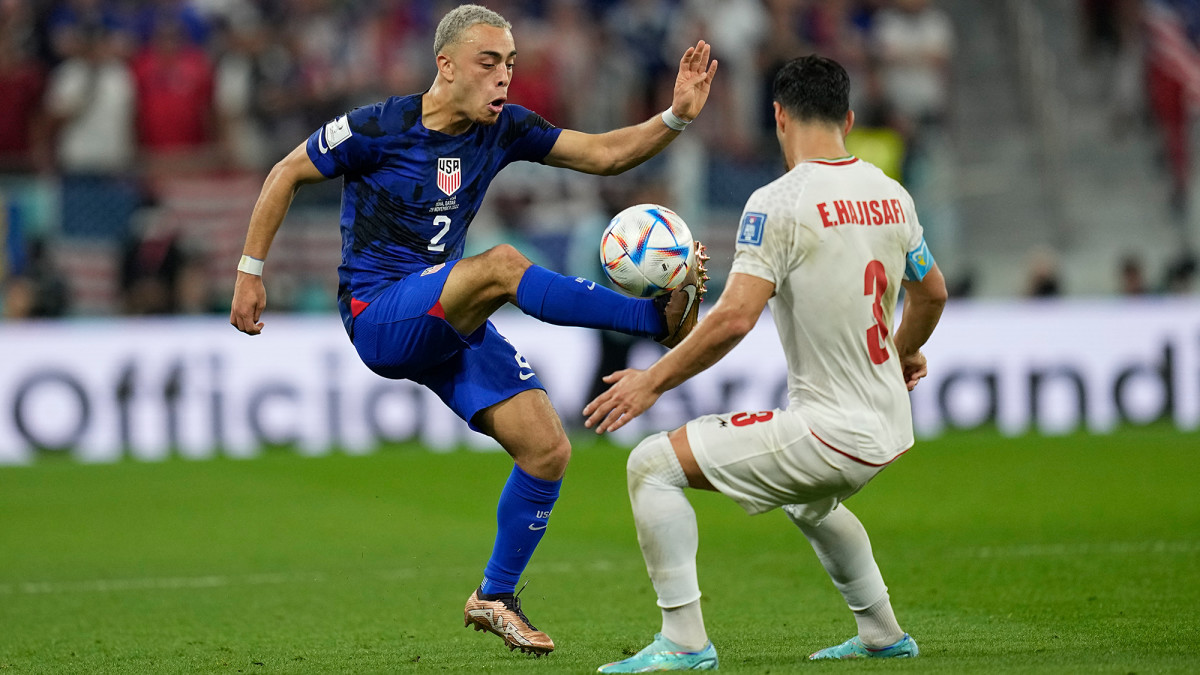
Biggest weakness

Of course, the fact that the Taegeuk Warriors boast such a talismanic star also means they run the risk of being overly reliant on Son. But perhaps the greater weakness is that, apart from Napoli defender Kim, the South Korea backline will hardly strike fear in the hearts of opposition attackers. It is perhaps for this very reason that Bento tends to adopt a conservative approach and his insistence on deploying an anchorman to shield the defence — usually Jung Woo-young — usually prevents South Korea from deploying their three most creative playmakers together, with Hwang In-beom, Lee Jae-sung and Lee Kang-in usually vying for just two berths.

Star player: Son Heung-min

It is impossible to look past Son as South Korea’s star player. But given his fitness is in doubt and the side will be coming up against some formidable opposition attackers — including Cristiano Ronaldo and Luis Suarez — the man who could have the biggest influence on how far the Taegeuk Warriors go might just be Kim. Standing at 6-foot-3 and strongly built, Kim is perfectly equipped to handle any striker he comes up against and it is hardly a surprise that he has already emerged as one of Serie A’s leading centre-backs just months after joining Napoli from Fenerbahce in the summer.

Projected starting XI

(4-2-3-1): Kim Seung-gyu; Kim Tae-hwan, Kim Min-jae, Kim Young-gwon, Kim Jin-su; Jung Woo-young, Hwang In-beom; Hwang Hee-chan, Lee Jae-sung, Son Heung-min; Hwang Ui-jo.

What the stats say

– Best World Cup finish: 4th place (as hosts in 2022.)

– South Korea’s 10 straight World Cup appearances are the longest by a team outside of Europe or South America.

FiveThirtyEight SPI: 45% chance to make the round of 16, 16% to make quarterfinals.

Betting odds: +25000 (via Caesars Sportsbook)

Prediction

Games against Portugal and Uruguay, two teams perennially expected to reach the knockout round, will not be easy — and Ghana are no slouches either. But if Son is fit and firing, South Korea could stand a chance. Victory over Ghana is a must and, should they manage to get a point off either Portugal or Uruguay, a round-of-16 berth could be on the cards. — Gabriel Tan, ESPN Asia.

World Cup 2022 team previews: Group D – France, Denmark, Australia, Tunisia

Nov 8, 2022

ESPN is previewing each of the World Cup’s 32 teams ahead of the tournament. Here’s what you need to know about the four sides set to do battle in Group D.

Jump to: France | Denmark | Australia | Tunisia

France

Manager: Didier Deschamps
Nickname: Les Bleus (The Blues)

FIFA Rank: 4

How they qualified

France finished top of their group and unbeaten to qualify for Qatar 2022. However, they struggled and drew with Ukraine (home and away) and Bosnia & Herzegovina (at home), so it was not the most convincing journey ever. Their mini-drop in form happened on the back of the disappointing end to Euro 2020, as they were knocked out against Switzerland on penalties in the round of 16, which really hurt the squad. But wins against Finland (twice) and Kazakhstan were enough to get the job done.

Style of play

Deschamps has tried to play a more proactive style of football since winning the 2018 World Cup. To fit Karim Benzema, Kylian Mbappe and Antoine Griezmann in the team, he moved to a 3-4-1-2 formation which had mixed results for Les Bleus. But while the French are more attacking and press a bit higher, Deschamps is still a defensive-minded coach so he might revert to what worked well years ago if things don’t go as planned.

Biggest strength

The talent and depth in the squad are what make it so special. Even with a host of injuries, the names on show are impressive. From the genius of 2022 Ballon d’Or winner Benzema, to Mbappe, and top young stars such as Aurelien Tchouameni and William Saliba, France are packed in every position with so many options to choose from. They also have experience, having been there and done it in 2018. They know how to control the game and want to use the disappointment of Euro 2020 to bounce back in style like they did at Russia 2018 after losing to Portugal in the Euro 2016 final.

Biggest weakness

Ideally, France would have gone to Qatar to retain their crown with all their best players who are available and fit. Instead, there will be no Paul Pogba, no N’Golo Kante and maybe no Raphael Varane either, which is a huge blow. Pogba and Kante will be hard to replace in midfield and have been so important for this team. There will be a slight lack of experience too as the 2022 version of France will be younger than the 2018 one. There are question marks over Deschamps as well regarding his ability to make this team play better and win again. With the likes of Benzema, Mbappe and other attacking talents such as Griezmann, Christopher Nkunku, Kingsley Coman and Ousmane Dembele, the coach’s conservatism could be a problem.

Star player: Karim Benzema

After a six-year exile from the national team, Benzema has had to wait eight years to play in a World Cup again. He missed the win in 2018 and now wants to make up for lost time. The Real Madrid striker has had an incredible few years, winning the Champions League and LaLiga with his club as well as the Nations League with France and the individual prize of the 2022 Ballon d’Or. Now, Benzema has his eyes set on delivering the World Cup. The 34-year-old’s partnership with Mbappe up front — and their ability to gel with Griezmann — will be one of the keys to France’s success. Les Bleus have a real chance of winning the tournament again, but only if Benzema performs at his best.

Projected starting XI

(3-4-1-2): Lloris; Kounde, Varane, Kimpembe; Pavard, Tchouameni, Rabiot, Theo Hernandez; Griezmann; Mbappe, Benzema.

What the stats say

– Best World Cup finish: Champion (1998, 2018), the side have two titles and three finals since 1998 (the most in that span).

– No defending World Cup champion from Europe has advanced past the group stage of the next tournament since Germany in 1994.

FiveThirtyEight SPI: 50% chance to make the quarterfinals, 9% to win the title.

Betting odds: +600 (via Caesars Sportsbook)

Prediction

It is very hard to retain a World Cup. The fact that the last time it happened — Brazil in 1962 — was so long ago shows it. However, France have the qualities to do it: incredible talent, experience and a team spirit to bring them together. If Mbappe and Benzema are at their best, France will be hard to stop. — Julien Laurens.


Denmark

Manager: Kasper Hjulmand
Nickname: De Rod-Hvide (The Red and Whites)
FIFA Rank: 10

How they qualified

Kasper Hjulmand’s side steamrolled through a fairly straightforward qualification group. In fact, the Danes were so dominant they didn’t even concede a goal before the penultimate round of games — Austria, Israel and Moldova were all brushed aside, with the latter suffering an 8-0 defeat in Herning — when the Faroe Islands grabbed a late consolation score. Their only defeat, and loss of points, came at the hands of Scotland in the final round of games.

Style of play

Whether deploying his preferred 3-4-3 (3-4-2-1) formation — which can either appear with two auxiliary attackers wide or tucked in behind the centre-forward, or even two central attackers with Christian Eriksen operating in the spaces behind — or lining up in a 4-2-3-1/4-3-3 shape, Hjulmand remains true to his principles of high pressing, a compact midfield and quick transitional play. While hurrying the opposition into making mistakes, and then capitalising quickly, has proved particularly efficient, the Danes are also capable of controlling games, often with Barcelona’s centre-back, Andreas Christensen, playing the first pass out of defence.

Biggest strength

The collective. While not short of high-quality players performing in top European leagues, Denmark remain a team rooted in rigid organisation, loyally deployed match plans and an evenly matched squad. They have plenty of quality in depth, dependable options across the field with clearly defined roles, and are a cohesive unit (which was evident in how they rallied together in the wake of Eriksen’s cardiac arrest during Euro 2020). While such an approach can appear ambitious at the international level — where proper training groundwork is a luxury for the head coach — Hjulmand has made it click to the extent that he’s considered one of the most meticulous and astute head coaches on the European circuit.

Biggest weakness

With an average of three goals per game — and having beaten France home and away in the Nations League during the past five months — the lack of a high-scoring centre-forward won’t necessarily give Hjulmand issues, as it’s not essential for the way he sets up his team. However, going into the tournament he would want his striking options — the likes of Kasper Dolberg, Martin Braithwaite, Andreas Cornelius (if picked) or Jonas Wind (if picked) — to register better recent tallies than they have been doing from club level. Winger Mikkel Damsgaard is also struggling to regain the momentum that saw him emerge as one of the most exciting attacking prospects of Euro 2020, while in goal, Kasper Schmeichel has faced adverse periods of form since he left Leicester for Nice in the summer, though his performances have picked up in recent weeks.

Star player: Christian Eriksen

Given Denmark’s “team before individuals” ethos, the need for a standout profile is secondary. However, based on pure footballing talent, pedigree, the dramatic nature of his comeback and positive displays for Manchester United — let alone nearly 120 caps — Eriksen remains the most obvious candidate. From a more advanced midfield role than he plays at club level (more akin to the position he played at Spurs), Eriksen was excellent during the home win against France in September. The No. 10 dictated the rhythm of the game (70 passes over 90 minutes), identified the right spaces between the French defensive lines and orchestrated waves of attacks.

Projected starting XI

(3-4-1-2): Schmeichel; Christensen, Kjaer, Andersen; Skov Olsen, Hojbjerg, Delaney, Maehle; Eriksen; Braithwaite, Poulsen.

What the stats say

– Best World Cup finish: Quarterfinals (1998.)

– Denmark have reached the round of 16 in four of their previous five appearances at a World Cup.

FiveThirtyEight SPI: 56% chance to make the round of 16, 28% to make the quarterfinals.

Betting odds: +2800 (via Caesars Sportsbook)

Prediction

No matter how well they perform in qualifiers or previous championships, Denmark are never mentioned in the same breath as the traditional European or South American heavyweights. The Danes won’t mind though; they’ll embrace their underdog status and enter the World Cup as possibly the trickiest opponents to face. They have already shown they can compete with France, while with Australia and Tunisia as their two other Group D adversaries, Denmark should be confident of advancing to the round of 16. In fact, nobody should be surprised to see this well-balanced, diligent side make the latter stages and possibly even repeat last summer’s feat of reaching a semifinal. — Tor-Kristian Karlsen.


Australia

Manager: Graham Arnold
Nickname: Socceroos
FIFA Rank: 38

How they qualified

In short, an absolute rollercoaster. At its commencement, the Socceroos looked like they were cruising through AFC qualification when they became the first nation to register 11-straight wins in a single FIFA World Cup qualifying campaign. However, the underlying weaknesses that were papered over by this streak eventually began to show and, as results began to align with performances, coach Graham Arnold slowly came under pressure. But wins over the UAE in the AFC fourth round and Peru in the intercontinental playoff — the latter in a dramatic 5-4 penalty shootout — secured the side a place at a fifth-straight World Cup.

Style of play

After starting his tenure by declaring that his side would play like Liverpool, Arnold has settled into a much more familiar and pragmatic style more attuned to his dominant Sydney FC sides. In Qatar, the Socceroos’ approach will be built on principles of containment, physicality, mental battles and seeking to hit sides on the counter.

Biggest strength

The Socceroos are at their most threatening when they are able to get out in transition and run at their opponents — particularly when they win the ball high up the pitch on the few occasions they utilise a high press. As qualifying wore on and his side’s position became more fraught, however, Arnold increasingly identified “Aussie DNA” as his side’s biggest asset: a nostalgic call to the supposed spirit of a bygone age where “you kick, you fight, you scratch, you run till you drop and leave nothing on the park and have no regrets.”

Biggest weakness

Given that they are at their best when getting out in transition and exploiting the physicality that Arnold has identified, it should perhaps come as no surprise that, like a great many nations around the world, the Socceroos struggle during extended periods in possession, particularly against a low block. Fortunately for them, this likely won’t be too much of a problem against group opponents France and Denmark — the conundrum instead is the sheer disparity in the number and depth of top-end talent. The Socceroos have also at times proved wobbly defending against transition, which could play into their game against Tunisia.

Star player: Ajdin Hrustic

The Socceroos’ preparations for the World Cup have been blighted by a wave of injuries and a dearth of minutes, none more concerning than those experienced by creative dynamo Ajdin Hrustic. One of the few Socceroos playing in one of Europe’s Big Five leagues, their most skilled attacker and an important reference point in possession, Hrustic has seen a lack of game time at Eintracht Frankfurt — where he won a Europa League in 2021-22 — resulting in a move to Serie A side Hellas Verona in September. He was just beginning to find form only to suffer an ankle injury in late October. The Socceroos are bullish that he will be ready for Qatar, but any absence would constitute a major blow.

Projected starting XI

(4-1-4-1) Ryan; Behich, Souttar, Rowles, Karacic; Mooy; Irvine, Hrustic, Mabil, Boyle; Duke.

What the stats say

– Best World Cup Finish: Round of 16 (2006.)

– The Socceroos have been eliminated in the group stage in four of their previous five tournament appearances.

FiveThirtyEight SPI: 18% chance to make the round of 16, 6% to make quarterfinals.

Betting odds: +40000 (via Caesars Sportsbook)

Prediction

True to form, Arnold has presented a publicly optimistic outlook, telling ESPN in August: “My expectation is the second round.” However, delivering on that target would be one of the shocks of the tournament and a more realistic target would be a first World Cup win since 2010. What is certain, though, is that predictions such as that will likely be used as motivation by this group. — Joey Lynch.


Tunisia

Manager: Jalel Kadri
Nickname: Eagles of Carthage
FIFA Rank: 30

How they qualified

Tunisia rode their luck to qualify, at no point giving an indication that they are a team who can make a big impact in Qatar. They won all three of their home games and away at a dysfunctional Zambia side to progress from their group, losing in Equatorial Guinea in the process, and were drawn in the third round of qualifying against Mali — the only one of the eight playoff qualifiers never before to reach a World Cup. Moussa Sissako‘s bizarre own goal in Bamako ultimately proved decisive, with the Eagles of Carthage largely content to neutralise their opponents at home having nabbed that fluke away goal.

Style of play

Tunisia will sit deep, absorb pressure, give little away and attempt to eke out every available minor advantage possible. Fans call the team’s battling spirit “grinta,” which is true for this particular generation, whose combative, workaholic midfield will need to compensate for ageing legs up top.

Biggest strength

Tunisia’s reputation as being defensively stout and tough to break down may well be re-evaluated after their recent 5-1 demolition by Brazil, although it is worth noting that they didn’t concede a single goal in their previous seven games, stretching back to the Nations Cup. Indeed, the Eagles of Carthage had only let in three goals in 12 matches throughout 2022 to that point, and they’ll be looking to lean (heavily) on this infamous resolve during the tournament. Ageing legs also mean experienced heads, and the underdogs won’t be overawed by the task ahead of them.

Biggest weakness

All of Tunisia’s star attackers, with the exception of Seifeddine Jaziri, are the wrong side of 30, and it remains to be seen whether the likes of Youssef Msakni or Naim Sliti still have enough zip to truly express themselves against a higher level of opposition at the World Cup. Beyond the forward unit, there’s also a lack of the kind of top-level quality and experience that both Denmark and France will bring to the table in Group D.

Star player: Wahbi Khazri

Msakni may be the more flashier of the forwards — and has a point to prove having missed Russia 2018 through injury — but it’s Wahbi Khazri whose performances will likely be decisive in determining what Tunisia can achieve in Qatar. He’s had a strange career, evolving from a creative midfielder who struggled to establish himself at Sunderland into a consistent goal threat and regular line-leader for club and country. He struck 10 goals for relegated Saint-Etienne last term, and Tunisia lost a dimension after he was missing with COVID-19 during the AFCON. He is struggling under new management at Montpellier, but he netted twice during the last World Cup, and from set pieces or open play he can trouble Tunisia’s Group D opponents.

Projected starting XI

(4-3-3): Dahmen; Drager, Talbi, Ifa, Maaloul; Laidouni, Skhiri, Sassi; Khazri, Jaziri, Msakni

What the stats say

– Best World Cup finish: Group stage

– Tunisia have five group-stage eliminations, which is tied for 2nd most by a team that have never advanced. Scotland have 8.

FiveThirtyEight SPI: 47% chance to make the round of 16, 20% to make quarterfinals

Betting odds: +30000 (via Caesars Sportsbook)

Prediction

On paper, Tunisia don’t have enough quality to progress. Australia represent eminently beatable opponents, but Denmark were among the toughest teams in Pot Two and could be tournament surprises. Even though confidence has been dented by that demolition by Brazil, Tunisia’s defensive solidity gives them optimism of neutralising the Danes and troubling France, but realistically, neither side will be too concerned. — Ed Dove, ESPN Africa.

World Cup has 3 women set to referee matches in Qatar

Soccer WCup Female Referees  

STEPHEN WADE n Tue, November 8, 2022

TOKYO (AP) — Japanese referee Yoshimi Yamashita knows that being one of three women picked to officiate matches at the World Cup — the first time a woman will be in charge on the game’s biggest stage — is not simply about soccer.

Stephanie Frappart of France and Salima Mukansanga of Rwanda must be of the same mind. They are in a pool of 36 referees listed for Qatar — the rest are all men. FIFA has also named three female assistant referees in a pool of 69: Neuza Back of Brazil, Karen Diaz Medina of Mexico and Kathryn Nesbitt of the United States.Yamashita is aware that her selection put the focus on Japan’s low ranking on most measures of equal pay for women, and in global studies of gender equality.“I would be very happy if women could play an active role in sports in this way, and if sports and especially soccer could lead this,” Yamashita said in an interview with The Associated Press. “In Japan, there is still a long way to go in the world of soccer (regarding participation of women), so it would be great if this could connect to the promotion of female participation in different ways, not only in soccer or in sports.”All three have worked men’s matches, and their World Cup debut comes in a Middle Eastern country where the role of women is closely prescribed.Frappart is the best known and has already worked men’s games in World Cup qualifying, and the Champions League. She also handled the 2019 Women’s World Cup final, and refereed this year’s men’s French Cup final.Yamashita has worked games in Japan’s men’s league, and has also been in charge of the Asian equivalent of the men’s Champions League. She was also a referee at last year’s Tokyo Olympics.Earlier this year, Mukansanga became the first woman to referee an Africa Cup of Nations match, leading an all-female officiating team.“As always, the criteria we have used is ‘quality first’ and the selected match officials represent the highest level of refereeing worldwide,” said FIFA referees committee chairman Pierluigi Collina, who worked the 2002 World Cup final. “In this way, we clearly emphasize that it is quality that counts for us and not gender.“I would hope that in the future the selection of elite women’s match officials for important men’s competitions will be perceived as something normal and no longer as sensational.”Yamashita said the difference in the men’s and women’s game was, of course, speed. But not simply that some men might run faster.“It’s the speed, but not just the players’ speed,” she told the AP. “Not the ball speed. It’s just the game speed. It means for me I have to make quicker decisions — more speed.”Then there’s the stress, the largest stage, and the attention she is certain to generate at the World Cup.“Of course, I think the pressure is huge,” she said, “and I think I have a lot of responsibility. But I am really happy to take this duty and pressure, so I try to take it positively and I try to be happy.”Though it’s likely that all three will be in charge of games, it’s not a given. They could alsobe used as “fourth referees” on the sideline. However, they cannot be used as assistants.Like many referees, Yamashita said her job was to stay out of the way and let the game shine.“One of the big goals as a referee is to bring out the the attractiveness of soccer,” she said. “I do my best for that, and I will do what I should at that time toward that end. So if I need to communicate with the players, I will do that. If I need to show a card, I will show a card. Rather than control, I’m thinking about what to do toward the big goal of bringing out the appeal of soccer.”Yamashita conducted most of the interview with the AP in Japanese, but said she would use English and “facial gestures, body gestures” when communicating with players in Qatar.“Usually when I give a card, I say nothing,” she said, shifting to English. “But when I give a warning, I just tell them I’m not happy. They understand.”